 20 min read
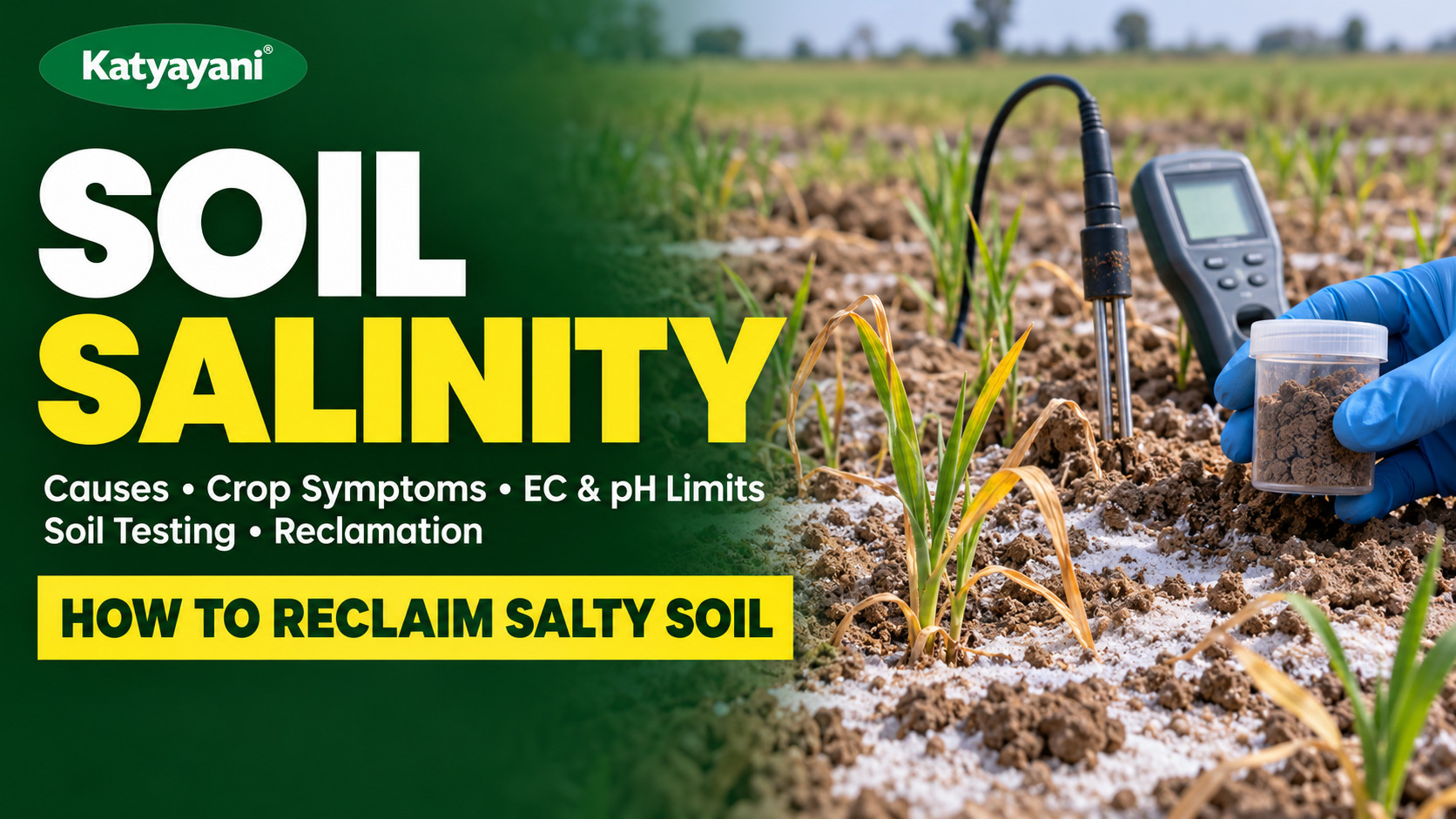
Soil salinity means too much soluble salt in the root zone. Water cannot move into roots, so crops look drought-hit even when the field is wet. A soil is called saline when its saturation-extract EC is above 4 dS/m, pH is below 8.5 and ESP is below 15 percent. If sodium is high instead (ESP above 15, pH above 8.5), it is sodic and needs gypsum. Confirm with a lab test first. Saline soil is fixed by good-quality water and drainage (leaching), not by gypsum. Add organic matter and grow tolerant crops such as barley or semi-dwarf wheat while it recovers.
What is soil salinity, and why does it cut crop yield?
Soil salinity is a build-up of water-soluble salts, mostly sodium, calcium and magnesium chlorides and sulphates, in the root zone. Plants do not poison easily on these salts at first. The real damage is simpler: as salt rises in the soil water, roots find it harder to pull water in. Kansas State University explains that the soil solution's osmotic pressure goes up, less water is available to the plant, and the crop wilts and grows poorly even though the soil is not dry.
That is why a salty field fools people. The soil is moist, the pump has run, and the crop still looks thirsty. Leaf tips go brown, the crop is stunted, and germination is patchy. A farmer then adds more urea or another spray, and nothing changes, because the problem was never a missing nutrient.
There is a second, different problem called sodicity, where sodium sits on the clay particles and ruins the soil structure. Many fields have both. We separate the two in the next section, because the cure for one can make the other worse.
Saline, sodic and saline-sodic soil: what is the difference?
Saline soil has too much total salt. Sodic soil has too much sodium on the clay particles, and the soil structure collapses. Saline-sodic soil has both. Labs tell them apart using four numbers: EC (total salt), pH, ESP (exchangeable sodium percentage) and SAR (sodium adsorption ratio).
| Feature | Saline | Sodic (alkali) | Saline-sodic |
|---|---|---|---|
| EC of saturation extract | Above 4 dS/m | Below 4 dS/m | Above 4 dS/m |
| pH | Below 8.5 | Above 8.5 | Usually below 8.5 |
| ESP (exchangeable sodium) | Below 15 percent | Above 15 percent | Above 15 percent |
| SAR | Below 13 | Above 13 | Above 13 |
| Soil structure | Normal, drains well | Poor: sticky when wet, hard and cloddy when dry | Normal while salts are high; collapses when salts are washed out |
| What you see | White crust, patchy crop | Dark, hard crust; water stands on top; poor seedling emergence | Mixed signs |
| Main fix | Good water, leaching, drainage | Calcium source (gypsum), then leaching | Gypsum first, then leaching |
The rows above follow the classification in the Kansas State bulletin. Use the cut-off your own lab prints on its report.
Saline-sodic soil is the trap. KSU warns that if the excess salt is leached out without a calcium source to replace the sodium, the soil turns sodic. So never wash a saline-sodic field with plain water and leave it at that. Get the gypsum step done first. For how much gypsum, when and how, see our gypsum dose and method guide. This guide does not repeat that dose.
How much of India has salt-affected soil, and where?
An ICAR page on CSSRI's work puts salt-affected land in India at about 6.73 million hectares, of which about 2.8 million hectares are sodic, mainly in the Indo-Gangetic plains.
| Item | Figure | Source |
|---|---|---|
| Salt-affected land in India | About 6.73 million hectares | ICAR page on CSSRI reclamation work |
| Sodic part | About 2.8 million hectares, mainly Indo-Gangetic plains | ICAR page on CSSRI reclamation work |
| Haryana example | Elders in one Rohtak-area village say nearly 30 percent of farm land has gone out of cultivation (a local estimate, not an official figure) | India Water Portal, Nov 2025 |
In the north-west plains, canal irrigation and waterlogging are the best documented drivers, as the Haryana example above shows.
What causes soil salinity?
Salt builds up when more salt arrives than leaves. It arrives with irrigation water, from a shallow salty water table, from the parent rock, or from heavy fertiliser and manure use. It fails to leave when rain is too low to wash it down or when the field cannot drain. Kansas State puts it simply: salinity occurs mostly in dry climates where rainfall does not leach salts, or where drainage is restricted.
Irrigation water with salt in it
Every irrigation adds a little salt. If the crop uses the water and the salt stays behind, the root zone gets saltier each season. Kansas State notes that field-wide sodic and saline-sodic problems can nearly always be traced to marginal or poor-quality irrigation water. Test your water before you blame the soil.
Canal irrigation and a rising water table
This is the big one in the north-west. The India Water Portal story on Haryana describes year-round canal water, continuous paddy flooding and poorly drained alluvial soil pushing the water table up. When the water table is shallow, water climbs through the soil pores (capillary rise) and evaporates at the top, leaving the salts behind. The same story notes that clay-heavy, flat land drains slowly, which makes it worse.
Poor drainage and heavy soil
If water cannot move down, salt cannot move out. Heavy clay, a hardpan, or a lime layer below the surface all block drainage. Fields at the tail end of a canal or in a low spot are the usual first casualties.
Dry weather and fast evaporation
In arid and semi-arid climates, evaporation beats rainfall for most of the year. Each time water evaporates, it leaves its salt behind. Without a good monsoon wash, the top layer slowly gets saltier.
Too much fertiliser or manure
Fertilisers are salts. KSU names excessive manure application as one cause of field-wide problems.
Natural salt in the soil or groundwater
Some soils sit on salty parent material or salty deep water, and some coastal fields are salty from the sea. Reclaiming these is slower, because the source stays. KSU warns that unless the source of the salt is removed or reduced, reclamation is at best temporary.
What are the signs of salinity in the field and in the crop?
The early signs are patchy germination, stunted plants, leaf tips and margins turning brown and dry, and wilting even when the soil is wet. In the field, look for a white crust on the surface (saline soil) or a dark, hard crust with water standing on it (sodic soil). Always confirm with a test, because other problems look the same.
| What you see | Saline soil | Sodic soil |
|---|---|---|
| Surface of the soil | White, powdery salt crust, often in patches or on bund edges | Brownish-black, hard crust; the dark colour comes from dispersed organic matter |
| Water behaviour | Normal; may stay moist for long | Water ponds on top, sticky when wet, hard and cloddy when dry |
| Germination | Patchy; seedlings burn or fail | Poor seedling emergence is often the first sign |
| Leaves | Tips and margins burn; young leaves first if sprinkled with salty water | Edges burn and dry, progressing inward between the veins |
| Whole plant | Stunted, dull, wilts in the afternoon even in wet soil | Stunted; roots cannot go deep |
| Field pattern | Irregular patches, worse on higher spots and near drains | Bare slick spots, worse after rain |
The leaf and crust descriptions agree across Kansas State and Colorado State Extension.
Leaf-edge scorch is shared by salinity, potassium deficiency, specific ion toxicity and other problems, so appearance alone is not proof. A white crust can be fertiliser residue. Yellow plants can be waterlogged, nutrient-locked, or attacked by termites or nematodes. Our guide on soil pH and nutrient lock covers the pH side of this. When the pattern is patchy and you cannot find a pest, test the soil.
What EC level is too high for crops?
Above 4 dS/m on a saturation extract, the soil is called saline and most crops are hit. Between 2 and 4, sensitive crops and seedlings may be injured. Above 8, only salt-tolerant crops grow well. The scale below is from Kansas State and matches the FAO classes.
| EC of saturation extract (dS/m) | Class | What it means for crops |
|---|---|---|
| 0 to 2 | Low (non-saline) | Very little chance of injury |
| 2 to 4 | Moderate (slightly saline) | Sensitive plants and seedlings of others may be injured |
| 4 to 8 | High (moderately saline) | Most non-tolerant crops show injury; sensitive ones severe injury |
| 8 to 16 | Excessive (strongly saline) | Tolerant crops grow; most others severely hurt |
| Above 16 | Very excessive | Very few plants survive |
The unit dS/m (decisiemens per metre) is the same as mS/cm and mmhos/cm, so a report in any of these reads the same.
One trap: these limits are for a saturation extract (ECe). Ask your lab which extract method it used and what cut-off it applies, before you compare your result with the table.
How do you test soil for salinity? Step by step
Take a composite sample from the bad patch and from a good patch next to it, send both to a soil lab, and ask for EC, pH and either ESP or SAR. Test your irrigation water the same way. Do not guess. Instructions for sampling are simple and are the same as for a normal soil test.
- Mark the problem area. Walk the field and mark bare and patchy spots. Treat each as a separate sample, because salinity is rarely even across a field (Colorado State).
- Take cores from 6 to 8 inches (15 to 20 cm) deep at several points in the area and mix them into one composite of at least a pint of soil (Kansas State).
- Take a comparison sample from a normal-looking patch nearby. The difference between the two tells the lab and you more than one number.
- Go deeper if salt has been standing for long. Where salty water has stood for weeks or a seep exists, KSU suggests sampling in layers down to 3 feet to see how deep the salt goes.
- Tell the lab what you suspect and ask for EC, pH, and SAR or ESP, plus a gypsum requirement test if it looks sodic. Ask which extract method the EC uses.
- Test the irrigation water too. Salts often come from the pump. Ask for EC and SAR.
- Check the water table. Colorado State suggests boring holes with an auger. If free water collects in a hole less than 4 to 5 feet deep, a shallow water table may be feeding the salt.
Our post on how to read your soil health card explains the EC and pH columns of your report. For ESP, SAR or a gypsum requirement, get a full salt test done at the state soil testing lab.
How much yield do you lose at a given salinity level?
It depends heavily on the crop. FAO's table gives each crop a threshold ECe, below which there is no loss, and a slope, which is the percent yield lost for every dS/m above it. Barley, semi-dwarf wheat and cotton are tough. Rice, maize, potato, sugarcane, onion and groundnut are not.
| Crop (FAO Table A1.1) | Threshold ECe (dS/m) | Loss per dS/m above it (percent) | Loss at ECe 4 (our arithmetic) | Loss at ECe 8 (our arithmetic) |
|---|---|---|---|---|
| Barley (grain) | 8.0 | 5.0 | 0 | 0 |
| Wheat, semi-dwarf | 8.6 | 3.0 | 0 | 0 |
| Cotton (seed cotton) | 7.7 | 5.2 | 0 | about 2 percent |
| Canola/rapeseed (B. campestris) | 9.7 | 14 | 0 | 0 |
| Sorghum (grain) | 6.8 | 16 | 0 | about 19 percent |
| Wheat (standard) | 6.0 | 7.1 | 0 | about 14 percent |
| Sunflower | 4.8 | 5.0 | 0 | about 16 percent |
| Soybean | 5.0 | 20 | 0 | about 60 percent |
| Rice, paddy | 3.0 | 12 | about 12 percent | about 60 percent |
| Sugarcane (shoot dry weight) | 1.7 | 5.9 | about 14 percent | about 37 percent |
| Tomato | 2.5 | 9.9 | about 15 percent | about 54 percent |
| Groundnut (peanut) | 3.2 | 29 | about 23 percent | total loss (calculated above 100) |
| Maize (ear weight) | 1.7 | 12 | about 28 percent | about 76 percent |
| Potato | 1.7 | 12 | about 28 percent | about 76 percent |
| Onion (bulb) | 1.2 | 16 | about 45 percent | total loss (calculated above 100) |
The numbers come from FAO Irrigation and Drainage Paper 29. The loss columns are our simple calculation: (ECe minus threshold) times slope. Real results change with variety, growth stage, climate and water. FAO notes that rice values refer to the soil water while the field is flooded, and that rice, wheat and barley are more sensitive at seedling stage than later.
Two practical readings. First, a field at 6 dS/m can still grow barley or semi-dwarf wheat with no loss on paper, but rice there would lose about 36 percent (6 minus 3, times 12). Second, because onion, potato, maize and sugarcane are on the sensitive side, a field of those on a patch that is only slightly saline can still be a poor bet.
How do you reclaim saline soil? A step-by-step plan
Saline soil is the easier one to fix, provided you have good-quality water and the field can drain. Remove the source of the salt, level and bund the field, then wash the salts below the root zone with water applied in rounds. No chemical or fertiliser reclaims a purely saline soil; Kansas State states this plainly.
- Test first (EC, pH, ESP or SAR) so you know the soil is saline and not sodic or saline-sodic.
- Find the source. Water quality, a shallow water table, a leaking canal or a blocked drain. If the source stays, the fix lasts one season at best.
- Fix the drainage before pouring water on. Clean the drains and outlets. If water has nowhere to go, you will only raise the water table.
- Level the field and make strong bunds so water stands evenly. Uneven land leaves salty high spots.
- Apply good-quality water in rounds, letting the field drain between rounds (KSU).
- Add organic matter (see below) to keep the soil open for water.
- Re-test after leaching and before sowing. If EC is still above what your crop can bear, repeat or switch to a tolerant crop.
- Sow a tolerant crop first (see below).
How much water does leaching take?
Kansas State says that about 8 to 10 inches (20 to 25 cm) of water, applied in rounds, may be needed to remove about 70 percent of the salt from each 12 inches (30 cm) of soil. The FAO chapter on saline soils gives a simpler rule of thumb: a unit depth of water removes nearly 80 percent of salts from a unit depth of soil. The exact amount depends on the starting salt level, the water quality and how the water is applied.
| Soil depth to clean | Water needed (KSU) | Litres per acre (our arithmetic) | Cubic metres per acre |
|---|---|---|---|
| 30 cm (1 foot) | 20 to 25 cm | about 8.1 to 10.3 lakh litres | about 810 to 1,030 |
| 60 cm (2 feet) | 40 to 50 cm | about 16 to 20 lakh litres | about 1,620 to 2,060 |
How we got those litres: 1 cm of water over 1 acre is about 40,500 litres (4,047 square metres times 0.01 metre). These are planning numbers, not a promise. That much water only helps if it can leave the field; if your land cannot drain, you may need a drainage line first.
Is subsurface drainage needed for waterlogged saline land?
Where the water table is shallow, leaching gives only a temporary fix, because the source of the salt remains (Kansas State). Subsurface drainage, buried pipes that carry water away, removes that source. It works best at village or block scale.
For a single farmer the real step is smaller: keep the field drains clean, avoid blocking the outlet, and talk to the Irrigation or Agriculture Department and your KVK about a joint drainage plan. The India Water Portal story records that Haryana farmers are asking for deep open drains and tubewell pumping at landscape scale, not field by field.
Does gypsum help saline soil?
No. Gypsum works by supplying calcium to push sodium off the clay. A purely saline soil has no sodium problem on the clay, and gypsum is itself a salt, so it can add salt and waste money. Use gypsum on sodic and saline-sodic soil only, and only after a test shows a gypsum requirement.
When the soil is sodic, recovery is real. In the ICAR programme at Santaraha village, Hardoi (Uttar Pradesh), farmers applied gypsum at 25 percent of the estimated requirement, ponded the field with about 10 cm of water for at least 10 days, added 10 t/ha of press mud and then grew salt-tolerant rice CSR 36. Soil pH on those fields ranged from 8.5 to 10.1. After three years all the previously uncultivated land was back in use. The yields below are from the ICAR page; the per-acre conversion is ours.
| Sodicity class | Rice before (t/ha; q/acre) | Rice after (t/ha; q/acre) | Wheat before (t/ha; q/acre) | Wheat after (t/ha; q/acre) |
|---|---|---|---|---|
| Normal soil | 4.87; about 19.7 | 5.21; about 21.1 | 3.65; about 14.8 | 3.77; about 15.3 |
| Slightly sodic | 2.95; about 11.9 | 4.99; about 20.2 | 2.82; about 11.4 | 3.36; about 13.6 |
| Moderately sodic | 1.22; about 4.9 | 4.65; about 18.8 | 1.42; about 5.7 | 2.96; about 12.0 |
| Sodic | 0 | 4.42; about 17.9 | 0 | 2.48; about 10.0 |
| Severely sodic | 0 | 3.04; about 12.3 | 0 | 1.85; about 7.5 |
Two things stand out on that page. Farmers paid a large share of the reclamation cost, and in the first year net returns were positive only on the slightly sodic fields. The more sodic the field, the longer it took to pay back. For dose, timing and method, use our gypsum guide and your lab's gypsum requirement.
Can organic matter, green manure, mulch and ridge sowing help?
Yes, as support, not as a replacement for water and drainage. Organic matter opens the soil, so water enters faster and salts wash out more easily. Kansas State says that adding manure or crop residue increases infiltration and speeds reclamation.
- Farmyard manure, compost and vermicompost. They add carbon and improve structure. Use well-decomposed material, because raw manure is itself salty (KSU names excess manure as a cause). KO sells enriched vermicompost, with organic matter at 30 to 40 percent and benefits for soil structure and water retention. Follow the pack dose and your soil test.
- Press mud and crop residue. In the Hardoi programme, press mud at 10 t/ha went in with gypsum. If you have paddy straw to deal with, our post on managing paddy residue with a decomposer is relevant, and Dekumpose compost activator is the KO product for composting residue.
- Humic and fulvic acid. Katyayani humic acid and fulvic acid granules are a soil conditioner that improves soil structure, water holding and nutrient uptake, with a label dose of 2 kg per acre on soil or through drip. They support soil structure and do not replace leaching.
- Mulching. Straw or crop-residue mulch keeps the surface moist and cuts evaporation. Our mulching guide covers types and depth.
More choices of manures and soil conditioners sit in the manures and soil fertilizer collection. Match the product to your soil test.
How should you fertilise a salty field?
Use split doses, keep fertiliser away from the seed, and avoid heavy single applications. Fertilisers are salts and add to the load in the root zone.
- Split your doses. Keep the total dose within what your soil test and state recommendation say.
- Do not place fertiliser in the seed row on a salty field. The seedling is the most sensitive stage.
- Check micronutrients where pH is high. A leaf test or soil test is better than guessing. Our nutrient lock guide covers this.
- Choose the right form. Our guide on water soluble versus granular fertiliser helps when you want small, frequent doses through drip.
Which crops and varieties grow on salty or sodic land?
Barley, semi-dwarf wheat, cotton and rapeseed relatives tolerate the most in the FAO table. CSSRI has also released salt-tolerant rice varieties for salt-affected land. Salt-tolerant does not mean salt-removing. The land still needs reclamation, but you get a crop while it recovers.
| Crop | Salt-tolerant choice | Note |
|---|---|---|
| Rice | Basmati CSR 30 and CSR 36 | CSR 30 is a salt-tolerant basmati; an ICAR page says about 60 percent of Haryana's basmati area is under it. CSR 36 was grown in the Hardoi sodic soil programme above. |
| Wheat, barley, cotton | Barley, semi-dwarf wheat, cotton | Highest thresholds in the FAO table (8.0, 8.6 and 7.7 dS/m) |
Confirm seed availability for your state with your KVK or state seed corporation. For sowing dates and seed rate of the main rabi crops, see wheat sowing time and seed rate and mustard farming in India.
A crop-rotation note from Haryana: the India Water Portal story observes that paddy-wheat persists on waterlogged salty fields because paddy tolerates standing water and wheat tolerates moderate salinity, while cotton, sugarcane, arhar and gram, once common there, became nearly impossible. A salinity-aware rotation helps. See crop rotation examples for how to plan one.
How do you stop salinity coming back?
Keep the water table low, keep the soil open, and watch the water you apply. Reclamation is wasted if the same cause repeats. Most of the prevention is boring and cheap: clean drains, no over-irrigation, organic matter, and a yearly test.
| Action | Why it helps | How to do it |
|---|---|---|
| Test the irrigation water every year | Water quality can change | Ask for EC and SAR at a soil and water lab |
| Do not over-irrigate | Extra water raises the water table and brings salt up | Irrigate by crop stage and soil type, not by habit |
| Keep drains and outlets clear | Salt must have a route out of the field | Clean before monsoon; agree with neighbours |
| Use drip or water-saving methods where you can | Less water on the surface, less evaporation | Match the system to the crop |
| Mulch and add organic matter | Slows evaporation and keeps soil open | Straw mulch, compost, vermicompost, green manure |
| Rotate crops to suit the salt level | Matches each crop to the field's salinity | See the crop rotation post |
| Do not overload with fertiliser or raw manure | Both are salts | Split doses, well-decomposed manure |
| Re-test every year or two | Catches the problem early | Same patch, same depth, same lab |
For winter crops, our note on cold-weather nutrient uptake in winter crops is useful reading for rabi fields.
What are the common mistakes with salty soil?
| Mistake | Why it hurts | What to do instead |
|---|---|---|
| Using gypsum on every white patch | Gypsum fixes sodic soil; on saline soil it adds salt | Test first; use gypsum only if ESP or SAR says so |
| Washing a saline-sodic field with plain water | Salts leave, sodium stays and the soil turns sodic (KSU) | Gypsum first, then leach |
| Leaching without drainage | Raises the water table and brings salt back | Fix the outlet before you flood |
| Adding more urea to a stunted crop | The cause is water stress from salt, and urea adds salt | Test; split doses |
| Ignoring the irrigation water | A salty tubewell re-salts the field | Test the water; mix or switch source if you can |
| Growing salt-sensitive crops on marginal land | Onion, potato, maize and rice lose heavily at low EC (FAO) | Match the crop to the EC |
| Expecting a one-season fix | Sodic reclamation in the ICAR trial took three years | Plan 2 to 3 seasons and re-test each year |
Conclusion
Soil salinity looks like a nutrient or water problem, but it is a salt problem, and the cure depends on the type. Test the soil and the water, find out whether it is saline, sodic or both, then drain, leach and add organic matter. Use gypsum only where sodium is the issue. Grow tolerant crops while the land recovers, and expect two to three seasons for badly affected fields. Confirm every limit on your own lab report and with your KVK.
Questions Farmers Ask
What is soil salinity?
What causes soil salinity?
What are the symptoms of soil salinity in crops?
What is the difference between saline and sodic soil?
How do you test soil for salinity?
How can you reduce salinity in soil?
Does gypsum reduce salinity?
What EC is too high for crops?
Which crops tolerate salty soil?
Can saline soil be made productive again?
How much water is needed to leach salt from soil?
Is white crust on the soil always salt?

Microbiologist
Microbiologist at Katyayani Organics. MSc in Microbiology, 2.6 years of experience.
View all authors

Leave a Comment