 9 min read
Why does nutrient uptake fall in cold weather?
Plants take up most nutrients through the roots. In cold
soil, roots grow less and work slowly. Nutrients like phosphorus and zinc do
not travel far in soil by themselves. They reach the root by slow diffusion, so
a shorter, slower root finds fewer of them. A study on maize found that cold
stress restricted phosphate and micronutrient uptake, including zinc, manganese
and iron, because these move poorly in cold soil. The plants had more leaf
damage and 25% less shoot weight (Frontiers in Plant Science
↗). That experiment used 8 to 14 °C root-zone temperatures for two
weeks.
The maize numbers show how big the effect can be. With
nitrate as the nitrogen source, shoot zinc fell from 46.0 to 24.4 micrograms
per gram of dry weight, and manganese from 50.5 to 34.8. Plants fed ammonium
kept zinc at 59.4 and manganese at 53.7, and showed 27 to 36% less leaf damage.
This was a greenhouse pot study on maize, so it explains the mechanism but is
not a field wheat result.
An older Indian paper from UAS Bangalore reaches the same
point from the soil side: low temperature slows root extension and shrinks the
soil volume the plant can draw from. Nutrients that reach roots by diffusion
(ammonium, phosphorus, zinc, manganese, iron) are hit first. Nutrients carried
with water flow (calcium, magnesium, nitrate) are less affected (Hunsigi, Annals of Arid Zone
↗). Penn State adds that cold, wet soil early in the season cuts
phosphorus uptake even in soils high in phosphorus, so starter fertiliser is
advised, and that phosphorus is best available at soil pH 6.0 to 7.0 (Penn State Extension ↗).
Evidence on nitrogen and potassium is mixed. Some sources
say nitrogen uptake is hardly affected and potassium uptake is reduced, while
others say nitrogen also falls in cold soil. So do not assume a single answer
for all nutrients.
Why do leaves turn purple or yellow in winter?
Phosphorus helps move sugars from leaves to growing parts.
When cold soil slows phosphorus uptake, sugars build up in the leaf and form a
purple pigment called anthocyanin. Michigan State University explains this for
wheat (MSU Extension ↗), and Texas
A&M notes that cold root zones cause purpling and that adding phosphorus
does not fix it (Texas A&M ↗). Plants
often recover when the soil warms.
Yellowing is similar. In Western Australia, the agriculture
department says cold-related yellowing and spots in wheat and barley are
physiological, thought to be a short nutrient shortfall in cool soils, so a
fungicide is not warranted (DPIRD ↗).
Is it cold stress or real deficiency?
|
Sign |
Likely cold stress |
Likely real deficiency |
|
Timing |
Appears after cold, wet
nights; fades on warm days |
Stays through warm weather |
|
Pattern |
Whole field, young plants,
lower leaves purple or yellow |
Patches, or the same plants
worsen each week |
|
After warm days |
Colour improves |
No improvement |
|
Soil test |
Nutrient levels adequate |
Low level shown for that
nutrient |
|
Action |
Wait, irrigate lightly,
avoid extra fertiliser |
Correct the nutrient as per
report and label |
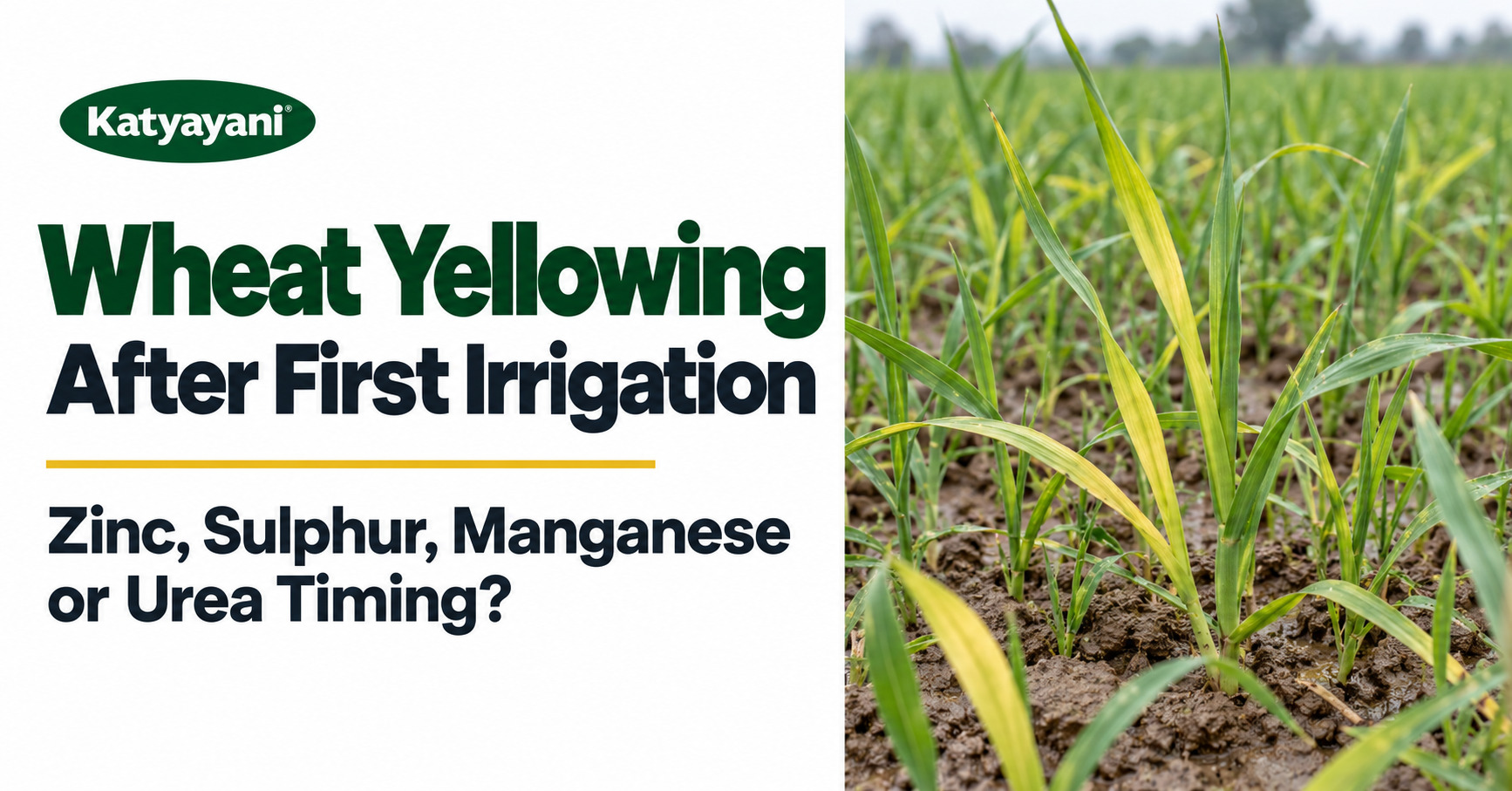
The table is a simple guide based on the sources above. Only a soil or plant test confirms a deficiency. If the soil pH is too high or too low, nutrients can be present but locked, as explained in our guide to soil pH and nutrient lock. For wheat that turns yellow after the first irrigation, use the checklist in wheat yellowing causes.
What should you do when the crop looks yellow
in the cold?
1.
Check the
weather and soil. Cold, wet soil is the first suspect. If warm days are
coming, wait three to five days before you act.
2.
Check
drainage. Waterlogged roots also turn plants yellow, because they lack
oxygen. Drain extra water.
3.
Hold back
extra urea. A Pakistani advisory suggests avoiding unnecessary urea in
cold, dry spells, because urea pushes soft vegetative growth. Use urea only
where the crop is weak and yellow, after advice.
4.
Give
light irrigation before a cold wave. A Punjab Agricultural University (PAU)
advisory for wheat in January 2026 suggests planning light irrigation before a
cold wave or frost (PAU advisory ↗). The
Tribune report on a PAU frost advisory adds balanced fertilisers and mulch (The Tribune ↗).
5.
Test the
soil if the colour does not improve. A Soil Health Card or lab report tells you what
is really low.
6.
Correct
the confirmed gap at label dose, as described below.
What fertiliser plan avoids the problem at
sowing?
Prevention is cheaper than correction. For phosphorus in
cold soil, a University of Minnesota study found that phosphorus is used much
more efficiently when it is placed with or near the seed (University of Minnesota ↗).
That is why basal DAP or SSP goes in at sowing. A PAU sowing advisory suggests
45 kg urea per acre as basal for timely sown wheat and 35 kg per acre for
sowing after mid-December. Follow your own state schedule: our wheat sowing planner and the mustard schedule cover basal doses.
Why wheat turns yellow in December and January:
causes and remedies
Farm advisories from Punjab Agricultural University (PAU),
as reproduced by a farm information site (India Agronet ↗), separate
the causes. Treat the right one, not all of them.
|
Cause |
Where it shows |
Remedy given |
|
Manganese deficiency |
Light soils, rice-wheat
rotation; yellowing after the first irrigation, with yellow stripes between
veins |
0.5% manganese sulphate: 1
kg in 200 litres of water per acre, 3 to 4 sprays at weekly intervals on
sunny days. Soil application is described as not profitable. One PAU summary
says to start 2 to 4 days before the first irrigation. |
|
Too little oxygen in the
root zone |
Heavy soils, waterlogged
fields; yellowing starts at the leaf tips |
Drain the field. When it
reaches field capacity, broadcast a small quantity of urea (no dose given). |
|
Sulphur deficiency |
Sandy soils after long
winter rain; youngest leaves look pale |
100 kg gypsum per acre,
described as the best and cheapest sulphur source |
|
Nitrogen shortage in
late-sown wheat |
Wheat sown after
mid-December |
Urea 35 kg per acre in two
splits. If yellowing continues after the full dose, spray 3% urea (a PAU
advisory reported in the press). |
I did not find a state university dose for zinc or iron sprays for December-January wheat yellowing, so none is given as a recommendation. For gypsum used as a sulphur source and for sodic soils, read our gypsum guide.
Should you spray in winter, and what?
Use a spray only when you know what is missing. Foliar
feeding mainly works for micronutrients, and sources disagree on the best time
of day. One extension handout prefers cool, overcast days to reduce leaf burn,
another prefers mid-morning when the leaf surface is soft, and others suggest
early morning or late afternoon at cooler temperatures. None of these is an
Indian wheat spray limit, so a safe rule from the evidence is to avoid frost,
fog and hot midday sun. Test a small patch first. One more sourced example, for
zinc:
|
Problem |
Sourced example |
Source type |
|
Zinc deficiency |
0.5% zinc sulphate spray at
tillering and grain initiation |
A Rajasthan study (not an
official package) |
|
Water stress at pod filling
in chickpea |
2% urea, then 2% potassium
nitrate (10 kg in 500 litres per hectare) after 10 to 15 days |
A Solapur advisory in the
ICAR-CRIDA national bulletin, Jan 2024 |
What do ICAR and state advisories say during a cold wave?
The National Agromet Advisory Services bulletin of
ICAR-CRIDA, issued 17 January 2024 for 12 to 25 January (bulletin PDF ↗), collects
state-wise advice. It is an example of the kind of advice issued each winter,
so check the current bulletin for your district. Highlights:
|
Crop / area |
Advice in the bulletin |
|
Wheat and other crops, cold
wave (Himachal, Una) |
Frequent, light
irrigations. Cover small horticultural plants with grass. |
|
Frost on vegetables and
fruit trees |
Generate smoke by burning
plant residue in the field (as stated in the bulletin) |
|
Wheat, eastern Uttar
Pradesh |
First irrigation at 21 days
(crown root initiation), second at 35 to 40 days (active tillering).
Broadcast nitrogen 2 to 3 days after irrigation. |
|
Wheat, Bihar |
Second irrigation at 45 to
50 days in timely sown wheat. First irrigation at 21 to 25 days after sowing
in late-sown wheat. Apply 30 kg N per hectare after irrigation. |
|
Wheat, Maharashtra
(irrigated) |
Top-dress 50 kg N per
hectare at 20 to 25 days after sowing with irrigation. With limited water,
three irrigations at 21, 42 and 65 days. |
|
Potato and vegetables,
Madhya Pradesh |
Light irrigation in tomato,
brinjal and chilli against cold wave. For potato, earthing up and fertiliser,
then light irrigation. Dew favours blight, and the bulletin mentions mancozeb
at 2.5 g per litre. Follow the label. |
|
Chickpea |
Cloudy weather raises pod
borer risk at flowering. Use T-perches and pheromone traps as the bulletin
lists. |
For potato, a CPRI-authored abstract in Indian Farming reports that furrow irrigation has been found to prevent frost damage to a large extent (Indian Farming abstract ↗). For mustard, university bulletins from Odisha list 0.1% sulphuric acid (1 litre in 1,000 litres of water) or thiourea at 500 ppm for cold protection (OUAT bulletin ↗). That is sulphuric acid in dilute form, not elemental sulphur, and it is a summary-level source, so check with your state university before use. I found no ICAR mustard frost bulletin from the mustard research directorate.
Check your own state recommendation before spraying. For
zinc, Katyayani sells zinc sulphate, and a micronutrient mix is available when a report
shows several gaps. Follow the label dose. Browse the full fertiliser range if you need a different
nutrient.
|
SPRAY SAFELY Do not spray during frost or in the coldest hours. A Texas
A&M note warns that liquid nitrogen sprays can burn leaves, with more
risk in warmer weather. Test on a small area first, and never mix products
without checking the label. |
Which crops are most affected?
Wheat, mustard, potato, chana, peas and winter vegetables
all face cold stress. The crop-wise advice above comes from the ICAR-CRIDA
bulletin and university notes. I did not find a dedicated ICAR frost bulletin
for potato, mustard or peas, and I found no pea-specific advice. If frost is
the main threat, use the steps in our frost protection guide. Potassium helps plants
handle frost according to a fertiliser company source, so keep potash in your
base plan.
Conclusion
Cold weather slows roots, and slow roots take up fewer
nutrients, especially phosphorus and micronutrients. Much cold-season yellowing
and purpling is temporary. Wait for warm days, avoid extra urea, irrigate
lightly before a cold wave and test the soil. Spray only for a confirmed
deficiency and at label dose. Plan phosphorus at sowing so the crop starts
strong next year.
Why trust this guide
Written by Team Katyayani, Editorial Team at Katyayani Organics. Cross-checked against published research and university extension programs.


Leave a Comment