 11 min read
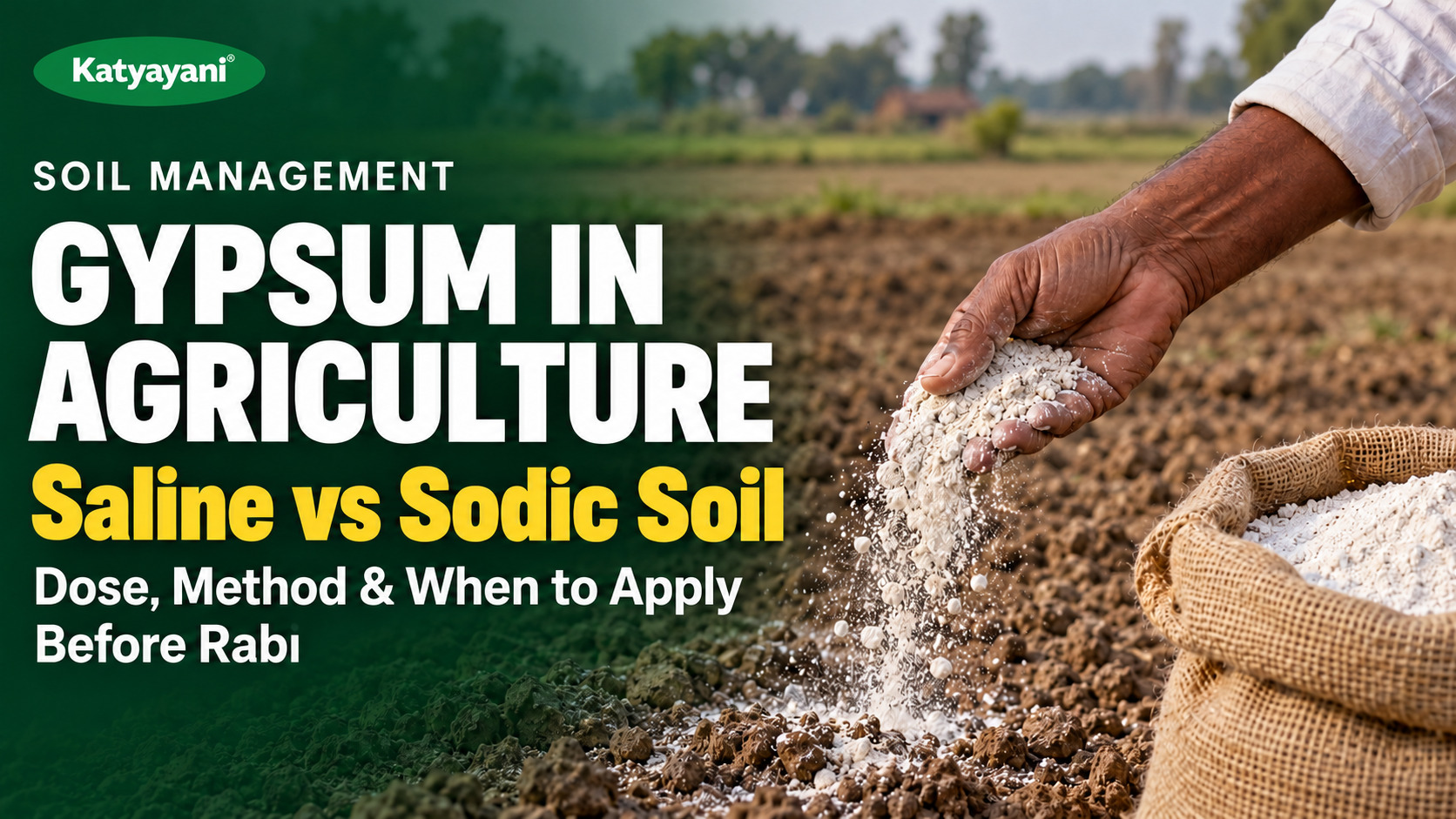
What is the difference between saline and sodic
soil?
|
Feature |
Saline soil |
Sodic (alkali / usar) soil |
Saline-sodic |
|
Main problem |
Too many soluble salts |
Too much sodium on soil
particles |
Both |
|
EC (dS/m) |
Above 4 |
Below 4 |
Above 4 |
|
pH |
Below 8.5 |
Above 8.5 (CSSRI uses above
8.2) |
Varies |
|
ESP (exchangeable sodium %) |
Below 15 |
Above 15 |
Above 15 |
|
What you see |
White salt crust on the
surface |
Dark, sticky, crusted,
waterlogged top layer; poor germination |
Mixed signs |
|
What fixes it |
Drainage and leaching;
gypsum does not fix it |
Gypsum, then leaching |
Gypsum and leaching |
Limits differ slightly between sources, for example pH 8.5 in the classic definition and 8.2 in CSSRI's document. Use them as a guide and confirm with a lab report. Field signs only point you in a direction.
How big is the problem in India?
According to the CSSRI document, India has about 6.73
million hectares of salt-affected soil: 3.77 million hectares alkali and 2.96
million hectares saline. Uttar Pradesh has the largest alkali area, about 1.35
million hectares (35.75% of the national alkali area), followed by Gujarat
(14.36%), Maharashtra (11.21%), Tamil Nadu (9.41%), Haryana (4.86%) and Punjab
(4.02%). About 1.95 million hectares have been reclaimed so far: Punjab 0.80,
Uttar Pradesh 0.73 and Haryana 0.35 million hectares. CSSRI estimates
alkalinity costs the country about 11.18 million tonnes of production a year,
around Rs 15,000 crore, including losses in groundnut and rapeseed-mustard.
Read the full figures in the CSSRI gypsum technology document
↗.
Why does gypsum fix sodic soil but not saline
soil?
In sodic soil, sodium clings to the clay. The soil crusts,
seals and drains badly. Gypsum supplies calcium. The calcium takes the place of
sodium on the clay, and the sodium washes out as sodium sulphate when water
drains through. In a purely saline soil there is no excess sodium on the clay.
The problem is soluble salt, which only leaching with good water and drainage
can remove. Gypsum on a saline soil wastes money.
How do you know which soil you have?
1.
Look at
the field. White crust points to saline. A dark, hard, crusted and
waterlogged surface points to sodic.
2.
Take a
soil sample up to 15 cm depth. CSSRI recommends gypsum based on the soil pH
value.
3.
Send it
to a lab for pH, EC and ESP. A Soil Health Card shows pH, EC and nutrients,
but may not show ESP.
4.
Use the
CSSRI tools. GypKit is a field kit for sodicity and gypsum need that needs
no electricity. The free GypCal Android app (Hindi and English) gives the
gypsum needed in 50 kg bags, the leaching water depth, estimated ESP and
expected yields. See the CSSRI technology page ↗.
High pH can also lock nutrients even when you apply
fertiliser. Read our guide on soil pH and nutrient lock.
Check your irrigation water first
Good gypsum work can be undone by bad water. The Bureau of
Indian Standards classifies irrigation water by EC, SAR and residual sodium
carbonate (RSC, the carbonate and bicarbonate left after calcium and magnesium
are counted, in me/l). The classes below are from IS 11624:2019, as hosted by
CSSRI (BIS standard ↗).
|
Water class |
EC (dS/m) |
SAR |
RSC (me/l) |
|
Good |
Below 0.7 |
Below 10 |
Below 2.5 |
|
Marginally saline |
0.7 to 3.0 |
Below 10 |
Below 2.5 |
|
Saline |
Above 3 |
Below 10 |
Below 2.5 |
|
Marginally alkali |
Below 4 |
Below 10 |
2.5 to 4.0 |
|
Alkali |
Below 4 |
Below 10 |
Above 4.0 |
|
High-SAR alkali |
Variable |
Above 10 |
Above 4.0 |
The standard notes that gypsum may be needed even for saline waters if SAR or RSC is high. If your tube-well water has high RSC, a gypsum chamber can treat it. TNAU describes using gypsum lumps (more than 85% pure in its example, broken to 25 to 50 mm) in a bed on the water channel, with a refill when 20 to 25% is used up. High-RSC groundwater is reported in about 25% of Punjab and 21% of Haryana. See the TNAU gypsum chamber note ↗.
How much gypsum per acre for sodic soil?
The CSSRI thumb rule is 12 to 15 tonnes of gypsum per
hectare. This equals 50% of the gypsum requirement of the 0 to 15 cm layer
according to soil analysis, and it is enough to reclaim the top 15 cm of a
highly deteriorated soil (pH as high as 10.7) for rice-wheat. A CSSRI web page
quotes 10 to 15 t/ha. Per acre, 10 to 15 t/ha is roughly 4 to 6 tonnes (my
arithmetic, 1 ha = 2.47 acres).
|
Option |
What CSSRI reports |
Notes |
|
Standard method |
12 to 15 t/ha (50% of
gypsum requirement, 0-15 cm), mixed in top 10 cm, ponded 7-10 days |
Rice first, then wheat or
berseem |
|
Half dose |
Reduce the dose to half if
10-15 t/ha FYM is applied with gypsum, or salt-tolerant rice and wheat are
used in the first 3 years |
FYM and tolerant varieties
act as a substitute |
|
Low-dose option |
25% of gypsum requirement
with salt-tolerant rice (CSR 13) and wheat (KRL 19) gave yields comparable to
normal varieties with 50% gypsum |
Cost about Rs 40,000/ha,
benefit-cost ratio 1.7 |
|
Highly sodic soil trial
(ESP 89, Lucknow) |
50% requirement (about 15.4
t/ha) beat the control and 15% |
Full requirement there
about 30.8 t/ha (my arithmetic) |
|
Marine gypsum |
About 23.8% less quantity
than mineral gypsum for soils above pH 10 as it is purer |
Saves about Rs 21,360/ha |
The lab formula that turns pH or ESP into tonnes of gypsum was not in the documents I could open. Ask a lab, use GypKit or the GypCal app instead of guessing.
How do you apply gypsum? Step by step
5.
Level the
land and build strong bunds on all sides. CSSRI advises completing the
layout with irrigation and drainage channels by early summer, before the rains.
6.
Spread
the gypsum evenly over the whole field by hand or spreader.
7.
Mix it
thoroughly within the top 10 cm of soil.
8.
Pond
water (irrigation or rain water) for about 7 to 10 days to promote
leaching, then drain the leachate.
9.
Start
with rice. CSSRI says reclamation should start with rice as the first crop.
Rice is puddled and transplanted, with 3 to 4 seedlings per hill at 15 to 20 cm
spacing, and the nursery is raised on normal soil. Keep the field submerged.
10.
Follow
with wheat or berseem in rabi. Summer green manure is desirable and can
save 60 to 70 kg/ha nitrogen for the next rice.
Note on sequence: the CSSRI PDF gives gypsum first, then
ponding. One CSSRI web page mentions leaching before gypsum. The PDF is the
full technology document, so this guide follows it. Ask your KVK if your soil
needs a different order.
When should you apply gypsum before rabi?
The best timing follows from the CSSRI method. Reclamation
starts with rice, so gypsum goes in before the paddy season, with land
preparation done in early summer before the rains. Wheat then follows in rabi
on soil that is already improving. If your field is fallow in October and you
want to reclaim before wheat, the document does not give a procedure. Applying
gypsum, ponding for 7 to 10 days and sowing a salt-tolerant wheat variety such
as KRL 19 is a reasonable reading of the CSSRI advice, but it is my inference.
Check with your KVK or state agriculture university first. For the sowing
window and seed rate of the following wheat, see our wheat sowing planner.
What fertiliser plan works on reclaimed soil?
|
Item |
CSSRI advice |
|
Nitrogen |
About 25% more than the
normal-soil dose in the first years, split into three equal parts: basal, 21
days and 45 days |
|
Zinc |
Zinc sulphate 25 to 40
kg/ha to rice for the first few years |
|
Phosphorus |
Around 22 kg P/ha after 4
to 5 years |
|
Organic matter |
FYM and summer green manure |
|
Irrigation to wheat |
Light and frequent
irrigations to avoid stagnation |
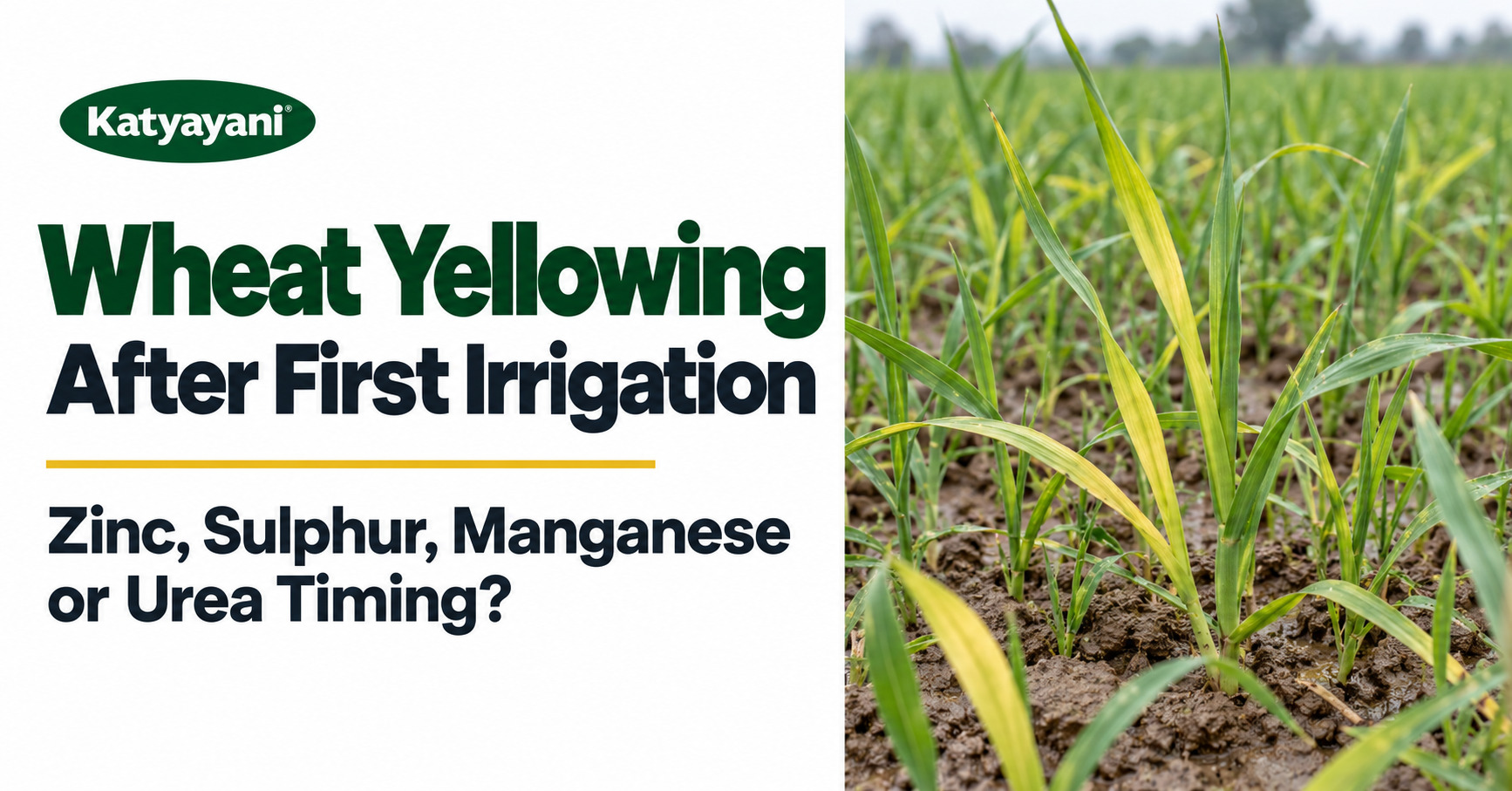
If wheat turns yellow on reclaimed land, check our guide to wheat yellowing causes before spraying.
What does it cost, and what do you gain?
CSSRI puts the capital cost at about Rs 76,000 per hectare.
Gypsum is about 57% of it, farm development (including a bore well per 4
hectares) about 27%, and labour and other items about 16%. It reports a
benefit-cost ratio of 1.34 to 2.47, IRR of 18 to 67% and a payback of 2 to 3
years. On reclaimed land in Uttar Pradesh, the extra yield was reported as 3.9
t/ha of paddy on severely sodic soil, 3.18 on moderately sodic and 1.76 on
slightly sodic soil. Extra wheat was 3.17 t/ha on moderately sodic, 2.75 on severely
sodic and 0.67 on slightly sodic soil. These are CSSRI figures and may be out
of date.
Gypsum as a calcium and sulphur source for
crops
Pure gypsum (CaSO4.2H2O) has 23.3% calcium and 18.6%
sulphur. Unlike lime, it does not change soil pH and acts as a neutral salt. It
is also about 200 times more soluble than lime, as an ICAR magazine article
from ICRISAT authors explains (Indian Farming, April 2024
↗). The article gives groundnut needs of about 11 kg calcium and 4 kg
sulphur per tonne of pods and says gypsum should go on at flowering in the
pegging zone. ICAR and ICRISAT recommend 500 kg/ha where soil calcium is below
1,000 ppm. Studies in the paper used 250 to 1,650 kg/ha with yield gains from
5% to 44%. Too much calcium can reduce uptake of phosphorus, potassium,
magnesium, copper, boron, iron and zinc. Gypsum for oilseeds is supplied under
the oilseeds mission at 50% of cost plus transport, according to the same
article.
For mustard I did not find a dose in a package of practices.
Journal snippets report that 250 kg/ha gypsum raised mustard yield by about 21%
in a Rajasthan farmer-field test, and that sulphur at 40 kg/ha from gypsum
worked well. At 18.6% sulphur, 40 kg S is about 215 kg gypsum (my arithmetic).
These are research results to verify, not a recommendation. See our mustard sowing and fertiliser schedule for the
sulphur plan.
Which gypsum should you buy?
Ask the seller for the source and the purity. TNAU describes
gypsum lumps from Hanumangarh, Rajasthan, as more than 85% pure. The Fertiliser
Control Order notification reported for granular phosphogypsum sets minimum
calcium sulphate dihydrate at 70% and sulphur at 13%, with limits for fluoride
and heavy metals (reported by a secondary law-update site, so verify in the
Gazette). Cheap market gypsum may be phosphogypsum or another by-product. I did
not find a purity or fineness standard for mineral gypsum in the documents I
could open.
Mistakes to avoid
·
Using gypsum on a saline soil that has no sodium
problem.
·
Applying without a lab test or without checking
irrigation water quality.
·
Expecting gypsum to raise the pH of acidic soil.
It is neutral. Acid soils need lime.
·
Skipping ponding and leaching. Without water,
the displaced sodium stays.
·
Letting water stand on the wheat crop. CSSRI
advises light and frequent irrigation.
·
Over-applying. The US NRCS standard says to use
a soil analysis under a year old and, in its context, not to exceed 5 tonnes
per acre a year (NRCS standard ↗).
For a farmer-led example of a lower gypsum dose combined
with organic material, see the Kaithal Farmer FIRST report
↗.
Conclusion
Test first, then decide. If your report shows high pH and
high ESP, you have sodic soil and gypsum with leaching is the proven fix. Use
the CSSRI method: level the land, mix 12 to 15 t/ha gypsum in the top 10 cm,
pond for 7 to 10 days and start with rice. Cut the dose to half with FYM or
salt-tolerant varieties. If your report shows high EC and normal pH, you need
drainage and leaching, not gypsum. Check your irrigation water, and ask your
KVK for local timing and advice.
Why trust this guide
Written by Team Katyayani, Editorial Team at Katyayani Organics. Cross-checked against published research and university extension programs.


Leave a Comment