
 17 min read
Crop health improves when you first find the real cause, then match the remedy class to it: nutrition for deficiency, a fungicide or bio fungicide for disease, scouting plus a suitable bio or neem-based spray for pests, and mulch, potassium and kaolin-type measures for heat or drought stress. FAO says pests and diseases destroy up to 40 percent of food crops every year. In two ICAR-NCIPM trials on Bt cotton, a managed IPM package gave 25.38 percent (Khandwa) and more than 18 percent (Fazilka) higher yield than farmers' practice. Leaf colour alone is not proof: TNAU says soil analysis, plant analysis and symptoms should be used together.
What does crop health mean, and how do remedies raise yield?
Crop health means the plant has enough nutrients, water and protection to use its full yield potential. A remedy raises yield by removing the thing that holds the plant back: a missing nutrient, a disease, a pest or a stress. A remedy that does not match the cause adds cost and no yield.
Think of yield as a bucket with holes. Each hole is a loss: roots that cannot reach zinc, leaves eaten by caterpillars, flowers that drop in heat, a fungus in the stem. Fertilizer pours more water into the bucket, but if the hole is a disease, the water still leaks out. That is why this post starts with finding the hole and only then picks the remedy.
The posts we already publish go deep on single parts of this: plant growth promoters, plant growth regulators versus biostimulants and bio versus chemical inputs. Use this post as the map and those as the detailed streets.
How much yield do pests, diseases and nutrient gaps really cost?
FAO says pests and diseases destroy up to 40 percent of food crops every year. The ICAR soil survey adds a second leak: more than half of surveyed Indian soils were short in sulphur or zinc. These two figures show why protection and nutrition both matter, and neither is a luxury.
| Source of loss | Figure | Source |
|---|---|---|
| Plant pests and diseases, world food crops | Up to 40 percent lost every year | FAO plant health |
| Soils short in available sulphur, India | 58.6 percent of 242,827 samples | Shukla et al. 2021 |
| Soils short in available zinc, India | 51.2 percent | Shukla et al. 2021 |
| Soils short in available boron, India | 44.7 percent | Shukla et al. 2021 |
| Soils short in iron, manganese, copper | 19.2, 17.4 and 11.4 percent | Shukla et al. 2021 |
Read these as the size of the problem, not as your own loss. Your field may lose far less, or more. The FAO figure is a global estimate, and the survey counts soils classed as acute deficient, deficient or latent deficient. The authors tie the gaps to low organic carbon, high pH and intensive cultivation.
How do you tell if the problem is nutrient, disease, pest or stress?
Start with which leaves show the problem first, what the damage looks like and what changed recently: heat, a dry spell, waterlogging or a new spray. TNAU says soil analysis, plant analysis and visual symptoms work best together. Symptoms alone can mislead, so confirm the cause before you spend on a remedy.
| Clue | Points to | What to do next |
|---|---|---|
| Yellowing of older leaves first | Low nitrogen or potassium; also salinity, overwatering or poorly aerated soil (TNAU) | Soil test and check drainage |
| Yellow young leaves with green veins | Iron or manganese, possibly copper or zinc (TNAU) | Check pH and soil test before spraying |
| Spots, mould or wilting that spreads from one point | Possible disease | Confirm with a KVK before spraying |
| Holes in leaves or insects on the underside | Possible insect pests; spider mites also cause yellow patches (TNAU) | Scout and count before choosing a spray |
| Flowers or fruit falling after heat or a dry spell | Heat or water stress (TNAU stress pages) | Fix water and mulch first |
| One corner of the field worse, near a waterlogged strip | Soil problem such as drainage or salinity | Check drainage and the soil report |
One caution from TNAU's diagnosis page: it lists several possible causes for each yellowing pattern, so a symptom alone does not name the cause. TNAU calls soil analysis, plant analysis and visual symptoms useful and complementary. If you are unsure, take a leaf with a part of the stem and a photo to your nearest KVK. Our guide to slow plant growth works through the same logic one step at a time.
What do yellowing leaves mean, and which remedy fixes them?
According to TNAU, yellowing of older leaves is linked to low nitrogen or potassium, high salinity, overwatering and poorly aerated soil, and yellowing of young leaves to iron or manganese, possibly copper or zinc. Spider mites, air pollution and pesticide injury can also cause yellow patches between veins, so check the pattern before you treat.
Start by asking which leaves turn yellow first. Then ask if the yellow follows the veins or ignores them. TNAU also lists spider mite injury, sulphur dioxide pollution and pesticide phytotoxicity as causes of yellow patches between the veins, so look at the underside of the leaf for mites before you buy a nutrient.
- Old leaves yellow first: think nitrogen or potassium. Our post on nitrogen deficiency shows the look-alikes and the fix.
- Yellow between veins on young leaves: think iron, manganese or zinc, and check that soil pH is not locking them up. The soil pH and nutrient lock post explains why a nutrient in the soil can still be out of reach.
- Yellow older leaves plus waterlogged, salty or poorly aerated soil: TNAU lists overwatering, salinity and poor aeration among the causes, so check drainage first.
- Yellow patches between veins with mites on the underside: TNAU lists spider mite injury as a cause, so look before you buy a nutrient.
A balanced water-soluble feed is one option when a plain nitrogen, phosphorus or potassium shortage is confirmed. The NPK fertilizer collection, titled "NPK Fertilizers - Water Soluble Plant Nutrition", lists eight grades on our site, including 19:19:19 for foliar and drip use, 12:61:00 and potassium nitrate. An NPK feed does not correct a zinc or iron gap, and it does nothing for a pest.
How common are hidden micronutrient gaps, and how do you fix them?
Very common. The ICAR survey found 51.2 percent of soils short in zinc and 44.7 percent in boron, and 58.6 percent short in sulphur. A soil test shows which gap you have. Fix a confirmed gap with the right micronutrient, following the label or your state package.
The survey authors say zinc shortage goes with low organic carbon, high pH, coarse texture and lime-rich soil, and they link iron shortage to alkaline soil and moisture deficit. That is why a soil test comes before any purchase.
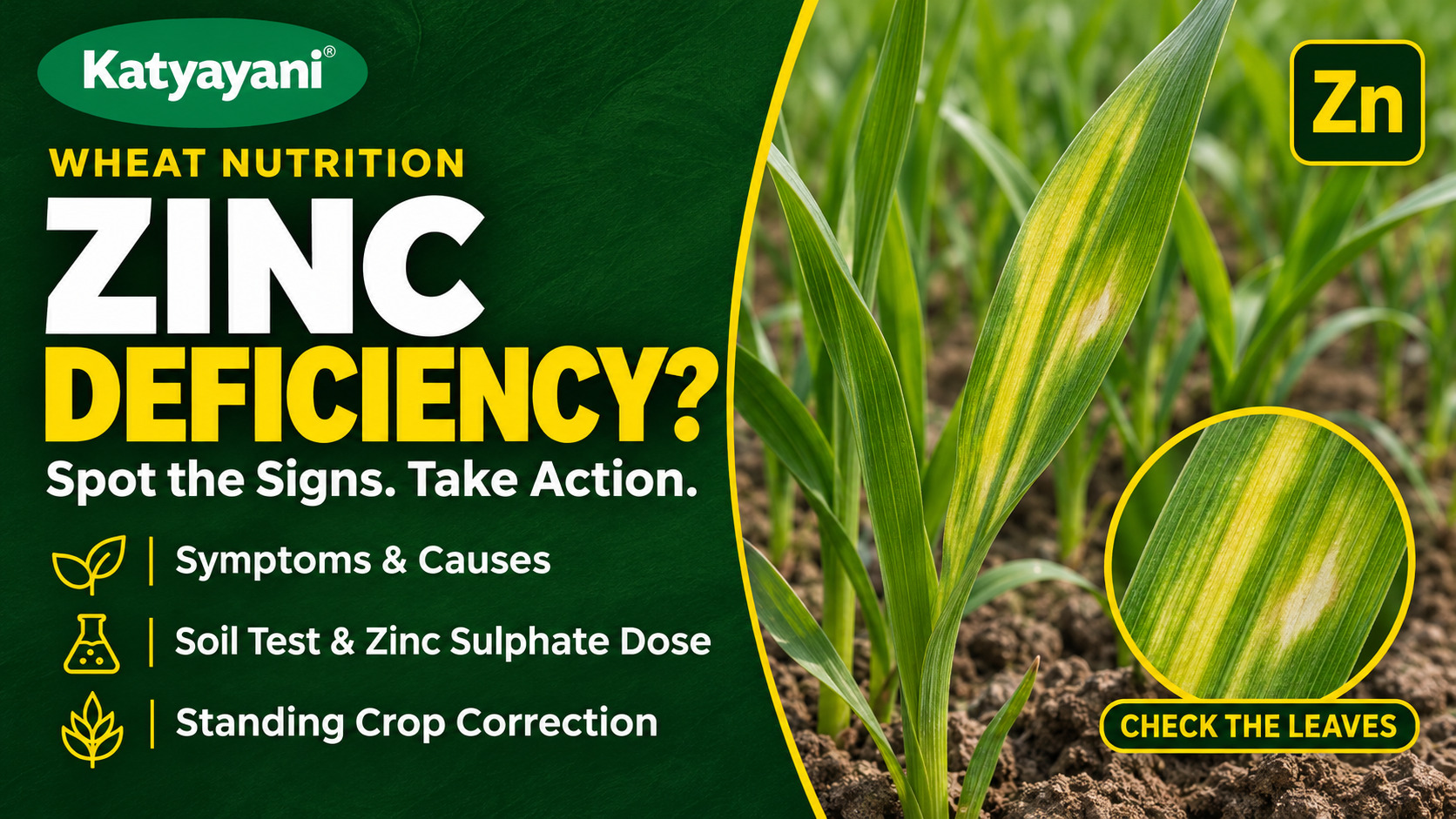
Zinc is a common fix. The micronutrient fertilizer page for zinc sulphate lists 33 percent zinc and says it corrects zinc deficiency, naming symptoms such as yellowing between leaf veins and stunted growth with smaller leaves. In wheat, the zinc problem has its own detailed guide: zinc deficiency in wheat.
Boron is the one to think about when flowers set badly. The boron fertilizer page lists 20 percent boron and links boron deficiency to flower drop, fruit cracking and poor pod filling; those are the page's statements. TNAU's own tomato page describes brittle leaves, uneven ripening and corky pits, and prints a correction of 0.3 percent borax foliar spray twice at a fortnight apart, or borax at 20 kg per hectare to soil (TNAU Agritech Portal, tomato boron deficiency page). Get a soil test and read the label before you apply boron.
Why do flowers drop, and what helps?
Flower drop can follow heat stress, and TNAU prints a 40 ppm NAA spray for premature flower or fruit drop under high temperature. Boron product pages also link boron shortage to flower drop. Find the cause first: steady the water supply, correct a confirmed nutrient gap, and use a growth regulator only per your state package.
TNAU's high-temperature page lists a 40 ppm NAA spray to reduce premature flower or fruit drop under heat stress, together with 2 percent calcium nitrate for cell membrane integrity and a foliar mix of zinc sulphate, boric acid, ferrous sulphate and urea. These are TNAU's printed stress measures (TNAU heat stress page). TNAU's growth regulator page lists NAA at 30 ppm among its cotton treatments, with "decrease boll shedding" as the listed response. Use the label and your state package for crop, dose and timing, not memory.
On our side, the plant growth regulator collection is titled "Plant Growth Regulators - Boost Flowering & Yield" and lists products such as NAA, gibberellic acid, paclobutrazol and homobrassinolide. Check the registered crop and purpose on each label before use.
How do fungal diseases cut yield, and what protects the crop?
TNAU's disease pages list control measures that work before the first spot appears: crop rotation, hot-water treatment of planting material and Trichoderma seed treatment. A bio or chemical fungicide is a targeted tool on top of these. Always check the registered crop and disease on the label before you buy.
TNAU's examples include a six-year rotation with sorghum for chickpea Fusarium wilt, hot-water treatment of sugarcane setts at 52 degrees Celsius for 30 minutes against red rot, and Trichoderma seed treatment at 4 g per kg seed for groundnut and chickpea and 5 g per kg for soybean (TNAU disease management). Notice how much of this is done before the crop shows disease.
For a bio fungicide, the CIB&RC list is the check. Its bio-fungicide list (updated to 31 March 2024) shows Trichoderma viride registered for uses such as wilt and root rot in pigeon pea, root rot in pulses, damping off in chilli, wilt in tomato and seedling wilt in groundnut, and Pseudomonas fluorescens for uses such as early blight in tomato, late leaf spot in groundnut and blast in rice (CIB&RC bio-fungicide list). The list carries a disclaimer that it is for guidance and not for legal purposes.
Our bio fungicides collection is titled "Bio Fungicides - Biological Disease Control for Crops" and lists Trichoderma, Pseudomonas, Bacillus and Ampelomyces products. Two of its pages are useful to read. The Trichoderma viride page names soil-borne problems such as wilt, root rot and damping off and lists seed treatment, soil drenching and seedling dip as methods. The Pseudomonas fluorescens page says the product works best when applied preventively, should not be mixed with chemical fungicides and is affected by temperature and moisture. Follow the label for rates.
The Pseudomonas page says it is most effective when applied preventively, so for a disease that is already active, ask your KVK which registered product suits your crop. How you apply a fungicide matters too; see fungicide application methods. If you prefer fewer chemicals, the single-product organic fungicides page lists an organic option, and the biopesticides guide explains what these living products can and cannot do.
How do you control insect pests without spraying blindly?
FAO defines IPM as careful consideration of all available pest control techniques and then integration of appropriate measures. Scouting your field, protecting natural enemies and spraying only when needed fit that approach. The ICAR cotton trials below cut sprays by 46.55 percent and by more than 68 percent, so blind calendar spraying is not the only way.
FAO's IPM page says the approach blends biological, chemical, physical and crop-specific management strategies and reduces pesticide residues (FAO on IPM). In the ICAR trials in the yield section below, that meant timely sowing, cowpea intercropping to protect natural enemies, neem sprays, need-based sprays and pheromone products.
For organic and bio options, the organic pest control collection lists neem oil of several strengths, pyrethrum extract and an all-in-one larvicide, and the bio pesticides collection lists Verticillium, Beauveria, Metarhizium, nematode-control and spinosad products.
The CIB&RC bio-insecticide list (as on 31 March 2024) shows how different strengths and organisms have different registered uses. Azadirachtin 0.03 percent EC lists cotton bollworm and aphids, and rice leaf roller, stem borer and brown plant hopper. The 3000 ppm EC entry lists cotton American bollworm. Beauveria bassiana entries are for caterpillars and borers such as cotton bollworm, rice leaf folder, cabbage diamond back moth, chickpea pod borer and tomato fruit borer (CIB&RC bio-insecticide list). So the pack label for your strength and crop decides, not a general claim.
Check the label for the crop, the pest and compatibility with other products before you spray, and note what you sprayed and what happened.
What do bio fertilizers do for plant growth?
TNAU describes bio fertilizers as preparations of living microorganisms that help crops take up nutrients, mainly by fixing atmospheric nitrogen or releasing bound phosphorus. Rhizobium suits legumes, Azospirillum suits cereals, millets, oilseeds and cotton, and mycorrhiza moves phosphorus into roots. They supplement chemical fertilizers and do not replace them.
The bio fertilizers collection lists zinc, potash and phosphate solubilising cultures, sulphur and iron bacteria, Rhizobium, mycorrhiza and a decomposing culture activator. Silica, calcium, Azotobacter, Azospirillum and Acetobacter cultures are also listed there.
The research side is explained in our soil microbiome post. For chemistry-versus-biology decisions, where each one actually wins is the better read. TNAU explains the methods: seed treatment with a slurry, then shade drying; a 5 to 10 minute seedling root dip before transplanting; or mixing with farmyard manure for the field (TNAU biofertilizers). It also says not to mix bacterial inoculants with insecticides, fungicides, herbicides or fertilizers, to apply the inoculant last if seed has a fungicide coat, and not to use packets past their expiry date.
Where do seaweed extract and growth regulators fit in a crop health plan?
The Katyayani seaweed liquid page says the product is not a full fertilizer, does not kill insects or fungi, and will not fix pest damage, disease or a real nutrient deficiency. It is an add-on to a plan that already covers nutrition and protection. Growth regulators are narrow-window products; use the label and your state package.
The seaweed extract liquid page says seaweed extracts carry only small amounts of nitrogen, phosphorus and potassium, so it is meant to be used with your regular fertilizer. That is a limit worth knowing before you buy. We found no opened ICAR or university trial that gives a yield percentage for seaweed extract alone, so we give none.
For the rules, categories and how Indian law treats these products, read biostimulants in India: FCO rules. TNAU prints a specific ppm for each crop and purpose, for example NAA at 40 ppm for heat-related drop and 30 ppm among its cotton treatments, so the label and your state package should decide the dose.
How do you protect a crop from heat and drought stress?
TNAU lists foliar potassium chloride at 0.5 to 1 percent, 3 percent kaolin at critical moisture-stress stages, split nitrogen and potassium, and mulch with 5 tonnes of sorghum or sugarcane trash per hectare, which TNAU says saves 19 to 20 percent of irrigation water. Check each against your state package before use.
| Measure | What TNAU prints | Source |
|---|---|---|
| Foliar potassium chloride | 0.5 to 1 percent, to offset nutrient imbalance under water stress | TNAU drought management |
| Kaolin spray | 3 percent at critical stages of moisture stress (a reflectant antitranspirant) | TNAU drought management |
| Mulching | 5 tonnes of sorghum or sugarcane trash is said to save 19 to 20 percent of irrigation water | TNAU drought management |
| Split nutrients | Split N and K at 45 and 60 days after sowing (as given for cotton) | TNAU drought management |
| High-temperature foliar mix | Zinc sulphate 0.5 percent, boric acid 0.3 percent, ferrous sulphate 0.5 percent and urea 1 percent | TNAU heat stress |
| Membrane support | 2 percent calcium nitrate foliar spray | TNAU heat stress |
| Flowering-stage foliar spray | 1 percent KCl with 2 percent DAP; keep enough soil moisture while spraying to avoid leaf scorching | TNAU drought management |
These are TNAU recommendations for the crops and conditions it describes, so check them against your own state package before using them. The calcium nitrate product page on our site lists 18.8 percent calcium and 15.5 percent nitrogen and names disorders such as blossom end rot, bitter pit and fruit cracking; see the calcium nitrate page.
What yield difference is actually documented?
The best documented figures in this topic come from two ICAR-NCIPM trials on Bt cotton. A managed IPM package gave 25.38 percent higher seed cotton yield at Khandwa (2022 to 2024) and more than 18 percent at Fazilka (2016 to 2018) than farmers' practice, with far fewer sprays.
| Trial | Result against farmers' practice | Source |
|---|---|---|
| Bt cotton, Khandwa, Madhya Pradesh, three kharif seasons 2022 to 2024 | Seed cotton yield up 25.38 percent; pest infestation down up to 81 percent; sprays down 46.55 percent; net returns up more than 56 percent | Birah et al., IJAgS |
| Bt cotton, Fazilka, Punjab, 2016 to 2018 (2.5 ha, 12 ha, 40 ha) | Yield up more than 18 percent; insecticide sprays down more than 68 percent; input cost down more than 17 percent; benefit-cost ratio 2.55 against 1.88 | Kumar et al., IJAgS |
What was in the package? At Khandwa: timely sowing with refugia, border cropping, cowpea intercropping to protect natural enemies, neem oil sprays (azadirachtin 1500 ppm), need-based flonicamid for sucking pests, pheromone formulations for pink bollworm, selective insecticides and crop termination with residue destruction. At Fazilka: timely sowing of a recommended hybrid, weed removal, proper plant nutrition including a foliar spray of 2 percent potassium nitrate, neem-based pesticides and protecting natural enemies.
Two points from these papers matter for you. First, the gain came from a bundle of practices, nutrition and protection together, not from one product. Second, these are cotton results from ICAR-run farmer-participatory trials; they do not prove the same percentage in your crop. We found no opened ICAR or university source giving a yield percentage for a bio fertilizer, seaweed extract or growth regulator used alone, so none is claimed.
Which remedy goes on at which crop stage?
Match the remedy to the stage. Before sowing: soil test, organic matter, seed treatment. At germination and early growth: bio fertilizers and root-zone protection. At vegetative growth: balanced nutrition and scouting. At flowering and fruit set: boron, potassium and stress care. Near harvest: stop sprays that the label restricts.
| Crop stage | Main risk | Remedy class | Useful page |
|---|---|---|---|
| Before sowing | Hidden nutrient gap, soil-borne disease | Soil test, organic matter, seed treatment with a bio agent | Soil health card guide |
| Germination to 3 weeks | Damping off, root rot, weak roots | Bio fungicide as seed or soil treatment; bio fertilizer as seed or seedling treatment (TNAU) | Bio fungicides and bio fertilizers collections |
| Vegetative growth | Pale leaves, slow growth, early pests | Balanced NPK if a shortage is confirmed, a micronutrient if confirmed, regular scouting | NPK fertilizer and organic pest control collections |
| Bud to flowering | Flower drop, poor set | Boron if short, steady water, growth regulator only per label and state package | Plant growth regulator collection |
| Fruit and grain filling | Cracking, poor filling, heat damage | Calcium support per product page, irrigation, mulch | TNAU stress measures |
| Before harvest | Residue limits | Check waiting period on the label before any spray | Product label |
For a crop that you know well, use the same table and replace the middle columns with your own crop's known problems. Our crop guide on IPM in banana shows what a stage-by-stage plan looks like for one crop.
What are the most common mistakes with crop health remedies?
The most common mistakes are treating by leaf colour alone, spraying without scouting, mixing products that do not go together, ignoring soil pH, overdosing growth regulators and expecting a bio product to act like a fast chemical. Each one costs money and can lower yield. A soil test and the label avoid most of them.
- Treating by leaf colour alone. TNAU says symptoms alone do not name the cause. Test the soil and check for pests.
- Fertilizer for a disease or a pest. NPK cannot stop a fungus, and a fungicide cannot supply zinc.
- Calendar spraying. Spraying by habit, not by scouting, wastes product. The ICAR trials above cut sprays by 46.55 percent and by more than 68 percent.
- Mixing bio and chemical products. The Pseudomonas page says not to combine it with chemical fungicides, and TNAU says not to mix bacterial inoculants with fungicides. Read each label.
- Ignoring soil pH and drainage. A nutrient in the soil can still be locked out; see the pH post linked above.
- Chasing flowers with regulators. Find the cause of the drop first; use a regulator only per label and state package.
- Using bio fungicides late. The Pseudomonas page says it is most effective when applied preventively.
- Skipping the label. Check the crop, pest, dose and waiting period before every spray.
- Buying a fake. Counterfeit inputs defeat every plan above; our fake pesticide and fertiliser checks explain how to spot them.
How do you build a simple crop health plan for your field?
Use six steps: test the soil, prepare the field, feed in stages, scout, act only where needed, and keep notes. The order matters. A soil report decides the nutrient plan, scouting decides pest and disease action, and your notes tell you next season what worked on your land and what did not.
- Test. Send a soil sample before sowing and read it with the soil health card guide.
- Prepare. Add organic matter (the organic fertilizer collection lists organic potash and rock phosphate options), fix drainage and treat seed with a bio agent where the CIB&RC list and your KVK support it.
- Feed in stages. Base nutrition at sowing, a top-up during vegetative growth if the soil report or symptoms call for it, and boron or potassium around flowering where a shortage is confirmed.
- Scout regularly. Walk the field, look at the underside of leaves and count what you see. Do not guess.
- Act where needed. Follow the IPM idea: use non-chemical measures first and a registered product only when the problem needs it.
- Write it down. Date, problem, product, result.
If you are a dealer or field staff member, the same plan is a ready script for the counter conversation: ask for the crop, the stage and a photo, and only then name a remedy class.
When should you ask an expert, and what should you check on a label?
Ask your KVK or agriculture officer when the cause is unclear, when many plants are dying fast, or when a spray did not work. On the label, check the crop, the pest or disease, the dose, the waiting period and compatibility. The CIB&RC Major Uses list shows what each active ingredient is registered for.
The CIB&RC lists are compiled for guidance, as their own disclaimer says, but they are the right reference point for crop, pest and active ingredient. If a shop or a video claims an input works on a crop or pest that the label and the list do not mention, ask the seller to show you the label claim. The bio versus chemical and biopesticides posts help you ask better questions.
Bring to the KVK: a fresh affected plant with roots, a healthy one for comparison, the soil report if you have it, and a list of what you sprayed in the last three weeks.
Conclusion
Better crop health comes from finding the cause before choosing the remedy. Test the soil, scout the field, match nutrition, disease, pest or stress care to what you actually see, and time each step to the crop stage. The best cited yield gains in this topic came from bundles of good practice, not from one bottle. Follow the label, check the registered uses, and keep notes so each season starts smarter than the last.

Leave a Comment