
 14 min read
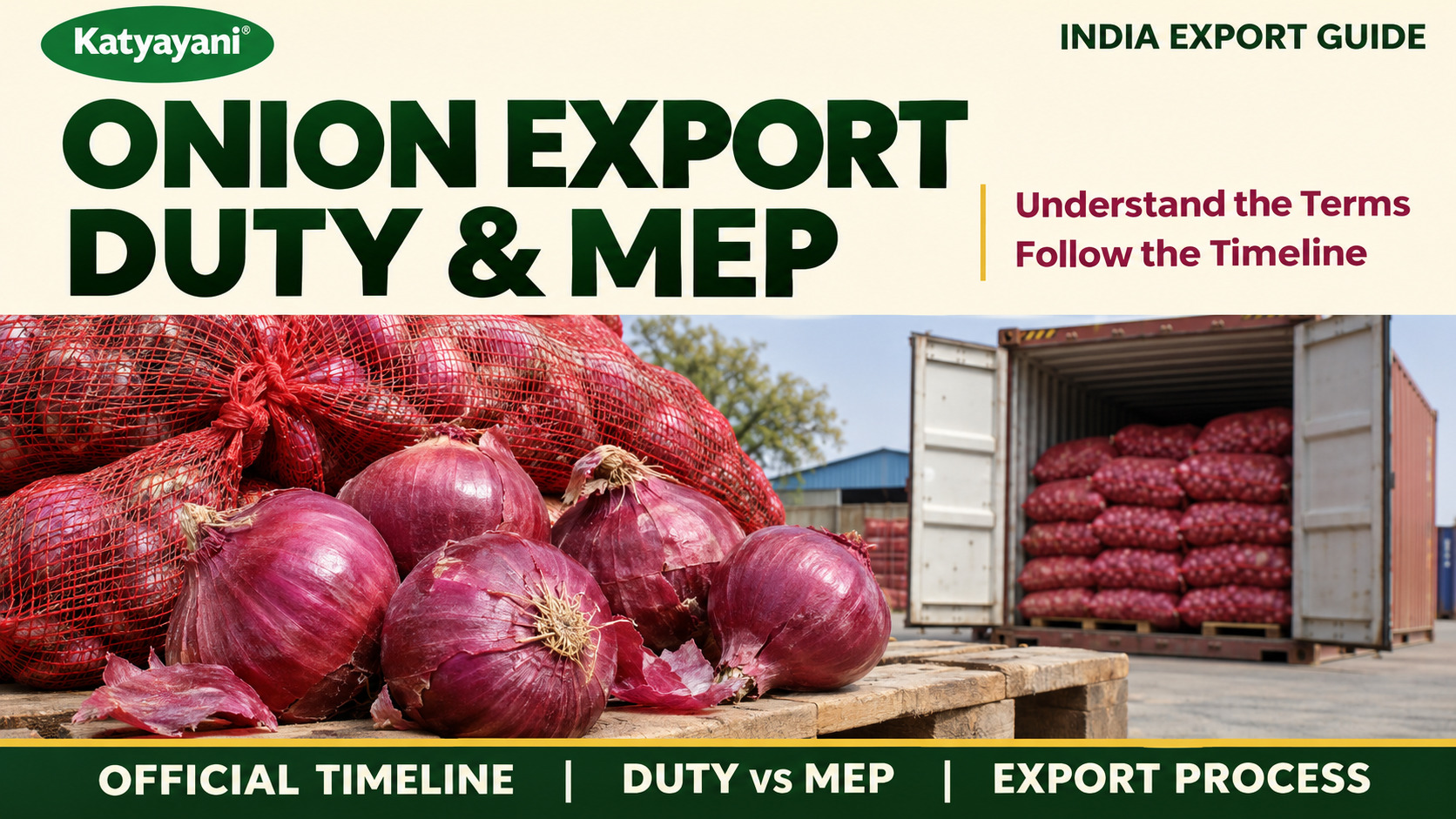
As per PIB of 22 March 2025, the 20% export duty on onion was withdrawn from 1 April 2025, and the minimum export price (MEP) was removed earlier. The 20% duty had applied since 13 September 2024, and before it the duty was 40% when export reopened on 4 May 2024 (PIB, 7 Aug 2024). DGFT Notification 28/2024-25 removed the minimum export price (MEP) of USD 550 per tonne on 13 September 2024. Export was prohibited from 8 December 2023 to 3 May 2024. Duty changes are notified by CBIC (cbic.gov.in) and MEP or ban changes by DGFT (dgft.gov.in).
Is there an export duty on onions in India?
As per PIB of 22 March 2025, the 20% export duty on onion was withdrawn from 1 April 2025. DGFT Notification 28/2024-25 (13 September 2024) had already removed the minimum export price. Duty is notified by CBIC (cbic.gov.in) and MEP or export bans by DGFT (dgft.gov.in), so read both sites for the date you ship.
Here is the short version of how we got here. The PIB release of 22 Mar 2025 says the Government of India withdrew the 20% duty on onion export, effective 1 April 2025. The notification was issued that day by the Department of Revenue, on the communication of the Department of Consumer Affairs.
The same release says the 20% duty had been in place from 13 September 2024. It also says the government had used duty, minimum export price (MEP) and even export prohibition to protect domestic supply.
Now the part many pages miss. Duty is only one of three tools. A trader can face a duty, an MEP or a ban, or two of them at once. The sections below explain each tool, then lay them out on one timeline.
What do export duty, MEP and export ban mean in simple words?
Export duty is a tax collected by customs when onion leaves India, set as a percentage of the value. MEP is a floor price: you may not export below it. An export ban or prohibition means onion cannot leave at all, except where the government allows it. DGFT notifications use the words "Free" and "Prohibited" for the policy.
| Term | What it means | Who issues it | Example from the papers |
|---|---|---|---|
| Export duty | A tax collected by customs on goods leaving India, usually a percentage of value | Department of Revenue (customs notification) | 20% duty from 13 Sep 2024, withdrawn from 1 Apr 2025 (PIB, 22 Mar 2025) |
| Minimum export price (MEP) | A price floor, stated in US dollars per metric tonne on an F.O.B. basis, below which export is not allowed | DGFT (export policy notification) | USD 800 per MT till 31 Dec 2023 (45/2023); USD 550 per MT (10/2024-25); removed (28/2024-25) |
| Export policy: Free | Export is allowed without a licence, subject to any condition in the notification | DGFT | "From prohibited to free" in 10/2024-25 |
| Export policy: Prohibited | Export is not allowed, except where the government gives permission | DGFT | Prohibited from 8 Dec 2023 (49/2023), extended until further orders (81/2023) |
F.O.B. means "free on board": the seller's price up to the point where the goods are loaded on the ship. DGFT writes the MEP as "US $ 800 F.O.B. per Metric Ton" in Notification 45/2023. So an MEP does not say what the farmer must get in the mandi. It says the lowest price at which a shipper may sell abroad.
Two different offices issue these rules, and that is a main reason for confusion. A news story that says "the government imposed a duty" is about the Finance Ministry. A story that says "the government set an MEP" or "banned export" is about DGFT in the Commerce Ministry. You often need both documents to know the full position on a given day.
Why do the numbers 20% and 40% keep conflicting?
Both numbers were real, at different times. PIB says export duty was 40% when onion export reopened on 4 May 2024. PIB says it was 20% from 13 September 2024. It was withdrawn from 1 April 2025. A page that says "20%" and a page that says "40%" are often describing different months, so always read the date next to the rate.
| Period | Export duty | Source |
|---|---|---|
| From 4 May 2024 | 40% (with MEP of USD 550 per MT) | PIB, 7 Aug 2024 |
| From 13 Sep 2024 | 20% | PIB, 22 Mar 2025 |
| From 1 Apr 2025 | Nil (20% duty withdrawn) | PIB, 22 Mar 2025 |
The PIB release of 7 Aug 2024 states: "Government has lifted the onion export prohibition from 4th May, 2024 and has allowed the export with minimum export price of (MEP) of USD 550 per MT and export duty of 40%." The two PIB releases agree with each other on the 13 September 2024 change, so the order of events is not in doubt.
There is a second source of confusion, and it is the MEP. Some pages still say an MEP applies. The DGFT papers show it was removed on 13 September 2024. A later section shows that notification line by line.
A third one is the word "ban". The ban was real, from 8 December 2023 to 3 May 2024. DGFT Notification 10/2024-25 ended it on 4 May 2024. A page written in early 2024 may still be at the top of search results.
What is the official timeline of onion export rules from 2023 to 2025?
The timeline below uses DGFT notifications and PIB releases. It runs from the USD 800 MEP of late 2023, through the ban of 8 December 2023 to 3 May 2024, to the removal of the MEP on 13 September 2024 and of the duty on 1 April 2025. Dates are the dates on the papers.
| Date | What the official paper says | Paper |
|---|---|---|
| 28 Oct 2023 | An earlier MEP notification (42/2023, S.O. 4719(E)) took effect from 29 Oct 2023; it was superseded on 23 Nov 2023 | DGFT 45/2023 |
| 23 Nov 2023 | Onion export is "Free" with an MEP of US $ 800 F.O.B. per MT till 31 Dec 2023 | DGFT 45/2023 |
| 7 Dec 2023 | Onion export (HS 0703 10 19) prohibited till 31 Mar 2024, from 8 Dec 2023 | DGFT 49/2023 |
| 22 Mar 2024 | Prohibition valid till 31 Mar 2024 extended until further orders | DGFT 81/2023 |
| 25 Apr 2024 | Export of up to 2,000 MT of white onion allowed through Mundra, Pipavav and Nhava Sheva/JNPT, with a certificate from the Horticulture Commissioner, Government of Gujarat | DGFT 09/2024-25 |
| 4 May 2024 | Policy changed from "prohibited" to "free" with an MEP of USD 550 per MT | DGFT 10/2024-25 |
| From 4 May 2024 | Export duty of 40% with the MEP of USD 550 per MT | PIB, 7 Aug 2024 |
| 13 Sep 2024 | MEP condition on onion removed, with immediate effect and until further orders | DGFT 28/2024-25 |
| From 13 Sep 2024 | Export duty of 20% in place | PIB, 22 Mar 2025 |
| 22 Mar 2025 | Government withdraws the 20% duty, effective 1 April 2025 | PIB, 22 Mar 2025 |
The DGFT notifications list also shows separate onion notifications titled "Export of Onions (under HS Code 07031019)" to Bangladesh (1 Mar 2024), the UAE (1 Mar 2024, 3 Apr 2024 and 15 Apr 2024 with Sri Lanka) and to Bhutan, Bahrain and Mauritius (6 Mar 2024). They show that even during the ban the government allowed some country-wise exports.
What happened to onion exports between 8 December 2023 and 3 May 2024?
Onion export was prohibited from 8 December 2023. DGFT Notification 49/2023 says so. On 22 March 2024, Notification 81/2023 extended the prohibition until further orders. PIB (22 Mar 2025) puts the ban at almost five months, from 8 December 2023 to 3 May 2024. Some exports still went out with government permission.
The DGFT notification of 7 Dec 2023 changed the policy of HS 0703 10 19 from "Free" subject to an MEP of USD 800 to "Prohibited till 31.03.2024". It also allowed consignments to go out if one of three conditions was met: loading on the ship had begun, the shipping bill had been filed and the ship was berthed or anchored with a rotation number allotted, or the consignment had been handed over to Customs and registered, with export up to 5 January 2024. Paragraph 3 says export is also allowed on permission granted by the Government of India to other countries at the request of their governments.
On 22 March 2024, Notification 81/2023 changed the entry "Prohibited till 31.03.2024" to "Prohibited until further orders". It said the provisions of paragraph 3 of the earlier notification remained unchanged. So country-to-country permission continued.
Then, on 25 April 2024, Notification 09/2024-25 allowed a small opening: up to an aggregate 2,000 MT of white onion through three named ports, only with a certificate from the Horticulture Commissioner of Gujarat that names the item and quantity.
Think of what this meant for an exporter in Nashik in February 2024. A buyer in another country might have an order, but the shipment could leave only under one of the exceptions in the notification, such as a government-to-government permission. Without one, nothing could be shipped. That is why the date on every news item matters.
How did the MEP of USD 800 and USD 550 work in practice?
The MEP was a floor on the F.O.B. selling price per metric tonne. At USD 800 per tonne, a shipper was not allowed to sell a 25-tonne lot below USD 20,000 F.O.B. At USD 550, the floor for the same lot was USD 13,750. The MEP did not fix the farmer's price. It limited low-priced exports.
| Notification | Date | MEP | Condition in the paper |
|---|---|---|---|
| 45/2023 | 23 Nov 2023 | US $ 800 F.O.B. per MT | Till 31 Dec 2023; supersedes 42/2023 of 28 Oct 2023 |
| 10/2024-25 | 4 May 2024 | USD 550 per MT | With immediate effect and until further orders |
| 28/2024-25 | 13 Sep 2024 | None | MEP condition removed with immediate effect and until further orders |
The sums above are plain arithmetic: 25 tonnes times USD 800 is USD 20,000, and 25 tonnes times USD 550 is USD 13,750. A real lot size and your own contract price are what matter for you. The example only shows what a floor price does.
The DGFT notification of 4 May 2024 reads: "The export policy of Onions is amended from 'prohibited' to 'free' subject to MEP of USD 550 per Metric Ton (MT) with immediate effect and until further orders." The notification of 13 Sep 2024 then says: "The Minimum Export Price (MEP) condition on Export of onions is removed with immediate effect and until further orders."
In plain words: the floor price disappeared on 13 September 2024, and the export duty was lowered to 20% on the same date, according to PIB. That is why many exporters call 13 September 2024 the date the rules eased.
How does a duty of 40%, 20% or nil change an exporter's cost?
Export duty is a percentage of the value, so it cuts directly into the margin. On a consignment valued at USD 20,000, a 40% duty would be USD 8,000, a 20% duty USD 4,000 and a nil duty zero. The example is arithmetic for understanding. It is not a quote of how customs values a particular shipment.
| Duty rate | Duty on a USD 20,000 consignment | Period it applied |
|---|---|---|
| 40% | USD 8,000 | From 4 May 2024 (PIB, 7 Aug 2024) |
| 20% | USD 4,000 | From 13 Sep 2024 to 31 Mar 2025 (PIB, 22 Mar 2025) |
| Nil | USD 0 | From 1 Apr 2025 (PIB, 22 Mar 2025) |
Why does this matter to the farmer and not only the shipper? A high duty makes foreign buyers pay more or buy elsewhere, so shippers bid lower in the mandi. A lower duty can help demand. PIB shows the pattern in its own numbers: monthly onion export rose from 0.72 lakh tonnes in September 2024 to 1.85 lakh tonnes in January 2025, after the duty was cut and the MEP was removed. The release does not claim that the cut alone caused the rise.
What is the latest news on onion exports in 2026?
The latest confirmed official position is policy Free, no MEP and no duty. As per PIB of 22 March 2025, the 20% export duty on onion was withdrawn from 1 April 2025, and DGFT Notification 28/2024-25 (13 September 2024) removed the MEP. Onion export under HS 0703 10 19 is Free. PIB puts exports at 11.65 lakh tonnes in 2024-25 until 18 March 2025.
Where do changes appear? Export duty is notified by the Central Board of Indirect Taxes and Customs (CBIC) at cbic.gov.in. The MEP, export bans and permissions are notified by DGFT at dgft.gov.in, in its notifications list. Both are public. An exporter who reads both pages for the shipping date has the full position, because duty and MEP come from different offices.
The PIB release of 22 Mar 2025 shows the direction of recent policy. After rabi arrivals, the all-India weighted average modal price fell 39% and rabi production was estimated at 227 lakh tonnes, over 18% above the 192 lakh tonnes of the year before. The duty was withdrawn on that background. PIB (7 Aug 2024) adds that NAFED and NCCF bought onion for the buffer, which is stock for the home market.
One thing is worth saying clearly: a buffer release is not an export restriction. The buffer is stock held for the home market. Reading the two as the same thing is a common error in news headlines.
How much onion does India export, and to whom?
PIB (22 Mar 2025) puts onion exports at 17.17 lakh tonnes in 2023-24 and 11.65 lakh tonnes in 2024-25 until 18 March 2025. An earlier PIB annexure (7 Aug 2024) shows 16.07 lakh tonnes for 2023-24. Bangladesh is the largest buyer in that annexure, ahead of Sri Lanka, Malaysia and the UAE.
Note the two PIB totals for 2023-24, 16.07 and 17.17 lakh tonnes. They come from two different releases and neither explains the difference, so both are printed with their dates. The country-wise table below is the 7 Aug 2024 annexure.
| Country | 2021-22 (lakh tonnes) | 2022-23 (lakh tonnes) | 2023-24 (lakh tonnes) |
|---|---|---|---|
| Bangladesh | 6.59 | 6.71 | 7.24 |
| Sri Lanka | 1.63 | 2.71 | 1.70 |
| Malaysia | 1.70 | 3.93 | 1.67 |
| United Arab Emirates | 1.23 | 4.03 | 1.55 |
| Nepal | 1.68 | 1.76 | 0.81 |
| Indonesia | 0.38 | 1.17 | 0.47 |
| Vietnam | 0.18 | 0.76 | 0.47 |
| Qatar | 0.33 | 0.80 | 0.34 |
| Oman | 0.15 | 0.62 | 0.28 |
| Kuwait | 0.24 | 0.45 | 0.28 |
| Others | 1.27 | 2.13 | 1.27 |
| Total | 15.39 | 25.27 | 16.07 |
The 2022-23 column shows how big the trade was before the curbs of 2023-24: 25.27 lakh tonnes. The 2023-24 column, the year of the duty, the MEP and the ban, shows 16.07 lakh tonnes. PIB also gives India's net export value from onion as Rs 3,326.99 crore in 2021-22, Rs 4,525.91 crore in 2022-23 and Rs 3,513.22 crore in 2023-24.
The same PIB annexure says India is a net exporter of onion. It also lists onion imports of 28,512.60 tonnes in 2021-22, none in 2022-23 and 20,516.52 tonnes in 2023-24, mainly from Afghanistan.
Why does the government restrict onion exports?
The stated reason is domestic supply and price. PIB (22 Mar 2025) says the government took measures to check export by duty, MEP and even prohibition to keep onion available at home. It adds that the aim is to give farmers remunerative prices while keeping onion affordable for consumers. The tools move in both directions: they tighten when prices rise and ease when they soften.
The release gives context for the March 2025 decision. It says mandi and retail prices had softened after rabi arrivals, and that the all-India weighted average modal price had dropped by 39%. It also says retail prices fell 10% over the past month. The Department of Agriculture and Farmers Welfare estimated rabi onion production at 227 lakh tonnes, over 18% higher than 192 lakh tonnes the year before.
PIB adds one fact that explains why timing matters: rabi onion accounts for 70 to 75% of India's total onion production, and the release says it matters for availability and price stability until kharif onion arrives from October and November onward. A bigger rabi crop therefore gives room to ease export curbs. A short crop does the opposite.
| State | Onion production 2023-24 (lakh tonnes) | Annual household consumption 2022-23 (lakh tonnes) |
|---|---|---|
| Maharashtra | 86.02 | 17.13 |
| Madhya Pradesh | 41.66 | 10.87 |
| Gujarat | 20.57 | 10.55 |
| Karnataka | 16.38 | 9.79 |
| Rajasthan | 16.31 | 9.29 |
| Bihar | 13.88 | 20.88 |
| All India | 242.12 | 193.61 |
The table is from the PIB annexure of 7 Aug 2024. Production data are from the Department of Agriculture and Farmers Welfare, and consumption is calculated from the MoSPI Household Consumption Survey 2022-23. Note how large Maharashtra's share is. That is why any export curb is felt hardest in Maharashtra, where the benchmark markets of Lasalgaon and Pimpalgaon named by PIB are located.
For readers who grow onion, the live posts on onion farming in India and the rabi onion nursery cover cultivation. They do not cover trade policy, which is why this post exists.
Who is affected by onion export rules?
Farmers, traders, exporters, buyers abroad and consumers are all affected, in different ways. Farmers feel it through mandi prices. Exporters feel it through the duty, the MEP and the shipment rules. Foreign buyers feel it through cost and supply. Consumers feel it through retail prices. A change in one rule usually moves several of these at once.
- Farmers and FPOs: a ban or duty can pull mandi prices down because fewer buyers compete. A relaxation can lift demand. PIB links the two in its releases but does not give a fixed link between a rule and a price.
- Traders and exporters: they carry the contract risk. A rule can change between signing and shipping, as the 7 Dec 2023 notification shows, with its transition conditions for cargo already loading.
- Foreign buyers: a floor price or duty changes landed cost. Buyers in Bangladesh, Sri Lanka, Malaysia and the UAE appear in the PIB table.
- Government agencies: NAFED and NCCF buy onion for the buffer, per PIB (7 Aug 2024).
- Consumers: retail prices follow mandi supply. The buffer held by NAFED and NCCF is for the home market and is a separate action from export policy.
Farmer groups that want to sell onion abroad can look at how an FPO is set up in the live SHG vs FPO guide. A group can hold an IEC and an RCMC as one entity, which is easier than each member applying alone.
Can I export onion from India?
Yes, as long as the policy for your HS code allows it on the day you ship. As per DGFT Notification 28/2024-25 and PIB (22 March 2025), fresh onion is "Free" with no MEP and no duty from 1 April 2025. You need an Importer Exporter Code (IEC), an APEDA RCMC, a phytosanitary certificate when the buyer country requires it, and an importer. Rules for the destination country also apply.
Policy status is the first gate. Every DGFT onion notification above names HS 0703 10 19, "Onions: Other". Check that your goods fall under that code, and read the newest notification for it. If the status were "Prohibited", you would need permission to ship, as in the ban period.
Registrations are the second gate. The steps are in order below.
- Get an IEC from DGFT. Every exporter needs this code. The live post on the IEC code for agri exporters gives documents, fees and the annual update.
- Get an APEDA RCMC. The APEDA circular says APEDA issues e-RCMC for APEDA scheduled products through the DGFT portal after you have an IEC, and lists "Fresh Fruits & Vegetables" among product groups. Fresh onion is a fresh vegetable, so confirm with APEDA that your product is covered by that group. The circular gives the validity as 5 years. The live post on APEDA registration and RCMC has the steps.
- Get the phytosanitary certificate. The DPPQS procedure page says a Phytosanitary Certificate is issued after satisfactory inspection and compliance with the importing country's requirements, and that exporters apply on the PQMS portal. The live post on how to get a phytosanitary certificate explains the process.
- Fix the contract. Agree the price basis (F.O.B. or other), grade, size, packing, payment terms and a clause on policy change. The live post on a letter of credit for exporters shows one common payment tool.
- Pack and label to the buyer country's rules. The live guide on packaging and labelling rules for food exports covers what buyers ask for.
- Book the shipment and file with customs. Port and customs rules apply as for other exports. If any duty or MEP is in force on that day, it applies to your consignment.
What is the HS code and policy line for fresh onion?
The DGFT notifications use HS code 0703 10 19 for "Onions: Other" under Chapter 07 of Schedule 2 (Export Policy) of ITC(HS). Notification 28/2024-25 lists it with policy "Free". Use the code on your documents exactly as the latest notification prints it.
The tariff item appears in the DGFT papers as "07031019" in Notification 28/2024-25 and "0703 10 19" in 10/2024-25 and 49/2023. Both are the same eight-digit code. The notification of 25 April 2024 also uses 0703 10 19 for the white onion quota.
Why the code matters: the policy status, the MEP and the duty are all attached to a code. If you ship onion under a different code, for example dehydrated or sliced onion, a different line of the policy applies. Check the policy line for your exact product code before you ship.
What is the current price of onion for export, and how do you read it?
There is no single official export price, because export prices are agreed between seller and buyer, usually on an F.O.B. basis. What officials publish are mandi prices and retail prices. Read the mandi modal price on the government's Agmarknet portal for a market such as Lasalgaon, and the Department of Consumer Affairs price reports, then add your own packing, freight and margin.
No daily price is written here, because it changes daily and would be wrong by tomorrow. Read the official sources instead. Agmarknet is the government's mandi price portal. "Modal price", the term PIB uses for mandi prices, means the price at which most of the trade in a market happened. The Department of Consumer Affairs runs a Price Monitoring System at fcainfoweb.nic.in that tracks retail and wholesale prices of selected essential commodities every day.
APEDA's AgriExchange portal lists export statistics, import regulations and import tariffs of importing countries in its home page menu.
- Step 1: note the mandi modal price for your variety and market for the last 7 days, not one day.
- Step 2: work out your cost to the port: transport, packing, grading, port charges.
- Step 3: add your margin to get a sell price, then compare it with the MEP if one is in force. DGFT Notification 28/2024-25 removed the MEP on 13 September 2024.
- Step 4: check whether duty applies on the shipping date. A nil duty means nothing is deducted. A duty is a percentage of value.
- Step 5: write the price basis and the effective date of the policy into the contract.
Can anyone predict onion prices?
No official body publishes a price forecast that you can rely on. What the official data show is a pattern: rabi onion is 70 to 75% of annual production, and the market depends on when it arrives and on how the kharif crop follows. Treat any single price forecast as a guess.
You can still read the signals that matter. PIB (22 Mar 2025) points to arrivals in the benchmark markets of Lasalgaon and Pimpalgaon, to the size of the rabi crop and to the movement in the weighted average modal price. These are the same signals traders watch. They tell you the direction of pressure. They do not give a number.
If you hold onion in storage and are deciding when to sell, the live post on what farmers can do when the mandi price is below MSP sets out the options farmers have. Onion has no MSP, so read that post for the general options such as stored-crop credit and farmer groups, not for a support price.
How do you read a DGFT or customs notification on onion?
Read six things in order: the HS code, the policy status, the MEP, the duty, the date it takes effect and any transition clause. Then check whether a newer notification replaces it. The phrase "with immediate effect and until further orders" means there is no end date, so it stays until another notification changes it.
- HS code: is it 0703 10 19, the code your goods use?
- Policy status: "Free" or "Prohibited".
- MEP: a dollar value per metric tonne, with the basis (F.O.B.) and an end date, if any.
- Duty: a percentage in a customs notification, not in the DGFT one.
- Effective date: "immediate effect" means the day it is issued. Customs notices often name a later date, as the duty withdrawal did (issued 22 Mar 2025, effective 1 Apr 2025).
- Transition clause: look at what happens to cargo already loaded or already registered, as in paragraph 3 of Notification 49/2023 and paragraph 3 of 45/2023.
In Notification 45/2023, paragraph 3 lists two cases where consignments could go without the MEP. One: the consignment had been handed over to Customs before 29 October 2023 and was registered in the system, with an export period up to 30 November 2023. Two: export duty had been paid before the notification, and the paper says such duty is non-refundable. Such lines matter more than the headline number when your cargo is on the way.
What mistakes do people make when they read onion export news?
The main mistakes are mixing up dates, mixing up the three tools and trusting a page with no notification number. Each error changes the answer. A page from 2024 can still sit at the top of Google. Always match the rate to the date and the document before you decide.
- Using a 2024 article in 2026: the ban, the 40% duty and the USD 550 MEP are all dated 2023 to 2024.
- Treating duty and MEP as one thing: one is a tax, the other is a floor price, and they come from different ministries.
- Reading a buffer release as a ban: NAFED and NCCF buffer sales are for the home market, not an export rule.
- Ignoring HS code: the policy line attaches to the code.
- Forgetting transition clauses: cargo already loaded or registered may have been allowed on old terms.
- Trusting a page with no notification number: always match a figure to its notification number and date.
- Skipping registrations: a good price does not help if you have no IEC, RCMC or phytosanitary certificate in time.
For a broader view of exporting farm produce, see the live post on a spices export business, which follows the same IEC, RCMC and certificate path with different product rules.
Conclusion
As per PIB of 22 March 2025, the 20% onion export duty was withdrawn from 1 April 2025. The MEP was removed on 13 September 2024 (DGFT 28/2024-25), and the ban ran from 8 December 2023 to 3 May 2024. The 20% and 40% in news pages are different dates, not a contradiction. Duty changes are notified by CBIC (cbic.gov.in) and MEP or ban changes by DGFT (dgft.gov.in), so match every rate to its date. To export fresh onion, get an IEC, an APEDA RCMC and, where the buyer asks, a phytosanitary certificate, and write the policy date into the contract.


Leave a Comment