 5 min read
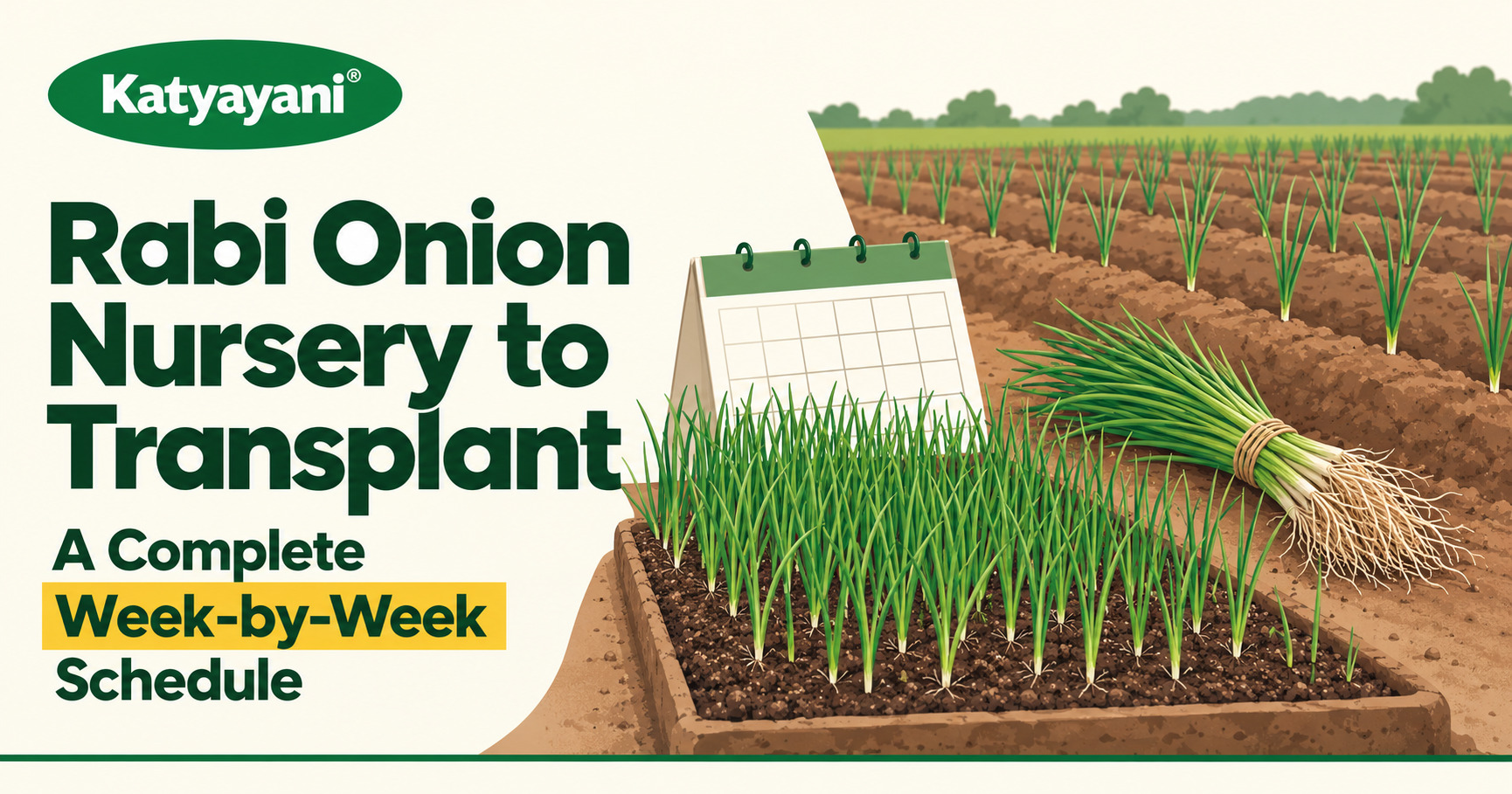
Quick answer: Sow a rabi onion nursery from October to mid-November on raised beds 15 cm high and 1.2 m wide. About 5 to 7 kg of treated seed on 0.05 hectare of nursery raises seedlings for one hectare. Transplant 50 to 55 day old seedlings from December to the first week of January at 15 x 10 cm spacing.
Key Takeaways
- Rabi onion gives the storable crop of the year, and a healthy nursery decides most of its final yield.
- Use 5 to 7 kg seed with more than 70% germination per hectare (about 2 to 3 kg per acre) on 0.05 hectare of nursery (about 200 square metres per acre).
- Treat seed with a fungicide at 2 to 3 g per kg or with Trichoderma, and keep beds well drained to prevent damping-off.
- Transplant at 50 to 55 days after sowing, when seedlings are pencil-thick and 15 to 20 cm tall.
- Pick a rabi storage variety such as Bhima Kiran, Bhima Shakti, Bhima Light Red, NHRDF Red-2 or Agrifound Light Red for your region.
When to sow a rabi onion nursery
The rabi onion nursery is sown from October to mid-November, and seedlings are transplanted from December to the first week of January. This timing is given in the MANAGE and ICAR-DOGR good agricultural practices guide for onion and garlic.
Rabi onion is harvested in March to May and is the crop that goes into storage for sale from June to October. Late sowing pushes bulb development into the hot weeks of April and May, which gives smaller bulbs and more bolting. Early sowing in warm October weather can raise damping-off and thrips pressure in the nursery.
| Region | Typical nursery sowing | Typical transplanting |
|---|---|---|
| Maharashtra, Karnataka, Gujarat, MP (central and western India) | October to early November | Early December to early January |
| Punjab, Haryana, UP, Rajasthan (north India) | Mid-October to mid-November | Mid-December to mid-January |
Adjust within these windows based on your local package of practices and the variety's maturity.
How much seed and nursery area do you need?
About 5 to 7 kg of onion seed with more than 70% germination raises enough seedlings for one hectare. The nursery area needed is about 0.05 hectare (500 square metres) for each hectare of main field.
| Main field area | Seed needed | Nursery area | Approx. beds of 1.2 m x 5 m (bed area only) |
|---|---|---|---|
| 1 hectare | 5 to 7 kg | 500 square metres | About 80 beds |
| 1 acre | 2 to 3 kg | About 200 square metres | About 33 beds |
| Half acre | 1 to 1.5 kg | About 100 square metres | About 16 to 17 beds |
Onion seed loses viability quickly, so buy fresh seed of the current season from a reliable source and check the germination percentage on the packet. Old or poorly stored seed is the most common reason for thin, patchy nurseries.
How to prepare onion nursery beds
Onion nursery should be on raised beds about 15 cm high and 1.2 m wide, with length as convenient, usually 3 to 5 m. Raised beds drain quickly, which is the single most effective step against damping-off.
- Choose a well-drained, sunny, weed-free plot near a water source. Avoid a spot where onion or garlic was grown last season.
- Plough or dig to a fine tilth and remove stones and stubble.
- Mix well-rotted FYM or compost into the soil, about 500 kg for 500 square metres of nursery.
- Mix a Trichoderma viride bio-fungicide into the FYM a week before bed making and apply it to the beds to suppress soil-borne damping-off fungi.
- Apply NPK at 2 kg N, 1 kg P and 1 kg K per 500 square metres before sowing, as recommended in the DOGR practices guide.
- Make raised beds 15 cm high and 1.2 m wide, with 30 to 45 cm paths between beds for walking and drainage.
- Level the bed surface and give a light irrigation a day before sowing.
How to treat and sow onion seed in the nursery
Treat seed with thiram, captan or carbendazim at 2 to 3 g per kg of seed before sowing, or use a Trichoderma seed treatment as per label. Seed treatment protects seedlings in the first two weeks, when damping-off does the most damage.
- Mix the seed with the fungicide or Trichoderma in a closed container or bag and shake for a few minutes so each seed is coated.
- Draw shallow lines across the bed about 5 to 7.5 cm apart and about 1 to 1.5 cm deep.
- Sow the seed thinly in the lines. Thick sowing gives weak, thin seedlings that bend at transplanting.
- Cover the seed with a thin layer of fine soil mixed with compost.
- Cover the bed with a thin layer of dry grass or straw mulch to hold moisture until germination, and remove it as soon as seedlings emerge.
- Water gently with a rose can or sprinkler. Do not flood the beds.
For nursery weed control, the DOGR practices guide recommends pendimethalin as a pre-emergence herbicide at 2 ml per litre of water, applied right after sowing. Follow the product label and local agriculture officer advice.
Nursery care from sowing to transplanting: week-by-week schedule
The schedule below assumes transplanting at 50 to 55 days after sowing (DAS), which is the recommended seedling age for rabi onion.
| Days after sowing | Stage | What to do |
|---|---|---|
| 0 to 7 | Germination | Keep top soil moist with light watering; remove mulch as seedlings appear |
| 8 to 20 | Loop and first leaf | Light irrigation every 2 to 3 days depending on soil; watch for damping-off (collapsing seedlings at soil level) |
| 20 | Early growth | Top-dress 1 kg nitrogen per 500 square metres as per DOGR; hand weed if needed |
| 21 to 35 | 2 to 3 leaf stage | Check for thrips (silvery streaks) and damping-off; a light foliar feed with water-soluble NPK can be given if seedlings look pale |
| 36 to 45 | Seedling thickening | Keep weeds out; avoid excess nitrogen, which makes seedlings soft |
| 45 to 50 | Hardening | Reduce watering gradually so seedlings toughen |
| 50 to 55 | Ready to transplant | Irrigate a day before uprooting so roots come out without breaking |
If seedlings are pale during the 21 to 35 day stage, a light spray of NPK 19-19-19 water-soluble fertiliser at the label dose helps them catch up. Do not overdo it close to transplanting.
How to control damping-off and pests in onion nursery
Damping-off is the main nursery disease. Seedlings rot at the soil line and fall over in patches, usually in wet, poorly drained beds or when sowing is too thick.
- Prevent with raised beds, thin sowing, seed treatment and Trichoderma in FYM.
- If patches appear, reduce watering, remove collapsed seedlings, and drench the affected area with a recommended fungicide such as carbendazim 12% + mancozeb 63% WP at the label dose. Follow the product label and local agriculture officer advice.
- Thrips can attack nurseries in dry spells. Blue or yellow sticky traps help with monitoring, and neem-based sprays can be used early.
- Cutworms may cut seedlings at night near bed edges. Hand pick in the evening and keep bed edges clean.
How to transplant onion seedlings in the main field
Transplant 50 to 55 day old seedlings at 15 cm between rows and 10 cm between plants. On heavy or flood-irrigated soils, broad bed furrows (BBF) of 15 cm height, 120 cm top width and 45 cm furrows help drainage and bulb shape.
- Prepare the main field with FYM and the basal fertiliser. DOGR recommends 110:40:60:30 kg NPKS per hectare for rabi onion, with one third of N and full P, K and S at planting.
- Irrigate the nursery a day before and uproot seedlings gently in the morning or evening.
- Reject thin, very short, diseased or double seedlings. Good seedlings are about pencil-thick and 15 to 20 cm tall.
- Dip roots in a Trichoderma or recommended fungicide solution for a few minutes before planting to protect against root rot.
- Plant at 15 x 10 cm, about 2 to 3 cm deep. Do not bury the neck.
- Give a light irrigation immediately after transplanting and another 2 to 3 days later.
- Apply the remaining two thirds of nitrogen in two equal splits at 30 and 45 days after transplanting.
Farmers who want a ready combination of soil nutrition products for the main field can use an onion soil nutrition kit alongside their soil test report.
Which onion varieties suit rabi season?
Choose a variety bred for rabi with good storage life, since most rabi onion is stored for months. The National Horticulture Board list of recommended onion varieties and the DOGR practices guide include the following.
| Variety | Developed by | Key traits (as reported) |
|---|---|---|
| Bhima Kiran | ICAR-DOGR | Light red, oval to round bulbs, very few bolters, 5 to 6 months storage |
| Bhima Shakti | ICAR-DOGR | Red, round bulbs, very few bolters, thrips tolerant |
| Bhima Light Red | ICAR-DOGR | Light red bulbs, matures in about 115 days after transplanting |
| Bhima Shweta | ICAR-DOGR | White bulbs, thrips tolerant, about 3 months storage |
| NHRDF Red-2 | NHRDF | Red bulbs, matures in 100 to 120 days |
| Agrifound Light Red | NHRDF | Light red, globular bulbs, good keeping quality |
| Pusa Red, Pusa Madhavi | ICAR-IARI | Good storage, suited to north India |
| Arka Niketan | ICAR-IIHR | Globular bulbs, good storage |
Do not use kharif or late kharif varieties for rabi planting, and do not save seed from your own bulbs unless you know the variety was pure. Mixed or wrong-season seed is a common cause of bolting (flower stalks) and doubles, both of which reduce market value and storage life.
Yields reported for these varieties differ between sources and seasons, so treat any yield figure as a potential under good management. Local KVK trials are the most reliable guide for your area.
What to do next
Fix your transplanting date first, then count back 50 to 55 days to get the nursery sowing date. Buy fresh seed, Trichoderma and a seed-treatment fungicide before sowing, and prepare raised beds a week in advance.
Keep a simple record of sowing date, treatments and transplanting date for each batch. Dealers and FPOs supplying onion growers for the rabi season can contact Katyayani Organics for bulk bio-inputs and crop nutrition products.
Why trust this guide
Written by Team Katyayani, Editorial Team at Katyayani Organics. Cross-checked against published research and university extension programs.

Leave a Comment