
 11 min read
Short answer
The bank does not lend to you. It lends to your group, and your group lends to you. No land papers are needed, because the group's savings record and repayment discipline are the security. A women's SHG can borrow up to Rs 20 lakh without collateral, and up to Rs 10 lakh with no collateral and no margin at all. Under DAY-NRLM the group pays 7 per cent a year on loans up to Rs 3 lakh. What one member gets out of that depends on the group's decision and the group's savings, not on a fixed per-person limit.
How much one woman actually gets
This is the question nobody answers, so start with it.
The bank sanctions a limit to the group. The group sits in its weekly or monthly meeting, looks at the Micro Credit Plan each member has written, and decides how much each woman takes and on what terms. There is no rule that says every member gets an equal share.
What sets the size of the group's limit is the group's own corpus, which means the members' savings plus the interest earned on internal lending. Under DAY-NRLM the drawing power on a cash credit limit works like this.
So a twelve member group with Rs 40,000 saved is looking at Rs 1.5 lakh in the first year, not Rs 20 lakh. Split twelve ways that is roughly Rs 12,000 each, though in practice groups give larger amounts to two or three members with a real plan and smaller amounts to the rest.
By the third year, with regular savings and clean repayment, the same group can be drawing Rs 6 lakh or more. This is why the boring part, saving every week and repaying on time, is what actually raises the money you can get.
The interest you will pay
Under DAY-NRLM the rate charged to a women's SHG is 7 per cent a year on loans up to Rs 3 lakh. For loans between Rs 3 lakh and Rs 5 lakh the rate is the bank's one year MCLR or other benchmark rate, or 10 per cent, whichever is lower.
The subvention that makes this possible goes to the bank, not to the group. So 7 per cent is what the group pays, and there is no further reduction that lands in your hand.
You will see many pages advertising a 4 per cent SHG loan. That figure came from an older arrangement giving an extra 3 per cent on prompt repayment in 250 identified districts. That structure is not in the current RBI master circular, which sets uniform rates without district categories. Plan on 7 per cent.
One caution before you assume the subvention applies. The current circular lists public sector banks, private sector banks and small finance banks. Regional rural banks and cooperative banks are not on that list. If your group banks with an RRB, ask specifically what rate you will be charged.
No land in your name is not a problem
Roughly speaking, this is the reason SHG credit matters so much for women in farming.
A Kisan Credit Card and most crop loans work off land records. A woman who farms her family's land, or leases land, or works as a sharecropper, usually has no document with her own name on it. Banks decline, and the woman is described as not being a farmer at all.
An SHG loan does not ask for land. The group's discipline is the security. That is why for a very large number of women in agriculture, the SHG is not the second best route to credit, it is the only route.
The government's own programme recognises this. Mahila Kisan Sashaktikaran Pariyojana, which runs under DAY-NRLM, works with women as farmers in their own right. As of June 2025, 4.62 crore women farmers had adopted agro-ecological practices under it, and 2.09 crore had been trained in livestock management. A network of more than 3.5 lakh community resource persons, known as Krishi Sakhis, Pashu Sakhis, Van Sakhis and Matshya Sakhis, supports this work at village level.
Money that comes before the bank loan
New groups often do not know that two funds arrive before any bank credit.
Revolving Fund is Rs 20,000 to Rs 30,000 per SHG. A group qualifies after three to six months of existence, following the Panchasutras, and only if it has not received it before. Older pages still show Rs 10,000 to Rs 15,000, which is out of date.
Community Investment Fund is up to Rs 2.5 lakh per SHG, given through the Cluster Level Federation rather than directly to the group.
Every woman member with a Jan Dhan account is also eligible for an overdraft of Rs 5,000, and one woman per SHG can take a Mudra loan of up to Rs 1 lakh.
The total capitalisation support released under DAY-NRLM stood at Rs 62,340 crore cumulatively, with Rs 12,670 crore released during 2025.
What you can spend it on
The rules are broader than most women assume. The circular allows the loan to be used for social needs, swapping high cost debt, house construction or repair, building a toilet, taking up sustainable livelihoods, or financing a common activity started by the group.
Farm use is squarely inside that. Seed, fertiliser, crop protection inputs, a pump set, a sprayer, buying a cow or goats, leasing land, or paying for labour at sowing and harvest all count as sustainable livelihood spending.
There is one condition that grows with the loan size. Above Rs 1 lakh, at least half the loan must go to income-generating purposes. Above Rs 4 lakh it is three quarters, and above Rs 6 lakh it is 85 per cent. So a large loan cannot be taken mostly for consumption.
Groups that buy inputs together often get better prices than members buying individually at the retail counter, because the order is large enough to buy directly. If your group plans to pool its input purchase for the coming season, ask a manufacturer for bulk supply terms before you finalise how much working capital you need.
Things banks do not put on the poster
Some banks now check individual credit records for SHG lending. One public sector bank's own SHG page states a minimum credit score requirement and a condition of no serious overdue in any credit line in the past twelve months. If a member has a defaulted loan somewhere else, it can affect the group. Ask your branch whether they run this check, before the file is submitted.
Joint liability is real. If one member does not repay, the group's next loan stops. The other members either cover the shortfall or the group stalls. Groups that survive are the ones that discuss this openly in the first month, not the ones that discover it in year two.
Bank ceilings differ from the RBI ceiling. RBI's position is collateral-free up to Rs 20 lakh. Individual banks set their own maximum, and some cap SHG lending well below that. The number your branch works with is the number that matters.
The sequence, from zero to a bank loan
Form the group with 10 to 20 women. In difficult areas, remote tribal areas, or groups of women with disabilities, the minimum can be five.
Meet every week and save a fixed amount, however small. Keep a written register.
Start internal lending from the group's own savings. This is what shows the bank you can manage credit.
Open the group's savings account with the bank within about two months of formation.
Follow the Panchasutras: regular meetings, regular savings, internal lending on demand, timely repayment, and proper books.
After six months of active existence, the group is graded on those parameters.
Once graded, apply for credit linkage. The first bank loan follows.
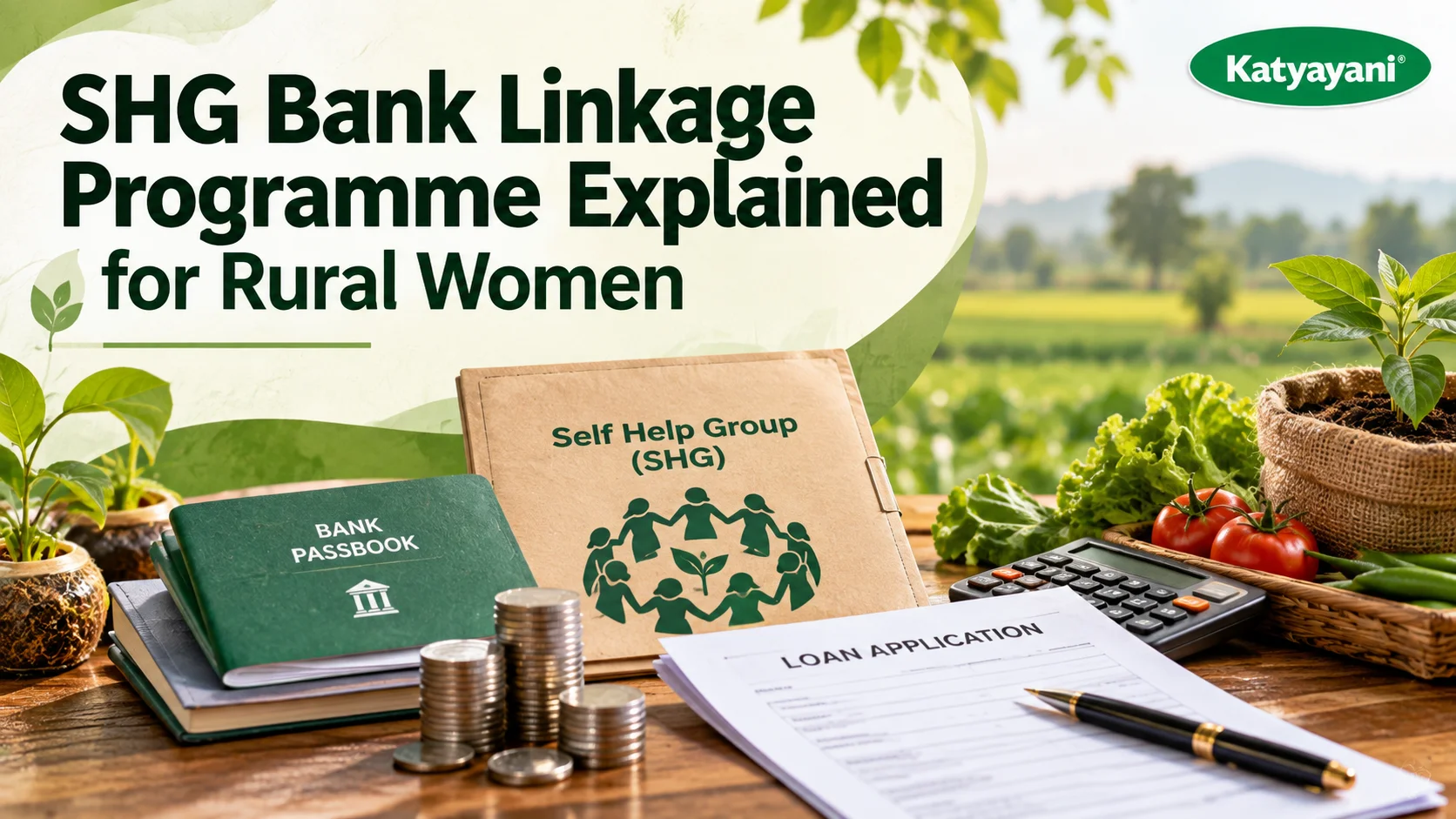
The full process, including what to do when a branch will not open the account, is in SHG bank linkage programme explained.
If you are choosing between routes
For crop inputs on land in your own name, a Kisan Credit Card is usually cheaper and purpose-built.
For a woman without land documents, SHG credit is the workable route.
For a tenant farmer or sharecropper, a Joint Liability Group is designed exactly for that situation and is worth asking NABARD or your bank about.
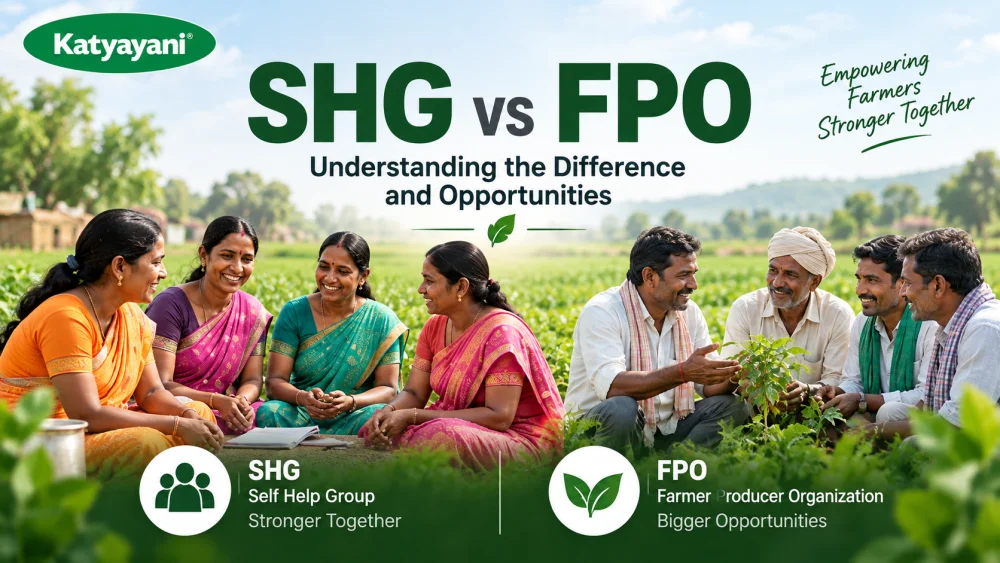
The comparison of group routes for farm business, including when a group should move on to an FPO, is set out in SHG vs FPO: which is better for farmers.
Frequently asked questions
How much loan can one woman get from an SHG?
There is no fixed per-member limit. The bank lends to the group and the group decides each member's share in its meeting, based on the Micro Credit Plan. The group's limit is driven by its savings: six times the corpus or Rs 1.5 lakh in the first year, eight times or Rs 3 lakh in the second, and a minimum of Rs 6 lakh from the third year.
Can an SHG loan be used for farming?
Yes. Seed, fertiliser, crop protection, a pump set, livestock, land lease and labour costs all count as sustainable livelihood use. Above Rs 1 lakh at least half the loan must go to income-generating purposes, rising to 75 per cent above Rs 4 lakh and 85 per cent above Rs 6 lakh.
What is the interest rate on an SHG loan for women?
7 per cent a year on loans up to Rs 3 lakh under DAY-NRLM. Between Rs 3 lakh and Rs 5 lakh it is the bank's one year MCLR or 10 per cent, whichever is lower.
How do I get a 4 per cent interest rate?
The 4 per cent rate came from an older arrangement that gave an extra 3 per cent on prompt repayment in 250 identified districts. That structure is not in the current RBI master circular. Plan on 7 per cent up to Rs 3 lakh.
Can a woman without land in her name get an agriculture loan?
Through an SHG, yes. SHG lending does not ask for land records, which is why it works for women who farm family land, leased land or as sharecroppers. A Joint Liability Group is another route built for tenant farmers.
Is a CIBIL score checked for an SHG loan?
Some banks now check it. At least one public sector bank publishes a minimum score requirement and a condition on recent overdues for SHG lending. Ask your branch whether they run this check before you submit.
What happens if one member does not repay?
The group carries it. The next loan stops until the account is regular, and the other members usually have to cover the shortfall. Discuss this in the group's first month, not after it happens.
How much can an SHG borrow without collateral?
RBI's position is up to Rs 20 lakh with no collateral. Up to Rs 10 lakh there is also no margin and no lien on the group's savings account. Between Rs 10 lakh and Rs 20 lakh the bank may take a margin of up to 10 per cent of the amount above Rs 10 lakh. Individual banks may set lower ceilings.
How many women are needed to form an SHG?
Ten to twenty. In difficult areas, remote tribal areas, and groups of women with disabilities the minimum can be five.
What is the difference between the Revolving Fund and the Community Investment Fund?
Revolving Fund is Rs 20,000 to Rs 30,000 given to the SHG itself after three to six months of good functioning. Community Investment Fund is up to Rs 2.5 lakh routed through the Cluster Level Federation rather than paid to the group directly.
Can an SHG loan buy a cow or buffalo?
Yes. Livestock purchase is a standard income-generating use, and dairy and goat rearing are among the most common activities financed through SHG credit.
Can I take an SHG loan and a Kisan Credit Card at the same time?
The two are different facilities from the bank's point of view, and holding both is not barred. Your repayment capacity across both is what the bank will look at. Ask your branch before assuming.
Sources used
RBI Master Circular on Deendayal Antyodaya Yojana - National Rural Livelihoods Mission, 1 April 2025 — https://rbi.org.in/Scripts/BS_ViewMasCirculardetails.aspx?id=12806
RBI Master Circular on SHG-Bank Linkage Programme, 1 April 2025 — https://www.rbi.org.in/Scripts/BS_ViewMasCirculardetails.aspx?id=12805
Ministry of Rural Development, Lakhpati Didi portal, financial assistance — https://lakhpatididi.gov.in/financial-assistance/
PIB, women farmers and Mahila Kisan Sashaktikaran Pariyojana coverage, 23 March 2026 — https://static.pib.gov.in/WriteReadData/specificdocs/documents/2026/mar/doc2026323831801.pdf
PIB, Department of Rural Development year ender, 1 January 2026 — https://www.pib.gov.in/PressReleasePage.aspx?PRID=2210378®=3&lang=1
Recommended external anchor links inside the article: "current RBI master circular" to the DAY-NRLM master circular, and "Lakhpati Didi portal" to the MoRD page. Nothing else is needed.
| Year | Drawing power |
|---|---|
| First year | Six times the existing corpus, or Rs 1.5 lakh, whichever is higher |
| Second year | Eight times the corpus, or Rs 3 lakh, whichever is higher |
| Third year onward | Minimum Rs 6 lakh, based on the Micro Credit Plan |
Leave a Comment