 8 min read
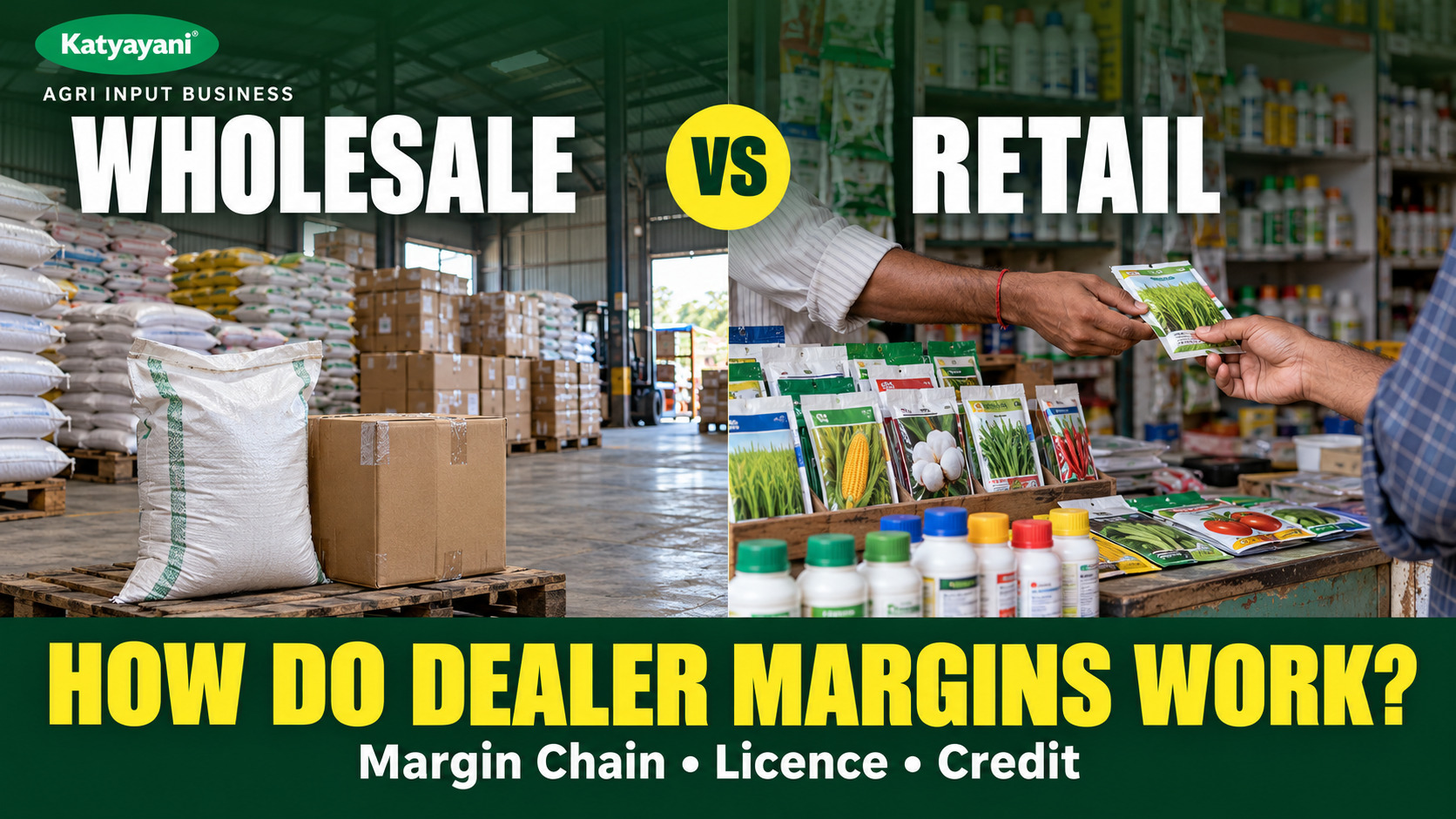
What is the difference between wholesale and
retail in agri inputs?
The law gives clear definitions. The Fertiliser (Control)
Order says a retail dealer is one who sells fertilisers to farmers or
plantations for agricultural use, and a wholesale dealer is one who sells
otherwise than in retail (FCO 1985 ↗). Nobody
may sell fertiliser as a wholesale or retail dealer without the authorisation
under clause 8. A separate application is needed for wholesale and for retail,
and separate books of accounts are kept for each.
|
Point |
Wholesaler / distributor |
Retailer |
|
Buys from |
Company or C&F agent |
Wholesaler or distributor |
|
Sells to |
Retail shops, large farms,
FPOs, institutions |
Farmers |
|
FCO definition |
"A dealer who sells
fertilisers otherwise than in retail" (clause 2(w)) |
"A dealer who sells
fertilisers to farmers or plantations for agricultural use" (clause
2(t)) |
|
Fertiliser filing |
Separate Memorandum of
Intimation (Form A1), certificate of source (Form O), acknowledgement in Form
A2 |
Separate Memorandum of
Intimation, same forms |
|
Validity |
3 years (clause 10) |
3 years (clause 10) |
|
Typical order |
Truck or pallet lots |
A few bags to a few cartons |
|
Margin per unit |
Smaller |
Larger |
|
Main risk |
Retailer credit and large
stock holding |
Farmer credit, expiry and
banned products |
Two details help beginners. The FCO text I read has no educational qualification for fertiliser dealers, and the only godown rule is that the godown location is declared and changes are reported. State rules may add conditions. One more point: a vermicompost maker with annual capacity under 50 tonnes (who is not a State Government or municipality) needs no authorisation letter under the FCO.
How does the margin chain work from company to
farmer?
The product moves in steps. At each step the seller adds a
small margin, so the farmer pays the MRP printed on the pack. The company sets
the MRP. The usual path is:
1.
Company
or manufacturer sells to its distributor or stockist.
2.
Distributor
/ stockist holds stock for a district or zone and sells to wholesalers or
large retailers.
3.
Wholesaler
breaks bulk and supplies retail shops and big farms.
4.
Retailer
sells to the farmer, often on credit till harvest.
Dhanuka's annual report gives a real example of the scale.
It says the company serves around 6,500 distributors and around 80,000
retailers, reaching more than 10 million farmers. In FY25 it sold to 6,334
dealers and distributors, who bought 87.91% of its total sales. The top ten
dealers made up only 2.99% of dealer sales, so the trade is spread across
thousands of small buyers (Dhanuka annual report FY2024-25
↗). Rallis has reported about 7,000 dealers and over 1,00,000 retailers
in a press release (a snippet I could not open in full). For agri-input franchise models, the company
handles part of this chain for you. For own-brand products made by a contract manufacturer,
you sit at the top of the chain and take the brand margin and the risk.
What is the dealer margin on fertiliser?
Fertiliser margins are the one part of this trade with an
official source. The figures below come from answers given in Parliament. I
could not open the PDFs myself, so please check them before you quote them in a
client note.
|
Fertiliser |
Dealer margin |
Source |
|
Urea |
Rs 354 per tonne from 1
April 2018, paid on point-of-sale transactions. Retailer gets Rs 50 per tonne
for acknowledging receipt in the m-FMS system. |
|
|
DAP and MOP |
Capped at 2% of MRP |
|
|
Other P&K (NBS) grades |
Capped at 4% of MRP |
Same Lok Sabha answer |
In simple terms, Rs 354 per tonne works out to about Rs 16 on a 45 kg bag of urea. That is before transport, labour and shop costs. Dealer bodies want more. The All India Agro Input Dealer Association asked for a margin of at least 6 to 8% on fertilisers, and a February 2024 report says the minister agreed to fix a minimum of 5% (news report ↗). That is a news report, not a notification, so check whether a new margin has been notified before you plan around it.
What is the margin on pesticides and
bio-inputs?
Here the honest answer is that there is no official figure.
Pesticide and bio-input margins are set by each company through dealer schemes,
volume slabs and season offers. I searched Competition Commission, NABARD,
industry bodies and university sources and found no reliable margin percentage
for any level of the pesticide chain. Studies that exist report rupee margins
on single products in one district, not percentages, so they are not a guide to
your shop.
What you can do is ask the company for its dealer scheme in
writing. Compare three things: the dealer price against MRP, the year-end
volume bonus, and the return policy for unsold or expired stock. The product
with the highest headline margin is not always the best if returns are refused.
|
REAL-WORLD CHECK
A study of agri-input dealers in
Chikkaballapur, Karnataka found average turnover of about Rs 2.4 crore and
net returns of about Rs 12.7 lakh per dealer. That is roughly 5% of turnover
(my calculation: 12.7 lakh divided by 2.4 crore). The top problems dealers
named were farmers not repaying credit, very low margin and competition. See
the UAS Bengaluru study ↗. It is one district and an older study, so use it as a sense of
scale. |
How long does a dealer wait for payment?
Receivable days show how long money is stuck. No company
publishes the credit period it gives its own channel, but ratios help.
Dhanuka's FY25 trade receivables turnover was 5.05 times, which implies about
72 days of receivables (365 divided by 5.05, my calculation). Its FY24 ratio of
5.13 implies about 71 days. The company also states that the credit period it
gives customers is short enough to carry no financing component. An investor
website shows 82 days for March 2025 on a different formula, and a peer table
shows other crop-protection companies at roughly 54 to 139 days, but those are
third-party figures. For a dealer, the lesson is simple: the company waits
about two months or more for its money, the farmer often waits for harvest, and
the dealer sits in between.
Which licences does a wholesaler need compared
with a retailer?
Both need licences from the state agriculture department.
Fertiliser sale falls under the Fertiliser (Control) Order 1985. Pesticide sale
falls under the Insecticides Act 1968 and the Insecticides Rules 1971 (rules text ↗). Seed sale
needs a seed licence. Licences are applied for separately for each place of
sale or storage.
·
Fertiliser: Memorandum of Intimation in Form A1
with the fee and a certificate of source; the acknowledgement in Form A2 acts
as the authorisation letter. Valid three years. The India.gov.in wholesale fertiliser licence service page
↗ shows the entry point.
·
Pesticide: licence valid two calendar years
under the rules text I could open. The licensing officer must be satisfied that
premises are adequate with proper storage. The person in charge must hold a
qualifying agriculture or science degree, or you must employ one.
Household-insecticide-only sellers are exempt from the education rule.
·
Forms, fees and godown rules differ by state.
Our state-wise dealer licence guide covers the
first licence, and the licence renewal guide covers what to do before
it expires.
What GST do you charge?
Summary pages (not CBIC text) show 5% GST on chemical
fertilisers, 18% on chemical pesticides, and 5% on 12 notified bio-pesticides
from 22 September 2025, down from 12% (GST summary ↗). Organic
manure is nil when unbranded and 5% when branded or in unit containers,
according to one summary, while another wording differs. Rates change, so
confirm on the GST portal or with your CA before pricing.
How much capital does each level need?
Retail needs shop rent, a licence, and enough stock to look
complete. Wholesale needs a godown, more stock and the cash to carry credit to
retailers. One published blog puts retail working capital at Rs 3 to 5 lakh and
wholesale at Rs 15 to 25 lakh. These are blog estimates, not official numbers,
so treat them as a starting point. Credit is a bigger problem than margin. Keep
these habits: written credit limits, a dated ledger, and a firm cut-off for
stock given before the rabi harvest. See our agri-input shop business plan for a worked
cost sheet.
Which is better to start: wholesale or retail?
|
If you have |
Start with |
|
Limited capital and a
qualified licence holder |
Retail shop |
|
Godown space, cash and a
retailer network |
Wholesale or
sub-distribution |
|
A village base and low
capital |
Sub-dealer under a licensed
dealer, if your state allows it |
A middle path is to start as a retailer and later supply two or three nearby shops, once you have the licence, the records and the cash cycle under control.
How do FPOs and large farmers buy in bulk?
An FPO can pool orders and buy in larger lots from a
wholesaler or directly from a company. I found no verified discount percentage
for FPOs, so do not promise one. Ask for a GST invoice, batch numbers and the
supplier licence number every time. Our bulk buying guide for FPOs covers minimum
order size, pricing and quality checks. For drip users, see the water-soluble fertiliser bulk guide. Dealers:
FPOs are also a customer group, so keep a bulk price list ready. The rabi stock list for dealers shows what to
hold.
What should a dealer stock beyond fertiliser?
Because fertiliser margin is capped and small, many dealers
add products where the farmer needs advice: micronutrients, bio-inputs and
crop-specific kits. These also build repeat trade. Browse the bio-fertilizer range and the NPK 19 19 19 water-soluble fertilizer to see
the pack styles retail shops stock. Check the dealer scheme, return terms and
shelf life before you place a large order.
Conclusion
Wholesale and retail are two different games. Retail gives a
better margin per bag but carries farmer credit. Wholesale carries more cash
and stock for a thinner margin. For fertiliser the margin is capped by
government, so the real profit lies in volume, low cost and strict credit
control. For pesticides, get the company dealer scheme in writing and watch the
receivable days. Hold the right licence for your level, keep separate accounts
for wholesale and retail, and start small.
Why trust this guide
Written by Team Katyayani, Editorial Team at Katyayani Organics. Cross-checked against published research and university extension programs.

Leave a Comment