
 17 min read
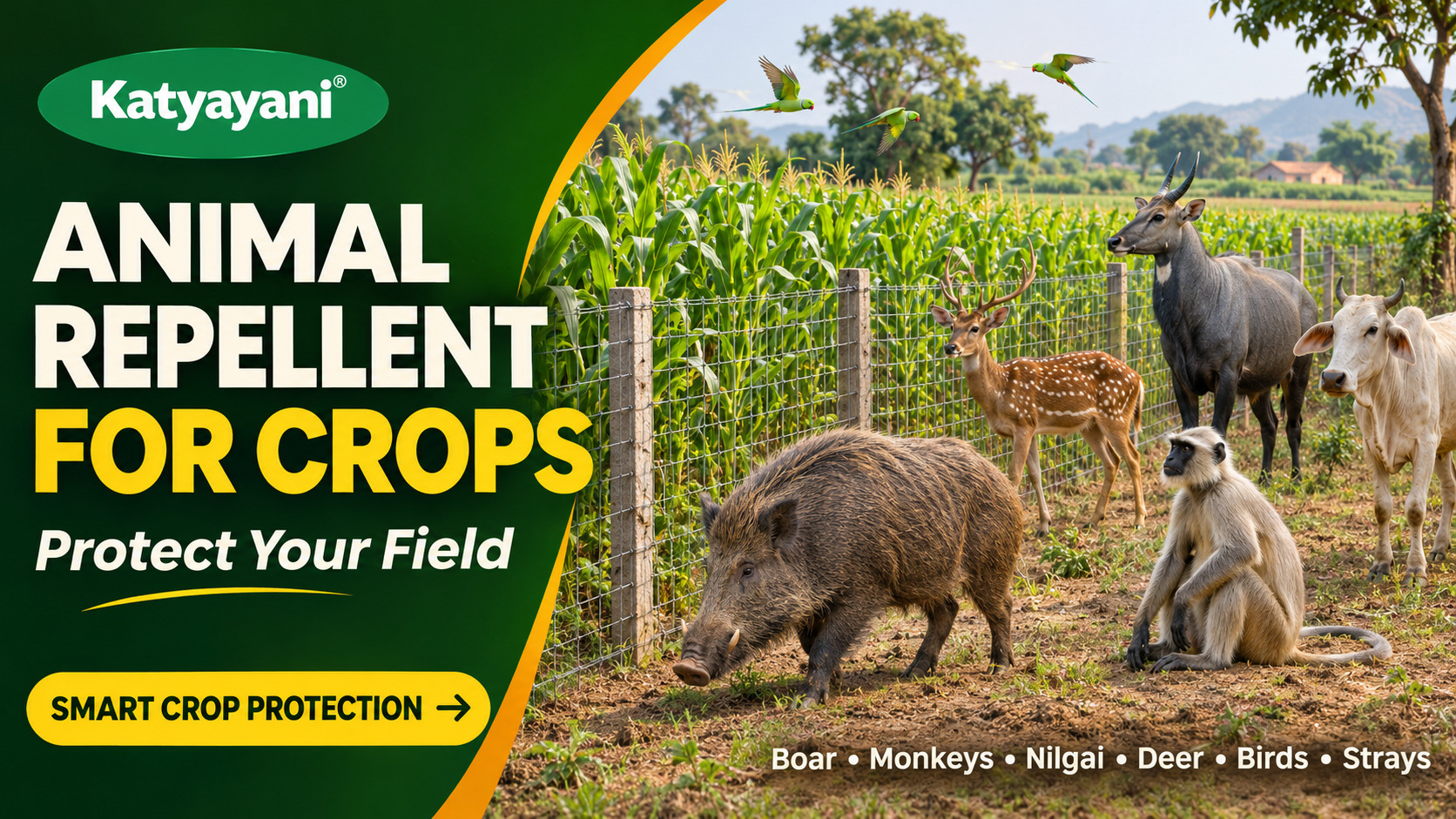
No single repellent protects a field. ICAR network projects get results by stacking layers: a border net or fence, a smell or border-crop barrier for boar, reflective ribbons or sound for birds, and a noise or solar fence for monkeys. ICAR-AINPVPM reports wild pig damage of 15 to 32 percent and a net border with a 1:4.3 cost-benefit ratio. Many of these animals are protected by law, so use deterrents, never poison, snares or blades, and report losses under the PMFBY wild animal add-on where your state has notified it.
What is the most effective animal repellent for crops?
No one repellent is the most effective. ICAR network projects get their results by stacking layers: a physical barrier, a smell or border crop, a scare device and guarding at the weak crop stage. A repellent alone slows animals down. It works best as one layer next to a net, fence or border crop.
That is the honest answer from the research. The ICAR-AINPVPM, which is the All India Network Project on Vertebrate Pest Management, says wild herbivores such as blue bulls, wild boars and monkeys have moved into farmland because fields now reach into forest fringes and natural food is short. See the AINPVPM coordinator note. The same project has built low-cost methods for wild pig, peafowl, monkeys and birds.
This guide goes animal by animal. For each one you get what ICAR or a state agricultural university tested, what it costs where a cost is printed, and what the law lets you do. Smell and taste repellents are covered too, with a plain statement of how much proof there is.
Which wild animals damage crops in India, and how much?
Wild boar, nilgai, monkeys, peafowl and rodents cause the most loss. ICAR-AINPVPM puts wild pig damage at 15 to 32 percent and peafowl damage at 5 to 18 percent. A 2025 ICAR review gives wild boar 25 to 35 percent, nilgai 10 to 30 percent and macaques 10 to 30 percent in orchards and vegetables.
| Animal | Crop damage reported | Crops hit most | Source |
|---|---|---|---|
| Wild pig / wild boar | 15 to 32 percent (AINPVPM); 25 to 35 percent in affected areas (2025 review) | Maize, groundnut, paddy, vegetables, tubers | AINPVPM sheet; Chellappan et al. 2025 |
| Nilgai (blue bull) | 10 to 30 percent in affected areas | Wheat, sugarcane, maize, pulses | Chellappan et al. 2025 |
| Rhesus macaque and other monkeys | 10 to 30 percent in orchards and vegetable fields | Fruits, vegetables, cereals, cotton, rice | Chellappan et al. 2025; Aruna Sri et al. 2026 |
| Indian peafowl | 5 to 18 percent (AINPVPM) | Cereals, pulses, oilseeds, vegetables, from sowing to harvest | AINPVPM sheet |
| Depredatory birds (parakeets, crows and others) | Not given as one figure | Sunflower, maize, sorghum, bajra | Rao 2015; AINPVPM desk note |
The numbers differ because they come from different surveys and regions. We show them side by side and do not average them. The 2025 review adds that wild pig damage reaches 5 to 36 percent in some states, quoting a 2022 Wildlife Institute of India report. The AINPVPM wild pig sheet makes one more point every farmer knows: a single raid can cause large damage.
The review also says small farmers carry most of this loss, because they have little irrigation and often no crop insurance. That is why the cheap layers in this guide come first.
Is it legal to scare, trap or kill animals that eat my crops?
You may scare them. You may not poison, trap, snare or injure them. The Wild Life (Protection) Act 1972 defines hunting to include killing, poisoning, trapping, snaring, injuring and, for wild birds, disturbing nests. Hunting Schedule I or II animals is banned except under sections 11 and 12, which need a written order.
This matters for repellents. A smell, a net, a reflective ribbon or a loud noise is a deterrent. A poison bait, a snare, a blade wire or a live mains wire can be hunting under the Act's own definition. Read the Act text on India Code for the exact words.
| Animal | Where the Act text we read lists it | What that means for you |
|---|---|---|
| Wild pig (Sus scrofa) | Schedule II | No hunting without a section 11 order. Use barriers and deterrents. |
| Nilgai (Boselaphus tragocamelus) | Schedule II | Same as wild pig. |
| Chital / spotted deer | Schedule II | Same as wild pig. |
| Rose-ringed parakeet | Schedule II | Do not harm birds or disturb nests. Use scarers and nets. |
| Blackbuck | Schedule I | Strictest protection. Use fences and report damage. |
| Indian peafowl | Schedule I | Strictest protection. Ribbons, ropes and nets only. |
| Rhesus macaque | We did not find it in the Schedule lists of the PDF we searched | MoEFCC issued a species guideline for it in 2023. Ask your range forest office for local status. |
The Act does give a way out for serious cases. Under section 11(1)(b), the Chief Wild Life Warden or an authorised officer can permit hunting of a Schedule II animal that has become dangerous to human life or to property, including standing crops. A 2025 PIB release repeats this. Section 62 lets the Central Government declare a Schedule II animal vermin for a named area and period. Both routes go through the state forest department, not through the farmer.
Livestock such as cows and bullocks are defined separately in the Act, and stray cattle are not in the Schedules. For the legal route on wild animals, write to the Range Forest Officer, with photographs and the date, before you attempt anything you are unsure about. We did not find the common rock pigeon in the Schedule text; if you are unsure about a bird, ask the forest office before acting.
How do you keep wild boar away from crops?
Start with a barrier. ICAR-AINPVPM recommends a nylon or HDPE net around the field border, 4 feet high, with a further 2 feet laid on the ground and covered with soil, or used sarees 3 feet high. Add a smell layer and guard the field at night during grain filling.
The wild pig fact sheet from AINPVPM gives the details. The ground part matters because boar push under a fence. Burying the trailing edge stops that.
| Method (AINPVPM sheet) | How it is fitted | Printed result |
|---|---|---|
| Nylon or HDPE net | 4 feet above ground, 2 feet trailed on the ground and covered with soil | Cost-benefit 1:4.3; life 5 years |
| Used sarees | 3 feet high, 3/4 feet trailed on the ground and covered with soil | Cost-benefit 1:3.7; life 2 years |
| Agri-solar pulse fence | Solar energiser with fence wires (see fencing section) | Yield gain 20 to 40 percent; covers up to 5 acres |
| Bio-acoustics | Plays predator sounds | Yield gain 10 to 20 percent; covers 3 to 4 acres |
For nets and sarees AINPVPM prints a yield gain of 15 to 35 percent. It also says the material can be reused and cuts the manpower needed for guarding. Sarees are a farmer idea: boar read them as a sign of people. Rao, in a 2015 review, says this works only in places with regular human movement and reports a damage drop of 30 to 55 percent.
Fix the net before the crop reaches milk or grain stage. Check it weekly for gaps at stream lines and gate corners, since animals test the weakest point.
What smells do wild boars hate, and do smell repellents work?
Boar find food by smell, so ICAR researchers use smell in two ways: to mask the crop or to suggest another boar territory. Egg solution, castor and safflower borders, and pig dung smoke are the tested ones. The reported results come from one ICAR network review, not from large independent trials.
| Smell method | How it is used (Rao 2015) | Reported effect on boar entry or damage |
|---|---|---|
| Egg solution spray | 20 ml per litre of water, on the border row or on wet soil around the crop | Entry reduced by 65 to 85 percent |
| Human hair | Spread on the boar paths, hair collected from barber shops | Damage controlled by 65 to 90 percent (farmer practice, as reported) |
| Dung solution of local pigs | Sprayed on soil in a 1 foot band around the crop | Entry reduced by up to 50 percent |
| Burning dried dung cakes of local pigs | Burnt slowly in earthen pots at dusk | Damage reduced by 35 to 50 percent |
| Strong-smelling border crops | 4 to 5 rows of castor or safflower, closely sown | See the border crop section |
Read the ranges as the author's reported figures. They are useful, and they are also wide. Rao 2015 explains the logic: boar identify the crop by its smell, and the strong odour masks it. The AINPVPM peafowl sheet lists the egg spray at 1 egg for 5 litres of water, a different strength. We print both because each is that source's own number; follow the ICAR or state university advice for your region.
Smell works best on the border. Repeat after rain, because rain washes the smell off. If you use a bought granule repellent, the same border placement logic applies; see the product section below.
Which border crops and fences work against wild boar?
Thick border rows of castor around maize and safflower around groundnut gave the biggest yield gains in the 2015 ICAR network trials, ahead of barbed wire and chain link. Thorny bio-fences of cactus, karanda or agave are also listed. The trials compared protected plots with unprotected plots.
| Barrier | Crop | Yield gain over unprotected plot, kharif | Yield gain, rabi |
|---|---|---|---|
| 4 to 5 rows of castor around the crop | Maize | 66.0 percent | 46.11 percent |
| 4 to 5 rows of safflower around the crop | Groundnut | 60.81 percent | 19.28 percent |
| Barbed wire fence, 3 rows, lowest at 1 foot | Maize | 14.33 percent | 31.14 percent |
| Chain link fence, 3 feet high, 1 foot from crop | Maize | 15.13 percent | 14.71 percent |
These come from Table 1 of Rao 2015. Control plots in those trials yielded far less (for example 786 kg per hectare of maize against 1,049 to 1,781 with barbed wire), which is why the gains look large. Do not expect the same percentage in your field.
The same review lists thorny plants on the bund, such as cactus, euphorbia, agave and ziziphus, and says they cut boar entry by 60 to 75 percent. A trench 2 feet wide, kept 1 foot from the crop, is reported to cut entry by 50 to 70 percent in dry land and also holds rain water. The review also describes a razor-blade circular fence. We do not recommend it: blades injure animals, and injuring is hunting under the Act.
Barbed wire fences and solar electric fences are among the barriers the Centre supports through its wildlife schemes, says PIB. Ask your forest or agriculture office whether your state pays any share.
How do you keep monkeys away from a farm?
Monkeys adapt fast, so use noise, a pulse fence and timed guarding rather than one scarecrow. ICAR-AINPVPM reports its Agri-canon scares monkeys 65 to 75 percent of the time. Guard during fruiting and grain filling, in the early morning and late afternoon, the peak activity hours in a Telangana study.
A 2026 study from the AINP VPM unit in Telangana watched monkeys in rice, cotton and guava fields. They fed most when the crop reached the stage with the richest food, such as milking and boll formation in rice and cotton and fruit development in guava. Cotton recorded the highest feeding, then rice, then guava. The team made its observations during the peak monkey activity hours, 6 am to 10 am and 4 pm to 6.30 pm. See Aruna Sri and colleagues.
| Method | What ICAR-AINPVPM prints | Cost printed on the sheet (undated) |
|---|---|---|
| Agri-canon (acetylene sound device) | Scares monkeys 65 to 75 percent, birds 70 to 90 percent; protects 4 to 5 acres with one person; weighs about 3 kg | One unit 3,540 rupees; cost-benefit 1:3.2 |
| Agri-solar pulse fence | Effective against wild boar, monkeys and antelopes; protects up to 5 acres | Device 15,800 rupees including GST; accessories 3,000 rupees per acre; total 18,800 rupees |
Both are on one ICAR sheet, Agri-canon and Agri-solar, from the AINPVPM centre at CAZRI Jodhpur. The cannon uses calcium carbide granules and a piezoelectric igniter to make acetylene gas and a loud sound, so treat it like any gas device and keep it away from children and from dry straw. The sheet says to use it at the vulnerable stage of the crop. It does not list the prices as current, so ask the supplier for today's price.
The Telangana note ends with the same advice: combine solar fencing, crop guarding, community effort and habitat steps at the critical crop stage. The 2025 review adds that government sterilisation drives for monkeys in Himachal Pradesh gave mixed results because coverage was low and the species adapts fast.
What are monkeys afraid of, and is there a proven monkey repellent?
We did not find an ICAR or state university trial that proves a smell or food repels monkeys. What the sources do show is that loud sound, a pulse fence and human presence reduce raids. Treat claims about monkey-hating smells or foods as unproven unless a university trial backs them.
People often ask what smells and foods monkeys hate. Many web pages list chilli, garlic, camphor or vinegar. None of the ICAR or university papers we opened tests those on monkeys, so we do not list them as repellents. The only formulation the 2025 review names is a chilli-garlic preparation from TNAU, listed among tools developed in the network, with no monkey data in the review.
Plan on the layers that have numbers: sound devices, a pulse fence, guarding at fruiting and a crop mix that is less attractive. Remove fallen fruit and open bins near the field, since easy food keeps troops coming back. For serious cases, the route is a written request to the forest department, as the legal section above explains.
How do you protect crops from nilgai and deer?
Fence them out. Smell is a weak barrier for large grazing animals, so a pulse fence or a strong barrier is the better layer. The Agri-solar fence is listed by ICAR-AINPVPM as effective against antelopes, and nilgai damage is put at 10 to 30 percent in affected areas.
Nilgai mainly hit wheat, sugarcane, maize, pulses and poplar in northern and central India, says the 2025 review. It also names nilgai, blackbuck, wild boar and peafowl as the main raiders in dry states such as Rajasthan and Gujarat.
The Government has issued advice for this. PIB, in 2017, notes that the Agriculture ministry, with MoEFCC, issued an advisory in March 2012 for the management of blue bulls. In 2023, MoEFCC issued species-specific guidelines that include Blue Bull and Blackbuck, among others, as the 2025 PIB release lists. Ask your state agriculture office for the current copy.
- Border fence first. A pulse fence on posts or a strong mesh barrier. Blackbuck and peafowl are Schedule I, so never use anything that harms.
- Guard the weak stages. AINPVPM says peafowl damage runs from sowing to harvest, and the Telangana study found monkeys feed most at fruiting and grain stages.
- Report the damage. Photographs, date, plot number and animal seen. You will need them for forest department or insurance claims.
- Do not chase large animals alone at night. Go in a group, keep a torch, and make sound from a distance.
How do you stop birds and peafowl from eating crops?
Use visual scarers at the right stage. Reflective ribbons hung 2 feet above the crop in a 6 by 6 feet grid cut peafowl and bird damage, and ICAR trials on sunflower, maize and sorghum show yield gains. Change positions often, because birds get used to a fixed scarer.
The AINPVPM peafowl sheet gives the layout: 2 inch wide reflective ribbons in a 6 by 6 feet grid, twisted, run north to south, 2 feet above the crop canopy. Coconut fibre ropes in the same grid work at critical stages. It prints a yield gain of 13 to 25 percent, with cost-benefit of 1:3.4 for ribbons and 1:2.7 for jute ropes. It lists nets of 1 inch mesh, a neem oil or salt solution at 10 percent and the egg spray as other options.
| Bird method (Rao 2015) | Crop in trial | Yield gain, kharif | Yield gain, rabi |
|---|---|---|---|
| Reflective ribbons | Sunflower | 12.15 percent | 23.85 percent |
| Reflective paper plates | Sunflower | 17.27 percent | 47.99 percent |
| Wrapping cobs in green leaves | Maize | 25.77 percent | 26.71 percent |
| Egg solution spray | Sunflower | 36.92 percent | 28.82 percent |
| Screen crop (thick sorghum or maize) | Sunflower | 19.2 percent | 13.58 percent |
| Bio-acoustics (distress calls) | Sunflower | 44.40 percent | 56.02 percent |
These figures are from Rao 2015. For maize, the review says parakeets mostly hit the outer rows, so wrapping about half the cobs on the outer 3 rows is enough. For sound, it describes a recorder with a 30 watt amplifier, two speakers and a 12 volt battery, run from about 100 metres away, and says to vary play times. Coconut rope at 1 foot height and 5 metre spacing at sowing is reported to cut peafowl entry by 85 percent.
Parakeets are in Schedule II and peafowl in Schedule I. Do not close or destroy nests, even though one older method in the review does; the Act counts disturbing the nests of wild birds as hunting. For pigeons around stores and roofs, the Katyayani pigeon repellent page describes a liquid you dilute and spray where birds sit, as the product section below explains.
Birds are also useful. Our pea farming guide and chickpea guide list bird perches among pest controls, since perching birds eat caterpillars. The AINPVPM desk note also says some birds help control insect pests and rodents.
What can you do about stray cattle in the field?
Stray cattle are not wild animals under the Act, so the legal limits above do not apply to them, but we did not find an ICAR or government source with tested numbers for them. Use a strong physical barrier, talk to the panchayat, and share guarding with neighbours.
A strong physical barrier on solid posts is the first thing to try, but we found no tested numbers for cattle, so treat this as common sense, not research. Check gates and drain gaps. A shared fence line with the next farmer can cost less per acre than each farmer fencing alone.
Do not use a live wire or a blade wire against cattle. Both can kill, and both bring legal and personal risk. If strays are many, raise it with the gram panchayat and local administration; the forest department deals with wild animals.
What does the Katyayani wild animal repellent page say, and where does it fit?
The page describes a non-toxic repellent granule scattered along the field border at 3 kg per acre, with re-application after 4 months. It says the granules work through smell and taste and release slowly. It lists no ingredients and no crops, and this guide found no ICAR trial that names it, so use it as one layer.
Here is what the Katyayani wild animal repellent page says, and nothing more. The granules are spread evenly along the border of the field or the infested place by hand or spreader. It says the granules work on the sense of smell and taste of the animals, so the treated border is an unpleasant place to cross. It names no particular animal, and it says to use the repellent together with fencing or guarding. Follow the label on the pack for use, safety and storage. The page also sells a 1+1 offer pack of the same product.
| Question | What the product page says | What it does not say |
|---|---|---|
| How is it used? | Scatter on the border at 3 kg per acre; re-apply after 4 months | Dose for gardens or small plots |
| What does it do? | Smell and taste barrier; slow release | Any trial result or percent protection |
| Which animals? | Wild animals that raid fields, in general; use with fencing or guarding | Wild boar, nilgai or monkeys by name |
| Which crops? | No crop list | Crop-wise use |
| What is in it? | A non-toxic granule | The ingredient list of this product |
So the fair way to use it is on the border, together with a net or fence, and to watch the result for one season. If you try it, note the animal, the dates and the damage before and after. That record helps you decide on the next buy, and it is the kind of evidence a repellent claim needs.
For pigeons, the Katyayani pigeon repellent page says to mix 100 ml in 2 to 5 litres of water and spray where birds visit, roost or breed, and repeat weekly. It also describes a coating method for roofs, window sills and corners. It names agricultural areas, houses and buildings, and it lists no active ingredient. If you also grow in pots or a small garden, our organic pest control for home gardens guide covers insects.
Which fence or device suits which animal, and what does it cost?
Match the layer to the animal. Nets and sarees suit boar, ribbons and ropes suit birds and peafowl, sound devices suit birds and monkeys, and a pulse fence covers boar, monkeys and antelopes. ICAR-AINPVPM prints costs for each on its sheets, undated, so confirm today's prices.
| Layer | Best for | Cost or cost-benefit printed by ICAR-AINPVPM | Area |
|---|---|---|---|
| Nylon or HDPE net | Wild boar | Cost-benefit 1:4.3; net life 5 years | Field border |
| Used sarees | Wild boar | Cost-benefit 1:3.7; life 2 years | Field border |
| Reflective ribbon | Peafowl, birds | Cost-benefit 1:3.4 | Grid 6 by 6 feet |
| Jute or coconut rope | Peafowl | Cost-benefit 1:2.7 | Grid 6 by 6 feet |
| Agri-canon | Monkeys, birds | 3,540 rupees per unit; cost-benefit 1:3.2 | 4 to 5 acres |
| Agri-solar pulse fence | Boar, monkeys, antelopes | 15,800 rupees device; accessories 3,000 rupees per acre; total 18,800 rupees | Up to 5 acres |
| Bio-acoustics (predator sounds) | Wild boar | 25,000 to 30,000 rupees | 3 to 4 acres |
Costs and gains are as printed on the ICAR sheets: wild pig, peafowl and Agri-canon and Agri-solar. They are undated and will have moved. A ratio of 1:4.3 is usually read as 4.3 rupees returned for each rupee spent.
How does a pulse (solar) fence work, and what are the safety rules?
A pulse fence gives a brief, sharp shock that scares the animal and does not kill. The ICAR Agri-solar design takes 12 volt input from a solar panel and battery and sends 8,000 to 9,900 volt pulses, one every 1.2 seconds. A fence tied to mains power is a different thing and is dangerous.
The ICAR Agri-solar sheet describes the design: a photovoltaic panel, a 12 volt energiser, pulses at intervals of 1 pulse per 1.2 second lasting 0.03 millisecond each, and a battery back-up to run at night and on cloudy days. The sheet says the shock gives a deterrent effect with no loss of life. It reports a life of 5 years and effectiveness for wild boar, monkeys and antelopes.
- Use an energiser built for fencing. The ICAR design runs on 12 volts and sends short pulses. Do not tie a fence wire to a mains line or a house supply.
- Do not electrify barbed wire. Animals can tangle in it. This is our caution, not a line from the sheet; ask your supplier and electricity board for the local rules.
- Put warning boards on the fence. People and children also walk near field edges.
- Keep grass and branches off the wires. They cause leaks and drain the battery.
- Ask the forest or agriculture office about permission and subsidy. PIB says the Centre supports solar powered electric fences through wildlife schemes, and states may have their own rules.
We did not find an official single national rule on voltage limits for farm fences, so we print only what the ICAR sheet describes. If your state has a fence rule, follow it.
Which crops and community steps cut wildlife damage?
Grow less attractive crops on the forest edge and act together as a village. MoEFCC advises crops that wild animals do not eat in forest fringe areas, and agroforestry with chillies, lemon grass and khus grass. Rao 2015 reports community-wide scaring worked in his trials.
The 2025 MoEFCC reply lists these steps in its guidelines: promotion of crops unpalatable to wild animals in forest fringe areas, agroforestry that mixes cash crops such as chillies, lemon grass and khus grass with trees and shrubs, and a long-term plan for alternate cropping in vulnerable areas. The 2025 review adds a boundary of citronella, lemongrass or Mexican marigold as an unpalatable border that can also be sold.
Rao 2015 reports that trained local dogs used on a community basis cut boar damage by 30 to 50 percent in selected cases, and that sound and fire at night work when a whole village does it together. Our crop rotation guide explains how to plan a rotation if you need to change crops near the forest edge.
| Step | Source | Who acts |
|---|---|---|
| Unpalatable crops on the forest edge | MoEFCC guidelines (3 Jun 2022), as in PIB 2025 | Farmer with agriculture office |
| Agroforestry with chillies, lemon grass, khus grass | MoEFCC guidelines, as in PIB 2025 | Farmer group, horticulture office |
| Boundary of citronella, lemongrass or Mexican marigold | Chellappan et al. 2025 | Farmer |
| Community guarding with local dogs, sound, fire | Rao 2015 | Whole village |
| Solar fence, barbed wire, bio-fence supported through wildlife schemes | PIB 2025 | State forest department with farmers |
Does crop insurance pay for wild animal damage, and how do you claim?
From Kharif 2026, wild animal attack is recognised as the fifth add-on under the localised risk category of PMFBY. States notify the animals and the vulnerable districts, and you must report the loss within 72 hours on the Crop Insurance App with geotagged photographs. Check that your state has notified it.
This is from the PIB release of 18 November 2025. Before this, wild animal losses were not covered because they were treated as preventable. PIB on 3 February 2026 said states were already allowed to notify wild animal losses as an add-on at the state's cost. See that release. Cover therefore depends on your state. Our PMFBY guide and the rabi registration guide explain enrolment and the wild animal point.
| Step | What to do |
|---|---|
| 1 | Check whether your state has notified wild animal cover and which animals and districts. |
| 2 | Enrol before the cut-off, with the add-on if your state offers it. |
| 3 | On the day of damage, take photographs with location turned on. |
| 4 | Report within 72 hours on the Crop Insurance App. |
| 5 | Also tell the village revenue and forest officers in writing, because state ex-gratia is separate from insurance. |
PIB (2025) says the ex-gratia relief states pay for crop, livestock and life loss follows each state's own norms, which vary. Do not quote a national amount. For other central and state schemes, see our agriculture subsidy schemes guide.
What is a practical plan, step by step?
Stack three or four cheap layers and time them to the crop stage. Fix the barrier before the vulnerable stage, add a smell or border crop, hang scarers for birds, and guard at the hours the animals come. Keep records for the forest office and insurance.
- Identify the animal. Footprints, damage pattern and time. Boar root and trample, nilgai graze and trample, monkeys pick fruit, birds peck grain.
- Fit the barrier. Net 4 feet high plus 2 feet buried, or a pulse fence, on the border.
- Add the smell or border crop. Egg spray on the border row, or 4 to 5 rows of castor or safflower, and repeat after rain.
- Hang scarers before the grain or fruit stage. Ribbons in a 6 by 6 feet grid, 2 feet above the crop. Move them every few days.
- Guard at the right hours. Early morning and late afternoon for monkeys; night for boar and nilgai, in a group.
- Use a repellent as a layer if you choose. Border placement, follow the label, and keep notes for the season.
- Photograph and report. Insurance within 72 hours where notified; the Range Forest Officer for serious cases.
If you spray egg solution or any other mix, use a clean sprayer; our sprayer guide covers how to choose and set one. A repellent granule is scattered by hand or spreader, not sprayed.
Conclusion
No single animal repellent for crops will save a field. The ICAR network results come from layers: a net or fence on the border, a smell or border crop for boar, ribbons and sound for birds, noise and a pulse fence for monkeys, and guarding at the weak crop stage. Keep to deterrents, because the Wild Life (Protection) Act treats poisoning, trapping and injuring as hunting. Use a granule repellent as one layer, follow its label, and keep notes. Photograph every loss, report it within 72 hours where your state has notified the PMFBY wild animal add-on, and write to the forest office for serious cases.




Leave a Comment