
 15 min read
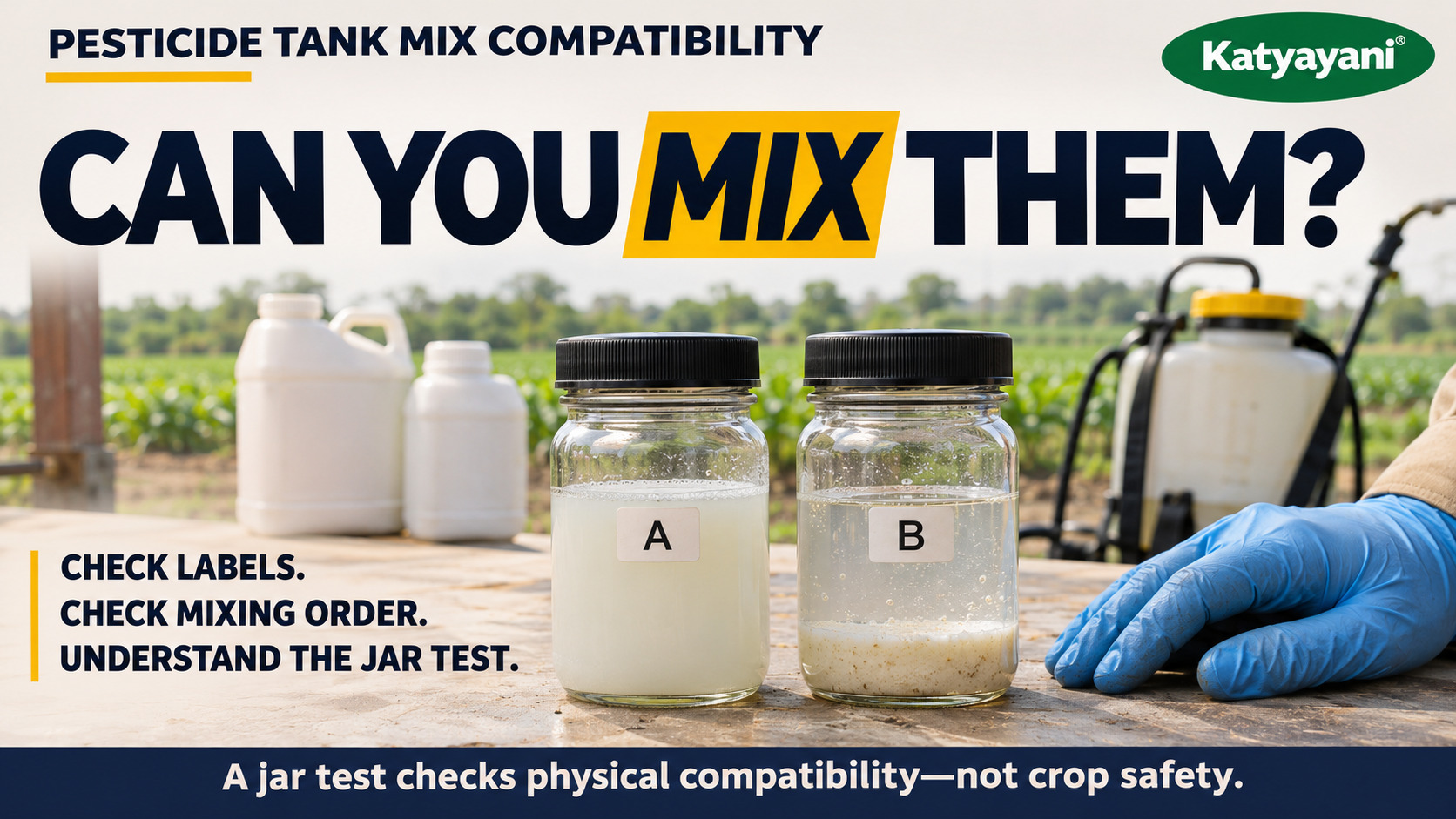
A pesticide tank mix is two or more products sprayed together from one tank. Read every label first, because the label can forbid a partner. Fill the tank half with clean water, add products one at a time (dry powders and granules first, then liquids and emulsifiable concentrates, spreaders last), and stir between each. Test any new combination in a jar before you fill the tank: same water, same proportions, stand 15 to 30 minutes, and reject it if you see layers, lumps, gel, heat or settled solids. A jar test shows physical problems only. It cannot show that one product has weakened the other.
What is a pesticide tank mix?
A pesticide tank mix is two or more products put into the same spray tank and sprayed together in one pass. The mix can be an insecticide with a fungicide, two insecticides, a pesticide with a foliar fertiliser, or a pesticide with a spreader. It is different from a ready-mix, which the factory makes and sells as one product.
Nebraska Extension lists why farmers do it: control several pests at once, make fewer trips through the field, save fuel, labour and sprayer hours, and (when partners are chosen well) slow down resistance. Fewer trips also means less soil compaction. All of that is true. The same guide says many things can go wrong, and the best way to avoid them is to run a jar test before filling the tank. Read the NebGuide G2350 once and you will have the basic method.
Picture a chilli grower in July. Thrips are on the new leaves and a leaf spot has started on the older ones. Two sprays means two tanks, two days and two sets of wages. One mix looks sensible. Whether it is sensible depends on what is in the two packs, the water in your tank and the order you pour. The rest of this post covers exactly that.
Why do farmers mix pesticides, and what can go wrong?
Farmers mix to save time, labour and money, and to hit two problems together. What can go wrong is the products clump or separate and block the nozzle, one product weakens the other, leaves are burned, or a living bio product dies. The more partners in the tank, the higher the chance of trouble.
The Ontario Crop Protection Hub puts it plainly: the odds of incompatibility rise with the number of tank-mix partners. Virginia Tech says the same. Their advice from BSE-351 is to plan the mix ahead of time, not while you are loading the sprayer. The Ontario page adds the same idea: decide on tank mixes in the off-season, not at the moment of loading.
| Possible problem | What you see | Why it matters |
|---|---|---|
| Blocked nozzle or filter | Lumps, sludge, grit in the strainer | Uneven spray, a stopped job in the field, a sprayer to clean |
| One product loses strength | Nothing visible | The pest or disease is not controlled and you do not know why |
| Crop injury | Burnt or spotted leaves after spraying | Yield loss, and you cannot undo it |
| Stronger effect than planned | Nothing visible | Nebraska notes that synergism can harm non-target animals, pollinators, crops or people |
| A living bio product dies | Nothing visible | You paid for spores or bacteria that were killed in the tank |
Notice that three of the five problems cannot be seen in the tank. That is why a jar test is good, but not enough on its own. A later section explains the small test plot that covers the gap.
What is the difference between physical and chemical incompatibility?
Physical incompatibility means the products cannot stay evenly mixed in the tank, even with moderate stirring. Chemical incompatibility means one product changes how well the other works. Physical problems show up as layers, lumps or gel. Chemical problems may show nothing at all until you see poor control in the field.
Nebraska Extension gives a clear physical example from the herbicide world. A 28% nitrogen liquid is compatible with 2,4-D ester but not with 2,4-D amine, because the amine mix thickens into something like mayonnaise. That is a purely physical failure: the jar shows it in minutes. The same guide gives the chemical example. Atrazine mixed with glyphosate is antagonistic, meaning one lowers the effect of the other. You cannot see that in a jar.
Virginia Tech describes the warning signs of chemical incompatibility as heat, a strong smell or gas, and a colour change. It says incompatibilities will almost always cut pesticide efficacy. Nebraska also lists three possible outcomes when two products meet: additive (each works as it would alone), antagonistic (one reduces the other) and synergistic (one boosts the other). Its table uses made-up percentages only to show the idea, so do not read them as real numbers.
| Type | Meaning | Can a jar test show it? |
|---|---|---|
| Physical incompatibility | Products do not stay uniformly mixed: layers, solids, gel, clumps (Nebraska, Virginia Tech) | Yes, usually within 15 to 30 minutes |
| Chemical incompatibility | One product alters the other's effect, or a harmful reaction occurs | Only if there is heat, a strong smell, gas or colour change. Otherwise no |
| Antagonism | The mix works worse than the better product alone (Nebraska) | No. Needs a small field test |
| Synergism | The mix works stronger than expected, with risk to non-targets and crops (Nebraska) | No. Needs a small field test |
Is it allowed to mix pesticides in India, and what does the label say?
No Indian source opened for this post gives a general rule for or against tank mixing. What the sources do say is that the label comes first. If a label forbids a partner, do not use it. If it names approved partners, use those. If it is silent, run a jar test and keep the first mix small.
Nebraska Extension says a product label may list approved or banned tank-mix partners, may forbid mixing with anything that is not explicitly approved, or may tell you to do a jar test. It also says that if its own advice conflicts with a label, follow the label. Ontario adds a checklist before you mix: each product is allowed on your crop, each is used as per its label, an adjuvant goes in only when one label specifically needs it, and no product is excluded on any other label in the mix.
The PAU Ludhiana paper in the Journal of Wheat Research is the one Indian line on the subject. Its authors write that combining different plant protection chemicals is not recommended as a rule, but that a combined spray saves time, labour and money, so farmers think about it when a disease and an insect arrive together. So the Indian research position is cautious: mix only when you have a good reason, and test it. Our post on pesticide formulation types explains the letter codes on the pack, and the sibling post in this set on how to read a pesticide label walks through the label panel by panel.
One more point from Nebraska is worth repeating. Even if you mixed two products successfully last year, read the labels again. A product name can stay the same while the formulation changes, and the dose, method and mixing rules can change with it. If the batch number is different from the last container, repeat the jar test.
Which pesticides cannot be mixed? Pairs named in Indian trials
The honest answer is that it depends on the exact products, the water and the label. The best Indian evidence is a PJTSAU jar test of 300 combinations of 25 agrochemicals used in pigeonpea. Only three failed with a lasting precipitate: neem seed kernel extract (NSKE) with thiodicarb, mancozeb or copper oxychloride.
The PJTSAU paper was a laboratory study done in 2011-12 at the Regional Agricultural Research Station, Warangal. It tested 20 insecticides (including botanical ones), two fungicides and urea, at their recommended doses, with no adjuvant, using the jar test. Compatibility was judged on precipitation, flocculation, layer separation, gelling, thickness change and heat. No heat reactions were seen in any treatment.
| Result in the PJTSAU jar test | Pairs | What the authors say to do |
|---|---|---|
| Clear, lasting incompatibility (persistent precipitate) | NSKE + thiodicarb; NSKE + mancozeb; NSKE + copper oxychloride | Do not combine these |
| Temporary sediment or clear layer that dissolved on stirring | Several other combinations (not named in the abstract) | Keep stirring all the time you spray |
| No problem seen | The rest of the 300 combinations | Physically compatible in the jar. Phytotoxicity, efficacy and field performance still need study before large-scale use |
Read the table with care. This is a physical test on pigeonpea products and doses from one station. It says nothing about whether the mixed pairs work well or are safe for the crop, and the authors say so. It is also not a list of every bad pair. What it does give you is a real, named example: a plant extract (neem) that is fine with most things can still drop out of solution with some protective fungicides. The same paper's finding that most pairs were fine is as useful as the three that failed.
From Nebraska you also get a named pair outside India: 28% nitrogen with 2,4-D amine thickens badly, while the ester form is fine. And from Virginia Tech, a general rule: cold water, hard water and very high or low pH raise the risk. When a source does not name a pair, this post does not either.
Can you mix a bio pesticide with a chemical pesticide?
Generally no, not in the same tank. Living products such as Trichoderma, Pseudomonas, Beauveria or Verticillium can be killed by chemical fungicides. Two ICAR-hosted studies agree on one point: carbendazim harms Trichoderma. Use the bio product on its own, or leave a gap between sprays and follow its label.
The Journal of Oilseeds Research study from 2023 found that carbendazim at 50, 100, 250 and 500 ppm completely stopped Trichoderma harzianum growth in the plate. The second ICAR-hosted study tested four fungal and four bacterial bio-agents against five fungicides and three pesticides at recommended doses, and found carbendazim highly toxic to all the fungal bio-agents it tested, including T. harzianum and T. viride. Both are plate tests, so they show the risk, not the exact field loss.
The two papers do not agree on every chemical, for example copper oxychloride, so no other fungicide is called safe or unsafe here. The sensible reading is: treat any chemical fungicide as a risk to a living fungus or bacterium, and do not put them together. Our bio versus chemical inputs post answers the tank question in one line (generally no) and lists mixing a bio product with a chemical fungicide as a cause of a failed bio spray. The biopesticides guide and the Trichoderma and Beauveria guide repeat the rule for the garden: do not mix either with a chemical fungicide.
If you use a bio fungicide such as Trichoderma viride bio fungicide, the product page describes it as a Trichoderma viride bio-fungicide for wilt, root rot and damping off. Keep it out of the tank that carries your chemical fungicide, and wash the sprayer between the two.
What is the right mixing order? WALES and the formulation order
If the label gives an order, follow it. If it does not, use WALES: Wettable powders first, Agitate, Liquid flowables, Emulsifiable concentrates, then Surfactants. Start with the tank at least half full of clean water. In short, dry products go in before liquids, and oils and spreaders go in last.
Virginia Tech explains WALES (also written DALES, where D stands for dry formulations) and says the order affects how well the carrier can spread the particles. Nebraska gives a seven-step order by formulation. Penn State Extension gives a similar one with ammonium sulfate first. They are not identical, which is why the label has the final word.
| Step | Nebraska G2350 (by formulation) | Penn State (2026) | Ontario OMAFA (jar test order) |
|---|---|---|---|
| 1 | Water-soluble packets or bags | Half fill tank with water; ammonium sulfate if the label calls for it | Compatibility agents |
| 2 | Wettable powders (WP) | Water-dispersible products: WP and dry flowables, pre-slurried | Water-soluble packets, wettable powders, dry flowables |
| 3 | Dusts, dry flowables, water-dispersible granules (WDG) | Stir until dissolved | Liquid drift retardants |
| 4 | Liquids and flowables | Microcapsule suspensions | Liquid concentrates, micro-emulsions, suspension concentrates |
| 5 | Emulsifiable concentrates (EC) | Liquids and emulsifiable concentrates | Emulsifiable concentrates |
| 6 | Microencapsulated products | Surfactants, crop oils last | Water-soluble concentrates or solutions |
| 7 | Surfactants or oils | Remaining adjuvants and surfactants |
Look at what is the same in all three: dry powders and granules go in early, ECs after them, and surfactants and oils near the end. That pattern is the part to remember. Nebraska gives the reason with a real case. A water-dispersible granule is built to break up when it meets water. If it meets an oil-based partner first, it will not disperse, and you get weak control and a blocked nozzle. The details around microcapsules and packets are where sources differ, so use the order on your own label.
Between each addition, stir. Virginia Tech says allow at least 3 to 5 minutes for a product to mix fully before adding the next, and Ontario says 3 to 5 minutes is typical. Penn State and Ontario both say to pre-slurry wettable powders and granules in a little water before they go into the tank. Shake liquid packs before you pour, because some separate into layers while standing (Nebraska).
How does your water change the result?
Water is most of the spray, so its pH, hardness and temperature change how products dissolve and perform. Cold water slows dissolving, hard water can bind some products, and alkaline water can break some down. Use the same water in your jar test that you will use in the tank, so the test shows what the tank will do.
Nebraska's table says some common pesticides break down above pH 7, others dissolve better in high pH, some products bind to minerals in hard water, and the colder the water, the longer soluble products take to dissolve. Virginia Tech advises mixing in water at least 50 degrees Fahrenheit, which is 10 degrees Celsius, and says cold water can leave sludge in the bottom that clogs the filter. Where cold water is unavoidable, it says to allow more mixing time.
| Water factor | What the extension sources say | Source |
|---|---|---|
| Hardness (dissolved calcium, magnesium, sodium) | Soft is under 50 ppm, medium-hard 50 to 100 ppm, hard 100 to 200 ppm. Hard water can bind to some formulations and cut effect | Penn State |
| pH | Best pH depends on the product. Penn State gives captan (best near pH 5) and carbaryl (best near pH 7) as examples. The label states the target | Penn State, Nebraska |
| Temperature | Colder water dissolves slowly. Mix at 10 degrees Celsius or warmer. Do not heat the jar-test water (Nebraska) | Virginia Tech, Nebraska |
| Source of water | Wells, ponds and tap water differ. Test the one you actually use. Use the same water in the jar test | Virginia Tech, Nebraska |
In practice, a farmer on a borewell with very hard water will often see different jar-test results from a neighbour using canal water. That is normal. It is the reason the jar test must use your water and not a bottle of clean water from the shop.
If you use a liquid fertiliser instead of water as the carrier, the risk goes up. Nebraska says this is more likely to cause unwanted interactions, and Virginia Tech says fill the tank to 50 to 75 percent first and note that more products in a fertiliser carrier means more risk. Our water soluble fertilizer guide covers which fertiliser grades clash in one tank and why a jar test with your own water helps there too.
How do you do a jar test, step by step?
A jar test is a small copy of your spray tank in a clear jar. Use the same water, the same proportions and the same order of addition. Stir between products, let the jar stand for 15 to 30 minutes, and look for layers, lumps, gel, heat or solids that settle. If any appear, the mix is not safe for the sprayer.
The steps below combine the Nebraska, Virginia Tech, Montana State and Ontario methods. They agree on the idea and differ on small details, which are shown in brackets.
- Wear the protective gear the labels ask for. If the labels differ, follow the one with the strictest rule (Nebraska).
- Read each label for tank-mix notes, mixing order and any adjuvant it requires. Decide the order before you start.
- Use a clean clear glass jar with a lid, and carrier water from the same source and at about the same temperature as your tank water. Do not heat it (Nebraska).
- Fill the jar one-third to one-half with water (Nebraska) or half full (Virginia Tech). Ontario uses 500 millilitres of water in a 1-litre jar.
- Shake each liquid pack so it is evenly mixed before you measure it.
- Add the products one at a time in the right order, in the same proportion as the tank (see the scale-down example in the next section).
- Cap and shake or stir the jar after each addition and wait until the product has dissolved or spread.
- Add the rest of the water, shake once more and let the jar stand. The stand time is 15 minutes (Montana State, Ontario), 10 to 15 minutes (Virginia Tech) or about 30 minutes (Nebraska). Use the longer time.
- Look at the jar. Then stir or shake and look again. A smooth mix that goes back to even after stirring is fine.
- Write down what you saw. Ontario suggests keeping the jars through the season, because they show which products settle when a sprayer sits overnight.
- Pour the jar contents into the spray tank when you are done (Montana State says the test mix should go into the tank, and rinse water too), or dispose of it safely if it failed. Do not reuse the jar for anything else.
None of this needs lab equipment. A jar, a measuring cap or syringe and a watch are enough. Nebraska mentions test kits with 100-millilitre bottles and 1-millilitre pipettes, but says you can make your own with graduated eyedroppers and jars marked at 100 millilitres.
How do you scale the jar test down from a knapsack tank?
Keep the jar in the same proportion as the tank. Divide the jar volume by the tank volume, then multiply each label dose per tank by that fraction. For a 15-litre tank and a 1-litre jar, the fraction is one-fifteenth. A product dosed at 30 millilitres per tank goes into the jar as 2 millilitres.
This sum is simple arithmetic and is not from a source. It follows the rule in the Nebraska guide that the proportions of pesticide, water and adjuvant in the jar must match the full-size tank. Here is a worked example. The doses are made up for the sum only and are not label doses for any product.
| Item | Tank (15 litres) | Jar (1 litre) = tank divided by 15 | Order of adding |
|---|---|---|---|
| Water to start | About 8 litres (at least half) | About 500 ml (half) | 1 |
| Wettable powder or granule (example 45 g per tank) | 45 g | 3 g | 2, slurry it first |
| Liquid or SC (example 30 ml per tank) | 30 ml | 2 ml | 3 |
| EC (example 45 ml per tank) | 45 ml | 3 ml | 4 |
| Spreader (example 5 ml per tank) | 5 ml | about 0.3 ml | Last, unless its label says otherwise |
| Top up with water | To 15 litres | To 1 litre | Last |
Very small amounts such as 0.3 millilitres are hard to measure with a cap. Use a plastic syringe without a needle. If you cannot measure that small, use a bigger jar (for a 2-litre jar the fraction is 2 divided by 15, so the same spreader dose becomes about 0.7 millilitres) rather than rounding up. Rounding up gives a stronger mix than the tank, which can fail a test that the real tank would pass.
How do you read the jar after the test?
Signs of a bad mix are layers, lumps, gel, scum, foam, heat, a strong smell or gas, and solids that settle quickly and do not come back after stirring. A smooth, even jar that returns to normal after shaking is a pass. Wettable powders may settle a little by themselves and that is normal.
| What you see | Meaning | Source |
|---|---|---|
| Oil and water in separate layers | Physical incompatibility | Virginia Tech |
| Clumps or solids that settle quickly | Physical incompatibility; clogging risk | Virginia Tech, Montana State |
| Gel or scum | Likely incompatible | Ontario |
| Heat given off | Not compatible | Ontario, Virginia Tech |
| Strong smell, gas or colour change | Possible chemical incompatibility | Virginia Tech |
| Foam | Too much stirring, or a foaming mix | Virginia Tech, Nebraska |
| Smooth, uniform mix after stirring | Pass for physical compatibility | Montana State |
Ontario makes one exception: solids that settle at the bottom count as a warning sign except when the product is a wettable powder, which settles by nature. Virginia Tech says the same thing in another way when it says wettable powders, granules, SCs and ECs can settle over time and may need more stirring during spraying. A PJTSAU result fits here too. Some combinations in the pigeonpea test made a temporary sediment or clear layer that disappeared on stirring, which the authors read as a sign that you must keep stirring in the field.
What does a jar test not tell you?
A jar test shows physical problems only. It cannot show antagonism, where one product weakens the other, or crop injury. Ontario states that a jar test does not reveal chemical incompatibility. The extra step is a small test plot: spray the mix on a small area first and watch for leaf damage and poor control.
Nebraska ends its jar test with that step: apply the mixture to a small test plot at the application site to find non-visible chemical incompatibilities, and look for damage to organisms that are not the target. For a field crop this can be a few rows at the edge. Wait for the time the products normally need to work, then compare the sprayed rows with the rest.
The PJTSAU authors are careful in the same way. They found most of the 300 pigeonpea combinations physically compatible, then added that studies on crop injury, efficacy and field performance are still needed before the mixtures are recommended for large-scale use. If the researchers who ran 300 jar tests say that, a farmer should too: pass in the jar, then try a small area.
What if the mix fails in the jar?
Do not mix those products in the tank. Change one thing at a time and test again: try a compatibility agent, a different water source, a different brand or formulation, or a different order. If it still fails, spray the two products separately. Montana State says a mix that cannot be fixed should not go in the tank.
The Montana State method lists the fixes in order. Repeat the test with a few drops of a compatibility agent added to the water before anything else, and if it looks fine, let it stand for an hour and stir and check it again. Use a different water supply, because hard water can cause incompatibility. Change brands or formulations. Change the order of mixing. It stresses that you should make only one change at a time and run the full test before the next change. Nebraska and Virginia Tech suggest the same: start again with a compatibility agent, and if the problem stays, replace one of the products.
| Change to try (one at a time) | Why it can help | Source |
|---|---|---|
| Add a compatibility agent first | Helps hold products together in the water | Montana State, Nebraska, Virginia Tech |
| Use a different water supply | Hard water can cause incompatibility | Montana State |
| Change the brand or formulation | A WG may mix where a WP did not, for example | Montana State |
| Change the order of adding | Wrong order is a common cause | Montana State, Virginia Tech |
| Replace one product | Last step if physical incompatibility stays | Nebraska, Virginia Tech |
What if the mix goes wrong inside the sprayer tank?
Stop spraying. Do not add water, ammonia, non-ionic surfactant or detergent in a hurry, because Ontario says this can create further problems. Take a small sample and try to break it down in a jar first. If you cannot bring it back to an even mix, it must be thrown away safely, not sprayed on the crop.
The Ontario page calls the small-sample step a reverse jar test. You take a little of the failed mix from the tank and try a fix in a jar first. If that succeeds, you may be able to repeat it in the tank. If it does not, the mix may no longer be usable and has to be disposed of safely. Do not pour a failed mix into a pond, drain or field channel. Nebraska reminds readers that chemical interactions can have unpredictable health effects, so keep the protective gear on while you deal with it.
Prevention is cheaper. Most field failures come from skipping the jar test, pouring the products in the wrong order, or using cold or hard water with a powder that needed more time to dissolve.
How long should you stir the mix, and how soon should you spray it?
Stir moderately between each product for at least 3 to 5 minutes, keep stirring while you spray, and use the mix soon after making it. Too little stirring lets particles settle and clog. Too much stirring makes foam. If the surface looks like boiling water, the stirring is too hard (Virginia Tech).
Nebraska says too much agitation can break emulsions or make foam, while too little lets suspended particles settle, so the spray load is uneven and the equipment blocks. It advises patience, especially when the water is cold. It also says to use the mixed load as soon as possible, because the chance of settling goes up the longer the mix waits, and to keep it agitated if a delay cannot be avoided. Virginia Tech notes that WP, WDG, SC and EC products will settle over time and may need more agitation during application.
On a hand-pumped knapsack, agitation means shaking the tank every few minutes and pumping steadily. If you must stop for lunch or rain, shake the tank well before starting again. Do not leave a tank mix overnight and use it the next morning without testing it, because the jar notes from Ontario show that some products settle when left standing.
When should you add a spreader or sticker?
Add a spreader or sticker only when a label calls for it or you have a reason, and add it last unless its own label gives another order. Ontario says to include an adjuvant in a tank mix only when one of the labels specifically requires it. Check that two labels do not give opposite instructions on adjuvants.
Nebraska explains the adjuvant family. A spreader-sticker has surfactants that spread the droplet over the leaf and help it stay on. Crop oils carry an emulsifier so that oil mixes with water. A label may require an adjuvant, recommend one, or forbid it. Adjuvant order can vary by product, so the adjuvant's own label should be read. Nebraska also warns that some products contain more than one adjuvant type, so read what you are buying.
The product page for a silicon spreader and sticker describes it as a silicon-based spreader and sticker for pesticide, fungicide and foliar sprays, aimed at better coverage and rain resistance. That is the maker's claim on its own page. No test result for a particular tank mix is shown there, so run your jar test with it in the jar if you plan to use it. Remember also that metal micronutrients like copper, iron, manganese and zinc may not stay in solution without a chelating agent such as EDTA (Nebraska), so a foliar micronutrient needs its own jar test.
Does mixing help or hurt resistance management?
A mixture helps against resistance only if the partners have different modes of action. IRAC says a different brand name with the same mode of action does not count. IRAC also does not support using the same mixture again and again as your only pest control. Mixing is one tool inside integrated pest management.
The IRAC statement of August 2023 lists conditions for a useful insecticide mixture: partners with different modes of action, each effective against the stage of the insect you are targeting, both reaching the insect at the same time, and little or no cross-resistance between them. It adds that mixtures work best when resistance to both active ingredients is absent or very low, and that for tank mixes you follow the label instructions for each component. So "two insecticides in one tank" is not good practice by default. Two insecticides with different modes of action, each doing a job, is.
A quick check on any pack: look for the active ingredient and its group. Two products with the same active ingredient under different brand names are the same thing in the tank. Our post on thiamethoxam 25% WG says in its FAQ that many fungicide combinations are used but a jar test comes first. The IRAC text is about insecticides and acaricides, so do not stretch it to fungicides or herbicides.
Browse the full range of insecticide products and fungicides on the site to compare active ingredients by name, and read the pack label for the mode of action. The chemical fungicide collection is the shorter list if you only want fungicides. Some entries on the fungicide page are sold as one product with two active ingredients, such as a carbendazim and mancozeb powder or a tebuconazole and sulphur granule. That is a ready-mix made by the maker, not a tank mix you make.
A real Indian case: propiconazole with imidacloprid or thiamethoxam in wheat
In a PAU Ludhiana trial, propiconazole mixed with imidacloprid or thiamethoxam kept its strength against stripe rust and aphids. Aphid control was lower when the mix was sprayed in 500 litres of water per hectare than in 250 litres. The extra water thinned the insecticide and also spared more ladybird beetles.
Singh and Kaur ran field trials at PAU's Plant Breeding Research Farm in 2014-15 and 2015-16 on the aphid and rust susceptible variety PBW 621, sown in the last week of November. Treatments were imidacloprid at 100 millilitres per hectare, thiamethoxam at 50 millilitres per hectare and propiconazole at 500 millilitres per hectare, each alone and in four mixes, sprayed at heading when there were 15 to 20 aphids per tiller and rust had appeared. The mixes did not harm the wheat, and the products did not lose strength, with 80 to 90 percent control of both disease and aphids.
| Finding from the PAU trial | Number or result |
|---|---|
| Insecticide + propiconazole mix | Did not hinder the efficacy of either; no toxic effect on wheat |
| Control level in mixes | 80 to 90 percent for both disease and aphids (2014-15) |
| Spray volume effect (2015-16) | Aphid control was 0 to 5.95 percent lower in 500 litres per hectare than in 250 litres |
| Ladybird beetle reduction | Smaller (2.48 to 8.96 percent less) at 500 litres per hectare |
| Best grain yield, 2014-15 | 63.11 quintals per hectare with propiconazole + imidacloprid (5:1) in 500 litres |
| Untreated plots | 45.95 quintals per hectare (2014-15); rust severity 60 percent |
Two lessons come out of it. First, a mix can be compatible and still work worse if you dilute it too much, so follow the label's water volume. Second, the PAU authors saw an unexpected cost for natural enemies: propiconazole alone cut ladybird numbers, and they call for laboratory work to find out why. A mix that saves a spray is not free of effects on the field's helpers. These are results for one variety, two seasons and one place, so use them as an example of method, not a rule for every field. For a mustard crop, our mustard aphid control post carries a similar caution not to mix with a fungicide unless the label allows it.
What should you do before and after the spray to avoid mixing problems?
Before: read every label, decide the mix in advance, test it in a jar and on a small plot, and set your sprayer up. After: use the mix soon, stir through the job, and clean the tank, hose, strainer and nozzle before the next product, because leftover residue can react with the next load.
Nebraska says clean equipment thoroughly between applications, especially when the next product differs from the last, because residue from a previous spray may react with the next load in unpredictable ways. Our sprayer guide covers calibration, nozzles and washing the tank, hose and nozzle after every product. The fungicide application methods post adds one useful rule: never put a dust into a spray tank.
| Stage | What to do | Source |
|---|---|---|
| Planning (off-season) | Decide the mix before loading; limit the number of partners | Ontario, Virginia Tech |
| Labels | Read each label for partners, order, adjuvant and water notes; re-read each season | Nebraska |
| Jar test | Same water, same proportions, stand 15 to 30 minutes | Nebraska, Virginia Tech, Montana State, Ontario |
| Small plot | Spray a small area to see crop damage and efficacy | Nebraska |
| Tank fill | At least half full with clean water before products | Virginia Tech, Ontario, Penn State |
| Adding | Right order, pre-slurry powders, stir 3 to 5 minutes between products | Virginia Tech, Ontario, Penn State |
| Spraying | Use soon, keep stirring, no boiling-water agitation | Nebraska, Virginia Tech |
| Afterwards | Clean the tank, hose, strainers and nozzles | Nebraska |
| New batch | Repeat the jar test when the batch number changes | Nebraska |
Are ready-mix products the same as a tank mix?
No. A ready-mix is made and sold by the manufacturer as one product with two or more active ingredients in a set ratio. A tank mix is something you build yourself from separate packs. IRAC treats both as insecticide mixtures, but the safety of a tank mix depends on the labels, order, water and test.
IRAC's statement refers to "tank-mix or pre-formulated mixture" side by side, which shows they are two ways of reaching a mixture. With a ready-mix the maker has already put the actives together in one formulation. With a tank mix, you are the formulator. Our buying checklist explains how to read the label and batch before you pay, and the fake pesticide guide covers the checks that protect you from a spurious pack, which would make any tank mix a gamble.
One practical difference is dosing. A ready-mix has one dose on one label. In a tank mix you have two or three doses to follow, and the PAU wheat trial shows that even the water volume per hectare matters. That is a good reason to choose a ready-mix when one exists for your pest pair and the label names your crop.
Conclusion
A pesticide tank mix saves time, but it only works when you treat it as a small experiment. Read every label first, because the label wins over any guide. Fill the tank half with clean water, add products one at a time (dry powders and granules, then liquids and ECs, spreaders last), and stir for 3 to 5 minutes between them. Test any new pair in a jar with your own water and stand it for at least 15 to 30 minutes. A jar shows physical problems only, so try the mix on a small plot before the whole field. Keep living bio products out of the tank with chemical fungicides, and clean the sprayer after every use.




Leave a Comment