
 15 min read
A biofertilizer is a product with living microbes that help the crop get nitrogen, phosphorus, potash or zinc. A biostimulant is a substance or microbe whose main job is to stimulate the plant's own processes, such as nutrient uptake, growth and stress tolerance, whatever its nutrient content. A biopesticide uses living organisms or natural substances to control pests and diseases. In India the first two are covered by the Fertiliser Control Order, 1985. Biopesticides are covered by the Insecticides Act, 1968, and need CIB&RC registration.
What is the difference between a biostimulant, a biofertilizer and a biopesticide?
The difference is the job and the law. A biofertilizer feeds the crop through living microbes. A biostimulant nudges the plant's own processes, such as nutrient uptake and stress tolerance. A biopesticide controls pests and diseases. In India the first two sit under the Fertiliser Control Order, 1985, and the third under the Insecticides Act, 1968.
Picture three farmers at the same input shop. One has a pulse field with pale, nodule-free roots. One has a chilli crop that is flowering in a heat wave and dropping buds. One has a tomato nursery where seedlings fall over at the base. They need three different bottles, and each bottle comes under a different rulebook.
| Point | Biofertilizer | Biostimulant | Biopesticide |
|---|---|---|---|
| Main job | Supplies or releases nutrients through living microbes | Stimulates plant processes: uptake, growth, quality, stress tolerance | Controls insects, fungi, bacteria, nematodes or weeds |
| What is inside | Living microorganisms in a carrier or liquid | A substance (extract, amino acids, humic acid and others) or a microbe, or both | A living organism (fungus, bacterium, virus) or a natural substance |
| Indian law | Fertiliser Control Order, 1985 (Schedule III) | Fertiliser Control Order, 1985 (Schedule VI, clause 20C) | Insecticides Act, 1968 and Rules, 1971 |
| Who approves it | Must meet the Schedule III standard | Must be listed in Schedule VI after an application in Form G | Registered by the Registration Committee (CIB&RC) under Section 9 |
| Word on the pack | BIO-FERTILISER/ ORGANIC FERTILISER | Biostimulant | Insecticide label with registration number, batch, expiry and hazard band |
| Typical examples | Rhizobium, Azotobacter, PSB, mycorrhiza | Seaweed extract, amino acids, humic and fulvic acid, vitamins | Trichoderma, Beauveria, Bt, NPV, Pseudomonas fluorescens, neem formulations |
The rest of this guide takes each column in turn, then shows where they overlap and how to pick between them.
What is a biofertilizer under Indian rules?
The FCO defines a biofertiliser as a product containing carrier-based (solid or liquid) living microorganisms that are agriculturally useful in terms of nitrogen fixation, phosphorus solubilisation or nutrient mobilisation, to increase the productivity of the soil or crop. In plain words: live microbes that help the crop reach nutrients.
That wording comes from clause 2(aa) of the Fertiliser Control Order text. The ICAR biofertilizer compendium of 2021 describes the same idea: products with living cells of microorganisms that enrich the nutrient quality of soil, using bacteria, fungi and cyanobacteria (blue-green algae). It sorts most biofertilizers into three groups: nitrogen fixers, phosphate, potash and zinc solubilisers and mobilisers, and plant growth promoting rhizobacteria.
Two points help you read a label. First, a biofertilizer is alive, so it has a use-by date and it suffers in heat. Second, it does not add nutrients the way urea or DAP does. It makes nutrients already in the air or soil easier for the crop to take. The NCOF handout puts it this way for Rhizobium: it lives in the root nodules of legumes and supplies nitrogen through fixation.
The FCO also defines an organic fertiliser, and people often mix it up with a biofertilizer. An organic fertiliser is made of unprocessed biological material (plant or animal), sometimes with mineral material altered by microbial decomposition. Compost and vermicompost belong here. They carry microbes, but the product is the decomposed material, not a culture of chosen strains.
Which biofertilizers does the FCO list, and what must each one meet?
Schedule III of the FCO lists seven biofertiliser types: Rhizobium, Azotobacter, Azospirillum, phosphate solubilising bacteria, mycorrhizal biofertilisers, potassium mobilising bacteria and zinc solubilising bacteria. Most of them need at least 5 x 10^7 CFU per gram of carrier, or 1 x 10^8 per ml of liquid, with no contamination at 10^5 dilution.
The numbers below are from the Schedule III copy hosted by the Goa agriculture department. CFU means colony forming units, a count of living cells that can multiply.
| Biofertiliser | Minimum count (carrier or liquid) | pH | Efficiency test in the schedule |
|---|---|---|---|
| Rhizobium | 5 x 10^7 CFU/g or 1 x 10^8 CFU/ml | 6.5 to 7.5 | Effective nodulation on all species listed on the packet |
| Azotobacter | 5 x 10^7 CFU/g or 1 x 10^8 CFU/ml | 6.5 to 7.5 | Fixes at least 10 mg nitrogen per g of sucrose used |
| Azospirillum | 5 x 10^7 CFU/g or 1 x 10^8 CFU/ml | 6.5 to 7.5 | White pellicle in nitrogen-free semi-solid medium |
| Phosphate solubilising bacteria | 5 x 10^7 CFU/g or 1 x 10^8 CFU/ml | 6.5 to 7.5 (carrier), 5.0 to 7.5 (liquid) | At least 30% solubilisation on spectrophotometer, or 5 mm zone |
| Potassium mobilising bacteria | 5 x 10^7 CFU/g or 1 x 10^8 CFU/ml | 6.5 to 7.5 (carrier), 5.0 to 7.5 (liquid) | At least 10 mm solubilisation zone |
| Zinc solubilising bacteria | 5 x 10^7 CFU/g or 1 x 10^8 CFU/ml | 6.5 to 7.5 (carrier), 5.0 to 7.5 (liquid) | At least 10 mm solubilisation zone |
| Mycorrhizal biofertilisers | Counted in propagules, not CFU: infectivity of 80 infection points per g | 6.5 to 7.5 | Moisture 8 to 12% |
Part B of the same schedule sets the tolerance during shelf life. For Rhizobium, Azotobacter, Azospirillum and PSB, the viable count must not fall below 1 x 10^7 CFU per gram of carrier (or 5 x 10^7 per ml for liquids) through the whole shelf life. In plain terms: a pack that was fine on the day it was made can still fail if it sat in a hot godown for months.
The schedule also says the carrier-based powders should hold 30 to 40% moisture at most, and that the carrier can be peat, lignite, peat soil, humus or wood charcoal. So a carrier powder is meant to carry some moisture, because the cells in it are alive.
What is a biostimulant under Indian rules?
The Gazette notification of 23 February 2021 defines a biostimulant as a substance or microorganism, or both, whose primary function is to stimulate physiological processes in plants and improve nutrient uptake, growth, yield, crop quality and stress tolerance, regardless of its nutrient content. It excludes pesticides and plant growth regulators.
That text is in clause 2(ab) of the S.O. 882(E) order, and the PIB release of 9 September 2025 repeats it. Three phrases carry the meaning. "Primary function" means the claim on the pack decides the box. "Regardless of its nutrient content" means a biostimulant may contain some nutrients, but it is not sold to feed the crop. And the last phrase draws a hard line against growth regulators, which stay under the Insecticides Act.
A simple picture: a fertiliser is food, a biostimulant is more like a tonic that helps the plant use its food and cope with a bad week. The live post on PGR vs biostimulants goes deeper on the hormone side, and the post on plant growth promoters explains the umbrella term that shops use for all of them.
For the rules on who can make and sell biostimulants and how Schedule VI came about, read the live guide on biostimulants and FCO rules. This post stays with definitions.
What categories and limits apply to a biostimulant?
A biostimulant listed in Schedule VI must fall into one category: botanical extracts including seaweed extracts, bio-chemicals, protein hydrolysates and amino acids, vitamins, cell-free microbial products, antioxidants, anti-transpirants, humic and fulvic acid and their derivatives, or live micro-organisms other than biofertilisers and biopesticides. It may carry no more than 0.01 ppm of pesticide.
The 2021 order lists eight categories. The PIB release of September 2025 lists nine, with live micro-organisms (excluding biofertilisers and biopesticides) as the ninth. The order also caps heavy metals in any biostimulant.
| Heavy metal | Maximum in a biostimulant (mg/kg) |
|---|---|
| Cadmium (as Cd) | 5.00 |
| Chromium VI (as Cr) | 50.00 |
| Copper (as Cu) | 300.00 |
| Zinc (as Zn) | 1000.00 |
| Lead (as Pb) | 100.00 |
| Arsenic (as As2O3) | 10.0 |
These limits are in sub-clauses (9) and (10) of clause 20C. They protect you from a cheap extract made from contaminated raw material. Biofertilisers and biopesticides have their own checks, covered below.
The order also says Schedule VI will state the product name, active ingredients, the crop it may be applied to, its benefits and the method of analysis. So a legal biostimulant claim is meant to be narrow and specific. Wide claims like "increases yield by 40%" do not fit that frame.
What is a biopesticide under Indian rules?
India has no separate law for biopesticides. They are registered as insecticides under the Insecticides Act, 1968, which counts any substance in its Schedule, any other substance the Centre adds (including fungicides and weedicides) and any preparation containing them. TNAU lists Bacillus thuringiensis, neem formulations, fungi and NPV among the products included.
You can see this in the Act itself. Section 3(e) of the Insecticides Act defines "insecticides" as any substance specified in the Schedule, such other substances (including fungicides and weedicides) as the Central Government adds by notification, and any preparation containing them. The TNAU Agritech page on biopesticides adds that Bacillus thuringiensis, neem-based formulations, and microbial pesticides such as fungi and NPV are in that schedule. It describes biopesticides as living organisms that intervene in the life cycle of insect pests so that crop damage is minimised.
The ICAR biopesticide compendium of 2021 adds the scale. It says more than 970 biopesticide products had been registered with the Central Insecticide Board and Registration Committee, from about 20 microorganisms, and that biopesticides were only 4.2% of the Indian pesticide market, against 40% in the USA and 20% each in Europe and Oceania. These are 2021 figures, so treat them as a snapshot of that year.
A longer list of types and examples is in the live post on biopesticides. For a gardener-level view of two common ones, see Trichoderma and Beauveria.
What kinds of biopesticides does CIB&RC register?
The CIB&RC guideline groups microbial biopesticides into five kinds: entomopathogenic or entomotoxic bacteria, antagonistic bacteria, entomopathogenic fungi, antagonistic fungi, and viruses (NPV and granulosis virus). Each kind has its own minimum count. Antagonistic bacteria and insect-killing fungi need at least 1 x 10^8 CFU per ml or g; Trichoderma needs 2 x 10^6.
The guideline approved at the 439th Registration Committee meeting on 25 April 2022 is the working document for applicants. It also covers consortia, meaning mixtures of compatible strains, and asks for the ratio of each strain in the formulation.
| Kind of biopesticide | What it does | Examples in the guideline | Minimum count in its specification |
|---|---|---|---|
| Antagonistic fungi | Fights plant disease fungi in soil or on roots | Trichoderma | 2 x 10^6 CFU per ml or g |
| Antagonistic bacteria | Colonises roots and suppresses disease | Pseudomonas fluorescens, Bacillus species | 1 x 10^8 CFU per ml or g |
| Entomopathogenic fungi | Infects and kills insects | Beauveria bassiana, Metarhizium anisopliae | 1 x 10^8 CFU per ml or g |
| Entomotoxic bacteria | Toxin kills insect larvae | Bacillus thuringiensis varieties | Labelled with bio-potency or toxin content |
| Viruses | Infect specific caterpillars | Helicoverpa armigera NPV, Spodoptera litura NPV | Counted in polyhedral occlusion bodies |
The spread in counts matters when you compare labels. A Trichoderma pack at the guideline minimum holds far fewer cells than a Pseudomonas pack at its minimum, and that is normal because each organism is measured against its own standard.
For Bt, the guideline adds a rule: Bt products must be labelled with bio-potency, toxin content or both. A Bt pack that gives no potency figure is missing something the guideline asks for.
Why does India regulate them under two different laws?
The split follows the purpose. Anything sold to nourish the crop or soil sits under the FCO, made under the Essential Commodities Act. Anything sold to control a pest, or to regulate plant growth as a hormone, sits under the Insecticides Act. The biostimulant definition draws the same line.
In practice this means two systems with two sets of officers. The FCO is enforced through fertiliser inspectors and notified labs. The Insecticides Act works through the Central Insecticides Board, the Registration Committee, insecticide inspectors and licensing officers. Section 13 of the Act requires a licence to manufacture, or to sell, stock, exhibit for sale or distribute, any insecticide. The live guide to dealer licences by state walks through the pesticide licence route.
One more consequence: a seaweed extract and a neem formulation can sit side by side on a shelf and both be called "organic", yet one answers to the FCO and the other to the Insecticides Act. If a dealer says "it is all the same thing", the law says otherwise.
Which box does my product belong in? Examples side by side
Ask what the product is made of and what the pack claims. Living nitrogen fixers and solubilisers are biofertilizers. Extracts, amino acids and humic acid sold for uptake and stress tolerance are biostimulants. Living organisms or natural substances sold against a pest or disease are biopesticides. Hormone-type regulators are none of these.
| Input | Usual box | Why | Source of the rule |
|---|---|---|---|
| Rhizobium culture | Biofertilizer | Fixes nitrogen with legume roots | FCO Schedule III |
| Azotobacter, Azospirillum | Biofertilizer | Free-living or root-associated nitrogen fixers | FCO Schedule III |
| Phosphate, potash or zinc solubilising bacteria | Biofertilizer | Release locked nutrients | FCO Schedule III |
| Mycorrhiza (VAM) | Biofertilizer | Listed as mycorrhizal biofertilisers | FCO Schedule III |
| Seaweed extract sold for stress tolerance and flowering | Biostimulant | Botanical extract category | FCO clause 20C |
| Amino acid or protein hydrolysate spray | Biostimulant | Protein hydrolysates and amino acids category | FCO clause 20C |
| Humic or fulvic acid product | Biostimulant | Humic and fulvic acid category | FCO clause 20C |
| Trichoderma | Biopesticide | Antagonistic fungus against plant disease | CIB&RC guideline |
| Pseudomonas fluorescens | Biopesticide | Antagonistic bacterium | CIB&RC guideline |
| Beauveria, Metarhizium | Biopesticide | Entomopathogenic fungi | CIB&RC guideline |
| Bt, NPV | Biopesticide | Entomotoxic bacterium, virus | CIB&RC guideline |
| Neem formulation sold to control insects | Biopesticide | Neem formulations are in the Insecticides Act schedule | TNAU page on the Act schedule |
| Gibberellic acid, NAA type regulator | Plant growth regulator | Hormone-type, excluded from the biostimulant definition | FCO definition, Insecticides Act |
You can see the examples on the shop shelf. A Rhizobium biofertilizer page on this site lists pulses and oilseeds such as chickpea, soybean and groundnut and says the organism forms root nodules. A phosphate solubilizing bacteria page says it turns insoluble soil phosphorus into a form plants can use. A Trichoderma viride bio fungicide page lists wilt, root rot and damping off, and a Beauveria bassiana page lists sucking pests and caterpillars. The full ranges are under bio fertilizers and bio pesticides.
Where do the three overlap, and where is the line?
They overlap at the edges. Biofertiliser microbes also make hormones and vitamins, a microbe can protect roots and feed the plant, and a mixture can do several jobs. The law resolves this by the main claim. The Schedule VI category for live micro-organisms even excludes biofertilisers and biopesticides, so those two keep their own boxes.
The ICAR biofertilizer compendium says it directly: biofertilizers, in addition to nutrients, also provide growth promoting substances like hormones, vitamins and amino acids that improve plant health and vigour. It also notes that rhizosphere bacteria that favour plant growth are called plant growth promoting rhizobacteria, which also help plants overcome abiotic and biotic stresses. That is why sellers sometimes describe the same microbe in different ways.
| Border case | What can confuse you | How the rule settles it |
|---|---|---|
| Microbe that fixes nitrogen and also makes hormones | Sounds like biostimulant and biofertilizer | Sold for nitrogen fixation: biofertilizer under Schedule III |
| Microbe that colonises roots and suppresses disease | Sounds like biostimulant | Sold to control disease: biopesticide under CIB&RC |
| Live microbe sold only to improve stress tolerance | Not a nutrient source and not a pest killer | Schedule VI category of live micro-organisms, if listed |
| Mixture of nitrogen, phosphate and potash microbes | Looks like three products in one | Microbial consortium, made possible in the FCO by a 2014 notification (ICAR) |
| Mixture of Beauveria, Metarhizium and Verticillium | Looks like a single bio input | Biopesticide consortium: CIB&RC asks for the ratio of each strain |
| Growth hormone from a bottle | Sounds like a biostimulant | Excluded from biostimulants: Insecticides Act |
So when a pack says something like "biostimulant, bio-fertilizer and bio-fungicide in one", read it as a red flag, not a bargain. The law gives each product one main box, and one set of tests.
How is each type tested before it can be sold?
A biostimulant needs a data file: chemistry, bio-efficacy trials at three doses in one season at three agro-ecological locations, nine toxicity and eco-toxicity tests, a heavy-metal report and a pesticide-free affidavit. A biopesticide needs strain identity, DNA fingerprinting, bio-efficacy, toxicity and shelf-life data. A biofertiliser must meet the Schedule III numbers.
| Test area | Biofertilizer | Biostimulant | Biopesticide |
|---|---|---|---|
| Identity and chemistry | Organism type and carrier as per Schedule III | Source (plant, microbe, animal or synthetic), product specification with GLP or NABL analysis, method of analysis, shelf life | Strain name and source, composition, CFU, shelf life, manufacturing process |
| Field trials | Efficiency character per schedule (for example nodulation for Rhizobium) | Agronomic trials at ICAR institutes or state agricultural universities: at least three doses, one season, three agro-ecological locations | Bio-efficacy data under the guideline, for example disease severity and root colonisation for bacterial antagonists |
| Safety | No contamination at 10^5 dilution | Five acute toxicity tests (oral, dermal, inhalation, skin and eye irritation) and four eco-toxicity tests (bird, fish, honeybee, earthworm); long-term chronic studies not needed | Toxicology under the guideline; no Salmonella, Shigella or Vibrio; other contaminants at most 1 x 10^4 per ml or g |
| Residue and metals | Not listed in Schedule III | Heavy-metal report and pesticide under 0.01 ppm | Undertaking that the product is free from chemical and botanical pesticides and from GMO |
| Sample checks | Sample sent to a notified lab or NCOF centre | Sample analysed at CFQC&TI Faridabad, its regional labs or a lab notified by the state with Centre approval | DNA fingerprinting at NBAIM Mau and pre-registration check at the Central Insecticide Laboratory |
Two details are worth noting. For biostimulants the order says long-term chronic studies "as in case of pesticides" are not needed. That is a clear difference from pesticide registration, and it is one reason a biostimulant must never claim to control a pest. For biopesticides the guideline asks for a storage study of up to 12 months for fungi, 8 months for Pseudomonas and 18 months for Bacillus at ambient temperature, which is the basis of the shelf life printed on the pack.
The route into the market also differs. A new insecticide introduced in India for the first time can get a provisional registration for two years under Section 9(3B) of the Act, while regular registration under 9(3) is meant to be decided within twelve months, extendable by six. The CIB&RC guideline refers to both 9(3) and 9(3B) registrants. A detailed walk through CIB&RC registration is the topic of a separate post in this set.
How do the labels differ, and who tests a pack in the market?
The FCO wants "BIO-FERTILISER/ ORGANIC FERTILISER" on a biofertiliser container and the word "Biostimulant" on a biostimulant container. An insecticide label, which covers biopesticides, must show the maker, brand name, registration number, ingredients, net content, batch number, expiry date and antidote, plus a hazard diamond. Different officers draw samples for each.
For biofertilisers, the FCO text says every container must be conspicuously marked "BIO-FERTILISER/ ORGANIC FERTILISER". Where the gross weight is 5 kg or less, the particulars can be printed on a separate label that is securely affixed. NCOF adds, in its handout, that each packet or bottle should carry the product name, crop, maker name and address, date of manufacture, date of expiry, batch number and instructions for use.
For biostimulants, clause 21 as amended by the 2021 order says the container must be conspicuously marked "Biostimulant".
For biopesticides, Rule 19 of the Insecticides Rules lists eight items on the label: manufacturer, name of the insecticide, registration number, ingredients and percentage, net content, batch number, expiry date and antidote statement. It also asks for a diamond that is split into two triangles. The upper half carries the symbol and signal word, and the lower half carries the colour band: bright red for extremely toxic, bright yellow for highly toxic, bright blue for moderately toxic and bright green for slightly toxic. Labels must be in Hindi, English and one or two regional languages. And Rule 19 bans claims of safety such as "SAFE", "NON-POISONOUS", "NON-INJURIOUS" or "HARMLESS". The CIB&RC guideline lists labels and leaflets as per the Insecticides Rules as required for biopesticide registration.
| Check on the pack | Biofertilizer | Biostimulant | Biopesticide |
|---|---|---|---|
| Word the law asks for | BIO-FERTILISER/ ORGANIC FERTILISER | Biostimulant | Hazard diamond and signal word as per Rule 19 |
| Registration number | Not named in the pack clause of the FCO text opened | Not named in the pack clause of the 2021 order | Registration number is a label item |
| Batch and expiry | Asked by NCOF guidance | Not named in the 2021 order clause | Both are label items |
| Safety claims | No rule in the FCO text opened | No rule in the order opened | "Safe", "harmless" and similar claims are barred |
| Who analyses a market sample | State-notified lab or NCOF centres (three-packet sampling) | CFQC&TI Faridabad, its regional labs or a notified state lab | Insecticide analyst under the Act |
If you want a deeper walk through spotting a bad pack, the live guide to identifying fake pesticides and fertilisers gives a 12-point check.
How does each one work in the field, and how fast?
A biofertilizer works slowly through living microbes in the root zone. A biostimulant is usually sprayed on leaves or applied to roots and acts on the plant within days. A biopesticide infects or antagonises the pest or disease organism and usually needs weeks of regular use to show a pattern. None of them is a quick knockdown like a chemical.
| Input | What it acts on | Reported gain or efficacy | Source |
|---|---|---|---|
| Rhizobium (legumes) | Root nodules, nitrogen fixation | 10 to 30% increase in crop yield with specific strains; leaves residual nitrogen for the next crop | NCOF |
| Azotobacter (non-legumes) | Free-living nitrogen fixation | 10 to 20% yield gain, 15 to 25 kg N per ha per season | NCOF |
| Azospirillum (rice, maize, sorghum, wheat, millets) | Root-associated nitrogen fixation | 15 to 35% yield gain | NCOF |
| PSB, KSB, ZSB | Solubilise phosphorus, potash, zinc | At least 10 to 25% yield gain | NCOF |
| Trichogramma, Trichoderma, NPV | Insect eggs, disease fungi, caterpillars | Field efficacy about 60 to 90%, variable | TNAU |
| Biostimulant listed in Schedule VI | Plant processes named in its entry | Only the benefits written in its Schedule VI entry | FCO clause 20C |
Read these as the upper end of what the sources report, not what you will get every season. The NCOF figures are ranges quoted in a government handout, and the TNAU range is described as variable. Soil, weather, seed quality and storage all change the result.
The TNAU page is candid about limits. It notes that biocontrol production needs controlled conditions and skilled handling, that field efficacy varies, and that some products have short shelf lives (Trichocards last only 2 to 3 days at room temperature). It also says chemical pesticides can harm released agents and that NPV should not be mixed with insecticides because of cross-resistance concerns. For a wider comparison with chemical inputs, see the live post on where bio and chemical inputs each win.
How are they applied: seed, soil, root dip or spray?
Biofertilizers go on the seed, on seedling roots or into the soil, because they need to meet the roots. Biostimulants are usually applied as a foliar spray or root drench. Biopesticides go on seed, soil or foliage depending on the target. The method is printed on the label, and NCOF gives a standard method for carrier-based biofertilizers.
The NCOF handout gives a clear seed treatment for carrier-based products: suspend 200 g of the nitrogen-fixing biofertilizer and 200 g of PSB in 300 to 400 ml of water, mix it with 10 kg of seed, dry the seed in shade and sow as soon as possible. For transplanted rice, it recommends dipping seedling roots for 8 to 10 hours in a solution of Azospirillum and PSB at 5 kg each per hectare. For soil treatment it mixes 4 kg of each with 200 kg of compost kept overnight before application.
| Method | Best for | Biofertilizer example (NCOF) | Biostimulant or biopesticide |
|---|---|---|---|
| Seed treatment | Legumes, cereals, vegetables | 200 g N-fixer plus 200 g PSB per 10 kg seed | Biopesticide such as Trichoderma can also be a seed treatment, per its label |
| Seedling root dip | Transplanted rice and vegetables | Azospirillum plus PSB solution, roots dipped 8 to 10 hours for rice | Rarely used for biostimulants |
| Soil application | Row crops, orchards, nurseries | Mixed with compost or FYM and left overnight | Biopesticides for soil-borne disease are mixed with compost or drenched |
| Foliar spray | Standing crops | Not a normal route for carrier-based biofertilizers | Most biostimulants and insect-killing fungi |
The live post on biofertilizer for chana shows the seed treatment steps for one crop in detail, including the order with fungicide.
Storage is part of the method. NCOF says biofertilizer packets should be kept in a cool, dry place away from direct sunlight and heat because they are live products. Rhizobium is crop specific, so a legume crop needs the culture labelled for it. And NCOF suggests buying from a reliable source such as a state agricultural university, a KVK or ICAR centre, or a government-authorised organisation like NFL or IFFCO.
Can you mix them with each other and with chemicals?
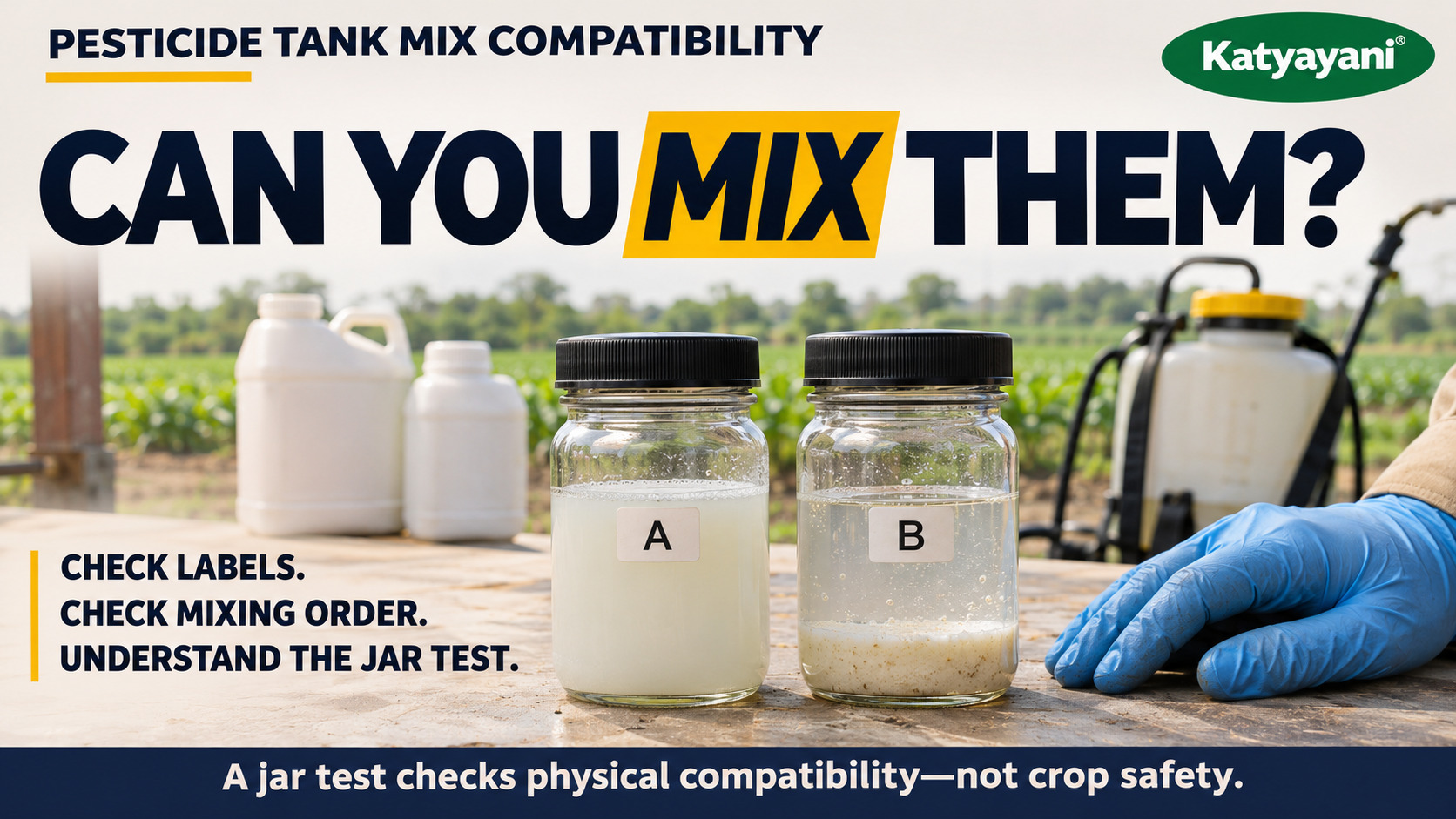
Do not mix living products with chemicals on the assumption that it is safe. TNAU says chemical pesticides can harm released biocontrol agents and that NPV should not be mixed with insecticides. NCOF stresses using the right biofertilizer combinations. A jar test and the label are the safe starting point, and a biostimulant label may say what not to mix.
Mixing living organisms with strong chemicals is the main way farmers waste a biological product. A fungicide that kills Trichoderma in the tank is no longer a bio input at all. The live post on bio vs chemical inputs sets out a stage-by-stage order for using both in one season, and the chana post shows how seed treatments are ordered.
| Mix | What the sources say | Practical rule |
|---|---|---|
| Biofertilizer plus PSB for legumes | NCOF recommends Rhizobium plus PSB as a seed treatment together | Fine as a standard pair |
| Biofertilizer plus chemical fungicide or insecticide | TNAU: chemicals can harm released agents | Keep them apart in time and in the tank; read the label |
| NPV plus insecticide | TNAU: not advised, cross-resistance concern | Spray separately |
| Biostimulant plus alkaline products | A product page on this site says do not mix with alkaline products and to jar-test any tank partner | Follow the label of the exact product |
| Biopesticide plus another biopesticide | CIB&RC allows consortia of compatible strains | Use registered consortia, not guesses |
Which one do you need for your problem?
Match the input to the problem. Poor nodulation or low phosphorus availability points to a biofertilizer. Heat, drought or a tough transplant points to a biostimulant. A disease or insect you can see points to a biopesticide, or a chemical if the outbreak is heavy. A hormone problem such as flower drop is a plant growth regulator question.
| Problem you can see | Likely box | Example input | Remember |
|---|---|---|---|
| Legume roots with few or no nodules | Biofertilizer | Rhizobium culture for that crop | Rhizobium is crop specific (NCOF) |
| Phosphorus locked in the soil, slow early growth | Biofertilizer | Phosphate solubilising bacteria | Does not add phosphorus, only releases it |
| Transplant shock, heat or drought stress | Biostimulant | Seaweed extract or amino acid spray | Claim limited to its Schedule VI entry |
| Wilt, root rot, damping off in nursery | Biopesticide | Trichoderma or Pseudomonas | Preventive use works better than rescue |
| Sucking pests or caterpillars at early stage | Biopesticide | Beauveria, Metarhizium, Bt, NPV | Needs regular use and good coverage |
| Heavy outbreak already spreading | Often a chemical first | Registered chemical, then biologicals for follow-up | Biologicals work best early (TNAU, live bio vs chemical post) |
| Flower drop or fruit set problem | Plant growth regulator, or a biostimulant if its entry says so | Registered PGR, or a listed biostimulant | PGRs sit under the Insecticides Act |
You will find a seaweed extract biostimulant page and a algae extract biostimulant page on this site. The first says it is a liquid seaweed biostimulant used alongside normal fertiliser, not instead of it. The second says it is a biostimulant that does not supply NPK, so it is not a fertiliser, and it does not control pests or diseases. Both statements match the definition above: neither is sold as a food, and neither claims to kill a pest.
What do you check on a pack before buying a bio input?
Check seven things: the product word on the pack, the organism or ingredient, the crop it is meant for, the manufacturer name and address, the batch number, the manufacture and expiry dates, and the instructions for use. For a biopesticide, also look for the registration number. A pack with no expiry date has no place in a live-microbe product.
- Read the word on the pack. A biofertiliser should say BIO-FERTILISER/ ORGANIC FERTILISER (FCO). A biostimulant should say Biostimulant. A biopesticide should carry an insecticide label with a hazard diamond.
- Find the organism or active ingredient by its proper name, for example Rhizobium, Trichoderma viride or Beauveria bassiana, and not just a brand name.
- Find the crop. Rhizobium is crop specific, so the culture should name your legume (NCOF).
- Find the manufacturer name and address, the date of manufacture, the date of expiry and the batch number (NCOF list).
- For a biopesticide, find the registration number and the colour band (Rule 19).
- Look for the count: CFU per gram or per ml. A count below the schedule or guideline minimum is a sign the pack may fail.
- Read the instructions for use, the storage line and the compatibility line before you open it.
Be careful with big claims. Rule 19 bars safety claims on insecticide labels, and the biostimulant order frames claims around the benefits written for each product. If a bottle promises to fix nutrients, kill pests and double your yield, it is not following either rulebook.
One more observation from this site: some Katyayani product pages, such as the Trichoderma viride, Beauveria and seaweed pages, show the product details but do not print a CIB&RC number or a Schedule VI reference in the page text. Look for that line on the physical label of any bio input, from any brand, before you buy.
What mistakes do farmers make when they mix up these three?
The costliest mistakes are using a biostimulant to treat a disease, a biopesticide to feed a crop, or a biofertilizer as a quick fix after the crop is already stressed. Others are leaving packets in the sun, mixing live products with chemicals, and treating one bottle as if it did three jobs.
| Mistake | Why it fails | What to do instead |
|---|---|---|
| Using a biostimulant on a diseased crop | A biostimulant is not allowed to claim pest or disease control | Use a registered biopesticide or fungicide for the disease |
| Using a biopesticide as a fertiliser | It does not supply nutrients | Use a biofertilizer or a fertiliser for nutrition |
| Using Rhizobium for the wrong crop | Rhizobium strains are crop specific | Buy the culture labelled for your crop |
| Expecting a biofertilizer to replace all nitrogen | NCOF quotes 15 to 25 kg N per ha per season for Azotobacter, not a full dose | Use it with a reduced chemical dose, not as a total replacement |
| Leaving packets in a hot shop or the field | They are live products; counts drop in heat and over time | Store cool and dry, use before the expiry date |
| Tank-mixing fungicide with Trichoderma | Chemicals can harm the living agent | Keep them apart in time and tank |
| Trusting a pack with no batch or expiry | Live products lose count with age | Do not buy it |
| Believing "one product, three jobs" | The law gives each product one main box and one set of tests | Buy by the claim you need |
The live guide to fake pesticides and fertilisers explains what to do if a pack fails these checks.
Do other countries use the same three boxes?
No. India splits the three between two laws, but other systems cut the cake differently. The US EPA, for example, defines biopesticides as pesticides derived from natural materials such as animals, plants, bacteria and certain minerals, and groups them into biochemical, microbial and plant-incorporated protectants. Its list has no separate box for fertilizer-type microbes.
The EPA page gives examples such as canola oil and baking soda. Biochemical pesticides act by non-toxic mechanisms, like insect sex pheromones. Microbial pesticides use a living microorganism such as a bacterium, fungus, virus or protozoan, and the most widely used is Bacillus thuringiensis. Plant-incorporated protectants are pesticidal substances produced by a plant from genetic material added to it.
Why does this matter to you? If you read a foreign article about "biologicals", the word can cover nutrient microbes, stimulants and pest-control agents together. In India, the label word and the law matter, because they decide which tests the product passed and which officer can inspect it. For export of products and registration abroad, see the live post on biopesticide registration in the EU, US and Africa.
Conclusion
A biofertilizer feeds the crop through living microbes, a biostimulant helps the plant use its food and cope with stress, and a biopesticide controls a pest or disease. In India the first two answer to the Fertiliser Control Order, 1985, and the third to the Insecticides Act, 1968. Read the pack word, the organism name, the crop, the batch and expiry, and for a biopesticide the registration number. Buy by the claim you need, keep live products cool and apart from chemicals, and treat any "one bottle, three jobs" promise as a warning.


Leave a Comment