Loading…
Loading…
Explore guides on agri business, licenses, registrations, and compliance requirements.
22 articles
 8 min
In agri inputs, a wholesaler buys in bulk from the company or distributor and sells to retailers and big buyers. A retailer sells to farmers. For fertiliser, the dealer margin is capped by government: Rs 354 per tonne on urea, and up to 2% of MRP on DAP and MOP. For pesticides and bio-inputs no official margin exists. Credit given to farmers, and the long wait for payment, is the biggest risk at every level.
 5 min
A pesticide sale licence is valid for 2 calendar years and is renewed on Form VII; a late application is allowed within 3 months with a late fee. A fertiliser authorisation is valid for 3 years, and late renewal is allowed only within 1 month. A seed licence is valid for 3 years, renewed on Form C, with a 1-month late window. Apply before expiry. Fees and online portals are set by each state.
 5 min
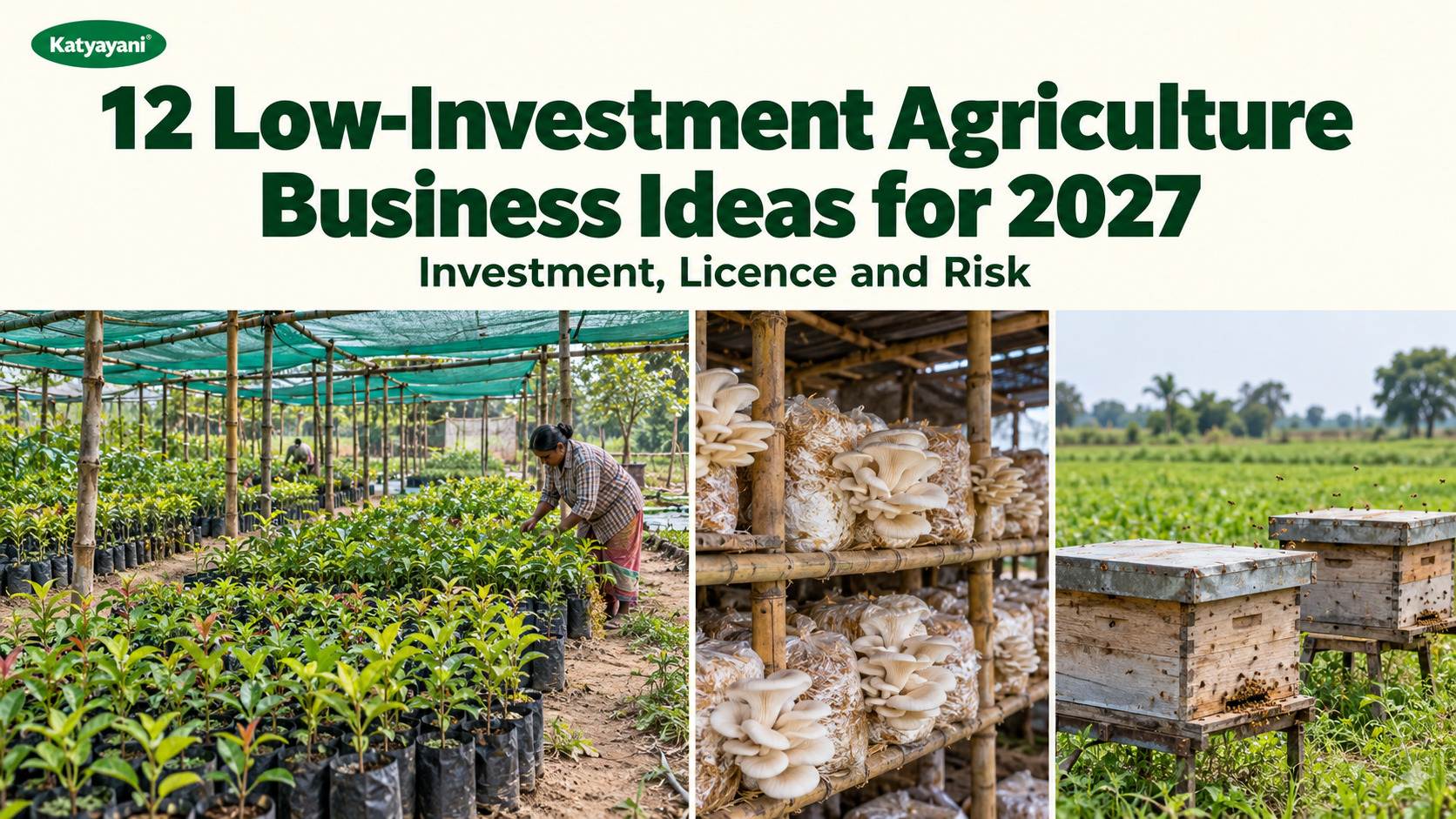
The best low-investment agriculture businesses for 2027 are agri-input retail, a micro-dealer or sub-dealer role, own-brand bio-inputs through a contract maker, vermicompost, oyster mushrooms, a plant nursery, custom hiring, drone services, beekeeping, makhana or millet processing, an FPO and cold storage. Each differs in money needed, licence and risk. The table below compares all 12.
 14 min
Commercial farming means growing crops or raising animals mainly to sell, using higher doses of modern inputs such as high yielding variety (HYV) seeds, fertilisers and crop protection to get higher productivity (NCERT Class 10). It is the opposite end of the scale from subsistence farming, where the harvest mainly feeds the family. Plantation farming (tea, coffee, rubber, sugarcane, banana) is a form of commercial farming. The same crop can be commercial in one region and subsistence in another: NCERT notes rice is a commercial crop in Punjab and Haryana but a subsistence crop in Odisha. Most Indian farms are small, so the practical routes are a market-first crop choice, FPOs, contract buyers, e-NAM, credit and insurance.
 5 min
A private label fertilizer manufacturer produces, tests and packs fertilizer under your brand name while holding the FCO certificate of manufacture. You typically register as a wholesale dealer or marketer with a source certificate, register your trademark, approve the label and place orders above the agreed MOQ. Pesticides need CIB&RC registration and a manufacturing licence.
 5 min
An agri-input franchise in India is a retail store that sells seeds, fertilizers, pesticides and bio-inputs under a company's brand, with its supply, training and marketing support. You still need your own state licences. Investment mainly covers shop setup, licences and opening stock; margins depend on product mix and credit discipline.
 15 min
To start an agriculture business in India, (1) pick one model that matches your land, skill and local demand, (2) write a simple business plan with costs and buyers, (3) choose a legal structure and register on Udyam (free) and GST if your turnover or buyers require it, (4) get activity-specific licences such as a pesticide, fertilizer or seed dealer licence, FSSAI for food, or a DGCA remote pilot certificate for drones, and (5) apply for credit-linked support such as the Agriculture Infrastructure Fund, AC&ABC, PMFME or Mudra through your bank. Start small, sell before you scale.
 12 min
Poultry farming means raising chickens (or ducks, quail, turkey) for meat, eggs or both. Broilers give the fastest cash turnover (sale in about 5-6 weeks), layers give steady daily income but need much more capital, and improved desi birds such as Vanaraja, Gramapriya or CARI-Nirbheek suit low-investment backyard farming. Plan about 1 sq ft of floor per broiler, feed is the biggest cost, and profit depends mainly on feed conversion, mortality and the selling price in your local market.
 5 min
To start an agri-input shop, you need a seed licence, fertilizer registration under the FCO and a pesticide sale licence from your state agriculture department, plus a qualified person (agri degree, diploma, DAESI or approved course). Indicative capital is about ₹3 lakh to ₹15 lakh. Subsidised fertilizers earn thin fixed margins; profit comes mainly from pesticides, bio-inputs and specialty nutrition.
 5 min
To get a pesticide licence in India, you (or an employee) need a science or agriculture degree or an approved diploma such as DAESI. You then apply to your state agriculture department, usually online, with ID, shop proof, principal certificates from suppliers and the fee. A fertilizer licence is a separate authorisation under FCO 1985 using Form A1.
