 5 min read
How do you choose the right agriculture
business?
Ask three simple questions. How much money can I put in
without borrowing more than I can repay? What can I do well in my village or
town? Who will buy from me every month? A business with a steady buyer, such as
a local shop, a processor or a hotel, is safer than one that depends on a good
season. If you want the step-by-step process of setting up, read our guide on how to start an agriculture business in India.
This post is the ideas list. That one is the process.
Quick comparison of the 12 ideas
|
# |
Idea |
Money needed (and basis) |
Licence or registration |
Main risk |
|
1 |
Agri-input retail shop |
No official figure. One
blog puts retail working capital at Rs 3-5 lakh (estimate). |
Fertiliser authorisation
(Form A1/A2), pesticide and seed licences; GST |
Farmer credit, expiry,
banned products |
|
2 |
Micro-dealer / sub-dealer |
No published figure. Cost
depends on stock and deposit. |
Often works under a
licensed dealer; rules vary by state |
Depends on the principal
dealer |
|
3 |
Own-brand bio-inputs
(private label) |
No published figure.
Depends on order size with a contract maker. |
Product registration and
GST; check rules for your product type |
Quality and compliance
liability |
|
4 |
Vermicompost unit |
NABARD unit cost Rs 3 lakh
for a 30 x 8 x 2.5 ft unit (Arunachal, 2025-26); HDPE bed Rs 24,000 |
No FCO authorisation if
capacity is under 50 tonnes a year; GST |
Slow sales, uneven quality |
|
5 |
Oyster mushroom |
NHB model about Rs 49,790;
KVK demo unit Rs 7,350 |
FSSAI registration if dried
or packed |
Contamination, short shelf
life |
|
6 |
Plant nursery |
NABARD unit cost Rs 7 lakh
for a 1 ha private nursery (Arunachal) |
State nursery rules; seed
licence if selling seed |
Plant loss, seasonal demand |
|
7 |
Custom hiring centre |
Subsidy norms assume
projects of Rs 10 lakh and above |
Udyam; vehicle papers |
Seasonal use, loan EMI |
|
8 |
Agri drone services |
Subsidy ceiling Rs 8 lakh
at 80% implies about Rs 10 lakh (inferred) |
Remote pilot certificate
from a DGCA-approved school; drone registration |
Seasonal work, rule changes |
|
9 |
Beekeeping |
NABARD unit cost Rs 6,000
per colony (20 colonies Rs 1.2 lakh); Assam scheme prices a colony at Rs
2,000 |
FSSAI for honey; state
registration may apply |
Colony loss, flower
shortage |
|
10 |
Makhana or millet
processing |
PM-FME grant 35% up to Rs
10 lakh; project cost not sourced |
FSSAI, Udyam, GST |
Raw material and buyers |
|
11 |
FPO or aggregation |
No published figure |
Company or cooperative
registration; GST |
Governance, working capital |
|
12 |
Cold storage or pack house |
Pack house norm Rs 17.5
lakh; cold storage Rs 2,800-3,500 per tonne (older norms) |
FSSAI if food; electricity
and fire NOC |
High power cost, low use |
Where I write "inferred", I worked it out from a subsidy cap and percentage. NABARD unit costs are from the Arunachal Pradesh regional office and may differ in your state. Where I write "no published figure", I could not find a reliable source. Treat blog figures as estimates only.
1. Agri-input retail shop
You sell fertilisers, pesticides, seeds and tools to farmers
in your area. For fertiliser, you file a Memorandum of Intimation in Form A1
with a certificate of source, and the Form A2 acknowledgement acts as your
authorisation, valid three years, under the Fertiliser Control Order
↗. Pesticide sale needs a licence and a qualified person. Credit given
to farmers is the biggest risk. Read the agri-input shop business plan for costs, and
the licence guide for the forms. Margin facts are
in our post on wholesale vs retail agri inputs, and renewal
rules are in the licence renewal guide.
2. Micro-dealer or sub-dealer
A micro-dealer serves a few villages and buys from a
licensed dealer or company. It needs less money than a full shop. Whether you
need your own licence depends on your state, so ask your district agriculture
office before you start. A franchise model can give you stock and training. See
agri-input franchise models. [DEV NOTE: add a
link to the Katyayani Micro-Dealer initiative page here.]
3. Own-brand bio-inputs (private label)
You get a contract maker to produce under your brand name
and you sell through your own network. This avoids a factory, but you carry the
brand risk. Quality control and product registration matter. Learn how this
works in our guide to private label fertiliser makers, and see the
finished range in the bio-fertilizer collection to understand
product types.
4. Vermicompost unit
Earthworms turn farm waste into organic fertiliser. A NABARD
unit-cost sheet for 2025-26 from the Arunachal Pradesh office lists Rs 3 lakh
for a vermicompost unit of 30 x 8 x 2.5 feet and Rs 24,000 for an HDPE vermi
bed of 12 x 4 x 2 feet (NABARD unit costs ↗). These are
state-specific unit costs, not an all-India model. A key legal point: under the
FCO, a vermicompost maker with annual capacity under 50 tonnes (who is not a
government body) does not need an authorisation letter. Larger units and
sellers should check state rules.
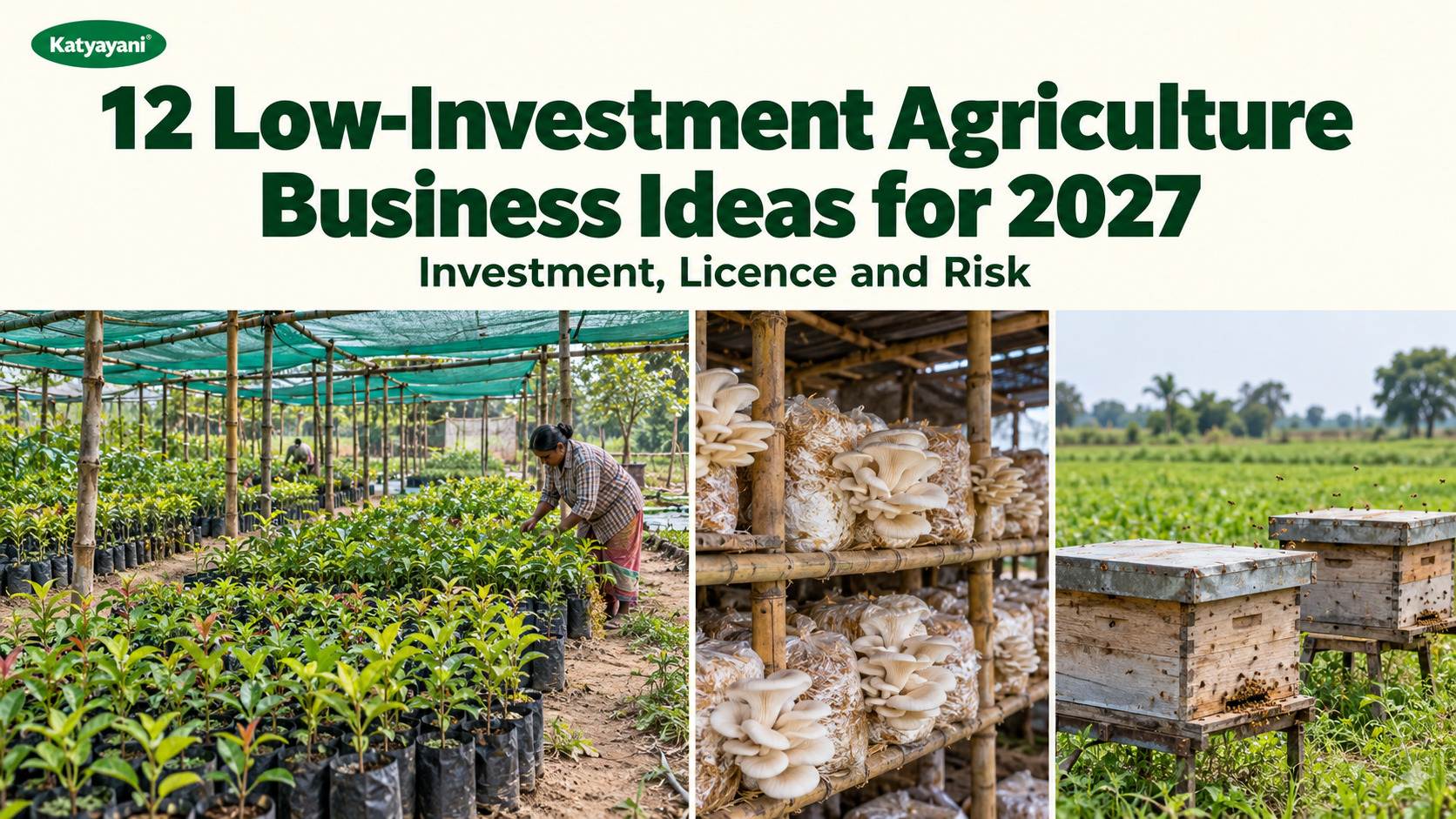
5. Oyster mushroom farming
You grow mushrooms indoors on straw. The NHB model cost
sheet totals about Rs 49,790 including contingencies, with a 300 sq ft HDPE
growing room at about Rs 15,000 and plant and machinery near Rs 11,900 (NHB model sheet ↗). A KVK
Tinsukia demonstration unit cost Rs 7,350 with a gross return of Rs 37,500 and
a benefit-cost ratio of 4.10 (KVK Tinsukia ↗). These are
small models, not a business plan. Fresh mushrooms spoil quickly, so you need a
nearby buyer. Learn the method in our oyster mushroom farming guide.
6. Plant nursery
You raise saplings and seedlings for orchards, kitchen
gardens and vegetable growers. NABARD lists Rs 7 lakh for a one-hectare private
nursery in its Arunachal sheet. Under the horticulture mission, small nurseries
up to one hectare can get 50% support up to Rs 7.5 lakh, and hi-tech nurseries
40% up to Rs 40 lakh, as listed by Telangana Horticulture Mission
↗. These are older norms, so check current rules. If you grow under
cover, see the polyhouse and shade net subsidy.
7. Custom hiring centre
You buy a tractor or implements and rent them to farmers by
the hour. Support under the farm mechanisation scheme is about 40% of project
cost, with caps that rise with project size (Vikaspedia summary ↗). Other
sites show different caps, so check the official portal. See also the tractor subsidy guide.
8. Agri drone services
You spray crops with a drone for farmers. Namo Drone Didi
gave 80% assistance up to Rs 8 lakh to women self-help groups, with an outlay
of Rs 1,261 crore for 2023-24 to 2025-26, and the balance could be financed
through AIF loans with 3% subvention (PIB-hosted document ↗). One
report says only 1,094 drones were distributed in 2023-24, and I found no
confirmation of continuation beyond 2025-26. A Remote Pilot Certificate from a
DGCA-approved training school is needed to fly. I could not confirm whether a
normal crop-spraying service needs a pesticide licence, so ask your agriculture
office. Our agri drone subsidy guide explains the options.
9. Beekeeping
Bees give honey and help pollination. Costs differ by state.
NABARD's Arunachal sheet lists Rs 6,000 per nucleus colony, or Rs 1.2 lakh for
20, while state schemes under the national bee mission price an 8-frame colony
at Rs 2,000, with 40% assistance and a cap of 50 colonies per person (Assam scheme description
↗). Honey needs FSSAI registration or licence by turnover. Disease and a
shortage of flowers are the main risks.
10. Makhana or millet processing
You clean, grade and pack makhana or millets for sale. The
PM-FME scheme gives a 35% credit-linked grant up to Rs 10 lakh per micro unit.
Reports say the scheme was extended to September 2026 and that the ministry is
seeking a five-year continuation from 2026-31 with revised norms, but I found
no confirmation that it was approved (The Hitavada report ↗).
That means it may already have lapsed, so verify with the ministry. Start by
learning the crop in our makhana farming guide. For food licensing,
reports say FSSAI limits changed from 1 April 2026: registration up to Rs 1.5
crore turnover, a state licence for Rs 1.5 to 50 crore and a central licence
above Rs 50 crore (IRIS MSME alert ↗). Confirm
on the FSSAI website.
11. FPO or farmer aggregation
A farmer producer organisation buys inputs and sells produce
for many farmers together. It takes time to build trust and needs good
record-keeping. See SHG vs FPO, the FPO credit guarantee scheme and the bulk buying guide for FPOs.
12. Cold storage or pack house
You store or sort fruit and vegetables for sale. Mission
norms put a pack house at Rs 17.5 lakh with 35% support in general areas, and
cold storage at Rs 2,800 to Rs 3,500 per tonne (Assam cost norms ↗). These are
older norms. Power cost is high, so you need steady use.
Which government support can you use?
|
Support |
What it gives |
Check |
|
PMEGP |
Projects up to Rs 50 lakh
(manufacturing) and Rs 20 lakh (services). Subsidy for new units: general 15%
urban and 25% rural; special categories 25% urban and 35% rural. |
PMEGP document ↗; see also our PMEGP loan guide |
|
Agriculture Infrastructure
Fund |
3% interest subvention on
loans up to Rs 2 crore for up to 7 years. The scheme runs to 2032-33; the
financing window may have been extended beyond 2025-26. |
AIF page ↗ |
|
Stand-Up India |
Loans for SC/ST and women
entrepreneurs |
|
|
CGTMSE |
Credit guarantee for small
units |
Scheme rules change. Confirm each one with the official portal or your bank before you apply. AIF has sanctioned about Rs 59,943 crore for 98,744 projects up to 28 February 2025, according to a Rajya Sabha answer reported in secondary sources.
Which idea is best for a student or a village?
|
If you are |
Consider |
|
A student with a small
budget |
Micro-dealer role, nursery
on a small plot, mushroom, or drone service as a partner |
|
A village woman or SHG
member |
Mushroom, beekeeping,
millet processing, drone services through an SHG |
|
A farmer with land and a
tractor |
Custom hiring,
vermicompost, nursery |
|
Someone with some capital
and a shop site |
Agri-input retail |
Conclusion
There is no single best agriculture business. The best one
is the one that fits your skills, your money and your local buyers. Start
small, test the market for one season and reinvest. Check licences before you
buy stock, and confirm scheme rules before you rely on a subsidy. To set up the
business step by step, read our guide on how to start an agriculture business
in India next.
Why trust this guide
Written by Team Katyayani, Editorial Team at Katyayani Organics. Cross-checked against published research and university extension programs.


Leave a Comment