Loading…
Loading…
Explore Rabi and horticulture crop guides with practical tips on cultivation, nutrition, pest control, disease management, and better crop growth.
69 articles
 15 min
Marigold (genda) can be grown in three seasons: rainy (nursery mid-June, transplant mid-July), winter (nursery mid-September, transplant mid-October) and summer (nursery January-February, transplant February-March), per the TNAU lecture on the ICAR e-course. Raise seedlings for about four weeks, plant at 40-45 cm between rows, pinch the top at 30-40 days and expect the first picking about 60 days after planting. Published yields run about 11-18 tonnes per hectare for African types, which is roughly 4.5-7.3 tonnes per acre. A 2020-21 Punjab survey of 25 growers reports about Rs 49,519 variable cost and Rs 48,934 net income per acre, but price swings with festivals, so check the local mandi before you plant.
 14 min
The vegetables that official sources list for the rainy (kharif) season are okra, tomato, brinjal, chilli, bottle gourd, bitter gourd, cucumber, ridge gourd, pumpkin, cowpea and amaranth. Most are sown or transplanted from May to July, on raised beds or ridges with drainage channels. The quickest are leafy: amaranth greens in about 25 days and fenugreek greens in 20 to 25 days (TNAU). Dates change with region, so check your state university or KVK.
 14 min
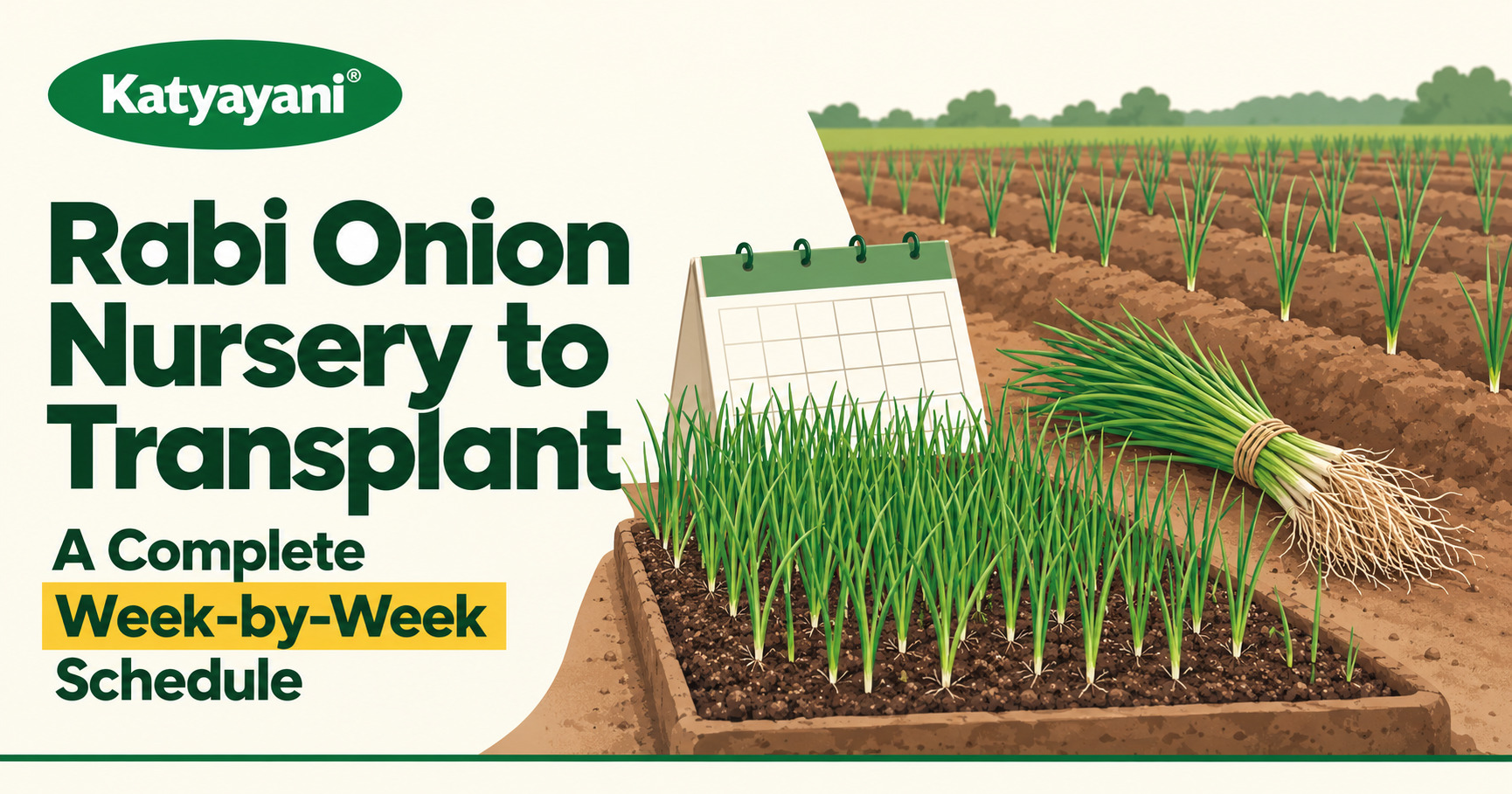
Sow the rabi onion nursery in the window your state follows: October to November in the northern plains and Rajasthan, November to December in Maharashtra and Gujarat, September to October in Tamil Nadu, Karnataka and Andhra Pradesh (NHB). Plan about 8 to 10 kg of seed per hectare, which is about 3 to 4 kg per acre (5 to 7 kg per hectare, about 2 to 3 kg per acre, where drip or sprinkler irrigation is used). Raise seed on raised beds, treat seed first, sow thinly in lines 5 to 7 cm apart and keep the soil moist but never flooded. Transplant at about 50 to 60 days, when seedlings are around 15 cm tall and 0.8 cm thick at the neck.
 5 min
For chana pod borer control, install 5 pheromone traps and 20 bird perches per hectare at flowering, and act when you find one mature larva per metre row or 2 young larvae per 10 plants. For mustard aphid, spray only when 10% of plants carry 26 to 28 aphids on the top 10 cm of shoot.
 5 min
Frost protection in crops means keeping plant tissue above freezing on cold, clear, still nights. The simplest steps are a light irrigation in the evening when frost is forecast, covering nurseries and young plants overnight, and, for mustard, gram and rajma, a spray of 0.1% sulphuric acid or 500 ppm thiourea as advised in agromet bulletins.
 5 min
Potato late blight control depends on spraying before symptoms appear. Start a protective mancozeb or chlorothalonil spray (0.2 to 0.25%) when forecasts show 10 to 20 C with high humidity or fog for more than 18 hours. At the first lesion, switch to a systemic such as cymoxanil + mancozeb or dimethomorph, repeating every 7 to 10 days.
 14 min
Treat chana seed on the day before or the morning of sowing. Pick one protection route: a fungicide dressing (university pages list carbendazim at 2 to 2.5 g per kg, or carbendazim plus thiram) or a Trichoderma bio-agent (4 g per kg on the TNAU wilt page). Do not mix a fungicide with Trichoderma unless the label says they are compatible. Apply Rhizobium (one 200 g packet per 10 kg seed, TNAU) after the protection step and sow the same day. Seed treatment lowers wilt but does not cure a sick field: also rotate crops, avoid warm-soil sowing and choose a wilt-resistant variety. Follow the product label for every dose.
 15 min
Sow irrigated Indian mustard between 10 and 25 October, ideally finishing by 20 October, when day temperature is not above 32 degrees C (ICAR-DRMR). ICAR advises 80:40:40 kg N:P2O5:K2O per hectare for timely sowing (about 32:16:16 kg per acre, our conversion) and 100:50:50 for late sowing, plus 40 kg sulphur per hectare (about 16 kg per acre), with half the nitrogen at sowing and half at the first irrigation, 30 to 45 days after sowing. Zinc sulphate at 25 kg and borax at 10 kg per hectare are for soils that need them. ICAR-DRMR reports that 40 kg sulphur per hectare can raise seed oil content by up to 2 percent and seed yield by up to 25 percent. Let your soil test decide the final dose.
 14 min
The best time to sow irrigated wheat is 1 to 15 November in Punjab, Haryana, western Uttar Pradesh, Rajasthan, Maharashtra and Karnataka, and 10 to 20 November in eastern Uttar Pradesh, Bihar, Madhya Pradesh and Gujarat (ICAR zone dates). Use about 40 kg seed per acre (100 kg per hectare) for timely sowing and about 50 kg per acre (125 kg per hectare) for late sown or rainfed wheat. Late sown wheat yields less: 44.5 against 54.3 q/ha in NWPZ in ICAR-IIWBR trial data. Treat seed against smut and termite, sow 4 to 6 cm deep, and drill DAP and potash with the seed.
