 14 min read
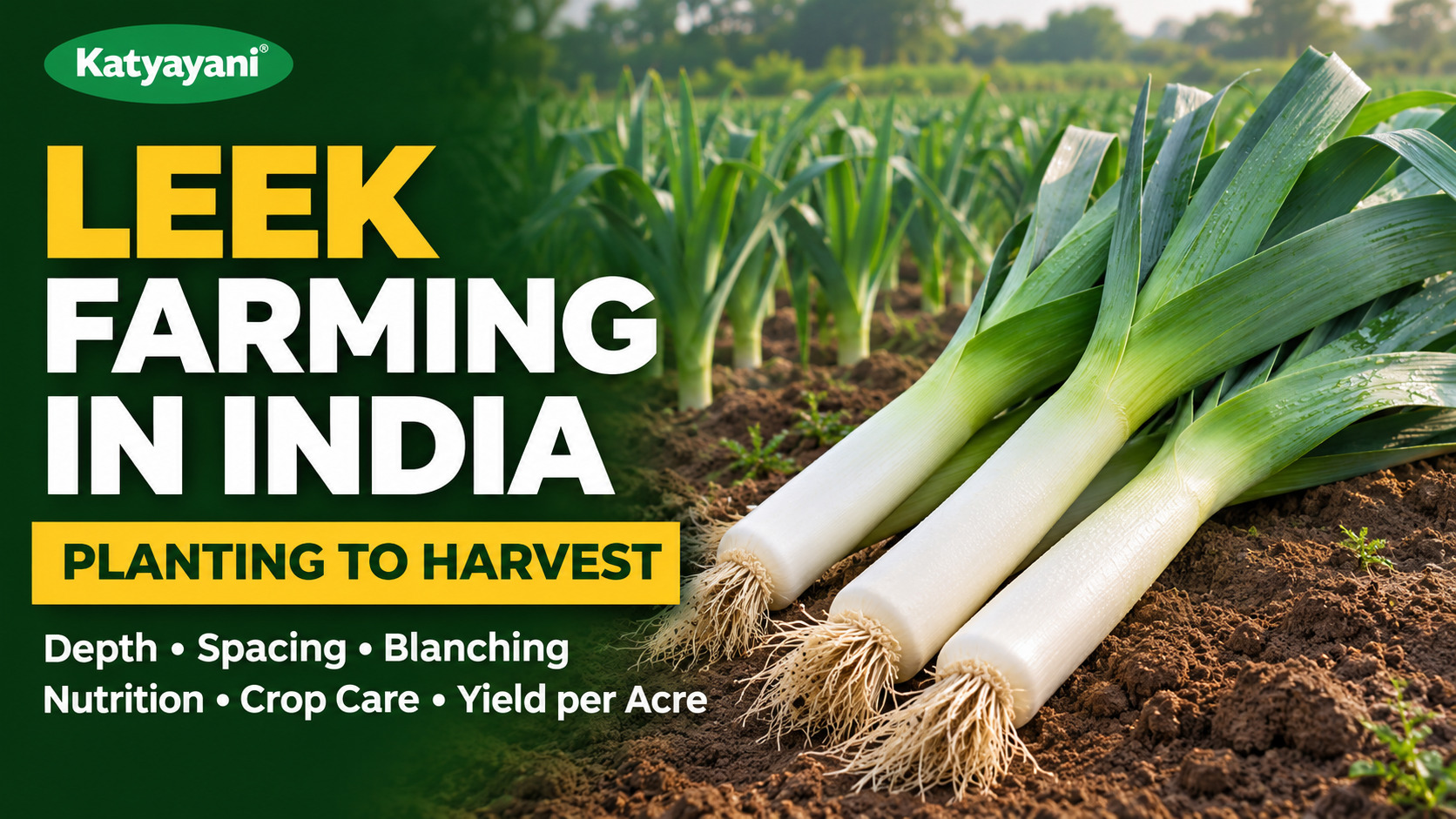
Leek (Allium porrum) is a non-bulbing onion relative grown for its blanched white stem. ICAR-linked authors say commercial leek farming is not practised in India and the crop is mostly a kitchen-garden vegetable, so there is no official Indian package of practices. The two Indian-named cultivars are Palam Paushtik (about 140 to 150 days, 300 to 350 q per ha, per CSKHPKV) and PPL-1. Raise seedlings to pencil thickness, plant them into a trench 10 to 15 cm deep, and hill soil up gradually so 15 to 20 cm of the stem stays white (OMAFRA, Canada). OMAFRA gives 200 to 250 kg N per ha split in three. Leek-specific problems are onion maggot, cutworm, rust, white tip and white rot. Cost and profit per acre could not be sourced for India.
What is leek, and can you grow it commercially in India?
Leek (Allium porrum, also written Allium ampeloprasum var. porrum) is an onion-family vegetable that does not form a bulb. You grow it for the long white shaft and the leaf bases. In India it is a small-scale crop, mostly kitchen gardens, so treat it as a niche market crop and test demand first.
The Just Agriculture article by ICAR-IARI and ICAR-DOGR authors calls leek a non-bulb-forming biennial and says plainly that commercial leek production is not practised in India. It adds that very little improvement work has been done on Indian leek cultivars and that the ones grown are introduced types. The ICAR magazine Indian Horticulture also lists leek among the less-known alliums, next to scallion, shallot and chives, in its review of minor Allium species.
What does that mean for a grower? Two things. First, there is no government package of practices to copy, so treat every number in this guide as a starting point for a small trial plot. Second, the buyer is likely to be a hotel, restaurant, retail chain or city market, not the normal mandi. Speak to the buyer before you plant a large area.
If you already grow onion or garlic, leek will feel familiar. This guide skips the general allium material and covers only what is specific to leek. For the basics of the crops grown at scale, read our guides to onion farming in India and garlic farming in India.
How is leek different from onion, spring onion and garlic?
Leek has flat, folded leaves and a thick white shaft with no real bulb. Onion forms a bulb, spring onion has tubular leaves and a small bulb, and garlic forms cloves. Leek is milder and sweeter than onion and is eaten cooked in soups and stews, though tender stems can be eaten raw.
| Crop | What you eat | Leaf shape | Bulb | Source |
|---|---|---|---|---|
| Leek | Blanched shaft (pseudostem) and leaf bases | Flat | No true bulb | Just Agriculture |
| Onion | Bulb | Tubular | Yes | Just Agriculture |
| Garlic | Cloves | Flat, narrow | Yes (cloves) | Just Agriculture |
| Palam Paushtik leek | Sold as an alternative to green onion for salad, soup and cooking | Flat | No | CSKHPKV |
The Just Agriculture authors say leek has a gentler, sweeter flavour than onion but a coarser texture. Because the sale value sits in the white shaft, almost every leek practice (deep planting, hilling, careful weeding, keeping soil out of the leaf folds) is about producing a long, clean white stem.
Which climate suits leek farming?
Leek tolerates low temperature and has no day-length need or bulb resting stage, which is why it is grown so widely. High temperature reduces stem thickness, so cool hill and highland areas give the best shafts. There are no tropical leek cultivars apart from vegetatively propagated forms.
| Climate point | What the source says | Source |
|---|---|---|
| Low temperature | Low temperature tolerance, no photoperiod requirement and no bulb resting stage make leek a versatile crop | Just Agriculture |
| Tropical types | No tropical cultivars other than vegetatively propagated tropical forms and old imports from temperate countries | Just Agriculture |
| Heat | High temperatures reduce stem thickness (Sri Lanka) | HORDI Sri Lanka |
| Early and late types | Early leeks are more frost susceptible; late types are the ones that need blanching | Just Agriculture |
In practice this points to hill districts and cool winter conditions. In the hot plains the quality risk is a thin, short stem, so do not expect hill-quality shafts from a hot-season harvest.
Which soil and pH does leek need?
Leek wants deep, well-drained soil with plenty of organic matter. OMAFRA prefers a deep topsoil with a pH of 6.5 to 7.0 and advises avoiding coarse sand, because grit lodged between the leaf sheaths is unwelcome to buyers. Test your soil first and correct it before planting.
The OMAFRA leek production page (Ontario, Canada) is the source for the pH figure. It is a cold-climate government recommendation, not an Indian one, so use it as a target and confirm it against your own soil test. Our post on soil pH and nutrient lock explains why a wrong pH makes fertiliser ineffective, and our guide to the soil health card shows how to read pH, organic carbon, phosphorus and potassium.
SARE's New York manual adds that compost should be incorporated and leek planted in raised beds. Raised beds help drainage, which also matters for the white tip and white rot diseases covered below.
Which leek varieties are grown in India?
Only a few are named in Indian sources. Palam Paushtik is listed by CSKHPKV Palampur for salad, soup and cooking with 300 to 350 q per ha. Just Agriculture also names PPL-1, London Flag and American Flag. All cultivars in use are introduced or selected from introductions.
| Cultivar | What the source says | Duration | Source |
|---|---|---|---|
| Palam Paushtik | Substitute for green onion; suitable for salad, soup and cooking; average yield 300 to 350 q per ha | About 140 to 150 days | CSKHPKV; Just Agriculture |
| PPL-1 | Light green leaves, swollen stem that does not form a bulb; decent substitute for green onion | 150 to 160 days | Just Agriculture |
| London Flag | Tall, broad leaves; most commonly cultivated | Not given | Just Agriculture |
| American Flag | Traditional home-garden type | 90 to 120 days | Just Agriculture |
| Lincoln | Early type with long white shanks; can be planted in the rabi season | About 80 days after transplanting | Just Agriculture |
The Just Agriculture article lists dozens of foreign cultivars, such as Musselburgh (hardy) and Lancelot (bolt resistant and virus tolerant). The University of Delaware also recommends Lancelot as disease tolerant and bolt resistant (Delaware leek factsheet). Whether foreign varieties perform in India is not shown in any source I opened, so run a trial of 100 square metres before planting an acre.
Early types take 50 to 100 days after planting, are smaller and milder, and do not need blanching. Late types take 120 to 180 days after germination, have broader stems and a stronger flavour, and need blanching for the best quality (Just Agriculture).
When should you sow leek in India?
No official Indian sowing calendar for leek was found, so none is given here. The Indian sources tell you only the duration: about 140 to 150 days for Palam Paushtik, and Lincoln is described as a rabi-season type. Choose a month by working back from the harvest you want and check with your KVK.
- Pick the harvest month your buyer wants.
- Count back the crop duration: about 140 to 150 days for Palam Paushtik (CSKHPKV) and 150 to 160 days for PPL-1 (Just Agriculture), which includes the nursery period.
- Check the weather for those months: the thickening weeks should be cool (see the climate section).
- Ask your KVK or state agricultural university for the window that suits your block, and test on a small plot first.
For comparison only, the OMAFRA page shows how a cold-climate grower schedules: summer leek transplants are started in a greenhouse in early March and set out in late April or early May, while late-fall types are seeded outdoors in late April or early May and transplanted in late June or early July. That is a Canadian calendar and does not transfer to Indian conditions.
How do you raise leek seedlings in a nursery?
Sow seed thinly in raised beds, keep the bed moist and plant out when seedlings are about pencil thick. Leek grows slowly and needs a few months in the nursery. Sri Lanka's department uses 3.75 kg of seed per hectare, about 1.5 kg per acre, sown in rows 15 cm apart in 3 x 1 m beds.
| Nursery item | Detail | Source |
|---|---|---|
| Seed rate | 3,750 g per ha (about 1.5 kg per acre, calculated) | HORDI Sri Lanka |
| Nursery beds | 200 to 225 beds of 3 x 1 m per ha; rows 15 cm apart; cover seed lightly with soil | HORDI Sri Lanka |
| Seedbed density | Aim for about 70 vigorous plants per metre of seedbed row | OMAFRA |
| Time in nursery | Leeks grow slowly and need a few months before field transplanting | SARE |
| Transplanting size | When seedlings are pencil thick | SARE |
For nursery disease control, our post on fungicide application methods explains seed treatment, drenching and spraying, and our rabi onion nursery schedule shows a week-by-week nursery routine for a related crop. Katyayani's Trichoderma viride bio-fungicide page lists seed treatment at 8 to 10 ml per kg of seed, a seedling dip of 500 ml in 50 litres of water for 30 minutes, and a nursery bed use of 500 ml mixed with 10 kg compost per acre. It names wilt, damping off and root rot but does not name leek or onion, so treat it as a general nursery option and read the label.
How do you prepare the field and plant leek, and how deep?
Plough deeply, mix in well-decomposed manure, and make raised beds or rows. Plant each seedling in a trench or hole 10 to 15 cm deep and let it fill gradually as the plant grows. OMAFRA says planting into a 10 to 15 cm trench with gradual hilling gives 15 to 20 cm of white shank.
HORDI Sri Lanka ploughs to 40 cm, adds well-decomposed organic manure and forms raised beds of 1.2 x 3 m. SARE's method is to transplant at pencil thickness, leave 1 to 2 inches of leaf above the soil, and keep the roots from bending upward.
- Moist soil. Water the nursery before lifting so roots come out with soil attached, and irrigate the field right after planting (OMAFRA).
- Do not bend roots upwards when dibbling (SARE).
- Keep soil out of the leaf fold, otherwise it turns into grit inside the shaft.
- Rotation. Leek shares diseases with other alliums, and OMAFRA lists white rot as a soil-borne problem, so avoid planting leek after onion, garlic or leek. See our crop rotation plans for a workable sequence.
What spacing and plant population should you use for leek?
OMAFRA uses 10 to 15 cm between plants. With 60 cm rows and 10 cm plants you get over 160,000 plants per hectare, about 65,000 per acre. With 91 cm rows and 15 cm plants you get over 70,000 per hectare, about 28,000 per acre. Closer spacing gives more but thinner stems.
| Layout (OMAFRA, Canada) | Plants per hectare (as stated) | Plants per acre (calculated) |
|---|---|---|
| 60 cm rows, 10 cm between plants | Over 160,000 | About 65,000 |
| 91 cm rows, 15 cm between plants | Over 70,000 | About 28,000 |
SARE's New York manual uses two rows on a 5 to 6 foot raised bed with 5 to 9 inches between plants in the row. Plants per acre are calculated as the hectare figure divided by 2.471. They ignore paths, so your real count will be lower. Use them to estimate how many seedlings to raise, and raise 10 to 15 percent extra to fill gaps after transplant shock.
How do you blanch leek and earth up the stem?
Blanching means keeping light off the lower stem so it stays white and tender. You do it by planting deep and gradually hilling soil around the plants, without letting soil fall between the leaves. OMAFRA aims for 15 to 20 cm of white shank from a 10 to 15 cm trench.
SARE's cultivation plan links weeding to hilling. The first pass, 7 to 10 days after transplanting, uses sweeps and a finger or tine weeder. The second pass uses side knives or spring hoes for slight hilling. A third pass, if possible, uses hilling discs. The Just Agriculture authors add that early leeks do not need blanching but late-season types do.
- At planting: put the seedling deep in a trench or hole so the first white section is already underground.
- First hilling: when plants are established, draw a little soil to the base and keep the leaf fold clean.
- Later hillings: repeat as the shaft grows, adding soil in thin layers over several weeks rather than all at once.
- Stop when the white section is the length your buyer wants; the green leaves must stay above soil.
A practical tip: hill when the soil surface is dry, because wet soil clings to leaves and ends up inside the shaft. Our post on mulching types and depth covers straw and film for weed control between hillings.
How much fertiliser does leek need?
OMAFRA recommends about 200 to 250 kg nitrogen per hectare, split into one-third pre-plant, one-third side dress and one-third top dress, plus 50 to 100 kg P2O5 and 150 to 200 kg K2O per hectare as sulphate of potash. That is about 81 to 101 kg N per acre (calculated). Confirm against a soil test.
| Nutrient (OMAFRA, Canada) | Per hectare | Per acre (calculated) | Note |
|---|---|---|---|
| Nitrogen | 200 to 250 kg N | About 81 to 101 kg N | One third pre-plant, one third side dress, one third top dress |
| Phosphorus | 50 to 100 kg P2O5 | About 20 to 40 kg P2O5 | Base on soil test |
| Potassium | 150 to 200 kg K2O | About 61 to 81 kg K2O | Sulphate of potash form |
This is a Canadian recommendation, so use it to size a trial, not as an Indian schedule. SARE adds that excess nitrogen favours purple blotch, so do not overfeed. For general allium sulphur and micronutrient advice, see the fertiliser section of our onion farming guide.
- Nitrogen with sulphur. Katyayani's ammonium sulphate fertilizer (21% N, 24% S) page lists onion among its vegetables and a rate of 25 to 75 kg per acre for vegetables, adjusted for growth stage and soil. The page does not name leek.
- Potassium. NPK 00 00 50 (potassium sulphate) is the sulphate form OMAFRA specifies. The product page lists onion, a foliar rate of 5 g per litre and a drip rate of 3 to 5 kg per acre, and does not name leek.
- Soil biology. The bio-fertiliser collection lists phosphate-solubilising, potash-mobilising and mycorrhizal products. No source I opened tested them on leek, so run them as a side-by-side trial next to a soil-test-based plan, not instead of it.
- Drip growers. A balanced water-soluble grade such as NPK 19 19 19 can top up between soil applications; its page gives 4 to 5 g per litre as a foliar spray or 1 to 3 kg per acre through fertigation, names vegetables in general but not leek, and says it does not replace soil applications. Our guide to water-soluble fertiliser for drip and bulk users and the NPK fertiliser collection cover grades and compatibility.
How do you irrigate and weed leek?
Irrigate right after planting and keep moisture steady, because leek is shallow rooted. Sri Lanka waters lightly in the morning, daily for four days after seedlings establish. SARE says to irrigate frequently, with the interval set by soil type, evaporation, rain and crop need. Weed early, shallowly, and by hand within the row.
Neither SARE nor OMAFRA gives a litre-per-plant figure, so no number is offered here. A simple field rule is to dig 10 cm beside a plant: if the soil does not hold together in your hand, irrigate. On sandy soil, short frequent irrigations work better than one heavy flood.
Young leek is slow, so weeds win early. OMAFRA suggests stale seedbeds, rotation, fields with few weeds and row spacing that allows cultivation. SARE warns that leeks are sensitive to leaf damage, so cultivate carefully, and HORDI Sri Lanka removes weeds by hand before each fertiliser dose. Straw or crop residue between rows helps in dry areas.
Which pests attack leek, and how do you manage them?
The leek-specific insect problems in the sources are onion maggot, root maggot and cutworm, with thrips as a shared allium pest. Use clean seedlings, rotation, sanitation and early scouting. Always confirm that any product is registered for your crop on CIB&RC before you spray.
| Pest | Damage | What the sources advise | Source |
|---|---|---|---|
| Onion maggot (Delia antiqua) | Stunted or wilting seedlings that break at the soil line | Sanitation, remove wild onion and chive volunteers, floating row covers stop egg laying. Ontario notes three generations per season | Penn State; OMAFRA |
| Root maggot (Delia spp.) | Wilting and shrivelling; spread largely through transported organic matter | Use clean, well-decomposed manure | HORDI Sri Lanka |
| Cutworm (Agrotis spp.) | Nocturnal; cuts plants at the base | Check young plants in the evening and early morning | HORDI Sri Lanka |
| Thrips | Silvery scarring, twisted leaves | SARE lists Beauveria bassiana as an option and repeats every 5 to 7 days, spraying at night | SARE; Penn State |
Thrips behave the same on leek as on onion and garlic, so for identification and control detail see the thrips section of our onion farming guide and our garlic farming guide. For a biological option, Katyayani's Beauveria bassiana page lists thrips and caterpillars among its targets, with a foliar rate of 5 ml per litre of water and 750 ml to 1 litre per acre. Its crop table names vegetables but neither onion nor leek, so read the label. Our explainer on biopesticides: types, examples and limits covers what these products can and cannot do.
Which diseases affect leek, and how do you prevent them?
OMAFRA names white rot, white tip and rust as the main leek diseases, with purple blotch, downy mildew and others also possible. Prevention is cultural: drained soil, rotation, no overcrowding, no excess nitrogen and removal of infected debris. Only spray a fungicide registered for your crop; check CIB&RC.
| Disease | What the source says | Source |
|---|---|---|
| White rot | Soil-borne; favoured by cool, wet seasons | OMAFRA |
| White tip | Appears after heavy summer rain, in poorly drained areas | OMAFRA |
| Rust | Common in dry summers (Ontario) | OMAFRA; also listed as a common leek problem by University of Delaware |
| Purple blotch (Alternaria porri) | Small water-soaked lesions with white centres, enlarging to brown-purple spots; long rotation, drained soil and foliage that dries in the day help; avoid excess nitrogen | Penn State; SARE |
| Downy mildew | Pale patches with grey-purple fuzzy growth; rotate 3 to 4 years and avoid overcrowding | Penn State |
The practical message is drainage. White tip and white rot are both tied to wet conditions, so raised beds and a field that does not hold water are your first defence. For purple blotch and downy mildew, which leek shares with onion, see the disease sections of our onion farming guide and use our explainer on fungicide application methods to get coverage on waxy allium leaves.
For leaf diseases such as rust, Katyayani's sulphur 80 WDG page names rust and mites among its targets, at 2.5 to 5 g per litre or 750 to 1,000 g per acre as a foliar spray. Its crop table lists grapes, mango, wheat, cumin, cowpea, guar, pea and apple, not onion or leek, so check the label and CIB&RC before use. Katyayani's onion collection page lists fungicides and insecticides for a related crop; none of its pages names leek.
When is leek ready to harvest, and how do you harvest it?
Palam Paushtik takes about 140 to 150 days. SARE says leek is ready when the shaft is about 1 inch (2.5 cm) across, with tall, dark green, blemish-free leaves. Loosen the soil with a fork, pull the plant, cut the roots at the root-stem junction and peel damaged outer leaves.
- Timing. Ontario harvests when the outer lower leaves start to senesce. Pick when your buyer's size is reached.
- Lifting. Use a fork or bed lifter to loosen the soil first, then pull (SARE).
- Trimming. Cut roots at the root-stem junction, peel damaged leaves and trim the tops evenly (SARE).
- Bunching. OMAFRA packs three uniform stalks per bunch, 12 bunches to a carton, and bigger stalks command better prices there.
- Washing. Rinse on a mesh table with clean water and take care not to bruise the leaves.
Harvest and washing are labour-heavy, so count labour hours in your trial. Ask your buyer how they want the leek trimmed and bunched before the first harvest.
What yield can you expect from leek per acre?
The one Indian yield figure from an opened source is 300 to 350 q per ha for Palam Paushtik on the CSKHPKV Palampur variety page. That is about 12 to 14 t per acre (calculated). It is a variety average from a hill university, not a promise for every field.
| Source | Yield per hectare | Yield per acre (calculated) | Context |
|---|---|---|---|
| CSKHPKV Palampur | 300 to 350 q (30 to 35 t) | About 12 to 14 t | Palam Paushtik, average yield |
Treat this as a ceiling for hill conditions. Stem size, spacing, disease and your trimming standard change the marketable share. Because leek trims heavily (outer leaves, roots, damaged tips), the weight you sell is always lower than the weight you pull.
How do you store and pack leek?
Cool leek quickly after harvest and hold it at 1 to 3 degrees C with high humidity. OMAFRA stores leek this way for 2 to 4 months. Keep it away from ethylene-producing fruit, because SARE notes ethylene turns the green leaves yellow.
| Storage point | Detail | Source |
|---|---|---|
| Temperature | 1 to 3 degrees C and high humidity for 2 to 4 months (Canada) | OMAFRA |
| Ethylene | Slightly sensitive; yellowing of green leaves | SARE |
| Bunch size | Three uniform stalks per bunch; 12 bunches per carton | OMAFRA |
In India you will probably sell within a day or two to a nearby buyer, so the real question is how to keep leaves from wilting in transit: wrap bunches in damp cloth or film, keep crates shaded and avoid piling. No Indian shelf-life figure for leek was found.
What does leek farming cost, and is it profitable?
No source I opened gives a cost of cultivation, mandi price or profit for leek in India, so no figure is quoted here. You can still judge profitability: list every cost per acre, divide by expected marketable kilograms for a break-even price, and compare it with a price your buyer will commit to in writing.
| Cost line | What to include | Your figure |
|---|---|---|
| Seed and nursery | Seed (about 1.5 kg per acre at the Sri Lanka rate), beds, seed treatment, losses | Fill in |
| Land preparation | Deep ploughing, organic manure, beds or trenches | Fill in |
| Fertiliser and plant protection | Basal, top dressings, pest and disease control | Fill in |
| Labour | Transplanting into trenches, weeding, hilling, harvest, trimming, washing, bunching | Fill in |
| Irrigation | Power or water, drip fittings | Fill in |
| Packing and transport | Crates, film, transport, commission | Fill in |
Use this arithmetic: total cost per acre divided by marketable kilograms per acre equals break-even price per kilogram. For marketable kilograms, start from the 12 to 14 t per acre variety average and deduct your own trimming loss. These are inputs for your sheet, not forecasts.
Three practical cautions. Labour for hilling, harvest and washing is heavy. The buyer base is narrow, so a crop planted without a buyer can sit unsold. And imported seed is variable in germination, so a pilot of 100 to 200 square metres tells you more than any blog.
Conclusion
Leek can be grown in India, but it is still a niche crop with no official package of practices, so grow it like a pilot. Start with Palam Paushtik on a small plot, raise pencil-thick seedlings, plant them 10 to 15 cm deep at a spacing that gives the stem size your buyer wants, and hill soil up gradually to blanch the shaft. Keep the field well drained to avoid white tip and white rot, rotate away from other alliums, and test your own fertiliser rate against a soil test. Fix the buyer first and work out your break-even price per kilogram before you plant more than a few cents of land.
Questions Farmers Ask
Can leek be grown in India?
Which leek variety is best for India?
When should I sow leek in India?
How long does leek take to grow?
What spacing should I use for leek?
How deep should I plant leek?
How do you blanch leeks?
How much fertiliser does leek need?
What pests attack leek?
What diseases affect leek?
What is the yield of leek per acre?
Is leek farming profitable in India?

Microbiologist
Microbiologist at Katyayani Organics. MSc in Microbiology, 2.6 years of experience.
View all authorsRead Next in Rabi & Horticulture Crop Guides

Chrysanthemum Farming in India: Types, Varieties, Propagation, Planting Time, Pinching, Disbudding, Nutrition, Pests, Diseases, Harvest and Yield

Purple Blotch in Onion: Causes, Symptoms, Weather, Resistant Varieties and How to Manage It


Leave a Comment