 11 min read
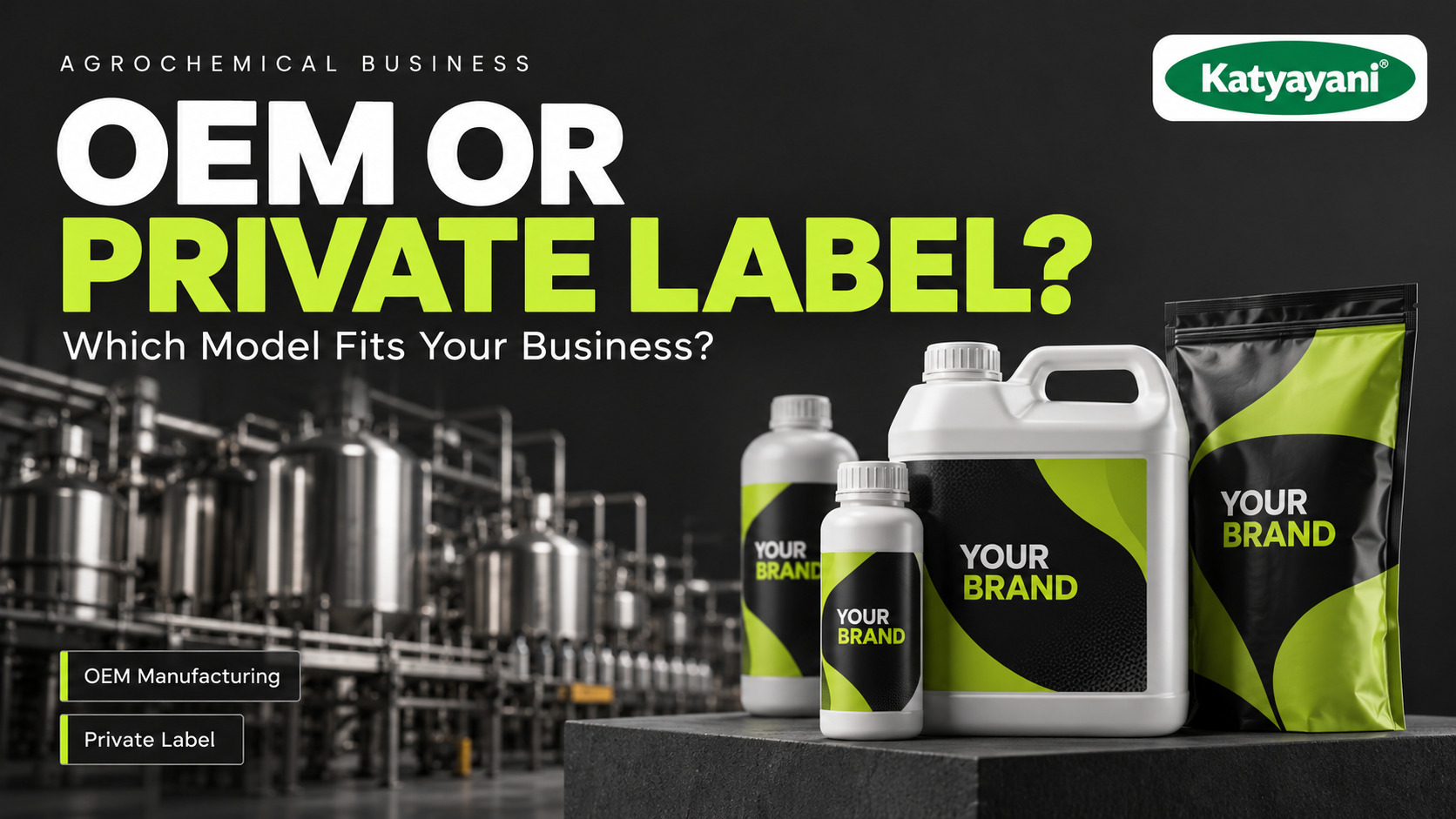
OEM agrochemical manufacturing means a factory makes a product to your specification and you sell it as your own. Private label usually means you take a ready formulation the factory already sells and put your brand on it. In India the key question is the same for both: who holds the CIB&RC registration and the state manufacturing licence. The label must name the true manufacturer in both models.
What is OEM agrochemical manufacturing?
OEM stands for original equipment manufacturer. In agrochemicals, the phrase is used loosely. An OEM arrangement usually means you give a factory your specification (active ingredient, strength, formulation type, pack design) and the factory produces it for you. You then sell it under your brand. The factory does the production, quality control and, in most cases, the paperwork for its plant.
In plain terms, you own the idea and the brand. The factory owns the machines and the plant licence. This is a trade meaning. There is no definition of OEM in Indian pesticide law, so two companies can use the word differently. Always write down in the contract what you mean by it.
What is private label in agrochemicals?
Private label usually means you buy a product the manufacturer already makes and sells, and it is packed with your brand name and design. Your own guide on private label fertilizer manufacturing describes it as a licensed manufacturer producing an agri-input and selling it under another company's brand, while the brand owner handles marketing and distribution.
The formulation is not yours. The same product may be sold by the factory under its own name or to other brands. That is the main trade-off: you get speed and low risk, but you do not have a unique product.
OEM vs private label: what is the difference?
The line between the two is blurred in daily use, and many factories offer a mix. The table shows how the terms are most often used. Treat it as a starting point for your talks, not as a legal definition.
| Point | Private label | OEM (made to your specification) |
|---|---|---|
| Formulation | The factory's existing formulation | Your specification, developed or adjusted with the factory |
| Who decides the product | Mostly the factory | Mostly you |
| Registration | Often the factory's registration is used; you act as marketer or distributor | A registration is needed for the exact product; who applies and who holds it must be agreed in writing |
| Speed to market | Faster | Slower, because of registration, trials and batch approval |
| Upfront effort and cost | Lower. Mainly packaging, label and trademark | Higher. Product work, data and approvals may add cost |
| Product uniqueness | Low. Others may sell the same formula | Higher, if the contract protects your formula |
| Main risk | Dependence on one supplier and no product advantage | Registration delay, stock tied up, and disputes over who owns the formula |
| Fits best | Dealers, distributors and new brands testing the market | Established brands with a clear product idea and funds |
A third route exists: buy a finished, branded product from a manufacturer-marketer and sell it as a distributor. It needs no registration of your own at all. Many dealers should start there. See our guide to agri franchise models in India if you are weighing that option.
Who holds the CIB&RC registration and the manufacturing licence?
This is the question that decides your risk. Here is what is on record.
- Registration first, licence second. The Haryana agriculture department page says manufacturing licences are issued under section 13 of the Insecticides Act, 1968 and the Insecticides Rules, 1971, and that each insecticide must be registered with the CIB&RC before a licence is issued (Haryana agriculture department, page last updated 2018).
- The licence belongs to the plant. The same page says a separate licence is needed for each place of manufacture, and the unit is inspected before a licence is granted or renewed.
- The brand owner can sell under the maker's registration. Your own guide on private label says a brand owner can sell a manufacturer-registered pesticide as its distributor, or obtain its own registration, usually under Section 9(4), which takes longer and costs more.
- A manufacturer-marketer agreement is part of the file. The Haryana page lists a manufacturer-marketing agency agreement among the documents for a licence. If you market someone else's product, expect this agreement to be asked for.
So in a typical private label deal, the factory holds the registration and the plant licence, and you hold the brand, the trademark and the marketing rights. In an OEM deal where you want the registration in your own name, the position depends on the route you take and on the contract. Do not assume. Ask your regulatory adviser which route applies to your exact product.
What Is A Loan Licence?: You may hear the term "loan licence" from factories. It comes from drug law. Your own guide on private label manufacturing says neither the Fertiliser Control Order nor the Insecticides Rules create a loan-licence category, so confirm what a factory means by it before you rely on it.
For fertilisers and biostimulants the rules are different. See our post on biostimulant manufacturing and FCO rules.
Why the paper trail of manufacturer authority matters: a 2026 court case
In a June 2026 report, the Delhi High Court quashed a registration certificate that had been issued for importing a herbicide technical and making a formulation in India. The court held that the grant under Section 9(3) was "manifestly illegal". The report says the Registration Committee had approved the certificate without evidence that the foreign maker named in the file was authorised to make the product at the relevant time (AgroSpectrum India). The result was that the company could no longer import or make the product, and dealers and retailers in the chain were also barred from dealing in it.
The lesson for a brand owner is simple. If your supplier's registration or authority is weak, your stock can be stopped even if you did nothing wrong. Ask for copies of the registration certificate and plant licence for the exact product, and check them.
What does the label have to show?
In both models the label must be truthful about who makes the product. Your own guide states that a fictitious manufacturer on a label counts as misbranding. On top of that, the label has to carry the content the Insecticides Rules require, such as the registration details, batch and expiry. I could not read the rule text in this session, so check the exact items against the Insecticides Rules, 1971 before you approve artwork. Our post on how to identify fake pesticides and fertilisers shows what a buyer or inspector looks for on a pack.
Common label set-up in trade, from a sample authorisation document seen in search and not an official template, is a "Manufactured by" line for the factory and a "Marketed by" line for the brand owner. Treat that as an example only.
| Label item | Private label | OEM |
|---|---|---|
| Brand name and design | Yours | Yours |
| Manufacturer name and address | Real factory, not your office | Real factory, not your office |
| Registration details | Match the registered product; confirm whose registration is shown | Match the registration obtained for your product |
| Batch and manufacturing date, expiry | Factory prints per batch | Factory prints per batch |
| Any change in text or claims | Needs the registration holder's consent and may need regulator approval | Same; do not change claims without checking |
What are the costs of OEM and private label?
I found no sourced price list, so no rupee figures are given. What can be said is where the money goes. Your own guide on private label lists the main cost drivers: batch size, printing minimums for custom packaging, raw material price swings, testing and documentation fees, freight and GST. It also notes that fertilisers generally carry a lower GST rate than pesticides.
| Cost item | Private label | OEM |
|---|---|---|
| Product and formulation work | Usually none | Yes, can be large |
| Registration and data | Usually none if you sell under the factory's registration | Yes, if you take your own registration. The cost depends on the route |
| Trademark and artwork | Yes | Yes |
| Packaging minimums | Yes, printed packs have minimum runs | Yes |
| Batch testing and documents | Usually included or charged per batch. Ask | Same |
| Stock and working capital | Plan for a full season. Sales are seasonal and credit-driven | Higher, because batch sizes and lead times are longer |
Ask each factory for a written quote that separates the product price, packaging, testing, freight and GST. Compare like with like.
What is the MOQ (minimum order quantity)?
There is no standard MOQ. Your own guide says each manufacturer sets it per product and pack size. The MOQ usually depends on the batch size of the plant and the printing minimum of the pack. Liquids and powders, small packs and large drums will all differ. Before you compare prices, ask for the MOQ per product and per pack, and whether you can split a batch across two SKUs.
How long does it take?
No official end-to-end timeline exists, and none was found for a brand launch. Three parts can be sourced or described:
- Plant licence: the Haryana page says processing typically takes about one month, mainly for inspection, then about a week after the inspection report. That is for one state in 2018. Check your state.
- Registration: private label under the factory's registration avoids this step. A new registration or a 9(4) route takes longer, and the time depends on the product and the data. The CIB&RC meets regularly; the 476th meeting on 10 September 2026 cleared a list of new registrations, which shows the committee is active, not how long your file will take.
- Trademark, artwork and first batch: the factory's schedule and your design approvals. Ask for dates in writing.
What are the risks of each model?
| Risk | What can go wrong | How to reduce it |
|---|---|---|
| Supplier's licence lapses | The plant licence is place-specific and is renewed on a cycle (two calendar years per the Haryana page). A lapse can stop supply | Ask for current licence and renewal date; add a clause for notice |
| Weak registration | The Delhi High Court case shows a faulty registration can end in a ban on the product | Check registration for the exact product and strength |
| Formula ownership | The factory may sell your formula to others | Put formula ownership and exclusivity in the contract |
| Quality problems | A bad batch under your brand harms your name and may lead to action | Batch-wise certificate of analysis, retained samples, recall clause |
| Fake or wrong claims on the label | Misbranding | Use only registered claims; never print a false manufacturer |
| Stock locked in | Seasonal sales, slow movement, expiry | Order in stages; start with a small SKU range |
| Single supplier dependence | Delays at one plant halt your business | Qualify a second source for key products |
Which model should you choose?
| Your situation | Better fit | Why |
|---|---|---|
| New brand, testing the market, limited funds | Private label (or distributor of a branded product) | Fast, low risk, no product development |
| Dealer with strong local trust and a few products in demand | Private label | Your name sells the product already |
| Established distributor wanting a unique product | OEM | You can protect a formula and build margin |
| Company with regulatory staff or adviser and a clear formulation | OEM | You can manage registration and data |
| Export or institutional supply | OEM, with careful registration planning | Buyers ask for specific compositions and papers |
| No clarity on rules yet | Start as distributor of a branded product | Learn the market before you carry legal risk |
If you are still at the idea stage, our agri input shop business plan and the post on dealer licences state-wise explain the retail side first.
Checklist: how to choose an OEM or private label agrochemical manufacturer
Our detailed 10-point checklist for choosing an agrochemical manufacturer covers each item at length. This short version is for the OEM and private label decision.
- Registration for your exact product. Ask for the CIB&RC registration certificate and read the product name, strength and formulation type.
- State manufacturing licence. Check it is current, for the plant that will make your batch, and covers your product.
- FCO papers for fertilisers and similar products. Your guide says the manufacturer needs a certificate of manufacture per product, and the brand owner needs state wholesale authorisation backed by a manufacturer form.
- Contract terms. Exclusivity, formula ownership, recall responsibility, MOQ, payment terms and what happens if either side stops.
- Quality system. In-house lab, batch-wise certificate of analysis and retained samples.
- Label and artwork review. True manufacturer name, correct registration details, no unapproved claims.
- Plant visit or video audit. Your guide recommends this before signing.
- Trial order. Start with one product, one batch.
- Capacity and lead time in writing. Do not rely on a verbal promise before the season.
- Verify each certificate with the issuing authority. Photocopies are not proof.
Katyayani Organics lists a Private Label page on its site, but no capacity, plant or OEM details are published there. If you are considering any manufacturer, including Katyayani, ask for these documents in writing, and compare at least two quotes.
Conclusion
OEM and private label are business terms. The law cares about registration, plant licence and an honest label. Pick private label if you want speed and low risk, and OEM if you want your own formula and can handle the registration work. In either model, get the registration and licence papers for your exact product, write the contract clearly, and start with a small trial order.
Why trust this guide
Written by Team Katyayani, Editorial Team at Katyayani Organics. Cross-checked against published research and university extension programs.

Leave a Comment