 12 min read
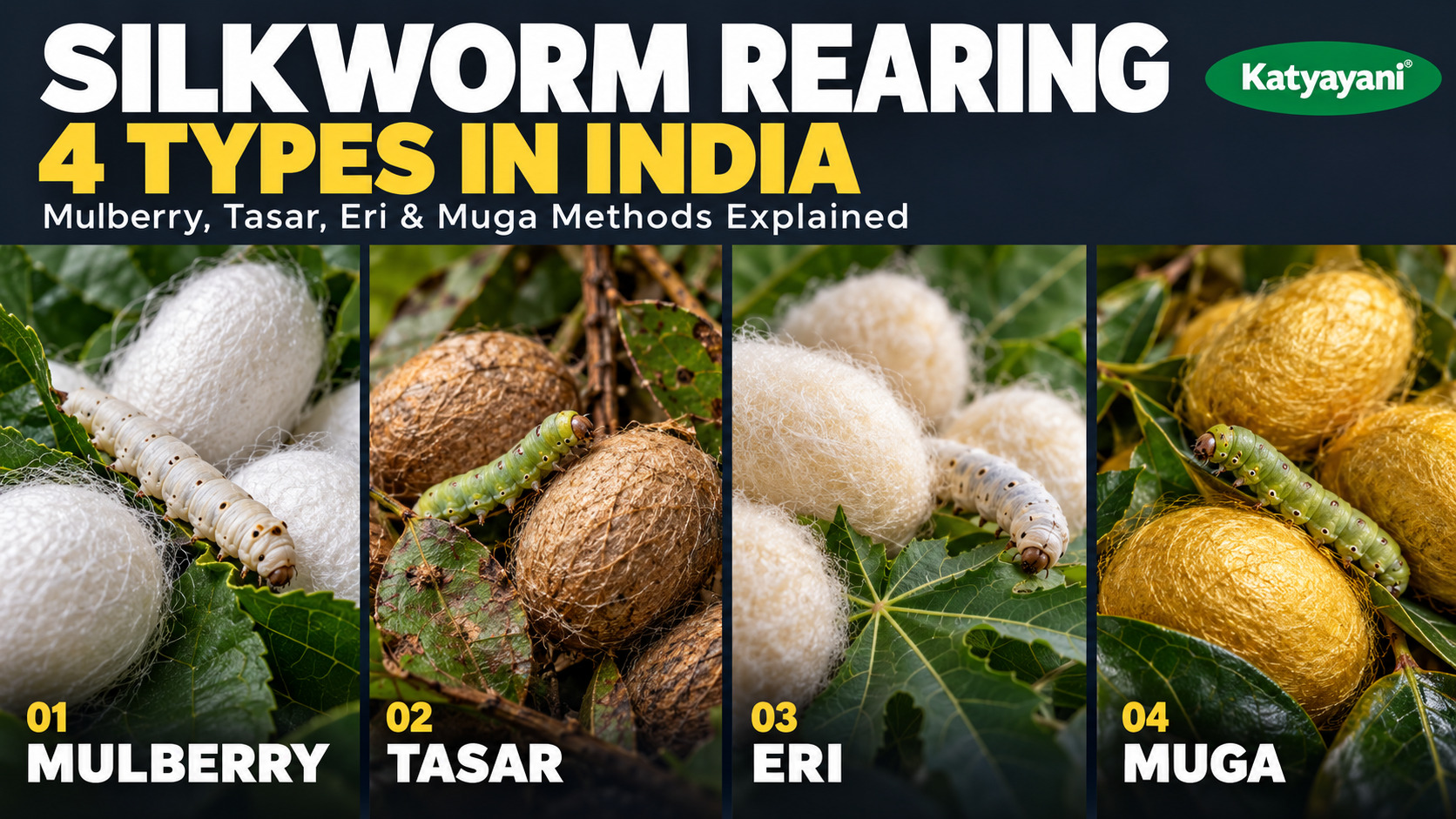
India has four commercial silk types: mulberry (Bombyx mori, reared indoors on mulberry leaves), tasar (Antheraea mylitta, reared outdoors on trees like asan, arjun and sal), eri (Samia/Philosamia ricini, reared indoors mainly on castor) and muga (Antheraea assamensis, reared on som and soalu trees in Assam). Mulberry is fully domesticated and indoor; muga is semi-domesticated and outdoor; eri is multivoltine and household based. Mulberry rearing runs in two stages, chawki (young worms) and late-age, in a clean, ventilated house kept at about 26 to 28 degrees C and 60 to 70 percent humidity.
What are the types of silkworm rearing in India?
Sericulture is the farming of silkworms to get cocoons, which are reeled into silk thread. India is unusual because it produces all the main commercial silks. The silk you buy is named after the worm, and each worm needs its own food plant and its own way of rearing. The TNAU silkworm types page gives the basic list.
| Silk type | Silkworm | Host plant | Rearing | Voltinism |
|---|---|---|---|---|
| Mulberry | Bombyx mori | Mulberry leaves only | Fully domesticated, reared indoors | Races vary (see below) |
| Tropical tasar | Antheraea mylitta | Asan, arjun (and sal per FAO) | Outdoors on trees | Eco-races: univoltine, bivoltine or trivoltine (FAO) |
| Oak tasar | Antheraea proylei (India) | Oak | Outdoors in the hills | Not stated in TNAU |
| Eri | Philosamia (Samia) ricini | Mainly castor | Domesticated, household activity, indoors | Multivoltine |
| Muga | Antheraea assamensis | Som and soalu | Semi-domesticated, on trees | Multivoltine |
Mulberry is the bulk of world commercial silk. The other four are called non-mulberry silks. Tasar is copper coloured and coarse and is used mainly for furnishings. Eri is spun from open-ended cocoons. Muga is golden yellow and specific to Assam, as the same TNAU page states.
So the real answer to "how many types of silkworm rearing" is simple. There are two broad ways: indoor rearing in a rearing house (mulberry and eri) and outdoor rearing on food plants (tasar, oak tasar and muga). The next sections take each one in turn.
What is the difference between mulberry, tasar, eri and muga silk?
| Feature | Mulberry | Tasar | Eri | Muga |
|---|---|---|---|---|
| Where reared | Indoor rearing house | Open air on trees | Indoor, household | On trees, semi-domesticated |
| Food | Mulberry leaf | Asan, arjun, sal | Castor leaf mostly | Som and soalu leaf |
| Look of silk | Fine, white to cream | Copper coloured, coarse | Spun from open-ended cocoons | Golden yellow |
| Main states (search summaries, VERIFY) | Karnataka, Andhra Pradesh, West Bengal, Tamil Nadu, Jammu and Kashmir | Jharkhand, Chhattisgarh, Odisha | Assam and other north-east states | Assam |
| Skill and risk | Needs a clean house and daily leaf | Open to weather and predators | Simple, low investment | Open to weather; seed crops often hit by heat (CSB, VERIFY) |
The state column comes from search-result summaries of Central Silk Board and Ministry statistics, not from a fetched government page, so treat it as a guide and confirm the current state-wise list with the Central Silk Board before publishing.
What is the difference between bivoltine and multivoltine silkworm?
Voltine means the number of generations a race completes in a year. A univoltine race has one generation, a bivoltine race has two and a multivoltine race has several. In mulberry, multivoltine races are hardy and suit hot and humid places, but give lower quality thread. Bivoltine races give better thread but are touchier in heat, as research papers summarised in search results say. These papers also say most Indian silk comes from hybrids where a multivoltine race is the female parent. This is from secondary summaries and needs checking with the Central Silk Board (VERIFY).
TNAU confirms eri and muga are multivoltine. The FAO article says the tropical tasar species has nearly 20 eco-races that are univoltine, bivoltine or trivoltine. TNAU also notes that bivoltine mulberry hybrids are harvested later than others (day 7 against day 5 of mounting), which matters when you plan the work.
How is mulberry silkworm rearing done step by step?
Mulberry is the main commercial type, so it gets the most detail here. Rearing starts with disease-free layings, called DFLs, bought from an approved grainage or seed centre. Never raise your own eggs without training, because disease passes through the egg.
- Build or prepare the rearing house.
- Disinfect the house and every tool before rearing starts.
- Collect DFLs and incubate them until they hatch.
- Brush the young worms onto tender chopped leaf and do chawki rearing.
- Move to late-age rearing (third to fifth instar) on trays, shoots or beds.
- Mount ripe worms on mountages so they spin cocoons.
- Harvest cocoons on the right day and sell or reel them.
What should a silkworm rearing house look like?
The TNAU rearing house page gives clear design rules:
- A separate building for rearing, facing east to west, with enough windows for cross ventilation and tree cover around it.
- A washable floor and an airtight room, so you can fully disinfect it.
- Space of 2 sq ft per DFL for floor rearing and 3 sq ft per DFL for shoot rearing. About 480 sq ft is needed for 100 DFLs.
- A main rearing hall, an ante room (8 by 8 ft) and a leaf preservation room. A separate chawki room is ideal.
- Avoid damp air, stagnant air, strong draughts and bright sunlight.
What temperature and humidity does a silkworm need?
TNAU says the rearing house should hold 26 to 28 degrees C and 60 to 70 percent relative humidity, kept even through the day. Young worms need it warmer and more humid. Summaries of Central Silk Board and Vikaspedia pages give the following by stage. These come from search results and not from a fetched page, so check them with your sericulture office (VERIFY).
| Stage | Temperature | Relative humidity | Source status |
|---|---|---|---|
| Whole rearing house (target) | 26 to 28 degrees C | 60 to 70 percent | TNAU, fetched |
| Chawki (second stage) | 27 to 28 degrees C | 80 to 90 percent | CSB-linked page via search, VERIFY |
| Third instar | 26 degrees C | 80 percent | Vikaspedia via search, VERIFY |
| Fourth instar | 25 degrees C | 70 percent | Vikaspedia via search, VERIFY |
| Fifth instar | 24 degrees C | 70 percent | Vikaspedia via search, VERIFY |
| Mounting and spinning | Not given on TNAU | 60 to 70 percent | TNAU, fetched |
The pattern is clear even if the exact numbers differ by page: warm and humid for the youngest worms, then cooler and drier as they grow. TNAU also tells growers to use charcoal stoves or heaters in winter, and to ventilate to cut humidity.
How do you disinfect the rearing house?
The TNAU rearing house page asks growers to disinfect at least 3 to 4 days before rearing starts, wash and spray walls, roof, floor and equipment, keep the room closed for about 24 hours and then open doors and windows for at least 24 hours to clear any smell. The page gives a disinfectant mix of chlorine dioxide with an activator, plus lime powder. Follow the pack instructions or ask your sericulture extension officer for current products.
What is chawki rearing and how is it done?
Chawki means young-age rearing, from brushing up to the second moult. The worms are small and weak, so this is the most sensitive part. The TNAU young-age rearing page describes it like this:
- Rear 20 DFLs in one tray (120 cm by 90 cm by 105 cm size as given by TNAU) up to the second stage.
- Feed tender leaf. Pick the largest glossy leaf, the third or fourth from the top, then the next 6 to 8 leaves for the young worms up to the second moult.
- In the second age, chop the leaf to 0.5 to 1.0 sq cm pieces.
- Keep cut leaf fresh in a wet gunny cloth, or in a wet leaf chamber in hot, dry weather.
- Clean the bed once in the first age and twice in the second age, by spreading a net and letting the worms crawl up to fresh leaf.
- Do not disturb worms during moulting. Keep the bed thin and dry and apply lime at 30 to 50 g per sq m.
Many farmers buy chawki worms from a separate chawki rearing centre and take over from the third instar. This saves risk, but you must confirm the batch is healthy before you buy.
How is late-age silkworm rearing done?
Late age means the third, fourth and fifth instars. The worms eat far more now. TNAU says larvae eat 85 percent of their total food in the fifth instar and about half of all labour falls in the last seven days. The TNAU late-age page describes three ways of feeding:
| Method | How it works | What TNAU says |
|---|---|---|
| Tray (bed) rearing | Worms are reared in bamboo trays with newspaper to absorb moisture and droppings | Feed medium-mature leaf (from the 6th leaf) in the 3rd and 4th ages and coarse leaf in the 5th. Reject over-mature and yellow leaf |
| Shoot rearing | Whole mulberry shoots, about 1 m long, are fed on racks | Saves up to 70 percent labour and 15 to 20 percent leaf, needs about 30 percent more floor area. Feed 3 times a day in rainy or winter weather and 4 times in summer |
| Floor rearing | Worms are reared on a floor bed | TNAU uses 2 sq ft per DFL for floor rearing in its house design |
Other points from TNAU: spread larvae evenly 6 to 8 hours before moulting, apply lime powder in rainy or winter weather, and use a bed disinfectant after each moult. Do not feed leaf that is wet, over-mature or yellow.
How do you mount silkworms and harvest cocoons?
When the fifth-instar worm is ripe, it stops eating, turns translucent and lifts its head. It must be picked up quickly and put on a mounting frame called a chandrike. Delay wastes silk, says TNAU. The TNAU late-age page gives these details:
- Stock 800 to 900 worms per sq m of mountage. About 30 to 40 chandrikes are needed for 100 DFLs.
- Keep mountages in shade with good airflow, at 60 to 70 percent humidity. Swings in humidity cause uneven thread.
- Moderate, even light. Dark corners or bright light cause crowding and double cocoons.
- Tilt the mountage so urine drains away and does not stain cocoons.
- Remove dead and non-spinning worms on the second day of spinning.
- Spinning ends in 2 to 3 days, but the worm is still a prepupa. Harvest on day 5 (day 7 for bivoltine hybrids), when the pupa is hard.
- Do not harvest when the pupa is amber coloured. Market cocoons on day 6 (day 8 for bivoltine hybrids).
How are tasar silkworms reared?
Tropical tasar is a forest silk. Worms feed on trees in the open, so rearing is outdoors. The FAO article lists asan (Terminalia tomentosa), arjun (Terminalia arjuna) and sal (Shorea robusta) as the main hosts, with several secondary trees. It describes a controlled rearing system on close-spaced plantations where overlapping twigs let worms move between plants without hand transfer. In its example, 400 DFLs yielded about 32,000 cocoons, and the new technique could give income within 40 to 45 days. Read the FAO tasar article for the full table.
Search summaries of Central Silk Board material say tasar is reared in up to three seasons a year (rainy season, autumn and winter) and that the CSB Basic Tasar Silkworm Seed Organisation at Bilaspur supplies seed to the country. These two points are VERIFY items because the CSB pages could not be fetched. Oak tasar is the temperate cousin, reared on oaks such as yung, banj, sahi and moru in the hills (FAO).
How is eri silkworm rearing done?
Eri is the easiest of the four for a household. TNAU calls it a domesticated, multivoltine, household activity on castor leaf. Central Silk Board summaries from search results add these details (VERIFY): rearing is indoors in a well-ventilated, fly-proof house; a room of about 10 m by 5 m suits 100 DFLs; sanitise the house at least a week before rearing; eggs are incubated at 24 to 26 degrees C and 75 to 85 percent humidity; March to April and September to October are the best seasons; and no more than about 300 fifth-instar larvae should go on a 3 ft by 3 ft tray. Eri silk is spun, not reeled, because the cocoons are open at one end.
How is muga silkworm rearing done?
Muga is the golden silk of Assam. TNAU lists it as semi-domesticated and multivoltine, reared on som and soalu leaves. The worms live on the trees, so weather, predators and heat matter. Central Silk Board summaries from search results (VERIFY) name five or six crops a year: two commercial crops (Jethua in May to June and Katia in October to November), two pre-seed crops (Jarua and Aherua) and two seed crops (Chotua and Bhodia). The same summary says seed and pre-seed crops often suffer from harsh climate, and that soalu is preferred for seed crops. Because muga is mostly an Assam and north-east activity, the state sericulture department and the Central Silk Board are the right places for exact schedules.
What are the common silkworm diseases and how can you prevent them?
Disease can wipe out a batch within days, so prevention is the whole game. The TNAU disease page lists these:
| Disease | Cause | What you see | Prevention and control (TNAU) |
|---|---|---|---|
| Grasserie | Virus | Sluggish worms, swollen between segments, fragile skin that bursts with milky fluid, worms hang head down | Sun-dry appliances, disinfect with 5 percent bleaching powder, remove and burn diseased worms, ventilate and avoid crowding, feed good leaf |
| Flacherie | Virus or bacteria, often together | Listed with grasserie; TNAU gives no separate steps | Same hygiene and leaf quality; confirm with the extension officer |
| Pebrine | Protozoan | Slow growth, small body, poor appetite, pale body with tiny black spots | Use healthy eggs, strict hygiene, surface-disinfect layings in 2 percent formalin for 10 minutes, burn diseased material |
| Muscardine | Fungus (white: Beauveria bassiana; green: Spicaria prasina as named by TNAU) | Worms turn hard and dry and mummify white or green | Avoid low temperature with high humidity, keep beds thin and dry, disinfect, reject infected lots |
TNAU names bed disinfectant products and some dust products for use after each moult. These are sericulture-specific and sold through the state sericulture department; do not mix agricultural fungicides into worm beds. Beauveria bassiana, which causes white muscardine in silkworms, is also used as a biological insecticide on crops. So keep any bio-insecticide use away from the rearing house and mulberry garden unless the sericulture department says it is safe.
Pesticide Warning: Silkworms are very sensitive to pesticide residue on mulberry leaf. Spray drift from nearby fields can kill a batch. Ask the state sericulture department about safe products and waiting periods before any spray in or near a mulberry garden (VERIFY with your local department; no waiting periods were fetched).
In which states is silk produced in India?
Search summaries of Ministry of Statistics and Central Silk Board material (not fetched pages) point to the following pattern, which you should verify with the latest CSB annual report:
- Mulberry: mainly Karnataka, Andhra Pradesh, West Bengal, Tamil Nadu and Jammu and Kashmir.
- Tasar: Jharkhand, Chhattisgarh, Odisha and neighbouring states.
- Eri: Assam, Meghalaya, Manipur, Nagaland and other north-east states.
- Muga: almost entirely Assam.
Sources disagree on production totals by year. One search result gives a record 41,121 MT for 2024-25 while another gives a Central Silk Board estimate of about 30,614 MT, so no national figure is quoted in this post.
Is there a government subsidy for sericulture and where do you get training?
The Central Silk Board (under the Ministry of Textiles, based in Bengaluru) runs schemes with state sericulture departments. Secondary sources describe Silk Samagra-2, covering 2021-22 to 2025-26, with help for mulberry, non-mulberry and post-cocoon work, including rearing sheds. Outlay figures and subsidy percentages differ between sources, and the official page could not be fetched, so no amount is given here. Check the Central Silk Board and your state sericulture department for the current scheme, its end date and any successor (VERIFY). Silkworm farming also fits other support: see agriculture subsidy schemes in India, the Kisan Credit Card scheme for working capital, PMEGP loans for agri-business and SHG loans for women farmers. If you are weighing silk as a new venture, how to start an agriculture business in India covers the first steps.
For training, start with the nearest sericulture department office, Krishi Vigyan Kendra or Central Silk Board research and training institute. TNAU also runs a sericulture portal that lists books, videos and training.
Which type of silkworm rearing is best for a beginner?
| If you have | Consider | Why |
|---|---|---|
| Irrigated land and a market nearby for cocoons | Mulberry | Predictable indoor rearing, established cocoon markets in producing states |
| Castor plants, a household workforce and low budget | Eri | Simple, household based, multivoltine |
| Forest or tree land, tribal belt, access to seed | Tasar | Uses forest trees, seed supply from the Central Silk Board network |
| Land in Assam or the north-east | Muga | Only grown there; seasonal and weather exposed |
Do not start by buying equipment. Visit a working farm in your state, ask what the cocoon price was last season, and take the basic training first. The right answer depends on your state, your land and your nearest market, not on a general guide.
Conclusion
India has four silk types, and each has its own worm, host plant and rearing style. Mulberry and eri are reared indoors, while tasar and muga are reared outdoors on trees. Mulberry needs the strictest hygiene and climate control, with careful chawki rearing, late-age feeding and timely mounting. Before you invest, get training and seed from the Central Silk Board network or your state sericulture department, and confirm current scheme details locally.
Why trust this guide
Written by Team Katyayani, Editorial Team at Katyayani Organics. Cross-checked against published research and university extension programs.




Leave a Comment