
 15 min read
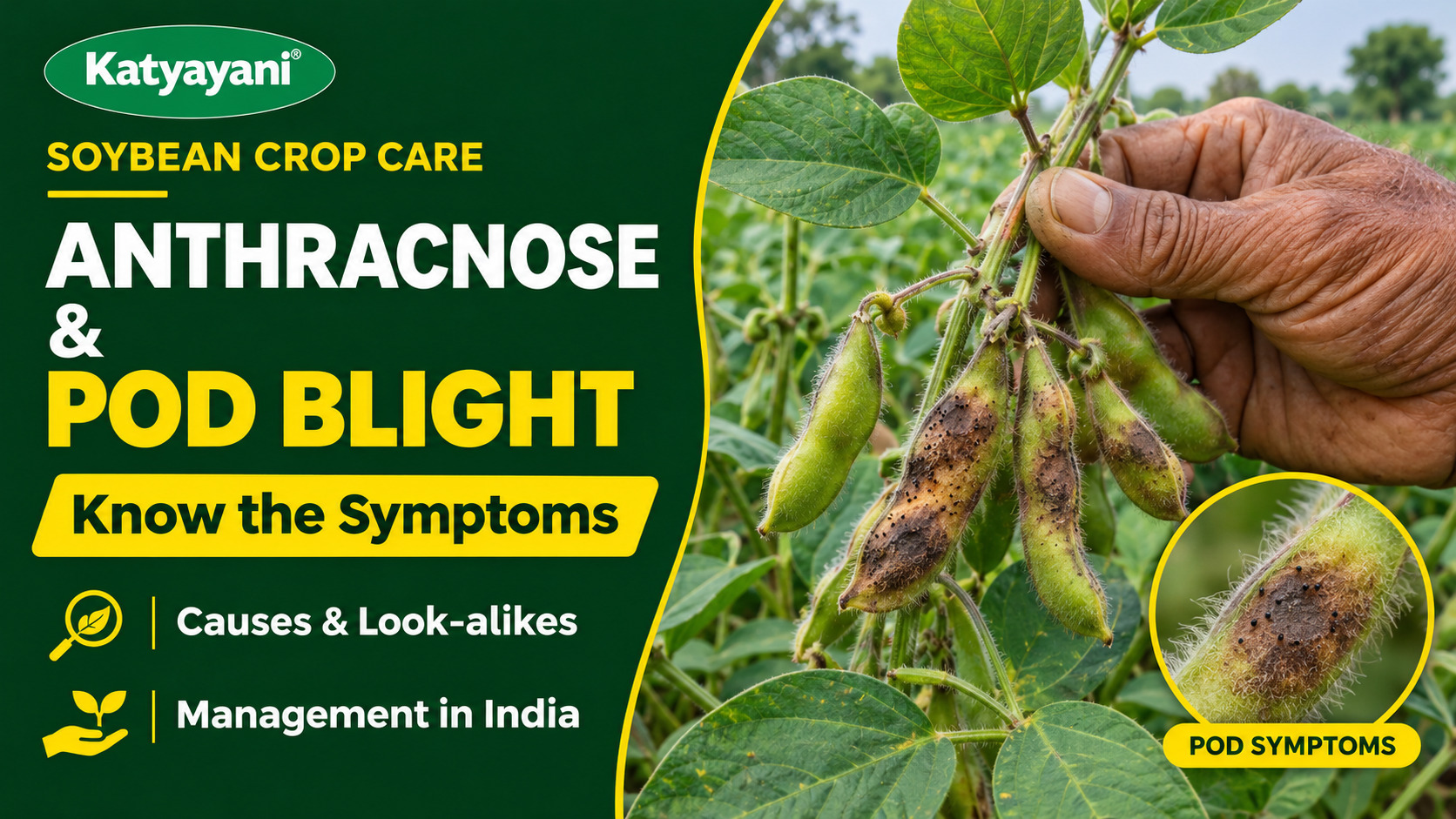
Anthracnose and pod blight is a seed-borne and residue-borne fungal disease of soybean caused by Colletotrichum truncatum. It likes warm, humid, wet weather. You see brown blotches on stems and petioles, curled leaves with dark veins, and black-specked pods that carry few, small or shrivelled seeds. It can start from the seedling stage and builds up through flowering and pod fill. Indian studies measured up to 64.8 percent yield loss at a high disease index (JNKVV Jabalpur trial), and each 1 percent rise in severity cost about 115 kg per hectare in one ICAR-IISR trial. Prevention carries most of the weight: clean seed, a seed treatment backed by your state recommendation, a moderately resistant variety, a sowing date that dodges peak wet weather at pod fill, rotation with a non-legume and clearing of residue. Spray only if scouting shows the disease and use a product whose label covers soybean and anthracnose.
What is anthracnose and pod blight in soybean and what causes it?
It is a fungal disease caused by Colletotrichum truncatum. The fungus attacks seedlings, stems, petioles, leaves and pods, and is called anthracnose on the plant and pod blight when it reaches the pods. Warm, humid, wet weather drives it, and infected seed and old residue keep it going.
An ICAR-led review in the Journal of Oilseeds Research (2025) names Colletotrichum truncatum as the main cause of soybean anthracnose, calls it seed-borne, and says it spreads quickly through wind and rain splash (Journal of Oilseeds Research, 2025). TNAU gives the same organism and describes shrivelled, mouldy, brown seed, dark sunken cankers on the seed leaves, and brown lesions that spread to leaves, stems and pods (TNAU Agritech).
The Pantnagar authors of an Indian Journal of Agricultural Sciences paper list the states where it occurs consistently as Uttarakhand, Himachal Pradesh, Madhya Pradesh, Rajasthan, Maharashtra, Karnataka, Andhra Pradesh, Tamil Nadu, Kerala, Chhattisgarh and Delhi and nearby areas (Bhatt et al., 2025). In other words, it is not a local problem.
This post is about this one disease. For soybean nutrition, see our stage-wise fertilizer schedule for soybean. For the soil-borne disease that dries soybean in hot, dry spells, see our guide to charcoal rot in soybean. We do not repeat either here.
Are anthracnose and pod blight the same disease, and how is pod blight different from pod and stem blight?
In Indian papers, anthracnose and pod blight describe one disease with two phases: leaf-and-stem anthracnose and the pod phase. Pod and stem blight is a different disease with a different fungus, seen as black specks in straight rows on mature stems. The two can occur on the same plant late in the season.
The Nagaland University paper calls pod blight (anthracnose) one of the major fungal diseases and says the pod blight phase is the most damaging (Umbon et al., 2023). University of Minnesota Extension says anthracnose symptoms can be mistaken for pod and stem blight, that the symptoms are different, and that both may be present on the same plants late in the season (University of Minnesota Extension).
| Feature | Anthracnose / pod blight | Pod and stem blight |
|---|---|---|
| Pattern on stems | Irregular brown spots in a random pattern, covered with tiny black spines (setae) that you can see with a 10X hand lens (Minnesota Extension) | Black raised specks in linear rows on mature stems (Crop Protection Network) |
| On pods | Reddish-brown spots that turn black; pods dry early with few, small or shrivelled seeds (Pantnagar and Nagaland papers; Minnesota Extension) | Specks can cover pods but may not follow the row pattern seen on stems (Crop Protection Network) |
| When it shows | Can infect any time; symptoms from V3 onwards in Indian screening, often more visible late (JNKVV paper; Minnesota Extension) | Most visible from R6 through R8 (Crop Protection Network) |
| Weather | Warm, wet, humid weather | Warm, humid weather as plants mature; worse if harvest is delayed (Crop Protection Network) |
The Crop Protection Network page on pod and stem blight gives the row pattern and the R6 to R8 timing used above. The practical use of this table: hold a hand lens over the stem. Spines (setae) point to anthracnose. Neat rows of specks point to pod and stem blight. When in doubt, take plants to your KVK.
What are the symptoms of anthracnose and pod blight at each growth stage?
Seedlings can show dark, sunken cankers and damp off. On growing plants look for brown blotches on stems and petioles, curled petioles, dark veins and rolled leaves. On pods, reddish-brown spots turn black, and pods hold few, small or shrivelled, mouldy seeds. Symptoms may stay hidden until warm, wet weather or maturity.
| Stage | What you may see | Source |
|---|---|---|
| Seed | Shrivelled, mouldy, brown seed; some infected seed may look normal or show brown or grey areas with black specks, and may not germinate | TNAU; Minnesota Extension |
| Seedling | Dark brown, sunken cankers on the seed leaves (cotyledons), and on the stem and root base that cause damping off | TNAU; Minnesota Extension |
| Vegetative to flowering | Irregular brown lesions on leaves and stems. In high humidity, veinal necrosis (dark, dying veins), rolled leaves, petiole cankers and early leaf fall | TNAU |
| Early reproductive stage | Irregular red to dark brown blotches on stems and petioles; a petiole may curl or hook like a shepherd's crook | Crop Protection Network |
| Pod fill to maturity | Reddish-brown pod spots turn black; black fungal bodies with small black spines on stems, petioles and pods; infected pods dry early, with few or small seeds | Pantnagar paper; Crop Protection Network; Minnesota Extension |
The Crop Protection Network describes the early stem and petiole blotches and the shepherd's crook as typical of the early reproductive stage, with the disease generally late-season on maturing plants. Two details matter for scouting. The JNKVV Jabalpur paper recorded anthracnose and pod blight appearing from V3 through R7 in its field trials (Amrate et al., 2023). And Minnesota Extension notes that older plants can be infected without symptoms until the weather is warm and moist or the plants reach maturity. So a clean-looking field in August can still be carrying the disease.
For disease scoring, Indian trials use a 0 to 9 scale based on how much of the leaf area carries lesions, with 9 meaning more than half the area is covered and lesions are very common on all plants with defoliation and plant death common. You do not need the scale in the field; it just explains why papers talk about a percent disease index.
How can I recognise pod blight on pods and seed?
Look for reddish-brown spots on green pods that darken to black, then open a few pods. Seeds from affected pods are small, shrivelled, mouldy or discoloured, and some pods hold no developed seed. A hand lens shows small black fruiting bodies with hair-like spines on the pod surface.
- Walk the field in the wet weeks. Check at pod set and pod fill, not only at maturity, because symptoms can stay hidden until warm, moist weather (Minnesota Extension).
- Check the petioles and stems first. Irregular brown blotches and a curled or hooked petiole are early signs on the stem (Crop Protection Network).
- Turn leaves and look at the veins. In humid weather TNAU describes veinal necrosis and leaf rolling.
- Use a 10X hand lens on a spot. Tiny black spines point to anthracnose (Minnesota Extension).
- Open the pods. The Nagaland and Pantnagar papers describe shrivelled, mouldy seed and unformed or few seeds in affected pods.
- Score ten plants, not one. The Pantnagar trial scored ten plants per replication; ten random plants per patch gives you a fair idea of how widespread it is.
If you plan to keep seed from the field, do not keep it from visibly affected patches. The seed section below explains why.
How do I tell anthracnose from other diseases that look like it?
Pod and stem blight, Rhizoctonia aerial blight, bacterial blight and Cercospora leaf blight can all leave spots, blight or discoloured seed on soybean. The reliable separators are the spine-covered spots of anthracnose, the weather and growth stage, and a check with your KVK.
| Problem | How it differs | Source |
|---|---|---|
| Pod and stem blight | Black specks in linear rows on stems; seen mostly R6 to R8 | Crop Protection Network |
| Rhizoctonia aerial blight | A canopy disease that starts at pod formation and runs to harvest; favoured by a dense canopy, warm 28 to 30 degrees C temperature, relative humidity above 85 percent and well-spread rain | Legume Research 2026 (ICAR-NSRI Indore and partners) |
| Bacterial blight | Small, angular, water-soaked leaf spots that turn translucent and merge; large black lesions on stems and petioles; managed with streptocyclin and a copper fungicide in the TNAU advisory | TNAU Agritech (bacterial blight page) |
| Cercospora leaf blight and purple seed stain | Leaves turn leathery and dark with a reddish-purple tint; reddish-purple, slightly sunken lesions on petioles and stems | TNAU Agritech |
| Charcoal rot | A root and lower-stem disease; split the taproot to see silver-grey tissue with black specks | Our charcoal rot guide |
Why this matters: the fungicide that suits a fungal spot disease will not touch bacterial blight, and a spray on a root disease will miss the problem. TNAU's own bacterial blight advice (streptocyclin plus a copper fungicide) is different from its anthracnose advice for that reason.
What weather and field conditions favour anthracnose and pod blight?
Warm, humid and wet weather favours it. Spores move by wind and rain splash, and TNAU links severe leaf symptoms to high humidity. Late-season rain around pod fill is the dangerous window. The one Indian weather study we opened, from Pantnagar, saw the disease start at 32 to 34 degrees C maximum, 22 to 25 degrees C minimum and over 85 percent humidity with frequent rain. It is a single-location result.
| Condition | What the source says | Source |
|---|---|---|
| Warm, wet, humid weather | Favours infection and disease development | Crop Protection Network; Minnesota Extension |
| Rain splash and wind | Spreads spores quickly | Journal of Oilseeds Research 2025 (ICAR institutes) |
| High humidity | Linked to severe leaf symptoms such as veinal necrosis and leaf rolling | TNAU |
| Favourable season | At Pantnagar the disease was highly severe in 2018 and 2019 "owing to favourable weather conditions" | Bhatt et al., 2025 |
| Weather at disease onset (Pantnagar, tarai Uttarakhand, 2017 to 2019) | Disease started on leaves in the first fortnight of September and on pods in the second fortnight, when maximum temperature was 32 to 34 degrees C, minimum 22 to 25 degrees C, relative humidity above 85 percent, with frequent rain. Fastest spread in October at 28 to 32 degrees C maximum and 12 to 21 degrees C minimum, with morning humidity 80 to 90 percent. Single location; not a rule for other regions | Bhatt et al., Journal of Agrometeorology 2022 (GBPUAT Pantnagar) |
| Wet foliage and poor drainage | TNAU advises not to work the crop when foliage is wet and to keep the field well drained | TNAU |
| Early sowing | Sown on 27 June, disease on both leaves and pods was higher than sowing on 4 July or 11 July in 2018 | Bhatt et al., 2025 |
A note on a conflict between sources. Minnesota Extension (United States) says the disease typically has minimal yield effects in its region and shows late. Indian papers (JNKVV Jabalpur, ICAR-IISR Indore, Nagaland University) measure serious losses, up to 64.8 percent in one Indian trial. These are different climates, years and varieties. For an Indian farmer the Indian papers are the better guide, but the US view is a fair reminder that a late, light attack does not always cost much.
How does the fungus survive and spread from season to season?
It survives in infected crop residue and on infected seed. Seed carries it into new fields, and wind and rain splash spread it across the crop. Because it is seed-borne, saving seed from an affected field can restart the problem next season. Residue left on the surface keeps inoculum in the soil.
The ICAR-led review describes the disease as seed-borne (Journal of Oilseeds Research, 2025). Minnesota Extension says the pathogen overwinters in infected crop residue and infected seed and has a wide host range that includes alfalfa, ragweed and velvetleaf. Infected seedlings can develop dark, sunken cankers that cause damping off, so a seed lot can fail at emergence as well as later.
- Seed. Infected seed may look normal or show brown or grey areas with black specks. It may not germinate (Minnesota Extension).
- Residue. TNAU asks farmers to clean-plough soon after harvest to remove plant residue and to destroy the previous year's infected stubble.
- Rain and wind. Splashed spores spread from plant to plant within the crop (Journal of Oilseeds Research 2025).
- Other hosts. Weeds and some other crops can carry the fungus (Minnesota Extension). We could not source an Indian host list, so we do not give one.
How much yield does anthracnose and pod blight cause in India?
Indian studies show wide ranges. A JNKVV Jabalpur trial recorded up to 64.8 percent yield loss at a 75.2 percent disease index, and an ICAR-IISR trial found about 115 kg per hectare lost for each 1 percent of severity. A Nagaland trial calculated avoidable yield loss as high as 37.96 percent.
| Figure | What it is | Source |
|---|---|---|
| Up to 64.8 percent | Highest yield loss recorded at a 75.2 percent disease index, assessed at 90 days, in heavily infected susceptible checks | JNKVV Jabalpur, Legume Research 2023 |
| 0.0 to 56.2 percent | Range of anthracnose and pod blight disease levels across 121 genotypes over 2017, 2018 and 2019 | JNKVV Jabalpur, Legume Research 2023 |
| About 115 kg per hectare per 1 percent severity | Yield fall for each 1 percent rise in anthracnose severity; severity and yield had a correlation of r = -0.91 | ICAR-IISR Indore and Coteva Agriscience, Legume Research |
| 37.96 percent | Highest avoidable yield loss in the Nagaland trial, in the susceptible variety; yields in the trial ran from 1,073 to 2,327 kg per hectare | Nagaland University, 2023 |
| Pantnagar control plots | Control plots yielded 18.30 q/ha pooled over two years, against 20.76 q/ha with two propiconazole sprays | Bhatt et al., 2025 |
Do not average these numbers. They come from different years, varieties and disease pressure, and some are from heavily infected susceptible checks. The takeaway is the shape of the loss: it rises steadily with severity, so every week the disease runs unchecked on pods costs grain.
The Pantnagar paper also cites studies saying yield losses can reach 25 percent in several Indian states and up to 100 percent in favourable conditions. Those are secondary citations inside the paper, so we do not use them as headline numbers.
Does sowing date change how bad anthracnose and pod blight get?
In the Pantnagar trials, soybean sown on 4 July and 11 July had less disease on leaves and pods than soybean sown on 27 June, and the July sowings gave higher pooled yields. The authors say shifting sowing creates a mismatch between the susceptible stage and favourable weather. It needs local confirmation.
| Sowing date (Pantnagar, 2018) | Leaf anthracnose (PDI %) | Pod blight (PDI %) | Pooled yield over two years |
|---|---|---|---|
| 27 June | 23.28 | 14.73 | 19.35 q/ha |
| 4 July | 19.86 | 11.17 | 20.04 q/ha |
| 11 July | 19.04 | 10.36 | 20.34 q/ha |
How to read it. The disease index figures are from 2018; the yields are the pooled two-year averages the paper reports. In 2019 sowing date did not change leaf anthracnose significantly, and pod blight index ran from 20.76 percent (11 July) to 21.87 percent (27 June), so the effect is not guaranteed every year. The authors also say too much delay in sowing can cut yield because the crop gets less time to grow.
This is one location in the tarai region of Uttarakhand. In Madhya Pradesh and Maharashtra the monsoon arrives on a different schedule, so we do not copy the dates. Ask your KVK for the recommended window and avoid pushing the crop into the heaviest rain at pod fill when you can choose.
Can clean seed and seed treatment prevent anthracnose and pod blight?
They help, because the fungus rides on seed, but they do not cure a field problem. TNAU recommends healthy or certified seed and a seed treatment of thiram, captan or carbendazim at 3 g per kg. The Pantnagar package used Trichoderma harzianum at 10 g per kg of seed. Check your state advisory first.
| Treatment | What the source says | Source |
|---|---|---|
| Healthy or certified seed | First step in TNAU's list; also named in the ICAR-led review | TNAU; Journal of Oilseeds Research 2025 |
| Seed treatment, chemical | Thiram, captan or carbendazim at 3 g per kg of seed (a Tamil Nadu advisory dose) | TNAU |
| Seed treatment, biological | Trichoderma harzianum at 10 g per kg of seed was the common treatment in the Pantnagar trial | Bhatt et al., 2025 |
| Seed treatment, trial | Thiophanate methyl at 2 ml per kg seed was used on all plots in the Nagaland trial before the foliar sprays | Nagaland University, 2023 |
| Overall | The ICAR-led review says seed treatment and foliar fungicides at key growth stages suppress the disease effectively, as part of integrated management | Journal of Oilseeds Research 2025 |
These doses are advisory or trial doses, not product-label doses. Always follow the label of the product you buy and the recommendation of your state agricultural university or KVK.
If you use Rhizobium on soybean, apply the fungicide to the seed first and the bacteria after, as explained in our seed treatment order guide for chana. The principle is the same, but check your own label for soybean. Our guide to fungicide application methods explains dry treatment and slurry coating.
Katyayani lists a seed treatment kit. Its page names soybean and root rot among its uses, with a tebuconazole 2 percent DS fungicide part. It does not name anthracnose, so treat it as a general seed treatment and read the label before relying on it for this disease.
When should I spray, and what do field trials show about fungicide timing?
Spray only when scouting shows the disease and weather favours it, starting at the first symptoms and before pods are fully infected. University of Minnesota Extension says sprays may help after flowering begins. The Pantnagar trial started sprays at the first symptom and repeated after 15 days.
| Source | Spray timing or schedule used | Result |
|---|---|---|
| Pantnagar (GBPUAT), 2018 and 2019 | Sprays started at the first symptoms, second spray 15 days later | Two propiconazole sprays gave pooled leaf PDI 13.04 percent, pod PDI 10.48 percent, yield 20.76 q/ha; control was 25.37, 24.73 and 18.30 q/ha |
| Nagaland University, 2021 | Tebuconazole sprays at 30, 45, 60 and 75 days after sowing (one to four sprays tested), on top of thiophanate methyl seed treatment | The moderately resistant variety with four sprays had the least disease, 4.00 percent incidence and 6.09 percent severity |
| ICAR-IISR Indore, 2018 and 2019 | A new picoxystrobin plus propiconazole mixture, three foliar sprays, against standards | Best disease control with the new mixture; the highest benefit-cost ratio came from a cheaper hexaconazole standard |
| Minnesota Extension and Crop Protection Network (US) | After flowering begins, through early to mid reproductive stages | Fungicide use is profitable only in limited situations |
Three honest points from this table. First, sprays reduced disease and raised yield in Indian trials. Second, the best choice on disease control was not always the best choice on profit: the ICAR-IISR paper found the highest benefit-cost ratio with a cheaper standard, not the new mixture (Rajput et al., Legume Research). Third, more sprays did not always mean a big gain: the Pantnagar team found one propiconazole spray plus one biocontrol spray comparable to two propiconazole sprays.
The Pantnagar authors also warn that pathogens can develop resistance to fungicides within a few years of exposure, and cite studies where fungicide efficacy against soybean anthracnose was falling, including carbendazim-resistant isolates reported in Thailand. That is a reason to rotate fungicide groups, use the label interval, and not spray by calendar.
Spray coverage matters on a tall, dense soybean canopy: under-dosing and poor coverage waste money. Check the label for water volume and interval.
Do bio-agents like Trichoderma harzianum and garlic extract work against anthracnose in soybean?
In the Pantnagar trial, two sprays of Trichoderma harzianum or garlic extract alone were the least effective of the sprays tested, though still better than no treatment. Mixed with one propiconazole spray they matched two propiconazole sprays. Treat them as helpers in a plan, not as stand-alone cures.
| Treatment (Pantnagar trial, pooled two years) | Leaf PDI % | Pod PDI % | Yield q/ha |
|---|---|---|---|
| Two sprays propiconazole | 13.04 | 10.48 | 20.76 |
| One propiconazole plus one Trichoderma harzianum | 14.55 | 11.65 | 20.47 |
| One propiconazole plus one garlic extract | 14.94 | 13.41 | 20.26 |
| Two sprays Trichoderma harzianum alone | 22.46 | 17.62 | 19.92 |
| Two sprays garlic extract alone | 23.37 | 19.64 | 19.74 |
| Untreated control | 25.37 | 24.73 | 18.30 |
In that trial the doses were propiconazole 25 EC at 0.1 percent, Trichoderma harzianum at 1 percent, and garlic extract at 10 percent, with Trichoderma harzianum at 10 g per kg of seed on all treated plots. These are trial doses, not product-label doses.
If you want to try a biological, read the product label for allowed crops and methods first. For how biologicals and chemicals differ in timing, see our post on bio versus chemical inputs.
Are there anthracnose-resistant soybean varieties in India?
No variety is fully immune, but ICAR and JNKVV scientists have named resistant and stable lines. JNKVV found five genotypes highly resistant to anthracnose and aerial blight, and an ICAR-IISR multi-location study picked PS 1611 and NRC 128 as parents for durable resistance. Susceptible checks included JS 335 and JS 93-05.
| Finding | Detail | Source |
|---|---|---|
| Five highly resistant genotypes | JS 20-57, JSM 222, MACS 1407, PS 1611 and Cat 2126 B, highly resistant to both aerial blight and anthracnose/pod blight, out of 121 genotypes screened over 2017 to 2019 | JNKVV Jabalpur, Legume Research 2023 |
| Most stable genotype | PS 1611 had the best stability score; NRC 128 and PS 1611 were superior for yield and stability across 19 genotypes, 5 locations and 3 years | ICAR-IISR Indore and partners, J. Agric. Sci. 2022 |
| Susceptible checks | JS 93-05, JS 335, JS 72-280, Punjab 1, RKS 18 and VLS 58 | JNKVV Jabalpur, Legume Research 2023 |
| Best screening site | Indore had the highest mean disease incidence among the five test locations | ICAR-IISR Indore and partners, J. Agric. Sci. 2022 |
| Moderately resistant in a field trial | PS 1042 with the Pantnagar IDM package | Bhatt et al., 2025 |
Be careful with this list. Resistance sources named in papers are not all varieties you can buy, and a variety rated in one location may behave differently in another. The WAASB paper itself says genotype by environment interaction explained 42.44 percent of the variation, more than the genotype alone (18.84 percent) (Nataraj et al., 2022). Ask your KVK or state agricultural university which recommended variety has been rated for anthracnose in your zone.
Does crop rotation and residue management help?
Yes. TNAU, Minnesota Extension, the Crop Protection Network and the ICAR-led review all list rotation with a non-host crop, clean seed and residue management as basic steps. Rotation with cereals is the usual Indian advice. Residue buries or removes the fungus that would infect next year's seed.
- Rotate with a cereal. TNAU lists rotation with cereals. Minnesota Extension says to rotate with a non-legume. Crop Protection Network says rotation and tillage can reduce inoculum.
- Clean-plough after harvest. TNAU asks farmers to plough soon after harvest to remove plant residue and to destroy the previous year's infected stubble.
- Do not work wet foliage. TNAU advises not to cultivate when foliage is wet. Moving through a wet crop spreads spores.
- Drain the field. TNAU asks for good drainage.
- Plant spacing. The ICAR-led review lists optimal planting density as one of the cultural measures that reduce primary inoculum and limit spread.
For planning a rotation after soybean, see our general guide to crop rotation examples and plans. It is not soybean specific.
How do I choose a product for anthracnose before I buy or spray?
Check the current CIB&RC registration and the product label before you buy or spray; ask your KVK. The label should name soybean and anthracnose or pod blight. A product registered for another crop or another soybean disease is not an anthracnose product.
| Check | Why it matters |
|---|---|
| Confirm the disease on the plant first | Pod and stem blight, Rhizoctonia aerial blight, bacterial blight and Cercospora blight need different answers |
| Read the crop and disease names on the label | Soybean rust, leaf spot and anthracnose are different diseases; a product for one is not a product for another |
| Check the current registration at the CIB&RC Major Uses of Pesticides page | The list is updated, so the official source is the reference and not a blog post |
| Follow the label for dose, water volume and interval | We print no label doses; trial doses in this post are not label doses |
| Ask your KVK or state agricultural university | They know the recommended local sowing window, varieties and which products are advised in your zone |
| Rotate fungicide groups | Pantnagar authors cite falling fungicide efficacy against soybean anthracnose in several studies |
What the official list shows. The CIB&RC fungicide list (as on 30.09.2026) has a row for thiophanate methyl 70% WP on soybean for anthracnose (pod blight). Its label and CIB&RC entry carry the dose, water volume and waiting period, so read those, not a blog. Other soybean rows in the list cover different diseases such as rust, leaf spot or root rot. A product registered for those is not an anthracnose product. The list changes, so check the current CIB&RC page before you buy.
What does a season-long prevention plan look like?
Start before sowing with clean seed, a rotation break and a resistant or tolerant variety. Treat seed, choose a sowing date that avoids the heaviest rain at pod fill, scout from the vegetative stage, spray only on confirmed symptoms and clear the residue after harvest. Each step cuts a little risk.
| When | Action | Why | Source |
|---|---|---|---|
| After the previous crop | Clean-plough; destroy infected stubble; rotate with a cereal | Cuts the fungus that carries over in residue | TNAU; Minnesota Extension |
| Before sowing | Choose certified, healthy seed; pick a variety rated for your zone; ask your KVK for the sowing window | Seed carries the fungus; sowing date and variety changed disease in trials | TNAU; Pantnagar and ICAR-IISR papers |
| At sowing | Seed treatment as your state recommends; check the label if mixing with Rhizobium | Protects the seedling stage | TNAU; Pantnagar paper |
| Vegetative to flowering | Scout stems, petioles and leaves; keep out of wet foliage; keep drainage open | Disease can appear from V3; wet foliage spreads spores | JNKVV paper; TNAU |
| First symptoms | Spray a product whose label covers soybean and the disease; repeat only per label interval | Trials started sprays at first symptoms | Pantnagar paper; Minnesota Extension |
| Pod fill | Re-scout pods; consider a second spray or a biological only if the label and weather support it | Pod phase is the most damaging | Nagaland paper; Pantnagar paper |
| Harvest | Do not keep seed from affected patches; harvest on time; plough in residue | The fungus is seed-borne and survives in residue | Journal of Oilseeds Research 2025; TNAU |
Good nutrition also matters for a healthy canopy. Our NPK requirement and deficiency symptoms guide for soybean and our INM in soybean guide cover fertiliser. We do not claim any fertiliser dose controls anthracnose.
Can I save seed from a field that had anthracnose and pod blight?
It is risky. The fungus is seed-borne, and infected seed may look normal or may not germinate. Do not keep seed from badly affected patches. Use certified or tested seed, and ask your seed agency or KVK about a germination and seed-health test before sowing saved seed.
- Look is not proof. Minnesota Extension says infected seed may have no symptoms.
- Germination. Seed infected with anthracnose may not germinate, and infected seedlings can damp off.
- Seed quality fall. The Pantnagar authors cite the disease as reducing plant stand, seed quality, seed germination and yield.
- Mark the patches. Note where the disease was worst, the variety and the sowing date, so next year you can change the plan there.
We did not find an Indian threshold for how much infected seed is acceptable, so we do not give one.
What mistakes do farmers make with anthracnose and pod blight?
The common mistakes are spraying without confirming the disease, spraying too late, using one product repeatedly, keeping seed from affected fields and sowing the same susceptible variety year after year. Each is avoidable once you know the disease starts with seed and residue and takes off in wet weather.
- Calling every black pod anthracnose. Pod and stem blight, aerial blight and other problems look similar. Use a hand lens and your KVK.
- Waiting for black pods. By then the damage to seed is done. Scout stems and petioles earlier.
- Spraying by the calendar. Spray on symptoms and weather, and respect the label interval.
- Repeating the same fungicide group. Pantnagar authors cite falling efficacy in several studies.
- Saving seed from patches that were bad. The fungus is seed-borne.
- Working in wet foliage. TNAU advises against it.
- Trusting a variety name alone. Resistance varies with location and year.
Conclusion
Anthracnose and pod blight is a weather-driven disease that starts with seed and residue and costs grain most when wet weather meets the pod stage. Indian papers measured up to 64.8 percent yield loss at a high disease index, and about 115 kg per hectare for each 1 percent of severity in one ICAR-IISR trial. No single measure solves it, so the plan is layers: clean, certified seed and a seed treatment your state recommends; a variety rated for your zone; a sowing date that does not push pod fill into the heaviest rain; rotation with a non-legume and clean ploughing of residue; scouting from V3 and a fungicide only when symptoms and weather call for it, using a product whose label names soybean and the disease. Where the evidence ends, such as exact weather thresholds or the safe level of infected seed, we have said so rather than guess.

Leave a Comment