
 17 min read
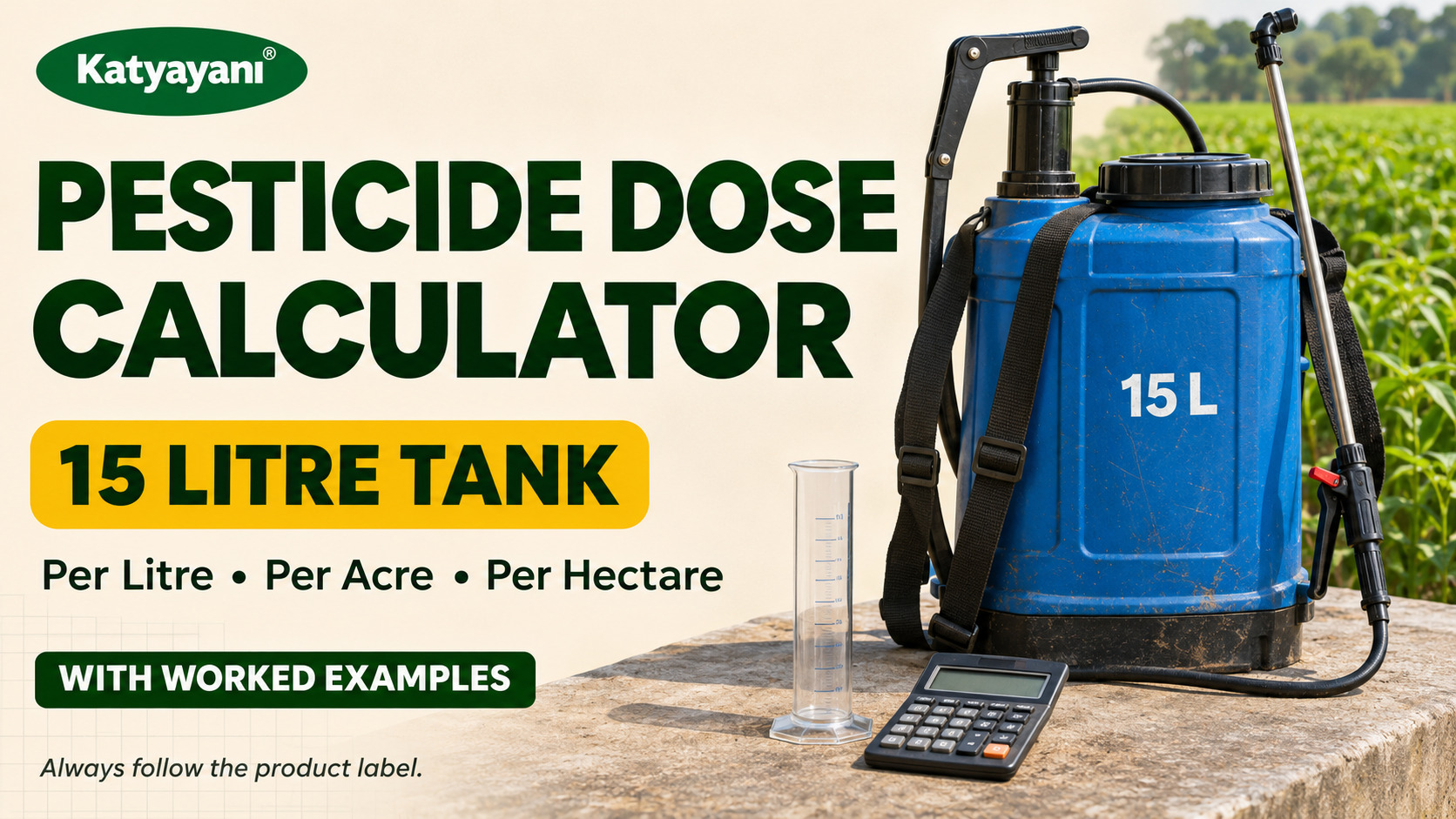
Dose per litre = dose per hectare (or per acre) divided by water per hectare (or per acre). Dose per tank = dose per litre times tank size. Example from a CIB&RC bio-insecticide row: 1,000 to 1,500 ml per hectare in 500 litres of water is 2 to 3 ml per litre, which is 30 to 45 ml in a 15 litre tank (our arithmetic). Water per acre is not fixed: NIPHM lists high volume as 300 to 500 litres per hectare and low volume as 50 to 150. Find your own by spraying plain water on a marked plot, then use the label dose for that area. The label on your pack always wins.
What does pesticide dose per litre of water mean?
Pesticide dose per litre of water is the amount of product mixed into each litre of water in your sprayer. It is written as ml per litre or grams per litre. It is not the dose per acre. The label gives a dose for a field area, and you turn that into a per litre figure.
Here is the usual problem. Ramesh buys a bottle that says 400 ml per acre. His pump holds 15 litres. He cannot pour 400 ml into 15 litres of water and spray one tank per acre, because one acre takes many tanks. He needs two more numbers: how much water the label wants for that acre, and how many tanks that makes. Then he can work out what goes into each tank.
| Number you need | Where it comes from | Example unit |
|---|---|---|
| 1. Dose for an area | The label or leaflet in the pack, or the CIB&RC "Major Uses of Pesticides" list | ml or g per acre, or per hectare |
| 2. Water for the same area | The label (dilution in water), or your own calibration of your sprayer | litres per acre, or per hectare |
| 3. Tank size | The marking on your own sprayer tank | litres (10, 12, 15, 16, 20) |
With these three numbers, every sum in this guide is a division and a multiplication. No special calculator is needed. A phone calculator is enough.
Which units do pesticide labels use, and what do they mean?
Labels use ml per litre, g per litre, percent, ml or g per acre, ml or g per hectare, and grams of active ingredient per hectare. They are all doses, but for different amounts of water or land. Change them into ml (or g) per litre first. Then the tank sum is easy.
The official CIB&RC "Major Uses of Pesticides" lists show the pattern. Each row gives the crop, the pest, the dose per hectare as grams of active ingredient (a.i.) and as formulation in g or ml, the dilution in water in litres per hectare, and the waiting period in days (CIB&RC fungicides list, up to 31 March 2024). Read the columns in that order.
| Label wording | What it means | How to turn it into ml or g per litre |
|---|---|---|
| ml per litre (ml/L), or g per litre | Product in each litre of the spray liquid | Nothing to do. This is already the dose per litre. |
| Percent, for example 0.2% | Product as a share of the spray liquid, ml in 100 ml | Multiply by 10. 0.2% = 2 ml per litre (our arithmetic). |
| ml or g per acre | Product for one acre of crop | Divide by the litres of water used for one acre. |
| ml or g per hectare | Product for one hectare (2.47 acres) | Divide by the litres of water used for one hectare. |
| g a.i. per hectare | Weight of the active ingredient only, not the product | Convert to product first (see the section on active ingredient below), then divide by water. |
| Dilution in water, litres per hectare | Water that the label dose is meant to be mixed in | This is the divisor. Dose per hectare divided by this number gives the dose per litre. |
How do you calculate pesticide dose per litre of water?
Divide the label dose for an area by the litres of water for the same area. The area must be the same on both sides, both per acre or both per hectare. The answer is the dose in each litre of water. This is Formula 1.
Formula 1: Dose per litre = label dose per hectare (or acre) divided by litres of water per hectare (or acre).
Take a real row. In the CIB&RC list, hexaconazole 75% WG on paddy for sheath blight and sheath rot shows 50 g of active ingredient, 66.7 g of formulation and 500 litres of water per hectare (CIB&RC, fungicides list). The sum is 66.7 divided by 500, which is 0.133 g per litre (our arithmetic). Round it to 0.13 g in each litre.
Why the same unit on both sides matters: if the dose is per hectare and your water figure is per acre, the answer is wrong by almost 2.5 times. Check the word "ha" or "acre" next to both numbers before you divide.
How do you calculate the pesticide dose for a 15 litre tank?
Multiply the dose per litre by 15. If the dose is 2 ml per litre, a 15 litre tank needs 30 ml. If it is 0.13 g per litre, the tank needs about 2 g. For any tank size, use the same step. This is Formula 2.
Formula 2: Product per tank = dose per litre times litres of spray liquid in the tank. Fill the tank to the same level every time.
Do the hexaconazole example through. 0.1334 g per litre times 15 litres is 2.0 g. For a 16 litre pump it is 2.13 g. So you weigh 2 g of the granules, mix them in the tank and spray. The number of tanks for an acre comes later in this guide.
The tank should be filled to its mark. A tank "about full" can hold 14 litres one time and 16 the next. If you always add 30 ml, that is 2.14 ml per litre in the first tank and 1.88 in the second (our arithmetic), and the error repeats over many tanks.
What is the pesticide dose for 10, 12, 15, 16 and 20 litre tanks?
Use the chart below. Pick the dose per litre in the first column, then read across to your tank size. Every value is the dose per litre multiplied by the tank volume, so it is pure arithmetic. It works in ml for liquid products and in grams for powders and granules.
| Dose per litre (ml or g) | 10 litre tank | 12 litre tank | 15 litre tank | 16 litre tank | 20 litre tank |
|---|---|---|---|---|---|
| 0.25 | 2.5 | 3 | 3.75 | 4 | 5 |
| 0.5 | 5 | 6 | 7.5 | 8 | 10 |
| 1 | 10 | 12 | 15 | 16 | 20 |
| 1.5 | 15 | 18 | 22.5 | 24 | 30 |
| 2 | 20 | 24 | 30 | 32 | 40 |
| 2.5 | 25 | 30 | 37.5 | 40 | 50 |
| 3 | 30 | 36 | 45 | 48 | 60 |
| 4 | 40 | 48 | 60 | 64 | 80 |
TNAU lists a petrol knapsack power sprayer with a 12 litre tank and a battery-operated low volume knapsack sprayer with a 10 litre tank (TNAU knapsack power sprayer, TNAU low volume sprayer). The Government of Alberta uses a 15 litre backpack tank in its worked example (Alberta). Your own pump may differ. Read the litre mark inside the tank, and use that number.
How do you convert a dose per acre into a dose per litre?
Divide the dose per acre by the litres of water per acre. If the label gives only a per hectare dose and a per hectare water volume, divide those two instead, because the acre factor cancels out. You only need the acre factor when you want a per acre total.
One hectare is 2.47 acres, so one acre is 0.4047 hectare (our arithmetic). Use it to move between the two:
| Row used (CIB&RC) | Per hectare | Per acre (multiply by 0.4047) | Per litre |
|---|---|---|---|
| Azadirachtin 1% EC (10,000 PPM), tomato fruit borer: dose and water | 1,000 to 1,500 ml in 500 litres | 405 to 607 ml in 202 litres | 2 to 3 ml |
| Azadirachtin 0.30% EC (3,000 PPM), cotton American bollworm: dose and water | 4,000 in 1,000 litres | 1,619 in 405 litres | 4 |
| Hexaconazole 75% WG, paddy sheath blight: dose and water | 66.7 g in 500 litres | 27 g in 202 litres | 0.13 g |
Sources for the rows: the CIB&RC bio-insecticides list for the two azadirachtin rows and the CIB&RC fungicides list for hexaconazole. The list prints one column headed "g/ml" for the formulation, and for a liquid EC the number is read in ml. The per acre and per litre columns are our arithmetic.
Notice what changed between the first and second row. The first dose is lower per hectare, but it goes in 500 litres. The second is higher and goes in 1,000 litres. That is why the per litre figure can look wildly different from the per hectare dose. The water volume is half the story.
What if the label gives the dose as a percent?
A percent dose is a per litre dose in disguise. Multiply the percent by 10 to get ml per litre for a liquid. 0.2% is 2 ml per litre and 1% is 10 ml per litre. The percent here is the share of product in the spray liquid, not the strength printed on the pack.
The CIB&RC fungicides list shows hexaconazole 5% SC on mango (powdery mildew) and paddy (sheath blight) with the dose written as 0.2% or "200 ml per 100 lt water". It adds that the water is "as required depending on size of tree and plant protection equipment used" (CIB&RC, fungicides list). Two ways of writing the same thing. 200 ml in 100 litres is 2 ml per litre. For a 15 litre tank that is 30 ml (our arithmetic).
Do not mix up the two percents. A pack of "5% SC" says the product has 5 percent active ingredient. A dose of "0.2%" says how strong the spray liquid should be. The first is on the front of the pack. The second is on the leaflet.
What if the label dose is given as grams of active ingredient?
Divide the grams of active ingredient by the strength of the product written as a fraction. 50 g a.i. of a 75% product is 50 divided by 0.75, which is 66.7 g of product. Weigh the product, not the active ingredient. The CIB&RC rows print both numbers side by side so you can check the sum.
The hexaconazole 75% WG row is a good check. It prints 50 g a.i. and 66.7 g formulation per hectare (CIB&RC, fungicides list). 50 divided by 0.75 is 66.67. The sum works. Use the formulation column for your tank and ignore the a.i. column unless you are comparing two products of different strength.
| Question | Use the a.i. column? | Use the formulation column? |
|---|---|---|
| How much product do I weigh or pour into the tank? | No | Yes |
| Is a 75% product stronger than a 25% product? | Yes, to compare | Compare the amounts needed |
The letters after the percent (EC, SC, WG, WP, SL) say what form the product is in, not how strong it is. Our guide to pesticide formulation codes explains them one by one. Shake or stir SC, WP and WG before you measure.
How much water does one acre need for spraying?
It depends on your sprayer, the crop size and the label. NIPHM, the national plant health institute under the Ministry of Agriculture, groups spraying into three classes: high volume at 300 to 500 litres per hectare, low volume at 50 to 150, and ultra low volume under 5 (NIPHM field guide for sprayers).
| Spraying class (NIPHM) | Litres per hectare | Per acre (our arithmetic) | Tanks of 15 litres per acre (our arithmetic) | Droplet size (NIPHM, microns) |
|---|---|---|---|---|
| High volume | 300 to 500 | 121 to 202 litres | 8 to 13.5 | 250 to 1000 |
| Low volume | 50 to 150 | 20 to 61 litres | 1.3 to 4 | 150 to 220 |
| Ultra low volume | Under 5 | Under 2 litres | Less than 1 | 70 to 100 |
Machines fit the classes differently. TNAU describes a petrol knapsack power sprayer (12 litre tank, covers 3 to 4 hectares a day) as a medium volume machine, and a battery knapsack low volume sprayer (10 litre tank, 1.5 hectares a day) as one that "requires 50 litres of water per hectare" (TNAU knapsack power sprayer, TNAU low volume sprayer).
The CIB&RC rows show how much the label itself varies. The azadirachtin rows above call for 500 litres per hectare on tomato and 1,000 on cotton. The tea rows in the same list use 450 and 600 litres (CIB&RC bio-insecticides list). The label for your product and crop is the number to follow. Never assume 200 litres per acre for everything.
How do you find your own spray volume per acre?
Spray plain water on a small marked plot at your normal walking speed, note the litres used, and scale up. This is the area and volume method, which TNAU calls "easier for a normal farmer to follow". The sum is: litres per acre = plot area times water used, divided by marked area.
Formula 3: Water per acre (litres) = acre area (4,047 square metres) times water used on the marked plot, divided by the area of the marked plot.
- Mark a plot. Use 10 m by 10 m (100 square metres) in a similar crop and stand. These are practice numbers; any measured area works.
- Fill the tank with a measured amount of plain water. Use a bucket and a litre jug. Note the litres.
- Spray the plot as you would in the field. Same pressure, same walking speed, same hand height. Cover the plot only once.
- Measure what is left. Subtract it from what you put in. Say you used 5 litres.
- Scale up. 4,047 divided by 100, times 5 litres, is 202 litres per acre (our arithmetic with practice numbers).
- Repeat once. If the two results differ by a lot, the sprayer pressure or your pace is not steady. Repeat until they match.
TNAU says a sprayer calibration exercise is "essential" before actual spraying, for uniform application (TNAU, spray calibration). FAO says to calibrate at the start of each season, after a repair, and whenever new nozzles are fitted (FAO good practice guidelines). SDSU Extension adds long storage, a change of nozzle type and drastic weather changes (SDSU Extension).
Now use the practice result. If a label dose were 400 ml per acre (a practice number, not a recommendation), 400 divided by 202 litres is 1.98 ml per litre. Round to 2 ml per litre. A 15 litre tank then needs 30 ml. One acre takes 202 divided by 15, which is 13.5 tanks.
How many tanks does an acre need, and how do you split the dose?
Divide the water per acre by the tank size. Then divide the dose per acre by the same number of tanks. If the tank count is not whole, you can either spray a part tank at the end or round up and spread the dose evenly. Do not just fill the last tank to the top with leftover mix.
The Government of Alberta shows the rounding step. A plot of 20 m by 50 m is 0.10 hectare. At 350 litres per hectare it needs 35 litres of water, which is 2.3 tanks of 15 litres. It rounds up to 3 tanks and puts the product for the whole plot (0.10 hectare times 150 ml per hectare) in 3 equal shares of 5 ml (Alberta backpack sprayer calibration). The result is a bit less water in each tank but the same dose on the plot.
| Step | Alberta example (metric) |
|---|---|
| Area | 20 m x 50 m = 0.10 ha |
| Total water | 0.10 ha x 350 L/ha = 35 L |
| Number of tanks | 35 L divided by 15 L = 2.3, round up to 3 |
| Product per tank | (0.10 ha x 150 ml/ha) divided by 3 = 5 ml |
Round up the number of tanks, not down. Our reasoning, not an Alberta statement: if you round down to 2 tanks but still add all the product, the same product goes into less water, so each tank is stronger than you planned.
Does the dose change for a knapsack, a power sprayer or a drone?
The label dose per hectare is the product the area needs. Different machines carry it in different amounts of water. A knapsack uses more water and a low volume sprayer uses less, so the per litre figure changes while the product per acre should not. Always start from the per acre dose.
| Machine | Tank (TNAU / Alberta / NIPHM) | Spray class and volume | What to do with the label dose |
|---|---|---|---|
| Manual knapsack sprayer | 15 litres in the Alberta worked example; your own tank may differ | Set by your own calibration. NIPHM calls 300 to 500 litres per hectare high volume and 50 to 150 low volume | Use the label water per acre or your calibrated volume. Work out per litre from that. |
| Petrol knapsack power sprayer | 12 litres (TNAU) | Medium volume (TNAU) | Calibrate your own volume. Keep the product per acre at the label figure. |
| Battery low volume knapsack | 10 litres (TNAU) | 50 litres per hectare (TNAU) | Same product per hectare in much less water, so the liquid in the tank is stronger per litre. Check the label allows it. |
| Drone | Set by the drone and its SOP | Set by the crop-specific SOP and label | Follow the drone SOP and the label for that product. Do not copy a knapsack number. |
For drones, the Ministry of Agriculture released SOPs for pesticide and nutrient application on 21 December 2021 (PIB, 21 Dec 2021) and crop-specific SOPs on 20 April 2023 (PIB, 20 Apr 2023). In a Lok Sabha reply on 13 December 2022, the Minister said CIB&RC has prescribed guidelines for registering pesticides for drone application and has finalised test protocols for phyto-toxicity and bio-efficacy (PIB, 13 Dec 2022). Drone water volumes were not opened for this guide, so none is printed.
A stronger liquid in a low volume machine has one more risk: leaf burn on a few crops. This is why the label for your product and crop is the only safe guide. Our guide to choosing an agricultural sprayer covers nozzle types and what each machine suits.
How do you measure small amounts like 5 ml or 2 g?
Use a graduated container for liquids and a scale for powders, never a bottle cap or a guess. SDSU Extension says liquid pesticides should be measured in a container with marks, and dry ones weighed on a quality scale. FAO says dose rates per tank are small on a knapsack, so precise measuring tools must be at hand.
- Liquids: a measuring cylinder of 50 or 100 ml, or a plastic syringe without the needle for amounts under 10 ml. Keep them for pesticide only and never use them for food or water.
- Powders and granules: a small digital scale that reads to 0.1 g. A kitchen scale that reads in 5 g steps is not good enough for 2 g.
- Rinse after measuring. NIPHM says to rinse the measuring vessel and the product container and pour the rinse into the tank. Otherwise part of the dose stays on the vessel.
- Write the figure down. Put the ml or g for one tank on a tag tied to the pump. It saves a recalculation every time and avoids mistakes when you are tired.
Sources: SDSU Extension, FAO and NIPHM. The 50 or 100 ml cylinder and the scale tips are ordinary practice, not quotes from these pages.
What is the right way to mix the spray tank?
Half fill the tank with clean water, add the measured product, rinse the measuring vessel into the tank, close the lid, shake or stir gently, then top up to the mark. This is the NIPHM order. Wettable powders go better when "creamed" with a little water first.
- Half fill the sprayer tank with clean water.
- Add the measured product.
- Rinse the measuring vessel, and the product pack if it is empty, and pour the rinse into the tank.
- Fit the lid and rock the sprayer gently, or stir.
- Remove the lid and top up with water to the correct level. Do not overfill.
- Do not shake a product bottle unless the label says so.
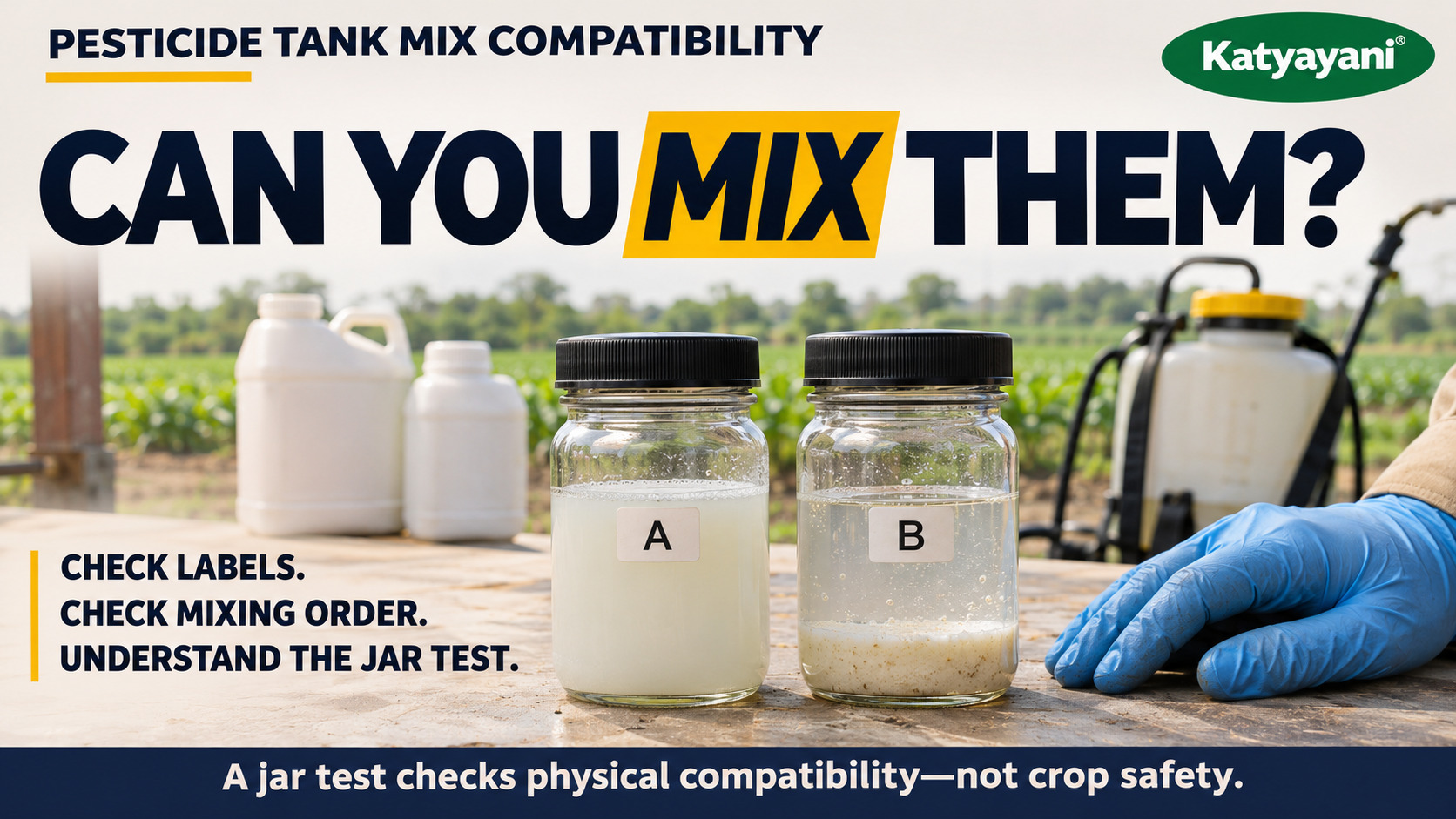
These steps are from the NIPHM field guide. If you plan to put two products in one tank, read our tank mix compatibility guide first. It gives the order for dry and liquid products and a jar test. Winter mornings add dew and fog problems, covered in our guide on when to spray pesticide in winter.
Should you raise the dose when the pest attack is heavy?
No. SDSU Extension says that if too little product is applied, the pest will not be controlled, and if too much is applied, the pest is controlled but "other undesirable and unintended consequences" may follow. The label dose is the tested amount. Fix the cause of a poor result instead: timing, coverage, the wrong product.
| If the spray seems to fail | Check this first | Not this |
|---|---|---|
| Pests are back after a few days | Coverage: did the liquid reach the underside of leaves? Is your nozzle worn? | Doubling the dose |
| Some plants are burnt | Per litre strength and the weather at spray time | Spraying again at once |
| No effect at all | Is the product right for this pest? Did it rain soon after? | More ml in the tank |
| Dose per tank looks too high | Did you use the per hectare dose with per acre water? | Trusting the first number |
Also respect the waiting period. A heavier dose does not shorten it. Our guide to the pre-harvest interval explains how to count the days from the last spray.
Why do nozzles and pressure change your dose?
A worn nozzle sprays more liquid than it should, so each acre gets more product than you planned. FAO says to replace nozzles when output rises 5 percent above the catalogue figure at a given pressure, or when nozzles on the same boom differ by more than 10 percent.
SDSU Extension gives a similar rule: replace a nozzle that is 10 percent off the desired output. A knapsack has one nozzle, so a simple test (our practical tip) is to time it. Spray a measured litre of water into a bucket at working pressure and note the seconds. If the time changes from week to week, the nozzle or pressure has changed. NIPHM lists nozzle types by job: hollow cone for insecticides, and flood jet or flat fan for weedicides and fungicides (NIPHM).
FAO also says the flow figures from makers are generated with clean water, and that it is advisable to measure the flow from actual nozzles (FAO). Recheck your calibration whenever you change a nozzle. A new nozzle can change your litres per acre, and that changes every per litre figure in this guide.
Which mistakes spoil a dose calculation?
The most common mistakes are mixing acre and hectare, using the wrong tank size, reading the a.i. column as the product, forgetting the water figure, rounding the tank count down and filling the tank unevenly. Each is easy to catch with a written sum and one check.
| Mistake | What goes wrong | Quick check |
|---|---|---|
| Per hectare dose with per acre water (or the reverse) | Dose is about 2.5 times too high or too low | Does the word acre or ha appear next to both numbers? |
| Using the a.i. grams as the product grams | Under-dose, by the strength of the product | Use the formulation column |
| Tank "about full" | Dose per tank changes from one fill to the next | Fill to the mark every time |
| Rounding the tank count down | Last tank is overloaded | Round up and share the dose evenly |
| Reading 0.2% as 0.2 ml per litre | Dose 10 times too low | Multiply the percent by 10 for ml per litre |
| Using last year's tank figure after changing the nozzle | Water per acre has changed | Calibrate again after any nozzle change |
| Copying a dose from a friend's crop | Different crop or pest, different row | Find the row for your crop and pest |
What safety steps go with measuring and mixing?
Wear the protection the label asks for, keep soap and water within reach, and wash up before eating or drinking. NIPHM lists the habits: wash hands and face often, keep soap and water with you, wash gloves before taking them off, and bathe with plenty of soap before changing into clean clothes.
- Wash gloves thoroughly before you take them off, then remove other protective clothing with the gloves still on (NIPHM).
- Put used gloves in a plastic bag together with the rinsed empty container (NIPHM).
- Do not use food containers or kitchen spoons for measuring. Keep a set of measuring tools for pesticide only.
- Read the toxicity colour band and the antidote line on the label before you open the pack. Our guide to reading a pesticide label walks through every panel under Rule 19 of the Insecticides Rules 1971.
- Buy only from a licensed seller and check the seal and batch. Our guide to identifying fake pesticides gives the checks.
Where can you read the label dose of popular insecticides?
Each product page below lists a dose table on the page, and several also give a figure per litre. This guide prints none of them, because a product page is not the same as the CIB&RC label, and the pack in your hand is the final word. Use the pages to see the format, then apply the formulas above.
| What people search | Page that lists it | What the page shows |
|---|---|---|
| imidacloprid 17.8 sl dose per litre | Imidacloprid 17.8% SL page | A dose per acre table by crop and pest, and a line for small use per litre |
| imidacloprid 30.5 sc dose per litre | Imidacloprid 30.5% SC page | Dose per acre by crop and the water per acre to mix it in |
| fipronil 40 + imidacloprid 40 dose per litre | Fipronil 40% + imidacloprid 40% WG page | Dose per acre, water per acre, and a foliar line per 15 litres |
| emamectin benzoate 5 sg dose per litre | Emamectin benzoate 5% SG page | A dose table by crop and pest with water per acre, a per litre line and a per acre line |
| thiamethoxam 12.6 + lambda cyhalothrin 9.5 zc dose per litre | Thiamethoxam + lambda-cyhalothrin ZC page | A dose per acre table by crop and pest |
| neem oil 10000 ppm dosage per litre | Neem oil 10,000 ppm page | A dose per litre of water line |
| spinosad 45 sc dosage per litre | Spinosad 45% SC page | A per litre line and a per acre line |
| indoxacarb 14.5 sc dose per acre | Indoxacarb 14.5% SC page | Dose per acre and water per acre by crop and pest |
| triple attack insecticide dose per litre | Triple Attack bio pesticide powder page | A foliar dose per litre of water |
For two common actives, our posts go deeper on uses and waiting periods: fipronil 5% SC uses and dosage and thiamethoxam 25% WG uses and dose. The CIB&RC lists and your pack label are still the rules. Posts on imidacloprid 17.8 SL, emamectin benzoate 5 SG, neem oil ppm and the thiamethoxam plus lambda-cyhalothrin ZC mix are planned in the same series.
A final check before you spray. Read the crop, pest, dose, water and waiting period on your own pack. Do the sum on paper. Measure with the right tools. Fill to the mark. Spray the plot you calibrated. That order catches nearly every error.
Conclusion
Pesticide dose per litre of water comes from three numbers: the label dose for an area, the water that goes with it, and your tank size. Divide the dose by the water to get ml per litre, multiply by the tank size to get ml per tank, and find your own water per acre by spraying plain water on a marked plot. A CIB&RC row such as 1,000 to 1,500 ml per hectare in 500 litres is 2 to 3 ml per litre, or 30 to 45 ml in a 15 litre tank. Keep acre and hectare apart, use the product column rather than the active ingredient column, round the tank count up, and never raise the dose to chase a poor result. The label on your pack is the final authority.


Leave a Comment