
 15 min read
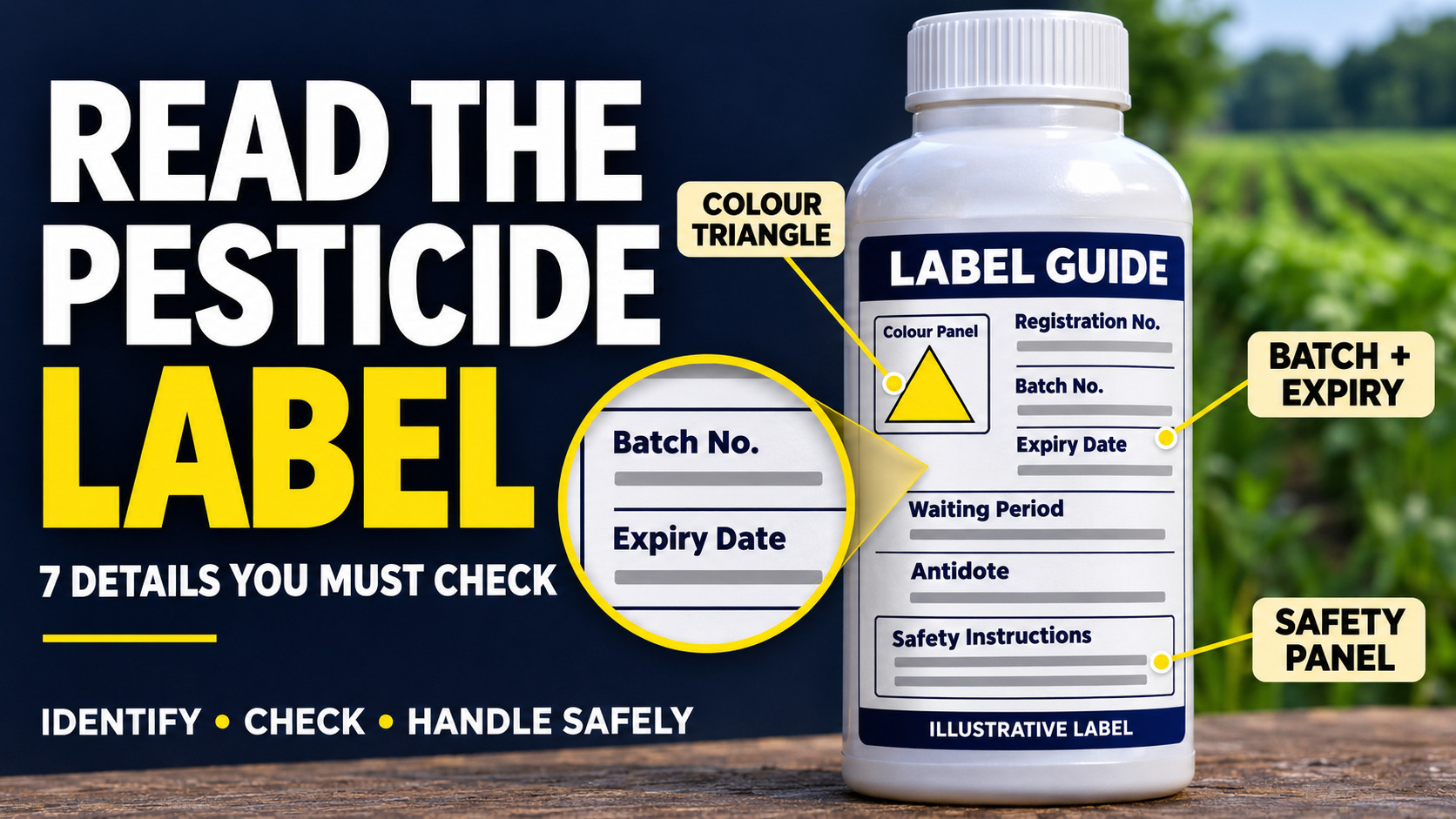
A pesticide label is the printed and written matter on the pack and on the leaflet inside it. In India, Rule 19 of the Insecticides Rules 1971 says it must show the manufacturer, brand name, registration number, active ingredients with percentages, net content, batch number, expiry date and an antidote statement. A diamond with a colour band shows the toxicity: red for extremely toxic, yellow for highly toxic, blue for moderately toxic and green for slightly toxic. Read the crop, pest and dose in the leaflet, and respect the waiting period before harvest.
What is a pesticide label, and why is it a legal document?
A pesticide label is every piece of printed, written or graphic matter on the pack and on the covering around it, plus anything that comes inside with the product. In India this is defined by the Insecticides Act 1968. Using the product against the label can be an offence, so the label is not just advice.
The Insecticides Act 1968 defines "label" in section 3 as any written, printed or graphic matter on the immediate package and on every other covering in which the package is placed, and it adds that this includes any matter accompanying the insecticide. That last part matters. The folded leaflet inside the carton is legally part of the label, so throwing it away unread is the same as ignoring the label.
The ICAR-CIWA manual for farmwomen puts it in one line: the label is a legal document, and using pesticides in ways other than listed on the label may lead to legal action. The Act backs this up. Section 29(2) of the text I opened says that whoever uses an insecticide against any provision of the Act or its rules can be fined up to Rs 500. The bigger penalties in the same section, jail up to two years for a first offence, are aimed at people who sell or stock misbranded or unregistered products.
FAO says almost the same in its 2022 labelling guidance: in many countries pesticides can legally be used only according to the label, and some labels carry a heading such as "It is a violation of law to use this product in a manner inconsistent with its labelling". Indian labels do not always print that line, but the principle is the same.
What must be printed on every pesticide label in India?
Rule 19(1) of the Insecticides Rules 1971 lists eight items: the manufacturer, the brand name, the registration number, the active and other ingredients with their percentages, the net content in metric units, the batch number, the expiry date and the antidote statement. They must be in indelible ink on the inner container and the outermost covering.
The Insecticides Rules 1971 also say in Rule 19(2) that the label must be fixed so that it cannot ordinarily be removed. And Rule 20 forbids anyone to alter, rub out or deface what the manufacturer printed on the container, label or wrapper, unless the Registration Committee itself allows it. So a pack with a scratched batch number or a pasted-over expiry date is a problem for the seller, not just for you.
| Item in Rule 19(1) | What it tells you | What to look at |
|---|---|---|
| Name of manufacturer | Who made it. If the registrant is a different company, the label must state the relationship between the registrant and whoever makes, packs, distributes or sells it | A real company name and address, not just a brand |
| Name of insecticide | The brand or trade mark it is sold under | Check it against the bill and the leaflet |
| Registration number | Shows the product is registered under the Act | It must be present. A missing number is a red flag |
| Active and other ingredients with percent | What is inside and how much, using the ISO or Indian Standards common name | The common name and the percent, not only the brand |
| Net content | The amount in the pack, in metric units, without wrapper weight | Compare with the bill |
| Batch number | Lets the maker trace the lot | Must match the outer carton and the bill |
| Expiry date | The date until which the product keeps its efficiency and safety | Never buy or use past this date |
| Antidote statement | The treatment a doctor can use if someone is poisoned | Read it before you open the pack |
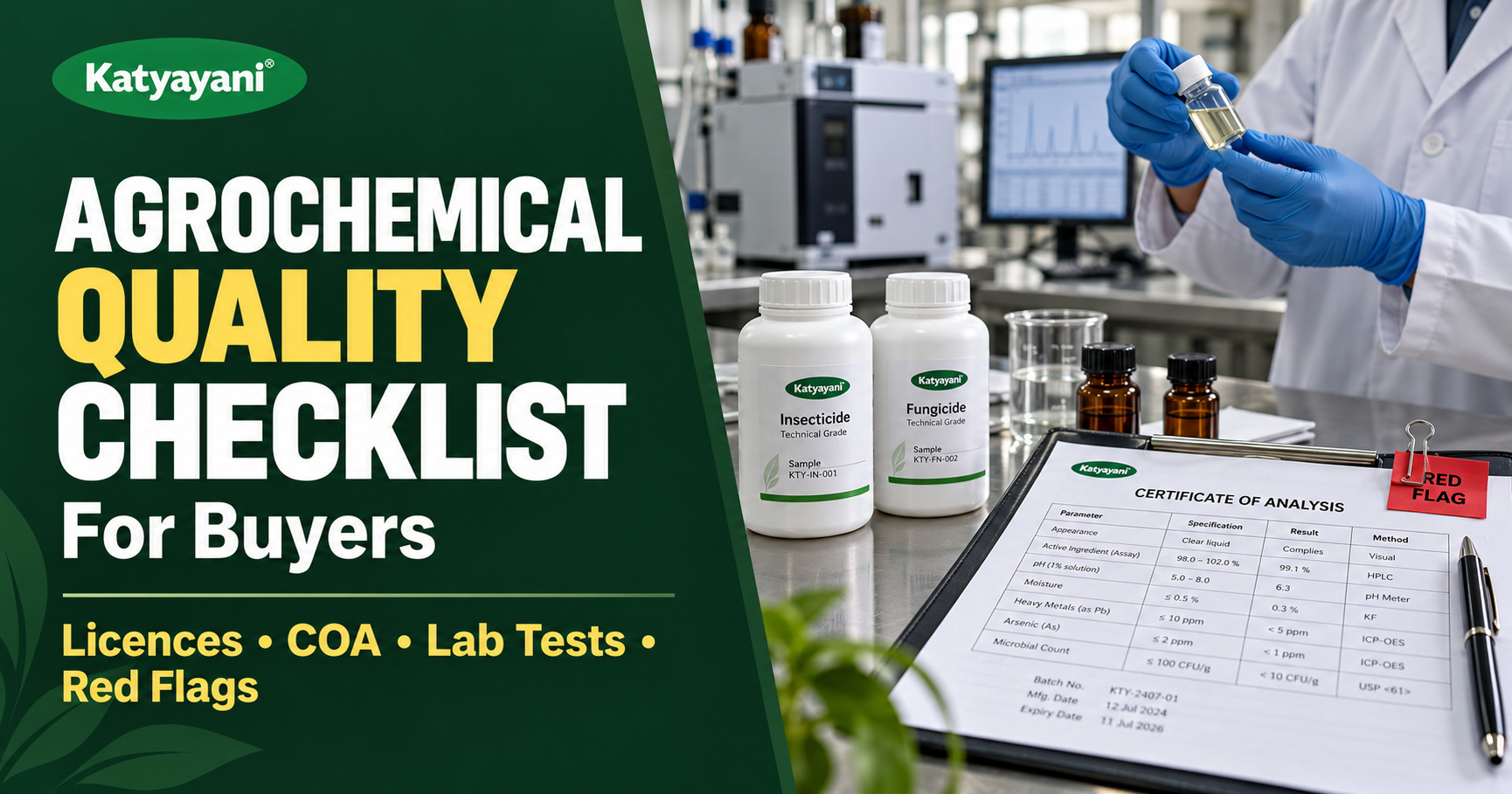
The live post on fake pesticides and fertilisers turns these eight items into a buying checklist. Here we go further: what each part really means and what to do with it in the field.
What is the difference between the label and the leaflet?
The label is on the pack and carries the identity, the toxicity diamond and the warnings. The leaflet is a folded sheet inside the pack. Rule 18 says every pack must include a leaflet with directions for use, hazards, first aid, storage and disposal, and the Registration Committee approves the leaflet.
According to Rule 18(1) of the Insecticides Rules, the leaflet must give: the plant diseases, insects, noxious animals or weeds the product is meant for, with adequate directions on how to apply it; particulars of chemicals harmful to humans, animals and wildlife, with warning statements, symptoms of poisoning, safety measures and emergency first aid; cautions on storage and application, including warnings about flammable, explosive or skin-harming substances; instructions for decontamination or safe disposal of used containers; the antidote statement, which must be in the leaflet and the label; a note if the product irritates the skin, nose, throat or eyes; and the ISO common name.
Rule 18(2) adds that approved copies of the leaflet, signed by the Secretary of the Registration Committee, go back to the manufacturer and to the state licensing officer. So the wording in your leaflet has been through the regulator.
FAO makes the same split in its 1995 guidelines. The essential instructions must always be on the label itself, and the leaflet can repeat and expand them. If a leaflet is used, the label must tell you to read it before use. For small packs, FAO says the panel with the hazard symbols should be on the part glued to the pack and the leaflet must stay firmly attached so it travels with the product.
On the farm, this means two things. Keep the leaflet with the empty pack until you finish the product, and take a photo of both sides before you mix. If the leaflet is missing from a new pack, you have a pack that is incomplete.
How do you read the front of the label: brand, common name, registration number and percent?
Start with the common name of the active ingredient, not the brand. Brands change, but the common name and the percent tell you what is actually in the pack. Then find the registration number, the formulation code and the net content. Together they tell you what you bought and in what form.
Rule 19(1)(iv) says ingredients must be given with the ISO or Indian Standards common name and the percentage of each, and the chemical name if no common name exists. FAO says content is usually written as grams of active ingredient per kilogram or per litre, or as a percent, along with the formulation type and its code.
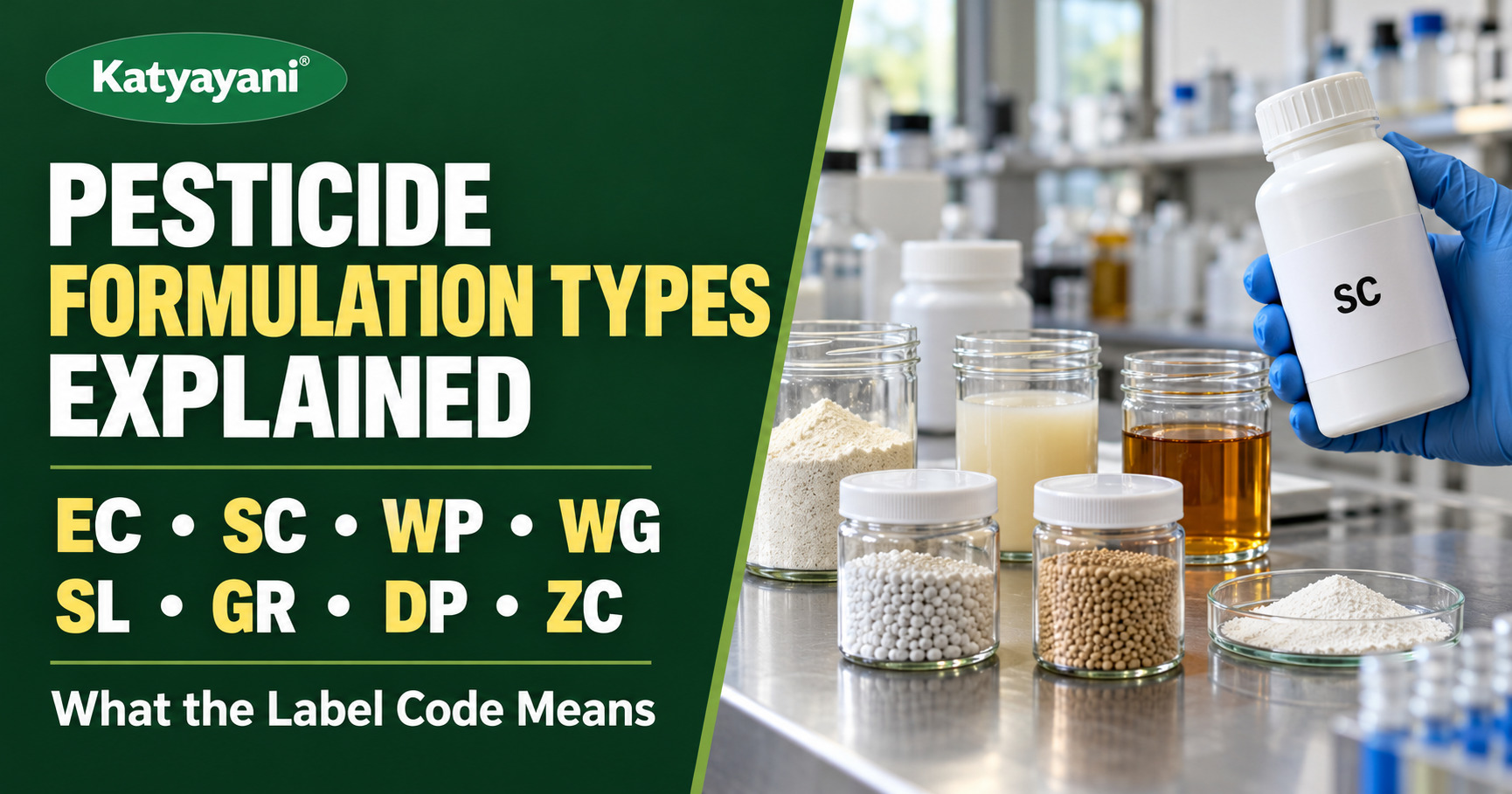
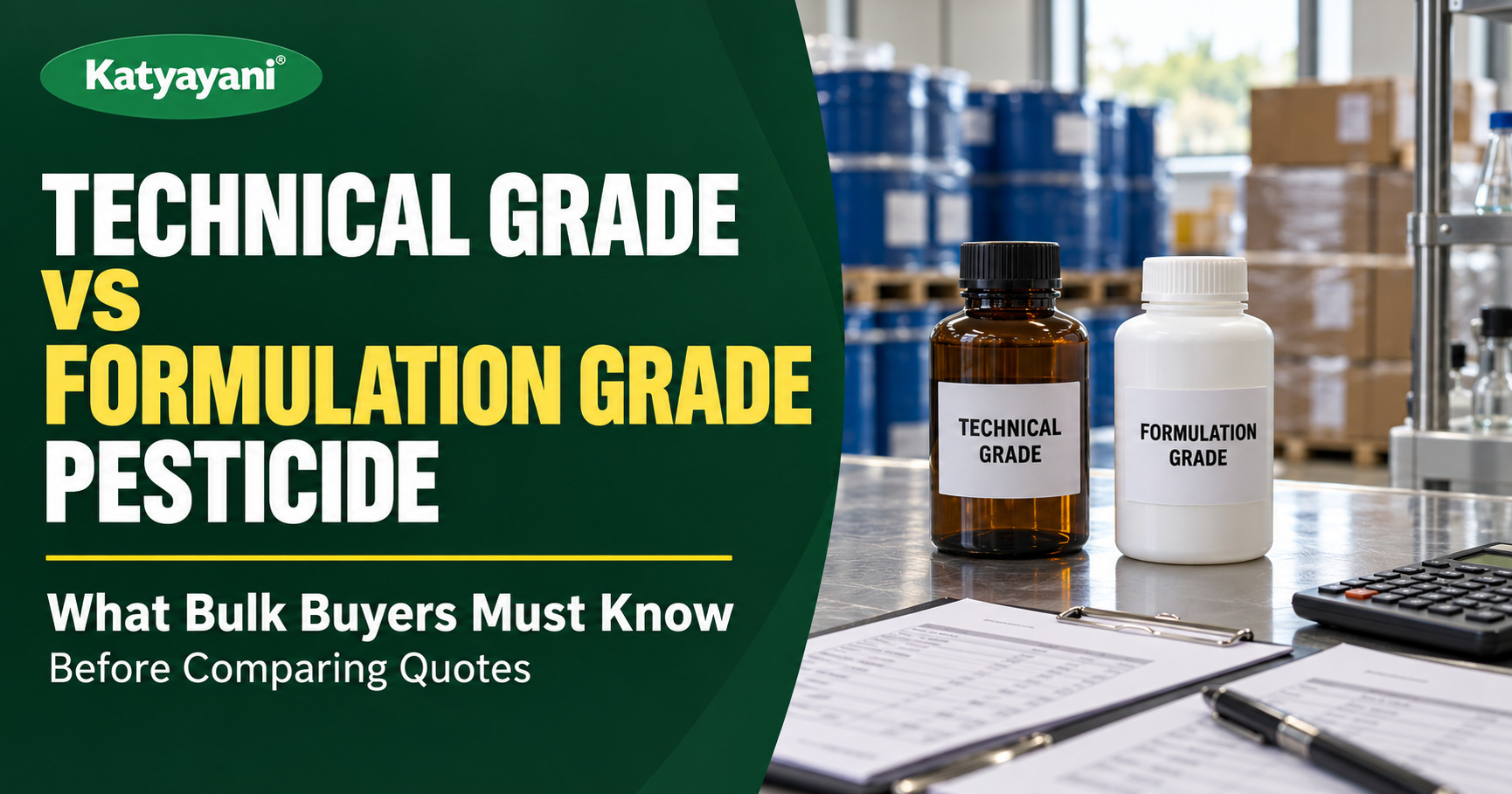
Say two shops sell products under different brand names. Both print the same active ingredient at 25%, but one pack says EC and the other says WG. The active is the same, but the form is not, and the dose, the mixing and the cost per gram of active will differ. Our guide to pesticide formulation types explains the codes, and the post on technical grade and formulation grade shows how to compare strength between two quotes. We will not repeat those here.
Look also at the "other ingredients" part. FAO 2022 recommends that hazardous co-formulants, such as petroleum distillates, be named with their concentration, because they matter for medical treatment. If a product contains a solvent that makes it more hazardous than the active alone, that is a reason to be more careful with PPE.
About the registration number: Section 3(k)(vii) of the Act says a product is misbranded if the label refers to registration in any way other than the registration number. Phrases such as "government approved" or "CIB certified" printed in big letters are therefore not what the law asks for.
What does the coloured triangle on a pesticide pack mean?
The coloured triangle is the toxicity warning. Rule 19(3) puts a diamond on the label, split into two triangles. The upper one carries a symbol and a signal word, and the lower one carries a colour band based on how toxic the product is. Red is the most toxic, then yellow, blue and green.
Under the Rules, the diamond must be set at an angle of 45 degrees, in a prominent place, and cover not less than one-sixteenth of the total area of the front of the label. Its size depends on the pack size. The colour is based on LD50, the dose that kills half of a group of test animals.
| Category | Toxicity | Oral LD50 (mg/kg) | Dermal LD50 (mg/kg) | Colour of band | Word in the top triangle |
|---|---|---|---|---|---|
| I | Extremely toxic | 1 to 50 | 1 to 200 | Bright red | POISON in red, with skull and cross-bones |
| II | Highly toxic | 51 to 500 | 201 to 2000 | Bright yellow | POISON in red |
| III | Moderately toxic | 501 to 5000 | 2001 to 20000 | Bright blue | DANGER |
| IV | Slightly toxic | More than 5000 | More than 20000 | Bright green | CAUTION |
The ICAR-CIWA bulletin gives the same colour order for farmwomen: red for extremely toxic, yellow for highly toxic, blue for moderately toxic and green for slightly toxic. It adds practical advice that is easy to remember. Never work alone when handling products that carry a red or yellow triangle.
One thing to note when you read international material: the FAO/WHO 2022 guidance describes a colour band scheme of red, yellow, blue or grey, and says the same colour is usually not allowed elsewhere on the label. The Indian rule text opened for this post names bright green for the lowest category. When you read an Indian pack, go by the Indian triangle.
What do POISON, DANGER and CAUTION mean, and what else must the label say?
These are the signal words under Rule 19(4). POISON in red is for Categories I and II. DANGER is for Category III. CAUTION is for Category IV. For Categories I to III the label must also say KEEP OUT OF THE REACH OF CHILDREN, outside the triangle, and Category I adds a call-a-physician line.
For Category I, extremely toxic, the Rule also asks for a skull and cross-bones symbol and two warnings outside the triangle: "KEEP OUT OF THE REACH OF CHILDREN" and "IF SWALLOWED, OR IF SYMPTOMS OF POISONING OCCUR CALL PHYSICIAN IMMEDIATELY". Rule 19(6) adds that a highly inflammable product must say so, or tell you to keep it away from heat or open flame.
The words are a quick scale. A green triangle with CAUTION is the lowest category, but it is not a licence to be careless. Rule 19(8) says a label must not make unwarranted safety claims. It names SAFE, NON-POISONOUS, NON-INJURIOUS and HARMLESS, with or without the phrase "when used as directed". FAO 2022 goes further and also bans "environmentally friendly" and superlatives such as "best" or "most effective".
So if a pack of any colour says "100% safe" or "harmless to humans", treat the label itself as the warning. It breaks the Rule.
What does LD50 mean, and does a lower toxicity colour mean zero risk?
LD50 is the dose of a substance that kills half of a group of test animals, measured in mg per kg of body weight. The lower the LD50, the more toxic the product. It measures sudden poisoning, not long-term effects, so even a green-band product needs gloves and care.
The ICAR-CIWA manual gives a simple example. Rotenone has an LD50 of 132, malathion 1,375 and table salt 3,750. So rotenone, which the bulletin calls an "organic" pesticide, is much more toxic than malathion or salt. The same bulletin warns that LD50 only shows acute toxicity. The long-term, chronic effects matter more to people who handle chemicals every day.
FAO 2022 says the same in another way. Its colour band scheme is meant to show both acute and severe chronic hazards, and it recommends red for products in certain cancer, gene-damage and reproduction hazard categories. In India the triangle follows the LD50 table in Rule 19(5), so the triangle alone will not tell you everything about long-term exposure. That is another reason to wear PPE for every spray, whatever the colour.
Where do you find the crop, pest and dose on a pesticide pack?
Look in the leaflet and in the directions for use on the label. Rule 18(1)(a) requires the leaflet to name the plant diseases, insects, noxious animals or weeds the product is for and give directions on how to apply it. If your crop and your pest are not listed, the product is not meant for that use.
FAO lists what good directions should cover: where to use the product (which crops, targets, areas), the dose, mixing instructions and water volumes, the method of application, timing and number of applications, warnings about mixing different pesticides in one tank unless it is a registered tank mix, phytotoxicity warnings and the waiting periods. The 2022 guidance adds that volumes in mixing instructions should be in the same units as the container to avoid conversion errors.
Imagine a farmer who buys a fungicide for tomato and sprays it on chilli because the leaf spots look the same. The label said tomato only. If the crop is damaged, or a residue test fails at the mandi, the label is not on his side. The ICAR-CIWA bulletin also advises not to use a lower or higher dose and dilution than the recommended one.
Crop-by-crop lists are kept by the central regulator. The public notice of the Directorate of Plant Protection, Quarantine and Storage dated 14 June 2023 lists the CIB&RC "Major Uses of Pesticides" documents for insecticides, fungicides, herbicides, plant growth regulators and bio-pesticides, as on 1 June 2023. These lists exist so you can cross-check a claim. The notice gives only the titles, and the full tables were not opened for this post, so no crop-wise values are printed here. The CIB&RC guidelines page lists the registration guidelines for sections 9(3), 9(3B) and 9(4) and for herbicide forms, but none with label or leaflet in its title, so the Rules themselves are the working source for label content.
For the spraying part, the live posts on fungicide application methods and on choosing and calibrating a sprayer show how to get the dose on the label onto the crop. The label sets the dose per acre or per litre of water. The sprayer calibration decides whether you deliver it.
What do the batch number, manufacturing date and expiry date tell you?
The batch number identifies the lot, so the maker can trace it if there is a quality problem. The expiry date, in the words of Rule 19(1)(vii), is the date up to which the insecticide retains its efficiency and safety. Both must be on the pack and on the outer covering, in indelible ink.
FAO 2022 recommends that a label show the batch number and the release date, and a shelf life or expiry date for products with a shelf life shorter than two years from release. The Indian Rule asks for the expiry date on every label.
- Match the batch number on the bottle, the outer carton and the bill. If they differ, do not take the product.
- The ICAR-CIWA bulletin says do not buy pesticides after the expiry date, and do not buy leaking containers, or loose, unsealed or torn bags.
- Buy only the quantity you need for one application, or at most one growing season, says the same bulletin.
- Keep the bill. Rule 15 of the Insecticides Rules says all sales must be made by a bill or cash memo, so a shop that refuses one is breaking the Rules.
- Never scratch, re-stick or paint over a date. Rule 20 forbids altering the manufacturer's inscriptions.
If you buy online, the same checks apply when the parcel arrives. The live post on what to check before buying agricultural products online has a short checklist for the label, the batch and the bill.
What is the waiting period (pre-harvest interval), and how is it different from the re-entry interval?
The pre-harvest interval (PHI), also called the waiting period, is the minimum time between the last spray and harvest. The re-entry interval is the time after spraying when people must stay out of the field. The first protects the person who eats the crop. The second protects the person who works in it.
The Health Canada fact sheet defines the PHI as the minimum amount of time between the last application of a pesticide and when the crop can be harvested, and says it exists so that residues stay below the maximum residue limit. It adds that rain after spraying does not shorten the PHI, and neither does using a lower rate. The restricted-entry interval fact sheet defines the REI as the time after application when people must not do hand labour in the treated area, and says that for hand harvest you follow the longer of the two intervals.
| Point | Pre-harvest interval (waiting period) | Re-entry interval |
|---|---|---|
| What it is | Minimum days between the last spray and harvest | Time after spraying before people may enter for hand work |
| Who it protects | The person who eats or sells the produce | The worker who enters the field |
| What goes wrong if ignored | Residue above the limit; produce can be seized, destroyed or barred from export (Health Canada) | Skin and breathing exposure |
| Does rain shorten it? | No (Health Canada) | Not stated on the page |
| If you tank-mix | Use the longest PHI among the products (Health Canada) | Use the longest REI among the products (Health Canada) |
| Where on the pack | Directions for use (Health Canada, FAO) | On the label where the product has one (Health Canada) |
In the Indian setting, the ICAR-CIWA manual tells farmwomen to learn the waiting period of each insecticide, and says fruits, fodder and vegetables should not be picked before it. The bulletin also carries a table of waiting periods in days for some older insecticides. We have not printed those values because the products are old and the figure for your product is the one on your leaflet.
One honest point. The base text of Rule 19(1) opened for this post does not name the waiting period among the eight label items. Rule 18 requires the leaflet to give directions for use and cautions. So in India, your best source for the waiting period is the leaflet and the directions on the pack. FAO guidance says the interval belongs on the label itself.
A quick example. You spray a vegetable on Monday and the leaflet says a waiting period of a set number of days. You count from the day of the last spray, not from the day it rains. If you plan a harvest for Saturday and the count falls short, you wait, or you pick a product with a shorter interval for the next round. A residue problem at the market costs far more than a delayed picking.
What does the safety panel say about protective clothing, storage and empty containers?
The safety panel and leaflet tell you what to wear, how to store the pack and how to dispose of the empty container. Rule 18(1) requires cautions on storage and application and instructions on decontamination or safe disposal of used containers. FAO adds that a label should warn against reusing containers.
FAO 2022 lists three statements as a minimum on all labels: keep locked away and out of reach of children, wash after use, and do not eat, drink or smoke when using the product. The older FAO guidance also required two pictograms on every label, one for washing after use and one for locking the product away.
| Stage | What to do | Source |
|---|---|---|
| Buying | Check the triangle, the seal, the expiry date; skip leaking or torn packs | ICAR-CIWA bulletin |
| Storage | Original container with intact seal, away from food, feed, children and livestock; locked cabinet; not in sun or rain; no freezing for liquids; weedicides stored apart | ICAR-CIWA bulletin; TNAU |
| Carrying to the field | Carry only the day's quantity, never in another container | TNAU |
| Mixing | Measure with tools used only for that purpose; no mouth siphoning; no smelling; do not mix granules with water | ICAR-CIWA bulletin |
| Spraying | Avoid high wind, high heat and rain; start from the downwind edge; no eating, drinking or smoking; never blow a clogged nozzle by mouth | TNAU; ICAR-CIWA |
| After spraying | Pour leftover spray in a pit on wasteland, never in a canal or pond; wash tools; wash and change clothes; keep records; mark the plot | TNAU |
| Empty pack | Do not reuse for any purpose; crush and bury; the ICAR-CIWA bulletin says rinse the sprayer a second and third time | TNAU; ICAR-CIWA |
The TNAU safe use page adds a few lines worth printing for the shed wall: keep children and unauthorised people away during mixing, never leave pesticides unattended in the field, and do not spray if the wind blows toward grazing livestock. The ICAR-CIWA bulletin also says to use a separate sprayer for herbicides and for insecticides, because herbicide residue in a tank can damage a crop later.
What does the antidote line mean, and what do you do in a poisoning?
The antidote statement tells a doctor which treatment counters the poison. Rule 19(1)(viii) makes it a required item on the label, and Rule 18(1)(e) puts it in the leaflet too. In an emergency, take the pack or label to the hospital and call the AIIMS poisons centre on 1800 116 117.
FAO 2022 says the label should always carry the line "If medical advice is needed, have the product container or label at hand", and that treatment advice should be detailed enough for medical staff to start emergency treatment as soon as the patient arrives. That is why you never throw the pack away before the spray is over, and why you tell the doctor exactly which product was used.
The AIIMS National Poisons Information Centre page gives the toll-free number 1800 116 117, and landlines 26589391 and 26593677, and says you can call 24 hours a day, 7 days a week. It advises three things: do not wait for the victim to look or feel sick, do not try to treat the person yourself, and take the victim to a nearby healthcare facility.
- Move the person away from the spray or spill and remove contaminated clothes.
- Follow the first-aid line on your pack. The ICAR-CIWA bulletin says to wash straight away after exposure and rinse eyes, nose or ears with water.
- Call 1800 116 117 and take the pack, leaflet or a photo of the label.
- Go to a healthcare facility at once, even if the person feels fine.
Which languages must a pesticide label use in India?
Rule 19(7) says the label and the leaflet must be printed in Hindi, English and one or two regional languages used in the areas where the pack is likely to be stocked, sold or distributed. So a pack sold in Maharashtra should carry Marathi, and a pack sold in Tamil Nadu should carry Tamil, along with Hindi and English.
FAO makes a practical point on this. When a label must be in more than one language, translations must carry the same meaning, and key safety information should be in all required languages on the label that is firmly attached to the container. FAO also notes that some users cannot read at all, which is why pictograms for safe use and protective clothing matter.
If you cannot find your own language on a leaflet, that is a gap. Ask the seller to show the local-language sheet, and do not rely on someone telling you the dose by memory. A dose passed along by word of mouth is how a 10 ml per pump mistake becomes 20.
What do the pictograms and the QR code on a pack mean?
Pictograms are small standard pictures that repeat the safety text, such as wearing gloves or washing after use. FAO says they should echo the safety text and never contradict it. A QR code, where printed, links to more product information, but FAO says a company website cannot replace what the law requires on the label.
FAO 1995 explains that the FAO and industry pictogram set was built so that people with different literacy levels in different countries get the same key safety message. It also says pictograms should only be used where the safety text carries the matching phrase. The 2022 guidance adds precautionary pictograms and hazard pictograms as separate groups and describes the QR code as optional, readable on a smartphone, with the warning that information on a company website cannot replace the information a country requires on the label.
The practical lesson: scan the QR code if there is one, but do not treat it as a proof of quality. The live post on fake pesticides explains why a copied QR code does not prove a pack is genuine.
How is a biopesticide label different?
A biopesticide label shows the living or natural active ingredient and its strength in biological units, not only a percent. FAO 2022 says microbial products can state strength as colony forming units (cfu) or viable units per kilogram or litre, and the label should give storage conditions that match the product's storage tests.
Microbial products such as Beauveria, Metarhizium and Bt are listed in the bio-pesticides collection. Use the label checks in this guide on each pack you pick.
The FAO/WHO guidance says the microbial agent is best identified by genus and species and, if suitable, by strain or isolate number. It adds that botanical products can state the amount of source material or the lead component, and semiochemicals can state grams of active substance. The label should also name the expected effect, such as pest control, reduction or suppression, and give directions for mixing and for conditions when the product should not be used.
In practice, check the strain name, the count, the manufacture and expiry dates and the storage line. A live product loses count in heat, so a pack left in a hot shop is a weak pack even before its expiry date. Our post on biopesticides, their types and examples lists what to look for on these packs.
What are the red flags that show a label is wrong?
A wrong label shows a missing registration number, a missing batch or expiry date, claims such as SAFE or HARMLESS, a missing or wrong triangle, no leaflet, a scratched or re-stuck date, a language you cannot read or a pack that does not match the bill. Each of these is a ground for refusal.
The Act gives the legal side. Section 3(k) lists when an insecticide is misbranded. These include a label with a false or misleading statement, a label without the warning or caution needed to prevent risk to humans or animals, a label where required information is not displayed in a conspicuous manner that an ordinary person can read, a product that is not packed or labelled as the Act requires, a product that is not registered, a label that refers to registration other than the registration number, and a product whose toxicity is higher than the prescribed level or that has a substance not included in the registration.
| What you see | Why it is wrong | Rule or section |
|---|---|---|
| No registration number | Cannot show the product is registered | Rule 19(1)(iii); Act s. 3(k)(vi) |
| Words such as SAFE or HARMLESS | Banned claims | Rule 19(8) |
| "CIB certified" or similar instead of a number | Reference to registration other than the number | Act s. 3(k)(vii) |
| No triangle or wrong colour for the stated toxicity | Pack not labelled as the Rules require | Rule 19(3) to (5); Act s. 3(k)(v) |
| Tiny warning text hidden among bright graphics | Required warnings must be conspicuous and readable | Act s. 3(k)(iv) |
| Only Hindi or only English on the pack | Hindi, English and one or two regional languages are required | Rule 19(7) |
| Edited, scratched or re-stuck batch or expiry | Altering the manufacturer's inscription is prohibited | Rule 20 |
| Seller gives no bill | Every sale must be by bill or cash memo | Rule 15(1) |
Penalties apply to the seller too. Section 29(1) of the Act text opened allows imprisonment up to two years, or a fine up to Rs 2,000, or both, for a first offence of selling or stocking a product deemed misbranded under sub-clauses (i), (iii) or (viii) of section 3(k). The text I opened is the base Act, so an amended figure may exist. If you suspect a product, the post on fake pesticides and how to complain lists the steps.
Dealers should note one more line from the dealer licence guide: a seller needs a state licence, and selling a product that is not endorsed on the licence is an offence. Registration also matters on the buyer side. Because each country sets its own label and registration rules, the country-wise registration post is the place to go if you plan to export or import.
How do you read a label in five minutes before you spray?
Do it in the same order every time: check the pack, find the triangle, confirm the crop and pest, read the dose and the waiting period, then read the safety and first-aid lines. Five minutes with the label saves a failed spray and a failed residue test. Follow these steps.
- Check the pack. Seal intact, label not torn, expiry date in the future, batch number same as the carton and the bill.
- Read the common name and percent. Confirm it is the product you meant to buy, and look at the formulation code.
- Find the registration number. If it is missing, stop.
- Look at the triangle and signal word. Red or yellow, POISON: wear full PPE and do not work alone. Blue, DANGER, or green, CAUTION: still wear gloves, mask and long sleeves.
- Open the leaflet. Find your crop and your pest in the list. If they are not there, do not use the product on them.
- Read the dose, the water volume, the number of sprays and the gap between sprays.
- Read the waiting period and count the days to your planned harvest. If you tank-mix, take the longest interval.
- Read the safety, storage and disposal lines, and the antidote statement. Note the helpline number.
- Photograph the label, the leaflet and the batch number. Keep the bill.
Tank mixing is a topic of its own, and mixing two products without a registered combination or a jar test is a risk in itself. The pesticide tank mix compatibility post in this series covers it in detail. The only label rule to carry from here is the FAO one: do not mix different pesticides in one tank unless the label says so or it is a registered tank mix.
What mistakes do farmers make with pesticide labels?
The most common mistakes are not reading the leaflet, using the product on a crop that is not listed, guessing the dose, ignoring the waiting period, reusing empty containers, buying a pack without a bill and storing it in the house. Each one is linked above to a rule or an official page, so each is avoidable.
| Mistake | What the sources say | Do this instead |
|---|---|---|
| Throwing away the leaflet | Leaflet is part of the label (Act s. 3(h); Rule 18) | Keep it until the pack is finished |
| Using a product on an unlisted crop | Label is a legal document (ICAR-CIWA) | Use only for the crops and pests on the leaflet |
| Using more or less than the dose | Do not use a lower or higher dose than recommended (ICAR-CIWA) | Measure with a marked cup and calibrate the sprayer |
| Ignoring the waiting period | Residue risk; produce can be seized or barred from export (Health Canada) | Count the days before you plan to pick |
| Pouring a leftover pesticide in a canal or pond | Pour in a pit on wasteland (TNAU) | Mix only what you need |
| Reusing empty containers | Do not reuse for any purpose (TNAU; FAO) | Crush and bury, as TNAU says |
| Storing at home with food | Avoid storage in house premises; keep away from food and feed (ICAR-CIWA) | Locked cabinet, original pack, away from sun and rain |
| Buying without a bill | Every sale must be by bill or cash memo (Rule 15) | Insist on a bill with batch and date |
None of this is difficult. It just needs a habit. Read first, mix second, spray third.
Conclusion
A pesticide label is the pack, the covering and the leaflet inside it, and it is a legal document under the Insecticides Act 1968. Rule 19 of the Insecticides Rules 1971 asks for the manufacturer, brand, registration number, ingredients with percentages, net content, batch number, expiry date and antidote statement, plus a diamond with a colour band: red, yellow, blue or green for extremely, highly, moderately and slightly toxic. Find your crop and pest in the leaflet, use the stated dose, count the waiting period before harvest, wear the protective clothing the label lists, and keep 1800 116 117 handy. If a pack has no registration number, no leaflet, a scratched date or a SAFE claim, do not buy it.

Leave a Comment