
 18 min read
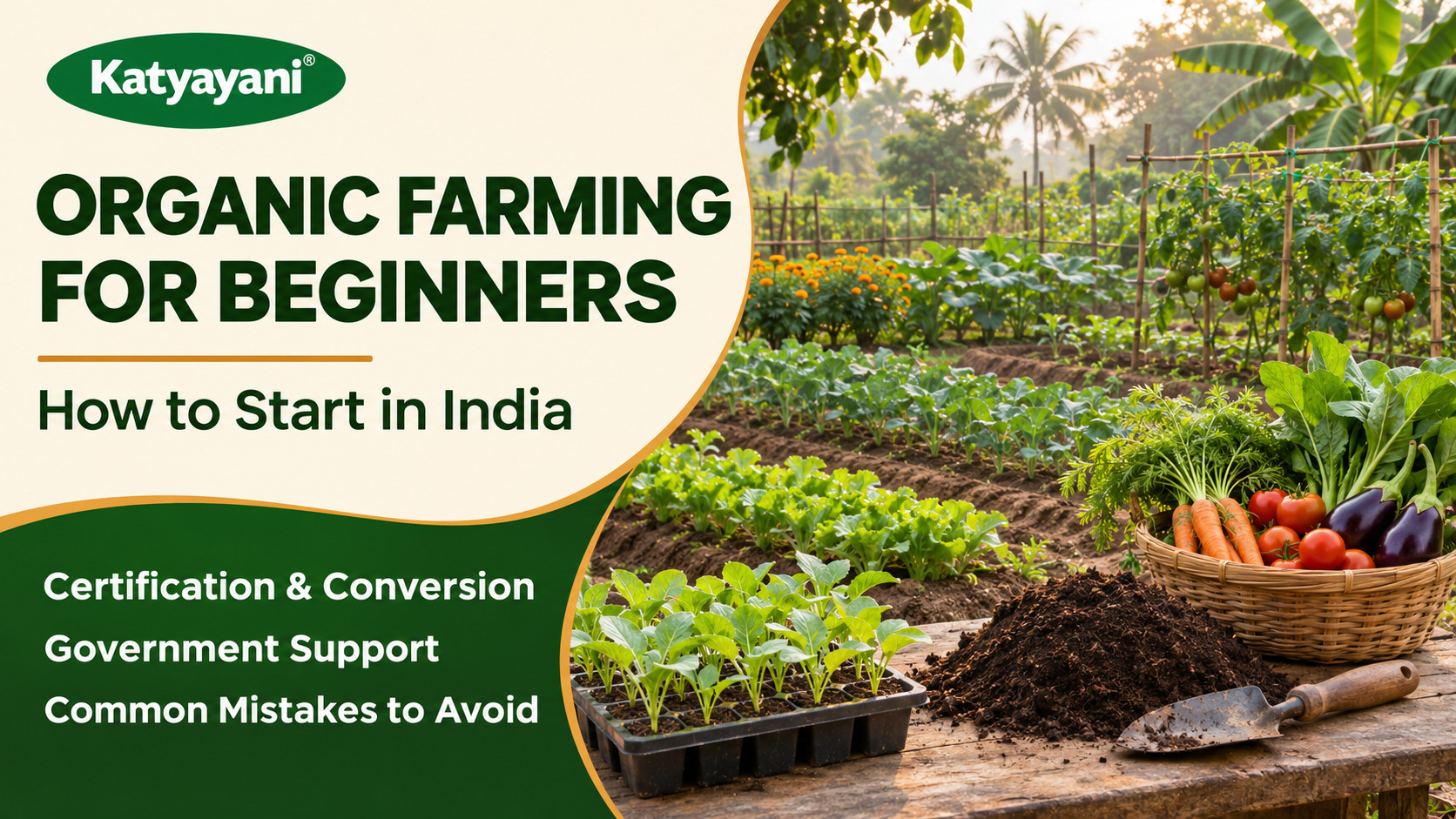
Organic farming in India means growing crops without synthetic fertiliser, synthetic pesticide, synthetic growth regulators or genetically engineered seed, and being able to prove it. To sell produce as organic you need certification under NPOP (third-party, mainly for export) or PGS-India (group peer review for the home market). The conversion period is at least 2 years for annual crops and 3 years for perennials under NPOP, and 24 and 36 months under PGS-India. ICAR network trials found the mean yield fell 6.7 percent in year 1 and 4.8 percent in year 2 against inorganic management, then matched it by year 3. Sikkim is the state the Prime Minister has called fully organic. PIB (4 Aug 2026) says PKVY gives Rs 31,500 per hectare over 3 years. No official source ranks crops by profit, so work out your own numbers before you convert.
What is organic farming, and what counts as "organic" in India?
Organic farming grows crops without synthetic fertiliser, synthetic pesticide, synthetic growth regulators or genetically engineered seed, and keeps records to prove it. In India the word "organic" on food is tied to two certification systems, NPOP and PGS-India. The FSSAI organic foods rules of 2017 are based on both, says the Jaivik Bharat portal of FSSAI.
Think of a farmer in Madhya Pradesh who stops buying urea and a pesticide spray and starts using compost and neem. His neighbour asks if the wheat is now organic. The honest answer under Indian rules is "not yet". The land has to go through a conversion period, he has to follow a written plan, and a certification body or a farmer group has to check the work.
The NPOP 8th Edition 2024 is the rulebook for third-party certification. It says the use of synthetic herbicides, fungicides, growth regulators, synthetic dyes, insecticides and other pesticides is prohibited, that all synthetic nitrogenous fertilisers are prohibited, and that genetically engineered seeds and plants are strictly prohibited. The ICAR base paper on organic farming says the same about synthetic fertilisers: their use is not permitted.
Our live post on bio versus chemical inputs compares the two kinds of inputs for conventional farms. This post is for the farmer who wants the full organic route.
Why does organic farming matter, and how big is it in India?
Organic farming matters because it is a regulated way to farm without synthetic inputs and to sell under a certified label. In India the certified area is large. APEDA data for 2025-26 lists 17,87,371.43 hectares of organic cultivated area under NPOP, and PIB (18 Mar 2025) reports 59.74 lakh hectares covered since 2015-16 under NPOP and PGS.
| Measure | 2025-26 | 2024-25 | Source |
|---|---|---|---|
| NPOP cultivated area, organic | 17,87,371.43 ha | 22,54,324.14 ha | APEDA 2025-26 and APEDA 2024-25 |
| NPOP cultivated area, in conversion | 9,78,088.89 ha | 17,13,713.97 ha | APEDA |
| NPOP wild harvest collection area | 17,55,048.57 ha | 22,58,859.50 ha | APEDA |
| NPOP operators, total | 10,509 | 12,637 | APEDA |
| Farmers inside grower groups | 14,95,522 | 21,84,807 | APEDA |
| Organic export quantity | 3,03,249.40 MT | 3,68,155.04 MT | APEDA |
| Organic export value | Rs 5,423.76 crore (US$ 635.10 million) | Rs 5,394.32 crore (US$ 665.97 million) | APEDA |
APEDA notes that its production figures are commercial output for sale and not actual production, and that the data come from certification bodies on TraceNet. The 2025-26 page does not explain why the organic area is lower than in 2024-25, so we do not guess.
The PGS-India side is counted separately. The PGS-India portal, home page, opened on 17 Nov 2026, shows 78,274 groups, 24,76,423 farmers, 2,54,462 valid certificates and 17,07,406 hectares of certified cumulative area. The counters change as groups upload data. The PIB release of 18 Mar 2025 gives the combined figure of 59,74,640.90 hectares, made of 44,75,836.90 hectares under NPOP and 14,98,804 hectares under PGS through PKVY, till 2023-24. These sets use different counting, so do not add or compare them line by line.
What are the steps to start organic farming in India, in order?
Start with the rules, then the soil, then the certification route, then a written plan, then the conversion clock, records and inspection. Skipping the plan or the records is the commonest reason a first-year farmer cannot sell produce as organic later. The table gives the order and the source for each step.
| Step | What to do | What the official text says |
|---|---|---|
| 1. Learn the rules | Read the NPOP or PGS-India standard for crops before you buy any input. | NPOP 8th Edition 2024 and PGS-India Revised Guidelines (2023) are the two rulebooks |
| 2. Test the soil and note field history | Take a soil test and write down what was grown and sprayed on each field in the past. | PGS-India asks each member for an application with the last one year of farm history; NPOP says the producer must keep the desired soil pH |
| 3. Choose the route | NPOP through an accredited certification body, or PGS-India through a local group of 5 or more farmers. | PIB (18 Mar 2025): NPOP is third-party certification, PGS-India is participatory |
| 4. Write the organic plan | List crops, practices, every input with its source, seed source and how you will check the plan works. | NPOP 3.1.1 asks for an organic crop production plan with these items |
| 5. Start the conversion clock | Apply the rules from day one on the converted field. | NPOP 3.1.2: all requirements apply from the start of conversion; the start may be counted from the first inspection by the certification body |
| 6. Keep records | Write inputs, dates, sowing, harvest and sales every season. | NPOP 3.1.1 asks for a record-keeping system; PGS-India asks for peer appraisal sheets and meeting registers |
| 7. Pass inspection or peer review | Be ready for an inspector or for your group peers to walk the farm. | NPOP: inspection at least once a year; PGS-India: each farm reviewed at least once each season |
| 8. Label and sell correctly | Use organic only on certified produce; use the in-conversion wording otherwise. | NPOP 3.1.5 and PGS-India 7.5.6 on in-conversion products |
A small farmer can do step 1 and step 2 in a week without paying anyone. Our soil health card post explains the 12 parameters on the card and what low, medium and high mean, which gives a starting picture of the field before you plan inputs.
Do I need certification: NPOP, PGS-India or none?
If you want to sell produce as organic, you need certification under NPOP or PGS-India. NPOP is third-party certification, which PIB says is for developing the export market. PGS-India is a peer-review system run by farmer groups. You can farm organically with no certificate, but you cannot honestly label the produce organic.
The Jaivik Bharat portal says fraud and mislabelling happen when a business marks a product organic although the organic standards were not followed. So the safe rule is simple: no certificate, no organic label. Our live NPOP organic certification post goes deeper on the export side.
| Point | NPOP | PGS-India |
|---|---|---|
| Run by | Department of Commerce, with APEDA as secretariat (NPOP 8th Edition) | Department of Agriculture and Farmers Welfare through the National Centre for Organic and Natural Farming (PGS-India manual) |
| Who certifies | An accredited certification body, which inspects the farm | The local group by peer appraisal, endorsed by a Regional Council |
| Purpose per PIB (18 Mar 2025) | Development of the export market | Stakeholders, including farmers, assess, inspect and verify each other |
| Who can apply | An individual farmer or a grower group | A local group of at least 5 farmers; individuals and large area certification also appear on the portal |
| Group size | Grower group of at least 25 and at most 500 farmers, in a society, FPO or FPC, or cooperative (NPOP Procedures 2024) | Minimum 5 members; the manual advises about 7 to 10 so the group survives if members leave |
| Cost | The certification body gives its tariff and fee structure on enquiry (NPOP Procedures 2024) | Secretariat services are free; Regional Council inspection and endorsement are paid services (PGS-India manual 1.4) |
| Certificate validity | Scope certificate valid for one year, renewed every year | Scope certificate valid 12 months from the Regional Council decision |
| Conversion period | 2 years annual crops; 3 years perennials | 24 months crops other than perennials; 36 months perennials |
| Logo | India Organic logo | PGS-India Organic logo, and PGS-India Green logo for produce in conversion |
Pick the route by where you sell. If your buyer is an exporter or a processor who needs a scope certificate and a transaction certificate on TraceNet, you need NPOP. If you sell near home to people who know you and you farm with neighbours, PGS-India is built for that. The NPOP Procedures 2024 set out the individual farmer flow: choose a certification body, sign a contract, register on TraceNet, submit the organic system plan, pass an on-site inspection, fix any non-compliance, and receive a scope certificate valid for one year.
How long is the conversion period before my crop can be sold as organic?
Under NPOP the conversion period is at least 2 years of organic management before sowing for annual and biennial crops, and at least 3 years before the first harvest of perennials. Under PGS-India it is 24 months for crops other than perennials and 36 months for perennials. Certifiers can lengthen or shorten it in set cases.
| Point | NPOP 8th Edition 2024 | PGS-India Revised Guidelines (2023) |
|---|---|---|
| Annual and biennial crops | At least 2 years of organic management before sowing | 24 months |
| Perennial plants | First harvest certified after at least 3 years | 36 months |
| Can it be shortened? | Yes, by the certification body in some cases; a derogation of up to the full period if there are documents showing 3 or more years of compliance | Yes, to 12 months at the Regional Council discretion if documents prove the standards were met for years |
| Land already clean | Land certified under PGS for 3 continuous years with no integrity sanctions, or notified natural hill land in Himalayan states and the North East untreated for 3 continuous years | Default organic areas with no history of prohibited substances: the PGS Secretariat can waive the period after physical verification |
| When does the clock start? | May be counted from the first inspection by the certification body | Only crops sown after the Regional Council approves the group registration qualify for PGS-Green |
| Selling during conversion | Not as organic; single-ingredient plant food with at least 12 months of conversion may be sold as in-conversion, without the organic label or India Organic logo | PGS-Green logo and the words "Under Conversion to Organic" only |
PGS-India also puts a cap on the in-conversion status. No member can hold PGS-Green for more than 3 years for annual crops or more than 4 years for plantation crops. A member who still does not qualify after that is sanctioned and excluded from the group.
The ICAR base paper gives the plain version: generally two years for annual crops and three years for perennial crops, and it can be relaxed on verification by the certification agency if the requirements are fully met. The lengths in the ICAR paper (2015), the PGS-India manual (2023) and NPOP (2024) agree, so no change in the basic periods shows up.
What do I use instead of chemical fertiliser?
Use materials made from plants, animals and microbes, mostly produced on your own farm: compost, farmyard manure, green manure and crop residue. NPOP says such biodegradable material from organic farms forms the base of the nutrient plan. Mineral inputs are only a supplement, and all synthetic nitrogen fertilisers are banned.
The NPOP rules add four limits you should know on day one. Brought-in mineral fertilisers and biofertilisers are supplementary and not a replacement for recycling nutrients on the farm. Mineral fertilisers must be used in their natural form and must not be made more soluble by chemical treatment. Manure containing human excreta is not allowed. Fertilisers with a high heavy metal content, such as basic slag, rock phosphate and sewage sludge, face restrictions set by the certification programme.
| Input type | What the official text says | Source |
|---|---|---|
| Farmyard manure, slurry, green manure, crop residue, straw and mulch from your own farm | Permitted for manuring and soil conditioning | ICAR base paper |
| Vermicompost and neem cake | Permitted | ICAR base paper |
| Rhizobium, Azospirillum and other bacterial biofertilisers | Permitted; microbial preparations such as biofertilisers, biodynamic preparations and EM solutions can be used | ICAR base paper; PGS-India manual |
| Lime stone, gypsum, chalk, magnesium rock | Permitted, in limited quantities when there is absolute necessity | ICAR base paper |
| Manure or vermicompost from other farms, blood meal, bone meal, sulphate of potash | Use only when absolutely needed and consult the certification agency first | ICAR base paper |
| Compost made from plant and animal waste | Must be aerobically composted; raw dung and urine only after controlled fermentation | PGS-India manual |
| Micronutrients | Allowed if deficiency is shown, mixed with compost | PGS-India manual |
| Synthetic fertilisers, mineral nitrogen, sewage sludge, human excreta | Prohibited | NPOP 8th Edition; PGS-India manual |
Do not buy a bag labelled "organic" and assume it is allowed. The PGS-India manual says off-farm inputs must be checked by the group so that no prohibited substance was used in making them, and inputs approved by an NPOP accredited certification body can be used without further group approval. NPOP says commercial inputs are evaluated by the certification body before approval. Ask your certifier or group first and keep the bill and the label.
The ICAR paper lists nutrient packages worked out at network project centres. One example: for basmati rice, wheat and berseem at Jabalpur, the package is vermicompost, farmyard manure and non-edible oil cakes, each giving one third of the nitrogen need. The official texts give such packages by nitrogen share for a cropping system and not one quantity for every farm, so we do not give a universal tonnes-per-acre number. Ask your state agricultural university for the package for your crop and soil.
If you want to make compost and liquid manures at scale, see our bio-input unit business post, which covers vermicompost and jeevamrut units. Our biostimulant, biofertiliser and biopesticide post explains what the three words mean on a label.
How do I control pests, diseases and weeds without chemicals?
Prevent first: choose adapted varieties, rotate crops, keep the soil balanced and protect natural enemies. Then use physical and biological methods and on-farm preparations. NPOP bans synthetic herbicides, fungicides, insecticides and growth regulators. Permitted plant protection products are listed in NPOP Annex 3(2), and you must keep evidence of the need to use them.
The NPOP text puts prevention ahead of cure: suitable rotations, green manures, early seedbed preparation, mulching, mechanical control and breaking the pest life cycle. It also asks you to protect the natural enemies of pests through hedges and nesting sites. Products made on the farm from local plants, animals and microorganisms are allowed, and the certification programme may judge if one is acceptable.
- Physical and mechanical. The PGS-India manual lists removal of infested plants and parts, destroying egg masses, light traps, yellow and blue sticky traps, pheromone traps, tilling, scraping and hoeing.
- Biological. The same manual lists release of predators, parasites and pathogens, and bird perches. Microbial biopesticides and natural mined products can be used.
- On-farm extracts. Plant extracts, oils or fermented products are allowed if no synthetic ingredient is used in them.
- ICAR list. The ICAR paper names neem oil and neem seed kernel extract, coloured and mechanical traps, pheromone traps, plant based repellents, soft soap and clay as permitted. It asks you to consult the certification agency before using Bordeaux mixture, cow urine spray, garlic extract, chilli extract or light mineral oils.
- Panchagavya. The ICAR paper reports that a 3 percent solution, which is 3 litres to 100 litres of water, was the most effective of the strengths tested.
ICAR also reports a benefit on the field. Citing the 2010-13 annual progress report of the network project at UAS Dharwad, the paper says coccinellids, which feed on hoppers and leaf folders, were two to three times higher under organic management in cotton, groundnut, soybean, potato and maize, and spiders were twice as high compared with inorganic management. That supports the idea that you protect pests with predators, not with sprays.
For weeds, NPOP allows mulching, mowing, hand and mechanical weeding, and flame or heat. Plastic mulch is allowed under NPOP, but it must be removed from the soil after use and must not be burnt on the farm. Our mulching post, manual weeder post and biopesticides post give field detail. All equipment from conventional farming must be cleaned of residues before it is used on organic land.
Which seeds, crop rotation and soil cover should a beginner use?
Use certified organic seed when it is available. If it is not, NPOP allows chemically untreated conventional seed, and you must tell the certification body season by season. Genetically engineered seed is strictly prohibited. Grow a mix of crops, rotate them, include legumes and green manures, and avoid growing the same crop on the same land year after year.
The NPOP text says soil fertility is kept up by growing legumes or deep-rooted plants, using green manures, and running a rotation, with organic inputs added. The ICAR paper adds that rotation should cover green manure and fodder crops, that perennial crops should have cover crops such as Kolinji (Tephrosia purpurea) for soil protection, and that monocropping should be avoided.
A beginner can turn this into a plain plan. In kharif, grow a cereal and follow it with a pulse or a green manure crop. In rabi, grow a different family. Leave crop residue on the field or compost it. Our crop rotation post gives sample rotations. This is our reading of the rules, not a rule from NPOP, so write the plan that suits your climate with your agriculture officer.
What records, buffer zones and separation does certification ask for?
You need a written organic plan, season-wise records of inputs and crops, and a buffer between your organic field and any sprayed neighbour. NPOP says an adequate buffer zone must be kept and the certification body checks it each year. Crops grown in the buffer cannot enter the organic supply chain.
| Requirement | NPOP 8th Edition 2024 | PGS-India manual (2023) |
|---|---|---|
| Written plan | Organic crop production plan: crops, practices, inputs with source, seed source, monitoring, barriers against mixing and record-keeping system | Local group operational manual and each member farm history sheet |
| Changes to the plan | Inform the certification body on a real-time basis | Discuss in group meetings; off-farm inputs need group approval or are treated as non-compliance |
| Buffer zone | Adequate to prevent contamination from conventional farms; checked at annual inspection | Buffer zones, raised bunds, separate storage and cleaned machines for split farms |
| Parallel production | Defined as growing visually similar crops in organic and non-organic systems at the same time; certifiers watch for mixing | Normally not allowed; members bring the whole farm with livestock under PGS; the Regional Council may allow phases |
| Inspection | At least once a year; extra and unannounced visits by the certification body (NPOP Procedures 2024) | Each farm reviewed by peers at least once in each season by a team of at least 3 appraisers; the Regional Council physically evaluates at least 50 percent of groups a year |
| Certificate | Scope certificate valid one year | Scope certificate valid 12 months, issued by season |
For grower groups NPOP is stricter in one way. The Internal Control System must inspect all member farmers twice a year, and records must include farm diaries, a farmer unique ID given by the Ministry of Agriculture and Farmers Welfare and the geo-location of each farm (NPOP Procedures 2024). A farm of 4 hectares or more may join a group but is inspected separately every year by the certification body.
Can I convert only one plot of my farm?
Yes under NPOP and ICAR guidance, if you keep the organic plot clearly separate. ICAR says you need a conversion plan and must keep organic and non-organic fields apart, with the whole farm including livestock converted in the long run. PGS-India normally expects the whole farm, though a Regional Council can allow phases.
The NPOP plan covers split operations and parallel operations, so converting part of a farm is a known case. In practice that means a written map, a buffer strip, separate stores for inputs and produce, and separate tools or well-cleaned ones. Choosing the plot farthest from a neighbour who sprays is our practical reading of the buffer rule, not a quote from the standard.
One mixed-farm example comes from the ICAR paper. It describes integrated organic farming system models at Meghalaya and Coimbatore centres that combine crops, dairy and other parts of the farm. It says such models could improve net returns, but we do not repeat those figures, because they come from two research centres and not from ordinary farms.
Will my yield fall in the first years of organic farming?
Often yes in the first two years, then it recovers. The ICAR base paper reports the mean yield change under organic input management against inorganic management across the network project crops as -6.7 percent in year 1 and -4.8 percent in year 2, 0 percent in year 3, and positive from year 4. The paper dates from 2015.
| Year of organic management | Mean yield change vs inorganic management |
|---|---|
| Year 1 | -6.7 percent |
| Year 2 | -4.8 percent |
| Year 3 | 0 percent |
| Year 4 | +1 percent |
| Year 5 | +8.4 percent |
| Year 6 | +5.6 percent |
| Year 7 | +9.0 percent |
The same paper says the major hurdle for organic farming in India is yield reduction in the initial years because of a quick switch from inorganic to organic, the gap between the organic nutrients available and those needed, and a lack of pest and disease options. It also says many organic growers name the lack of a support price and of marketing infrastructure as a major constraint.
For crops, the ICAR analysis after the 8th cycle across locations found a yield advantage for basmati rice, soybean, garlic, groundnut, cauliflower and tomato (4 to 6 percent) and for greengram, onion, chilli, cabbage and turmeric (7 to 14 percent). It found a yield reduction of 5 to 8 percent for wheat, mustard, lentil, potato and French bean. Soil organic carbon was 22 percent higher under organic production over inorganic in 6 years. In the year-by-year table single crops swing more than the mean: wheat stayed below inorganic in all 7 years shown (-15 percent in year 1, -4 percent in year 7), while soybean and cotton were at or above it from year 1.
Read these as research station results. No newer ICAR table was available, so it cannot be said that your farm will match them. Land that never had chemical inputs is a special case. The ICAR paper says that in a village that had never used synthetic fertiliser or pesticide, a fall in yield from going organic did not arise. Plan for a dip, keep some savings aside for the first two seasons, and do not promise a buyer a quantity you cannot grow yet.
Which state of India is 100% organic?
Sikkim. The Prime Minister said on 28 Apr 2026 that Sikkim declared itself a fully organic state in 2016, and on 29 May 2025 that Sikkim has attained the distinction of being a 100% organic state (PIB). No other state is described this way in the official texts.
The 2016 step is on record. PIB (PMO, 18 Jan 2016) reports that the Prime Minister inaugurated the Sikkim Organic Festival 2016 at Gangtok, launched the "Sikkim Organic" logo and handed the Chief Minister two commendations for the state journey towards total organic farming. He also asked other states to pick a district, or even a block, to convert to 100 percent organic.
| Sikkim fact | Figure | Source and date |
|---|---|---|
| Declared fully organic | 2016 | PIB, 28 Apr 2026 (PM address) |
| NPOP organic cultivated area, 2025-26 | 65,804.78 ha | APEDA |
| NPOP in-conversion area, 2025-26 | 269.43 ha | APEDA |
| NPOP organic cultivated area, 2024-25 | 75,451.57 ha | APEDA |
| NPOP in-conversion area, 2024-25 | 258.83 ha | APEDA |
Other states certify more area but are not called fully organic. APEDA lists Maharashtra with 5,20,780.25 hectares of organic cultivated area and Madhya Pradesh with 3,76,432.14 hectares in 2025-26, while Madhya Pradesh led in 2024-25 with 6,70,425.55 hectares. Size of certified area and share of all farm land are two different things. APEDA does not give the share for any state, so we do not compute one.
Sikkim shows that a whole state can move. It also reminds you of one thing a beginner should keep in mind: the state declaration is a state level status. Your own farm still needs its own certificate if you want to sell with a label.
Which organic farming is most profitable in India?
No official source ranks organic crops or organic systems by profit, so no winner is named. Profit depends on your yield, certification and input cost, and the price your buyer pays. The ICAR paper says growers name lack of a support price and of marketing infrastructure as major constraints.
What you can do is work out your own numbers with the same formula for every crop you are considering. Profit equals yield times the price you get, minus cost of inputs, labour, certification and transport. Then add the first two seasons at the lower yields in the ICAR table. If the number is still worth it, go ahead. If it is not, start with a small plot.
| Question to answer | Where to find it from an official or university source |
|---|---|
| What yield can my crop give? | Package of practices of your state agricultural university and the ICAR crop-wise results above |
| What will certification cost? | APEDA lists tariffs of accredited agencies on the NPOP site; PGS-India fees are agreed with the Regional Council |
| Which crops sell as organic near me? | Ask the buyer or exporter; APEDA shows the export quantity and value but not a price list |
| What support can I get? | PKVY or MOVCDNER through your state agriculture department (see the support section) |
| How much working money do I need? | Add the first-year yield dip and the conversion years before certification; our agriculture business post covers funding basics |
APEDA export data gives a sense of scale, not a farm return. The 2025-26 page records organic exports of 3,03,249.40 MT worth Rs 5,423.76 crore. Do not read that as a price per kilo for your crop, because the mix of products and the processing are not given.
How can I start an organic farming business as an individual, a group or a processor?
You can start as an individual farmer, as a member of a group or FPO, or as a processor or trader. APEDA counts all of these as operators under NPOP: in 2025-26 there were 4,815 individual farm producers, 3,789 grower groups, 1,255 processors, 586 traders and 64 wild collection operators.
| Route | Who it suits | Key rule from the official text |
|---|---|---|
| Individual farmer under NPOP | A farmer selling to an exporter or processor | Contract with a certification body, registration on TraceNet, organic system plan, inspection, one-year scope certificate |
| Grower group under NPOP | An FPO, society or cooperative of 25 to 500 farmers | Legal entity, similar production systems, members within 50 km, Internal Control System with 100 percent member inspections twice a year |
| PGS-India local group | Five or more neighbours who sell in the home market | Pledge signed by all members, peer appraisal each season, registration with a Regional Council |
| Processor or trader | A person who packs or buys organic produce | Counted as an operator under NPOP; PGS-India also lists a processor category |
| Input maker | A person making vermicompost or jeevamrut for sale | See our bio-input unit post for licence and quality rules |
Group routes spread the cost and the paperwork. Our SHG vs FPO post helps you decide the legal form, and the FPO credit guarantee scheme post explains one source of loan cover for an FPO. If you plan to export, read our IEC code post first.
What government support can an organic farmer get?
Two central schemes support organic farming: Paramparagat Krishi Vikas Yojana (PKVY) and Mission Organic Value Chain Development for North Eastern Region (MOVCDNER). PIB (4 Aug 2026) says PKVY gives Rs 31,500 per hectare over 3 years and MOVCDNER gives Rs 46,500 per hectare over 3 years.
| Item | PKVY | MOVCDNER (North East) |
|---|---|---|
| Total assistance, 3 years | Rs 31,500 per ha | Rs 46,500 per ha |
| Direct benefit transfer to farmers | Rs 15,000 per ha for on-farm and off-farm organic inputs | Rs 15,000 per ha, inside Rs 32,500 per ha for on-farm and off-farm inputs |
| Marketing, packaging, branding, value addition | Rs 4,500 per ha | Not split out in the release |
| Certification and residue analysis | Rs 3,000 per ha | Rs 10,000 per ha in total for training, capacity building and certification (PIB, 18 Mar 2025) |
| Training and capacity building | Rs 9,000 per ha | Included in the Rs 10,000 above |
| Maximum area per farmer | 2 hectares | 2 hectares |
| Source | PIB, 18 Mar 2025; PIB, 4 Aug 2026 | PIB, 18 Mar 2025; PIB, 4 Aug 2026 |
PIB (4 Aug 2026) adds that the main focus is to form organic clusters, with preference to small and marginal farmers, to create a supply chain, and that both schemes are carried out through state and UT governments. So you apply through your district agriculture office or the state agency that runs the cluster, not directly to the Centre. The same 18 Mar 2025 release gives Rs 9,000 per hectare for training in one place and Rs 7,500 in another, so ask your office for the exact split in your state.
PIB (14 Mar 2023) says 11.85 lakh hectares had been brought under organic farming through PKVY since 2015-16 and the Government intended another 6.00 lakh hectares through PKVY from 2022-23 to 2025-26. For a different scheme with a different focus, read our natural farming mission post, and for a wider list see the agriculture subsidy schemes post.
How do I sell organic produce and what must the label say?
Sell it as organic only when your scope certificate covers that crop and quantity. Certified organic food in India carries the Jaivik Bharat logo of FSSAI, which the portal says is the unified logo for organic products. You can also show the India Organic logo (NPOP) or the PGS-India Organic logo. Produce in conversion has separate wording.
| Case | Label rule | Source |
|---|---|---|
| Certified organic single-ingredient food | Jaivik Bharat logo on every certified organic food container; PGS-India Organic logo for PGS produce | FSSAI Jaivik Bharat; PGS-India manual 7.5.5 |
| NPOP produce in conversion | Not sold as organic; may not use the organic label or the India Organic logo | NPOP 3.1.5 |
| PGS-India produce in conversion | PGS-Green logo and only the words "Under Conversion to Organic" | PGS-India manual 7.5.6 |
| Multi-ingredient, at least 95 percent organic ingredients by weight | May be labelled organic (PGS-India manual, citing NPOP Appendix 5 for additives) | PGS-India manual 7.5.3.1 |
| Multi-ingredient, 70 to under 95 percent organic | Only "made with organic ingredients" | PGS-India manual 7.5.3.2 |
| Any PGS-India pack | Logo with the unique ID code; the name and address of the company legally responsible for processing and packing | PGS-India manual 7.4 and 7.5.7 |
Buyers can check you. The PGS-India manual says consumers can enter the unique ID code on the PGS-India website to check the certificate and the last end handler. The Jaivik Bharat portal calls itself an Indian organic integrity database where products can be searched by food or company name. For export, only NPOP produce qualifies, and the certificate trail runs through TraceNet, where scope and transaction certificates are issued with a unique verifiable code (NPOP 8th Edition). Our packaging and labelling rules for food exports post covers the buyer side.
What mistakes do beginners make, and what should I do or not do?
The common mistakes are selling produce as organic before it is certified, using a banned input in a hurry, keeping no records, skipping the buffer strip, buying inputs without checking they are allowed, and expecting full yield in year one. Each one is avoidable if you follow the written rules.
- Using a banned input "just once". PGS-India treats use of chemical fertilisers, pesticides or hormones as serious non-compliance, and the member status goes back to zero. A member has to be excluded or restart as a new member with the full conversion period.
- Labelling too early. NPOP does not allow in-conversion produce to be sold as organic. PGS-India allows only the Under Conversion wording.
- No buffer zone. NPOP says the buffer must be big enough to stop prohibited substances from the next farm, and the certifier checks it each year.
- Buying inputs without checking. PGS-India says use of an unapproved off-farm input is non-compliance. Keep the bill and ask first.
- Skipping records. Both systems rest on records. PGS-India asks for peer appraisal sheets for the last four seasons.
- Expecting year one to match the old yield. The ICAR mean was -6.7 percent in year 1 and -4.8 percent in year 2.
- Mixing the produce. Parallel production and shared stores risk contamination. Keep separate storage and clean equipment.
| Do | Do not |
|---|---|
| Write the plan and the input list before the season starts | Spray a banned product "to save the crop" and plan to hide it |
| Use certified organic seed or untreated seed and tell the certifier | Use treated or genetically engineered seed |
| Compost aerobically and ferment raw dung and urine before use | Use raw dung heaps, human excreta or sewage sludge |
| Keep a buffer strip and separate stores | Share unwashed sprayers and tools with a conventional field |
| Ask the certifier before using Bordeaux mixture, cow urine, garlic or chilli extract | Assume every "bio" product is allowed |
| Remove plastic mulch from the field after use | Burn plastic or leave it in the soil |
| Label in-conversion produce as in conversion | Print "organic" on uncertified produce |
What is new or what changed in 2025-26?
There are a few dated changes. APEDA hosts the NPOP 8th Edition 2024 and NPOP Procedures 2024 as the rulebooks. PIB figures for PKVY now read Rs 31,500 per hectare, down from Rs 50,000 in a 2023 reply. PGS-India listed Regional Council notices in Nov and Dec 2025, and APEDA data for 2025-26 changed from 2024-25.
| What | Detail | Source and date |
|---|---|---|
| NPOP 8th Edition | APEDA hosts the 8th Edition 2024 (English and Hindi) and NPOP Procedures 2024. Its menu also lists amendments to the 8th Edition, including one to Annex 3(17); the amendments were not read. Its notification list shows an entry dated 5 Jan 2025 (39/2024-2025) but not its subject | APEDA NPOP site, opened 17 Nov 2026 |
| PKVY support rate | PIB (14 Mar 2023) reply said Rs 50,000 per hectare for 3 years, with Rs 31,000 as DBT. PIB (18 Mar 2025) and PIB (4 Aug 2026) say Rs 31,500 per hectare, with Rs 15,000 as DBT. The releases do not explain the change, so check your state office | PIB, 14 Mar 2023; PIB, 18 Mar 2025; PIB, 4 Aug 2026 |
| PGS-India notices | The portal lists a 25 Nov 2025 announcement on authorisation of Regional Councils for natural farming and organic farming certification, and a 3 Dec 2025 permanent suspension of one Regional Council; details are not shown there | PGS-India portal |
| NPOP annual data | Organic cultivated area 17,87,371.43 ha in 2025-26 against 22,54,324.14 ha in 2024-25; operators 10,509 against 12,637; export value Rs 5,423.76 crore against Rs 5,394.32 crore | APEDA |
| Conversion periods | No change found. The 2 and 3 year (NPOP) and 24 and 36 month (PGS-India) periods match the ICAR 2015 text | ICAR 2015; PGS-India 2023; NPOP 2024 |
| Sikkim status | PM repeated on 28 Apr 2026 that Sikkim declared itself fully organic in 2016 | PIB, 28 Apr 2026 |
The 8th Edition was not compared line by line with the 2014 edition, so no single NPOP rule is called new. If you plan to process organic food, open the amendment list on the APEDA site before you finalise a recipe.
Conclusion
Organic farming for beginners in India starts with the rules, not with the inputs. Choose NPOP or PGS-India, write a plan, expect at least 2 years of conversion for annual crops and 3 for perennials under NPOP, and keep records and a buffer zone. ICAR network trials saw yields dip about 7 percent in year 1 and 5 percent in year 2 before matching inorganic management in year 3. PKVY gives Rs 31,500 per hectare over 3 years (PIB, 4 Aug 2026). No official source ranks crops by profit, so work out your own numbers on a small plot first.

Leave a Comment