
 18 min read
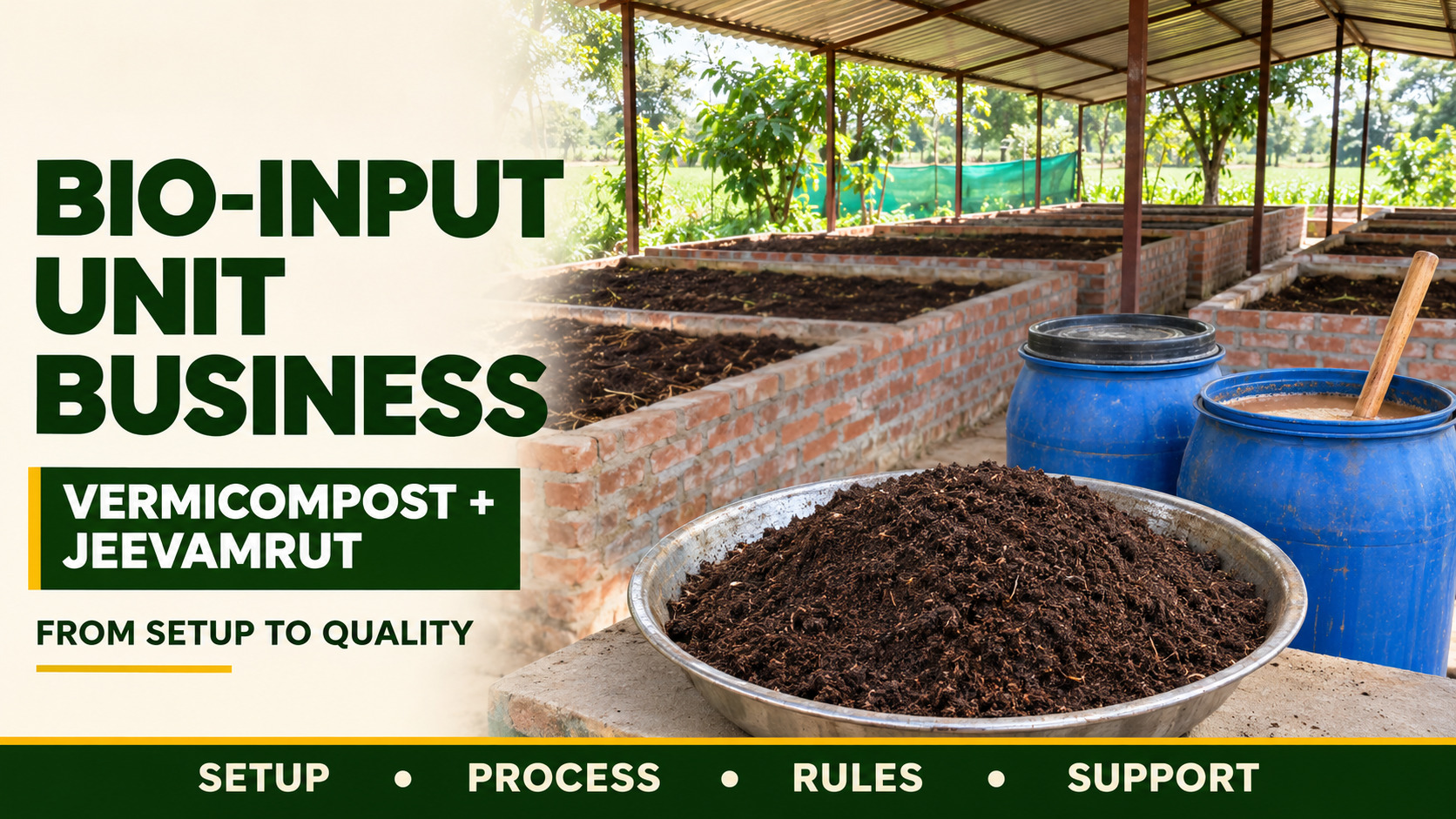
A bio-input unit makes vermicompost or jeevamrut from cow dung, plant waste and worms and sells it nearby. Under the National Mission on Natural Farming a Bio-input Resource Centre gets Rs 1 lakh in two tranches of Rs 50,000, but shed and rent are not covered, and the guideline names natural farming inputs, not vermicompost. Vermicompost sold in packs must meet the FCO standard: 15 to 25 percent moisture and at least 18 percent organic carbon in the copy we read. Start with worm beds in a shaded shed, a cow-dung supply and a buyer list.
What is a bio-input unit, and what does it make?
A bio-input unit is a small village enterprise that turns dung, urine, plant waste and earthworms into farm inputs and sells them to nearby farmers. The two common products are vermicompost, a dry manure made by worms, and jeevamrut, a fermented liquid starter. The government calls the organised version a Bio-input Resource Centre, or BRC.
PIB describes a BRC as a cluster level enterprise that provides ready to use natural farming bio-inputs such as Beejamrut and Jeevamrut to local farmers who may not be making on-farm inputs themselves. It also gives training and demonstrations. So a BRC is both a small factory and a classroom.
One thing to know early. The NMNF Operational Guidelines list on-farm inputs such as Beejamrut, Jeevamrut, Ghan Jeevamrut, Neemastra and Dashparni. The word vermicompost does not appear in that 49-page document. We searched it. That does not make vermicompost a bad business, it only means the BRC money and the vermicompost business run on different rules, which the next sections separate.
Why would farmers buy from a village bio-input unit?
Because many farmers do not keep cattle, and dung and urine are the base of most natural farming inputs. The BRC guideline says a BRC prepares and supplies locally made inputs to farmers who may not be able to produce them individually. The unit saves them the work and the wait.
There is real demand pushed from the top. The PIB release of 16 December 2025 says the Cabinet approved the mission on 25 November 2024 with an outlay of Rs 2,481 crore, and one objective is more use of on-farm made bio-inputs to cut dependence on bought inputs. The March 2026 PIB release reports 18,786 clusters and 18.19 lakh enrolled farmers as on 5 March 2026, with an output based incentive of Rs 4,000 per acre per year for two years, up to one acre per farmer. These are farmers who need inputs. How the farmer incentive works is in our natural farming mission subsidy guide.
A short real situation. A farmer with two acres and no cow joins a cluster. He cannot make jeevamrut because he has no dung. The nearest BRC sells it by the drum. That farmer is your customer.
Vermicompost or jeevamrut: which unit should you start?
Start with the one your dung supply and buyers support. Vermicompost needs a shed, beds, worms and 75 days or more per batch, and is sold in bags under the FCO. Jeevamrut needs drums and a week of fermentation, but it is liquid, spoils fast and mostly serves natural farming clusters. Many units run both.
| Point | Vermicompost unit | Jeevamrut unit |
|---|---|---|
| Raw material | Cattle dung and plant waste, pre-digested | Fresh dung, urine, jaggery, pulse flour, soil |
| Time per batch | One cycle is 75 days on the TNAU enterprise page | 7 to 8 days incubation in the UAS trial; 3 to 4 days for ghan-jeevamrit in the ICAR-IARI article |
| Space | Shaded shed with beds or tanks | Drums or tanks, plus space for disc drying |
| Shelf life | TNAU: stored at 40 percent moisture it keeps its quality for up to one year | Liquid is used soon; ICAR-IARI says discs store up to one year when dry |
| Government support lane | FCO standard and NABARD or bank finance | BRC support under NMNF (natural farming inputs) |
| Main buyer | Orchards, vegetable growers, nurseries, home gardeners | Natural farming cluster farmers |
Who can run a BRC, and what do you need to qualify?
A BRC can be run by practising natural farming farmers, FPOs, SHGs, PACS, cooperatives and local entrepreneurs. The entrepreneur or group must practise natural farming, or have members who do, and must use the inputs on its own farm. It also needs raw materials and space. These rules come from the BRC guideline.
- The entrepreneur, group or entity must be a practising natural farming farmer or have such members with prior experience (para 3.1).
- The BRC should use natural farming bio-inputs on its own farms (para 3.2).
- If no practising farmer exists in the region, the State Natural Farming Cell may pick a willing farmer entrepreneur who starts natural farming from the immediate crop season and is trained (para 3.3).
- The BRC must have access to livestock and plant biomass, and may tie up with a nearby goshala, preferably within the same gram panchayat, for dung and urine (para 3.4).
- It must have adequate space for preparing inputs and storing the finished product (para 3.5).
The operational guidelines add that BRCs can be run with goshalas at the gram panchayat and also by KVKs. If you are an SHG or FPO, the roles and money are explained in SHG vs FPO for farmers.
How do you apply, and who approves a BRC?
You apply through the state system. The State Natural Farming Cell, headed by the Secretary in charge of agriculture, assesses demand, identifies BRCs and approves them after discussion with the District Level Monitoring Committee. The committee reviews applications, may make spot visits and checks the business plan before funds are released.
The guideline lists what the application must hold:
- Valid documents that prove you are eligible to be a BRC entrepreneur.
- A business proposal: location, status of natural farming there, a short market analysis, and a plan to market and raise awareness.
- The list of natural farming bio-inputs you will produce.
- Details of how you will source raw material.
- Any partnership with an SHG, FPO, PACS, goshala, gram panchayat or community group.
- Anything else the District Level Monitoring Committee asks for, as per local conditions.
The state and district teams must also see that the price of inputs sold at the BRC stays affordable for all farmers, small and marginal included. So write your plan with fair prices in mind.
How much does the government give a BRC, and what can it buy?
The guideline gives Rs 1 lakh per BRC, in two tranches of Rs 50,000. It can pay for drums, small grinders, storage cans, racks, a refrigerator, urine collection and storage, fermentation chambers, stirrers or timed aerators, larger fermentation tanks with stands and containers for storage. Sheds and rent are not covered.
| Item | What the BRC guideline says |
|---|---|
| Support per BRC | Rs 1 lakh, two tranches of Rs 50,000 each (para 7.1) |
| Indicative things it can buy | Drums, grinders for cutting biomass, storage cans, racks, refrigerator, livestock urine collection and storage, automated fermentation chambers, automated stirrers or timed aerators, higher capacity fermentation tanks with stands, larger containers (para 7.2) |
| Not covered | Sheds, renting of premises and similar expenses; the entrepreneur arranges these (para 7.3) |
| Convergence ideas | The 10,000 FPOs scheme and the National Mission on Edible Oilseeds for reaching farmers; AIF for infrastructure support and expansion (para 8) |
| Scale in the mission | 10,000 need-based BRCs in an enterprise model (NMNF guidelines, section 19) |
A fact worth knowing before you borrow. The PIB release of 16 December 2025 states the mission outlay runs until the 15th Finance Commission period, March 2026. Read the current notice of your State Natural Farming Cell for what applies now. The Rs 1 lakh is a start-up grant for equipment, so the shed, the dung supply and the working cash are still yours to find. Bank and scheme options are in the later section on finance.
What does a BRC entrepreneur have to learn first?
The guideline asks every BRC entrepreneur to complete two rounds of training of 3 days each. The first round is held in pre-kharif or pre-rabi, as the season may be. The second comes before the next agricultural season. Training is hands-on and covers input preparation and the business side.
The indicative topics in the guideline are: a recap of natural farming principles and practices, preparation of natural farming bio-inputs, roles and responsibilities of a BRC, enterprise development (market evaluation, market creation, pricing and finance management) and about NMNF. Practising farmers, Farmer Master Trainers, existing BRC entrepreneurs and natural farming experts can serve as resource persons. Approved BRCs train at Centres of Natural Farming, state or central agricultural universities, KVKs and ICAR institutions, NGOs with experience, or other approved bodies, as the state decides.
The guideline also says a BRC should share knowledge on dosage, application and storage with farmers and may make insect traps, pheromone traps and sprayers. Later it can grow into nurseries, rental of farm equipment, and processing and packaging of natural farming produce. That is a second income stream to plan for.
What do you need to set up a vermicompost unit?
You need shade, a place for beds or tanks, cattle dung, plant waste, water and surface-dwelling earthworms. TNAU describes cement tubs 2.5 feet high and 3 feet wide, or brick compartments 1 foot high and 3 feet wide, with the length set by the room. Wooden boxes, plastic buckets and any container with a bottom drain hole also work.
| Item | Figure from TNAU | Source |
|---|---|---|
| Cement tub | 2.5 ft high, 3 ft wide, bottom sloped to a sump | TNAU organic farming page |
| Brick or block compartment | 1 ft high, 3 ft wide, length to suit | TNAU organic farming page |
| Windrow style bed | 1.5 m wide, 0.9 m high, length as needed; bed thickness 75 to 90 cm | TNAU enterprise page |
| Bed base layers | 3 cm sawdust, husk, coir or cane trash; 3 cm fine sand; 3 cm garden soil, all moistened | TNAU organic farming page |
| Stocking, small bed | 1 kg of worms (about 1,000) for a 1 m x 1 m x 0.5 m bed | TNAU organic farming page |
| Stocking, large bed | 350 worms per cubic metre of bed volume | TNAU enterprise page |
| Shed for 200 tonnes a year | 8 to 10 sheds of about 180 to 200 sq ft on half to one acre; a temporary shed of 8 m x 15 m x 5.4 m is also given | TNAU enterprise page |
| Temperature | 20 to 30 C | TNAU enterprise page |
Keep the beds out of sun and rain. TNAU says worms need protection from temperature extremes. A shaded, moist shed is the aim. Pick a site close to the dung, because hauling is the cost that grows quietly. The NABARD-hosted toolkit says units suit areas near commercial dairy units, places with dense cattle numbers, or near a mandi with plenty of agri-waste.
How do you make vermicompost, step by step?
Shred and clean the waste, heap it with cattle dung slurry for 20 days to pre-digest it, fill the bed with the pre-digested waste mixed with 30 percent cattle dung, put worms on top, keep the bed moist, and harvest the castings. TNAU lays out five phases.
- Collect waste, shred it, remove metal, glass and ceramics, and store the organic waste.
- Pre-digest the waste for 20 days by heaping it with cattle dung slurry.
- Build the worm bed on a concrete base, mix the pre-digested waste with 30 percent cattle dung by weight or volume, fill to the brim and place worms on top. They move in by themselves.
- Keep moisture right (see below). Sprinkle rather than pour, and stop watering before harvest.
- Harvest the castings, sieve the finished compost and return the partly composted material to the bed.
- Store the sieved vermicompost so that it keeps moisture and lets beneficial microbes grow.
Two TNAU pages give different moisture figures. The organic farming page says keep about 60 percent during production and store finished vermicompost at 40 percent at the least. The enterprise page says 40 to 50 percent, kept up by sprinkling. Both agree on sprinkling, not flooding, and on 20 to 30 C. Pick a number in that overlap and judge by hand: the bedding should feel like a squeezed sponge.
For harvesting, TNAU says in tub systems you can collect castings about once a week, stopping where worms show on top; in bed systems you harvest when the process ends. To save the worms, push 5 or 6 cow dung balls into the bed for 24 hours, then lift them out and separate the worms in water. One cycle on the enterprise page is 75 days. If your waste is crop residue and you want a faster first stage, the decomposer guide shows how a decomposer culture speeds up straw breakdown in 20 to 25 days at 30 to 32 C. The compost culture activator page says it holds Basidiomycetes, Trichoderma, Actinomyces and Clostridium thermocellum and can be used on farmyard manure, cane trash and coco peat. That is a pre-composting step; use it before the worms go in, not on the worm bed.
Which earthworm species work, and how fast do they multiply?
Use surface-dwelling worms only. TNAU names the African worm Eudrilus eugeniae, the red worm Eisenia fetida and Perionyx excavatus, and says the three can be mixed. It prefers the African worm because it gives faster output and more young. Soil-dwelling worms are not suitable.
| Biology point | Figure on the TNAU enterprise page |
|---|---|
| Age at breeding | About six weeks |
| Egg capsule | One every 7 to 10 days |
| Young per capsule | 7 embryos; 3 to 7 worms emerge |
| Lifespan | About 2 years |
| Time to build a worm population | 6 months to 1 year (stated for the unit) |
The slow build-up matters for your plan. If you start with a small stock, you will not fill 8 to 10 sheds in the first season. The NABARD-hosted toolkit lists lack of suitable earthworms as a real sector problem: even trained farmers find it hard to start or scale because the worm supply chain is thin. Buy a first stock from a source you can see working, and grow your own from there.
What kills a worm bed?
Wet dung, the wrong dung, salt, meat or fat, heat from fresh high-nitrogen feed, and red mites. TNAU says dry cattle dung in the sun first, never use pig, poultry or goat dung in place of cattle dung, and pre-digest all other waste with cow dung for 20 days. Most bed losses come from these.
| Mistake | What TNAU says to do instead |
|---|---|
| Wet cattle dung | Dry it in sunlight first |
| Pig, poultry or goat dung in place of cattle dung | Do not use them as the dung; keep high-protein feed like poultry manure to small quantities |
| Fresh waste straight into the bed | Pre-digest all non-dung waste with cow dung for 20 days |
| Meat or high-fat waste | Do not add without pre-composting |
| Seaweed with salt | Rinse the salt off |
| Rabbit manure | Leach it first because of high urine content |
| Paper or cardboard from municipal waste | Do not use it; organic producers should note certification rules for fibre sources |
| Heat in the bed | High-nitrogen feed can heat up. Heat is tolerable in the food layers but not in the bedding |
On pests and disease, TNAU says worms are not affected by microbial diseases, red mites are the worst predators, and the main trouble is "sour crop", which comes from environmental conditions. If your beds smell sour, they are too wet or too rich. Add dry bedding and cut the feed.
What counts as good vermicompost, and what does the law say about selling it?
Under the Fertiliser (Control) Order 1985, packaged vermicompost sold for agriculture must meet Schedule IV: moisture 15 to 25 percent, dark brown to black colour, no foul smell, at least 90 percent passing a 4.0 mm sieve, organic carbon of at least 18 percent, and set minimums for N, P2O5 and K2O.
| Parameter | FCO Schedule IV, vermicompost (copy on the Odisha licence portal) |
|---|---|
| Moisture, percent by weight | 15.0 to 25.0 |
| Colour and odour | Dark brown to black; absence of foul odour |
| Particle size | Minimum 90 percent material should pass through a 4.0 mm IS sieve |
| Bulk density, g/cm3 | 0.7 to 0.9 |
| Total organic carbon, percent, minimum | 18.0 |
| Total nitrogen (N), percent, minimum | 1.0 |
| Total phosphate (P2O5), percent, minimum | 0.8 |
| Total potassium (K2O), percent, minimum | 0.8 |
| Heavy metals, mg/kg, maximum | Cadmium 5.0; chromium 50.0; nickel 50.0; lead 100.0 |
| Tolerance | N, P and K together not less than 2.5 percent in vermicompost |
The same Order says the vermicompost specification applies only where it is sold in packaged form and for agricultural purposes. A non-government vermicompost maker with an annual capacity below 50 tonnes does not need the certificate of manufacture or authorisation letter. A fertiliser with a false claim on the label, or one that has been adulterated by adding something that lowers its nutrients, is not allowed to be sold. Anyone who sells fertiliser must also file a Memorandum of Intimation in Form A1; the steps are in the dealer licence guide.
Here is a gap that catches new units. TNAU reports vermicompost organic carbon at 9.5 to 17.98 percent, nitrogen at 0.5 to 1.50 percent, phosphorus at 0.1 to 0.30 percent and potassium at 0.15 to 0.56 percent. The FCO copy sets 18.0, 1.0, 0.8 and 0.8 as minimums. A typical home batch can sit under these lines. Test every batch before you print a bag.
How do you make jeevamrut in a 200 litre drum?
Mix dung, urine, jaggery, gram flour and soil in water and let it ferment. The UAS Bengaluru trial used, per litre, 50 g dung, 50 mL urine, 10 g jaggery, 10 g chickpea flour and 2.5 g soil. For a 200 litre drum that is 10 kg, 10 L, 2 kg, 2 kg and 500 g (our arithmetic).
| Ingredient | Per litre ([[x:uas|UAS Bengaluru trial]]) | For a 200 L drum (our arithmetic) |
|---|---|---|
| Cow dung | 50 g | 10 kg |
| Cow urine | 50 mL | 10 L |
| Jaggery | 10 g | 2 kg |
| Chickpea (gram) flour | 10 g | 2 kg |
| Soil | 2.5 g | 500 g |
| Water | to make up the volume | to 200 L |
What do the numbers say about timing? In the UAS paper, pH and EC were followed to day 7, and C/N ratio and microbes to day 8. The final pH was about 5.05 to 5.20, EC about 1.38 to 1.44 dS/m, and the C/N ratio fell, for example from 20.77 to 13.55 for the Hallikar cow batch. The authors say the high microbial population on day 7 justifies field application after 7 to 8 days of incubation. The paper tested four cow breeds: Hallikar, Deoni, Ongole and HF.
The NMNF guidelines list Jeevamrut, Beejamrut, Ghan Jeevamrut, Neemastra and Dashparni as the on-farm inputs. If you plan to sell, use the same ingredients and record dates and weights for every drum, so you can tell a buyer what is inside.
How do you make ghan-jeevamrit, the dry form that stores longer?
Ferment dung with urine, jaggery, gram flour and soil for 3 to 4 days, shape the semi-dry mix into discs of 5 to 20 g, dry them fully in shade and pack them. ICAR-IARI Assam says the discs store up to one year in a dry place. That solves the spoilage problem of liquid jeevamrut for sellers.
| Item | ICAR-IARI Assam method (Indian Farming, March 2026) |
|---|---|
| Cow dung (fresh, indigenous) | 4 kg |
| Cow urine (indigenous) | 1,200 mL |
| Jaggery | 60 g |
| Gram flour | 120 g |
| Soil | 120 g |
| Water | 500 mL |
| Ferment | 3 to 4 days; sprinkle 50 to 60 mL water daily and mix |
| Shape and dry | Discs of 5 to 20 g, dried completely under shade |
| Yield | About 1.8 kg of discs from 4 kg dung and 1.2 L urine |
| Packing | 250 g pouches, sealed, stored in a moisture-free place |
The article also costs one trial batch, with dung and urine counted as free. Read that as a trial-scale figure, not a promise for your unit. If you buy dung, the cost of every batch goes up.
How much jeevamrut should a crop get, and what do trials say?
No single official dose exists for all crops. The CSK HPKV Palampur wheat trial (Rabi 2017-18) tested jeevamrit at 5, 10 and 20 percent at 2, 3 and 4 week intervals. The top grain yield, 3,117 kg/ha, came from 20 percent every 2 weeks. The best benefit-cost ratio, 1.69, came from 10 percent every 3 weeks.
| Treatment in the Palampur wheat trial | Result reported in the abstract |
|---|---|
| Jeevamrit 20 percent, every 2 weeks | Highest grain yield, 3,117 kg/ha |
| Jeevamrit 10 percent, every 2 and 3 weeks; 20 percent every 3 weeks | At par with the top yield |
| Jeevamrit 10 percent, every 3 weeks | Highest benefit-cost ratio, 1.69 |
| Check: vermicompost 10 t/ha plus 3 sprays of vermiwash at 750 L/ha | At par with the top yield |
Look at the last row. In that wheat trial, vermicompost plus vermiwash performed at par with the best jeevamrit treatments. So selling both makes sense, and a buyer can choose by budget. The paper is one crop, one season and one farm in Himachal Pradesh, and its own introduction says little scientific information exists on application time and dose. Do not print crop-wise doses on your bag from this one study. Give buyers the trial as a reference and let your local KVK or SAU recommendation set the dose.
What does a model vermicompost unit look like on paper?
The July 2019 NABARD-hosted GIZ and BIRD toolkit models one unit at 6 batches of 15 tonnes a year, selling 90 tonnes from about 180 tonnes of dung and waste. It reports a benefit-cost ratio of 1.33 and a net return near Rs 1 lakh to Rs 1.25 lakh a year, excluding capital cost.
| Point in the NABARD-hosted model (July 2019) | What it says |
|---|---|
| Output | 6 batches of 15 tonnes; 90 tonnes of vermicompost sold a year |
| Raw material | 180 tonnes of dung, slurry and waste a year, bought at the model price |
| Work-shed and tools | Work-shed Rs 60,000 plus tools, equipment, borewell and scale Rs 30,000, so Rs 90,000 in capital |
| Loan interest used | 12 percent |
| Benefit-cost ratio | 1.33 for an individual farmer |
| Net return | About Rs 1 lakh to Rs 1.25 lakh a year, excluding capital cost |
| Group size | Farmer Interest Groups of 10 to 30 members; at least 80 units brought under an FPO for a strong supply chain |
| Time to stand on its own feet | 2 to 3 years for the Guntur model it is based on |
Check the model against the TNAU page. The model sells 90 tonnes from 180 tonnes of input, which is about half (our arithmetic). The TNAU enterprise page states a recovery of 30 percent. That gap shows why you should record your own input and output weights from the first batch. The toolkit also carries a disclaimer: the figures are advisory, and actual cost and return depend on the project.
The same 2019 toolkit describes the Nilagiri Foundation model in Guntur district of Andhra Pradesh: over 50 units, over 250 farmers, 4,500 tonnes a year of capacity, and the use of the compost on organic chilli, turmeric and vegetables. It is a good case to study before you build.
What loans and schemes can help beyond NMNF?
For a vermicompost unit the usual route is a bank or NABARD-linked loan, PMEGP, and an FPO or SHG route. PMEGP allows vermicompost as an off-farm activity, and the 2019 toolkit lists a few state and central subsidies by name. Treat the 2019 numbers as history; the current NMNF guideline above is the live reference.
| Support | What the page says | Source |
|---|---|---|
| PMEGP | Funds new manufacturing and service units; vermicompost and bio-fertiliser or bio-pesticide manufacturing are eligible, agri-input retail shops are not | PMEGP loan guide |
| FPO credit guarantee | Project loans up to Rs 2 crore per FPO; FPOs need at least 300 members in plains, 100 in hilly and North Eastern areas | FPO credit guarantee scheme |
| SHG bank loans | Allied activities count; the group Micro Credit Plan must show how each item earns income | SHG loan for agriculture |
| MIDH (as listed in 2019) | 50 percent of unit cost up to Rs 50,000 per beneficiary for a 30 ft x 8 ft x 2.5 ft unit; HDPE bed of 96 cft up to Rs 8,000 per bed | NABARD-hosted toolkit, July 2019 |
| PKVY (as listed in 2019) | Rs 5,000 per unit for worms, pits, labour and raw material | NABARD-hosted toolkit, July 2019 |
| NABARD capital subsidy (as listed in 2019) | Up to 33 percent of outlay, ceiling Rs 63 lakh, back-ended, for commercial organic input production | NABARD-hosted toolkit, July 2019 |
More on the full range of farm schemes is in the agriculture subsidy schemes guide. A broader view of small agri ventures, including vermicompost and own-brand bio-inputs, is in agriculture business ideas with low investment.
How should you pack, store and sell the product?
Store vermicompost in a dark, cool place out of sun, at not less than 40 percent moisture on the TNAU page, and use laminated sacks if you must bag it, because open sacks lose moisture. Sell packed lots with a batch number, the date and the declared nutrients that your test supports.
- TNAU says compost stored at 40 percent moisture keeps its quality for up to one year. Do not pack it in sacks for open storage; use laminated sacks to limit moisture loss.
- The FCO prohibits a false claim on a fertiliser label. Write only what your lab report shows.
- The FCO also expects a manufacturer to have a minimum laboratory facility as set by the Controller. Small units should plan for batch testing at a recognised lab.
- If your buyers farm organically for export, the certifier decides whether your product is accepted. The NPOP organic certification guide lists vermicompost and compost as permitted inputs and says commercial products need the certifier's approval.
- Sell near the unit first. The NABARD-hosted toolkit places the best sites near dairies, mandis and cash-crop belts, which also shortens delivery.
For a ready reference of how a retail pack is presented, see the vermicompost fertilizer product page, which lists several pack sizes and crop-wise use, and the manures and soil fertilizer and bio fertilizer collections. A kitchen gardener is a ready buyer too; the kitchen garden fertilizer schedule shows how potting mix and top-dress use vermicompost.
Where do bio-input units usually fail?
The NABARD-hosted toolkit names eight problems: low awareness, no standard operating procedures, weak training, difficulty scaling, poor market connection, finance, scarce worms and lack of quality testing. Most failed units trace to the last four. The product is made, but nobody knows it is good, and nobody is waiting to buy it.
| Problem the toolkit names | What it means for your unit |
|---|---|
| Market connectivity | Demand is limited and retail and distribution networks of existing units are weak, so line up buyers before you build |
| Quality testing facilities | Nutrient levels vary batch by batch; some makers mix dry cow dung to raise quantity; labs are scarce in rural areas |
| Availability of suitable earthworms | There is no strong supply chain for worms; plan to breed your own stock |
| Scalability | Land, raw material, worms and labour are all limits; start small and grow |
| Financial constraints | Formal finance is hard to get in many places; a group or FPO route helps |
| Lack of SOPs and training | Write your own steps and train every worker the same way |
One more risk: the mission period. The PIB release says the outlay ran till March 2026, so a business that exists only for the BRC grant is fragile. A unit with paying buyers, tested batches and two products can stand without it.
What does a 90-day launch plan look like?
Spend the first 30 days on buyers, site and training, the next 30 on building beds and starting the first batch, and the last 30 on testing, packing and first sales. This order puts the market first, which is the lesson from the toolkit. It is our plan, built on the steps in the sources above.
- Days 1 to 15: list 20 to 30 farmers or gardeners who might buy, and note what pack size and form they want. If you plan jeevamrut, read the BRC application list above and start collecting those documents.
- Days 10 to 30: fix the site near dung and water, arrange a dung supply (goshala or neighbours), and book training if you are applying as a BRC.
- Days 20 to 45: build the shed and beds, buy the first worm stock, start the 20 day pre-digestion heap.
- Days 45 to 60: fill beds, add worms, and make your first small jeevamrut drum for local farmers to trial.
- Days 60 to 75: keep moisture steady, record weights in and out, and keep the shed dark and cool.
- Days 75 to 90: harvest, sieve, send a sample to a lab, and pack only if the report meets the FCO figures. Start with your buyer list.
If you also plan a retail shop later, read the agri-input shop business plan first, because a shop needs separate seed, fertiliser and pesticide authorisations.
Conclusion
A bio-input unit works when three things line up: a steady dung and waste supply, a product that meets a written standard, and buyers who are known before the first batch. Jeevamrut and ghan-jeevamrit fit the natural farming mission lane with its Rs 1 lakh equipment grant and two training rounds. Vermicompost fits the FCO lane, with a 18 percent organic carbon minimum and a NABARD-style plan. Start small, record every weight, test every batch, and let paying customers, not a grant, decide how big you grow.

Leave a Comment