
 18 min read
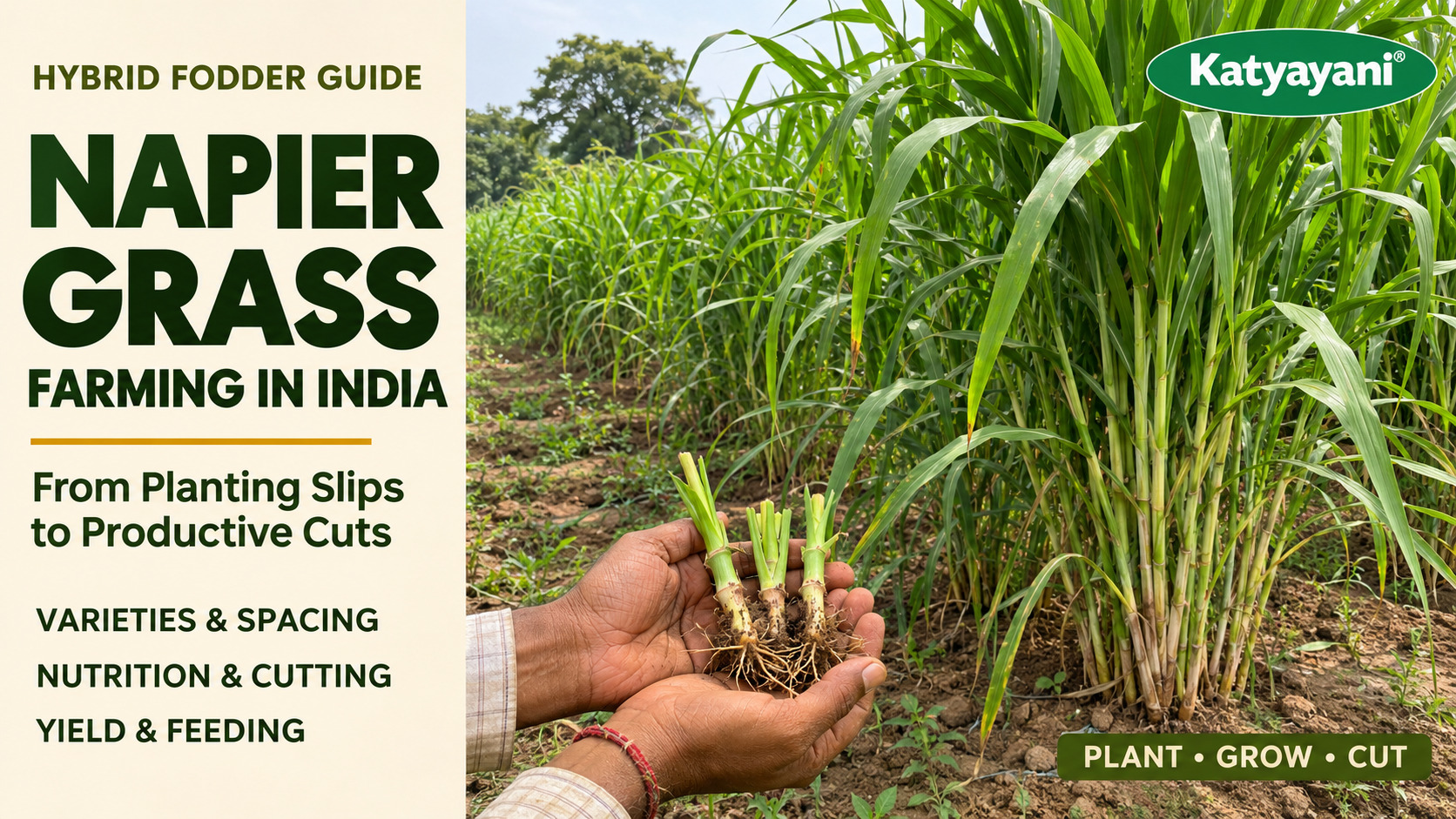
Hybrid Napier (Napier bajra hybrid) is a perennial, sterile fodder grass planted from rooted slips or two-budded stem cuttings, not seed. TNAU gives 33,333 slips or cuttings per hectare at 60 x 50 cm, 25 t FYM and NPK 75:50:40 kg per hectare at planting, 75 kg N at 30 days and 75 kg N after every cut. The first cut comes at 75 to 80 days (TNAU) or 60 to 65 days (ICAR-NDRI), then every 40 to 45 days, leaving a 5 to 8 cm stubble. Official yields range from 100 to 450 t green fodder per hectare per year depending on variety, climate and feeding. It needs irrigation, hates waterlogging, goes dormant below 15 degrees C, and carries 3 to 6 percent oxalate, so feed it with legumes and calcium.
What is Napier grass and how is hybrid Napier different?
Napier grass, also called elephant grass, is a tall perennial grass (Pennisetum purpureum) from tropical Africa. Hybrid Napier is its cross with bajra (pearl millet). The hybrid is softer, leafier and higher yielding, but sterile, so you plant slips or cuttings. ICAR-NDRI says Napier reached India in 1912 and that the bajra cross it names is the Pusa Giant Napier.
Names change by state. ICAR-NDRI lists Napier in Hindi, Hattigavat in Marathi, Napier hullu in Kannada, Napier gaddi in Telugu and Napier pul in Tamil. ICAR-IVRI also calls the hybrid Sankar Napier and writes it as NB hybrid or BN hybrid. TNAU uses the name cumbu Napier, since cumbu is the Tamil word for pearl millet. All of these point to the same kind of crop.
Compared with plain Napier, the hybrid has less hair on the leaf, less fibre, more tillers and softer leaf sheaths. ICAR-NDRI says it holds 25 percent more crude protein and 12 percent more sugar than Napier grass, which means less is wasted when you chop and feed it. See ICAR-NDRI, Indian Farming 2019.
This post covers perennial hybrid Napier only. If you want an annual green fodder grown from seed every season, that is a different crop; our sibling post on fodder sorghum covers it (planned, not yet live).
Why do dairy farmers grow hybrid Napier?
Because feed is the biggest bill in dairying and green fodder runs short for months every year. ICAR-IVRI says fodder makes up to 70 percent of total livestock input cost, and one planting of hybrid Napier gives 8 to 10 cuts a year for several years, with no yearly tillage or sowing.
The same ICAR-IVRI article says the cost of producing Napier is nearly half that of single-cut fodder crops while output per unit area and time is about double, at 150 to 200 t per hectare per year. It puts the national net deficit at 30.6 percent for green fodder and 11.85 percent for dry fodder. See ICAR-IVRI, Indian Farming 2025. A newer ICAR-IGFRI article gives a different deficit (11.24 percent green), so treat the exact percentage as a moving figure and the direction as settled.
In Bareilly district of Uttar Pradesh, ICAR-IVRI found green fodder scarce for 4 to 5 months a year (September to November and April to May). After it introduced hybrid Napier, the area under CO 4 and CO 5 rose from nil to about 50 ha and 450 farmers adopted it. Farmers said lactation length and household income went up by as much as 15 percent. These are farmer opinions, not a controlled trial. See ICAR-IVRI, Indian Farming 2019.
Government help exists for people who want to start fodder units. The National Livestock Mission covers feed and fodder units; read our National Livestock Mission subsidy guide for the unit types and the application route, and the wider agriculture subsidy schemes list for other schemes.
How much green fodder can hybrid Napier give per hectare and per acre?
Official figures run from about 100 to over 400 tonnes of green fodder per hectare per year. TNAU says 360 to 400 t for its CO varieties, NDDB says 150 to 200 t, and ICAR-NDRI says 100 to 200 t, rising to 200 to 350 t with heavy manuring. Divide by 2.47 for tonnes per acre.
| Source | Green fodder (t per ha per year) | Per acre (our arithmetic) | Notes |
|---|---|---|---|
| TNAU Agritech | 360 to 400 (CO BN 5); 375 to 400 (CO CN 4); 380 (CO 6) | about 146 to 162 | 7 harvests, under irrigation, all year |
| NDDB Farmers Corner | 150 to 200 | about 61 to 81 | Year-round with assured irrigation |
| ICAR-NDRI 2019 | 100 to 200; up to 200 to 350 with heavy manuring | about 40 to 81; up to 81 to 142 | 8 to 10 cuts in a cycle |
| ICAR-IVRI 2025 | 150 to 200 (general); variety table runs 70 to 450 | about 61 to 81 | 8 to 10 cuts a year |
| ICAR-IVRI 2019, farm fields | Year 1: 154 to 161 (4 cuts); year 2: 371 to 380 (6 cuts); year 3: 408 | year 1: 62.5 to 65; year 2: 150 to 154; year 3: 163 | Bareilly farmers, one plot followed for 3 years |
| ICAR-IGFRI 2020 | 70 to 290 (range quoted for BN hybrid) | about 28 to 117 | Cited from earlier work in the paper |
Why the spread? Variety, rainfall, irrigation, nitrogen and how often you cut all change the number. In the ICAR-IVRI Bareilly study, a crop raised in a February nursery and planted in April gave 4 cuts and about 154 to 161 t per hectare in its first year, then rose year by year to 408 t per hectare in the third year. Plan on the lower official range for your first season and treat the TNAU figure as what a well-fed, well-watered plot of a recommended variety can reach.
Feedipedia, which gathers data from trials worldwide, puts yields in dry matter: 20 to 80 t DM per hectare per year under high inputs and only 2 to 10 t DM with no or too little fertiliser. That tenfold difference is the reason fertiliser gets its own section below. See Feedipedia, Napier grass.
Which hybrid Napier variety should you plant?
Pick the variety released for your zone. TNAU recommends CO (CN) 4, CO (BN) 5 and CO 6 for irrigated land. ICAR-IVRI lists CO 4, 5, 6 and 10 for the south and north-west, PBN 233 and Giant King for the north-west, and APBN-1 for Andhra Pradesh and Gujarat. NDDB names Co-3, PBN 233, Co-4 and APBN-1.
| Variety | Where it is listed for | Green fodder (t per ha per year) | Source |
|---|---|---|---|
| CO (CN) 4 | Irrigated land, all year (Tamil Nadu) | 375 to 400, 7 harvests; crude protein 10.71% | TNAU |
| CO (BN) 5 | Irrigated land, all year (Tamil Nadu) | 360 to 400, 7 harvests; crude protein 14% | TNAU |
| CO 6 | Released for the north-west and central zone | 380, 7 harvests; crude protein 11.50% | TNAU |
| IGFRI Hybrid Napier No. 3 | North and central zone | 70 to 100 | ICAR-IVRI |
| PBN 233 | North-west regions | 250 to 300 | ICAR-IVRI |
| NB 21 and Pusa Giant | Whole country | 100 to 160 | ICAR-IVRI |
| Giant King | North-west India | 350 to 450 | ICAR-IVRI |
| CO 4, 5, 6 and 10 | South and north-west zone | 300 to 450 | ICAR-IVRI |
| Yashwanth | Maharashtra | 190 to 250 | ICAR-IVRI |
| PBN 83 | Punjab | 125 to 170 | ICAR-IVRI |
| APBN-1 | Andhra Pradesh and the whole of Gujarat | 260 to 295 | ICAR-IVRI |
| Pant Selection 1 | North zone | 250 to 300 | ICAR-IVRI |
| IGFRI 10 | Whole country | 300 to 350 | ICAR-IVRI |
| Sampoorna (DHN 6) | Karnataka | 120 to 150 | ICAR-IVRI |
| Supriya | Kerala | 250 to 300 | ICAR-IVRI |
The same ICAR-IVRI table names TBN-20-15 from ICAR-IGFRI Jhansi as India's first seed-producing bajra-Napier hybrid. That is a new type, still spread by slips and cuttings in most farms today. ICAR-IGFRI Jhansi, which coordinates the national forage project, supplies rooted slips and stem cuttings of perennial fodder to centres across the country, so slips from a recognised source are easier to find than you may think. See ICAR-IGFRI, Indian Farming 2024.
Quality also differs. TNAU lists crude protein at 10.71 percent for CO (CN) 4, 14 percent for CO (BN) 5 and 11.50 percent for CO 6, all with about 2.4 to 2.5 percent oxalate. ICAR-IVRI measured 13.1 to 13.5 percent in CO 5 at 42 to 48 days after cutting. Higher protein helps, but only if you cut on time, as the cutting section shows.
What climate and soil does Napier grass need?
Warm, moist climates with irrigation. ICAR-NDRI says it grows best on light fertile loam or sandy soil near neutral, in a pH range of 6 to 8. Growth stops below 15 degrees C, the best temperature is about 31 degrees C, frost harms it, and waterlogging, strongly acidic soil and salty soil should be avoided.
ICAR-IVRI adds that it does well with more than 1,000 mm rainfall but cannot stand flooding, that it copes with short dry spells and high heat, and that it grows well above 15 degrees C. It is not advised for hilly areas because of frost and lower sunlight. Dry regions can still grow it if irrigation is assured, as TNAU and NDDB both state.
If you are unsure about the field, test it first. A sample report shows pH and salts; our soil health card guide explains how to read the numbers, soil salinity guide explains the EC and pH limits that matter for salty land, and the soil pH and nutrient lock post shows why fertiliser fails on the wrong pH. For the broad soil group of your state, see types of soil in India.
When is the best time to plant Napier grass?
Spring planting gives the best stand. ICAR-IVRI says mid-February to May under assured irrigation, and July to September in the rainy season. ICAR-NDRI says February to end of August in north India, and almost all year in central, south and east India, except cold December to January and hot May to June.
TNAU treats cumbu Napier as an all-year crop under irrigation in Tamil Nadu. The timing matters for the first year. ICAR-IVRI followed two plantings near Bareilly. A plot planted in October gave 6 to 7 cuts the next year, from the first fortnight of April to the second fortnight of November. A plot raised in a nursery in February and planted out in the first fortnight of April gave 4 cuts in that first year.
A young plot in winter sits idle and is easy to lose to frost, since ICAR-NDRI calls the grass very susceptible to frost. Our frost protection guide lists the field steps for a cold wave.
How do you prepare the field for Napier grass?
Plough two to three times to get a fine tilth, then make ridges and furrows. Spread 20 to 25 t per hectare of well-rotted farmyard manure 15 to 20 days before planting (ICAR-NDRI) or 2 to 3 weeks (ICAR-IVRI). TNAU gives 25 t FYM per hectare as basal manure. Level the plot so water does not stand.
ICAR-NDRI recommends one deep ploughing followed by two harrowings and cross planking, then ridges and furrows, and says shallow trench planting does better than flat planting. Standing water is the biggest danger, so drainage is part of land preparation, not an afterthought. ICAR-IVRI also finds that ridge and furrow planting establishes the crop better and saved almost 40 percent of irrigation water in its farm trials.
Off-season ploughing helps older plots. ICAR-IVRI says it matters for perennial fodder like NB hybrid because it opens the soil, controls weeds and helps irrigation water and nutrients reach roots.
How do you plant Napier: rooted slips or stem cuttings?
Use rooted slips if you can get them, or stem cuttings with two or three nodes. ICAR-NDRI says root slips generally give the best result. Plant slips 20 to 25 cm deep, or lay cuttings at a 45 degree slant with 5 to 7.5 cm of stem below the soil.
- Pick healthy mother plants. ICAR-NDRI says take cuttings from a moderately mature stem about 3 months old, and from the lower two-thirds of the stem because it sprouts better than older stem.
- Cut the setts. Use 45 to 60 cm lengths with 2 to 3 nodes (ICAR-NDRI), or two-budded pieces (TNAU, ICAR-IVRI). Feedipedia describes setts of at least 3 nodes with 2 nodes buried.
- Or split the clump. Rooted slips come from dividing the base of an established clump. They already carry roots, so they need less water to get going.
- Place them in the furrow. Plant one slip or cutting per hill at the chosen spacing. ICAR-NDRI also describes 3-budded setts laid end to end in the furrow.
- Irrigate at once. TNAU says irrigate immediately after planting, then a life-saving irrigation on the 3rd day and then once every 10 days.
- Fill gaps. If some setts do not sprout, replace them in the first few weeks from the same variety.
Hybrid Napier does not set viable seed, so there is no seed packet to buy, and "Napier seed" sold for a sterile hybrid is a warning sign. ICAR-NDRI states plainly that the cross is sterile and propagated vegetatively. The exception is TBN-20-15, the new seed-producing type mentioned above, which ICAR-IVRI calls a first for India.
What spacing should you use for Napier grass?
TNAU and ICAR-IVRI recommend 60 cm between rows and 50 cm between plants, which needs 33,333 slips or cuttings per hectare. ICAR-NDRI uses 90 cm rows and 60 to 90 cm between plants for about 30,000 slips. Wider spacing suits heavy nitrogen and fewer irrigations.
| Source | Row spacing | Plant spacing | Planting units per hectare | Notes |
|---|---|---|---|---|
| TNAU and ICAR-IVRI 2025 | 60 cm | 50 cm | 33,333 | Two-budded cuttings or rooted slips |
| ICAR-NDRI 2019, slips | 90 cm | 60 to 90 cm | about 30,000 | Slips 20 to 25 cm deep |
| ICAR-NDRI 2019, cuttings | 60 to 90 cm | 60 cm | not stated | Cuttings 45 to 60 cm long, slanting at 45 degrees |
| ICAR-IVRI 2019, ridge and furrow | 100 cm between ridges, ridge 100 cm wide | 60 cm, both sides of the ridge, diagonal | not stated | Used with CO 4 and CO 5 on a 30 acre farm |
| KVK Panchmahal trial | 75 cm | 60 cm | not stated | Best of the spacings tested with 200 kg N per ha |
| ICAR-IGFRI 2020 weed trial | 1 m | 1 m | not stated | Rainy-season trial at Jhansi |
Close spacing gives a faster canopy and fewer weeds. Wide spacing gives bigger clumps and needs less seed material. The IGFRI paper notes that the wide 1 m spacing and slow early growth leave the crop open to weeds, which is why weed control in the first 35 to 40 days is covered below. In the Gujarat KVK trial, yield rose with wider spacing and more nitrogen, and the best result came at 75 x 60 cm with 200 kg N per hectare. Choose the TNAU spacing as your starting point if you irrigate regularly and cut often.
How much manure and fertiliser does Napier grass need?
A lot. ICAR-NDRI calls it a highly nutrient-exhaustive crop. TNAU gives 25 t FYM and NPK 75:50:40 kg per hectare at planting, 75 kg N at 30 days and 75 kg N after each cut. ICAR-NDRI gives 150 kg N, 50 kg P and 50 kg K per hectare as the base, plus urea after each cut.
For the manure part of the plan, organic manure is one option. Its page describes it as suitable for all crops and soil types. Work out the quantity from the Napier figures above, not from a general pack dose.
| Source | At planting | Top dressing | Yearly top-up |
|---|---|---|---|
| TNAU | FYM 25 t/ha; N:P:K 75:50:40 kg/ha | 75 kg N at 30 days after planting; 75 kg N after each cut | Not stated |
| ICAR-NDRI 2019 | FYM 20 to 25 t/ha (2 kg per plant) 15 to 20 days before planting; 50 kg N plus all P (50 kg) and K (50 kg) | 100 kg N in two splits (July and end of winter, February); urea 110 kg/ha after each cut | P and K at 40 kg each every year with the first monsoon showers |
| ICAR-IGFRI 2020 trial | N:P:K 60:50:40 kg/ha | 90 kg N as 30 kg N per ha after every cut | Not stated |
| KVK Panchmahal trial | Not stated in the abstract | N at 150, 175 and 200 kg/ha tested; 200 kg gave the best yield and returns | Not stated |
TNAU adds a saving: apply Azospirillum (2,000 g) and Phosphobacterium (2,000 g), or Azophos (4,000 g), with 75 percent of the recommended N and P, and it says this saves 25 percent of the fertiliser dose. Treat that as a TNAU package for its zone, not a rule everywhere.
Two cautions from Feedipedia. First, heavy nitrogen and manure raise cost and loss, and there is a nitrate risk when grass regrows fast after a drought. Outbreaks of nitrate poisoning occurred in Brazil after manure was spread at the end of the dry season. So split nitrogen into small doses after each cut instead of one big dose. Second, without fertiliser the crop gives a tenfold lower yield. A hungry plot turns pale and thin; our nitrogen deficiency guide shows what to look for and what is not nitrogen.
One special case: ICAR-NDRI says that where the plot is irrigated with sewage water, nitrogen top dressing is not needed. That is a finding for dairy farm conditions, not advice to use untreated wastewater.
How often should you irrigate Napier grass?
TNAU says irrigate right after planting, give a life irrigation on day 3, then irrigate once every 10 days. ICAR-NDRI says 3 to 4 irrigations at 10 to 12 day intervals in summer, every 15 to 20 days in winter, and none in monsoon if rains are normal and well spread.
The grass is hardy, but hardy does not mean it likes wet feet. ICAR-NDRI says waterlogging is very harmful and must be avoided. In the IGFRI weed trial at Jhansi, the plot was irrigated at 10 to 15 day intervals in March and April and not irrigated in winter (dormant growth) or the monsoon.
Water use is a selling point. ICAR-IVRI found that ridge and furrow planting saved almost 40 percent of irrigation water. For village-level water works, our watershed development guide lists fodder banks and fodder plantation among the works it covers.
How do you control weeds in Napier grass?
Keep the plot weed-free for the first 35 to 40 days, because young Napier grows slowly. ICAR-IGFRI says the critical weed-free period is 4 to 32 days for rooted slips and 5 to 27 days for stem cuttings. TNAU says hand weed whenever needed. Once the canopy closes, the grass smothers weeds.
ICAR-NDRI names the common weeds as baru (Sorghum halepense), swank (Echinochloa colonum) and nut grass (Cyperus rotundus), and recommends inter-cultivation early to hold them down. It adds that intercropping with legumes also helps weed control. In its own list of chemical options, ICAR-NDRI mentions 2,4-D at 1 kg per hectare, sprayed 5 to 6 weeks after planting on broad-leaf weed infestations.
The ICAR-IGFRI Jhansi weed trial used oxadiargyl 0.09 kg per hectare, sprayed 3 to 5 days after planting, with and without 2,4-D at 1.0 kg per hectare at 25 to 30 days. Both gave similar weed control and yield, about 9.3 to 10.3 percent below a fully weed-free plot, and the authors say oxadiargyl does not control broad-leaf weeds such as Commelina, which is why 2,4-D was added in one treatment. This is a trial report, not a label. Hand weeding and ridge cultivation in the first six weeks are the simplest route on small plots.
Does Napier grass get pests and diseases?
Very little. ICAR-NDRI describes hybrid Napier as highly tolerant to insect pests and diseases and almost free of them, with stem borer the main insect. ICAR-IVRI likewise describes it as an easy-to-establish, drought-tolerant crop. Most problems come from waterlogging, weeds and cutting too late, not from pests.
Because the grass goes straight to the animal, any spray on it is a bigger decision than on a grain crop. The best defence is plant health: healthy slips, good drainage, timely cutting and a thinned clump.
When should you cut Napier grass, and how high?
Cut when the crop reaches about 1.5 m, which is 60 to 65 days after planting for the first cut and every 40 to 45 days after that (ICAR-NDRI). TNAU says 75 to 80 days for the first cut and every 45 days after. Leave a 5 to 8 cm stubble so buds at the base survive.
| Source | First cut | Later cuts | Stubble or other note |
|---|---|---|---|
| TNAU | 75 to 80 days after planting | Every 45 days | 7 harvests a year |
| ICAR-NDRI 2019 | 60 to 65 days after planting | About every 40 to 45 days, at 1.5 m height | Stubble 5 to 8 cm; first cut after winter close to the ground to remove decayed tillers; 5 cuts in north India up to end of November, 7 to 10 in south India |
| ICAR-IVRI 2019 | 60 days after planting | Within 35 to 40 days | Delay cuts quality and efficiency, and tillers die; CO 5 crude protein 13.1 to 13.5% at 42 to 48 days |
| ICAR-IGFRI 2020 | Harvests at 65, 95 and 125 days after planting in the trial | About every 30 days | Trial at Jhansi, following the IGFRI recommendation |
| Feedipedia, Kenya | At 1 to 1.2 m, usually 3 to 4 months after planting | Every 6 to 8 weeks | Stubble 10 to 15 cm; monthly in hot wet areas, 2-monthly in drier areas |
Why the discipline? Old grass turns woody. ICAR-NDRI says an over-mature crop is lignified, with lower palatability, digestibility and nutritive value. ICAR-IVRI found that late cutting reduced fodder quality and caused tiller death. Feedipedia reports one Venezuelan study where crude protein fell from 21 percent of dry matter at 30 days of regrowth to under 4 percent at 70 days, and another source where grass at 1 m gave cows 9.3 kg dry matter intake and 8.6 kg milk a day against 6.8 kg and 6.9 kg for grass at 1.5 m. That is one trial in Kenya, not an Indian result, but the direction matches the ICAR advice.
After each cut, apply the nitrogen described above (TNAU: 75 kg N per hectare). Sewage-irrigated plots are the one exception ICAR-NDRI names.
How long does a Napier plot last, and what is quartering?
Plan on 3 to 6 years. ICAR-NDRI says the hybrid can be kept productive for 3 to 4 years in one field, and in its cutting section for 5 to 6 years; ICAR-IVRI says 5 to 6 years, and adds that with good moisture and nutrition farmers can enjoy it for a decade. Quartering thins old clumps.
Quartering is simple. After about two years the clumps become dense with dead tillers and yield falls (ICAR-IVRI). Divide each clump into four equal parts, remove three, and let the fourth keep growing. ICAR-NDRI says do it every year or whenever clumps grow big. The three removed quarters are free planting material for a new plot.
| Year of the plot | What ICAR-IVRI (Bareilly farm study) saw | Source |
|---|---|---|
| Year 1 (nursery in February, planting in April) | 4 cuts; 62.5 to 65.0 t per acre in the year (about 154 to 161 t per ha); about 15.6 to 16.3 t per acre per cut on average | ICAR-IVRI 2019 |
| Year 2 | 6 cuts; 150 to 154 t per acre in the year (about 371 to 380 t per ha); tillers increased after the 2nd cut | ICAR-IVRI 2019 |
| Year 3 | Peak of 27.1 t per acre per cut (67.7 t per ha); 163 t per acre in the year (408 t per ha) | ICAR-IVRI 2019 |
The three-year ICAR-IVRI case is a farm study of one Bareilly farmer, so treat the numbers as an upper example, not a promise. What it does show is that Napier is a build-up crop: the first year is the weakest.
What happens to Napier in winter, and how do you keep fodder coming?
Growth stops. ICAR-NDRI says the crop stays dormant below 15 degrees C and is very susceptible to frost. In north India it gives about 5 cuts, until end of November; south India can take 7 to 10. ICAR-IVRI farmers said fodder was available at all times except December to February.
The fix is a winter companion. ICAR-NDRI says to intercrop hybrid Napier with lucerne or berseem in winter, which keeps fodder flowing and protects the Napier plants from frost. Other winter options it lists are oats, barley, Chinese cabbage and Japanese rape. ICAR-NDRI also says the first cut after winter should be taken close to the ground to remove decayed tillers.
To protect young plots from a cold wave, use the steps in our frost protection guide. That guide lists light irrigation in the evening when frost is expected as one of the simplest steps.
Can you grow legumes between Napier rows?
Yes, and ICAR recommends it. ICAR-NDRI says plant hybrid Napier and a leguminous crop in a 1:3 ratio to take 4 to 5 cuttings of Napier and 1 to 2 of the legume. In winter use berseem, oats or barley; in summer cowpea, moong and guar. Legumes add protein, nitrogen and weed cover.
ICAR-IVRI lists tested systems from IGFRI: Napier bajra hybrid with velvet bean, berseem and mustard in the north zone; with berseem in semi-arid alluvial soil; with lucerne in black soil; with cowpea and berseem in the central and western region; and with hedge lucerne in the south. ICAR-IVRI says picking the right intercrop is the key to year-round green fodder.
In a drought-prone area, ICAR-NDRI suggests multicut crops such as sweet sudan, MP Chari and bajra. These annual fodders belong to our sibling post on fodder sorghum (planned, not live).
How do you feed Napier grass to cattle, and what about oxalate?
Feed it fresh, chopped, cut on time and mixed with legume fodder. ICAR-NDRI says Napier carries 3 to 6 percent oxalate, which can damage the kidney and deplete body calcium, so give dicalcium phosphate with mineral mixture, or feed legume fodder and groundnut cake along with the grass.
ICAR-NDRI also says calcium can be given through lime water: half a litre of clear lime-water supernatant in drinking water, or sprinkled on the feed daily. Feedipedia reports oxalate of 2.5 to 3.1 percent of dry matter in older work with no animal health problems seen, and 1.95 to 3.23 percent across seven cultivars in Malaysia, higher in leaves than stems. TNAU lists 2.40 to 2.48 percent oxalate for its CO varieties.
How does it feed? ICAR-NDRI lists the composition as about 10.2 percent crude protein, 30.5 percent crude fibre, 0.5 percent calcium and 0.4 percent phosphorus. ICAR-IVRI gives 8.7 to 10.2 percent crude protein and 28 to 30.5 percent crude fibre on a dry basis. A Sri Venkateswara Veterinary University trial fed chopped COBN-5 fresh, as the only feed, to six Murrah buffalo bulls for 66 days. Dry matter intake was 6.01 kg a day, digestible crude protein and TDN met the ICAR standards, nitrogen, calcium and phosphorus balances were positive, and no adverse effect was seen. See Indian Journal of Animal Nutrition, 2021. These were bulls on maintenance, not high-yielding milking animals, so a high-yield cow still needs concentrate on top.
Two feeding rules follow from the sources. Cut on time, because over-mature grass is lignified and loses palatability and digestibility (ICAR-NDRI). And do not make Napier the only feed for milking animals. The ICAR-NDRI advice to mix with legumes covers both protein and calcium.
How do you make silage or hay from Napier grass?
Cut at the right stage, chop it, wilt it to 60 to 70 percent moisture and seal it fast. ICAR-NDRI says hybrid Napier suits hay and silage, with legume fodder mixed in at a 1:2 ratio for balance. Feedipedia gives a 1 to 3 cm chop and molasses at 3 to 5 percent of fresh weight.
- Moisture. Aim for 60 to 70 percent at ensiling. Very wet young grass ferments badly and loses nutrients (Feedipedia).
- Chop length. 1 to 3 cm (Feedipedia).
- Sugar source. Molasses at 3 to 5 percent of fresh weight; Japanese trials used 4 to 5 percent (Feedipedia).
- Seal at once. In one trial a 24-hour delay in sealing caused poor fermentation and faster spoilage (Feedipedia).
- Mix with legume. ICAR-NDRI suggests legume and grass in a 1:2 ratio for balanced silage.
- Hay. Cut early, because stems get coarse with age. Feedipedia reports best hay quality at about 60 to 76 days of growth for one Brazilian variety.
In Gujarat, NDDB helped a dairy cooperative society grow hybrid Napier (BNH-10) on 1.5 acres of common grazing land, then store surplus as hay in a biomass bunker for the lean period. This shows how a village fodder bank can work. See NDDB, Indian Farming 2019.
What mistakes ruin a Napier plot?
The big five are waterlogging, late cutting, skipped nitrogen after cuts, early weeds and never thinning old clumps. Each one is covered by an ICAR or TNAU source above. Avoid these and the plot gives cut after cut for years.
- Standing water. ICAR-NDRI calls waterlogging very harmful. Plant on ridges and keep drains open.
- Late cutting. The grass turns woody, protein falls and tillers die (ICAR-NDRI, ICAR-IVRI).
- No nitrogen after cuts. TNAU gives 75 kg N per hectare after every cut; ICAR-NDRI gives urea after each cutting. Without it the crop gives a fraction of the yield (Feedipedia).
- Weeds in the first 40 days. The ICAR-IGFRI paper puts the critical weed-free period at 35 to 40 days after planting.
- Planting in the cold or hot window. ICAR-NDRI advises against December to January and May to June in central, south and east India.
- Feeding overgrown grass alone. Risks oxalate and calcium trouble (ICAR-NDRI).
- Never thinning. After two years clumps crowd and yield falls (ICAR-IVRI). Quarter them.
Conclusion
Napier grass farming rewards patience in the first year and discipline after that. Choose a variety released for your zone, plant slips or cuttings on ridges at the TNAU or ICAR spacing, give manure at planting and nitrogen after every cut, cut at about 1.5 m, and thin the clumps after two years. Feed it with legumes and calcium, and keep a winter companion crop ready. Do these and one planting can feed your animals for several years. Annual fodder sorghum is a different crop and gets its own post.


Leave a Comment