
 17 min read
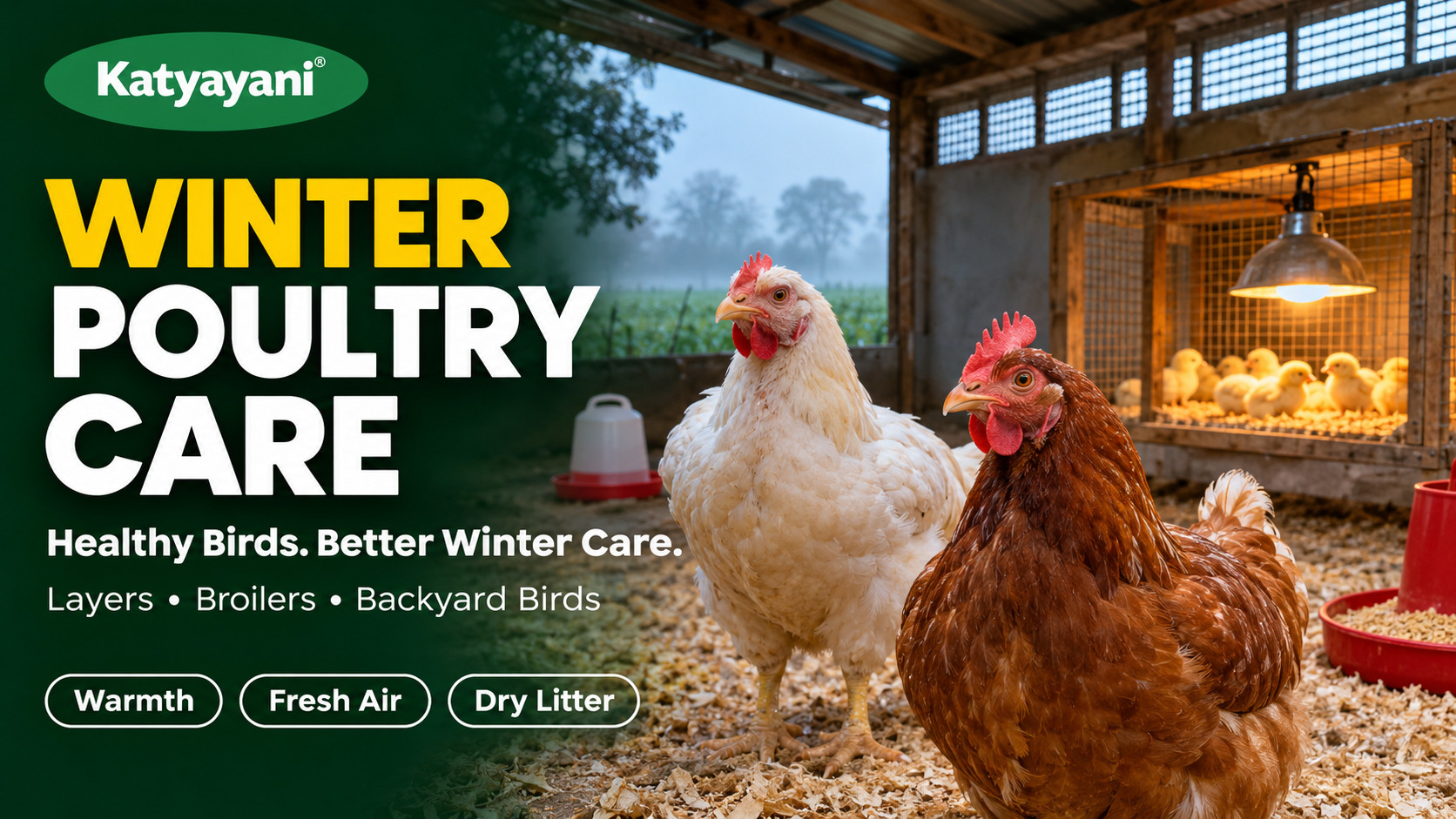
In winter, keep day-old chicks at about 35 C (95 F) at chick level in week 1 and cut about 5 F each week, as TNAU and the Hy-Line breeder guide show. Close the sides with curtains but leave an opening near the ceiling, as GADVASU advises, because wet litter and ammonia hurt more than cold air. Add litter depth, keep feeders full and water unfrozen, give laying hens about 16 hours of light, and give the Ranikhet booster before the cold starts. Watch the birds: huddling means cold, panting means hot.
What does winter do to poultry, and why does it cut production?
Cold makes birds burn more energy to stay warm, so they eat more and gain or lay less on the same feed. Short days cut laying. Closed sheds trap moisture and ammonia. GADVASU says falling temperature, poor ventilation and shorter daylight can hurt egg and meat output, so farmers need winter stress measures.
There is real Indian evidence that the cold is felt by the bird, not just by the farmer. In a study from Central Agricultural University, Mizoram, 60 White Leghorn layers aged 42 weeks were followed from 1 December 2019 to 29 January 2020. The lowest temperatures came at 6 am, and humidity peaked in early January. The authors concluded that the hens had faced cold stress with high humidity. See the Indian Journal of Animal Sciences paper.
They measured a stress marker called HSP70 in blood. In the group given only the basal diet, it rose from 10.86 ng/ml on day 0 to 13.79 ng/ml on day 60. The paper says an increase in HSP70 during winter shows cold stress in layers. It also cites earlier work that puts the comfortable range for poultry rearing at 15 to 20 C and 60 to 70 percent relative humidity.
| What changes in winter | What it does to the flock | Source |
|---|---|---|
| Lower temperature and shorter days | Hurts egg and meat output unless you manage the shed | GADVASU |
| Cold plus high humidity at dawn | Cold stress marker (HSP70) rises in White Leghorn layers | ICAR journal paper |
| Closed sheds | Moisture builds up; wet litter and ammonia follow | Mississippi State |
| Cold nights | Birds eat more; extra feed can be up to 25 percent in cold weather | Arkansas extension |
| Cold for chicks | Day-old chicks need a heat source of about 95 F in week 1 | GADVASU |
A word on the supplements in that study. Groups given chromium picolinate, vitamin C, or both showed lower HSP70 by day 60. It was one short study on 60 hens in one hill state, so it is a lead for researchers and not a feeding rule. Talk to your veterinarian before changing the ration.
How cold is too cold for chickens, and when should you add heat?
No Indian source gives one cut-off for every flock. Chicks need 35 C at chick level in week 1. Adult birds cope better, and the ICAR paper cites 15 to 20 C as comfortable. Arkansas extension says backyard flocks need extra heat below 35 F (1.7 C). Watch the birds for fluffed feathers and huddling.
| Bird group | Reference figure | Source and note |
|---|---|---|
| Day-old chicks, week 1 | 35 C (95 F) at chick level | TNAU; also GADVASU |
| Chicks, after week 1 | Lower by about 5 F (about 3 C) a week to about 21 C (70 F) | TNAU; Manitoba; Hy-Line |
| Poultry rearing in general, comfortable range | 15 to 20 C and 60 to 70 percent humidity | Cited in the ICAR paper |
| Backyard adults in a cold climate | Supplemental heat when it falls below 35 F (1.7 C) | Arkansas extension, a US backyard figure |
The Arkansas figure comes from a US state with hard freezes and mostly backyard hens. It is useful as a warning level, not as a rule for the plains of Punjab or Maharashtra. A better test is the bird. Arkansas extension names fluffed feathers and huddling as signs of cold stress, and says to check birds routinely.
Frostbite shows on the comb, wattles, toes and feet. Affected tissue looks blackened or gray and feels brittle, per the same Arkansas release, and a veterinarian should see the bird. Wooden roosts keep feet off the cold floor; the release says to avoid metal and plastic roosts, which can cause frostbite.
Energy is the other side of cold. The Hy-Line breeder guide says that for each 0.5 C change below or above 22 C, a bird needs about 1.8 kcal a day more or less. Per degree that is about 3.6 kcal (our arithmetic). A shed at 12 C is 10 degrees under 22 C, so each hen needs about 36 kcal a day more, which is why feed intake climbs.
What brooding temperature do day-old chicks need in winter?
TNAU says chicks need 35 C (95 F) in the first week, reduced step by step as they feather. TNAU also says night heat should run to the end of week 2 or 3 depending on season, and can be extended to three weeks in winter or rainy weather, against one week in peak summer.
| Chick age | Floor-level air temperature, Hy-Line breeder guide (C) | Approx. in F (our conversion) |
|---|---|---|
| Days 0 to 3 | 33 to 35 | 91 to 95 |
| Days 4 to 7 | 31 to 33 | 88 to 91 |
| Days 8 to 14 | 29 to 31 | 84 to 88 |
| Days 15 to 21 | 27 to 29 | 81 to 84 |
| Days 22 to 28 | 24 to 27 | 75 to 81 |
| Days 29 to 35 | 22 to 24 | 72 to 75 |
| Days 36 to 42 | 21 | 70 |
The table is from the Hy-Line W-36 guide (January 2020), a breeder guide for white-egg layers, so use it as a reference. It lines up with the Indian and Canadian figures. TNAU gives 95 F in week 1 falling by 5 F a week to about 70 F (21 C). Manitoba Agriculture gives 32 to 35 C (90 to 95 F) at the edge of the heat source in week 1, then 3 C (5 F) lower each week, and a room at 18 to 21 C (65 to 70 F) after six weeks.
Do not rely on air temperature alone. Manitoba says a cold floor can chill chicks even when the air is right, and the floor temperature, measured 1 cm below the litter surface, should be at least 26 C (80 F). Put a thermometer at chick height, and check it every day, as TNAU advises.
How long does heat last? TNAU says the brooder and artificial heat can be removed after about six weeks of age. Manitoba describes a room at 18 to 21 C after six weeks. In a winter batch, plan for the longer end, and let the chicks tell you when they are ready.
How can you tell if chicks are too cold or too hot?
Look at where the chicks sit. Chicks crowding under or near the heat source are cold. Chicks keeping away from it are too hot. Evenly spread, active chicks are comfortable. TNAU calls chick distribution the guide to warmth, and GADVASU adds that loud chirping or huddling means cold.
| What you see | What it means | What to do | Source |
|---|---|---|---|
| Chicks pile up under the heat, sharp noises | Too cold or a draft | Add a bulb or lower the hover; check for gaps in the curtain | TNAU; Manitoba |
| Chicks stay at the edge, away from heat; some pant | Too hot | Raise the hover or remove a bulb | TNAU; Manitoba |
| Chicks spread out, walk about, some rest head down | Comfortable | No change | TNAU |
| Chicks bunch at one wall | Draft from that side | Block the gap, keep ventilation open higher up | Manitoba; GADVASU |
| Loud chirping and huddling | Cold | Give fresh water and move chicks near the heat device | GADVASU |
The Manitoba page adds that in a warm room chicks should use the whole pen, while hot chicks may gather around cold outside walls and panting signals heat stress. This matters in winter because a strong heater can overheat the middle of the brooder while the walls stay cold.
Check at least in the evening and again in the early morning. The coldest hour in the Mizoram study was 6 am. If you only look in the afternoon, you will miss the problem.
How do you set up a winter brooder, step by step?
Switch the heat on at least 24 hours before the chicks arrive, so the litter and the room are warm. Close the shed sides with thick curtains for the first week, put a guard around the heat, and place feed and water inside the warm zone. GADVASU and TNAU both give the preheating rule.
- Clean and dry the shed. TNAU says the brooder house should be draft-free, rain-proof and protected from predators, with wire-mesh windows for air. Clean and disinfect feeders, waterers and hovers first.
- Spread dry litter. TNAU suggests sawdust or paddy husk about 5 cm deep, and stirring it often to stop caking.
- Preheat. Run the brooder for at least 24 hours before chick arrival; GADVASU says to bring the room to 95 F for one day.
- Close the sides, not the top. TNAU advises thick curtains on the sides for the first week in winter or rainy weather. GADVASU says gunny-bag or plastic curtains are fine but ventilation must stay.
- Fit a guard. Manitoba suggests a cardboard ring around the heat; for 300 birds, a ring of about 3 m diameter. It keeps chicks near the warmth and away from drafts.
- Set the heat. Manitoba hangs a 250-watt bulb 45 to 60 cm above the floor, with a single-light unit covering up to 100 chicks. Raise it or cut wattage as chicks grow.
- Place feed and water. TNAU gives 50 linear cm of water space per 100 chicks for the first two weeks and 10 cm of feeder space per bird for growing birds.
- Run heat for the right hours. TNAU says the hover may run 22 hours a day, off for about 30 minutes at night, with night heat to week 2 or 3, and up to week 3 in winter.
About space: TNAU suggests 45 to 65 square cm of brooder space per chick, starting with 0.05 square metre of floor per chick in the growing flock. Crowding is a winter risk because chicks pile up, so do not squeeze extra birds under one heat source to save fuel.
Safety. TNAU mentions kerosene or coal stoves with a vessel of sand to spread the heat, and heater coils instead of bulbs, hung out of the chicks' reach. Penn State warns of fire risk from wiring and dust and says to keep fixtures where birds cannot jump on or peck at them. Mississippi State notes that burning propane adds water to the air (6.8 pounds of water per gallon) and lists carbon monoxide among the gases to manage. Whatever heater you use, keep fresh air coming in.
How do you keep the shed warm without shutting out fresh air?
Cover the sides with curtains or gunny bags, but keep an opening near the ceiling. GADVASU says to keep open space near the roof so foul air and ammonia can escape. Mississippi State says moisture is the greatest cold-weather challenge and only air exchange removes it.
Mississippi State explains why. Each bird keeps only about 20 percent of the water it drinks; the rest leaves as breath, droppings and heat. In its example of 20,000 broilers drinking 2,200 gallons a day, 1,760 gallons end up in the house air and litter. Without air exchange, litter cakes and the air nears saturation. The sheet adds that warming incoming air by 20 degrees F halves its moisture level, so a warm, sunny afternoon is a good time to open up more and dry the litter.
The same publication lists typical minimum ventilation rates for broilers. They are written for tight, fan-ventilated US houses, so read them as a pattern: the need grows every week as birds grow. Conversion to cubic metres per hour is our arithmetic (1 cfm = 1.7 m3/h).
| Broiler age | Minimum ventilation, cfm per bird (MSU) | About m3/h per bird (our conversion) |
|---|---|---|
| Week 1 | 0.10 | 0.17 |
| Week 2 | 0.25 | 0.42 |
| Week 3 | 0.35 | 0.59 |
| Week 4 | 0.50 | 0.85 |
| Week 5 | 0.65 | 1.10 |
| Week 6 | 0.70 | 1.19 |
| Week 7 | 0.80 | 1.36 |
| Week 8 | 0.90 | 1.53 |
The Mississippi State sheet stresses a tight house. Air leaking around curtains, doors and fans gives cold drafts on the birds and wastes fuel, while a well-sealed house lets incoming air travel along the ceiling and warm up before it falls on the birds. In a curtain-sided Indian shed, the same idea means no gaps at the bottom of the curtain, with an opening high up.
Many sheds in India are open-sided, and a full seal is not possible. Then the practical rule is GADVASU's: curtain the sides, do not cut ventilation, and keep the top open. Pull the curtains up on sunny days and drop them in the evening.
Which air limits should you watch: ammonia, carbon dioxide and humidity?
Ammonia at 20 ppm for the whole grow-out can harm bird health and performance, according to Mississippi State. Carbon dioxide above 3,000 ppm for long periods causes problems, and oxygen should stay near 20 percent. Humidity of 60 to 70 percent is cited as comfortable in the ICAR paper.
| Air factor | Limit or fact | Source |
|---|---|---|
| Ammonia | Long exposure to 20 ppm is harmful; eye damage can start after 12 hours at 45 to 100 ppm | Mississippi State |
| Carbon dioxide | Above 3,000 ppm for long periods can cause ascites, lower weight gain and less feed and water intake | Mississippi State |
| Oxygen | Fresh air is about 20 percent and the house should be at or near that | Mississippi State |
| Relative humidity | 60 to 70 percent cited as comfortable for rearing | ICAR paper |
| Litter moisture | Wet litter is the root of ammonia and caked floors; replace wet patches at once | TNAU; Mississippi State |
Do not trust your nose. Mississippi State warns that growers can get used to ammonia and miss levels below 50 ppm, and many technicians now carry ammonia meters. If your eyes sting when you walk in at dawn, the level is already too high.
Ammonia is not fixed by fans alone. The sheet says minimum ventilation is meant for moisture removal, and that litter amendments which lower litter pH in the first weeks are a cost-effective alternative to over-ventilating, especially during brooding. Ask your veterinarian or feed dealer which amendment is sold locally.
How should you manage litter in winter?
Keep litter deep, dry and loose. TNAU suggests sawdust or paddy husk about 5 cm deep, stirred often so it does not cake, with wet patches replaced by dry material at once. GADVASU advises making the litter deeper in winter for warmth. Wet litter means ammonia and, per our live guide, coccidiosis.
The sources give different numbers because they speak for different birds. TNAU's 5 cm is for the brooder house. GADVASU says to increase litter depth by about 6 inches (15 cm) in winter. Arkansas extension suggests wood shavings 4 to 8 inches (10 to 20 cm) deep in backyard coops. Choose by the size of your flock and check the floor: if you dig a hand in and the bottom is damp, it is too wet.
- Stir daily with a rake in the morning, mainly around drinkers and under the brooder.
- Replace wet patches with dry husk or shavings. TNAU says to do it right away to stop ammonia.
- Fix leaks from drinkers. Spilled water adds moisture to the litter, says Mississippi State.
- Do not overstock. Our live poultry farming guide says overcrowding raises ammonia, wet litter, heat stress and disease.
Used litter is a farm input. The same guide explains how to compost litter before it goes on fields, because fresh litter is strong and can burn young plants. Winter is a good time to clear and compost it, because you are replacing wet litter anyway.
How should you manage drinking water in cold weather?
Birds drink less in cold weather but still need clean, unfrozen water all day. Arkansas extension says to give constant access to clean, unfrozen water. In India, freezing is rare on the plains, but cold water, blocked pipes and spilled water in the litter are common winter faults.
| Item | Figure | Source |
|---|---|---|
| Layer water intake at 72 weeks | 148 to 209 ml per bird per day | Hy-Line W-36 guide, breeder guide |
| Water space, chicks | 50 linear cm per 100 chicks for the first two weeks | TNAU |
| Water space, growing birds | 2 to 2.5 cm per bird | TNAU |
| Water consumed vs feed (by weight) | Two to three times as much water as feed | Oregon State Extension |
| Share of water kept by the bird | About 20 percent; the rest ends up in the house | Mississippi State |
For 200 layers, the Hy-Line range works out to about 30 to 42 litres a day (200 birds x 148 to 209 ml; our arithmetic), so a blocked pipe in a cold morning matters fast. Check drinkers at first light, midday and evening. Wash them every day, because algae and droppings gather quickly in a closed shed.
Cold water is its own problem. Mississippi State notes that spilled water from drinkers adds moisture to the litter, so use drinkers that do not leak and remove wet litter around them each morning. Where nights are freezing, as in a US winter, drinkers need checking several times a day; on most Indian plains farms the job is to keep pipes clear and drinkers clean.
What should you feed poultry in winter?
Feed more, not different. Arkansas extension says cold-weather birds may eat up to 25 percent more, so keep feeders topped up. GADVASU advises unrestricted balanced feed and fresh water for all age groups. Do not cut the ration to save money, because cold already pulls energy from the bird.
Here is what that looks like for a small layer unit. The Hy-Line guide gives 99 to 105 g of feed per bird per day at 72 weeks. A 25 percent rise on 100 g is 125 g, or 25 g more per hen. For 200 hens that is about 5 kg of extra feed a day (our arithmetic on a US backyard figure). Use it to plan your stock of feed for December and January, not as a target.
Do not dilute the ration with extras. Oregon State extension says layer feed holds about 16 percent protein with 3 to 4 percent calcium, and that scratch grain should be limited to what hens eat in about 20 minutes, which is roughly 10 to 15 percent of daily intake. Scratch also needs insoluble grit, and oyster shell cannot replace grit.
- Keep feed dry. Damp feed grows mould in a closed shed. Store bags off the floor and away from the wall.
- Feed in two or more meals so the last feed is eaten before dark; GADVASU's advice is unrestricted feed, and the Mizoram study fed twice a day.
- Do not add energy from random sources. Ask your feed dealer or veterinarian for a ration change; the Hy-Line rule is about energy in the total ration, not about adding scratch.
- Chromium and vitamin C were tested in one small ICAR-journal study; they are not a standing recommendation.
How much light do laying hens need in winter?
Laying hens need about 16 hours of light a day. GADVASU says laying hens need about 16 hours of daylight to lay well and advises supplemental light in sheds. Penn State Extension also says aim for 16 hours a day and not more, because too long a day stresses birds.
| Light rule | Figure | Source |
|---|---|---|
| Day length for mature layers | About 16 hours | GADVASU; Penn State |
| Minimum brightness | 5 lux (half a foot-candle) is enough to stimulate laying | Penn State |
| Bulb size | No more than 30 to 40 watts, warm colour below 3,500 K, not a heat lamp | Penn State |
| Changing the day length | No more than 1 hour a week | Penn State |
| Control | Use a timer; add the light in the morning | Penn State |
Penn State says molt and reduced laying begin when the day falls under 12 hours. In north India the shortest days are in December, so the extra light matters most then. Use a timer, and add the light in the morning. Penn State also warns of fire risk from wiring and dust, so clean fixtures and keep them out of reach.
For chicks the rule is different. TNAU says the hover may run 22 hours a day, off for about 30 minutes. The Hy-Line guide starts layer chicks at 20 to 22 hours of light in the first days, and reduces it to about 16 hours by days 36 to 42. TNAU also says light at night is not required for egg-type growers after brooding.
Which diseases rise in winter, and what vaccination should be done before the cold?
Respiratory diseases and Ranikhet (Newcastle disease) are the main winter worries, and avian influenza arrives with migratory birds. PIB says the disease spreads mainly through migratory birds from September/October to February/March. Vaccinate on schedule before winter and keep biosecurity tight.
The PIB release of 6 January 2021 adds that DAHD issues periodic advisories to all states and union territories before winter. It says biosecurity, personal hygiene and cleaning and disinfection protocols are effective ways to control the spread, and names ICAR-NIHSAD, Bhopal, as the referral laboratory. See the PIB release.
| Disease | Signs per TNAU | Control per TNAU |
|---|---|---|
| Ranikhet (Newcastle) disease | Sneezing, gasping, droopiness in young birds; watery foul-smelling diarrhoea and heavy salivation; soft-shelled, deformed eggs in layers | Sanitation plus vaccination |
| Infectious coryza | Watery nasal and eye discharge, facial swelling, closed eyes | A veterinarian chooses the antibiotic |
| Chronic respiratory disease (CRD) | Nasal discharge, head shaking, coughing, swollen sinuses beside the eyes, rattling in the windpipe | A veterinarian chooses the drug; vaccines exist |
These signs are from the TNAU disease page. Winter is when wet litter, ammonia and cold stress lower a bird's defences, so these diseases show up. We print no doses. TNAU lists drug classes, but the right drug and dose depend on the diagnosis, which a veterinarian or the nearest animal husbandry hospital should make.
| Age | Vaccine for layer-type chicks (TNAU) | Route |
|---|---|---|
| 1 day | Marek's (HVT) | Injection |
| 5 to 7 days | Ranikhet, Lasota/F | Eye or nose drop |
| 10 to 14 days | IBD (Gumboro) live | Drinking water |
| 24 to 28 days | IBD live | Drinking water |
| 8th week | Ranikhet R2B/RDVK | Under the skin |
| 16 to 18 weeks | Ranikhet, killed or live | Under the skin |
The schedule above is from the TNAU disease page for layer-type chicks. TNAU also advises deworming before R2B vaccination and repeated at 3-week intervals, four times before housing at 18 weeks. Our poultry farming guide says to repeat Ranikhet (Lasota) and fowl pox boosters before summer (February/March) and before winter (September/October). Dates differ by region and vaccine brand, so confirm with your veterinary officer.
Report sudden deaths at once. The same guide tells farmers to report sudden high death rates to a veterinary hospital. Dispose of dead birds safely and keep wild birds, rodents and stray animals out of the shed.
How many eggs will your layers give in winter?
A healthy young white-egg flock can lay about 91 to 94 percent hen-day at 24 weeks, per the Hy-Line breeder guide, so 200 layers would give about 182 to 188 eggs a day (our arithmetic). Cold, short days and poor feed pull that down. Field flocks and older hens lay less.
| Layer age | Hen-day production, Hy-Line W-36 | 200 layers, eggs per day (our arithmetic) |
|---|---|---|
| 24 weeks | 91 to 94 percent | 182 to 188 |
| 72 weeks | 82 to 84 percent | 164 to 168 |
The figures come from the Hy-Line guide, a breeder's target under good management. It does not give a winter number, and we found no Indian source that does. Do not plan your income on these percentages. Use them as the top of the range and compare your own records with them.
What can you do to protect egg numbers? Give the 16 hours of light. Keep the ration unrestricted and balanced. Keep the shed dry and well aired. Arkansas extension also says to gather eggs regularly so they do not freeze, and to discard cracked or frozen eggs.
How do you protect backyard and desi birds in winter?
Give them a dry, draft-free night shelter with wooden roosts and deep dry bedding, and keep them out of wind and rain. Arkansas extension says to inspect the coop for drafts, ventilate to remove moisture and ammonia, and keep feeders full. Chicks of backyard birds still need brooder heat.
- Night shelter. Block gaps and use curtains, but open a vent high up. Arkansas extension suggests roof vents, or partly opened windows with burlap over the opening.
- Roosts. Wood, not metal or plastic.
- Heat, if needed. Place heat sources at nest-box height or the lowest roost, per Arkansas extension, and follow all fire-risk warnings. A thermostat helps.
- Chicks. A hen with chicks or a small brooder box with a bulb is needed in the first weeks; the temperature table above applies.
- Vaccination. Follow the backyard schedule in our poultry farming guide; it cites the ICAR schedule for backyard and improved desi birds.
Arkansas extension suggests insulating coop walls and keeping wood shavings 4 to 8 inches (10 to 20 cm) deep. For an Indian village shelter built of brick, mud or bamboo, the aim is the same: dry floor, no wind at bird level, a vent at the top.
What is the winter checklist for a poultry shed?
Do six jobs before the cold starts and four every day. Before: repair curtains and roof, fix the brooder and thermostat, vaccinate on time, stock feed, set up lights on a timer, and clean drinkers. Daily: check birds at dawn and dusk, stir litter, check water, and record temperature.
| Task | When | Source |
|---|---|---|
| Repair curtains, doors and roof gaps | Before the cold | Mississippi State; GADVASU |
| Test brooder, bulbs and thermometer | Before the batch arrives | TNAU; Manitoba |
| Preheat 24 hours | Before every chick batch | TNAU; GADVASU |
| Ranikhet and other vaccine boosters | Before winter (September/October) | Our live poultry guide; TNAU |
| Set the timer for 16 hours of light | Layer sheds, from short days | GADVASU; Penn State |
| Check chick behaviour | Evening and early morning | TNAU; Manitoba |
| Stir litter, remove wet patches | Daily | TNAU |
| Check water and drinkers | Morning, midday, evening | Arkansas extension |
| Keep feeders full | Daily | Arkansas extension; GADVASU |
| Biosecurity: limit visitors, keep wild birds out, disinfect | Daily during September to March | PIB |
Keep a notebook. Write down the morning shed temperature, number of dead birds, eggs and feed used each day. A sudden change in feed use, eggs or deaths is usually the first sign of disease, and it gives your veterinarian something to work with.
Which winter mistakes cost the most?
The usual ones are sealing the shed completely, leaving litter wet, letting chicks get cold on a cold floor, and skipping vaccines. Each one is covered by a source above, and each is cheaper to avoid than to treat once birds fall sick.
- Closing every opening. GADVASU and Mississippi State both say cut the wind, not the ventilation. Trapped moisture and ammonia do more harm than cold air.
- Trusting the air thermometer only. Manitoba says a cold floor chills chicks; measure at bird level and 1 cm under the litter.
- Heat lamps near bedding. Penn State and Arkansas extension warn about fire risk. Hang bulbs out of reach and follow wiring rules.
- Cutting the ration. Cold-weather birds may eat up to 25 percent more (Arkansas extension).
- Skipping the pre-winter boosters. The live poultry guide and TNAU both put vaccination before winter.
- Treating without a diagnosis. TNAU lists drug classes for coryza and CRD, but the choice belongs to a veterinarian.
- Letting visitors and wild birds in. PIB says avian influenza spreads mainly through migratory birds in winter and by handling.
- Wet drinkers. Spilled water makes wet litter (Mississippi State).
Can a scheme or loan help you set up a winter-ready poultry unit?
Sometimes. The National Livestock Mission gives a one-time 50 percent capital subsidy up to Rs 25 lakh for specified rural poultry units, but not for working capital, per our live guides. Loan schemes may cover poultry too. Each has conditions, so check with the bank.
| Scheme or loan | What our live post says about poultry | Read more |
|---|---|---|
| National Livestock Mission | Capital subsidy of 50 percent of project cost or the cap, whichever is lower, with a Rs 25 lakh cap on the rural poultry parent farm model; applications at nlm.udyamimitra.in | National Livestock Mission subsidy |
| PMEGP | Poultry is named in the permitted list | PMEGP loan for poultry farm |
| Kisan Credit Card | Extended to animal husbandry working capital in 2019; poultry is not named, so ask the bank | Kisan Credit Card for animal husbandry |
| CGTMSE | Egg production and poultry hatchery operation fall inside eligibility | CGTMSE loan |
| SHG loan | Allied activities include poultry, in principle, and the bank assesses the plan | SHG loan for agriculture |
For the wider picture of subsidies, see our agriculture subsidy schemes post. For the full setup cost, shed design and examples of profit, the poultry farm setup cost and profit guide has NABARD model worked examples. A sibling post in this set on livestock insurance in India (not live yet) covers cover for animals; it is a different topic from crop insurance.
Conclusion
Winter poultry care comes down to a few repeatable habits. Keep chicks at 35 C at chick level in week 1 and cut about 5 F a week, watch where they sit, and keep the floor warm. Curtain the sides but leave a vent near the roof so moisture and ammonia leave. Add dry litter, keep water unfrozen, feed freely, give layers about 16 hours of light, vaccinate before the cold, and keep wild birds and visitors away. When birds fall sick, call a veterinarian.



Leave a Comment