
 16 min read
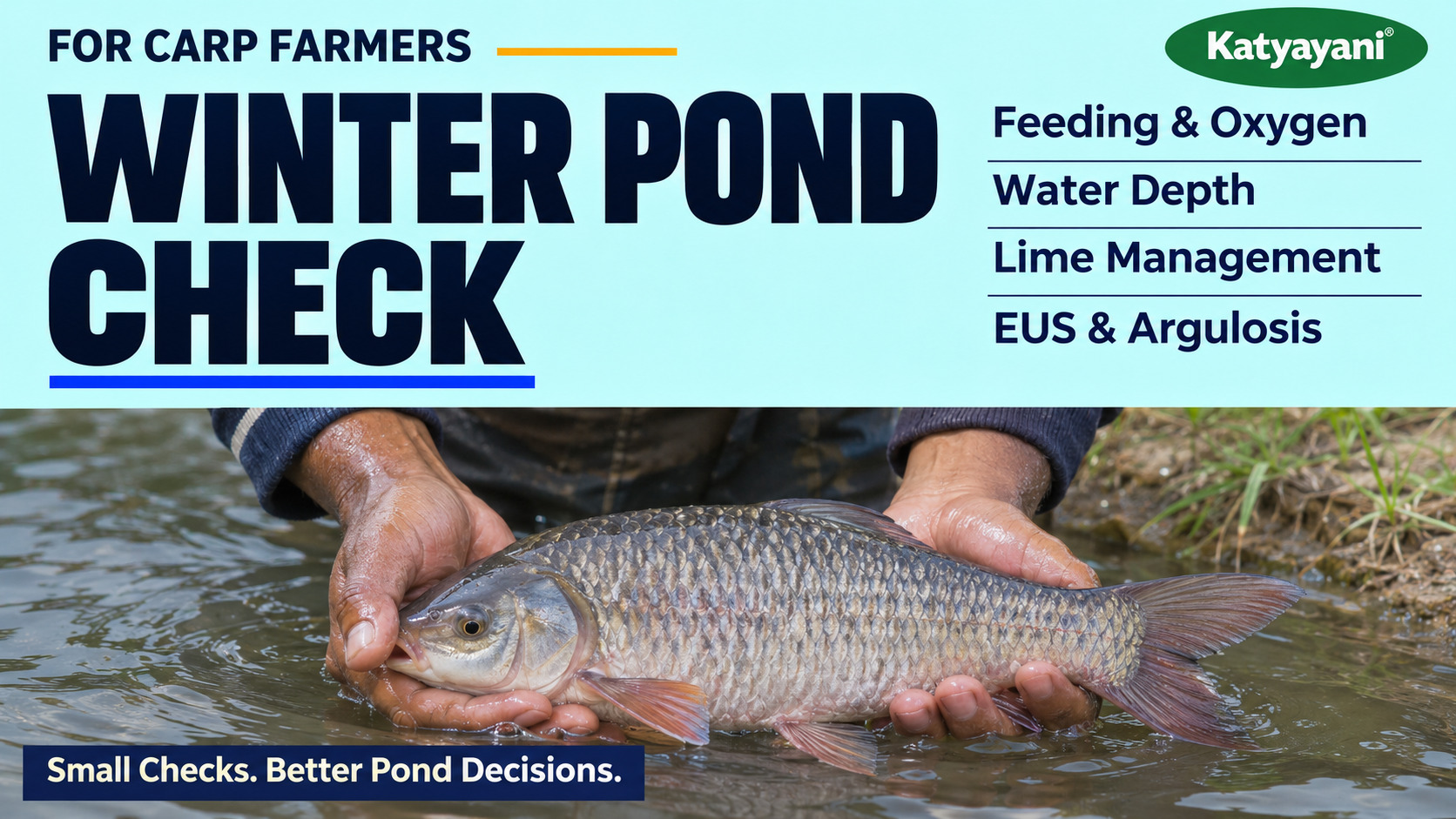
In winter, keep pond water about 6 feet deep so fish can rest in the warmer bottom layer. When water falls below 15 C add tube well water at dusk, cut feed by 25 to 75 percent as it gets colder, and stop feed below 10 C, as GADVASU advises. Stop manure and urea or DAP, aerate in the early hours and on cloudy days, and lime only after a pH check. Fin rot, gill rot, ulcers (EUS) and fish lice (argulosis) are the winter diseases, and ICAR links EUS deaths to crowded, poor-quality ponds in winter. Harvest fish above 500 g before the cold deepens.
What does winter do to a fish pond and the fish in it?
Cold water slows fish down. They eat less, move less and fight disease less well. Short days and cloudy skies cut the oxygen that pond plants make. KVK Cachar says most fish disease occurs in winter because pond depth and water temperature are both low, and the fish take in less food and move slowly.
Think of a small pond in Punjab or Assam in December. The water level has dropped after the monsoon, nights are cold, and a foggy week has kept the sun off the surface. The farmer keeps feeding as in October. The fish do not finish it. Leftover feed sinks, rots, and takes oxygen out of the water. That is how a calm-looking pond turns dangerous. The KVK Cachar page lists the same chain: overfeeding, dense stocking, dead leaves and algae all make disease more likely.
| What changes in winter | What it does to the pond | Source |
|---|---|---|
| Lower water temperature | Fish eat less and swim more slowly; disease risk rises | KVK Cachar |
| Shallow water after monsoon | The whole water column can turn cold, which can kill fish | GADVASU, 2017 |
| Cloudy and foggy days | Less photosynthesis, so oxygen falls further | GADVASU |
| Leftover feed and manure | Rot on the bottom, worse water quality, algal blooms | GADVASU |
| High stocking density | Linked with winter EUS mortality in an ICAR-NBFGR study | ICAR, Indian Farming 2020 |
Cold waves make all of this sharper. Our post on frost and cold wave sets out how the India Meteorological Department defines a cold wave in the plains, with a minimum of 10 C or less and 4.5 to 6.4 C below normal, or a minimum of 4 C or less. Pond owners can use the same forecasts to plan.
At what water temperature should you change what you do?
GADVASU gives two temperature points. Below 15 C, add tube well water at dusk to keep the surface warmer. Cut feed as the water cools and stop it when the water falls below 10 C. These are guide points for carp ponds in Punjab. Carry a simple thermometer and read it at the same hour each day.
| Water temperature | What GADVASU advises | Source |
|---|---|---|
| Falling toward winter | Cut feed gradually by 25 to 75 percent; stop manure and urea or DAP | GADVASU |
| Below 15 C | Add tube well water at dusk to keep the surface warm | GADVASU |
| Below 10 C | Stop feeding | GADVASU, GADVASU |
| December (one earlier notice) | Stop feeding completely | GADVASU, 19 November notice |
The notices are not all the same. The 19 November notice says to stop feed "in December", while the two newer-worded notices tie the stop to 10 C. The temperature rule is the better one because a warm December in the south and a cold November in the hills are not the same winter. The 2017 notice also printed a stop figure that reads "50C"; that is clearly a typo, so it is not used here.
Why the dusk top-up? GADVASU gives the purpose as keeping the surface warm at night. Adding fresh water is also one of the two ways GADVASU names to raise oxygen, the other being aerators.
How deep should the water be in winter?
About 6 feet (roughly 1.8 m). GADVASU says deep water lets fish rest in the warmer bottom and middle layers. Its 19 November notice says 5 to 6 feet. In shallow water the whole column can turn cold, and GADVASU warns that this can be fatal.
This is why a pond that is half empty in January is a risk. If you can pump in water from a tube well or canal to hold the depth, do it before the cold wave, not after the first dead fish. An ICAR journal abstract on EUS adds that adding water is one of the steps used in EUS control in hill ponds, with the abstract naming 1,000 to 1,500 cubic metres per hectare (Indian Farming, abstract). That figure is for EUS control in a watershed pond study, not a daily rule for every pond.
Also trim trees on the bank. GADVASU says to cut branches, especially of trees that drop leaves, so sunlight reaches the water and leaves do not fall in. Shaded ponds run short of oxygen sooner. Dead leaves rot and eat oxygen as well.
How much should you cut feeding in winter, and when should you stop?
GADVASU says cut feed gradually by 25 to 75 percent as the water cools, and stop when it falls below 10 C. The 2017 notice says cut by 50 to 75 percent depending on temperature. Fish eat less in the cold, and leftover feed rots on the bottom and spoils the water.
| If water is... | Feed plan | Source |
|---|---|---|
| Cooling but above 15 C | Start trimming; GADVASU range 25 to 75 percent less than your autumn ration | GADVASU |
| Between 10 and 15 C | Keep feed low; watch how much is left after an hour | GADVASU (range), our reading of it |
| Below 10 C | Stop feed | GADVASU |
Example, our arithmetic. Say your autumn ration is 20 kg a day. A 25 percent cut is 15 kg. A 50 percent cut is 10 kg. A 75 percent cut is 5 kg. Move down the steps over a week or two rather than in one day, and check the feeding spot each evening. If feed is still there, you are giving too much.
There is one more practical point from an FAO-hosted pond manual written for Lao PDR (a foreign source, used only for the habit). It says feeding may have to be reduced or stopped in the cool season, particularly in upland areas, and that in cool weather you may delay or skip the morning feeding session because the fish may not be active (FAO-hosted manual). Feeding in the warmer afternoon fits that advice.
On the type of feed, the 2017 GADVASU notice says to use low-protein feed in winter but to switch to high-protein feed just before winter begins. It gives no protein percentages, so none is written here.
Why does oxygen fall in a winter pond, and how do you protect it?
Pond plants make oxygen only in sunlight. In winter the days are short, and cloudy or foggy days cut it further. GADVASU says to aerate in the early hours, adding fresh water or running aerators, especially on cloudy days. Oxygen is lowest just before dawn.
The dawn point is general pond science. Mississippi State Extension, writing about catfish ponds, says aeration should continue past dawn until readings show oxygen rising from photosynthesis, and that aeration usually starts when oxygen falls to a critical level of about 3 to 4 mg per litre (Mississippi State). That is a foreign summer-catfish sheet. It is used here only for the idea that the low point comes at dawn.
For timing, an ICAR-CIFA study in Bhubaneswar tested night aeration windows for rohu fingerlings in concrete tanks. Aerating from midnight to 6 am did better than 9 pm to 3 am, and all aerated tanks beat the tank with no aeration on survival and growth (Fishery Technology, 2014). The tanks were seed-rearing tanks at very high density, not winter grow-out ponds, so treat it as a guide to the hour, not a winter rule. In a winter pond the same logic says: run the aerator in the small hours and into the early morning.
- Watch the fish at dawn. Fish gulping at the surface mean low oxygen. The FAO-hosted manual says to flush the pond with fresh well-oxygenated water, or pump pond water out and back in to oxygenate it (FAO-hosted manual).
- Go easy on feed on a dull, foggy day. Less light means less oxygen, and leftover feed uses oxygen (our reading of the GADVASU advice).
- Keep the surface clear. GADVASU's 19 November notice says to skim surface algal mats and remove dead vegetation from shallow areas.
- Rake the bottom. The 2017 notice says to rake the bottom soil from time to time with barbed wire to let trapped gases out.
Should you add manure or fertiliser to the pond in winter?
No. GADVASU says to reduce or stop organic manure in winter and not to use inorganic fertiliser such as urea, SSP or DAP. They feed algal blooms, and when the bloom dies it takes oxygen out of the water. The FAO-hosted manual gives the same cool-season rule.
In the Lao manual the wording is that fertiliser and manure should be decreased or even stopped when pond temperatures are dropping in the cold season. The same page gives an easy test: put your arm into the water up to the elbow. If you can see your hand, the water can take more fertiliser; if you cannot, add none until it clears. In winter you simply do not do the first half. Use that arm test only to see how green the water is.
If your pond was heavily manured in the autumn, expect a thick bloom. Do not add to it. The next sections cover how to handle it.
When should you lime a fish pond in winter, and how much?
Check pH first. GADVASU says that if pH falls below 7.0 on cloudy days, add lime at 100 kg per acre in two instalments. If pH is above 8.5, do not use lime. For the pond bottom before stocking, TNAU gives 200 to 250 kg per hectare as the normal lime dose, adjusted by soil pH.
| Soil pH of the pond bottom | Lime, kg per hectare (TNAU) | In kg per acre (our arithmetic) |
|---|---|---|
| 4.5 to 5.0 | 2,000 | about 810 |
| 5.1 to 6.5 | 1,000 | about 405 |
| 6.6 to 7.5 | 500 | about 200 |
| 7.6 to 8.5 | 200 | about 80 |
| 8.6 to 9.5 | Nil | Nil |
The TNAU Agritech page gives this table for new or drained ponds. A winter grow-out pond is usually full, so use GADVASU's water-pH rule for that. The conversion is our arithmetic: 1 acre is about 0.405 hectare, so multiply kg per acre by 2.47 to get kg per hectare, or divide kg per hectare by 2.47.
The same TNAU page says copper sulphate is not very effective in ponds with a pH above 8.6, which is one more reason to read pH before reaching for any chemical. The FAO-hosted manual adds a target: keep about 100 mg of calcium carbonate per litre in the pond water, which limits swings in pH, and lime if pH is below 6.5 or alkalinity below 75 mg per litre.
Two small habits help. Test pH at the same time each day, in the morning, and write it down. And never dump all the lime in one go; GADVASU says to split the 100 kg per acre into two doses.
How do you control an algal bloom in a winter pond?
GADVASU says either lime at 50 to 100 kg per acre, after checking that pH is below 8.5, or potassium permanganate at 2 to 3 kg per acre. Remove floating mats by hand. Most of all, stop the fertiliser that fed the bloom, because treating a bloom while still feeding it never works.
A dying bloom uses oxygen, so treat only part of the pond at a time if the water is very green, and keep the aerator or fresh-water inflow running through the night. This is our reading of the oxygen advice above, not a separate GADVASU line. The 19 November notice also says to skim algal mats from the surface and clear dead plants from shallow edges.
Which fish diseases appear in winter?
GADVASU names fin rot, gill rot, ulcers (including EUS) and argulosis (fish lice) as the winter diseases to prevent. KVK Cachar adds that most disease occurs in winter. The signs below come from KVK Cachar and the ICAR papers.
| Disease | What you see | Source |
|---|---|---|
| Fin and tail rot | Frayed fin edges; soft tissue between fin rays breaks down | KVK Cachar |
| Gill rot (branchiomycosis) | Yellow colour and break-up of gill tissue | KVK Cachar |
| EUS (epizootic ulcerative syndrome) | Tiny red spots, then ulcers, scale loss, open sores | KVK Cachar; ICAR |
| Argulosis (carp lice) | Fish swim erratically, refuse feed; parasite is visible; ulcer at the bite spot | KVK Cachar |
| Cotton wool disease (saprolegniosis) | White fungal mesh on skin, fins, mouth or gills | KVK Cachar |
The KVK page also lists what makes a pond disease-prone: lack of feed, dense stocking, misuse of pesticide in the pond, rotting waste and dry leaves, excess algae, too much artificial feed, and poor decomposition of organic matter at the bottom. Nearly every item on that list is a thing the pond owner controls.
One caution if your pond sits beside a crop field. KVK Cachar names "misuse of pesticide in the pond" as a cause of fish disease. Spray drift or run-off from a field can reach a pond. The same care applies to water bodies in other crops; our makhana farming post makes the same point for makhana ponds, and says makhana can be grown with fish, particularly catfish, per its source.
What is EUS, and how do you spot it early?
Epizootic ulcerative syndrome is a disease caused by the water mould Aphanomyces invadans. ICAR-NBFGR says more than 160 fish species can get it. Early signs are pinhead red spots. Then come 2 to 4 cm ulcers, scale loss and bleeding. Late stage shows large open sores and death.
| Stage | What the fish looks like (ICAR-NBFGR) |
|---|---|
| Early | Pinhead-sized red spots on the body, head, fins, tail base, back or gill cover; no clear bleeding or ulcer yet |
| Middle | Small dermal ulcers of 2 to 4 cm, scales lost, bleeding |
| Late | Large, open, necrotic ulcers spreading over the body; the fish dies |
The ICAR paper says that after more than three decades since EUS first came to India in 1988, a prevalence of about 69 percent was recorded in Lakhimpur Kheri district of Uttar Pradesh, with 13 fish species infected. It also says EUS is mostly a problem for small farmers with extensive systems, and that Indian carps, the main food fish, are susceptible.
Look at a few fish from each net haul or at the feeding point. Red pinhead spots are the first sign, and early action is the only edge you have.
How can you reduce the risk of EUS, and is there a treatment?
ICAR-NBFGR says there was no fully effective treatment as of 2020, so prevention matters most. Keep stocking density low, avoid stress, hold water quality, stop skin damage from parasites and bacteria, and harvest susceptible fish before the high-risk winter period.
That advice comes from a field study in Maharajganj, Uttar Pradesh. It found that high stocking densities and poor water quality were linked with fish deaths in winter, which is also the EUS season. For farms that had the disease, the paper lists steps for a clean restart: remove all susceptible fish before stocking, dry and lime the pond, and disinfect nets and tools. Then keep it out: take seed and brood only from EUS-free farms, use water from a disease-free source, and screen out wild fish.
The same paper reports a formulation developed by ICAR-NBFGR under the All India Network Project on Fish Health. It was used in 38 farms in Assam, West Bengal and Uttar Pradesh, and the lesions of affected fish reduced significantly after a single application. The paper does not print the formulation, so nothing more is claimed here.
| Step (ICAR-NBFGR and Indian Farming) | In plain words |
|---|---|
| Low stocking density in winter | Do not run the pond near its limit in November to February |
| Avoid stress and keep water good | Fewer netting jobs, no overfeeding, check pH and oxygen |
| Prevent skin damage from parasites and bacteria | Treat lice early; handle fish gently |
| Harvest susceptible fish before the risky period | Take marketable fish out early |
| After an outbreak: dry, lime, disinfect, restock from clean sources | For a drainable pond; ICAR and KVK give lime on dry beds |
| Hill watershed ponds: weekly lime and permanganate, extra water, thinning | Indian Farming abstract: lime 125 kg Ca(OH)2 per ha and KMnO4 0.5 mg per litre, once a week for 3 weeks; 1,000 to 1,500 m3 water per ha |
The last row is from an abstract about ponds in a watershed programme in the north-western Himalayas (Indian Farming abstract). It reads as an outbreak response for that setting. Do not use it as a routine winter dose.
What is argulosis (fish lice), and why is it worse in winter?
Argulosis is a skin parasite problem. Argulus, called fish lice or carp lice, clings to the fish and bites. A 2025 ICAR journal survey of six farms in Ganjam, Odisha found prevalence higher in winter than in other seasons, and rohu was the most affected fish.
In that survey (January to October 2019), Argulus siamensis was found on 27.6 percent of fish and Argulus bengalensis on 13.9 percent. After rohu, the affected fish were common carp, mrigal, grass carp and catla. The authors also say Argulus accounts for 19.5 percent of parasite infestations cited from earlier work, and that India has 17 species and one sub-species (Indian Journal of Fisheries, 2025).
Signs, per KVK Cachar: erratic swimming, fish that will not take feed, a parasite you can see with the naked eye, and an ulcer at the point where it attached. ICAR-NBFGR lists preventing skin damage from parasites and bacteria among its EUS steps, and GADVASU puts argulosis in the same list as ulcers.
What do the sources say to do? The pond-level options on the KVK Cachar page are potassium permanganate in the pond at 4 mg per litre, or a short salt bath for the fish at 2.5 to 3 percent for 5 to 10 minutes, with treated fish put straight back into the pond. If the pond can be drained, lime at 200 to 250 kg per hectare on the dried bed for two weeks clears the parasite before restocking. GADVASU lists deltamethrin for argulus at 15 ml per acre with a booster after 15 days. That one is an insecticide used in water, and the ICAR paper cautions that despite many drugs, argulosis keeps recurring, drugs build up in fish tissue, and some toxicants harm non-target species. Use the drain-and-lime route where you can.
What does GADVASU advise before winter starts, in numbers?
GADVASU lists these preventive and winter-care doses per acre. For disease prevention it names a CIFA-developed medicine at 400 ml per acre, potassium permanganate at 1 to 2 kg, limestone at 50 to 100 kg, salt at 50 to 100 kg, and turmeric powder at 500 g (for fin rot, gill rot and ulcers). The 2017 notice says to treat just before winter begins.
| Item (GADVASU) | Per acre as printed | Per hectare (our arithmetic) | Why |
|---|---|---|---|
| Lime, if pH below 7.0 on cloudy days | 100 kg, in two instalments | about 247 kg | Raise pH |
| Lime, algal bloom (pH below 8.5) | 50 to 100 kg | about 124 to 247 kg | Bloom control |
| Potassium permanganate, algal bloom | 2 to 3 kg | about 5 to 7 kg | Bloom control |
| Potassium permanganate, disease prevention | 1 to 2 kg | about 2.5 to 5 kg | Fin rot, gill rot, ulcers, argulosis |
| Limestone, disease prevention | 50 to 100 kg | about 124 to 247 kg | Disease prevention |
| Salt, parasites and rot | 50 to 100 kg | about 124 to 247 kg | Fin rot, gill rot, parasites |
| Turmeric powder | 500 g | about 1.2 kg | Fin rot, gill rot, ulcers |
| CIFA-developed medicine (as GADVASU names it) | 400 ml | about 1 litre | Winter disease prevention |
| Deltamethrin, for argulus | 15 ml, booster after 15 days | about 37 ml | Fish lice |
Use the numbers as printed. They are listed by GADVASU as a package of options ("or"), not as a set to apply all together. For a quarter-acre (25 decimal) pond divide the per-acre figure by four, our arithmetic: salt becomes 12.5 to 25 kg. Read the 14 November notice and the 6 December notice side by side; the doses match, except that the 14 November item also lists turmeric at 500 g per acre and states that the deltamethrin dose is repeated every fortnight.
When should you harvest, and should you stock in winter?
GADVASU says to harvest marketable carp above 500 g from November to February, so the pond is free for stocking in March or April, and not to stock in winter. Complete harvest of the winter-sensitive pangas catfish before 20 November.
Thinning is also a disease measure. ICAR-NBFGR ties winter deaths to high stocking and advises harvesting susceptible fish before the risk period. A lighter pond leaves more oxygen and feed for each fish (our reading), and a December sale gives money without waiting for spring. Plan each harvest to leave the pond lighter before the coldest weeks.
Protect what is left from birds. GADVASU says to use reflecting tapes, nylon thread or nets over the pond, and sound scarers, to keep fish-eating birds away. A stressed, slow fish in cold water is an easy catch.
What is a simple winter checklist for a carp pond?
Check temperature, depth, oxygen signs, feed left over, and fish behaviour every day. Check pH on cloudy days. Cut feed in steps and stop at 10 C. Keep fertiliser out. Treat early if fin rot, ulcers or lice show. The table puts the Indian guidance into a daily and weekly routine.
| When | What to do | Why (source) |
|---|---|---|
| Every morning, early | Look for fish gulping at the surface; run aerator or add fresh water | Oxygen is lowest before sunrise; GADVASU |
| Every day | Read water temperature; adjust feed to the 15 C and 10 C points | GADVASU |
| Every evening | Check feeding spot for leftover feed; add tube well water if below 15 C | GADVASU |
| Cloudy or foggy spell | Test pH; lime at 100 kg per acre in two doses only if below 7.0 | GADVASU |
| Weekly | Look at a few fish for red spots, frayed fins, lice; skim algae; clear dead leaves | KVK Cachar; GADVASU |
| Before the cold wave | Top up depth toward 6 feet; stop manure and urea or DAP | GADVASU |
| November to February | Harvest fish above 500 g in steps; no new stocking | GADVASU |
Which winter mistakes cost the most fish?
Most winter losses trace back to six habits: feeding on as in autumn, letting depth fall, adding fertiliser or manure, liming without a pH test, crowding the pond and ignoring early signs of lice or red spots. Each one is covered in the sources above.
- Keeping the autumn ration. GADVASU says to cut 25 to 75 percent and stop below 10 C. Leftover feed rots.
- Letting the pond run shallow. GADVASU says about 6 feet, and warns that a shallow pond can chill through and kill fish.
- Adding urea, DAP or manure. GADVASU says not to use urea, SSP or DAP and to reduce or stop manure, because blooms follow.
- Liming blind. Lime only after testing pH: below 7.0 on cloudy days it helps, above 8.5 it does not.
- Running the pond crowded. ICAR-NBFGR links crowding and poor water with winter EUS deaths.
- Waiting on fish lice. The ICAR survey found lice more common in winter. Lice wounds let in other disease. Treat early and do not rely on one drug again and again.
Can you get a loan or scheme support for a fish pond?
Yes, support exists, but amounts change and are not quoted here. Our Kisan Credit Card post says the KCC was extended to fishers and fish farmers in 2018-19 and explains the allied-only sub-limit for fisheries. Our PMEGP post lists fish or prawn farming as allowed under aquaculture.
For group credit, the SHG loan post says fisheries is one of the allied activities under the RBI priority sector rules. The wider scheme overview is in the agriculture subsidy schemes post, which mentions fisheries in the KCC section. The National Livestock Mission post covers goat, poultry and pig units only, not fish. If you also keep birds, our poultry management in winter post is the companion for the shed.
Conclusion
Winter fish care is a handful of habits. Keep about 6 feet of water, add tube well water at dusk below 15 C, cut feed in steps and stop below 10 C, leave out manure, urea and DAP, aerate early in the morning, and lime only after a pH check. Watch for red spots, frayed fins and lice, keep the pond lightly stocked, and take out fish above 500 g before the cold deepens.


Leave a Comment