
 15 min read
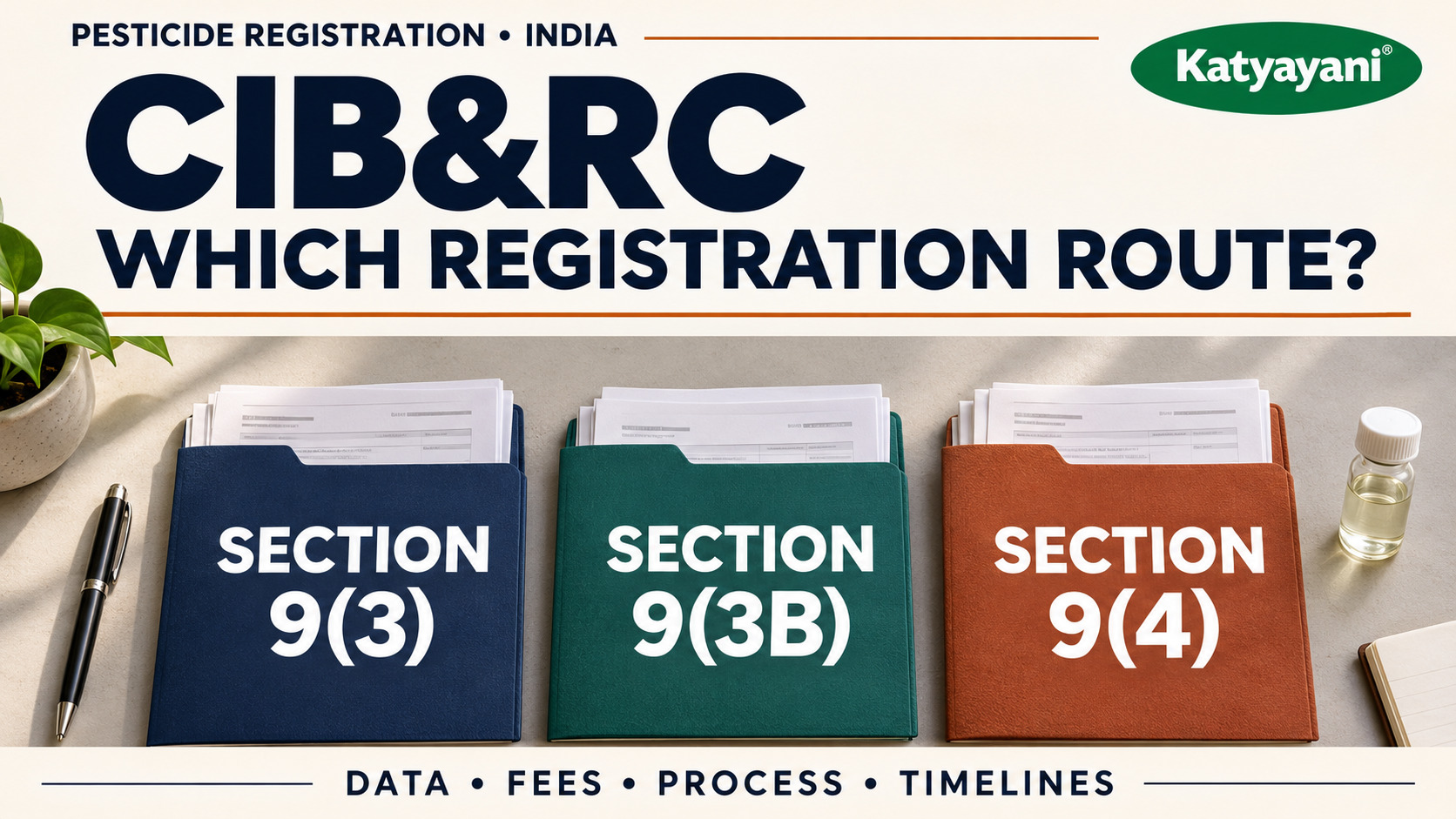
CIB&RC registration is the central permission, under the Insecticides Act, 1968, that every pesticide needs before it is made, imported or sold in India. Section 9(3) is regular registration, Section 9(3B) is a provisional two-year registration for a product new to India, and Section 9(4) gives a second applicant a certificate for an already registered product on the same conditions. Applications go online on the CROP portal, where the registration fee set by the Rules is paid.
What is CIB&RC and what does it do?
CIB&RC stands for the Central Insecticides Board and Registration Committee. Under the Insecticides Act, 1968, the Board advises the Centre and the states on technical matters, and the Registration Committee scrutinises each pesticide and registers it if its claims on efficacy and safety hold up. Both work from the Directorate of Plant Protection, Quarantine and Storage at Faridabad.
The Insecticides Act gives the two bodies separate jobs. Section 4 sets up the Board to advise on risks to people and animals and on safe manufacture, sale, storage and transport. Section 5 sets up the Registration Committee: a Chairman and not more than five members of the Board, including the Drugs Controller of India and the Plant Protection Adviser to the Government of India. Its task is to register insecticides after scrutinising the formulae and checking the importer's or manufacturer's claims on efficacy and safety.
There is one more split to keep in mind. CIB&RC works at the central level, so one registration is valid for the whole country. Licences to make or sell are different. They come from licensing officers appointed by each State Government under Sections 12 and 13 of the Act. Think of two locks on one door. CIB&RC gives the product permission to exist in India. Your state gives your factory or shop permission to make or sell it. The live pesticide dealer licence guide covers the second lock.
Applications are sent to the Secretary of the Registration Committee at the Directorate of Plant Protection, Quarantine and Storage, NH-IV, Faridabad, as Rule 6 of the Insecticides Rules, 1971 says. In practice the CIB&RC FAQ now says you apply online through the CROP portal.
Which products need CIB&RC registration, and which do not?
Every pesticide that is imported, made or sold in India needs it. The Act defines an insecticide to include fungicides and weedicides added by notification. Section 18 bars anyone from selling, stocking, exhibiting, distributing, transporting or using an insecticide that is not registered. Fertilisers and biostimulants follow a different law, the Fertiliser (Control) Order.
The CIB&RC guideline (the 449 RC data requirements) is built around five parts: legal papers, chemical pesticides, microbial pest control agents, botanical products and pheromones. It also says that the chemical pesticide data rules apply to chemical plant growth regulators. That is why a gibberellic acid or 6-benzyladenine product sits in the same registration system as an insecticide.
| Product type | Where it is registered | Source |
|---|---|---|
| Chemical insecticide, fungicide or herbicide | CIB&RC, chemical annexure (technical or formulation) | Insecticides Act s.3(e); 449 RC guideline, Annexure II |
| Chemical plant growth regulator (for example gibberellic acid) | CIB&RC, same data as chemical pesticides | 449 RC guideline, note on PGR |
| Microbial biopesticide (bacteria, fungi, virus) | CIB&RC, microbial annexure | 449 RC guideline, Annexure III |
| Botanical or plant-origin product (for example neem-based) | CIB&RC, botanical annexure | 449 RC guideline, Annexure IV |
| Pheromone or semio-chemical | CIB&RC, pheromone annexure | 449 RC guideline, Annexure V |
| Household, public health and rodent-control formulations | CIB&RC, with a separate list on the Registered Products page | CIB&RC Registered Products page |
| Biostimulant, bio-fertiliser, fertiliser | Not CIB&RC. Fertiliser (Control) Order | Live KO biostimulant post |
If you are not sure which side a product falls on, the live posts on biostimulant manufacturing under FCO and PGRs versus biostimulants draw the line. In short, a product that claims to kill, repel or control a pest, or to regulate growth as a chemical PGR, belongs to CIB&RC.
What is the difference between Section 9(3), Section 9(3B) and Section 9(4)?
Section 9(3) is regular registration after enquiry, decided within 12 months. Section 9(3B) is a provisional registration for two years, given when an insecticide is being introduced for the first time in India. Section 9(4) lets another person who wants to import or make an already registered insecticide get a registration number and certificate on the same conditions as the first registrant.
The CIB&RC guideline uses plain labels for the three. It calls 9(3B) provisional, 9(3) regular and 9(4) the subsequent or "me-too" registration. The Act text behind each one is short, so here it is in simple words, side by side.
| Point | Section 9(3B) | Section 9(3) | Section 9(4) |
|---|---|---|---|
| What it is | Provisional registration | Regular registration | Later registration of an already registered insecticide ("me-too") |
| What the Act says | Insecticide is being introduced for the first time in India. Registered provisionally for two years, pending enquiry, on conditions the Committee sets | After enquiry, the Committee registers on conditions it sets, allots a number and issues a certificate within 12 months of receiving the application. It can add up to 6 months | Another person who wants to import or make the insecticide gets a number and certificate on the same conditions on which it was first registered |
| Bio-efficacy data | Yes. Two seasons at a minimum of two agro-climatic conditions for a formulation (FIM) | Yes. Two seasons at a minimum of three agro-climatic conditions for a formulation (FI, FIM) | No data requirement. Claims follow the approved 9(3) label |
| Data given earlier | Not applicable | Data given at 9(3B) need not be sent again if composition and claims have not changed | Uses the position of the original registrant |
| Licence link | A manufacturing licence issued on a provisional registration ends on the date the provisional registration ends (Rule 11) | Normal state licence, valid two calendar years (Rule 11) | Normal state licence |
Two points often get lost. First, 9(3B) is not a shortcut around safety. It still asks for the acute and sub-acute toxicity studies, as the data table later in this post shows. Second, 9(4) is not an automatic copy. A 9(4) applicant still files the legal papers, the chemistry data, the packaging data and, for a technical, the in-process sample. What it skips is the field bio-efficacy work, because the claim is already approved for the first registrant.
Which registration route fits your business?
It depends on what you hold and whether the molecule already has a certificate in India. A company with a molecule never sold here looks at 9(3B). A company with a new formulation or new crop claims for a known molecule looks at 9(3). A company that wants its own number for a product someone else already registered looks at 9(4).
| Your situation | Route to look at | Why, from the documents |
|---|---|---|
| You hold a molecule that has never been sold in India | 9(3B), then 9(3) | Section 9(3B) is for an insecticide introduced for the first time in India. The guideline says data given at 9(3B) need not be sent again at 9(3) if composition and claims are unchanged |
| You have a new formulation, a new mixture or new crop claims for a known molecule | 9(3), formulation columns (FI or FIM) or label expansion | The 9(3) bio-efficacy table has columns for FI, FIM and label expansion, each asking two seasons at a minimum of three conditions |
| Someone else holds the certificate and you want your own number for the same product | 9(4) | Section 9(4) grants a number and certificate on the same conditions. The legal annexure asks a legalised consent letter for 9(4) technical or formulation import |
| You only sell under your brand, and a registered factory makes the product | Often no separate registration | The live KO OEM post explains that in many private label deals the factory holds the registration and plant licence, and a brand owner can later seek its own registration, usually under 9(4) |
| You make or import only for export | Export-only registration, or none if already registered in your name | CIB&RC export guideline, covered in its own section below |
For the commercial side of these arrangements, read the OEM versus private label post. For the question of what technical and formulation grade mean in a quote, see technical grade vs formulation grade.
What do TI, TIM, FI and FIM mean in a CIB&RC application?
They are four application types in the guideline tables. TI is technical import, TIM is technical indigenous manufacture, FI is formulation import and FIM is formulation indigenous manufacture. A technical is the pure active ingredient. A formulation is the finished product made from it, such as a wettable powder or a suspension concentrate.
| Code | Meaning | Example from daily trade |
|---|---|---|
| TI | Technical import | A company brings in imidacloprid technical from a foreign plant |
| TIM | Technical indigenous manufacture | A company makes the technical in its own Indian plant |
| FI | Formulation import | A company imports a ready 20% SC from abroad |
| FIM | Formulation indigenous manufacture | A company mixes technical and additives in India to make a 20% SC |
The legal annexure sets one rule that trips up many first-time applicants. The technical used in a formulation must already be registered in India, or its own application must be filed in parallel. A deemed registration status without a certificate does not count. The guideline also covers formulation import or manufacture "without registering the technical" (FI-WRT and FIM-WRT). In those cases the full chemistry data on the technical, including shelf life and packaging, must still be submitted, with the chemical composition on a Rs 10 non-judicial stamp paper.
Samples matter too. For a technical made in India (TIM), an in-process sample is drawn from the applicant's R&D or manufacturing site, and a certified reference material and impurity standards go to the Central Insecticides Laboratory at Faridabad for pre-registration verification. A public notice of 14 October 2026 shows what happens if this step is left hanging: the Registration Committee closed 31 pending 9(4) TIM applications because the applicants had not completed the in-process sample drawl.
How do you apply for CIB&RC registration, step by step?
You apply online on the CROP online portal. The CIB&RC FAQ says so directly. The steps below come from the FAQ, the 449 RC guideline and the Rules. The CROP portal screens are not described on the official pages, so no screen-by-screen claims are made here.
- Open one account on the CROP portal. A public notice of 10 February 2021 (following the 425th RC meeting) says each applicant should use only one active CROP account.
- Complete the online KYC (Know Your Company) template. The FAQ says it started on 14 November 2022 under a public notice of 7 November 2022. Once KYC is active, the guideline says the company papers do not have to be submitted again with every application.
- Choose your category before you start the data work: chemical or biopesticide, technical or formulation, 9(3B), 9(3) or 9(4), and domestic use, export or both. The guideline says the data needed depends on all of these.
- Fill Form I with the chemical composition, signed digitally by an authorised person. The Rules say who signs for an individual, a Hindu undivided family, a partnership, a company or any other body.
- Upload the legal, chemistry, bio-efficacy, toxicity and packaging data listed in the guideline annexures. Studies should follow Good Laboratory Practice where it applies, and complete study reports are required.
- Pay the registration fee set by the Rules for your section, and send the samples your category needs to the Central Insecticides Laboratory (and ICAR-NBAIM for biopesticides).
- Wait for scrutiny. The CIB&RC checklist page carries 86 checklist PDFs, grouped under bio-efficacy, toxicology, chemistry, packaging, herbicide, plant pathology and legal scrutiny. Each is a tick-list the officers use on your file.
- The Registration Committee decides. If it registers the product, it gives a registration number and a certificate in Form II or Form II-A with conditions.
Keep one more thing in mind. The Act says "there shall be a separate application for each such insecticide." A company with five products files five applications, each on its own file number.
Which legal papers does the Committee ask for?
The legal annexure of the guideline lists the company papers. Most need notarisation. They show who you are, that your plant exists and that your technical source is legitimate. Missing or unsigned papers are the quietest reason for delay because nothing else moves until they are complete.
| Paper | Note from the guideline |
|---|---|
| Form I, signed or digitally signed | By the person authorised as per the Rules |
| Board resolution, affidavit or partnership deed | Notarised |
| Affidavit of chemical composition on non-judicial stamp paper | Notarised |
| Certificate of the industry category or manufacturing licence | Notarised |
| PAN | Notarised |
| Incorporation certificate and other KYC papers | Notarised. Not repeated if KYC is active on the portal |
| Proof of ownership or lease of the manufacturing site | Notarised |
| Proof that the technical is registered in India, or a parallel application for it | Deemed registration without a certificate is not accepted |
| Name of the registrant of the formulation import, with the Committee meeting reference | For import cases |
| Legalised consent letter from the country of origin (embassy, high commission, consulate or apostille) | Applicable for 9(4) technical or formulation import |
| List of products registered to the firm, licences obtained and products actually made in the last three years | Not repeated if KYC is active |
What safety and quality data does 9(3B) ask for compared with 9(3)?
The first-time technical table in the guideline shows the gap clearly. For a molecule new to India, 9(3B) asks for the identity, composition, process, impurity and acute toxicity data but not the shelf-life, residue, cost-benefit or long-term toxicity studies. 9(3) asks for all of them. This table reads the columns for technical import (TI) and technical indigenous manufacture (TIM).
| Data item (first-time technical) | 9(3B) | 9(3) |
|---|---|---|
| Chemical identity, composition, manufacturing process, impurities | Required | Required |
| Acute oral, dermal, inhalation; skin and mucous membrane irritation | Required | Required |
| Sub-acute oral (rat), dermal and inhalation | Required | Required |
| Toxicity to birds, freshwater fish, honeybees and livestock | Required | Required |
| Shelf-life data (the claim itself is required in both) | Not required | Required |
| Residues in plant and soil | Not required | Required |
| Residue tolerance limits fixed by foreign countries | Not required | Required |
| Cost-benefit ratio | Not required | Required |
| Neurotoxicity, teratogenicity, effect on reproduction, carcinogenicity, mutagenicity, metabolism | Not required | Required |
Read this as a first-time technical table, not as a rule for every product. The Annexure II tables for formulations and for 9(4) differ again, and the guideline notes that data needs also change with the formulation type, the purpose (domestic, export or both) and the intended label claims. What the pattern does tell you is the purpose of 9(3B): a two-year permission to put a new product to work while the longer studies are completed for the regular certificate.
How much field data (bio-efficacy) is needed under each route?
Field data is where the routes differ most. A 9(3) formulation needs two seasons or years of data at a minimum of three agro-climatic conditions. A 9(3B) formulation needs two seasons at a minimum of two. A 9(4) application needs no bio-efficacy data, because the claim follows what is already approved.
| Application type | Bio-effectiveness and phytotoxicity data | Note |
|---|---|---|
| 9(3B) technical (TI, TIM) | Required | Not asked if filed together with a formulation application |
| 9(3B) formulation indigenous manufacture (FIM) | Two seasons at a minimum of two conditions | Also asks effect on natural enemies |
| 9(3) technical (TI, TIM) | Required | Not asked if filed together with a formulation application |
| 9(3) formulation (FI, FIM) and label expansion | Two seasons at a minimum of three conditions | Also asks effect on natural enemies and, for soil or seed use, on beneficial soil microbes |
| 9(4), any type | No data requirement | Claims granted as per the approved 9(3) label |
Residue data has its own rule. For fungicides, insecticides and plant growth regulators the guideline asks one season at a minimum of four agro-climatic conditions. For seed treatment it asks one season at a minimum of three. For soil-applied products a second season is needed only if the residue at harvest is above the limit of quantification. For herbicides the effect on the next three normally grown crops must also be studied in the same plots. The guideline gives its own example: a herbicide meant for wheat may be tested on maize, green gram and sesamum that follow it.
This is also why crop claims on a label are not free text. A new crop on the label is a label expansion, and that needs the same field work as a regular formulation. The live fungicide application methods post shows why spray, dust, granule and seed use are treated as different ways of use.
How is the shelf life of a pesticide decided?
The applicant states a shelf-life claim and backs it with storage data. Samples are stored under varied agro-climatic conditions for six months beyond the claimed shelf life. A short accelerated test at 54 degrees C can support a provisional shelf life of up to two years, but real-time data for at least 30 months must follow.
The guideline spells this out. Accelerated storage data can support a provisional shelf life, and the certificate is then valid for two years. The applicant must submit real-time storage data in the proposed pack for at least 30 months within two and a half years of applying, or the registration becomes invalid. The accelerated test runs at 54 degrees C (plus or minus 2) for 14 days with a corrosiveness check on the pack, and the longest shelf life it can support is two years.
Packaging data travels with it. The guideline asks the type and manner of packaging, the packaging material and its fit with the content, performance of the container during the storage test and a transport-worthiness test, with BIS specifications to be followed where they exist. All pack tests must be done on the product of the same batch in its commercial pack, preferably in Indian conditions. For a formulator this means the pack you plan to sell is the pack you must test. Switching to a cheaper bottle later is a change that needs the Committee.
How is a biopesticide registered in India?
A biopesticide goes through the same Act and the same Committee, but under its own data annexure. A microbial product needs the strain identity, proof of source, a DNA fingerprint by ICAR-NBAIM and undertakings that it carries no chemical pesticide and no GMO. Since October 2026 the sample steps follow a fixed 30-day flow.
The microbial annexure of the 449 RC guideline covers entomopathogenic and entomotoxic bacteria, antagonistic bacteria, entomopathogenic fungi, antagonistic fungi and baculoviruses (NPV and GV). Applicants submit an agreement or authorisation letter from the inventor of the strain, an undertaking that the product is free from chemical pesticides and other agro-chemicals, an undertaking on composition and an undertaking that the product is free from GMO. They also need the fee receipt issued by ICAR-NBAIM at Mau after a sample is submitted for DNA verification. Where the strain is already registered, the composition must match the earlier 9(3) or 9(3B) registrant.
The public notice of 14 October 2026 redefined the flow after the Committee noticed that many applicants sent samples to NBAIM but never filed on CROP. The steps now are these.
- File the biopesticide application on CROP and pay the fee.
- Send a 500 g sample to ICAR-NBAIM, Kushmaur, Mau Nath Bhanjan, mentioning the CROP application number, within 30 days of filing.
- Send a 500 g sample to the Central Insecticides Laboratory, also mentioning the application number, within 30 days.
- Upload both sample receipts through the notification that appears in your CROP login.
- If a receipt is not uploaded within 30 days, the application is deemed rejected, and the expert prepares a list for the Committee to approve the rejection.
Here is why strain identity matters on the market. The formulation list on the CIB&RC page (as on 31.03.2026) has 17 separate Beauveria bassiana lines, most of them Beauveria bassiana 1.15% WP, each tied to its own strain and accession number, such as one from an ICAR research complex or one from NBAIM. The same fungus name can therefore sit behind several different registrations. If you want to see what such products look like on a shop page, the KO bio pesticides collection groups fungus and bacteria based insecticides, and the Beauveria bassiana bio insecticide page describes a liquid at 2 x 10^8 CFU per ml.
CIB&RC also lists minimum infrastructure guidelines for manufacturers of botanical biopesticides, of NPV and granulosis virus products and of antagonistic and entomopathogenic fungi. For the types and field use of these products, see the live biopesticides guide. The difference between a biostimulant, a bio-fertiliser and a biopesticide is the subject of a separate post in this series.
How long does registration take and what does it cost?
The Act asks the Committee to decide within 12 months of receiving the application, with up to 6 more months if it cannot decide on the material before it. The Rules set a registration fee for each application, and each insecticide needs its own application. The amount is published on the CIB&RC Registration Procedure page, which is the official place to read it. Study costs, lab charges and consultant fees are not set by any official page.
Pay the fee only through the CROP portal. Websites and consultants often quote older or higher figures, so read the amount on the official Registration Procedure page before you budget.
On pace, the CIB&RC news page shows the Committee meets often. The 474th meeting was held on 30 July 2026 and the 476th on 10 September 2026, two meetings in about six weeks, and the minutes of the 477th were posted on 5 November 2026. The same page shows the Committee working through backlogs, which is why the biopesticide flow and the 9(4) TIM closures above were published.
What do you get after the Committee says yes?
You get a registration number and a certificate in Form II or Form II-A, with conditions printed on it. You may import or make the product only in line with those conditions. You still need a state manufacturing licence for your plant, and your labels must carry the registration number. The Committee can later change the conditions.
Section 17 of the Act bars anyone from importing or making an insecticide except in accordance with the conditions of its registration. Section 9(3C) lets the Committee vary the conditions, having regard to efficacy and safety, and ask the holder to hand back the certificate. So a registration is a living document, not a one-time stamp.
The licence side is separate. Under Rule 9 and Rule 11, the manufacturing licence is for each place of manufacture, and one made on a provisional registration under Section 9(3B) ends on the date the provisional registration ends. That is why a company using 9(3B) must plan the move to 9(3) well before the two years are up.
The label comes next. Rule 19 lists what must be printed on the innermost container and the outermost covering: the manufacturer, the product name, the registration number, the active and other ingredients with percentages, net content, batch number, expiry date and the antidote statement. The label must carry the colour band and warning words of its toxicity class, and the label and leaflet must be printed in Hindi, English and one or two regional languages of the area where the pack will be sold. The Act also treats a label that mentions registration in any way other than the registration number as misbranded. Reading a label panel by panel is the subject of a separate post in this series.
How do you read the CIB&RC lists of registered products?
The Registered Products page carries six downloadable lists, each with its own "as on" date. The two main ones are the list of formulations and the list of molecules registered under Section 9(3). To check a product, find the formulation line in the first list, then the crop in the Major Uses lists, which show approved crops and doses.
| List on the CIB&RC page | As on date shown | What it tells you |
|---|---|---|
| Pesticide formulations registered for use in the country | 31.03.2026 | Formulation lines such as "Abamectin 1.9% EC", grouped as insecticides, herbicides, plant growth regulators, fungicides, nematicides, bio-insecticides and bio-fungicides, with strain details for biological products |
| Insecticides and pesticides registered under Section 9(3) | 31.03.2026 | A molecule list. The serial numbers run to 372 and include biological entries such as Trichoderma viride, Bacillus thuringiensis var. kurstaki and Beauveria bassiana |
| Pesticides banned, refused registration and restricted in use | 31.10.2026 | The prohibited and restricted names, with notification numbers |
| Source of import and list of indigenous manufacturers | 31.07.2026 | Which source or maker is approved for each product |
| Formulations for household, public health and rodent control | 31.07.2026 | The separate list for these uses |
| Approved pesticides for desert locust control | No date shown | Locust-control products |
The Major Uses of Pesticides page has six more lists, each dated 30.09.2026: insecticides, fungicides, bio-fungicides, herbicides, plant growth regulators and bio-insecticides. The CIB&RC FAQ describes this page as the place for approved pesticides for different crops with recommended doses. A product that is registered but not listed for your crop has no approved claim on that crop.
For a dealer, a practical order of checks is the registration number on the pack, the formulation line in the registered list, the crop in the Major Uses list and the manufacturer against the approved source list. The live agrochemical manufacturer checklist and the fake pesticide identification guide use the same logic from the buyer side.
Which pesticides are banned, refused, withdrawn or restricted in India?
The CIB&RC list updated on 31 October 2026 has four groups. Fifty names are banned for manufacture, import and use. Five are banned for use but may still be made for export. Eight are withdrawn. Eighteen were refused registration. A fifth part lists restrictions by crop or by use, such as chlorpyriphos being banned on ber, citrus and tobacco.
| Group on the list (31.10.2026) | Count of names | Examples from the list |
|---|---|---|
| Banned for manufacture, import and use | 50 | Alachlor, Aldicarb, Endosulfan (Supreme Court order), Methomyl and Dicofol (S.O. 4294(E), 3 Oct 2023), Paraquat Dichloride (S.O. 5234(E), 22 Sep 2026) |
| Banned for use but manufacture continues for export | 5 | Captafol 80% powder, Dichlorvos, Nicotine sulfate, Phorate, Triazophos |
| Withdrawn | 8 | Dalapon, Ferbam, Simazine, Warfarin |
| Refused registration | 18 | 2,4,5-T, Lead arsenate, Mevinphos |
| Restricted in use | By crop or by use | Chlorpyriphos banned on ber, citrus and tobacco; Mancozeb banned on guava, jowar and tapioca; Malathion banned on a list of crops including soybean, brinjal, tomato and mango |
The restricted group carries a lesson that applies to every registration: approval is given crop by crop. A molecule can be fully registered and still be barred on certain crops. The CIB&RC news page shows a public notice of 7 October 2026 about the Gazette notification prohibiting Paraquat Dichloride. Before you plan a product around a molecule, read its line in this list.
What if the Committee refuses registration, and how do you appeal?
The Committee may refuse registration if the safety precautions the applicant claims cannot be easily observed, or if the use of the insecticide still involves serious risk to people or animals even when they are observed. You can appeal to the Central Government within 30 days of the decision reaching you, in Form II-B.
The appeal route is short. Section 10 of the Act lets any person aggrieved by a decision of the Registration Committee under Section 9 appeal within 30 days to the Central Government in the prescribed manner and with the prescribed fee. The Central Government may take a late appeal if it is satisfied that the applicant had a good reason for the delay, and its decision is final. The Rules ask for the appeal in writing in Form II-B, in duplicate, with the grounds set out under distinct heads.
A refusal is not private. Rule 8 requires a refusal to register, or a cancellation of a certificate, to be published in two English and Hindi newspapers with wide circulation and in a journal of the Department of Agriculture. Closure of a stalled file, as with the 31 TIM files above, is a different step. It is decided by the Committee and announced by public notice.
Can you make or import pesticides only for export without a fresh registration?
Not if the product is already registered in your name: the CIB&RC export guideline says no separate registration is needed then. For a product you will only export, an export-only registration is asked. It needs chemistry data, and toxicity data only for products not registered for use in India. It does not ask for bio-efficacy data.
The reasoning in the guideline is plain. A product meant only for export will not be used on Indian fields, so field data is not asked. Basic chemistry and, where needed, toxicity are still required to confirm identity and protect factory workers. The same guideline states that about 90% of export applications are for products already registered for use in India, and for those only basic chemistry is asked. The guideline is listed on the CIB&RC guidelines page as the guideline for registration of pesticides exclusively for export, updated in September 2018.
That covers the Indian side. The rest of the export journey (IEC, CHEMEXCIL, documents, shipping and the importing country's own registration) is in the live how to export agrochemicals from India post. How the EU, USA, Brazil and Africa register a pesticide is in the live pesticide registration by country post, so none of it is repeated here.
What happens if you make, sell or use an unregistered pesticide?
The Act bars it and punishes it. Section 18 bars selling, stocking, exhibiting, distributing, transporting or using an insecticide that is not registered. Section 29 sets a first-offence penalty for importing or making without a certificate of up to two years in jail, or a fine of Rs 10,000 to Rs 50,000, or both.
| Section of the Act | What it bars | Penalty or effect |
|---|---|---|
| 3(k) | An insecticide not registered as required is deemed misbranded | Starting point for most offences |
| 17(1) | Importing or making a misbranded insecticide, or one not in line with its registration conditions | Barred |
| 17(2) | Making any insecticide without a licence | Barred |
| 18(1)(a) | Selling, stocking, exhibiting, distributing, transporting or using an unregistered insecticide | Barred |
| 29(1) | Importing or making without a certificate of registration; making or selling without a licence | First offence: up to 2 years, or fine of Rs 10,000 to Rs 50,000, or both. Second and later: up to 3 years, or Rs 15,000 to Rs 75,000, or both |
| 29(2) | Using an insecticide against the Act or Rules | Fine of Rs 500 to Rs 5,000, or up to 6 months, or both |
Penalty amounts can change when the Act is amended, so the figures above are those printed in the Act copy opened for this post. The live fake pesticides post has a fuller section on penalties for sellers and on how to check a pack.
What mistakes stall a CIB&RC application?
Most stalls come from process gaps, not from science. The CIB&RC documents point to missing samples, missing receipts, a technical that is not registered, two portal accounts and shelf-life claims without a plan for real-time data. Each is avoidable if you read the guideline before you start the studies.
| Mistake | What the CIB&RC documents say | How to avoid it |
|---|---|---|
| In-process sample not completed | 31 pending 9(4) TIM applications were closed on this ground (notice of 14.10.2026) | Book the sample drawl with the Plant Protection Adviser's office soon after filing |
| Biopesticide sample sent but no CROP filing, or filing without sample receipts | Application is deemed rejected if receipts are not uploaded within 30 days (notice of 14.10.2026) | File on CROP first, then send both 500 g samples quoting the application number |
| Two CROP accounts for one applicant | One applicant, one account rule (notice of 10.02.2021) | Keep one active login for the company |
| Technical not registered and no parallel application | A deemed status without a certificate is not accepted | File the technical and formulation applications together |
| Shelf-life claim of two years with no real-time plan | Real-time data for 30 months is due within 2.5 years of applying, else the registration becomes invalid | Start the real-time study in the final pack on day one |
| Strain composition that differs from the earlier registrant | For a registered strain, the composition must match the earlier 9(3) or 9(3B) registrant | Copy the registered composition exactly |
| New crop on the label without data | Label expansion needs two seasons at a minimum of three conditions | Plan crop claims before the field trials, not after |
| Unsigned or un-notarised legal papers | Most legal annexure items are to be notarised | Keep a standing folder of notarised company papers |
One last habit helps. The guideline reminds applicants to make sure the data is authentic, replicable and of good quality, and to submit complete study reports. A short, clean file that follows the checklist gets a smoother ride than a thick file with gaps.
Conclusion
CIB&RC registration is the central permission without which no pesticide may be made, imported or sold in India. Section 9(3) is regular registration, 9(3B) is a two-year provisional route for a product new to India with lighter long-term data, and 9(4) gives a later applicant a certificate for an already registered product without new field data. Apply online on CROP, plan the samples, shelf-life study and legal papers before you start, pay the registration fee online as published on the CIB&RC page, and remember that your state licence and your label are separate steps. Registration is crop by crop and product by product, so read the lists before you plan a launch.


Leave a Comment