
 15 min read
Pseudomonas fluorescens is a living bacterium sold as a bio-fungicide. The CIB&RC list (updated upto 30.09.2026) shows it for wheat, tomato, paddy, groundnut, chilli seedlings, cotton, brinjal, carrot and okra. Seed treatment is 4.5 ml or 5 to 20 g per kg of seed depending on the product. Soil dose is 1 to 5 kg per hectare, usually mixed with farmyard manure (about 0.4 to 2 kg per acre). Spray doses printed are 5 or 6 g per litre of water (wheat, tomato) and 1.87 to 6 L per hectare for liquids. It is a preventive tool. TNAU says biocontrol agents and fungicides are incompatible. Read the strength, strain and dose on your own pack.
What is Pseudomonas fluorescens and what is it used for?
Pseudomonas fluorescens is a common soil bacterium. Some strains are grown in a factory, mixed with a carrier and sold as a bio-fungicide. In India the Central Insecticides Board and Registration Committee (CIB&RC) lists it for diseases such as wheat loose smut, tomato early blight and wilt, paddy blast and bacterial leaf blight, and groundnut late leaf spot (CIB&RC bio-fungicide list).
A farmer meets it in three ways. Some use it to coat seed before sowing. Some mix it with farmyard manure and spread it on the soil. Some dip seedlings in a water mix before transplanting or spray it on the crop. Each registered product has its own strain, strength and dose, so the dose on one pack cannot be copied to another.
This post follows the official list. It is not a sales page, and it does not promise a yield figure. If you want the wider picture of living products used for crop protection, read our guide on biopesticides: types, examples and limits. If you only want to know how a bio-agent differs from a bio-fertiliser or a bio-stimulant, see biostimulant vs biofertilizer vs biopesticide.
One note on the word "dose". The government list prints doses per hectare, per kg of seed, per square metre of nursery bed or per litre of water, depending on how the product is applied. This post copies those numbers first and then, in a separate column, shows a simple per-acre value that we calculated by dividing by 2.47. Calculated numbers are marked as calculated.
Is Pseudomonas fluorescens a biopesticide or a biofertiliser in India?
For disease control it is a biopesticide. The CIB&RC document is headed "Major Uses of Bio-Pesticides (Registered under the Insecticides Act, 1968)" and carries the Pseudomonas fluorescens rows. The Fertiliser (Control) Order 1985 handles biofertilisers, and the copy opened for this post names four of them, not Pseudomonas.
| Question | What the official text says | Source |
|---|---|---|
| Which list shows Pseudomonas fluorescens with crops, diseases and doses? | The CIB&RC "Major Uses of Bio-Pesticides", registered under the Insecticides Act, 1968; updated upto 30.09.2026 | CIB&RC list |
| How does the FCO define a biofertiliser? | A carrier based (solid or liquid) product with living microorganisms useful for nitrogen fixation, phosphorus solubilisation or nutrient mobilisation | FCO 1985 |
| Which biofertilisers have a listed standard in the FCO copy opened? | Rhizobium, Azotobacter, Azospirillum and phosphate solubilising bacteria (Schedule III, Part A in that copy) | FCO 1985 |
| Does that FCO copy name Pseudomonas? | No | FCO 1985 |
| What does ICAR say about registration? | Its 2021 booklet says about 20 microorganisms were registered as biopesticides with CIB&RC at that time | ICAR booklet |
Two cautions. First, the FCO copy opened is hosted by Odisha's agri-licence portal and may not show every later amendment, so treat the statement "not named" as true for that copy only. Second, some products on the market call themselves "bio-fertiliser" or "PGPR" (plant growth promoting rhizobacteria) and sell the same bacterium for growth. The disease claims on a pack must match a CIB&RC registration. Our post on FCO licence for biofertilizer manufacturing explains the licence side for makers.
What this means for you as a buyer: if the pack says it controls a disease, look for the registration details on the label. If the pack says only "growth promoter", it is making a different claim and the disease doses in this post do not apply to it.
How does Pseudomonas fluorescens work against crop diseases?
The bacteria live on and around roots. TNAU's biological control page reports that siderophore action (iron-grabbing chemicals made by the bacteria) was the main way three P. fluorescens strains (IISR-6, IISR-11 and IISR-13) held back Phytophthora capsici (TNAU Agritech). That is a strain-level research finding, not a promise for every product.
Because the bacteria must be alive and must settle on roots, they work best before the disease is established. Treat the seed or the nursery, then watch the crop. Do not wait for a field full of wilted plants and hope a powder will rescue it. Results can differ between soils and seasons, so scout the field after application.
Which crops and diseases is Pseudomonas fluorescens registered for in India?
The CIB&RC list (updated upto 30.09.2026) has eight Pseudomonas fluorescens entries. Together they cover wheat, tomato, paddy (rice), groundnut, chilli seedlings, cotton, brinjal, carrot and okra. Diseases named include loose smut, early blight, Fusarium wilt, bacterial wilt, bacterial leaf blight, blast, damping off and late leaf spot.
| Product entry on the list | Crop and disease printed |
|---|---|
| 1.75% WP (T Stanes Pf-1 strain, MTCC 5671) | Wheat: loose smut. Tomato: early blight |
| 2.0% AS (strain IPL/PS-01, MTCC 5727) | Paddy: bacterial leaf blight (Xanthomonas oryzae pv. oryzae) |
| 0.5% WP (TNAU strain, ITCC BE 0005) | Groundnut: late leaf spot. Rice: leaf and neck blast. Chilli seedlings: damping off (Pythium aphanidermatum). Tomato: wilt (Fusarium oxysporum). Cotton: bacterial leaf blight |
| 1.5% WP (BIL-331, MTCC 5866) | Paddy: bacterial leaf blight, blast, leaf spot (Helminthosporium oryzae) |
| 1.0% WP (IPL/PS-01, MTCC 5727) | Tomato: wilt (Fusarium oxysporum), damping off (Pythium aphanidermatum), root rot (Rhizoctonia spp.) |
| 1.0% WP (IIHR-PF-2, ITCC B0034) | Tomato and brinjal: bacterial wilt (Ralstonia solanacearum). Carrot: bacterial soft rot (Erwinia carotovora). Okra: wilt (Fusarium oxysporum f.sp. vasinfectum) |
| 1.5% LF (Pf-1, MTCC 5671) | Paddy: leaf and neck blast |
| 1.5% AS (AMMFA-TH1, MCC 0580; CFU 1 x 10^8 per mL minimum) | Tomato: wilt (Fusarium oxysporum f.sp. lycopersici) |
Source: CIB&RC Major Uses of Bio-Pesticides, bio-fungicides. WP means wettable powder, AS is aqueous suspension, LF is liquid formulation. If your crop or disease is not in this table, the list does not show it for Pseudomonas fluorescens. A pack may still carry claims for other crops, so read the label and ask the dealer for the registration details.
Notice how many entries are about the same disease on the same crop. Tomato wilt has four different products. This is why two neighbours can use "Pseudomonas" on tomato and follow two different doses. Both can be right for their own pack.
What is the Pseudomonas fluorescens seed treatment dose per kg of seed?
The printed seed doses range from 4.5 ml to 20 g per kg of seed. Most powders are 5 g per kg (1.75%, 1.5% and 1.0% IPL/PS-01 products) or 10 g per kg (0.5% WP). The IIHR-PF-2 product is 20 g per kg. The liquid 1.5% LF is 4.5 ml per kg. Use the number for your exact product.
| Product entry | Crop (disease) | Seed dose printed | Example for 10 kg seed (calculated) |
|---|---|---|---|
| 1.75% WP | Wheat (loose smut); tomato (early blight) | 5 g per kg seed | 50 g |
| 1.5% WP (BIL-331) | Paddy (leaf blight, blast, leaf spot) | 5 g per kg seed | 50 g |
| 1.0% WP (IPL/PS-01) | Tomato (wilt, damping off, root rot) | 5 g per kg seed | 50 g |
| 0.5% WP (TNAU) | Groundnut, rice, chilli seedlings, tomato, cotton | 10 g per kg seed | 100 g |
| 1.0% WP (IIHR-PF-2) | Tomato, brinjal, carrot, okra | 20 g per kg seed | 200 g |
| 1.5% LF (Pf-1) | Paddy (leaf and neck blast) | 4.5 ml per kg seed | 45 ml |
Source: CIB&RC list; the last column is simple arithmetic done for this post. The TNAU seed treatment page also shows 10 g per kg of seed for Pseudomonas fluorescens in several crops, among them rice (0.5% WP), brinjal bacterial wilt and tomato (TNAU seed treatment page). TNAU's red gram and lablab pages give "Pseudomonas fluorescens at 10 g per kg of seed" as one of the seed treatment options (TNAU red gram page).
How to coat the seed, as the list words it: mix the required quantity of seed with the required quantity of the product, coat evenly, dry the seed in shade and sow. For the 1.5% WP and 1.0% WP (IPL/PS-01) entries the list says to make a thin paste of the powder with a minimum amount of water, coat the seed and shade-dry it just before sowing.
- Read the pack: strength, strain, crop and the seed dose per kg.
- Weigh the seed. Multiply the kg of seed by the dose per kg. For arithmetic only: 10 kg seed at 5 g per kg needs 50 g.
- If the product is a powder, make a thin paste with a small amount of clean water. Do not make it runny.
- Pour the paste over the seed in a clean bucket or on a clean sheet and turn the seed by hand (wear gloves) until every seed looks evenly coated.
- Spread the seed in shade. Do not dry it in direct sun.
- Sow the same day, or as soon as the seed has dried on the surface. The list says to sow after shade drying.
- Write down the date, the crop, the product, the batch number and the dose.
Do not treat the seed with a chemical fungicide on the same day and then add Pseudomonas on top. The TNAU pages say biocontrol agents and fungicides are incompatible. The compatibility section below shows the order TNAU gives.
What is the Pseudomonas fluorescens soil application dose per acre and per hectare?
The printed soil doses are 1 kg per hectare (rice, 0.5% WP), 2.5 kg per hectare (tomato, paddy and tomato 1.0% WP) and 5 kg per hectare of IIHR-PF-2 enriched in 5 tonnes of farmyard manure (tomato, brinjal, carrot, okra). Dividing by 2.47 gives about 0.4, 1.0 and 2.0 kg per acre.
| Crop and product | Soil dose printed (per hectare) | How the list says to apply it | Per acre (calculated) |
|---|---|---|---|
| Groundnut, 0.5% WP | 1 kg | Spread evenly over 1 hectare of land | about 0.40 kg |
| Rice (blast), 0.5% WP | 1 kg | Broadcast 1 kg after mixing with 2.5 kg organic manure over one hectare | about 0.40 kg |
| Tomato (wilt), 0.5% WP | 2.5 kg | Spread evenly over a hectare of land | about 1.0 kg |
| Paddy, 1.5% WP (BIL-331) | 2.5 kg | Mix with 50 kg FYM and broadcast evenly over a hectare, 30 days after planting | about 1.0 kg in about 20 kg FYM |
| Tomato, 1.0% WP (IPL/PS-01) | 2.5 kg | Mix with 62.5 kg FYM (printed as "FYN" in the list) and broadcast over a hectare | about 1.0 kg in about 25 kg FYM |
| Tomato, brinjal, carrot, okra, 1.0% WP (IIHR-PF-2) | 5 kg | Enrich in FYM at 5 tonnes per hectare and apply to the soil before transplanting or sowing | about 2.0 kg in about 2 tonnes FYM |
Source: CIB&RC list; the last column is calculated. The ICAR booklet gives the same IIHR-PF-2 numbers: seed 20 g per kg, nursery bed 50 g per square metre, soil 5 kg per hectare after enrichment in 5 tonnes of FYM (ICAR booklet, 2021). FYM here means farmyard manure. It must be well rotted. Fresh, hot manure can harm living bacteria, but no official source gives a number for this, so this guide only says: use well-rotted FYM, as the practice sheets assume.
The "per acre" column is for planning only. When you buy a product, work from the pack label for the area you actually have. If the label says 1 kg per acre and the list says 2.5 kg per hectare, those are the same dose (2.5 divided by 2.47 is about 1.0). If your label shows a very different figure, ask the maker which registration it follows.
What is the Pseudomonas fluorescens spray dose per litre and per acre?
Only a few Pseudomonas entries carry a spray dose. The 1.75% WP shows 2.5 kg per hectare (5 g per litre) on wheat and 3 kg per hectare (6 g per litre) on tomato, both in 500 litres of water. The 2.0% AS for paddy shows 1.87 to 2.50 litres per hectare, and the 1.5% LF shows 6 litres per hectare.
| Product and crop | Spray dose printed | Water printed | Per litre (printed or calculated) | Per acre (calculated) |
|---|---|---|---|---|
| 1.75% WP, wheat (loose smut) | 2.5 kg per ha | 500 L per ha | 5 g per L (printed) | about 1.0 kg in about 200 L |
| 1.75% WP, tomato (early blight) | 3 kg per ha | 500 L per ha | 6 g per L (printed) | about 1.2 kg in about 200 L |
| 2.0% AS, paddy (bacterial leaf blight) | 1.87 to 2.50 L per ha, after 40 to 45 days of transplanting | 500 L per ha | about 3.7 to 5.0 ml per L (calculated) | about 0.76 to 1.0 L in about 200 L |
| 1.5% LF, paddy (leaf and neck blast) | 6.0 L per ha | not printed | not printed | about 2.4 L |
| 0.5% WP, rice (blast) | 1 kg per ha | not printed | not printed | about 0.40 kg |
Source: CIB&RC list. Where the list prints the water volume (500 litres per hectare, about 200 litres per acre), the per-litre value can be checked: 2.5 kg in 500 L is 5 g per litre. Where it does not print the water volume, this guide does not guess a per-litre figure.
Tank arithmetic for a 15 litre knapsack, using the printed per-litre doses and nothing else: wheat at 5 g per litre needs 75 g per tank; tomato at 6 g per litre needs 90 g per tank. For other products, follow the pack label for the tank mix. For choosing a nozzle and spraying evenly, our guide on how to choose an agricultural sprayer helps.
Nothing on the opened pages gives a foliar spray rate for crops that are not in the table above. If a pack shows "5 to 10 g per litre" for every crop, that is the maker's line, not a figure from this list. Ask which CIB&RC entry the pack follows.
How do you do a seedling root dip with Pseudomonas fluorescens?
For a root dip you mix the product in water and dip the roots of seedlings before transplanting. The list prints 10 ml of Pseudomonas fluorescens 2.0% AS per litre of water for paddy seedlings (dip for 30 minutes) and 10 g of the 1.0% WP (IPL/PS-01) per litre of water for tomato seedlings.
| Crop and product | Root dip mix printed | Dip time printed | Example for 10 litres of water (calculated) |
|---|---|---|---|
| Paddy, 2.0% AS (bacterial leaf blight) | 10 ml per litre of water | 30 minutes, before transplanting | 100 ml |
| Tomato, 1.0% WP (IPL/PS-01) | 10 g per litre of water | The list text does not show a readable time | 100 g |
| Tomato, 1.5% AS (AMMFA-TH1) | Seedling dip at transplanting, then drenching 15 days after transplanting at 2,500 ml per hectare | not printed | not applicable |
Source: CIB&RC list. For the tomato 1.0% WP row the list has a typing gap where the dip time should be, so this post does not state a time. Follow the pack label.
- Fill a clean tub with clean water. Rainwater or tube-well water is fine; do not use water that carries pesticide residue.
- Add the product at the printed rate and stir to a uniform suspension.
- Lift the seedlings from the nursery with their roots. Do not let the roots dry out.
- Dip the root portion in the mix for the time on the label (30 minutes in the paddy entry).
- Transplant the same day.
- Keep the left-over mix out of ponds and drains.
For paddy, the list adds a follow-up: after 40 to 45 days of transplanting, spray 1.87 to 2.50 litres of the product in 500 litres of water per hectare; 2 to 3 sprays are needed depending on disease incidence, at 10 to 12 days gap, with a knapsack or power sprayer fitted with a hollow cone nozzle. The waiting period printed is NIL.
How should you use Pseudomonas fluorescens in paddy?
Paddy has four separate entries. Which one applies depends on your product: root dip plus sprays for bacterial leaf blight (2.0% AS), seed plus soil dose for leaf blight, blast and leaf spot (1.5% WP), seed, soil and spray for blast (0.5% WP), and seed plus spray for blast (1.5% LF). Choose the row that matches your pack.
| Entry | Disease printed | Step 1 | Step 2 | Step 3 |
|---|---|---|---|---|
| 2.0% AS | Bacterial leaf blight | Root dip: 10 ml per litre, 30 min | Spray after 40 to 45 days of transplanting: 1.87 to 2.50 L per ha in 500 L water | 2 to 3 sprays, 10 to 12 days apart |
| 1.5% WP (BIL-331) | Bacterial leaf blight, blast, leaf spot | Seed: 5 g per kg, thin paste | Soil: 2.5 kg per ha with 50 kg FYM, 30 days after planting | None printed |
| 0.5% WP (TNAU) | Leaf and neck blast | Seed: 10 g per kg | Soil: 1 kg per ha mixed with 2.5 kg organic manure | Spray: 1 kg per ha |
| 1.5% LF (Pf-1) | Leaf and neck blast | Seed: 4.5 ml per kg | Spray: 6.0 L per ha | None printed |
Source: CIB&RC list. The TNAU seed treatment page also shows rice (bacterial sheath blight and root rot) with Pseudomonas fluorescens 0.5% WP at 10 g per kg of seed. Note that the root dip and the transplanting-based spray timing apply only to transplanted paddy. For direct seeded paddy the list gives no separate row, so ask your KVK.
A simple way to plan: write the four rows on a card, circle the one that matches your pack, and ignore the rest. Many farmers mix two rows and end up with a dose that matches no label.
How should you use Pseudomonas fluorescens in tomato, brinjal, chilli, okra and carrot?
For vegetables the list is built around the nursery and the planting hole: coat the seed, treat the nursery bed, then mix the product into farmyard manure for the main field. Tomato, brinjal, okra and carrot share the IIHR-PF-2 plan. Tomato and chilli seedlings also have 0.5% WP and 1.0% WP seed doses against damping off and wilt.
| Crop | Disease printed | Plan on the list |
|---|---|---|
| Tomato | Bacterial wilt (Ralstonia solanacearum) | IIHR-PF-2 1.0% WP: seed 20 g per kg; nursery bed 50 g per square metre; soil 5 kg per ha enriched in 5 tonnes FYM before transplanting |
| Brinjal | Bacterial wilt (Ralstonia solanacearum) | Same IIHR-PF-2 plan as tomato |
| Carrot | Bacterial soft rot (Erwinia carotovora) | IIHR-PF-2 1.0% WP: seed 20 g per kg; soil 5 kg per ha enriched in 5 tonnes FYM before sowing |
| Okra | Wilt (Fusarium oxysporum f.sp. vasinfectum) | IIHR-PF-2 1.0% WP: seed 20 g per kg; soil 5 kg per ha enriched in 5 tonnes FYM before sowing |
| Tomato | Fusarium wilt, damping off, root rot | 1.0% WP (IPL/PS-01): seed 5 g per kg; soil 2.5 kg per ha with 62.5 kg FYM; seedling root dip 10 g per litre |
| Tomato | Fusarium wilt | 0.5% WP (TNAU): seed 10 g per kg; soil 2.5 kg per ha. Also the 1.5% AS: seedling dip and drench at 2,500 ml per ha |
| Chilli seedlings | Damping off (Pythium aphanidermatum) | 0.5% WP (TNAU): seed 10 g per kg |
Source: CIB&RC list. The ICAR booklet names brinjal, tomato, carrot and okra as the crops for its IIHR Pf-2 powder, which matches these rows (ICAR booklet). The TNAU seed treatment page also shows tomato, brinjal bacterial wilt and capsicum root knot nematode among uses of Pseudomonas fluorescens at 10 g per kg of seed, in some rows together with other agents.
Plan by growth stage. Seed treatment protects the seedling in the nursery. The nursery bed dose covers the roots that will travel to the main field. The soil dose in FYM puts the bacteria around the roots at planting. You do not need every step for every crop; follow the row for your product. For crop-wise growing guides, see tomato farming in India and brinjal farming in India, and for chilli diseases see integrated disease management in chilli.
If you worry about phomopsis in brinjal, note that this is a different disease. Pseudomonas is not listed for phomopsis blight in the CIB&RC rows above. Read phomopsis blight in brinjal for what that disease needs.
What do ICAR and TNAU say about Pseudomonas fluorescens doses for other crops?
ICAR's 2021 booklet and TNAU's pages give extra research-based doses. ICAR shows 10 g per kg of seed for a strain active on wheat spot blotch, rice sheath blight and tomato and chickpea wilt, and 2.5 kg per hectare in farmyard manure for red gram wilt. These are validated technologies, not CIB&RC label doses.
| Source and date | Strain or product | Crop and target | Dose and method printed |
|---|---|---|---|
| ICAR booklet, July 2021 | NAIMCC-SB-0053, talc, 1 x 10^8 cfu per g, shelf life 12 months at 25 to 35 C | Wheat spot blotch, rice sheath blight, tomato and chickpea wilt | Seed treatment 10 g per kg of seed |
| ICAR booklet, July 2021 | NBAIR-PFDWD, talc, 1 x 10^8 cfu per g, shelf life 12 months | Capsicum thrips | Foliar 20 g per litre of water at 20, 30, 40 and 50 days after transplanting; water 200 L per ha |
| ICAR booklet, July 2021 | NBAIR-PFDWD | Red gram Fusarium wilt | Soil, root zone, at 25, 40 and 55 days after sowing: 2.5 kg per ha, mixed in 250 kg FYM |
| ICAR booklet, July 2021 | IIHR Pf-2, wettable powder, 2 x 10^8 cfu per g, shelf life 10 months | Brinjal, tomato, carrot, okra: bacterial and fungal wilt, rot, root knot nematode | Seed 20 g per kg; nursery bed 50 g per square metre; soil 5 kg per ha after enrichment in 5 tonnes FYM |
| TNAU seed treatment page | Pseudomonas fluorescens 0.5% WP and others | Rice, tomato, brinjal bacterial wilt, capsicum, bhendi and others | 10 g per kg of seed |
| TNAU red gram page (updated on 10.06.2013) | Pseudomonas fluorescens | Red gram seed treatment | 10 g per kg of seed, as an option beside carbendazim or Trichoderma viride at 4 g per kg |
Sources: ICAR booklet, TNAU seed treatment page, TNAU red gram page. For both NAIMCC-SB-0053 and NBAIR-PFDWD the ICAR booklet says toxicological data needed for CIB&RC registration were "yet to be generated" at the time of printing in 2021. In plain words, those two were research technologies in 2021, not registered label products. The list updated upto 30.09.2026 shows no entry under those strain names.
Capsicum arithmetic, for planning only: 20 g per litre in 200 litres per hectare is 4 kg per hectare, or about 1.6 kg per acre. A 15 litre knapsack tank would carry 300 g at that rate. The red gram figure is 2.5 kg per hectare, about 1.0 kg per acre, mixed with 250 kg of FYM per hectare, about 100 kg per acre.
TNAU's red gram page also mentions a separate bio-fertiliser option: if seed treatment with PGPR (Pseudomonas sp.) is not done, mix 10 packets (2 kg) of PGPR and 10 packets (2 kg) of phosphobacteria with 25 kg of FYM and 25 kg of soil before sowing. That is a growth-promoting use from the 2013 page and is not a CIB&RC disease claim. For the pulse side of seed treatment see chana seed treatment to prevent wilt and biofertilizer for chana.
How many CFU should a Pseudomonas fluorescens product have, and how long does it last?
CFU means colony forming units, the count of living bacteria. The CIB&RC 1.5% AS entry prints a minimum of 1 x 10^8 per mL. ICAR shows 1 x 10^8 to 2 x 10^8 per gram for its strains, with a shelf life of 10 to 12 months at 25 to 35 degrees C. The FCO copy opened sets no CFU number for Pseudomonas.
| Item | What the official text says | Source |
|---|---|---|
| CFU printed on the CIB&RC list | 1.5% AS (AMMFA-TH1): CFU 1 x 10^8 per mL minimum | CIB&RC list |
| CFU of ICAR strains | NBAIR-PFDWD 1 x 10^8 cfu per g; NAIMCC-SB-0053 1 x 10^8 cfu per g; IIHR Pf-2 2 x 10^8 cfu per g | ICAR booklet |
| Shelf life of ICAR strains | 12 months at 25 to 35 C (NBAIR-PFDWD, NAIMCC-SB-0053); 10 months (IIHR Pf-2 wettable powder) | ICAR booklet |
| FCO standard for Pseudomonas | Not named in Schedule III Part A of the copy opened (it lists Rhizobium, Azotobacter, Azospirillum, phosphate solubilising bacteria with, for example, a minimum 5 x 10^7 cells per g or 1 x 10^8 per mL) | FCO 1985 |
| Official storage instructions | Not found on any opened page beyond the shelf-life temperature range | Not stated |
What a farmer can do with this: check the manufacture and expiry dates on the pack, keep it closed and away from direct sun and heat, and use it within the shelf life shown on the pack. The ICAR figures are for ICAR strains, so they show what is possible, not what your pack promises. Your pack label states its own count and expiry.
Do not store opened packs for the next season. Living bacteria die slowly in heat and damp. No opened official source gives a rule for opened packs, so the safest plan is simple: buy for the crop you will treat in the next few weeks and write the date of opening on the pack.
Can you mix Pseudomonas fluorescens with fungicides, fertiliser or Trichoderma?
TNAU's pages say biocontrol agents are compatible with biofertilisers, but fungicides and biocontrol agents are incompatible. If you use both, treat seed with the biocontrol agent first and Rhizobium after; and treat seed with the bacterial culture again after 24 hours when fungicide or biocontrol agent was used first. Do not tank-mix with chemicals unless the label says so.
| Question | What the TNAU pages say | Source |
|---|---|---|
| Biocontrol agent and Rhizobium on the same seed | Compatible. First treat the seed with the biocontrol agent, then with Rhizobium | TNAU red gram page |
| Biocontrol agent and chemical fungicide | Incompatible | TNAU red gram page and lablab page |
| Gap after fungicide or biocontrol seed treatment before bacterial culture | Treated seed is treated again with bacterial culture after 24 hours | TNAU red gram page |
| Pseudomonas and Trichoderma together | The TNAU seed treatment page shows both agents in its tomato row but states no mixing rule, so ask your KVK before mixing them | TNAU seed treatment page |
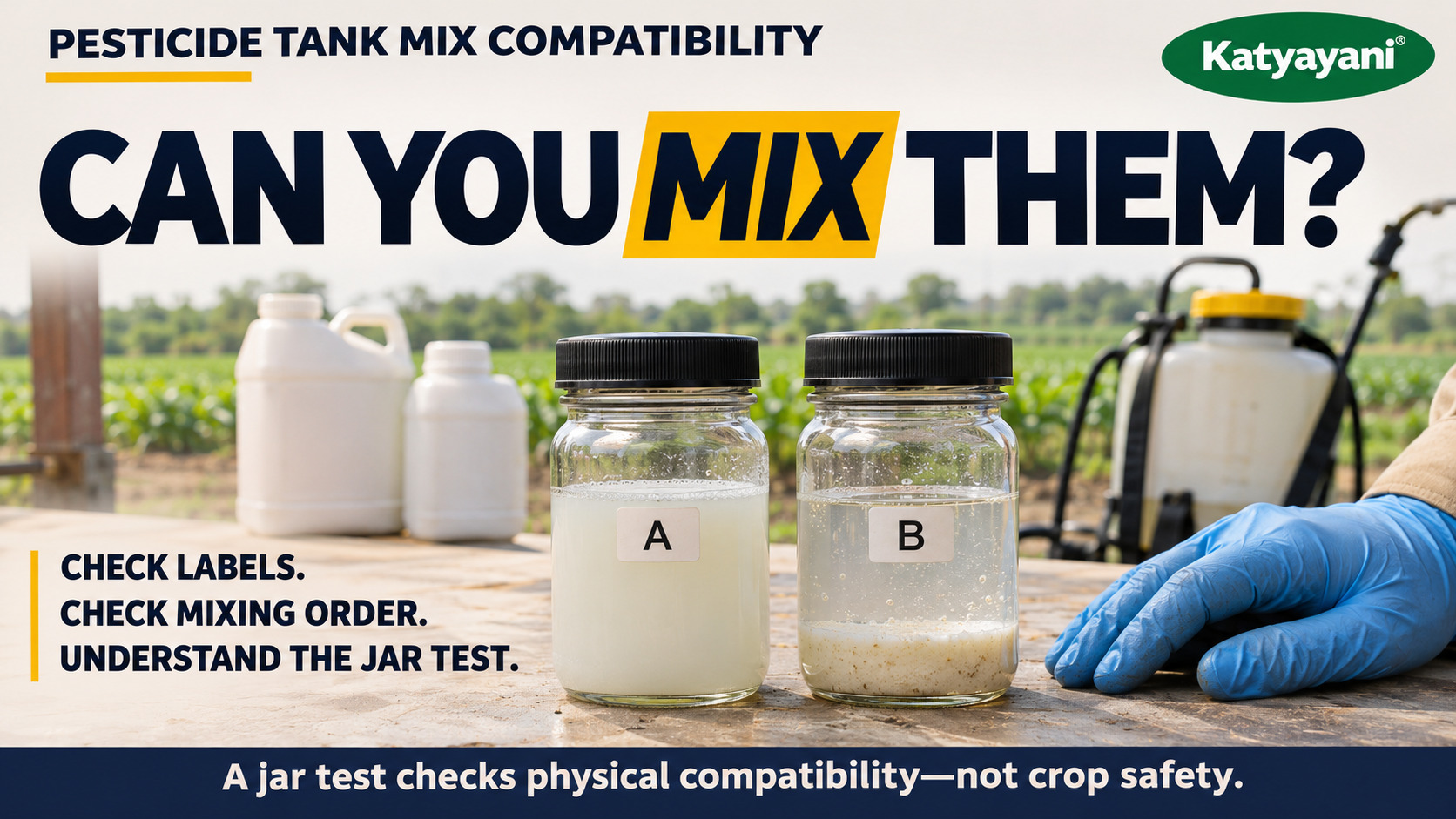
The 2013 TNAU pages are old, but the logic is simple: a chemical fungicide can kill the living bacteria you just paid for. If you must use a fungicide on the crop, keep a gap and follow the label of both products. Our guide on pesticide tank-mix compatibility explains jar tests and the order of mixing for chemical products, and our post on fungicide application methods shows how seed, soil and spray routes differ.
One more rule from common sense and the label: do not mix a living product with a strong chemical in the same tank and leave it standing. Mix only what you will use. For a gardener-level view of bio-agents such as Trichoderma, read Trichoderma and Beauveria for gardeners.
When should you apply Pseudomonas fluorescens, and how do you judge the result?
Apply it early. The list times its doses before or at planting: seed before sowing, nursery and soil before transplanting, soil 30 days after planting in paddy, a root dip at transplanting, a drench 15 days after transplanting in tomato, and paddy sprays from 40 to 45 days after transplanting at 10 to 12 day gaps.
| Stage | What the list prints | Crop and product |
|---|---|---|
| Before sowing | Seed coating, shade dry, sow | All seed treatment rows |
| Nursery | Nursery bed at 50 g per square metre | Tomato, brinjal (IIHR-PF-2) |
| At transplanting | Seedling root dip; FYM-enriched soil dose before transplanting | Paddy, tomato, brinjal |
| 30 days after planting | Soil dose of 2.5 kg per ha with 50 kg FYM | Paddy (1.5% WP) |
| 15 days after transplanting | Drench at 2,500 ml per ha | Tomato (1.5% AS) |
| 40 to 45 days after transplanting | Spray, 2 to 3 times at 10 to 12 days gap | Paddy (2.0% AS) |
Source: CIB&RC list. To judge the result, compare two things in your own field: a plot treated as per the label and a small plot left untreated if you can spare it, with the same variety, same sowing date and same water. Walk both plots every week and count wilted or spotted plants. Disease can vary from field to field, so one season is a weak test.
What research can show, as one example only: ICAR-NBAIR's Annual Report 2025 (March 2026) says that a liquid of Pseudomonas fluorescens NBAIR-PFDWD (1 x 10^8 cfu per ml) used as seed treatment at 10 ml per kg for 12 hours, then soil drench at 5 ml per litre and foliar spray at 5 ml per litre, brought sorghum anthracnose incidence down from 59 to 12 percent (NBAIR Annual Report 2025). That is a research result on sorghum, not a label recommendation.
Do not judge by leaf colour in the first week. Bacteria do not give a fast "burn down" like a chemical. Judge by how many new plants fall sick over the next three to five weeks compared with the plot you expected to lose.
What mistakes do farmers make with Pseudomonas fluorescens?
The common mistakes are copying the dose of one product onto another, mixing it with a chemical fungicide, using it late on a diseased crop, drying treated seed in the sun, using fresh unrotted manure, and keeping an opened pack for months. Each of these can be avoided by reading the pack and the official list.
| Mistake | Why it hurts | Better practice |
|---|---|---|
| Using the 5 g per kg dose on a product that says 20 g per kg | The strength and strain differ, so the number of living cells per seed changes | Use the dose for your exact product |
| Applying with a chemical fungicide on the same seed or in the same tank | TNAU pages say biocontrol agents and fungicides are incompatible | Choose one route; keep a gap; read both labels |
| Waiting until the field has wilting patches | The bacteria work best before the disease is established | Treat seed, nursery or soil early |
| Drying treated seed in direct sun | The list says to dry seed in shade | Shade-dry and sow |
| Using fresh, hot manure to carry the product | Practice sheets assume well-rotted FYM | Use well-rotted FYM |
| Using the product on a crop or disease not on its label | No registered dose | Pick a registered crop-disease pair |
| Keeping an opened pack for the next season | Living bacteria lose number with time and heat | Buy for the current crop; note the open date |
| Expecting a miracle | It is a preventive tool; results differ between fields and seasons | Use it with clean seed, drainage and crop rotation |
Add the basics that no product replaces. Use clean seed, avoid waterlogging, remove diseased plants, rotate crops, and follow the crop guide. For paddy and vegetables with several diseases, our bio vs chemical inputs post lays out where a living product fits and where a chemical is still the better tool.
How do you check that a Pseudomonas fluorescens pack is genuine and registered?
Read the label for the product name, strength and form (for example 1.0% WP), the strain or CFU count, batch number, manufacture and expiry dates, the maker's name and the registration details. Buy from a licensed dealer, keep the bill, and compare the label dose with the official list entry for that strength.
- Find the strength and form on the pack (for example 1.0% WP or 2.0% AS).
- Open the CIB&RC bio-fungicide list on the PPQS website and find the entry with that strength.
- Check that your crop and disease are printed under that entry.
- Compare the dose on your pack with the dose on the list. If they differ a lot, ask the dealer which entry the pack follows.
- Check the manufacture and expiry dates. The ICAR strains list a shelf life of 10 to 12 months.
- Keep the bill and the batch number.
Our guides on how to read a pesticide label and how to identify fake pesticides and fertilisers explain the label checks and the complaint steps.
Katyayani lists two Pseudomonas fluorescens bio-fungicide pages. The powder page, Pseudomonas fluorescens bio-fungicide powder, names wheat, tomato, paddy, groundnut, chilli, cotton, brinjal, carrot and okra, the same nine crops that appear on the CIB&RC list above. The liquid page, Pseudomonas fluorescens liquid bio-fungicide, names the same crops with disease names. Both pages carry their own dose lines. This post does not repeat them, because they are not copied from a single CIB&RC row. Follow the pack label for the pack you hold.
Where to get the official table: the CIB&RC "Major Uses of Pesticides" documents are posted on the PPQS website as separate PDFs for insecticides, fungicides, herbicides, plant growth regulators and bio-pesticides (PPQS page). The version used here is the one marked "updated upto 30.09.2026". Check for a newer version when you read this.
What is new or changed for Pseudomonas fluorescens in 2025 and 2026?
Comparing the CIB&RC bio-fungicide list updated upto 31.03.2024 with the one updated upto 30.09.2026, one new Pseudomonas entry appears: Pseudomonas fluorescens 1.5% AS (AMMFA-TH1 strain, MCC 0580) for tomato wilt. The other seven entries are the same as in 2024. Official dates between those two lists were not opened.
| Point | List updated upto 31.03.2024 | List updated upto 30.09.2026 |
|---|---|---|
| Pseudomonas fluorescens entries | 1.75% WP, 2.0% AS, 0.5% WP, 1.5% WP, 1.0% WP (IPL/PS-01), 1.0% WP (IIHR-PF-2), 1.5% LF | The same seven plus 1.5% AS (AMMFA-TH1, MCC 0580) |
| New entry details | Not on the 2024 list | Tomato wilt (Fusarium oxysporum f.sp. lycopersici); seedling dip at transplanting and drench 15 days after transplanting at 2,500 ml per ha; CFU 1 x 10^8 per mL minimum |
| Other changes in doses of the seven older entries | Not found in the comparison of the Pseudomonas text | Not found in the comparison of the Pseudomonas text |
Sources: CIB&RC list, 31.03.2024 and CIB&RC list, 30.09.2026. The comparison was done on the text of both PDFs. The PPQS page that holds the lists was itself last updated on 17 November 2026 (PPQS page), and the lists on it are all dated 30.09.2026.
Other dated items. ICAR-NBAIR's Annual Report 2025 (published March 2026) reports a field test of a Pseudomonas fluorescens NBAIR-PFDWD liquid on sorghum anthracnose (59 to 12 percent) and, in a trial against maize fall armyworm during 2025-26, a P. fluorescens liquid at 10 ml per litre gave a 63.33 percent drop in infestation, while a four-microbe mix gave up to 75 percent (NBAIR Annual Report 2025). These are research results from trials. They are not label uses and the CIB&RC list does not show Pseudomonas for fall armyworm.
What did not change, as far as the opened pages show: the TNAU pages are old (the red gram page says updated on 10.06.2013) and the ICAR booklet is from July 2021. The latest official data available on seed, soil and foliar doses for Pseudomonas fluorescens is the CIB&RC list of 30.09.2026, and for field research the ICAR-NBAIR report of March 2026.
Conclusion
Pseudomonas fluorescens is a living bio-fungicide. The CIB&RC list updated upto 30.09.2026 shows eight entries for wheat, tomato, paddy, groundnut, chilli seedlings, cotton, brinjal, carrot and okra, with seed doses of 4.5 ml to 20 g per kg, soil doses of 1 to 5 kg per hectare and spray doses printed for wheat, tomato and paddy. Use the dose for your exact product, apply early, keep it away from chemical fungicides, store it with its expiry date in mind, and check the registration on the pack.


Leave a Comment