 11 min read
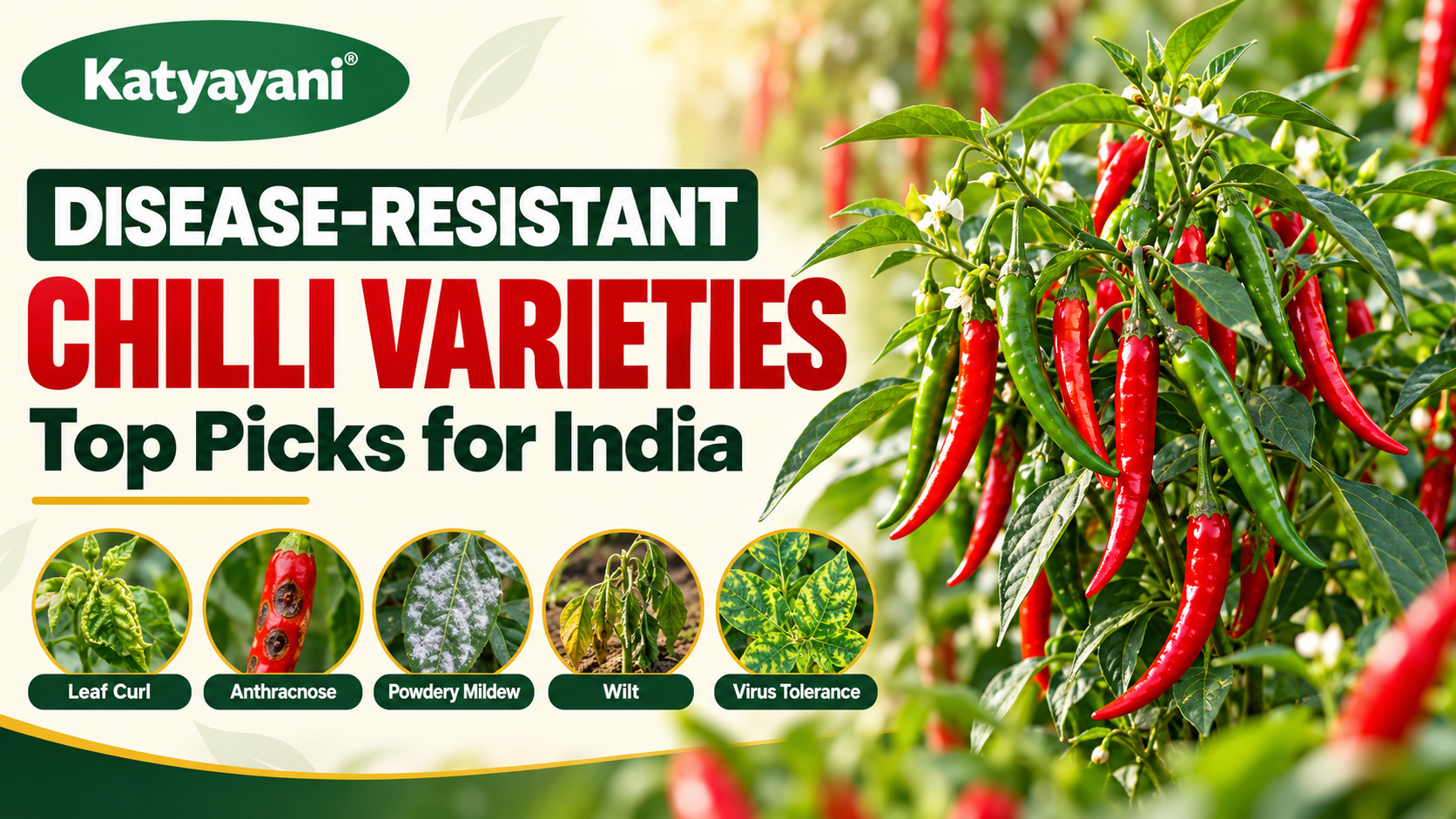
There is no chilli that is fully immune to every disease. What farmers can buy are varieties rated tolerant or moderately resistant to one or two problems. For leaf curl, ICAR-IIHR lists Arka Yashasvi, Arka Gagan and Arka Tanvi, IIVR lists Kashi Garima and Kashi Ratna, and PAU lists Punjab Sindhuri and Punjab Tej. For powdery mildew, look at Arka Harita and Arka Suphal. For bacterial wilt, Kerala's Ujwala and Anugraha. Match the variety to your state and your main disease.
Which chilli varieties are disease resistant in India?
The honest answer is that the public varieties are mostly tolerant, not immune. Breeders at ICAR institutes and state universities test a variety against a disease and report how much damage it shows. "Tolerant" means the plant still gets the disease but loses less yield. "Moderately resistant" is similar. Only a few releases claim plain "resistant", and even those are for one disease.
The table below collects what the institutes themselves printed. Yield is shown the way the source gave it: quintal per acre (q/acre) or quintal per hectare (q/ha). One acre is about 0.4 hectare, so do not compare the two columns directly. Where a page did not state crop duration, the table says so instead of guessing.
| Variety / hybrid | Source and type | Disease rating (source wording) | Yield (source wording) | Duration | Where recommended |
|---|---|---|---|---|---|
| Arka Yashasvi (H 8) | ICAR-IIHR F1 hybrid | Tolerant to chilli leaf curl virus (the page title says resistant, the body says tolerant) | 30-35 q dry chilli per acre | Not stated | Eastern dry zone of Karnataka |
| Arka Gagan | ICAR-IIHR F1 hybrid | Tolerant to chilli leaf curl virus | 80-100 q green chilli per acre | Not stated | Eastern dry zone of Karnataka; suited to green chilli market |
| Arka Tanvi | ICAR-IIHR F1 hybrid | Tolerant to chilli leaf curl virus | 80-100 q green and 30-35 q dry per acre | Not stated | Eastern dry zone of Karnataka |
| Arka Meghana | ICAR-IIHR F1 hybrid | Tolerant to chilli veinal mottle virus | 80-100 q green and 20-25 q dry per acre | Not stated | Page says "major chilli growing states", no state named |
| Arka Sweta | ICAR-IIHR F1 hybrid | One page: tolerant to cucumber mosaic virus. An older page: field tolerant to viruses | One page: 80-100 q green and 20-25 q dry per acre. Older page: 28-30 t/ha fresh, 4.5 t/ha dry | Not stated | Older page: recommended for release nationally (2005) and notification for the entire country (2007) |
| Arka Harita | ICAR-IIHR F1 hybrid | Tolerant to powdery mildew and viruses | 35-38 t/ha fresh, 5-5.5 t/ha dry | Not stated | Karnataka (release recommended March 2007, gazette 16 March 2012) |
| Arka Suphal | ICAR-IIHR open-pollinated variety | Tolerant to powdery mildew and viruses | About 25 t/ha green, 3 t/ha dry | Not stated | Irrigated and rainfed; recommended for national release in 2002 |
| Arka Neelanchal Prabha | ICAR-IIHR | Moderately tolerant to anthracnose | 10-12 q dry chilli per acre | Not stated | Odisha |
| Kashi Garima | ICAR-IIVR hybrid, notified 2024 | Tolerant to ChiLCV, thrips and mites | 200-225 q/ha green | First picking 50 days after transplanting | Uttar Pradesh |
| Kashi Ratna | ICAR-IIVR hybrid, 2019 | Moderately tolerant to ChiLCV under field conditions | 200-230 q/ha green | Not stated | Uttar Pradesh |
| Kashi Sinduri | ICAR-IIVR paprika type (non-pungent), 2012 | Moderately resistant to anthracnose | 200-225 q/ha | Not stated | Karnataka, Kerala, Puducherry, Tamil Nadu |
| Kashi Gaurav | ICAR-IIVR open-pollinated, 2012 | Thrips and mites (no disease named) | 100 q/ha | 50% flowering 35-40 days after transplanting | West Bengal, Assam |
| Punjab Sindhuri | PAU Ludhiana open-pollinated | Moderately resistant to leaf curl virus, dieback and root-knot nematodes; tolerant to aphids, thrips, yellow mites | 76 q/acre red ripe fruit | First picking of red fruit after 75 days | Punjab |
| Punjab Tej | PAU Ludhiana open-pollinated | Moderately resistant to leaf curl virus, dieback and root-knot nematodes; tolerant to aphids, thrips, yellow mites | 56 q/acre red ripe fruit | First picking of red fruit after 75 days | Punjab; highly pungent, suited to powder making |
| CH-27 | PAU hybrid, seed licensed to Harilal Seeds (per The Tribune, Oct 2024) | PAU breeder says multiple resistances to leaf curl virus, fruit rot and root-knot nematodes | Described as high-yielding; no figure given | Not stated | Described as widely adaptable across the country |
| Ujwala | Kerala Agricultural University | Bacterial wilt resistant; resistant to mosaic and leaf roller | Listed as high yielding, no figure | Not stated | Kerala |
| Anugraha | Kerala Agricultural University | Bacterial wilt resistant | 27 t/ha average | Early maturing, no days given | Kerala |
| Manjari | Kerala Agricultural University | Bacterial wilt resistant | Not stated | Not stated | Kerala |
Read The Table Like This: The Arka hybrids are F1 hybrids, so seed is bought fresh every season. Punjab Sindhuri and Punjab Tej are open-pollinated, and PAU says farmers can save their own seed. Pick a hybrid only if the yield gain pays for the seed cost in your area.
Which chilli varieties are resistant to leaf curl virus?
Leaf curl is the disease most farmers ask about. Leaves roll upward, plants stay short and fruit set drops. The virus is carried by whitefly, so even a good variety needs whitefly watch.
| Variety | Rating | Best for |
|---|---|---|
| Arka Yashasvi, Arka Gagan, Arka Tanvi | Tolerant (IIHR) | Karnataka eastern dry zone. Gagan for green chilli, Yashasvi for dry, Tanvi for both |
| Kashi Garima | Tolerant to ChiLCV (IIVR) | Uttar Pradesh, green chilli, early first picking |
| Kashi Ratna | Moderately tolerant (IIVR) | Uttar Pradesh, higher green yield figure |
| Punjab Sindhuri, Punjab Tej | Moderately resistant (PAU) | Punjab, open-pollinated, seed can be saved |
| CH-27 | Multiple resistance claimed by the PAU breeder | Wide adaptability claimed; ask for the PAU or licensee data sheet |
One more caution. The Tribune report on CH-27 quotes the PAU breeder, not a trial table. Treat it as a lead and ask the seed seller for the release notice.
Which chilli variety is tolerant to powdery mildew?
IIHR lists two. Arka Suphal is an open-pollinated variety, tolerant to powdery mildew and viruses, with green, smooth, medium-long fruit that hang down and turn deep red. It is suitable for irrigated and rainfed fields. Arka Harita is the hybrid option, also tolerant to powdery mildew and viruses, and gives the higher yield figure on the IIHR page (35-38 t/ha fresh).
Powdery mildew shows up as white powder on the underside of leaves in dry, warm weather with cool nights. If your field has a history of it, choose from these two before anything else.
Which chilli varieties handle mosaic and other viruses?
- Arka Sweta: one IIHR page says tolerant to cucumber mosaic virus; an older IIHR page says field tolerant to viruses. The two pages also give different yield figures, so ask for the latest release data.
- Arka Meghana: IIHR says tolerant to chilli veinal mottle virus. Fruits are 8-10 cm, dark green turning red, medium pungent.
- Arka Harita and Arka Suphal: tolerant to viruses (not named) and powdery mildew.
- Ujwala (Kerala): resistant to mosaic according to the KAU page.
Is there an anthracnose resistant chilli variety?
Not a fully resistant one on the pages I read. Two releases carry a moderate rating. Kashi Sinduri (IIVR) is a paprika type, which means non-pungent and grown for colour, so it will not suit a normal hot-chilli market. Arka Neelanchal Prabha (IIHR) is moderately tolerant to anthracnose and recommended for Odisha, for both green and red chilli, with a yield of 10-12 q dry chilli per acre.
Anthracnose (fruit rot, die-back) is worst in hot, humid, rainy weather and on ripe red fruit. If you grow in a high-rainfall area, a moderate rating alone is not enough. Seed health and spacing matter more than most farmers think; our post on seed treatment to prevent wilt explains the idea for another crop.
Which chilli varieties resist wilt?
The only wilt rating I could read on an institute page is bacterial wilt, from Kerala Agricultural University: Ujwala, Anugraha and Manjari are listed as bacterial wilt resistant. Anugraha is also listed as early maturing with an average yield of 27 t/ha. Ujwala is also listed as resistant to mosaic and leaf roller.
I did not find a fetched institute page listing a variety as resistant to Fusarium wilt. A common compilation names Phule Jyoti as wilt tolerant, but I could not read an official MPKV page, so it is not in the table. Ask your KVK before relying on it.
Which chilli variety is best for my state?
Recommendation is tied to where the trials were done. Seed from a variety that was never tested in your climate is a gamble, even if the disease rating looks good.
| State or region | Varieties from the pages read | Main disease addressed |
|---|---|---|
| Karnataka (eastern dry zone) | Arka Yashasvi, Arka Gagan, Arka Tanvi | Leaf curl |
| Karnataka (general) | Arka Harita; Kashi Sinduri (paprika) | Powdery mildew and virus; anthracnose |
| Odisha | Arka Neelanchal Prabha | Anthracnose (moderate) |
| Uttar Pradesh | Kashi Garima, Kashi Ratna | Leaf curl, thrips and mites |
| Punjab | Punjab Sindhuri, Punjab Tej; CH-27 per PAU | Leaf curl, dieback, root-knot nematode |
| Kerala | Ujwala, Anugraha, Manjari | Bacterial wilt |
| West Bengal, Assam | Kashi Gaurav | Thrips and mites (no disease rating) |
| Tamil Nadu | Kashi Sinduri (IIVR) is recommended for the state. TNAU's own chilli list names CO 1, CO 2, CO 4, PKM 1, PMK 1, PLR 1 and others but gives no disease rating on that page | Check TNAU description pages |
| Rest of India (Andhra Pradesh, Telangana, Madhya Pradesh, Maharashtra, Gujarat and others) | No state-specific disease-rated variety found on the pages I read | Ask your KVK or state university |
If your state is in the last row, that is a gap in what I could verify, not proof that nothing exists. State agricultural universities in Guntur, Rahuri and elsewhere have their own releases that I did not find on a readable page.
Should I buy a private-company hybrid?
Many farmers grow private hybrids, and some of them are good. This post does not list any by name because I did not read a company or official page for them, and the BigHaat list I used only as a reference gives company-stated ratings. A simple rule helps. Ask the seller for three things in writing: the exact disease and the word used (tolerant or resistant), the state or zone where it was tested, and the seed lot number printed on the pack. If the seller cannot show the first two, treat the claim as marketing.
How do I choose between tolerant varieties?
- Name your worst disease. If leaf curl wiped out last year's crop, start there. If it was fruit rot, look at the anthracnose rows.
- Check the state column. Prefer the variety tested in your zone.
- Check the market. Fresh green chilli, dry red or powder making need different fruit. Punjab Tej is highly pungent and suited to powder; Kashi Sinduri is non-pungent paprika.
- Compare yields in the same unit. Convert q/acre and q/ha before comparing.
- Look at crop duration. Several pages do not state it, so ask the seed company or KVK for the days to first picking.
- Buy sealed seed with a bill, and keep the pack label for the lot number.
- Plan for a backup. Even a tolerant variety needs scouting and clean nursery practice. For a home or terrace chilli, see our guide to growing chillies in pots from seed.
What does a "resistant" rating actually protect you from?
A rating is from a trial where scientists either infect plants on purpose or leave them in a field with high disease. The result is a score for that year, that place and that virus or fungus strain. If a new strain arrives or the weather changes, the score can change. Cotton leaf curl in North India is a hard example, where earlier tolerant varieties became susceptible once a new strain spread, and our cotton post covers that case. Chilli leaf curl is also a virus complex, so a variety that does well in one state can disappoint in another.
So use the variety as the first layer. The next layers are a healthy nursery, whitefly and thrips control, balanced fertiliser, field hygiene and crop rotation. Crop rotation examples and plans help break soil-borne disease. Plant protection steps are covered in the separate chilli disease management guide, so they are not repeated here. When you are ready to plan inputs, the chilli crop products collection lists Katyayani combos arranged by crop stage.
Chilli seed buying checklist before you pay
- Variety or hybrid name matches what you asked for, spelled the same on the pack.
- Pack has a lot number, test date, germination percentage and expiry.
- You have the bill with seller name.
- The seller can name the zone where the variety was tested.
- For hybrids, you understand you cannot save seed from this crop.
- Nursery bed is ready and seed treatment is planned before sowing.
Conclusion
Disease resistant chilli is mostly a matter of picking a tolerant variety that was tested in your state. For leaf curl look at Arka Yashasvi, Arka Gagan, Arka Tanvi, Kashi Garima, Kashi Ratna, Punjab Sindhuri and Punjab Tej. For powdery mildew look at Arka Harita and Arka Suphal, and for bacterial wilt at Ujwala and Anugraha in Kerala. Read the rating word carefully, ask for the release data, and treat the variety as the first layer of protection, not the only one.
Why trust this guide
Written by Team Katyayani, Editorial Team at Katyayani Organics. Cross-checked against published research and university extension programs.

Leave a Comment