 11 min read
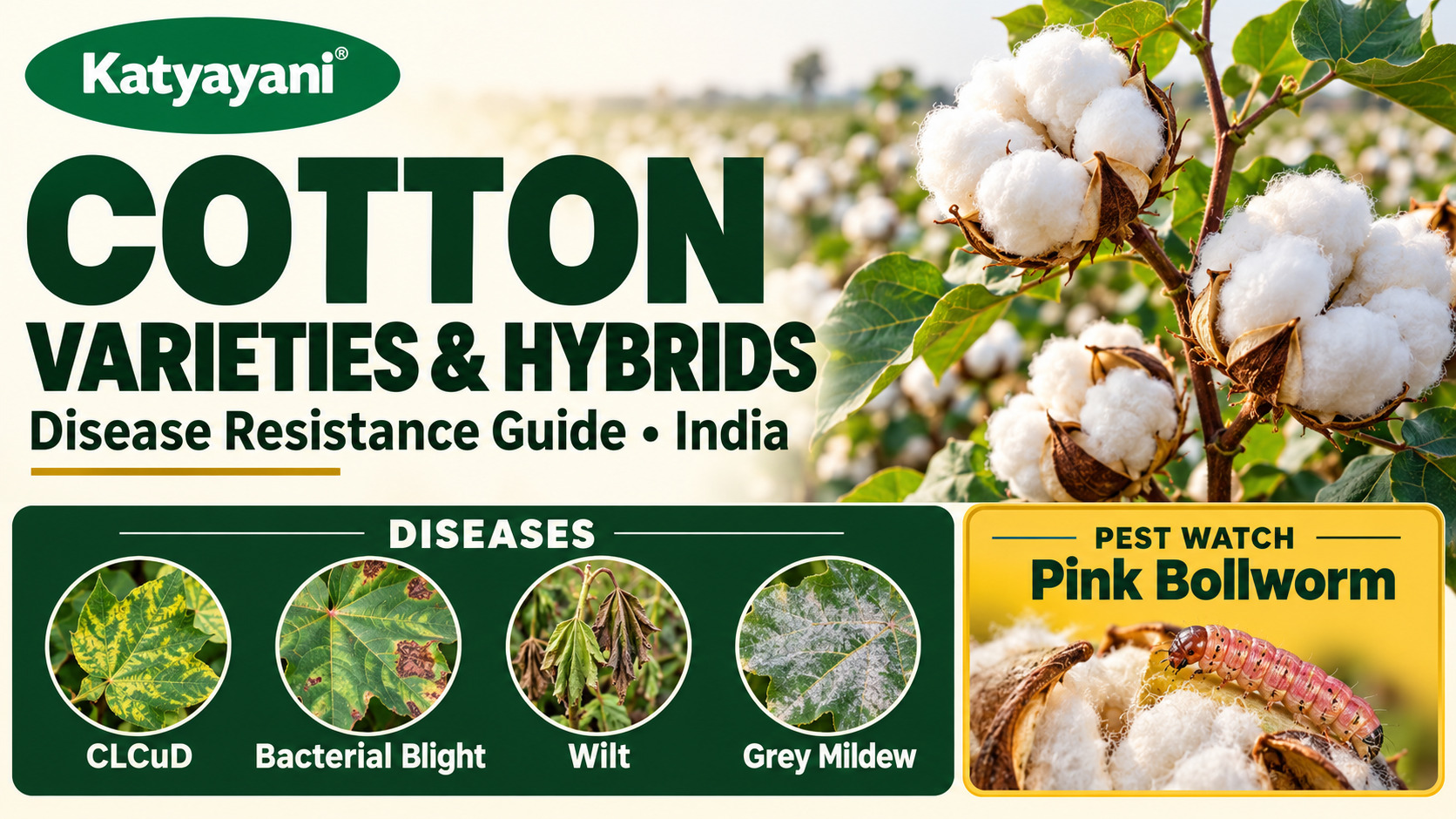
No cotton hybrid sold in India is rated fully resistant to cotton leaf curl disease (CLCuD). Desi cotton (Gossypium arboreum) is the exception: ICAR-CICR says desi varieties are immune to CLCuD and tolerant to whitefly. For bacterial blight, grey mildew and root rot, TNAU lists the CICR variety Suraksha as resistant. Only GEAC-approved Bt cotton is legal, so buy sealed Bt seed with a bill, choose short to medium duration, and sow on time.
Which cotton varieties and hybrids are disease resistant in India?
The short answer: a few, for specific diseases, and none for everything. Cotton farmers deal with a mix of diseases, and the same plant may handle one well and fail on another. So a variety rated resistant to bacterial blight may still get leaf curl. This is why zone matters more than brand.
The table below lists what the Indian institutes printed. It does not include private company hybrids because I could not read a company or official page for them. The CICR variety list gives species, year and zone but no disease column, so disease words are shown only where a second source gave them.
| Variety or group | Species and type | Disease statement (source wording) | Zone or state | Source |
|---|---|---|---|---|
| Desi varieties and hybrids (all) | G. arboreum | Tolerant to whitefly and immune to cotton leaf curl disease | All; central for North India | ICAR-CICR advisory 2024-25 |
| Suraksha (CCH-15-1, CICR-H Cotton 36), 2021 | G. hirsutum, non-Bt variety; listed with the CICR non-Bt releases | Resistant to bacterial leaf blight, grey mildew, root rot and tobacco streak virus; tolerant to jassids, whitefly, thrips, aphids | Central and South zones per CICR list; TNAU page says winter, rainfed, 165 days, 1,600 kg/ha average | TNAU and CICR list |
| PA 740 | G. arboreum desi, long staple | Tolerant to bacterial blight, Alternaria leaf spot and sucking pests | Marathwada, Maharashtra, rainfed | Journal of Pharmacognosy and Phytochemistry, 2020 (VNMKV Parbhani authors) |
| CICR Bt 6 (RS 2013), 2020 | G. hirsutum Bt variety | No disease rating in the list | Haryana, Punjab | CICR list |
| ICAR-CICR GJHV 374 Bt, PKV 081 Bt, Rajat Bt, Suraj Bt, CICR 16 Bt | G. hirsutum Bt varieties, 2020-2021 | No disease rating in the list | Maharashtra | CICR list |
| CICR 23 Bt, CICR Bt 21, Yugank Bt, Tejas Bt, Namami Bt, ICAR-CICR 18 Bt, 20-31 Bt | G. hirsutum Bt varieties, 2020-2024 | No disease rating in the list | Central Zone | CICR list |
| ICAR-CICR Bt 25, Bt 14 (CPT 2), Samrat Bt | G. hirsutum Bt varieties, 2021-2022 | No disease rating in the list | South Zone | CICR list |
What The Table Does Not Say: The CICR list is a list of public-sector releases. It does not prove disease resistance, and it says nothing about private hybrids, which hold most of the Bt seed market. Treat any resistance claim on a seed packet as a company claim until you see a trial result for your zone.
Which cotton variety is resistant to leaf curl virus (CLCuD)?
None in the hirsutum (American) group is rated fully resistant today. The best evidence points the other way. Punjab Agricultural University said in August 2024 that CLCuD is the most severe disease of American cotton in Punjab, Haryana and Rajasthan, and quoted a yield loss of about 40 percent in India. It also said new virus strains have made earlier tolerant varieties susceptible, including Bt hybrids. PAU is working on resistant lines, using genes from a wild cotton species, but those are breeding lines, not seed on a shop shelf.
What can farmers do now? ICAR-CICR gives three points for North India:
- Grow desi cotton (Gossypium arboreum) on part of the farm. CICR says desi varieties and hybrids are tolerant to whitefly and immune to CLCuD.
- For American cotton, grow a genotype approved by the SAU, ICAR or the state agriculture department, and sow on time: up to 15 May for hirsutum hybrids and varieties, and up to 30 April for desi. A timely sown crop tolerates whitefly and CLCuD better.
- Keep 8,000 to 10,000 plants per acre for hirsutum hybrids. Avoid too much urea in the early vegetative stage.
There is no honest way to name one "best" hirsutum hybrid for leaf curl country. If a seller does, ask for a university trial table that includes your district and the last two years.
Desi cotton vs hirsutum Bt cotton: what is the difference for disease?
| Point | Desi (G. arboreum) | American hirsutum (Bt hybrids and varieties) |
|---|---|---|
| CLCuD | Immune, per CICR advisory | Tolerant at best; PAU says earlier tolerance has broken down |
| Whitefly | Tolerant, per CICR | Susceptible; needs vector control |
| Bollworm | The desi releases in the CICR list are in the non-Bt table; no Bt trait is shown for them | Bt trait gives protection against bollworms, but pink bollworm has become a problem in some areas |
| Sowing window (North India, CICR) | Up to 30 April | Up to 15 May |
| Fibre example | PA 740 mean fibre length 27.86 mm, described by the authors as long staple | Suraksha fibre length 32.4 mm (TNAU) |
| Examples from CICR list | CICR 1 (CISA 310), CICR 3 (CISA 614), CNA 1003, CNA 1028, CNA 1032, CNA 1054, CNA 1031, CNA 1091, CNA 17522, CNA 1092 | Suraksha, CICR Bt 6 and the Bt varieties above |
Several states are pushing desi cotton for this reason. Punjab, for example, announced in April 2026 a 33 percent subsidy on certified Bt cotton hybrids and desi cotton seed varieties recommended by PAU. The report did not name the varieties or give the full terms, so check with the Punjab agriculture department before you plan around it.
Which cotton variety is resistant to bacterial blight and grey mildew?
Two names have a source behind them. Suraksha is the first. TNAU's variety page lists it as resistant to bacterial leaf blight, grey mildew, root rot and tobacco streak virus, and tolerant to jassids, whitefly, thrips and aphids. The CICR variety list shows Suraksha released in 2021 as a G. hirsutum variety for the Central and South zones, from the Coimbatore centre. The TNAU page does not mention leaf curl, so do not assume it handles CLCuD.
The second is the desi PA 740. A 2020 paper by VNMKV Parbhani authors describes it as a long staple desi variety for rainfed Marathwada, tolerant to bacterial blight, Alternaria leaf spot and sucking pests. The paper does not rate grey mildew. Seed cotton yield was reported 21.41 percent above the check PA 402 in trials.
CICR also holds laboratory material. Its registered genetic stock list shows several G. arboreum lines described as immune to grey mildew (Ramularia areola), such as G-135-49 and 30805, and one hirsutum line, CNH-123, described as resistant to cotton leaf curl virus. These are breeding stocks used to make new varieties, not seed you can buy.
Which cotton varieties are resistant to Fusarium wilt and Verticillium wilt?
I could not find a fetched institute page that names an Indian variety resistant to Fusarium or Verticillium wilt. TNAU's cotton disease page lists both diseases, with Fusarium wilt shown as yellowing and wilting, and Verticillium wilt as a tiger-stripe pattern, but names no resistant variety on that page. The BigHaat page I used as a reference lists bacterial blight, grey mildew and leaf curl ratings, not wilt.
If wilt is your worry, the plain steps still help: do not plant cotton back into a field that had wilt, rotate with a cereal, and ask your KVK which varieties were tested in your district. Our guide to crop rotation examples and plans explains how to break the disease cycle.
Is pink bollworm a variety problem or a timing problem?
Mostly timing. The ICAR-CICR advisory for 2024-25 lists these steps for pink bollworm: rotate crops; buy authentic Bt hybrids and keep the bill; sow short to medium duration seed on time; avoid pre-season sowing; follow recommended spacing; do not over-apply urea; start pheromone trap monitoring at 45 days after sowing at 5 traps per hectare; and do not extend the crop beyond 180 days.
| Pink bollworm checkpoint (CICR 2024-25) | Number or rule |
|---|---|
| Pheromone traps for monitoring | 5 per hectare, from 45 days after sowing |
| Damaged flowers (rosette flowers) action level | 10 percent at flowering |
| Damaged green bolls action level | 10 percent, found by dissecting 20 green bolls per acre |
| Moth catch action level | 8 moths per trap for 3 consecutive days |
| Pyrethroids | Strictly avoid before 120 days after sowing, and avoid insecticide mixtures |
| Crop duration | Do not extend beyond 180 days |
| Stalks | Clean up residue; stack away from the field and use before March |
For monitoring in the field, Katyayani sells a Helicoverpa armigera lure. That one targets American bollworm, not pink bollworm, so check the label for the pest your trap is meant for.
Neem oil also appears in the CICR advice: two sprays at the initial stage up to 60 days after sowing, using neem seed kernel extract plus neem oil, as part of the pink bollworm and sucking pest plan. You can read about the types in our post on biopesticides and how they work.
Is Bt cotton the only legal GM cotton in India? What about HTBt?
Yes. In a written Lok Sabha reply reported in July 2021, the Union agriculture minister said Bt cotton is the only GM crop approved by the Genetic Engineering Appraisal Committee (GEAC) for commercial cultivation, and that herbicide tolerant (HT) cotton is not approved by GEAC. He added that the ministry had advised states to control the sale, production and storage of HT cotton. A July 2022 report quotes the Union government that GEAC clearance is mandatory for environmental release of GM crops.
In plain terms: only Bt cotton hybrids and varieties cleared by GEAC are legal. Do not buy or sow HTBt or any seed sold without a proper bill and brand. CICR's own advisory says to procure seed of authentic Bt hybrids or varieties and retain the bill. This post makes no claim for HTBt seed.
What is the official price of Bt cotton seed?
The Union agriculture ministry fixes a maximum sale price each year under the Cotton Seeds Price (Control) Order. For 2025-26, a notification dated 28 March 2025 set Rs 901 for BG-II and Rs 635 for BG-I, per 475 gram packet that includes 5 to 10 percent non-Bt refuge seed. Do not pay more than the printed maximum price. Keep the bill and the packet.
For 2026-27, a gazette notice dated 23 April 2026 (S.O. 2071(E)) exists according to a search result, but the PDF would not open here, so I could not read the amount. Trade reports from March 2026 expected prices to stay unchanged. Please read the figure from the gazette before printing a number in the blog. Until then, the post should say "check the maximum price printed on the packet".
Which cotton variety or hybrid for which zone?
| Zone and states | Main disease worry | What the sources support |
|---|---|---|
| North zone: Punjab, Haryana, Rajasthan | CLCuD and whitefly | Desi varieties (immune to CLCuD per CICR). Sow by 15 May (hirsutum) or 30 April (desi). CICR Bt 6 (RS 2013) is a CICR Bt variety listed for Haryana and Punjab. Hybrids: ask PAU or CCS HAU for the current recommended list |
| Central zone: Maharashtra, Gujarat, Madhya Pradesh | Pink bollworm, bacterial blight, sucking pests | Suraksha (Central and South zones, TNAU/CICR). CICR Bt varieties listed for Maharashtra and Central Zone. Desi PA 740 for rainfed Marathwada |
| South zone: Karnataka, Tamil Nadu, Andhra Pradesh, Telangana | Tobacco streak virus (necrosis), bacterial blight, grey mildew | Suraksha. CICR advises monitoring for tobacco streak virus 40 to 75 days after sowing and controlling thrips and Parthenium weed. CICR Bt 25, Bt 14, Samrat Bt listed for South Zone |
This table shows what I could source. State university lists (Gujarat, Karnataka, Telangana, Andhra) change every year and were not readable, so confirm with your KVK.
How do I pick a cotton seed in practice?
- Choose the zone first. Disease patterns differ between North, Central and South.
- Pick duration. CICR asks for short to medium duration Bt seed, and says not to run the crop beyond 180 days.
- Check legality. Brand name, GEAC-approved Bt seed, printed price, lot number, bill.
- Ask for the trial. Who tested the hybrid, in which district, and what was the leaf curl or blight score.
- Plan the refuge. The pack contains 5 to 10 percent non-Bt seed. Plant it, do not discard it.
- Sow in the window and plan crop-stage inputs. The cotton combos collection arranges Katyayani products by spray stage; confirm every dose on the product page before use.
- Scout every week from 45 days after sowing for traps, flowers and bolls.
Conclusion
Disease resistant cotton exists in parts, not in full. Desi cotton is the one group CICR calls immune to leaf curl, Suraksha has a TNAU rating for bacterial blight and grey mildew, and Bt cotton handles bollworms but not leaf curl. Only GEAC-approved Bt seed is legal, and the price is capped each year. Choose by zone, sow in the recommended window, keep the bill, and ask your KVK for the current district list.
Why trust this guide
Written by Team Katyayani, Editorial Team at Katyayani Organics. Cross-checked against published research and university extension programs.

Leave a Comment