
 13 min read
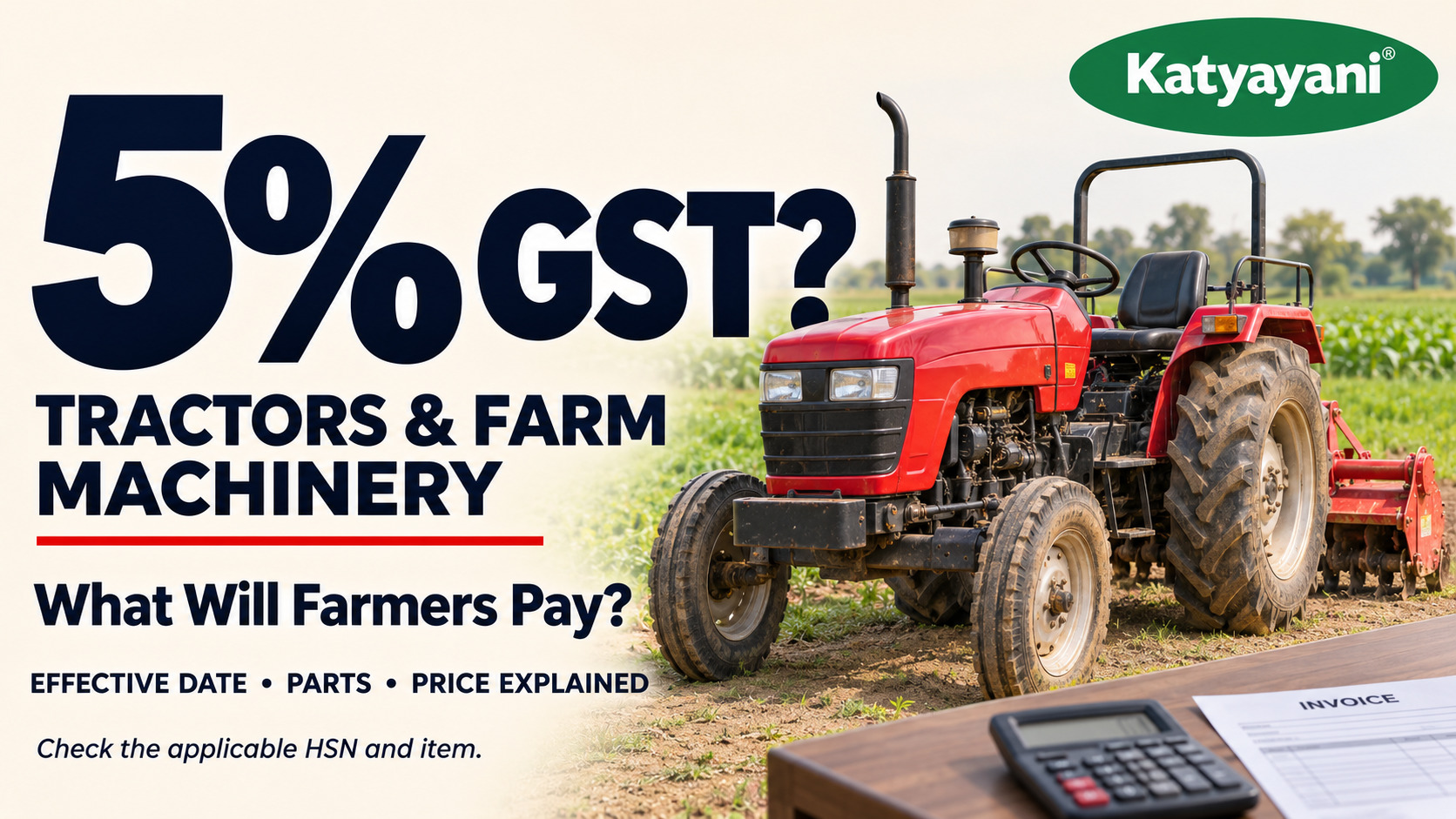
GST on tractors is 5% from 22 September 2025, down from 12%. The GST Council decided it on 3 September 2025 at its 56th meeting. The 5% covers tractors of heading 8701 except road tractors for semi-trailers with an engine above 1800 cc, which are at 18% (down from 28%). Farm machinery for soil work, harvesting, threshing, baling, mowing and composting, plus sprinklers and drip systems, also moved from 12% to 5%. Tractor tyres, tubes and listed tractor parts moved from 18% to 5%. It is 5% and not nil because a nil rate would block the maker from claiming credit on inputs.
What is the GST rate on tractors in India now?
The GST rate on tractors is 5%. It was 12% before 22 September 2025. The cut covers tractors under tariff heading 8701 except road tractors for semi-trailers with an engine above 1800 cc. On a tax invoice inside one state, the 5% shows as 2.5% central tax and 2.5% state tax.
The official wording of the entry is "Tractors (except road tractors for semi-trailers of engine capacity more than 1800 cc)". It sits in the 5% list of the rate notification. The GST Council release puts it under the group "Reduction of GST from 12% to 5% on agricultural goods".
The PIB release on the 56th Council meeting names tractors in its list of agricultural goods. The PIB factsheet on GST reforms in agriculture repeats it and says lower GST on tractors and farm equipment will make mechanisation more affordable for farmers.
| Item | Rate now | Earlier rate | Where it is stated |
|---|---|---|---|
| Tractors (heading 8701), except road tractors above 1800 cc | 5% | 12% | Council release and Annexure II, agriculture sector |
| Road tractors for semi-trailers, engine above 1800 cc | 18% | 28% | PIB FAQ, question 32 |
When did the GST cut on tractors start, and who decided it?
The GST Council decided it at its 56th meeting on 3 September 2025, in New Delhi. The new rates on goods, including tractors, took effect on 22 September 2025. The Council had first said the cut needed to apply from that date for all goods except tobacco items.
The Council release states the date plainly: the changes in GST rates of all goods, except pan masala, gutkha, cigarettes, chewing tobacco products, unmanufactured tobacco and bidi, take effect from 22nd September 2025. The PIB FAQ says the same in its first answer and adds that the rate notification would be placed on the CBIC website.
The rate notification is No. 9/2025-Central Tax (Rate), dated 17 September 2025. The PIB note of 4 September 2025 sums it up in one line: farm machinery and irrigation equipment cut from 12% to 5%. A companion notification, No. 12/2025-Central Tax (Rate) of the same date, refers to it and says it comes into force on 22 September 2025. States issued their own matching notifications. The Maharashtra copy is dated 17 September 2025 and lists the tractor entry under the 2.5% state-tax schedule, which is the state half of the 5%.
| Step | Date | What happened |
|---|---|---|
| GST Council, 56th meeting | 3 September 2025 | Rates on tractors, farm machinery and parts cut |
| PIB FAQ and factsheets | 3 to 12 September 2025 | Government explained the changes |
| Rate notification issued | 17 September 2025 | Notification No. 9/2025-Central Tax (Rate); states issued matching ones |
| New rates in force | 22 September 2025 | Applies to supplies on or after this date |
Which tractors get 5% GST, and which do not?
Every tractor under heading 8701 gets 5%, with one exception. Road tractors built to pull semi-trailers, with an engine above 1800 cc, stay in the 18% slab. These are heavy haulage units, not farm tractors. The PIB FAQ says the 18% for them is down from 28%.
The PIB FAQ puts it this way: tractors, other than road tractors for semi-trailers of engine capacity more than 1800 cc, attract 5%; road tractors for semi-trailers above 1800 cc attract 18%, reduced from 28%. The Ministry of Road Transport release describes the cut as "Tractors (<1800 cc) 12% to 5%". That is a short label. The notification wording above is the one to follow, because it names the exception exactly.
For a farmer this changes little. A field tractor of the usual horsepower bands is under heading 8701 and sits in the 5% slab. The exception matters only to transport operators who buy road tractors for semi-trailers.
The Ministry of Road Transport release of 12 September 2025 lists tractors in its table of vehicle cuts, beside buses and trucks, and says the tractor cut strengthens the country's position as a global tractor hub and boosts farm mechanisation.
How much cheaper can a tractor get? A worked example in rupees
The cut is on the tax, not on the maker's price. If the price before tax stays the same, 5% instead of 12% saves 7% of that price. On a made-up base price of Rs 8,00,000, tax falls from Rs 96,000 to Rs 40,000, a saving of Rs 56,000. The invoice total falls by 6.25%.
The numbers below are arithmetic on an imaginary base price, not a quote from any company. They show how the tax part of an invoice changes. They do not say what a dealer charges today, because the official notes give no price after the cut.
| Base price before tax (made-up) | Tax at 12% | Tax at 5% | Tax saved | Total at 12% | Total at 5% |
|---|---|---|---|---|---|
| Rs 5,00,000 | Rs 60,000 | Rs 25,000 | Rs 35,000 | Rs 5,60,000 | Rs 5,25,000 |
| Rs 8,00,000 | Rs 96,000 | Rs 40,000 | Rs 56,000 | Rs 8,96,000 | Rs 8,40,000 |
| Rs 12,00,000 | Rs 1,44,000 | Rs 60,000 | Rs 84,000 | Rs 13,44,000 | Rs 12,60,000 |
The shortcut: new total divided by old total is 1.05 divided by 1.12, which is 0.9375. So the invoice total is 6.25% lower when the base price does not move. If a company raises its base price at the same time, the saving is smaller, and the arithmetic above shows how to work it out for any quote.
What are the GST rates on farm machinery and implements?
The Council moved a block of farm machinery from 12% to 5%: machinery for soil preparation or cultivation, harvesting or threshing machinery, straw and fodder balers, grass and hay mowers, other agricultural, horticultural, forestry, poultry-keeping and bee-keeping machinery, composting machines, sprinklers, drip systems and mechanical sprayers.
The PIB FAQ, question 20, says these goods "earlier attracted 12% GST" and are now at 5%. The entries are by tariff heading in the Council's Annexure II, agriculture sector.
| Tariff heading | Description in the Council annexure | Old rate | New rate |
|---|---|---|---|
| 8432 | Agricultural, horticultural or forestry machinery for soil preparation or cultivation; lawn or sports-ground rollers; parts | 12% | 5% |
| 8433 | Harvesting or threshing machinery, including straw or fodder balers; grass or hay mowers; parts thereof | 12% | 5% |
| 8436 | Other agricultural, horticultural, forestry, poultry-keeping or bee-keeping machinery, including germination plant fitted with mechanical or thermal equipment; poultry incubators and brooders; parts thereof | 12% | 5% |
| 8424 | Sprinklers; drip irrigation system including laterals; mechanical sprayers | 12% | 5% |
| 8424 | Nozzles for drip irrigation equipment or nozzles for sprinklers | 12% | 5% |
| 8414 20 20 | Other hand pumps | 12% | 5% |
| 8408 | Fixed speed diesel engines of power not exceeding 15 HP | 12% | 5% |
| 8716 | Composting machines (listed with the agriculture sector entries) | 12% | 5% |
Two reading tips. First, the annexure says "parts" for several headings, so spare parts of these machines follow the machine. Second, the Council annexure does not name individual brands or models. Your invoice carries a tariff heading (HSN), and that heading is the thing to match against this table.
Which tractor parts and tyres moved from 18% to 5%?
A separate list of tractor parts moved from 18% to 5%: rear tractor tyres and tubes, tyres for tractors, tubes for tractor tyres, agricultural diesel engines above 250 cc for tractors, hydraulic pumps for tractors, and listed parts such as wheel rims, gear boxes, brakes, clutch assemblies and radiators.
The reason this list matters: the same notification set a uniform 18% on other auto parts. The Council release says "uniform rate of 18% on all auto parts irrespective of their HS code". Tractor parts are carved out of that rule and given 5%. Heading 8708 itself reads "parts and accessories of the motor vehicles... [other than specified parts of tractors]".
| Tariff heading | Tractor part or tyre in the Council annexure | Old rate | New rate |
|---|---|---|---|
| 4011 | Rear tractor tyres and rear tractor tyre tubes | 18% | 5% |
| 4011 70 00 | Tyre for tractors | 18% | 5% |
| 4013 90 49 | Tube for tractor tyres | 18% | 5% |
| 8408 20 20 | Agricultural diesel engine of cylinder capacity exceeding 250 cc for tractor | 18% | 5% |
| 8413 81 90 | Hydraulic pumps for tractors | 18% | 5% |
| 8708 | Rear tractor wheel rim, tractor centre housing, housing transmission, support front axle | 18% | 5% |
| 8708 10 10 | Bumpers and parts thereof for tractors | 18% | 5% |
| 8708 30 00 | Brakes assembly and its parts for tractors | 18% | 5% |
| 8708 40 00 | Gear boxes and parts thereof for tractors | 18% | 5% |
| 8708 50 00 | Transaxles and its parts for tractors | 18% | 5% |
| 8708 70 00 | Road wheels and parts and accessories for tractors | 18% | 5% |
| 8708 (radiator) | Radiator assembly for tractors and parts; cooling system for tractor engine and parts | 18% | 5% |
| 8708 92 00 | Silencer assembly for tractors and parts | 18% | 5% |
| 8708 93 00 | Clutch assembly and its parts for tractors | 18% | 5% |
The annexure continues with steering wheels, hydraulic parts, and fender, hood, grill, side panel and fuel tank parts for tractors, all in the same 18% to 5% group. The table above is not every row, but every row shown is from the Council annexure. The PIB factsheet gives the same summary: tractor tyres and tubes, hydraulic pumps for tractors and many other components move from 18% to 5%.
One thing the list does not do: it does not cover every part you might buy for a tractor. A part that is not named, or that is a general auto part with no tractor-specific description, falls under the general 18% rule for auto parts. The words in the invoice description and the tariff heading decide it.
What about tractor trailers, engines, pumps and hand tools?
Self-loading or self-unloading trailers for agricultural purposes (heading 8716 20 00) are in the agriculture group moving from 12% to 5%. So are hand-propelled vehicles such as hand carts and rickshaws, and animal-drawn vehicles (8716 80), plus hand pumps and diesel engines up to 15 HP.
The Council annexure lists "Self-loading or self-unloading trailers for agricultural purposes" and "Hand propelled vehicles (e.g. hand carts, rickshaws and the like); animal drawn vehicles" in the same 12% to 5% agriculture block as tractors. The Maharashtra notification repeats the trailer entry in its 2.5% schedule.
A common search is "GST on tractor trolley". The documents opened name the self-loading or self-unloading agricultural trailer entry. They do not use the word "trolley", so this post does not say that every trolley of every design is in that entry. It gives the official wording, and the heading on the trolley invoice is the match to check.
Heavy road tractors are the opposite case. The PIB FAQ says road tractors for semi-trailers above 1800 cc attract 18%. If your purchase is a farm tractor, you can read the 5% rows. If it is a haulage unit for a semi-trailer, the 18% row applies.
Why is GST on tractors 5% and not zero?
The Council chose a low rate over a nil rate on purpose. The PIB FAQ explains that when a good is taxed at nil, the maker cannot claim input tax credit on raw materials and must reverse it. That raises the maker's cost, which eventually passes to the buyer. So 5% protects the farmer better.
Question 37 of the PIB FAQ (the same FAQ is also posted as a PDF on the GST Council site) asks why small agricultural tractors were not fully exempted. The answer: the objective is relief to farmers while not discouraging domestic producers, and fully exempting small tractors would be counterproductive because producers would absorb the cost and pass it on.
Question 21 gives the same reasoning for all farm machinery: "the objective of the rate rationalisation is to maintain balance between users and producers". If the machines were fully exempt, manufacturers and dealers could not claim input tax credit on the GST paid on raw materials, and they would have to reverse credit already taken. The FAQ says this "may in turn be passed on to farmers in the form of higher prices".
There is a side effect, and the FAQ admits it for other goods: when the rate on the finished item falls below the rate on inputs, tax credit can pile up. The FAQ says refund of accumulated credit from an inverted duty structure is available to manufacturers under GST. That is the maker's paperwork, not something the farmer deals with.
Which rate applies if you booked, paid or took delivery around 22 September 2025?
The rate follows the time of supply. The PIB FAQ says GST is levied on supply, so goods supplied on or after the revised rate date carry the new rate. For advances and late invoices, section 14 of the CGST Act decides, using the date of payment or invoice, whichever the law makes the time of supply.
In the PIB FAQ, question 11 answers the stock question: GST is levied on supply, so on goods supplied on or after the date the revised rates apply, the new rate applies on the outward supply. A dealer holding stock bought at the old rate does not keep charging the old rate to you for a supply made after the change.
Questions 4 and 5 cover the awkward cases. If goods were supplied before the change but the invoice was issued after it, section 14(a)(i) sets the time of supply. If payment came after the change, the time of supply is the date of payment or the date of invoice, whichever is earlier. If payment came before the change, the time of supply is the date of payment. For an advance where the supply is not complete and no invoice is issued, the rate is decided by the time-of-supply rules of section 14.
| Situation | What the PIB FAQ says decides the rate |
|---|---|
| Tractor supplied and invoiced on or after 22 Sept 2025 | New rate (5%) |
| Supplied before the change, invoice issued after, payment received after | Time of supply = date of payment or date of invoice, whichever is earlier |
| Supplied before the change, invoice issued after, payment received before | Time of supply = date of payment |
| Advance received, supply not complete, no invoice | Decided by the time-of-supply rules in section 14 of the CGST Act |
| Dealer holds old stock | Rate depends on the date of supply, not on when the stock was bought |
If you paid a booking amount and got delivery after the new rates started, read the table above against your own receipt dates. The official notes do not publish a single answer for every sale, because the answer depends on those dates.
How does the 5% show on a tractor invoice: CGST, SGST, IGST?
For a sale inside one state, a 5% rate shows as 2.5% central tax (CGST) and 2.5% state tax (SGST). For a sale from another state, it shows as 5% IGST. The PIB FAQ says IGST on goods follows the rates in the rate notification, and the same rule applies to imports.
The Maharashtra notification gives the state half: it fixes 2.5% state tax for the goods in its Schedule I and puts the tractor entry there. The central notification mirrors it with 2.5% central tax. Together that is 5%.
On imports, question 7 of the PIB FAQ says the IGST on imported goods will be the rates in the rate notification, except where IGST has been exempted separately. So an imported farm machine with a heading in the 5% list carries 5% IGST under this rule. Customs duty is a different levy and is not covered by these documents.
| Type of sale | Tax lines on invoice | Total |
|---|---|---|
| Dealer and buyer in the same state | CGST 2.5% + SGST 2.5% | 5% |
| Dealer in another state | IGST 5% | 5% |
| Imported machine under a 5% heading | IGST at the notified rate | 5% under the same rule |
What should you read on a tractor or implement invoice?
Five things: the date of supply, the tariff heading (HSN), the tax split, the description of the item, and the type of tractor. Match the heading to the Council annexure. For a farm tractor it should be 8701 and the tax should add up to 5%. A 12% line on a supply after 22 September 2025 needs an explanation.
- Date: is the supply on or after 22 September 2025? Use the time-of-supply table above if payment and delivery fall on different sides of that date.
- Heading: a tractor should be under 8701. A tillage or cultivation machine should be 8432, a harvester or baler 8433, a sprinkler or drip set 8424.
- Tax split: CGST 2.5% and SGST 2.5%, or IGST 5%.
- Description: it should name the tractor or machine and not a generic "vehicle part".
- Type: confirm it is not a road tractor for semi-trailers above 1800 cc.
For parts and tyres, the description matters even more. The annexure says "for tractors" on most rows. A part billed as a general auto part may carry 18%, because the general auto-part rule is 18%. If a tractor-specific part is billed at 18%, point to the matching annexure row, such as "Gear boxes and parts thereof for tractors".
The rate notifications themselves are published on the CBIC tax information portal, which is where the entry text for each heading is kept.
Does the GST cut change the tractor subsidy?
The documents opened do not link the two. The subsidy under the Sub-Mission on Agricultural Mechanization is a share of the machine cost: 40% for general beneficiaries and 50% for SC/ST farmers, small and marginal farmers and beneficiaries in North-Eastern states, per the PIB note of 9 July 2026. How tax counts inside that cost is not stated there.
So this post gives no rupee figure for "subsidy plus GST saving". The PIB note on SMAM says the subsidy is paid through the Direct Benefit Transfer system. It also says small and marginal farmers receive Rs 2,000 per hectare for mechanised services, including drones, through custom hiring centres, SHGs and FPOs. The Agricultural Mechanization DBT portal is the official place where applications are handled.
For rates by state, caps by horsepower band, and the application route, use the live tractor subsidy guide. For the wider list of schemes, see the agriculture subsidy schemes guide. The GST cut and the subsidy are separate things: one lowers the tax on the invoice, the other pays part of the cost back after purchase.
How does the GST cut help custom hiring centres, FPOs and shared machinery?
A lower rate lowers the project cost of a custom hiring centre or farm machinery bank, because the machines in them are on the 5% list. The PIB note on SMAM gives the support levels: 40% for centres up to a project size of Rs 250 lakh, and 80% for farm machinery banks up to Rs 30 lakh.
The PIB SMAM note says the scheme has supported 27,554 custom hiring centres, 646 hi-tech hubs and 25,608 farm machinery banks between 2014-15 and 2025-26, with central assistance of Rs 9,404.47 crore for 21.61 lakh machines to individual farmers. Funding is shared between Centre and States, mostly 60:40, and 90:10 for North-Eastern and Himalayan states.
The PIB factsheet adds that cheaper tractors let even marginal farmers use machinery through ownership or shared use in cooperatives and FPOs. If you are weighing an FPO route, the live posts on the FPO credit guarantee scheme and the bulk buying guide for FPOs cover the money and the invoice side.
For crop-residue machines, the live post on parali management and the CRM subsidy explains the Happy Seeder and Super Seeder. Those fall under the machinery headings, so the 5% rule above is the tax that applies to them as listed in heading 8432 for soil preparation and cultivation machinery.
Are drip systems, sprinklers, sprayers and solar devices cheaper too?
Yes. Sprinklers, drip irrigation systems including laterals, mechanical sprayers and nozzles for drip and sprinklers moved from 12% to 5%. The PIB factsheet also lists solar power based devices at 5%, down from 12%, and says cheaper solar devices reduce irrigation costs.
The PIB factsheet ties the cut to water saving: it says the cuts encourage adoption of water-saving irrigation, drip and sprinklers. In the Council annexure, "mechanical sprayers" sit in the same heading 8424 entry as sprinklers and drip systems. If you are choosing a sprayer, the live post on how to choose an agricultural sprayer covers the types and what to check.
Solar pumps have their own subsidy route. The live PM-KUSUM solar pump guide covers the central share and the application steps. The GST on the pump is a separate matter from that subsidy, and the factsheet speaks only of "solar power based devices" in general.
A state-level note: the live post on the Tamil Nadu micro irrigation subsidy says the state absorbs 12% GST on approved drip and sprinkler systems. That figure dates from before 22 September 2025. The rate for drip and sprinkler goods in the Council annexure is now 5%.
Which other farm inputs got a GST cut on the same day?
The same notification cut three fertiliser raw materials from 18% to 5%: sulphuric acid, nitric acid and ammonia. It also cut 12 named bio-pesticides, gibberellic acid and FCO-registered micronutrients from 12% to 5%. Chemical pesticides are not in that list.
Two of those input groups are sold on this site: microbial and other bio-pesticides, and plant growth regulators, which include gibberellic acid products.
| Input | Old rate | New rate | Where it is stated |
|---|---|---|---|
| Sulphuric acid (2807), nitric acid (2808), ammonia (2814) | 18% | 5% | Council Annexure II, fertiliser sector |
| Gibberellic acid | 12% | 5% | Council Annexure II, fertiliser sector |
| 12 listed bio-pesticides (Bt strains, Trichoderma viride, T. harzianum, Pseudomonas fluorescens, Beauveria bassiana, NPV of Helicoverpa armigera and Spodoptera litura, neem based pesticides, Cymbopogon, Bacillus sphaericus) | 12% | 5% | Council Annexure II, heading 3808 |
| Micronutrients under serial 1(g), Schedule 1, Part A of the Fertilizer Control Order 1985, from FCO-registered makers | 12% | 5% | Council Annexure II; PIB factsheet |
| Sprinklers, drip systems, mechanical sprayers, tractors, harvesting and threshing machinery | 12% | 5% | Council Annexure II, agriculture sector |
| Tractor tyres, tubes and listed tractor parts | 18% | 5% | Council Annexure II |
The PIB factsheet says the bio-pesticide cut promotes eco-friendly farming by making bio-based inputs more affordable, and that the fertiliser raw-material cut corrects an inverted duty structure. For what these bio-inputs are and how they work, read the live post on biopesticides: types, examples and advantages.
Has anything changed since September 2025?
In the documents opened, nothing after 22 September 2025 touches the tractor, machinery or parts entries. Notification 19/2025-Central Tax (Rate) of 31 December 2025, effective 1 February 2026, amended the same schedules but dealt only with tobacco entries and the removal of the 14% schedule. Later amendments were not opened.
The text of that 31 December 2025 notification inserts an entry for biris in the 9% schedule, adds pan masala and tobacco items to the 20% schedule, and omits Schedule VII at 14%. A search of its text for "tractor", "8432", "8433" and "8701" finds nothing.
The Council release also kept the old rates for pan masala, gutkha, cigarettes, chewing tobacco, unmanufactured tobacco and bidi until the compensation cess loan is cleared. That has no bearing on tractors, but it explains why these notifications talk about a later date for some goods.
Rate notifications do change from time to time. The CBIC tax information portal is the official place where a new notification would appear. Rates in this post are as stated in the September 2025 documents and the 31 December 2025 amendment.
What mistakes do buyers make when reading GST on farm machinery?
The common ones: expecting the full 7% to show up as a lower sticker price, treating the 5% list as covering every part, forgetting the 1800 cc road tractor exception, and mixing up the GST cut with the subsidy. Each is easy to avoid once you know what the documents say.
| Mistake | What the official text says |
|---|---|
| Expecting the price to fall by exactly 7% | The cut is on tax. The notes do not set prices; the example above shows the arithmetic when the base price is unchanged |
| Assuming every part is 5% | Only listed tractor parts moved to 5%. Other auto parts stay at a uniform 18% |
| Applying 5% to a heavy road tractor | Road tractors for semi-trailers above 1800 cc are at 18% |
| Counting the GST cut as part of the subsidy | Subsidy is a separate share of machine cost paid by DBT |
| Reading the old 12% from an older article | Rate is 5% for supplies from 22 September 2025 |
| Ignoring the date of supply | The FAQ makes the time of supply decide the rate in advance and late-invoice cases |
The mix-up between the GST cut and the subsidy is the most expensive one. A farmer who budgets a "5% tractor plus 50% subsidy" on the whole sticker price may overshoot, because the subsidy is a share of an approved machine cost and is paid after purchase. The tractor subsidy guide walks through the maths.
Drone buyers face the same mistake. The live agri drone subsidy post lists the SMAM rates for drones. The GST rows in this post do not name drones, so the table above does not claim a rate for them.
Conclusion
GST on tractors is 5% for supplies from 22 September 2025, down from 12%, as decided by the GST Council on 3 September 2025. The cut also covers soil-preparation machinery, harvesting and threshing machinery, balers, mowers, composting machines, sprinklers, drip systems and mechanical sprayers, and moves tractor tyres, tubes and listed parts from 18% to 5%. Heavy road tractors above 1800 cc stay at 18%. The rate stays at 5% and not nil so that makers can keep claiming input credit. Match the date of supply and the tariff heading on your invoice against the tables above, and keep the GST cut separate from the subsidy.




Leave a Comment