
 13 min read
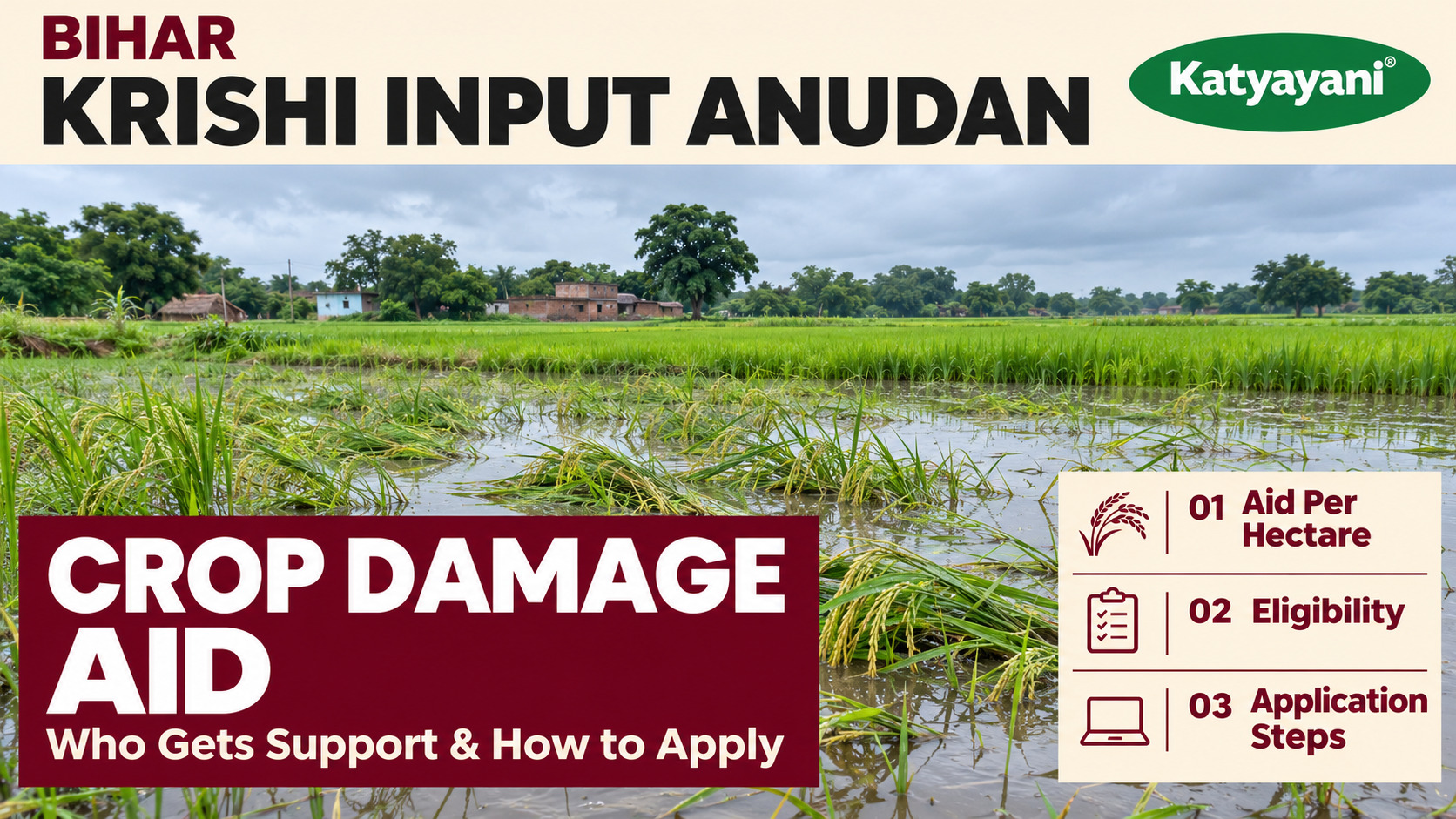
Krishi Input Anudan is a cash aid that the Bihar Agriculture Department pays by DBT to farmers whose crops are damaged by a notified flood, storm, hail or drought. The Kharif 2026 flood instruction (22 Sep 2026) pays Rs 8,500 per hectare for rainfed land, Rs 17,000 for irrigated land and Rs 22,500 for perennial crops, up to 2 hectares per farmer, for crop loss above 33%. You must have a 13-digit DBT registration, live in a notified panchayat, upload land or self-declaration papers, and hold an Aadhaar-linked bank account. Each round has its own dates, so check the portal.
What is Krishi Input Anudan in Bihar?
Krishi Input Anudan is a cash aid the Bihar Agriculture Department pays directly to farmers after a notified natural calamity damages their crops. It follows the state disaster aid rules, and the money goes to the farmer's bank account through Direct Benefit Transfer. It helps a farmer restart sowing. It does not repay the full loss.
The state Agriculture Department runs it on the DBT Agriculture Bihar portal, and the portal home page describes it as aid for flood and drought affected farmers. The CAG audit report on the scheme calls it immediate relief for crop damage from flood or excessive rain, hailstorm, and drought or scanty rain.
The CAG report adds one useful detail. It notes that the state has not notified the aid as a formal scheme; the department uses the name Krishi Input Subsidy Scheme in its records and issues a fresh set of instructions, called an Anudesh, for every calamity. That is why rates, dates and documents are written separately for each round.
If you have not registered on the portal yet, start with the guide to DBT Agriculture Bihar registration and login. This post starts after that step.
When does Bihar pay Krishi Input Anudan: flood, drought, hail or storm?
Bihar pays it only after the state treats an event as a notified calamity and picks the affected districts, blocks and panchayats. The CAG report lists past rounds for drought, floods, hailstorms and a cyclone. A farmer outside the notified list cannot apply for that round, even if the field is damaged.
The CAG report names the eight events it audited between 2018 and 2022: drought in Kharif 2018, floods in Kharif 2019, 2020 and 2021, hailstorms in February, March and April 2020 (three separate rounds), and Cyclone Yaas in May 2021. The 2026 round is a flood round, so the same system now covers flood, storm, hail, drought and cyclone events.
The CAG report describes the flow this way. After a notified calamity, the Agriculture Department assesses the damaged area and the loss, and the affected districts and blocks are identified. The Disaster Management Department releases the money after the State Executive Committee approves it. Then the Agriculture Department issues the Anudesh and invites applications, and the report says it advertises the last date in local newspapers.
The CAG report gives one example of why a notified event can still leave farmers waiting. The Disaster Management Department declared a drought for Kharif 2022 in October 2022, but the audit found that the Agriculture Department had not sent the money proposal by April 2023, so farmers of 7,841 drought-hit villages had not received the aid. So the first thing to do after a flood is not to fill a form. First check whether your panchayat is in the list of the round, and ask the block agriculture office if no round has been announced for your area.
How much does Krishi Input Anudan pay per hectare in 2026?
The Kharif 2026 flood instruction of 22 September 2026 pays Rs 8,500 per hectare for rainfed land, Rs 17,000 for irrigated land and Rs 22,500 for perennial crops. Each farmer gets at least Rs 1,000, Rs 2,000 or Rs 2,500 respectively, and the aid covers at most 2 hectares per farmer.
| Land or crop type | Aid per hectare | Minimum per farmer | Source |
|---|---|---|---|
| Rainfed (unirrigated) crop area | Rs 8,500 | Rs 1,000 | Anudesh, Kharif 2026 |
| Irrigated crop area | Rs 17,000 | Rs 2,000 | Anudesh, Kharif 2026 |
| Perennial or multi-year crops | Rs 22,500 | Rs 2,500 | Anudesh, Kharif 2026 |
| Maximum area per farmer | 2 hectares | - | Anudesh, Kharif 2026 |
The instruction says these rates follow the disaster management norms the state fixed in its Disaster Management Department letter of 31 December 2022. The same three rates appear in the Home Ministry norms for 2022-23 to 2025-26, where the input subsidy applies when crop loss is 33% and above, and only to the sown area.
The amount is worked out from the damaged area you enter, not from the size of the whole farm. The Anudesh says the total is set according to the area with more than 33% crop damage. Because rounds differ, read the rate printed in the instruction for the round you apply under.
Why do some websites show Rs 6,800, Rs 13,500 and Rs 18,000 instead?
Those are older rates. The CAG report shows that the state notified Rs 6,800 (rainfed), Rs 13,500 (irrigated) and Rs 18,000 (perennial) per hectare in May 2015, following a Home Ministry letter of April 2015. The Home Ministry revised the norms on 10 October 2022, and the 2026 Bihar instruction uses the revised amounts.
| Item | Older norms (2015, in CAG report) | Norms in the Kharif 2026 instruction |
|---|---|---|
| Rainfed | Rs 6,800 per hectare | Rs 8,500 per hectare |
| Irrigated | Rs 13,500 per hectare | Rs 17,000 per hectare |
| Perennial | Rs 18,000 per hectare | Rs 22,500 per hectare |
| Minimum per farmer, rainfed | None (CAG: minimum not applicable to rainfed land) | Rs 1,000 |
| Minimum per farmer, irrigated | Rs 1,000 | Rs 2,000 |
| Minimum per farmer, perennial | Rs 2,000 | Rs 2,500 |
The Home Ministry letter of 10 October 2022 says its revised list takes effect from the financial year 2022-23 and supersedes the earlier letters, including the one of 8 April 2015. Its list covers the period 2022-23 to 2025-26, so a later revision can change the figures again. The 2026 Anudesh is the safest guide for the current round.
The takeaway is practical. If a website, a YouTube video or a local agent quotes Rs 13,500 per hectare as the irrigated rate for a 2026 round, they are quoting an outdated number. Ask for the rate in the Anudesh itself.
How much will I actually get? Worked examples in rupees and acres
Multiply the damaged area in hectares by the rate for your land type, then apply the minimum and the 2-hectare cap. One hectare is 247 decimals and one acre is 100 decimals, so an acre is about 0.405 hectare. An irrigated acre with qualifying loss works out to about Rs 6,880 at the 2026 rate.
| Case | Working at 2026 rates | Aid |
|---|---|---|
| 1 hectare irrigated, loss above 33% | 1 x Rs 17,000 | Rs 17,000 |
| 1 acre irrigated (100 decimals) | 100 / 247 = 0.405 ha x Rs 17,000 | About Rs 6,880 |
| 1 acre rainfed | 0.405 ha x Rs 8,500 | About Rs 3,440 |
| 1 acre perennial crop (orchard) | 0.405 ha x Rs 22,500 | About Rs 9,110 |
| 0.05 hectare rainfed (about 12 decimals) | 0.05 x Rs 8,500 = Rs 425, below the minimum | Minimum of Rs 1,000 applies |
| 3 hectares irrigated land damaged | Only 2 hectares count, 2 x Rs 17,000 | Rs 34,000 at most |
These are plain arithmetic on the rates in the instruction. The department checks the area at verification and can reduce it, so the final figure can be lower. The Anudesh keeps the minimum amounts, which is why a very small plot still gets Rs 1,000, Rs 2,000 or Rs 2,500.
The cap in decimals is simple: 2 hectares x 247 decimals = 494 decimals. The print and status page and the application page of the portal both state the limit as 2 hectares (494 decimals).
Who is eligible for Krishi Input Anudan?
You qualify if you farm in a notified panchayat, are registered on the DBT Agriculture portal with a 13-digit number, sowed a crop that lost more than 33% and cannot revive, and have an Aadhaar-linked bank account. The scheme is only for farmers and farmer families, with one claim for one piece of land.
- The panchayat must be in the reported list of districts, blocks and panchayats for that round (Anudesh, point 2.1).
- You must be registered online. A 13-digit registration number is compulsory on the application (points 2.2 and 2.3).
- The crop must actually have been planted, the loss must be above 33% of the crop area, and the crop must not be able to revive (point 4.1 iv).
- The damage must come from the notified event of that round and not from something else.
- The money goes only to a bank account linked with Aadhaar (point 2.4). If your account is not linked, the Anudesh says you will not get the benefit.
- A farmer family means husband, wife and minor children. Only one member of the family gets the aid. Separate families, for example after a split, can apply separately if no one applied for the same land (points 1.4 and 4.1.3).
- If your farmland lies in two districts, the agriculture coordinator of the panchayat where you registered visits the other district for the check (point 4.11).
The instruction has no income or caste condition. The 2-hectare cap is the only land limit it states. For tenants, see the next two sections.
Who counts as "Self", "Actual cultivator" or "Both"?
The portal sorts farmers into three types. "Self" means you own the land and farm it. "Actual cultivator" (vastavik khetihar) means you farm someone else's land. "Self plus Actual cultivator" means both. You can apply under one type only, and only one person gets the aid for one field.
| Farmer type | What you enter on the form | What you upload |
|---|---|---|
| Self (landowner who farms) | Thana number, khata number, khesra number, the area hit by the calamity, and the names of two neighbouring farmers | Land receipt, jamabandi or LPC |
| Actual cultivator (tenant or sharecropper) | The same plot details and the names of two neighbouring farmers | Self-declaration certificate signed by the neighbouring farmers and certified by the agriculture coordinator and an elected representative |
| Self plus Actual cultivator | Plot details for the land you own and for the land you farm for others | Both sets of papers |
For tenants the Anudesh says the agriculture coordinator and an elected representative (ward member, mukhiya or sarpanch) jointly arrange the identification, and that the person who really farms the field gets the aid. The self-declaration format is on the DBT portal and can be downloaded.
The CAG report found a problem here in earlier rounds. It says 5,473 applications from the "Self" category were rejected for an incorrect self-attested declaration even though only actual cultivators needed that declaration. Pick the right category before you upload.
Which documents do you need for Krishi Input Anudan?
Every applicant needs the 13-digit registration number, the registered mobile for the OTP, an Aadhaar-linked bank account and family details. Landowners upload a land document: a land receipt, jamabandi or Land Possession Certificate. Tenants upload a self-declaration certificate. The exact years of land papers can change from round to round.
| Document | Who needs it | Detail from the portal and Anudesh |
|---|---|---|
| 13-digit DBT registration number | Everyone | Compulsory; if you type it right, your registration details and form are displayed |
| Mobile number linked at registration | Everyone | OTP is sent there; without OTP the form is invalid |
| Aadhaar-linked bank account | Everyone | Payment goes only to this account |
| Land receipt, jamabandi or LPC | Landowner who farms (Self) | Kharif 2026 Anudesh point 3.6.1: LPC or land receipt, updated or for 2023-24, 2024-25 and 2025-26; read the page of your round for the years it asks |
| Self-declaration certificate | Actual cultivator (tenant) | Certified by the ward member, mukhiya or sarpanch and the agriculture coordinator; format on the DBT portal |
| Names of two neighbouring farmers | Everyone | Entered with the plot details |
As a dated example, the online application page for the October 2026 storm round, read on 12 November 2026, used different wording from the flood Anudesh. It asked landowners for land documents from 2024-25 onward, or the last three years, or an updated LPC. It said family details must be entered and are verified with Aadhaar, and that lineage (vanshavali) papers are not valid for a landowner, who should apply as an actual cultivator in that case. That is why the page of your own round matters more than any general guide.
The CAG report lists the kinds of document faults it found in approved cases: a name or father or husband name that does not match, papers of an old or irrelevant period, the wrong document uploaded, papers not signed by the prescribed authority, and illegible uploads. Use a clear scan of the latest paper, with your name spelled as in your registration.
To get a land record before the window closes, see the guide to checking land records online state-wise, which points to the Bihar Bhumi portal.
How do you apply for Krishi Input Anudan online, step by step?
Open the DBT Agriculture Bihar portal, choose the Krishi Input Anudan link for the open round, enter your 13-digit registration number, fill the land and damage details, solve the captcha, enter the OTP sent to your registered mobile, upload the land document and press Submit. An SMS then gives you the application number.
- Check that your panchayat is in the list of the round (Anudesh point 2.1). The page of the October 2026 storm round linked its list above the form.
- Go to dbtagriculture.bihar.gov.in. Under the "apply online" menu, open the drop-down item for that calamity (point 3.1).
- Type the 13-digit registration number. If it is right, your registration details and the form show on screen (point 3.2).
- Enter the total land first. The scheme covers 2 hectares at most. Enter the area in decimals (1 acre = 100 decimals, 1 hectare = 247 decimals) (points 3.3 and 3.8).
- Choose your farmer type: Self, Actual cultivator or both. Enter thana, khata and khesra numbers, the damaged area, and two neighbouring farmers (point 3.4).
- After the compulsory details, enter the captcha and click Get OTP. The OTP goes to the registered mobile. Without an OTP the application is invalid (point 3.6).
- Upload the land document (receipt, jamabandi or LPC) or the tenant certificate, then press Submit.
- You get the application number by SMS on the registered mobile. The form then goes to the agriculture coordinator for checking (point 3.6).
- Save or print the form from the "print application" option. You can fetch it again any time with the registration number (points 3.9 and 3.10).
The Anudesh warns that any attempt to bypass the DBT portal in any way is a serious offence and will bring penal legal action (point 3.7). Do not pay anyone to get around the portal.
Can you apply without a smartphone, and does it cost anything?
Yes. The Anudesh lets you apply from your own phone or laptop, free, or at the block agriculture office or e-Kisan Bhawan, also free. You can also use a Common Service Centre, a Vasudha Kendra or any other computer centre. The instruction states no fee amount for those centres, so do not pay an agent for the free routes.
- Own mobile or laptop: free (nishulk in the Anudesh).
- Block agriculture office or e-Kisan Bhawan: free (nishulk in the Anudesh).
- Common Service Centre or Vasudha Kendra: allowed.
- Any other computer centre: allowed, as per your convenience.
The OTP needs your registered mobile with you, even at a centre. Keep it with you. The application page describes the OTP as necessary and confidential, so enter it yourself.
Who checks your application, and how many days does each step take?
The agriculture coordinator checks it first, in 2 to 4 days, with a site visit and a photo of you at the plot. The sub-division agriculture officer then has 1 to 2 days, the District Agriculture Officer 1 to 2 working days, and the additional collector (relief) 1 to 2 days before payment is sent. You get SMS updates.
| Step | Officer | Time in the Anudesh |
|---|---|---|
| 1 | Krishi Samanvayak (agriculture coordinator) at panchayat | 2 to 4 days: check the claim, then accept with a recommendation or reject with a reason |
| 2 | Sub-division agriculture officer | 1 to 2 days |
| 3 | District Agriculture Officer | 1 to 2 working days |
| 4 | Additional Collector (relief) or the officer the DM names | 1 to 2 days, then sent to the department for payment |
| 5 | Bank | Money credited to the Aadhaar-linked account; SMS to you |
At the first step the coordinator checks that your name and farmer type are right, that the land and damaged area are right, that you really sowed the crop, that the loss is above 33%, that the crop cannot revive, and that the damage came from that calamity. For tenants, the coordinator asks the neighbouring farmers. A photo of the applicant at the affected plot is uploaded in the software.
The instruction also sets random re-checks: the block agriculture officer checks at least 7% of cases, the block development officer 5%, the circle officer 5%, the sub-divisional officer 3%, the land reforms deputy collector 3%, the District Magistrate or the officer named 0.2%, the District Agriculture Officer 5% and the divisional joint director 2% of cases in each district. Wrong or double payments are to be recovered, and the officers responsible face action.
How do you check Krishi Input Anudan status and print your application?
Use the print and status page on the DBT Agriculture portal. Enter your 13-digit registration number, choose Application Print or Application Status, pick the season from the drop-down and submit. Acceptance or rejection also reaches you by SMS on the registered mobile. Keep the application number from your first SMS.
The print and status page asks for the registration number (13 digits), an option for Application Print or Application Status, and a season. The Anudesh says that you can get the submitted application any time with the registration number (point 3.10), and that approval details come by SMS (points 3.11 and 4.7).
If you are not sure your registration is active, the registration status page lets you search by registration ID, Aadhaar number or mobile number with a captcha. It is a registration check, not a payment check.
If the status page shows nothing, check that the season you picked in the drop-down matches the round you applied under. For PM-Kisan style status checks, see the separate guide to PM-Kisan installment status.
How and when does the money reach your bank account?
Once the approved transfer order goes to the bank, the amount is credited to the farmer's Aadhaar-linked account and you get an SMS. The Anudesh gives no payment date. The CAG report says the prescribed time from application to payment under DBT was 30 days, and that earlier rounds ran later.
The Anudesh says the payable amount is transferred to the Aadhaar-linked account once the bank has the approved transfer order, and that the farmer is informed by SMS (point 4.9). If your bank account is not linked to Aadhaar, the instruction says you will not get the benefit.
The CAG report is blunt about timing in earlier rounds. It found that no time limit was set for processing at the Department level, and that 14.76 lakh cases took 8 to 489 days there. It also found banks took up to 608 days to pay in 7,27,530 cases (Rs 308.01 crore) after approval, in the 10 test-checked districts. These findings are about 2018 to 2022 rounds, not about 2026. They are a reason to keep your SMS and application number safe.
To make sure the account is ready, ask your bank branch whether Aadhaar is linked for DBT. As a dated example, the application page of the October 2026 storm round asked farmers to check the Aadhaar/NPCI link of the bank account through the UIDAI portal or the branch manager. The guide on PM-Kisan installment status also covers bank seeding and NPCI mapping.
Why do Krishi Input Anudan applications get rejected?
Reasons named in the Anudesh and the CAG report: a panchayat outside the list, loss of 33% or less, no sown crop, a crop that can revive, a wrong declaration for the farmer type, owner and tenant both claiming one plot, Aadhaar errors, and straw burning. The coordinator must give a reason when rejecting.
| Reason | Where it comes from | What to do |
|---|---|---|
| Panchayat not on the list | Anudesh point 2.1 | Check the list before applying; ask the block agriculture office about the next round |
| Loss not above 33%, crop not sown, or crop can revive | Anudesh point 4.1 iv | Apply only for the area that truly lost the crop; keep photos |
| Wrong farmer type or wrong declaration | CAG report (5,473 rejected for an unnecessary declaration) | Landowners who farm should not upload the tenant declaration |
| Both owner and tenant applied for one plot | Anudesh point 4.1.2 | Agree who will apply; only one gets the aid |
| Aadhaar error at registration | CAG report (12,810 rejected for "Error in Aadhaar detail", Rs 15.98 crore) | Fix Aadhaar details at registration before the round opens |
| Burning straw after harvest | Anudesh point 4.1 vii | Do not burn straw; use another method |
The Anudesh says farmers are told of a rejection or recommendation by SMS (point 4.2), and that rejection must carry a reason (point 4.1). Ask the block agriculture office or the District Agriculture Officer for the reason that the coordinator entered.
What did the CAG audit find about earlier rounds, and what does it mean for you?
The CAG audit of 2018 to 2022 rounds in 10 test-checked districts found that applicants claimed Rs 5,524.80 crore but only Rs 1,321.54 crore was paid. Payments of Rs 184.74 crore failed because Aadhaar was not mapped or seeded with the bank account. Paperwork and the bank link decide who gets paid.
| Finding in the CAG report (test-checked districts, disasters of 2018 to 2022) | Number |
|---|---|
| Subsidy claimed by 43,02,613 applicants | Rs 5,524.80 crore |
| Subsidy paid to 28,06,049 applicants (65% of applicants) | Rs 1,321.54 crore (24% of the claim) |
| Applications rejected by coordinators without any reason | 7,18,982 (claims of Rs 901.71 crore) |
| Payments that failed because Aadhaar was not mapped to the bank account | Rs 184.74 crore to 6,04,700 applicants |
| Applications rejected for "Error in Aadhaar detail" | 12,810 (Rs 15.98 crore) |
| Applications uploaded after the last date (portal did not block them; 15.94 lakh of these were paid Rs 815.23 crore in nine districts) | 22.13 lakh |
| Payments made into accounts of persons other than the applicant | 18,412 cases, Rs 6.60 crore |
| Longest bank delay in making payment after approval (2019-20 to 2021-22) | Up to 608 days in 7,27,530 cases (Rs 308.01 crore) |
The report says that at the exit conference in July 2024 the department accepted that Aadhaar authentication was not done at registration in the initial years, although the Anudesh required it. It is a report about past rounds, and the figures are not a 2026 result. But the lessons hold for any farmer: link Aadhaar to the bank, check your Aadhaar details at registration, upload the right paper for your farmer type, and keep your application number.
The CAG report recommends that the department follow the Anudesh rules strictly by building them into the system as checks. If your registration was done years ago, check now that the Aadhaar and bank details on it are correct, not when the next flood comes. For the national Farmer ID, see the guide on AgriStack and the Farmer ID.
What happens if you burn paddy straw after harvest?
The Kharif 2026 Anudesh tells field staff to ask farmers not to burn straw (puaal) in the field after harvest. If a farmer is found burning straw, that farmer loses the benefit and the application is rejected with a clear reason. This rule is in the instruction itself, so plan your straw management in advance.
The point sits in the verification list, where the coordinator is told to warn farmers during the site visit about the loss that straw burning causes. It is a condition tied to the aid, not a general fine. For methods that avoid burning, see the guide on parali management with a decomposer.
How is Krishi Input Anudan different from crop insurance and PM-Kisan?
Krishi Input Anudan is relief paid per hectare after a calamity the state announces, to farmers who apply in the round window. Crop insurance (PMFBY) and PM-Kisan are separate central schemes that the DBT Agriculture Bihar home page lists beside it. Check each scheme on its own rules, and ask the District Agriculture Officer if one loss touches two schemes.
| Scheme | What the official page says | Source |
|---|---|---|
| Krishi Input Anudan | Input subsidy per hectare for crop loss above 33% from the notified event, in reported panchayats, applied for online in the round window, paid to an Aadhaar-linked account | Anudesh, Kharif 2026 |
| PM Fasal Bima Yojana (PMFBY) | Listed under central schemes on the portal as insurance protection against crop loss from natural calamities | DBT Agriculture Bihar home page |
| PM-Kisan | Listed under central schemes on the portal as Rs 6,000 a year paid directly to the farmer's account in three instalments | DBT Agriculture Bihar home page |
The Home Ministry norms carry one direct note on overlap with insurance. They say input subsidy under the 33% and above item will be adjusted to the extent of the insurance claim received under PMFBY for the same calamity. The Bihar Anudesh does not mention insurance, so ask the District Agriculture Officer how this applies to your claim. For insurance steps, read the guides on PM Fasal Bima Yojana, PMFBY rabi registration, frost damage claims and weather-based crop insurance.
For Bihar's state income support, see the guide on Karpoori Thakur Kisan Samman Nidhi. It is a different scheme and does not need a crop loss.
What is the helpline, and where do you complain?
The DBT Agriculture Bihar portal lists the toll-free number 1800-180-1551 and the email agridbtcell2@gmail.com, with contact hours of Monday to Saturday, 9 AM to 5 PM. The same toll-free number is the national Kisan Call Centre, which says it is open 6 AM to 10 PM every day. Start with your block agriculture office.
The Ministry of Agriculture's Kisan Call Centre page says the line works from mobiles and landlines on all networks, with advisers who answer in local languages. The Bihar DBT portal gives its own hours for the same number, so if one time is busy, try the other.
The Anudesh does not describe a separate grievance form for a rejected claim. It does say that the coordinator must reject with a reason, that the District Agriculture Officer is answerable for verification in the district (point 4.6), and that the farmer is told by SMS. The portal pages give agridbtcell2@gmail.com for technical problems. The CAG report found that no online grievance system existed on the portal in the audited period and that 242 offline complaints in six districts had no disposal details on record. So write down your complaint and keep a copy: go to the block agriculture office, then the District Agriculture Officer, then the portal email.
Keep proof for every complaint: the registration number, the application number from the SMS, a screenshot of the status page, and the land paper you uploaded. The sibling guides on Karnataka's Bele Parihara and West Bengal's Krishak Bandhu in this series show how other states handle the same problem; each state's system is different.
For wider scheme options, read the agriculture subsidy schemes guide. It covers central schemes and does not replace the Bihar instruction for this aid.
Conclusion
Krishi Input Anudan is a round-by-round relief aid, not a standing scheme. If your panchayat is on the list for a notified flood, storm, hail or drought round, you can apply on the DBT Agriculture Bihar portal with your 13-digit registration number, your land paper or tenant declaration, an OTP and an Aadhaar-linked bank account. The Kharif 2026 instruction pays Rs 8,500, Rs 17,000 or Rs 22,500 per hectare for loss above 33%, up to 2 hectares. Check the panchayat list first, apply early, keep every SMS, and ask the District Agriculture Officer in writing if a claim is rejected.




Leave a Comment