
 17 min read
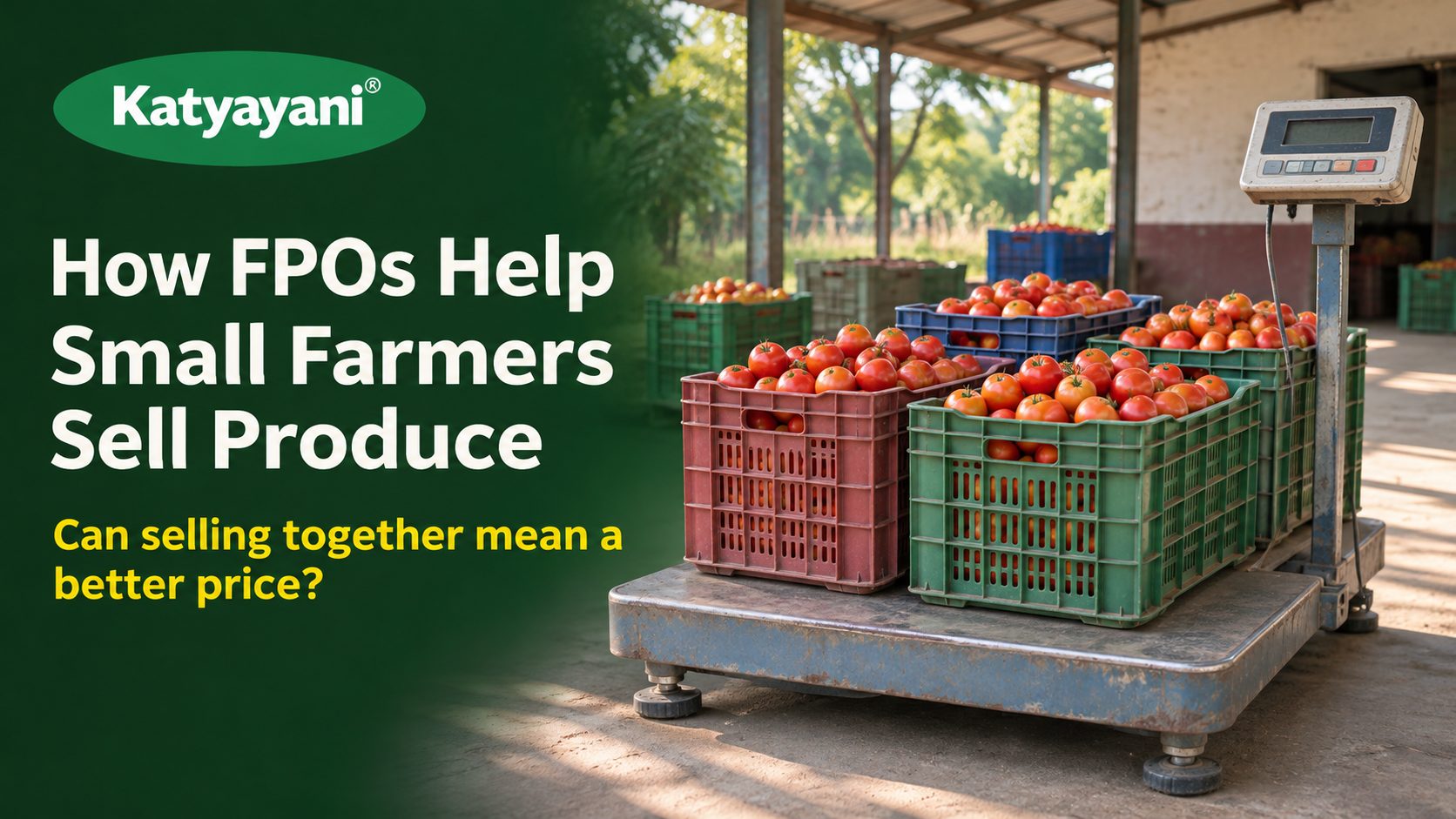
An FPO (farmer producer organisation) is a company or cooperative owned by farmers. It helps small farmers sell by pooling their small lots into one big lot, grading and storing it, and selling to bigger buyers or on e-NAM with better bargaining power. A NABARD paper quoting a PwC study reports about 22% higher price realisation and about 31% lower marketing cost through FPOs. Under the central scheme an FPO needs at least 300 farmer members in plains and 100 in hilly and North-Eastern areas. Join one that keeps clean accounts and sells in more than one way.
What is an FPO and how does it help small farmers sell produce?
An FPO is a farmers' company or cooperative. Small farmers become members, pool their produce and sell it together. A bigger lot gives members more bargaining power with buyers, which NABARD lists as a benefit. The FPO also grades, stores and transports the produce and looks for the best buyer. Members share the benefit.
The Department of Agriculture and Farmers Welfare (DA&FW) defines it in its Operational Guidelines. FPO is a general name for a farmer producers' organisation registered either under Part IXA of the Companies Act or under the Cooperative Societies Act of a State. Its purpose is to use "economies of scale in production and marketing". The Small Farmers' Agribusiness Consortium (SFAC), run under the agriculture ministry, says it has pioneered the formation and growth of such producer companies. See the SFAC site.
Land stays with the farmer. The SFAC brochure says an FPO is a form of aggregation that "leaves land titles with individual producers" and uses collective planning for production, buying and marketing. You do not give your field to anyone. You only sell together.
If you want to know how an FPO differs from a self-help group, read SHG vs FPO for farmers. This guide stays on one question: how does an FPO help you sell?
How do small farmers normally sell their produce, and what goes wrong?
Most small farmers sell a few quintals at a time, often to a local trader or at the nearest mandi. Their lot is small, so they have little say on price. They also pay for transport, loading and waiting. NABARD says this low marketable surplus pushes farmers to depend on intermediaries.
The NABARD paper PLP 2021-22 gives the background. Small and marginal farmers hold about 86% of the total land holdings (2015-16 data, as the paper uses). They cultivate about 47% of the land. NABARD says small marketable surplus, lack of quality inputs and poor credit and market facilities make them depend on "exploitative intermediaries and local money-lenders", and this cuts the farmer's share in the consumer's price.
| Problem for a small farmer | Why it happens | How an FPO can help |
|---|---|---|
| Small lot, weak price talk | Only a few quintals to sell | Pools lots and sells as one big lot |
| High cost per quintal | Own transport and loading for small quantity | Bulk transport shared by members |
| Forced sale at harvest | No storage, need for cash | Common storage and a place to wait for a better rate |
| No grading | Mixed quality lot | Cleaning, sorting and grading before sale |
| Few buyers | Only the local trader comes | Contact with bigger buyers, processors and e-NAM |
An FPO helps only when it is run well. Later sections show what to check.
How does collective selling work step by step?
Collective selling follows a simple order. Members bring produce to a collection point. The FPO cleans, sorts and grades it, stores it, finds a buyer, sells the pooled lot and pays each member by the quantity and grade supplied. The DA&FW guidelines list these services as the core work of an FPO.
The DA&FW guidelines list the services an FPO may provide. Among them: aggregation of smaller lots of members' produce, value addition like cleaning, assaying, sorting, grading and packing, storage and transport, market information, and marketing the aggregated produce "with better negotiation strength to the buyers".
- Members grow the same or similar crop in a cluster. The scheme builds an FPO around one produce cluster.
- The FPO tells members the date, place and quality needed for delivery.
- Members bring the produce. The FPO weighs it and records each member's quantity.
- The FPO cleans, sorts, grades and packs it. Farm-level processing is possible where the FPO has a unit.
- The FPO stores it in a common store or a warehouse if the market rate is low.
- The FPO finds a buyer: a bulk buyer, a processor, a retailer or an online platform like e-NAM.
- The sale is made as one lot or in several lots. Payment comes to the FPO account.
- The FPO pays each member by quantity and grade, after meeting agreed costs. Members get a statement.
For example, if ten members each carry 2 quintals to the mandi on separate days, that is ten trips. With an FPO, one vehicle can carry the 20 quintals in one trip. NABARD lists bulk transport among the benefits of aggregation.
How much more price and how much less cost can an FPO give?
A study by PwC, quoted by NABARD in its 2021-22 national paper, found that selling through FPOs raised price realisation to members by around 22%. It also found the cost of marketing was approximately 31% lower than in other marketing channels. These are approximate figures, not a promise for every FPO.
| Finding quoted by NABARD (PLP 2021-22) | Figure |
|---|---|
| Increase in price realisation to members when selling through FPOs | About 22% |
| Cost of marketing compared with other channels | About 31% lower |
| Producer organisations holding a licence to market inputs | More than 82% |
| Members who bought inputs from their FPO | 28% |
| Net saving on inputs for those members | Rs 1,384 per acre |
NABARD quotes "a recent study" by PwC in a paper for the planning year 2021-22. NABARD does not give the number of FPOs, the years or the crops in the study. Your FPO may do better or worse. The gain also depends on the crop, the season and how honest and active the FPO is.
Can an FPO sell on e-NAM, and how does payment work?
Yes. The e-NAM portal has a page for FPOs. An FPO registers on the website, on the mobile app or at the nearest e-NAM mandi. It can sell one lot or many lots by e-trading. The entire payment is credited to one bank account of the FPO, and the FPO then pays its members.
The e-NAM FPOs page says the FPO acts as an aggregator of its members' produce to "enhance the economy of scale and bargaining power" of the members. It also says the FPO gets a dashboard with reports of its trades. If lots stay unsold, the FPO must arrange the logistics.
The Registration Guidelines say an FPO gives its name, the name, address, email and phone of the authorised person (MD, CEO or Manager) and its bank details: bank, branch, account number and IFSC code. For the full steps, read how to register and sell on e-NAM.
On reach, the Minister of State for Agriculture told the Lok Sabha on 21 July 2026 (Question 247) that as on 30 June 2026, 1,656 mandis from 23 States and 4 UTs are integrated with e-NAM. Integrated mandis give farmers a larger pool of buyers, online bidding and direct payment into bank accounts, the reply says.
The scheme guidelines also say States should encourage FPOs to sell through e-NAM, including the FPO module, "from their premises itself" without bringing the produce to the mandi yard.
Can an FPO sell stored produce without going to the mandi?
Yes, through e-NWR linked with e-NAM. A farmer or FPO deposits produce in a nearby warehouse accredited by WDRA and sells it on e-NAM against the warehouse receipt. The e-NAM page says this saves travel to the mandi, lowers transport cost and helps avoid distress sale in the season.
The eNWR Trade page names depositors, farmers and FPOs as users. For a loan against a receipt, read e-NWR loan against warehouse receipt. For building a store or a pack house, see Agriculture Infrastructure Fund.
Does an FPO help when the mandi price is low?
It can help in three ways. It can store the produce and wait, sell through a different channel such as e-NAM, or sell to a processor or bulk buyer at an agreed rate. The scheme guidelines also say the Government may prioritise FPOs for procurement at Minimum Support Price (MSP).
That last point is a statement of intent in the guidelines, not a promise that every FPO gets an MSP purchase. Procurement depends on the crop, the State and the agency. Read PM-AASHA MSP procurement and what to do when the mandi price is below MSP for the routes. Current MSP is in rabi MSP crop-wise rates.
Storage needs money and some skill. Do not store a crop that spoils fast, or one with no price recovery in the past. Ask the FPO for its storage plan before you agree.
How does an FPO add value and reach bigger buyers?
An FPO can clean, grade, pack and sometimes process members' produce. Better grading gets a better rate. Several FPOs can also join as a federation at district, State or national level for processing, branding and trading. The guidelines also push the One District One Product approach for specialised crops.
According to the guidelines, FPOs can federate "at district level and State level" based on their need for processing, branding and marketing, and can federate nationally for packaging, branding and domestic and international trading. A federation can also use the credit guarantee facility for infrastructure and supply chain work.
Support for marketing buildings is also on offer. In the Lok Sabha reply of 4 August 2026 (Question 2740), the Minister said that under the Agricultural Marketing Infrastructure part of the Integrated Scheme for Agriculture Marketing, the subsidy is 33.33% for North-Eastern, hilly area, Women, SC and ST promoters, PACS and FPOs, and 25% for others. The same reply says the Sub-Mission on Agriculture Mechanization gives 40% of project cost (up to Rs 250 lakh) for Custom Hiring Centres and 80% of project cost (up to Rs 30 lakh) for Farm Machinery Banks to FPOs and SHGs.
Input buying is the other half of FPO business. The same group that sells together also buys seed, fertiliser and crop-protection products in bulk. For the buying side, see bulk buying for FPOs.
How many farmers are required to form an FPO?
Under the central scheme, an FPO needs at least 300 farmer members in plain areas and at least 100 in North-Eastern and hilly areas. Hilly means 1,000 metres or more above sea level. The scheme aims for an average of 500 members in plains and 200 in hilly and North-Eastern areas.
| Point | Rule in the DA&FW guidelines |
|---|---|
| Minimum farmer members, plains | 300 |
| Minimum farmer members, North-Eastern and hilly areas | 100 |
| Average target size | 500 in plains, 200 in hilly and North-Eastern areas |
| How groups build up | Small groups of 15 to 20 farmers (FIG, SHG, farmers club or similar). About 20 or more groups make an FPO in plains. 7 to 8 groups in hilly and North-Eastern areas. |
| Legal form | Part IXA of the Companies Act, or a State Cooperative Societies Act |
| Share limit for one member (for equity grant) | Not more than 10% of total equity |
| Small, marginal and landless tenant farmers (for equity grant) | At least 50% of shareholders |
| Women on the board | At least one woman member |
| Change of norm | DA&FW may revise the minimum, with the Union Agriculture Minister's approval |
A farmer can be a member of more than one FPO if the produce clusters differ, but gets the matching equity grant through only one of them. The guidelines also say the scheme gives special focus to small, marginal and women farmers and SC/ST farmers.
What is the salary of a CEO of an FPO?
There is no fixed salary. The FPO decides what it pays, and the executive body appoints the CEO. Under the central scheme, the support is up to Rs 25,000 a month for a CEO or Manager and up to Rs 10,000 a month for an Accountant, with an annual increase of up to 5%, for the first 3 years only.
The DA&FW guidelines say the management support for an FPO is up to Rs 18 lakh or the actual cost, whichever is less, over three years from formation. It is not meant to pay all costs. From the fourth year the FPO must meet these costs from its own business.
| Cost head under management support | Limit in the guidelines |
|---|---|
| CEO or Manager salary | Up to Rs 25,000 per month |
| Accountant salary | Up to Rs 10,000 per month |
| One-time registration cost | Up to Rs 40,000 or actual, whichever is lower |
| Office rent | Up to Rs 48,000 a year |
| Utility charges | Up to Rs 12,000 a year |
| One-time minor equipment | Up to Rs 20,000 |
| Travel and meetings | Up to Rs 18,000 a year |
| Other small costs | Up to Rs 12,000 a year |
The guidelines say the CEO or Manager should be appointed by the executive body. A graduate in agriculture, agri-marketing, agri-business management or BBA is preferred. A local person with 10+2 and a diploma in a related area can also be considered. An FPO should have at least a CEO or Manager and an Accountant. An FPO may pay more from its own income.
What money support does the scheme give an FPO?
The central scheme gives an FPO management support, a matching equity grant and a credit guarantee. The equity grant is up to Rs 2,000 per farmer member, with a limit of Rs 15 lakh per FPO. The credit guarantee supports collateral-free project loans up to Rs 2 crore per FPO. The cover is 85% of the loan up to Rs 1 crore and 75% above that. Handholding lasts up to 5 years.
| Support | What the 4 Aug 2026 Lok Sabha reply and the guidelines say |
|---|---|
| Management cost | Up to Rs 18 lakh per FPO for 3 years |
| Matching equity grant | Up to Rs 2,000 per farmer member, limit Rs 15 lakh per FPO |
| Credit guarantee | Guarantee on project loans up to Rs 2 crore per FPO (85% cover up to Rs 1 crore, 75% above) |
| Handholding | Up to 5 years from the year of creation, through a Cluster Based Business Organisation (CBBO) |
| Scheme period | Guidelines plan support for FPOs till 2027-28 |
The equity grant is not government equity. It matches the money members put in. The FPO must issue extra shares to members within 45 days of receiving it. Details of the loan cover are in FPO credit guarantee scheme. Other schemes are listed in agriculture subsidy schemes in India.
What are the main benefits of joining an FPO?
NABARD lists these benefits for members: lower input cost through bulk buying, lower marketing cost through aggregation and bulk transport, better bargaining power, access to technology and credit, less loss after harvest through grading and processing, and better price discovery. They come only if the FPO works well.
| Benefit (as NABARD lists it) | What it means for you at selling time |
|---|---|
| Aggregation and bulk transport reduce marketing cost | Less spent per quintal on moving produce |
| Scale and better bargaining power | A bigger lot to negotiate with |
| Lower post-harvest loss through processing and quality control | Fewer rejected bags and less wastage |
| Improved price discovery and contract farming | Know the price before and after you sell; may agree a rate earlier |
| Access to financial resources and agri-logistics | Warehouse, vehicle or loan through the FPO |
| Bulk procurement of inputs at wholesale price | Lower cost of production |
Women farmers get a place in this system by rule. The scheme asks for at least one woman on the board and gives special focus to women farmers and women SHGs. See also International Year of the Woman Farmer 2026.
What does a small farmer have to do to get the benefit?
Membership alone does not raise your price. You have to take part. Buy your share, bring clean produce of the agreed quality, supply on the dates fixed, attend the general meeting and ask to see the accounts. Sell through the FPO in a regular way so the FPO can promise quantity to buyers.
- Find the FPO that works in your village or cluster and the crop it handles.
- Ask for the bye-laws or articles, the share amount and the list of services.
- Buy your share. Keep the receipt or share certificate.
- Grow the crop as the FPO advises on variety and quality, so lots match.
- Bring the produce on the date and place fixed. Get a weight slip.
- Ask how the price was fixed and which buyer or platform was used.
- Check that payment reached you for the quantity and grade shown on your slip.
- Go to the annual meeting and read the account statement.
A simple example: one small farmer, with and without an FPO
Take a farmer with 20 quintals to sell. The rates below are made up for this example only. They are not real market rates. Selling alone, the farmer gets Rs 2,000 per quintal and spends Rs 100 per quintal on moving and handling. With an FPO, the farmer gets the approximate gains NABARD quotes.
| Item (example only) | Selling alone | Selling through an FPO |
|---|---|---|
| Quantity | 20 quintals | 20 quintals |
| Price per quintal | Rs 2,000 | Rs 2,440 (22% higher) |
| Sale value | Rs 40,000 | Rs 48,800 |
| Marketing cost per quintal | Rs 100 | Rs 69 (31% lower) |
| Marketing cost for 20 quintals | Rs 2,000 | Rs 1,380 |
| Left after marketing cost | Rs 38,000 | Rs 47,420 |
The difference in this example is Rs 9,420 on 20 quintals. That is only because the example applies the study figures. A real FPO may charge a small service fee or hold back money for a common fund. Ask what the FPO charges before you sell.
Why do some FPOs fail to help farmers sell?
NABARD names five common gaps: farmers who do not know the benefits or the rules, no trained CEO and a weak board, little money and credit, poor links with buyers because transport, storage and price information are weak, and no cover for price and market risk. An FPO with these gaps often stays small and does not sell collectively.
| Reason (NABARD PLP 2021-22) | What it looks like in the village |
|---|---|
| Low technical skill and awareness among farmers | Members do not know how to use the FPO or its rules |
| No experienced, trained CEO; weak board decisions | Decisions are slow or one person runs everything |
| Limited own funds and limited credit | No money to buy produce from members at harvest |
| Poor market connect: weak transport, storage and price discovery | Produce waits and the trader sets the price |
| No cover for price and market risk | One bad price year hits all members |
The DA&FW guidelines add that an FPO should have services all through the year, so members are engaged beyond one crop, and that a business plan must guide its work. To apply for the equity grant an FPO must submit audited accounts and a business plan and budget for the next 18 months. The scheme also tracks whether FPOs get registered on e-NAM or another platform and start trading there.
How do I choose a good FPO, and where do I join?
Ask for proof, not promises. A good FPO shows its registration papers, audited accounts, a list of members, a business plan and records of past sales. It pays members on time and has small and marginal farmers on its board. Under the scheme, a Cluster Based Business Organisation helps form and guide FPOs in your cluster.
| Check | What a good sign looks like |
|---|---|
| Registration | Registered as a producer company or a cooperative society |
| Accounts | Audited statements filed in time; members can see them |
| Members | Many small and marginal farmers; at least 300 in plains or 100 in hilly areas if under the scheme |
| Board | At least one woman member; no one holds more than 10% of shares if the FPO took the equity grant |
| Staff | A CEO or Manager and an Accountant |
| Selling record | Sold through more than one route, such as buyers, processors and e-NAM |
| Payment | Members paid by quantity and grade, with a statement |
| Services | Grading, storage or transport that members actually use |
To find one, ask the block agriculture office, your Krishi Vigyan Kendra or the district agriculture office which FPOs work in your area. The scheme sets up a District Level Monitoring Committee to coordinate FPOs in each district. The SFAC site and the scheme guidelines name the agencies that promote FPOs.
What do the latest official replies say about FPOs and marketing?
A Lok Sabha reply of 21 July 2026 (Question 247) says the Department is promoting FPOs to strengthen collective marketing. It also gives a local count for Meerut, Hapur, Ghaziabad, Bagpat, Muzaffarnagar, Bijnor and Amroha: 62 FPOs registered with 43,226 member farmers.
A reply of 4 August 2026 (Question 2740) states the support terms and the marketing infrastructure subsidy, which are covered in the sections above.
Rules and amounts can change. Before you act on any figure, check the latest circular of your State agriculture department or the scheme guidelines. The DA&FW Operational Guidelines are the base document.
Conclusion
An FPO helps a small farmer sell by turning many small lots into one large, graded lot with storage, transport and a wider choice of buyers, including e-NAM. NABARD, quoting a PwC study, reports about 22% higher price realisation and about 31% lower marketing cost, but these are approximate figures. Under the central scheme an FPO needs 300 members in plains or 100 in hilly areas, and the Government supports a CEO or Manager pay up to Rs 25,000 a month for 3 years. Join an FPO that shows audited accounts, sells in more than one way and pays on time. Then take part: bring good produce, ask for accounts and attend the meeting.


Leave a Comment