
 14 min read
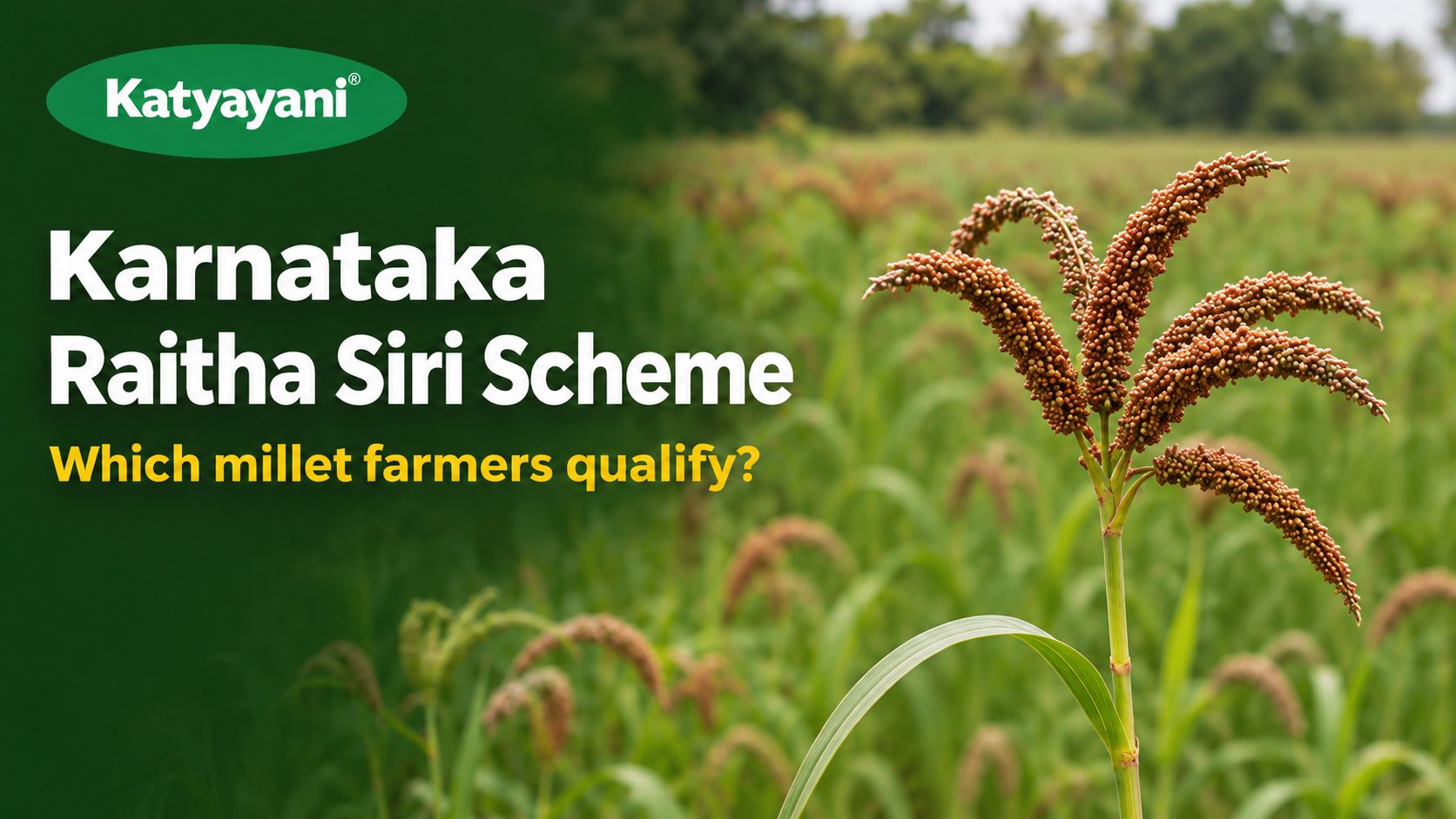
Raitha Siri is a Karnataka Department of Agriculture scheme that pays millet growers a cash incentive. In the 2024-25 guideline (dated 6 May 2024) it is Rs 10,000 per hectare, up to 2 hectares per farmer, for six minor millets, chosen from the crop survey. Farmers who receive a millet demonstration under the Food and Nutrition Security (FNS) scheme in 2024-25 are not eligible. The 2022-23 guideline pays by Direct Benefit Transfer (DBT) to the bank account; the 2024-25 guideline does not state how it is paid, so keep your bank details right in FRUITS. The department page lists no guideline newer than 2024-25, so check your Raitha Samparka Kendra for the current season.
What is the Raitha Siri scheme of Karnataka?
Raitha Siri is a Karnataka Department of Agriculture scheme that gives cash to farmers who grow minor millets (siridhanya). The Raita Siri page of the department lists it as a new scheme for 2019-20, under G.O. No. K.E 45 KRYOKA 2019 dated 17 July 2019. The aim is to bring more land under millets and raise millet output.
The 2024-25 guideline lists four aims. They are to increase millet area and production, to get farmers to grow millets for food and nutrition security and a lasting farm system, to use dry land with very low rain and low fertility, and to spread awareness of millets and link them to markets.
In Kannada, siridhanya means millets. The district Joint Director of Agriculture and the taluk agriculture offices handle the work on the ground, as the guidelines show.
The scheme has two parts. The first is the per-hectare incentive for farmers who grow the crop. The second is help for people who set up millet processing, value addition, grading, packing and branding units. This post covers both, with the first part in more detail because most farmers search for it.
Which millets are covered under Raitha Siri?
The 2024-25 guideline names six millets: oodalu, navane, haraka, korale, saame and baragu. In English these are barnyard, foxtail, kodo, browntop, little and proso millet. Ragi, jowar and bajra are not named in the 2024-25 text. The 2022-23 RKVY guideline says plainly that ragi, jowar and bajra are left out.
| Kannada name | English name | Hindi or common name |
|---|---|---|
| Oodalu | Barnyard millet | Sawa |
| Navane | Foxtail millet | Kakun, kangni |
| Haraka | Kodo millet | Kodon |
| Korale | Browntop millet | Korale |
| Saame | Little millet | Kutki |
| Baragu | Proso millet | Cheena |
The English names follow the PIB explainer on the International Year of Millets (18 Mar 2023). Korale is browntop millet in common usage.
One more point. The Raita Siri page of the department also lists a government order of 5 October 2020 (G.O. No. AGRI-AML/92/2020) on adding chia, quinoa and teff. The page says this came from the 2020-21 budget announcement. The 2024-25 guideline does not name those three crops, so do not count on them for this year.
If your main crop is ragi or jowar, ask your Raitha Samparka Kendra which department programme applies to it. Raitha Siri, as written in the 2024-25 guideline, is for the six crops above.
How much does Raitha Siri pay per hectare?
The 2024-25 guideline says Rs 10,000 per hectare, with a limit of 2 hectares for each farmer. That is at most Rs 20,000 per farmer. The amount depends on the millet area recorded in the crop survey. The 2022-23 guideline (28 April 2022) gave the same Rs 10,000 per hectare and the same 2 hectare limit.
| Item | 2022-23 guideline (28 Apr 2022) | 2024-25 guideline (6 May 2024) |
|---|---|---|
| Rate | Rs 10,000 per hectare | Rs 10,000 per hectare |
| Limit per farmer | 2 hectares | 2 hectares |
| State grant set aside | Rs 500 lakh | Rs 550 lakh |
| Crop basis | Millets grown in the 2021-22 summer season, from the crop survey | Millets grown in 2024-25, from the crop survey |
| Paid first | Farmers left unpaid from 2021-22 | Farmers left unpaid from 2023-24 |
| Exclusion | Farmers who received a millet demonstration under NFSM | Farmers who receive a millet demonstration under FNS |
The grant figure is the money the state set aside for the whole scheme, not a per-farmer amount. When the grant is used up, the department cannot pay more than it has. Get your crop recorded in good time.
Do not confuse hectares with acres. One hectare is about 2.47 acres, so the 2 hectare limit is about 4.94 acres. A farmer with 3 acres has about 1.21 hectares. The worked example later in this post shows the sum.
Also note a second figure in the 2022-23 papers. The same document carries a set of RKVY Raitha Siri guidelines that give Rs 6,000 per hectare (up to 2 hectares) by DBT to farmers who grew the same six millets in 2022-23. The guideline does not say that a farmer gets both amounts, so do not add them together.
Who is eligible for Raitha Siri?
A farmer is eligible when one of the six named millets is grown in the season and the crop is recorded in the crop survey. The 2024-25 guideline sets a limit of 2 hectares for each farmer. Farmers who receive a millet demonstration under the Food and Nutrition Security (FNS) scheme in 2024-25 are not eligible.
| Rule | What the guideline says | Source |
|---|---|---|
| Crop | Oodalu, navane, haraka, korale, saame or baragu | 2024-25 guideline |
| Proof of crop | Millet recorded in the crop survey (the farmer uploads it, or Panchayat Raj (PR) staff record it) | 2024-25 guideline |
| Land limit | Incentive for at most 2 hectares per farmer | 2024-25 guideline |
| Overlap | Farmers who receive a millet demonstration under the FNS scheme are not eligible | 2024-25 guideline |
| FRUITS ID | Farmer must be registered with FRUITS ID (2022-23 guideline) | 2022-23 guideline |
| Joint land holders | For a survey number held jointly, the farmer registers with FRUITS ID with the consent letter of the other holders (2022-23 guideline) | 2022-23 guideline |
| Priority groups | As per law, priority to SC, ST, minorities, women and backward class farmers (2022-23 guideline) | 2022-23 guideline |
The 2022-23 guideline also asked farmers to register at the Raitha Samparka Kendra with their FRUITS ID. The 2024-25 guideline does not repeat this. Having a FRUITS ID is the safe step because many state schemes use it. The FRUITS home page says it was built by the DPAR e-Governance department with NIC so that farmers do not have to submit the same papers again and again to different departments.
If you have not yet registered, read the step-by-step guide on FRUITS ID registration first. It is the one record that most Karnataka schemes ask for.
Who is not eligible for the Raitha Siri incentive?
Three groups miss out. A farmer who grew no millet from the named list, a farmer whose millet is not recorded in the crop survey, and a farmer who receives a millet demonstration under the Food and Nutrition Security scheme in 2024-25. Area above 2 hectares is also not paid.
- Growers of crops outside the six named millets, such as ragi, jowar or bajra, are not covered by the 2024-25 text.
- A crop that is missing from the crop survey cannot be paid. The guideline says the incentive follows the crop survey.
- Farmers who receive a millet demonstration under FNS in 2024-25. In 2022-23 farmers who received a millet demonstration under NFSM were left out in the same way.
- Land above 2 hectares. The farmer still qualifies, but only 2 hectares are counted.
Do not give up if your crop is not on the list of named millets. Ask the Raitha Samparka Kendra what the department offers for your crop. A different programme may suit you, and the officer can tell you the rules for it. Always ask for the answer in writing if the amount is large.
If a farmer has more than one holding, the limit is for the farmer, not for each plot. Keep all plots in one FRUITS record so that your area is counted once.
How do I get enrolled in Raitha Siri? Is there a form to fill?
The 2024-25 guideline names no separate form. It asks farmers to record the millet in the crop survey, by uploading it themselves or through the PR. In 2022-23 farmers were also asked to register at the Raitha Samparka Kendra with their FRUITS ID. Local newspapers carry a notice about the scheme.
The Crop Survey Scheme page of the department lists the yearly orders. Its latest entries are the work schedule for 2026-27 dated 25 May 2026 and a 2026-27 guideline. The page names the Farmer App and Panchayat Raj staff, who are paid a fee for the work. Ask at your Raitha Samparka Kendra when the survey window for your season is open.
The 2022-23 guideline adds three steps that were then in force. The Joint Director fixes provisional taluk-wise targets from the crop survey. The taluk Assistant Director gives publicity and asks farmers to register at the Raitha Samparka Kendra with their FRUITS ID. Farmers get the incentive in proportion to the area they grew.
What is the step-by-step process to claim the incentive?
Register in FRUITS, grow one of the six millets, get the crop recorded in the crop survey in the right season, keep your bank details right, and then watch for the payment. Keep your bank details right in FRUITS. The 2022-23 guideline paid by Direct Benefit Transfer (DBT) into the bank account.
- Register with FRUITS and keep the FRUITS ID safe. Add all your survey numbers.
- Check that your bank account in FRUITS is yours, active and linked to Aadhaar, so that any payment can reach you.
- Sow one of the six millets on your land. Note the survey number and the sowing date in a diary.
- Get the crop recorded in the crop survey. Do it yourself on the survey app or ask the PR of your village. Do it within the season window.
- Check the entry. See that the crop name is the millet you grew and the area is right. Ask for a correction before the survey closes.
- If your land is held jointly, keep the consent letter of the other holders ready.
- Wait for the department to prepare the list. The Raitha Samparka Kendra can tell you if your name is on it.
- Check your bank account for the credit. If nothing comes, ask the taluk agriculture office.
A small habit helps. Keep a dated photo of the millet crop in your field, and write the survey number on the back or in your diary. If the crop survey entry is wrong or missing, this gives you something to show the officer when you ask for a correction.
To confirm your land and survey number before the crop survey, see how to check land records online.
What documents and records do I need?
For the per-hectare incentive, the 2024-25 guideline does not list a paper pile. The crop survey entry is what carries the claim. It helps to keep your FRUITS ID, land record, Aadhaar copy, bank passbook and the consent letter for joint land ready.
| Record | Why it matters | Where it comes from |
|---|---|---|
| FRUITS ID | The state farmer database used to find you and your land | FRUITS portal or Raitha Samparka Kendra |
| Land record (RTC) and survey number | Shows the plot where the millet is grown | Bhoomi or the village office |
| Crop survey entry | The proof of the crop and area that the incentive is based on | Crop survey app or the PR |
| Bank account in your name | Any payment is credited here | Your bank |
| Consent letter of joint holders | Needed for a jointly held survey number (2022-23 guideline) | The other holders, on paper |
| Caste certificate | Only if you claim the SC or ST priority group | Competent authority |
A caste certificate is needed only if you apply for the SC or ST group.
Farmers who have an AgriStack Farmer ID should ask the department whether it is accepted for this scheme.
How is the Raitha Siri money paid, and what if it is delayed?
The 2022-23 RKVY guideline says the money is credited to the farmer's bank account by Direct Benefit Transfer (DBT). The 2024-25 guideline does not state how it is paid, so keep your bank details right in FRUITS. If your payment is late, check those details, check the crop survey entry, and ask the taluk agriculture office.
The 2024-25 guideline also shows why delays happen. Its first use of the Rs 550 lakh grant is to pay the farmers who were left unpaid from 2023-24. Only after that does it pay for 2024-25 crops. A farmer from the earlier year is paid first.
| Problem | What to check | Who to ask |
|---|---|---|
| No credit after weeks | Name on the list, bank details in FRUITS | Taluk agriculture office |
| Crop not shown in the survey | Whether the crop was recorded in the season | Raitha Samparka Kendra, PR |
| Wrong area recorded | Survey number and area on the entry | Raitha Samparka Kendra |
| Bank account rejected | Account active, name matches, Aadhaar linked | Your bank branch |
| No answer at the local office | Raitha Call Centre 1800 425 3553 or 8277003553 | Department call centre |
If your problem is crop loss and not millet incentive, that is a different scheme. See the guide on Bele Parihara payment status.
How much will I get? A worked example
Divide your acres by 2.47 to get hectares, count at most 2 hectares, and multiply by Rs 10,000. The two examples below are made up to show the sum. They are not real farmers, and the real amount depends on the crop survey entry and on the funds that the department has set aside.
| Example (illustration only) | Millet area | Hectares | Counted hectares | Incentive at Rs 10,000 per hectare |
|---|---|---|---|---|
| Farmer A grows foxtail millet on 3 acres | 3 acres | 3 divided by 2.47 = about 1.21 | 1.21 | About Rs 12,100 |
| Farmer B grows little millet on 6 acres | 6 acres | 6 divided by 2.47 = about 2.43 | 2 (limit) | Rs 20,000 |
| Farmer C grows ragi on 2 acres | 2 acres | Not a named millet | 0 | Nil under the 2024-25 text |
In the example, Farmer B loses the incentive on 0.43 hectare because of the limit. Do not record land in another name to cross the limit. It is wrong, and it can cause trouble with the department.
Other Karnataka and central schemes follow their own rules, so read the guide to agriculture subsidy schemes before you count on more than one.
How has Raitha Siri changed since 2019?
The scheme began in 2019-20, the department added chia, quinoa and teff by a 2020 order, and a processing part is listed from 2022. The 2022-23 and 2024-25 guidelines both pay Rs 10,000 per hectare with a 2 hectare limit. The grant rose from Rs 500 lakh to Rs 550 lakh between them.
| Date | What the department page lists | What it means |
|---|---|---|
| 17.07.2019 | New Scheme Raita Siri 2019-20 (G.O. No. K.E 45 KRYOKA 2019) and Scheme Continuation order | Scheme started and continued |
| 05.10.2020 | Inclusion of chia, quinoa and teff (G.O. No. AGRI-AML/92/2020) | Three high-nutrient crops added by order |
| 28.04.2022 | Raithasiri Guidelines 2022-23 and Raithasiri Processing Guidelines 2022-23 | Rs 10,000 per hectare, 2 hectare limit, processing help listed |
| 06.05.2024 | Scheme guidelines of Raithasiri Yojane 2024-25 | Rs 10,000 per hectare, 2 hectare limit, Rs 550 lakh grant, unpaid 2023-24 farmers first |
| After 06.05.2024 | No newer Raita Siri guideline is listed | See the next section |
| Point | 2022-23 guideline | 2024-25 guideline |
|---|---|---|
| FRUITS ID | Farmers asked to register at the Raitha Samparka Kendra with FRUITS ID | Not repeated |
| How it is paid | The RKVY section says DBT to the bank account | Not stated |
| Ragi, jowar, bajra | RKVY guideline says plainly they are left out | Not named |
| Joint land | Consent letter of the other holders | Not repeated |
| Exclusion | Millet demonstration under NFSM | Millet demonstration under FNS |
The department page does not list a 2023-24 guideline. The 2024-25 guideline says some 2023-24 payments were still due, so the incentive ran that year too.
Some websites quote other rates. Trust the guideline of the year you are in and check it with your taluk office.
Is Raitha Siri running in 2026-27?
As of 21 November 2026, the department's Raita Siri page lists no guideline for 2025-26 or 2026-27. The newest one is dated 6 May 2024, so the 2026-27 rate is not published there. Ask your Raitha Samparka Kendra before you plan on the money.
The Budget Highlights 2026-27 of the Karnataka Finance Department (6 March 2026) list a Millet Hub, a single window system for encouragement of millets and organic produce. The highlights do not name Raitha Siri.
The Action Taken Report on the 2025-26 budget speech says an Organic and Millet Hub will be set up at a cost of Rs 20 crore, with G.O. No. AGRI 257 ACT 2024 dated 16.11.2024. It also says Rs 2.28 crore was already spent on the hub building. The department's organic and millet page lists a hub order dated 30 May 2026 for 2026-27.
| Question | What the official pages show | Date |
|---|---|---|
| Newest Raita Siri guideline on the department page | Guidelines 2024-25 | 06.05.2024 |
| Raita Siri rate for 2026-27 | Not given on the department page | Checked 21.11.2026 |
| Millet Hub in the state budget | Named in the Budget Highlights 2026-27 | 06.03.2026 |
| Millet Hub order for 2026-27 | Listed on the organic and millet page | 30.05.2026 |
| Crop survey schedule for 2026-27 | Listed on the Crop Survey Scheme page | 25.05.2026 |
Do not read the Millet Hub as a replacement for the incentive or the other way round. The pages do not say either. Treat each as a separate item and ask the department which one applies to you. The Action Taken Report describes the hub as a market facility.
Is there help for setting up a millet processing unit?
Yes. The 2024-25 guideline offers help for processing, value addition (making products from the raw grain), grading, packing and branding units for millet products. Support is 50 percent of the total machinery cost, up to Rs 10 lakh, for all categories. Farmers, entrepreneurs, farmer groups, registered SHGs, FPOs and private entrepreneurs can apply.
The guideline says the scheme is proposal based. This means you send a project proposal and the department approves it. These groups can claim: farmers, new entrepreneurs, farmer organisations, registered self help groups, farmer producer organisations (FPOs) and private entrepreneurs. People who run or plan food units can also apply.
| Point | Rule in the 2024-25 guideline |
|---|---|
| Aim | Help farmers get a better price for millet products and give buyers millet value added products |
| Support | 50 percent of the total machinery cost, or at most Rs 10 lakh, for all categories |
| Project cost above Rs 5 lakh | The applicant must take a bank or finance institution loan for the unit. The government support is tied to that bank loan |
| Project cost below Rs 5 lakh | The applicant sets up the unit with own money or a loan. Support is credited to the applicant's bank account after the unit is done |
| Machines | ISI or BIS mark, or at least the main parts marked. Only machines bought after 1 April 2024 qualify |
| Technology | Technology from a recognised food-technology institute, or a satisfactory technical certificate from an engineering or university department |
| Release | After the unit is set up, the Joint Director of Agriculture of the district releases the support on the inspection report |
For an FPO planning a unit, read the FPO credit guarantee scheme guide for loan support.
The Chief Minister's Krishi Vistara Yojana is also about value addition of farm crops and re-use of farm waste. The Budget Highlights 2026-27 name it with Rs 100 crore over 3 years.
What papers does a millet processing unit application need?
The 2024-25 guideline lists fifteen items. Items 1 to 13 go with the application. Items 14 and 15, the ISI or BIS proof and the inspection report with photos, go with the claim after the unit is built. The district proposals go to the department's head office for approval.
- The application in the prescribed format.
- Proof of the unit site: lease, rent or own land papers.
- A detailed project report.
- For an organisation: registration certificate, memorandum and articles of association, society bye-laws, partnership deed or MSME Udyog Aadhaar certificate as it applies.
- The building plan and a flow diagram of the process.
- A licence for the unit from the local body.
- Power supply approval.
- Bank or finance institution loan sanction letter.
- Quotations or invoices from machine makers or sellers.
- An undertaking to run the unit and do commercial production for at least 5 years, and to return the support with simple interest if that is not done, with an affidavit that no help was taken from other government bodies.
- A declaration that no help was taken from other state or central government bodies for the proposed unit.
- Caste certificate, for SC and ST applicants.
- Aadhaar and PAN copies.
- Proof that the machines carry the ISI or BIS mark.
- An inspection report with photos of the finished unit.
This list follows the department's 2024-25 guideline. Confirm the current list with your district Joint Director of Agriculture before you apply. The department page also says the Raitha Siri processing guidelines of 28 April 2022 are available.
What other Karnataka support helps a millet farmer?
Two other schemes may suit a millet farm: Krishi Bhagya for water and PM Fasal Bima Yojana for crop cover. Each has its own rules, so read each page and do not assume you can stack them.
- A Krishi Bhagya farm pond can hold water for a dry spell in a millet field.
- Crop insurance under PM Fasal Bima Yojana covers notified crops, and the department menu lists a Karnataka Raitha Suraksha PM Fasal Bima Yojana. Check if your millet is notified in your area.
What mistakes make farmers miss the Raitha Siri incentive?
The six common mistakes are an unrecorded crop, a wrong crop name, a missing FRUITS ID, a bank account with wrong details, a missing consent letter for joint land, and a claim for land above the 2 hectare limit. Most of these can be fixed in time if the farmer checks early.
| Mistake | What happens | How to avoid it |
|---|---|---|
| Crop not recorded in the survey | The incentive follows the crop survey, so there is no basis to pay | Record it in the season or ask the PR |
| Wrong crop name in the entry | The crop may not match the six named millets | Read the entry back after it is saved |
| No FRUITS ID | The farmer may not be found in the state database, and the 2022-23 guideline asked for it | Register first |
| Bank account details wrong | A payment can fail or go to the wrong place | Check account details in FRUITS |
| Joint land, no consent letter | The claim can be held up (2022-23 rule) | Get the letter before the survey |
| Waiting for a form | The 2024-25 guideline names no separate form | Record the millet in the crop survey and watch for the local notice |
| Counting on ragi or jowar | They are not named in the 2024-25 text | Ask the Raitha Samparka Kendra first |
Where can I get help or make a complaint?
Start at your Raitha Samparka Kendra or the taluk agriculture office. The department home page lists a toll free Raitha Call Centre on 1800 425 3553 and 8277003553. For FRUITS problems, the FRUITS page gives 080-22208333, 080-22209331, 080-22209332 and a helpdesk email. The home page also gives 1902 for grievances.
| Need | Contact | Source |
|---|---|---|
| Scheme and crop survey questions | Raitha Samparka Kendra or taluk agriculture office | Department of Agriculture |
| Department call centre | 1800 425 3553 or 8277003553 | Raitamitra home page |
| FRUITS ID problems | 080-22208333, 080-22209331, 080-22209332 | FRUITS home page |
| FRUITS email | fruitshelpdesk at karnataka.gov.in | FRUITS home page |
| Grievance about any state service or scheme | 1902 | Raitamitra home page |
Millet growers often live far from the taluk office, so a group visit can save time. Several farmers from one village can go together with their survey numbers and crop names, and ask the officer one set of questions about the season, the survey window and the list of names.
When you call, keep your FRUITS ID, survey number, crop name and season ready. Write down the date, the name of the person you spoke to and what they said. A clear note helps if you must raise the matter again.
Conclusion
Raitha Siri pays Karnataka millet growers Rs 10,000 per hectare, up to 2 hectares, in the department's 2024-25 guideline. It covers six named millets and works from the crop survey. Keep your bank details right in FRUITS. Get the crop recorded in season. The department page lists no guideline newer than 6 May 2024, so ask your Raitha Samparka Kendra what applies in 2026-27 before you plan on the money.

Leave a Comment