
 12 min read
Khet Talab Yojana is the Uttar Pradesh Agriculture Department's farm pond programme. A farm pond is a pit dug in your own field to store rain or runoff water for irrigation. On 21 Nov 2026 the department website at agriculture.up.gov.in shows a booking link for farm ponds for financial year 2026-27, with pages to upload bills and photos of the work. You register as a farmer with your Aadhaar and land details, make your Farmer ID, and then book. The department decides the subsidy rate, pond size and last date each year, so get them from your district Bhumi Sanrakshan office before you spend money.
What is UP Khet Talab Yojana?
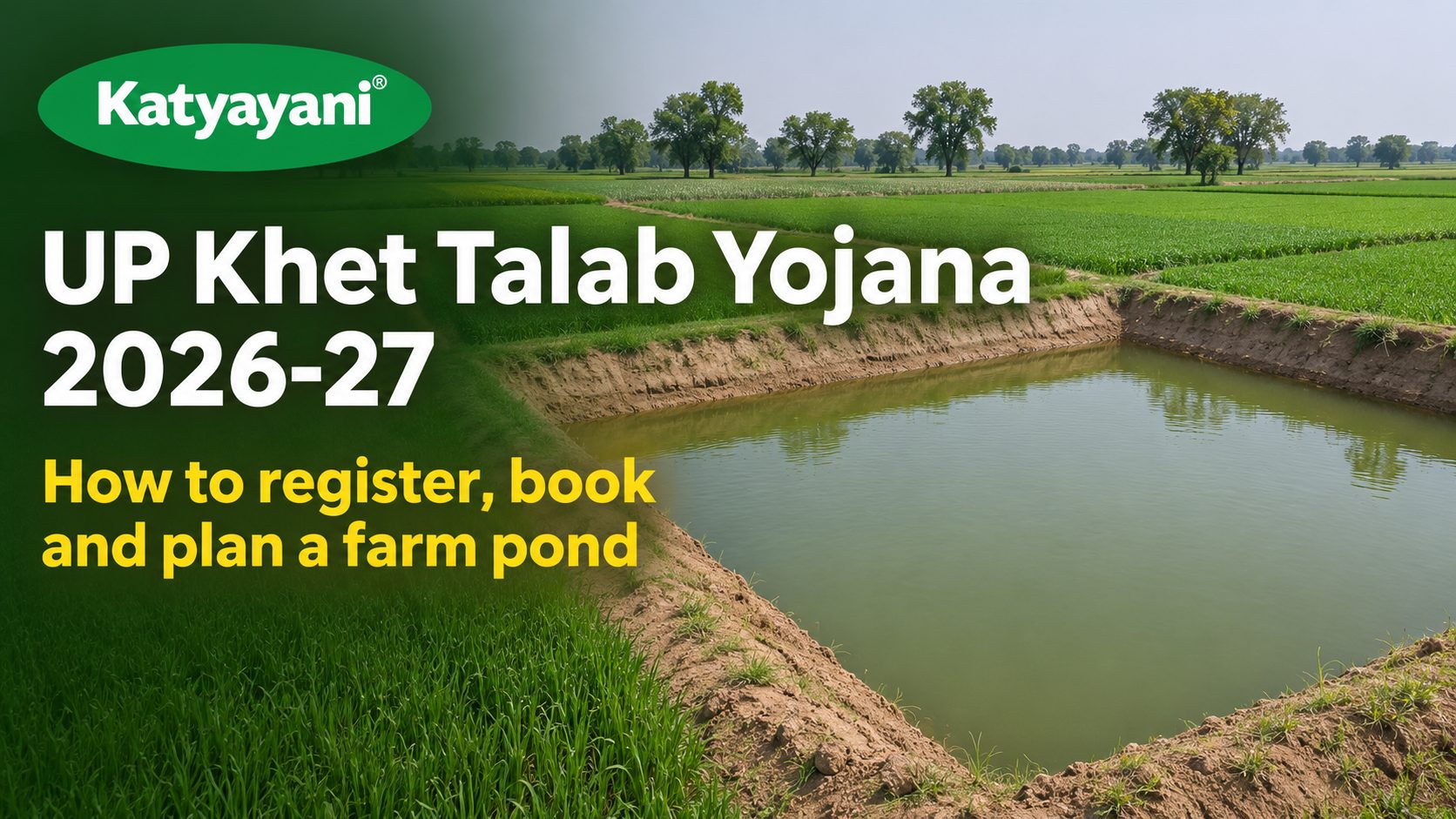
Khet Talab Yojana is the name farmers use for the Uttar Pradesh Agriculture Department's farm pond programme. "Khet talab" means a pond in the field. The farmer digs a pond on their own land to store rainwater, and the department supports the work after the farmer books online. The department's own pages call it खेत तालाब, farm pond.
A farm pond is a simple water store. Rain falls on your field and the nearby slope. The extra water runs off and is lost. A pond catches that runoff so you can use it later for a life-saving irrigation, for cattle, or for fish. The ICAR article in Indian Farming (November 2022) calls it a low-cost way to store runoff at the farm level. It says the water can serve irrigation, fodder, cattle drinking water, fish and home use.
Is Khet Talab Yojana open for 2026-27 in Uttar Pradesh?
Yes, the department website shows a farm pond booking link for financial year 2026-27. On 21 Nov 2026 the token page of agriculture.up.gov.in lists it, along with a page to upload bills and a page to upload photos of the first-stage work. The page shows no opening date and no last date.
The home page carries the same notice in Hindi: "खेत तालाब की बुकिंग एवं डॉक्यूमेंट अपलोड यहाँ से करें". It means "book a farm pond and upload documents from here". Whether seats are still free in your district today is a question for your district office.
| Official page (21 Nov 2026) | What it offers a farmer |
|---|---|
| Home page of agriculture.up.gov.in | Notice to book a farm pond and upload documents; farmer registration link; helpline |
| Token page | Farm pond booking link for 2026-27; bill upload page; photo upload page |
| First booking screen | Farmer ID declaration, which the farmer must accept before clicking Next |
| Farmer registration page | Aadhaar OTP steps, land and bank detail fields |
Where do I get the subsidy rate, pond size and last date for 2026-27?
The department decides the subsidy rate, the pond size and the last date for each year. Get all three from your district Bhumi Sanrakshan (soil conservation) office before you dig. Ask for them in writing, or ask the officer to show you the department order. You can also call the department's registration and DBT helpline, 7839883124. Book only through the links on agriculture.up.gov.in, and keep a screenshot of every screen.
Figures shared on videos and social media differ from page to page and from district to district. A pond costs real money, so work from the rule printed for this year, not from a number you heard. If two people give you two different numbers, ask the officer which one is in the order.
| Question for the district office | Why it matters |
|---|---|
| What is the rate of help and the rupee limit for 2026-27? | It decides how much of your own money you must put in |
| What pond size is approved for my block? | A pond dug to a different size may not be accepted |
| What work must I do myself before payment? | Some stages are done by the farmer before bills are checked |
| At which stage is money paid, and into which account? | You need to plan cash for the early work |
| What is the last date for booking and for finishing work? | Late work can cancel a booking |
Who can apply for Khet Talab Yojana?
A farmer who is registered on the department portal, has made a Farmer ID, and has a pond site on land that is in the farmer's name in the land record. The district office confirms any other rule for the year. The registration page says it is for farmers who want the department's services, and farmers who are already registered need not register again.
Keep three things ready. You need a pond site on land you can show in your record. You need an Aadhaar linked to a mobile number. You need a bank account in your name to receive money. The registration form asks for all three.
The booking page also needs your Farmer ID. If you have not made one, read our guide to the AgriStack Farmer ID first. Do this before booking opens in your district, because you cannot go past the first screen without agreeing to the declaration.
Two checks save trouble. First, the name on the Aadhaar, the land record and the bank account must match. A spelling gap is a common reason for a stuck form. Second, look at your khatauni. Our guide to check land records online shows the steps for Uttar Pradesh.
The registration form asks for category (General, SC, ST or OBC), and SC or ST applicants enter a certificate number. Do not assume any quota or priority. Ask the district office.
How do I register on the UP Agriculture Department portal?
Open the farmer registration page on agriculture.up.gov.in. You give consent for Aadhaar authentication, enter your 12-digit Aadhaar and a captcha, and then the OTP sent to your Aadhaar-linked mobile. After that you fill your farmer, land and bank details, check them, and save.
These are the steps on the registration page as it stood on 21 Nov 2026.
- Read and accept the consent. The page says the department will use your Aadhaar for UIDAI authentication and that Aadhaar and biometric data will not be stored or shared.
- Enter your 12-digit Aadhaar number and the captcha.
- Enter the OTP sent to the mobile linked to your Aadhaar and click Proceed.
- Fill farmer details: district, tehsil, block and village; your name and your father's or husband's name in Hindi and English; gender and date of birth; category; ration card number, mobile number, pincode and address. SC and ST applicants also enter an application number and a certificate number.
- Add land details: khata or khatauni number, khasra number and area in hectares. Add each plot to the table. Upload the land document as a PDF file only.
- Add bank details: district, bank, branch, IFSC code and account number.
- Check everything and press Save.
If you already have a registration number, the home page has a link to find it. Call the helpline 7839883124 if the OTP does not come or the land entry does not save.
PM-Kisan is a separate registration on the central PM-Kisan portal. The department page says PM-Kisan farmers must register there and not on this form. Registering for one does not book the other.
How do I book a farm pond online?
Log in as a registered farmer, open the farm pond booking link on the token page, and follow the screens for 2026-27. The first screen has a declaration about your Farmer ID, and you cannot move on without agreeing to it.
On 21 Nov 2026 the booking page on agriculture.up.gov.in starts with a declaration. You must say that you have made your Farmer ID, and show it to the officer at the land check. If you cannot show it, your application is cancelled. You must agree before you click Next.
| Stage | What the official site offers | What you should do |
|---|---|---|
| Registration | Farmer registration form | Register once with Aadhaar OTP, land and bank details |
| Farmer ID | Declaration on the first booking screen | Make your Farmer ID first and keep it ready for the land check |
| Booking | Farm pond booking link for 2026-27 on the token page | Book from the link. Note every message and receipt on screen |
| Document upload | Home page notice says documents are uploaded through the same route | Upload clear scans, not photos taken in poor light |
| Work progress | Page to upload photos of first-stage work | Take dated photos at each stage of digging and lining |
| Bills | Page to upload bills | Keep the original bill and upload a clear copy |
Book only from agriculture.up.gov.in. The department says it has no website named www.upagriculture.org.in. It also warns farmers not to act on phone calls that claim to confirm a booking. Report such calls to the Deputy Director of Agriculture of your district.
The Darshan portal login page is a staff login. The farmer route is the booking link. If a payment screen appears at any stage, read the amount and the purpose line, take a screenshot and keep the receipt. If the amount differs from what your district office told you, stop and call them first.
Which documents should I keep ready for a farm pond booking?
Keep your Aadhaar and linked mobile, your Farmer ID, your land record (khata, khatauni and khasra details), a bank passbook page with the IFSC, and your category certificate if you are SC or ST. The registration form asks for most of these. The booking screens may ask for more, so read each screen.
| Document or detail | Where it is used | Tip |
|---|---|---|
| Aadhaar and linked mobile | OTP step of registration | Keep the phone with you. The OTP goes to the Aadhaar-linked number only |
| Farmer ID | Declaration on the first booking screen; shown at land verification | Make it before booking. No Farmer ID at the land check means the application is cancelled |
| Khatauni, khata and khasra number, area in hectares | Land details step | Enter the plot where the pond will be dug |
| Land document as PDF | Upload in land details | The page accepts PDF files only. Keep each file small and readable |
| Bank passbook or cheque | Bank details step | Account must be in the farmer's own name. Check the IFSC twice |
| SC or ST application and certificate number | Category step | Only for SC and ST farmers |
| Ration card number | Farmer details step | The form asks for it |
| Dated photos and bills during work | Photo and bill upload pages | Start taking photos on day one |
If your district office asks for any form, take it from the portal or from the office itself, not from an agent.
What happens after booking and how is money paid?
The token page shows that the process goes on after booking. There is a page to upload photos of first-stage work and a page to upload bills. This shows that the department checks work and bills in stages. Your district office tells you how many stages there are and when money is paid.
Plan on this pattern, and confirm each point with your office. You book. An officer checks your land and your Farmer ID. You dig or get the pond dug. You take dated photos. You upload photos and bills. Money then comes to the account you gave at registration.
Keep cash ready for the early work. In many schemes the farmer spends first and is paid after the check. If that is the rule here, the first weeks cost you your own money. Ask the office before you hire a machine, and keep the machine hire slip with the bills. If you need a short loan for the gap, read our guide to the Kisan Credit Card and ask your bank.
Do not start digging until your booking is confirmed on the portal and your office tells you the approved size. Work done before approval may not be counted. Also decide where the dug soil will go, so that it does not block a drain or your neighbour's field.
What mistakes should I avoid with Khet Talab Yojana?
The biggest mistakes are acting on a subsidy number heard on a video, booking without a Farmer ID, digging before approval, using the wrong site, skipping photos and bills, and booking on a fake website. Each can cost you money or the whole benefit.
- Trusting a figure you saw on social media. Get the rate and the rupee limit in writing.
- Booking without a Farmer ID. If you cannot show it at the land check, the application is cancelled.
- Booking on any site other than agriculture.up.gov.in. The department says it has no website named www.upagriculture.org.in.
- Paying an agent. Pay only the amounts that the portal itself asks for.
- Digging before the booking and the size are confirmed.
- Choosing a leaky site and skipping lining.
- Not taking dated photos at each stage. The portal has a page for photos of first-stage work.
- Losing bills. The portal has a bill upload page.
- Using a different bank account from the one in your registration.
If something goes wrong, call the helpline 7839883124 for registration and DBT problems, or write to dbt.validation@gmail.com, which the department lists on its site. Report phone calls that claim to confirm a booking to the Deputy Director of Agriculture of your district. For a booking problem, meet the district soil conservation officer in person.
How is Khet Talab Yojana different from other water and subsidy schemes?
Khet Talab Yojana is about a storage pit on your own field. Other schemes cover solar pumps, drip and sprinklers, crop insurance or groundwater work. They are separate bookings with separate rules, so do not mix them up when you register or call.
| If you want | Look at | Our guide |
|---|---|---|
| A solar pump | PM-KUSUM booking (the UP home page lists solar pump booking separately) | PM-KUSUM solar pump subsidy |
| A pond in another state | Karnataka farm pond scheme | Krishi Bhagya scheme. Karnataka rules do not apply to UP |
| Groundwater management in selected areas | Central scheme for groundwater | Atal Bhujal Yojana |
| Other subsidies | Central and state farm schemes | agriculture subsidy guide |
| Dates of scheme windows | Agri scheme calendar | agri schemes calendar |
Farm machinery booking for 2026-27 is a separate window and ran from 7 to 27 October 2026 on agriculture.up.gov.in. It is not the pond booking.
How big should a farm pond be, and how much water does it hold?
Size the pond from your catchment and your need. ICAR says capacity depends on the runoff you can collect and the water you need. A safe guide for runoff is 10 to 15 percent of seasonal rainfall in black soils and 5 to 10 percent in red soils on mild to medium slopes. Add 20 percent to capacity for losses and for an unusual flood.
Here is a worked example with assumed rainfall. A catchment of 1 hectare (10,000 square metres) gets 600 mm of rain in the season. That is 10,000 x 0.6 = 6,000 cubic metres of rain. In red soil at 5 to 10 percent, you can expect 300 to 600 cubic metres of runoff. In black soil at 10 to 15 percent, you can expect 600 to 900 cubic metres.
| Soil (ICAR guide) | Share of seasonal rain that runs off | Runoff from 1 ha at 600 mm rain (example) |
|---|---|---|
| Black soil | 10 to 15 percent | 600 to 900 cubic metres |
| Red soil | 5 to 10 percent | 300 to 600 cubic metres |
ICAR lists a 21 x 21 x 3 m pond holding 837 m3 for the northern dry zone at Vijayapura, Karnataka. This is a research size. It is not the size the UP department approves, so follow the approved size for your booking. Ask the engineer how the approved size fits your plot, and mark the corners with pegs before the machine comes.
| Pond example (ICAR table) | Where | Size in metres |
|---|---|---|
| 1 ha catchment | Bengaluru, Karnataka | 12 x 12 x 3 |
| Research size | Parbhani, Maharashtra | 20 x 20 x 3 |
| Research size | Varanasi, Uttar Pradesh | 26 x 21 x 2.5 |
The Varanasi row is the only Uttar Pradesh entry in the ICAR table. ICAR judged that pond not to need lining. Do not copy that for a sandy or gravelly plot. Soil decides lining, as the next sections explain.
Where in the field should I dig the pond?
Dig at the low point of your land where runoff gathers, in deep soil that holds water, away from anything that can pollute it. ICAR says a lower site gives better storage and less seepage, and the catchment must give the water you need.
The ICFRE note on rain water harvesting adds more points. Put the pond on a well-treated catchment so silt does not fill it fast. Place it on one side of a watercourse and not in the middle. Keep the land you will irrigate free of salt trouble. If you are not sure about salts in your soil, read our guide on soil salinity first.
| Site check | Good sign | Warning sign |
|---|---|---|
| Position | Low point where water naturally gathers | High ground that never collects water |
| Catchment | Covered or treated slope with clean runoff | Bare, eroding slope that brings in silt |
| Watercourse | Beside the stream or drain | Right in its path |
| Soil | Deep, heavy soil that holds water | Gravel below, which drains water away |
| Irrigated land | Free of salt trouble | White salt crust on the surface |
| Pollution | Away from drains, pesticide mixing spots and animal sheds | Near any of these |
Most UP farm land is flat, so a simple dug pit is the usual type. ICFRE says a square pond has less evaporation and seepage area than a long one. Your soil type matters here, and our page on types of soil in India helps you name yours before you speak to the engineer.
Plan the inlet and outlet too. ICAR says a pipe inlet is cheaper than a weir for small ponds, and the outlet sits 15 to 20 cm lower than the inlet. Its capacity is about half the inlet at peak runoff. Keep a small settling pit at the inlet and clean it before every rainy season. A deep pond near a village path is a risk for children and cattle, so fence it.
Does a farm pond need lining?
It depends on the soil. ICAR says ponds on soils with gravel below, mainly shallow to medium deep soils, can lose 50 to 70 percent of the stored water through seepage and evaporation. Lining is the usual cure. Heavy clay soil with very little seepage may not need it.
ICAR names many lining materials tested by research centres: plastic films (PVC, LDPE, HDPE, silpaulin), stone slabs, brick, cement and soil cement mixes. At Arjia in Rajasthan, cement concrete with 750 micron polythene worked best, and 500 micron polythene was next and far cheaper.
| Lining | What ICAR says |
|---|---|
| Plastic sheet (for example 500 micron HDPE or polythene) | Widely used. Cheap against brick, easy to buy and quick to lay. Keep some water in the pond all the time so the sheet lasts |
| Cement concrete plus 750 micron polythene | Best at Arjia, Rajasthan, but costlier |
| 500 micron polythene sheet | Next best at Arjia, and far cheaper |
| Brick, soil cement mortar, rubble masonry | Permanent options used at different research centres |
| No lining | ICAR lists Varanasi as needing none |
ICAR reports a pond of 488 cubic metres (17 x 17 x 3 m) built in 2021 on a farmer's field near Vijayapura, Karnataka. Excavation cost Rs 29,783, which was 21 percent of the total. Lining with a 500 micron HDPE sheet cost Rs 57,200, which was 41 percent. Inlet and outlet work cost Rs 45,574, which was 33 percent.
That cost is for Karnataka in 2021 and will be different in UP today. It shows one lesson: lining and inlet-outlet work cost more than digging. Ask what your approved estimate includes.
How much will the stored water help my crop?
A pond helps most as a back-up irrigation at the right stage. ICAR reports that one or two extra waterings from a farm pond raised yield by 30 to 75 percent at various centres, compared with no extra watering.
Those are results from rainfed dryland centres. A canal-fed or tube-well field may gain less. Use them as a sign that timing matters, not as a promise for your farm. ICAR advises a life-saving irrigation when a dry spell lasts 20 to 25 days.
ICAR gives minimum depths of 5 cm for surface irrigation and 3 cm by sprinkler. Take the 837 cubic metre pond above and ignore losses. One 5 cm irrigation needs 0.05 x 10,000 = 500 cubic metres per hectare, so the pond covers about 1.67 hectares once. At 3 cm by sprinkler it needs 300 cubic metres per hectare, so it covers about 2.79 hectares once. Real losses will cut this.
| Method | Minimum depth (ICAR) | Water per hectare | Area one 837 m3 pond covers once (example, no losses) |
|---|---|---|---|
| Surface irrigation | 5 cm | 500 cubic metres | About 1.67 ha |
| Sprinkler | 3 cm | 300 cubic metres | About 2.79 ha |
This is why a pond works well with sprinklers or drip. ICAR says mud in pond water can choke drip emitters, so use good filtering.
How can I cut seepage and evaporation losses from the pond?
Line the pond where the soil leaks, and cover the surface or use a film that slows evaporation in hot, dry places. ICAR says that after seepage, evaporation takes a major share of stored water, and it is worse in dry regions.
| Evaporation measure (ICAR) | Result reported |
|---|---|
| Stearyl alcohol film (Vijayapura, 2016-17 to 2018-19) | 46.2 percent less evaporation than the untreated pond |
| Neem oil, a locally available material (same trial) | 33.8 percent less evaporation |
| Sawdust, groundnut shell, paddy husk, bamboo mat | Tested by centres as a cover |
| Floating rubber and thermocol; algae and water hyacinth | Listed as options |
Mulching also keeps field moisture. Our guide on benefits of mulching explains types and depth.
Can I keep fish in a farm pond?
ICAR lists fish farming among the uses of stored farm pond water. Whether your approved pond suits fish depends on depth, lining and water through the year. A pond that dries in April is not a fish pond. Ask the department before you stock, and do not let cattle drink from a fish pond without a separate access point. If you want fish, tell the engineer early, because depth and slope should be planned for the whole year and not only for the rainy months.
Conclusion
The UP Agriculture Department website carries a farm pond booking link for 2026-27. Make your Farmer ID, register on the portal with your Aadhaar, land and bank details, keep dated photos and bills, and book only on agriculture.up.gov.in. Get the subsidy rate, pond size and last date from your district office before you dig. Then plan the pond for a low site, the right soil and lining where the soil leaks.


Leave a Comment