
 11 min read
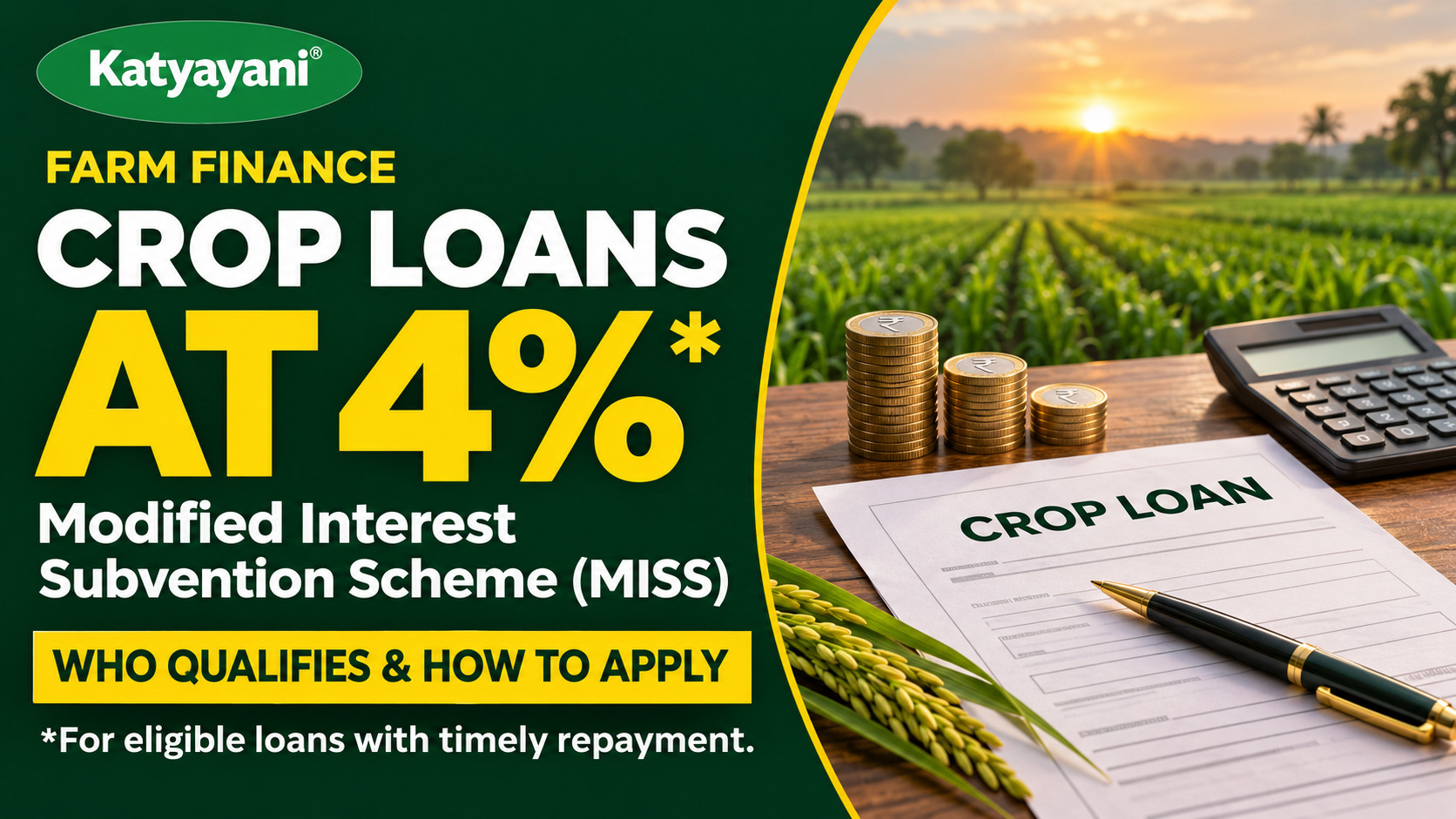
The Modified Interest Subvention Scheme (MISS) is a central sector scheme that makes short-term Kisan Credit Card loans cheaper. For 2025-26, the Cabinet decision and the RBI circular say farmers borrow at 7%, the government pays lenders 1.5% interest subvention, and farmers who repay in time get a further 3% prompt repayment incentive, which brings the effective rate to 4%. The RBI circular sets an overall limit of Rs 3 lakh, with at most Rs 2 lakh for farmers who have only allied activities; the Budget announced Rs 5 lakh (see the limit section). The incentive does not apply to loans repaid after one year. The notices I read cover 2025-26, so ask your bank what applies to your loan now.
What is the Modified Interest Subvention Scheme (MISS)?
MISS is a Government of India scheme that lowers the interest cost of short-term farm loans taken on a Kisan Credit Card. The Cabinet decision calls it a Central Sector Scheme aimed at making short-term credit available to farmers at an affordable rate. The government pays part of the interest to the lender, and rewards timely repayment.
The Cabinet decision of 28 May 2025 approved continuing the Interest Subvention component for the financial year 2025-26 and approved the fund arrangements. It also says no changes were proposed in the structure or other components of the scheme. The same decision says there are more than 7.75 crore KCC accounts in the country.
So the scheme is not a new loan product. It sits on top of the normal KCC loan. If you have read the Kisan Credit Card guide, think of the card as the loan account and MISS as the interest support that the government attaches to it.
How does a KCC crop loan end up at 4% interest?
Three numbers build the 4%. The farmer lending rate is 7%. The government gives lenders 1.5% interest subvention, which is why 7% is possible. A farmer who repays in time gets a further 3% incentive. Seven minus three leaves an effective 4%. The official texts use exactly this arithmetic.
| Step | Number | Who it is for | Source |
|---|---|---|---|
| Farmer lending rate, 2025-26 | 7% | The farmer, on the KCC short-term loan | RBI circular and Cabinet decision |
| Interest subvention | 1.5% | The lending institution (paid by the government) | RBI circular and Cabinet decision |
| Prompt repayment incentive (PRI) | Up to 3% | The farmer, for repaying in time | RBI circular and Cabinet decision |
| Effective rate after PRI | 4% | The farmer who repays in time | Cabinet decision |
The Cabinet decision words it this way: farmers who repay promptly are eligible for an incentive of up to 3%, effectively reducing their interest rate on KCC loans to 4%. The words "up to" matter. The 3% is a reward, so it is not automatic for every loan.
What is interest subvention, and who actually receives the 1.5%?
Interest subvention means the government pays part of the interest so that the borrower can be charged less. Under MISS, the 1.5% is paid to the lending institution. The farmer never receives the 1.5% in hand. The farmer sees it only as a lower lending rate of 7%.
The Cabinet decision says the 7% rate comes with 1.5% interest subvention provided to eligible lending institutions. It also gives the reason for keeping the rate at 1.5%: given lending cost trends and repo-rate movements, it is essential to support rural and cooperative banks and to keep low-cost credit available to farmers.
The RBI circular adds the calculation basis. It says the subvention is calculated on the loan amount from the date of disbursement. It runs from disbursement, drawal or renewal until repayment, or the tenure, due date or renewal date, whichever is earlier, subject to a maximum of one year.
What is the prompt repayment incentive (PRI)?
The PRI is an extra interest subvention of 3% per annum for farmers who repay their loan in time. The RBI circular describes it as an additional 3% provided to farmers repaying in time. It is the part of the scheme that moves the farmer from 7% to 4%.
The circular is specific on one limit. The benefit does not accrue to farmers who repay their agricultural loans after one year of availing them. The page also says the PRI runs from disbursement, drawal or renewal until repayment, tenure or due date, whichever is earlier, up to one year.
The documents do not explain how a branch passes the incentive on. A bank may charge 7% and credit the incentive later, or charge a lower rate from the start. Ask your branch which method it follows, and ask for it to be shown in your loan statement.
Worked example: what does a Rs 1,00,000 crop loan cost at 7% and at 4%?
On a Rs 1,00,000 short-term KCC loan held for a full year, 7% interest is Rs 7,000. A 3% incentive for repaying in time is Rs 3,000. The effective cost is Rs 4,000, which is 4%. This is plain arithmetic on the rates in the official documents. Your bank statement decides the final figure.
| Item | Rs 1,00,000 loan, one year | Basis |
|---|---|---|
| Interest at the 7% farmer lending rate | Rs 7,000 | 7% of Rs 1,00,000 |
| Prompt repayment incentive, 3% | Rs 3,000 | 3% of Rs 1,00,000, only if repaid in time |
| Effective interest after incentive | Rs 4,000 | 4% of Rs 1,00,000 |
| If repaid after one year | No PRI | RBI circular: benefit does not accrue after one year |
Two honest limits on this example. First, the documents tie the benefit to the period from disbursement until repayment, so a loan repaid sooner would carry interest for fewer days, and the exact day-count is your bank's calculation. Second, the example ignores any other charge the bank may take, because the documents I read do not discuss them.
Who is eligible for interest subvention under MISS?
The RBI circular and the Cabinet decision describe MISS as covering farmers who take short-term crop loans, and short-term loans for allied activities such as animal husbandry, dairy, fisheries and bee keeping, through the Kisan Credit Card. The farmer needs a KCC loan from a covered lender.
The documents do not list a land size, caste or income condition in the text I read. They do set conditions on the loan and the lender: a short-term loan under KCC, a covered lending institution, Aadhaar seeding and e-KYC, and only one KCC per land parcel getting the benefit. The next sections go through these.
For who can hold a KCC at all, use the eligibility section of the KCC guide and your bank's own form. This post does not restate it.
Which banks and societies give loans under MISS?
The RBI circular names four types of lenders: public sector banks, private sector banks (only for loans from their rural and semi-urban branches), small finance banks, and computerised Primary Agricultural Credit Societies (PACS) ceded with scheduled commercial banks, using their own resources.
| Lender type | Condition in the RBI circular |
|---|---|
| Public sector banks | Covered |
| Private sector banks | Covered for loans from their rural and semi-urban branches |
| Small finance banks | Covered |
| Computerised PACS | Covered when ceded with scheduled commercial banks, lending from their own resources |
If you borrow through a cooperative society, ask whether it is a computerised PACS ceded to a commercial bank. The circular also says PACS claims are uploaded separately by the sponsoring banks and only for loans without NABARD refinance, which is a bank-side rule, not a farmer task.
What is the maximum loan limit under MISS: Rs 3 lakh or Rs 5 lakh?
Official sources differ, so confirm with your bank. The Cabinet decision (28 May 2025) and the RBI circular (13 January 2026) work on a Rs 3 lakh limit. The Union Budget 2025-26 announced a rise to Rs 5 lakh, and a PIB note of 11 March 2026 says the limit has been enhanced to Rs 5 lakh.
The PIB summary of Budget 2025-26 (1 February 2025) says the Finance Minister announced an increase in the loan limit under MISS from Rs 3 lakh to Rs 5 lakh for loans taken through the KCC. The Cabinet decision of 28 May 2025 still describes loans of up to Rs 3 lakh at 7% and says no changes were proposed in the structure of the scheme.
The RBI circular of 13 January 2026, issued for 2025-26, gives an overall limit of Rs 3 lakh and a Rs 2 lakh allied sub-limit. The PIB backgrounder of 11 March 2026 says the loan limit under MISS has been enhanced to Rs 5 lakh, and in the same note it describes short-term loans up to Rs 3 lakh at 7% with an extra 3% for timely repayment, reducing the effective rate to 4%.
I did not find an official notice that gives the date from which the Rs 5 lakh limit applies to the 1.5% subvention. So the 7% and 4% figures in this post are safe for loans within Rs 3 lakh. For any part above Rs 3 lakh, ask the branch in writing which rate applies. The limit that counts is what the bank sanctions on your KCC.
The Cabinet decision also says that for loans taken exclusively for animal husbandry or fisheries, the interest benefit applies up to Rs 2 lakh, which matches the RBI sub-limit.
How do the Rs 3 lakh and Rs 2 lakh limits work with crop and allied loans?
The RBI circular gives five illustrations. The rule that comes out of them: crop loans get priority, the allied part counts only up to Rs 2 lakh, and the benefit applies to a combined amount of up to Rs 3 lakh. Amounts above those caps earn no MISS benefit.
| Case | Total loan | Crop part | Allied part | Amount that gets MISS benefit |
|---|---|---|---|---|
| I | Rs 2.5 lakh | Rs 1.5 lakh | Rs 1 lakh | Rs 2.5 lakh (Rs 1.5 lakh crop + Rs 1 lakh allied) |
| II | Rs 3 lakh | Rs 0.5 lakh | Rs 2.5 lakh | Rs 2.5 lakh (Rs 0.5 lakh crop + Rs 2 lakh allied) |
| III | Rs 4 lakh | Rs 1.75 lakh | Rs 2.25 lakh | Rs 3 lakh (Rs 1.75 lakh crop + Rs 1.25 lakh allied) |
| IV | Rs 4.5 lakh | Rs 2 lakh | Rs 2.5 lakh | Rs 3 lakh (Rs 2 lakh crop + Rs 1 lakh allied) |
| V | Rs 4 lakh | Rs 3.15 lakh | Rs 0.85 lakh | Rs 3 lakh, all crop; the allied part gets none |
Read case II carefully. A Rs 3 lakh limit with Rs 2.5 lakh of allied credit gets benefit on Rs 2.5 lakh: the allied part counts only up to the Rs 2 lakh sub-limit, and the Rs 0.5 lakh crop part is added to it. Cases III to V show the Rs 3 lakh overall cap at work. These illustrations are from the 2025-26 circular, so they use the Rs 3 lakh cap. The table is based on the illustrations on the RBI circular page. Ask your bank for the exact working on your account.
How long does the MISS benefit last: what is the one-year rule?
The subvention is counted from the day the loan is disbursed, drawn or renewed until the day it is repaid, or the tenure, due date or renewal date, whichever comes first, subject to a maximum of one year. The prompt repayment incentive does not reach farmers who repay after one year.
In practice this means a short-term loan should be treated as a one-year loan. If you plan to take the full year, repay or renew inside the year. The circular also uses the word renewal, so renewing the KCC limit on time starts a fresh period.
The documents do not say how a bank treats a loan that is repaid a few days late within the year. The wording speaks of repaying in time. Ask the branch for the due date written on your sanction letter, and plan to pay before that date.
What are the key MISS numbers for 2025-26 in one table?
For 2025-26 the official numbers are a 7% farmer rate, 1.5% subvention to lenders, up to 3% prompt repayment incentive, a 4% effective rate, a Rs 3 lakh overall limit, a Rs 2 lakh allied sub-limit, and a one-year maximum benefit period. Use this table as a checklist when you talk to the bank.
| Item | 2025-26 figure | Where it is stated |
|---|---|---|
| Farmer lending rate | 7% | RBI circular, Cabinet decision |
| Interest subvention to lenders | 1.5% | RBI circular, Cabinet decision |
| Prompt repayment incentive | Up to 3% | RBI circular, Cabinet decision |
| Effective rate for farmers who repay in time | 4% | Cabinet decision |
| Overall limit in the RBI circular | Rs 3 lakh (Budget announced Rs 5 lakh) | RBI circular, Cabinet decision, PIB |
| Allied activities sub-limit | Rs 2 lakh | RBI circular, Cabinet decision |
| Maximum benefit period | One year | RBI circular |
| Warehouse receipt loans (small and marginal farmers) | Up to six months after harvest | RBI circular |
Every row is for 2025-26. If a bank quotes a different number for the loan you are taking now, ask which notice it is following and note the answer in writing.
Is there any benefit for produce kept in a warehouse after harvest?
Yes, for small and marginal farmers. The RBI circular provides subvention for up to six months after harvest on loans against negotiable warehouse receipts, for produce stored in WDRA-accredited warehouses. The rate is the same as for crop loans, counted from the pledge date.
The purpose is to let a small farmer wait for a better price instead of selling straight after harvest. The condition is the warehouse: it must be accredited by the Warehousing Development and Regulatory Authority, and the receipt must be negotiable. If you want to use this route, ask the bank which warehouses it accepts before you store anything.
For the support-price side of selling, see the guide on rabi MSP crop-wise rates. It is a different scheme from MISS.
What happens to the subvention if a crop is lost in a natural calamity?
The RBI circular covers restructured loans after natural calamities. For ordinary calamities, subvention continues for the first year on the restructured amount, with normal interest from year two. For severe calamities, subvention is allowed for the first three years or the entire period, up to five years, along with the 3% PRI.
For severe calamities the circular says a High Level Committee decides, based on recommendations of the IMCT and SC-NEC. A farmer cannot trigger this alone. If your crop is damaged, talk to the bank early about restructuring. The PM Fasal Bima Yojana guide and the weather-based crop insurance post explain the insurance side separately.
What must the bank do before it can give MISS benefit?
The RBI circular sets bank-side conditions. Aadhaar seeding and authentication, and e-KYC, must be completed for every farmer. Multiple KCCs are allowed within the overall limit, but only one KCC for a land parcel gets MISS benefit, and it is the account with the highest sanctioned amount.
- Aadhaar seeding and authentication, and e-KYC for every farmer.
- Only one KCC per land parcel can receive MISS benefit: the account with the highest sanctioned loan amount.
- Banks should encourage digital channels, including RuPay cards.
- Beneficiary data, including social category, must be reported on the Kisan Rin Portal and not altered later.
- Crop data on the portal must be accurate or validation errors may follow.
For a farmer, the practical lesson is simple. Keep Aadhaar linked and your land and crop details correct at the branch. A wrong crop entry can create an error in the bank's claim. For identity data across schemes, see the post on AgriStack and the farmer ID.
How do banks claim the money, and what is the Kisan Rin Portal?
Banks upload MISS claims on the Kisan Rin Portal (KRP), certified by statutory auditors. The Cabinet decision says the portal, launched in 2023, has improved transparency and efficiency in claim processing. The claim is the bank's task, not the farmer's, but the data a farmer gives at the branch feeds it.
The RBI circular says claims must be uploaded on time and certified by statutory auditors. PACS claims are uploaded by the sponsoring banks. I could not open the portal home page for details, so this post does not describe screens or farmer logins. If a bank officer says your claim is stuck, ask which record is failing validation.
How to get a crop loan at 4%: a step-by-step list for the bank visit
There is no separate MISS application form in the documents I read. The scheme attaches to a short-term KCC loan. The steps below are practical advice built on the rules above, not an official procedure: confirm the loan type, the rate, the due date, how the incentive is shown, and then repay in time.
- Check that your lender is one of the covered types: public sector bank, private bank rural or semi-urban branch, small finance bank, or computerised PACS ceded with a commercial bank.
- Ask for a short-term crop loan or an allied-activity loan on your Kisan Credit Card, and see the KCC guide for the card and documents.
- Make sure Aadhaar seeding and e-KYC are done and that the land and crop entries are right.
- Ask in writing: what is the farmer rate, what is the due date, and how will the 3% incentive be shown?
- Note that the one-year limit counts from disbursement or renewal. Plan repayment before that.
- Repay in time, then ask for the statement that shows the incentive was applied.
If the bank charges more than the scheme rate without explaining, ask for the reason in writing. The documents I read do not give a farmer-facing complaint route, so use the bank's own grievance channel first.
What mistakes cost a farmer the 3% incentive?
The main mistake is repaying after one year, because the RBI circular says the benefit does not accrue to farmers who repay after one year. Other risks come from the loan setup: more than one KCC on the same land parcel, wrong crop data, or a lender that is not covered.
| Mistake | What the official text says | What to do |
|---|---|---|
| Repaying after one year | Benefit does not accrue to farmers who repay after one year | Repay or renew inside the year |
| Several KCCs on one land parcel | Only the account with the highest sanctioned amount gets MISS benefit | Ask which account the bank has tagged |
| Borrowing above the limit | Benefit counted up to the overall limit in the RBI circular (Rs 3 lakh) | Know which part earns the benefit |
| Wrong crop or personal data | Data must be accurate on the portal or validation errors may follow | Check your records at the branch |
| Using a lender outside the list | Only listed lenders are covered | Ask the branch if it is covered |
Is MISS available for 2026-27?
I found no official 2026-27 notice for MISS. The Cabinet decision (28 May 2025) and the RBI circular (13 January 2026) cover 2025-26. The scheme has been continued year by year, so ask your bank which terms apply to a loan taken now, and do not plan on last year's numbers alone.
The RBI circular itself refers back to its earlier circular of 6 August 2024 for 2024-25, which shows the pattern: the government approves continuation, and the RBI then informs banks. Rates and limits can change with each continuation.
RBI did issue new KCC Directions on 19 June 2026. The Commercial Banks KCC Directions apply to loans sanctioned from 1 January 2027; earlier loans stay under the existing rules until maturity or renewal. They do not name MISS. They tell banks to follow the instructions on interest subvention and prompt repayment incentives as applicable from time to time, and they allow banks to waive collateral on agricultural loans up to Rs 2 lakh per borrower.
RBI issued separate Directions of the same date for small finance banks, regional rural banks and rural co-operative banks, with the same 1 January 2027 start. Ask your branch which Directions govern your lender.
For other schemes and dates in one place, use the agri schemes calendar and the broader agriculture subsidy schemes guide. For farm credit beyond KCC, see the posts on SHG loans for agriculture and the FPO credit guarantee scheme.
How is MISS different from PM-Kisan and from a subsidy?
MISS lowers the interest on a loan you must repay. PM-Kisan is a direct income payment and not a loan. A subsidy on equipment reduces the price you pay. With MISS, you still borrow, and you still repay the principal. Only the interest cost is reduced.
The Cabinet decision gives context on why the loan side matters. It says institutional credit disbursement through KCC rose from Rs 4.26 lakh crore in 2014 to Rs 10.05 lakh crore by December 2024, and overall agricultural credit rose from Rs 7.3 lakh crore in FY 2013-14 to Rs 25.49 lakh crore in FY 2023-24. Payment status for PM-Kisan is a separate topic; see PM-Kisan installment status.
If your need is livestock, remember the allied-activity sub-limit. The National Livestock Mission post covers a different, capital-subsidy side.
Conclusion
MISS is a simple idea with several moving parts. The farmer lending rate is 7%, the government pays lenders 1.5%, and the farmer who repays in time earns a further 3%, which gives the 4% in the headlines. The Rs 3 lakh limit in those notices (with Rs 5 lakh announced in the Budget), the Rs 2 lakh allied sub-limit, the one-year rule, the covered lenders, the Aadhaar and e-KYC conditions and the one-KCC-per-land-parcel rule come from the Cabinet decision and the RBI circular I read, both for 2025-26. Before you borrow, ask your bank for the current year's rate, your due date and how the incentive will show in your statement, then repay in time.


Leave a Comment