
 16 min read
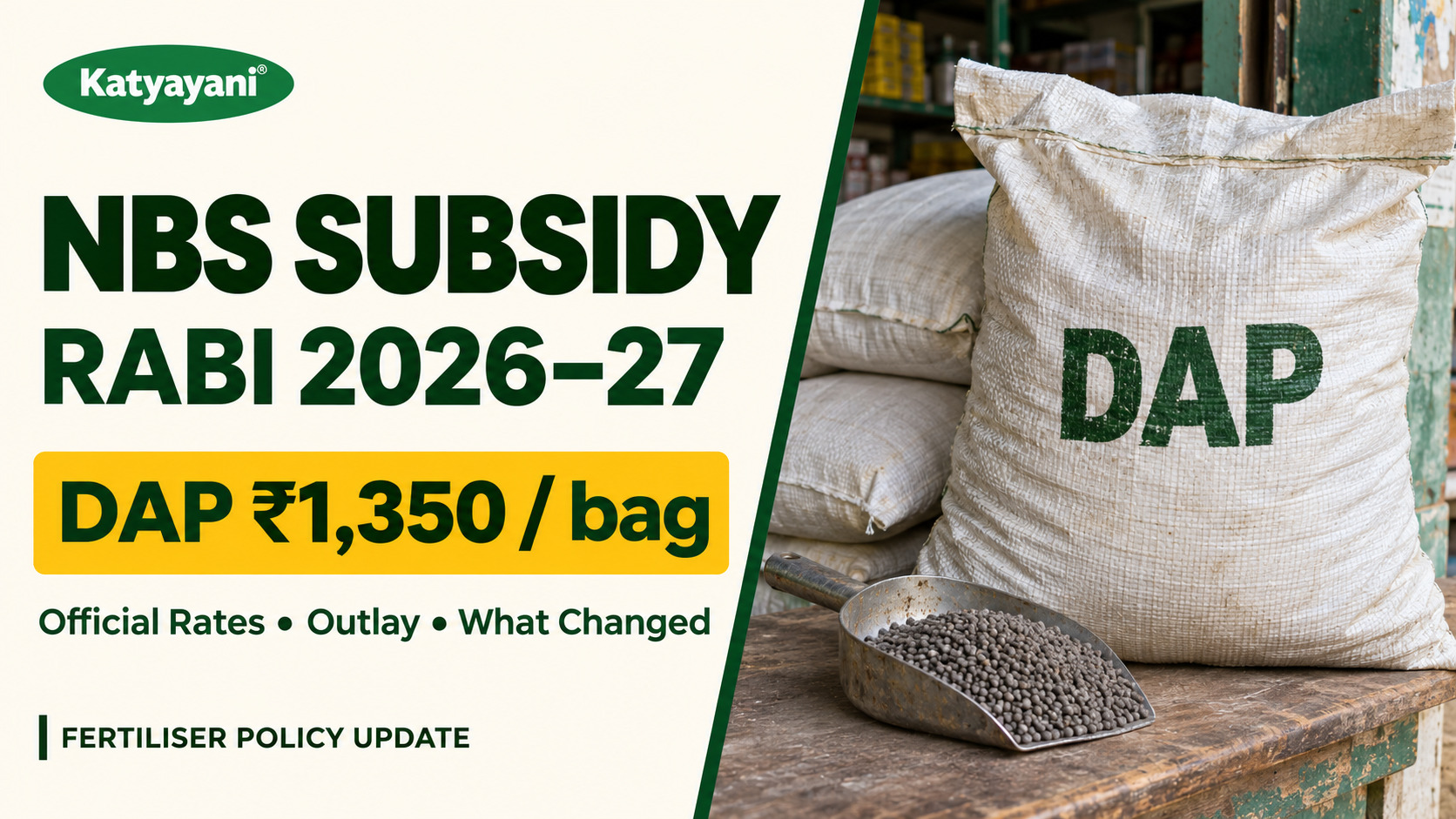
The Nutrient Based Subsidy (NBS) scheme pays fertiliser companies a fixed rupee amount per kg of nutrient in phosphatic and potassic (P&K) fertilisers. For Rabi 2026-27 (1 Oct 2026 to 31 Mar 2027) PIB gives these rates: nitrogen Rs 94.21, phosphate Rs 66.11, potash Rs 2.38 and sulphur Rs 10.42 per kg. The tentative outlay is about Rs 62,370.02 crore, against Rs 37,952.29 crore for Rabi 2025-26 (PIB, 11 and 12 Nov 2026). DAP stays at a fixed Rs 1,350 per bag (PIB, 12 Nov 2026). The subsidy goes to the companies at notified rates, and farmers receive the benefit when they buy.
What is the NBS subsidy?
The Nutrient Based Subsidy (NBS) is the Government of India scheme that pays fertiliser makers and importers a set rupee amount for each kilogram of nitrogen (N), phosphate (P), potash (K) and sulphur (S) in phosphatic and potassic (P&K) fertilisers. It started on 1 April 2010. Rates are decided twice a year, for the Kharif and Rabi seasons, for 28 grades.
PIB (12 Nov 2026) explains the idea in one line: subsidies are linked to the nutrient content of a fertiliser. The P&K sector is decontrolled. Makers and importers can fix the Maximum Retail Price (MRP) at a reasonable level, subject to government oversight, and PIB says farmers receive the benefit of the subsidy when they purchase these fertilisers.
So there are two different amounts to keep apart. One is the MRP printed on the bag, which you pay. The other is the NBS, which the Government pays the company. Urea is separate: it has its own Urea Subsidy Scheme, and PIB (27 Mar 2026) states the MRP of a 45 kg bag of urea as Rs 242, excluding neem-coating charges and taxes. The rest of this post is only about P&K fertilisers like DAP, MAP, TSP, NPK complexes and ammonium sulphate.
Why did the Government choose a nutrient-based system? The Rabi 2025-26 backgrounder says the scheme aims to promote balanced use of nitrogen, phosphorus, potassium and sulphur, so that farmers avoid over-dependence on any single fertiliser and keep soil healthy while productivity improves. It also says the scheme supports new and innovative fertilisers, including micronutrient-enriched products, and lets companies compete on quality and efficiency.
What did the Cabinet approve for Rabi 2026-27?
On 11 Nov 2026 the Union Cabinet approved NBS rates for Rabi 2026-27, valid from 1 October 2026 to 31 March 2027, for P&K fertilisers including DAP and NPKS grades. The tentative budget need is about Rs 62,370.02 crore. That is about Rs 24,417.73 crore more than the Rs 37,952.29 crore set for Rabi 2025-26.
| Point | What the official release says | Source and date |
|---|---|---|
| Decision date | 11 Nov 2026 | PIB Cabinet release, 11 Nov 2026 |
| Period | 1 Oct 2026 to 31 Mar 2027 | PM India copy of the release, 11 Nov 2026 |
| Fertilisers covered | Phosphatic and Potassic (P&K) fertilisers including DAP and NPKS grades; 28 grades | PIB Cabinet release |
| Tentative outlay, Rabi 2026-27 | About Rs 62,370.02 crore | PIB Cabinet release |
| Increase over Rabi 2025-26 | About Rs 24,417.73 crore more (Rabi 2025-26 was Rs 37,952.29 crore); "over 64% higher" in the backgrounder | PIB Cabinet release; PIB Backgrounder, 12 Nov 2026 |
| Reason given | Recent trends in the international prices of fertilisers and inputs such as urea, DAP, MOP and sulphur | PIB Cabinet release |
The word "tentative" matters. The Cabinet release calls the budget requirement "approximately" Rs 62,370.02 crore. The PIB backgrounder says the outlay is over 64% higher than the Rs 37,952.29 crore for Rabi 2025-26. PIB (28 Jul 2026) adds that NBS subsidy is provided on notified P&K fertilisers based on nutrient content and Point of Sale (PoS) sales.
The release also says what the decision is meant to do. It lists two benefits: that fertilisers stay available to farmers at subsidised, affordable and reasonable prices, and that the subsidy on P&K fertilisers is rationalised in view of recent trends in international prices of fertilisers and inputs. It adds that the subsidy is given to fertiliser companies as per approved and notified rates.
What are the NBS rates per kg for Rabi 2026-27, and how do they compare with last season?
PIB (12 Nov 2026) gives the Rabi 2026-27 subsidy as Rs 94.21 per kg of nitrogen, Rs 66.11 per kg of phosphate, Rs 2.38 per kg of potash and Rs 10.42 per kg of sulphur. Last season (PIB, 5 Jan 2026) the rates were Rs 43.02, Rs 47.96, Rs 2.38 and Rs 2.87. Potash is unchanged.
| Nutrient | Rabi 2025-26 (Rs per kg) | Rabi 2026-27 (Rs per kg) |
|---|---|---|
| Nitrogen (N) | 43.02 | 94.21 |
| Phosphate (P) | 47.96 | 66.11 |
| Potash (K) | 2.38 | 2.38 |
| Sulphur (S) | 2.87 | 10.42 |
Sources: PIB Backgrounder, 12 Nov 2026 for Rabi 2026-27 and the PIB Backgrounder PDF, 5 Jan 2026 for Rabi 2025-26. In words: the nitrogen, phosphate and sulphur rates are all higher this season, and the potash rate stays where it was.
Note where each number sits. The Cabinet release of 11 Nov 2026 gives the outlay but no per-kg rates. The per-kg table is in the PIB backgrounder issued the next day. When you quote a rate, name that backgrounder and its date.
How does a per-kg rate become the subsidy on a tonne of fertiliser?
The subsidy on a grade is built from its nutrient content. Take the percentage of each nutrient in the grade, apply it to a tonne, and pay the per-kg rate on each nutrient kilogram. A grade written as 18-46-0-0 means 18 percent nitrogen, 46 percent phosphate, no potash and no sulphur by weight. The nutrient parts are added to give the subsidy per tonne.
- Read the grade. For DAP, 18-46-0-0 means N 18, P 46, K 0, S 0 (percent by weight).
- Find the kilograms of each nutrient in one tonne of the fertiliser.
- Apply the per-kg rate for the season to each nutrient.
- Add the nutrient amounts. The total is the subsidy per tonne (Rs per MT) for that grade.
- A 50 kg bag carries one twentieth of the tonne figure.
A worked check with the official Rabi 2025-26 rates. One tonne of DAP (18-46-0-0) holds 180 kg of nitrogen and 460 kg of phosphate. At Rs 43.02 per kg and Rs 47.96 per kg, that is about Rs 7,744 plus Rs 22,062, which is about Rs 29,805. PIB printed Rs 29,805 per tonne for DAP in Rabi 2025-26, so the method matches the official figure. The same sum for MOP (60% potash) is 600 kg x Rs 2.38, which is Rs 1,428, again the PIB figure.
The official list shows this in practice. For Rabi 2025-26, PIB printed one per-tonne figure for each of the 28 grades. A grade with no potash or sulphur, such as DAP, gets its subsidy from N and P only. A grade like MOP (0-0-60-0), which has only potash, gets its subsidy from K only, and the potash rate has not moved. That is why the per-tonne figure for MOP in the Rabi 2025-26 table is small, Rs 1,428.
This post does not print a Rabi 2026-27 per-tonne figure for any grade. A per-tonne table for Rabi 2026-27 was not in any official page opened for this post, so only figures the Government has printed are used. Look for the Department of Fertilizers notification for those numbers.
What per-tonne subsidy did PIB print for the 28 grades in Rabi 2025-26?
The PIB backgrounder of 5 Jan 2026 printed the product-wise NBS rate for all 28 grades for Rabi 2025-26. DAP was Rs 29,805 per tonne, MAP Rs 29,671, TSP Rs 22,062 and MOP Rs 1,428. It also says the DAP subsidy was raised from Rs 21,911 per tonne in Rabi 2024-25. These are last season's numbers, shown for reference.
| Grade (Rabi 2025-26) | NBS rate printed by PIB (Rs per tonne) |
|---|---|
| DAP 18-46-0-0 | 29,805 |
| MAP 11-52-0-0 | 29,671 |
| NP 28-28-0-0 | 25,474 |
| NP 24-24-0-0 | 21,835 |
| NPS 24-24-0-8 | 21,835 |
| TSP 0-46-0-0 | 22,062 |
| NPK 14-35-14 | 23,142 |
| NPK 12-32-16 | 20,890 |
| NPK 14-28-14 | 19,785 |
| NPK 11-30-14 | 19,453 |
| NP 14-28-0-0 | 19,452 |
| NPS 20-20-0-13 | 18,569 |
| NP 20-20-0-0 | 18,196 |
| NPK 19-19-19 | 17,738 |
| NPK 10-26-26 | 17,390 |
| NPS 16-20-0-13 | 16,848 |
| NPK 9-24-24 | 15,953 |
| NPK 17-17-17 | 15,871 |
| NPK 16-16-16 | 14,938 |
| NPKS 15-15-15-09 | 14,262 |
| NPK 8-21-21 | 14,013 |
| NPK 15-15-15 | 14,004 |
| Ammonium sulphate 20.5-0-0-23 | 9,479 |
| Urea-SSP complex 5-15-0-10 | 9,088 |
| SSP 0-16-0-11 | 7,408 |
| SSP 0-16-0-11 (second row in the PDF; the text says SSP fortified with magnesium, zinc and boron was added from Kharif 2024) | 7,408 |
| MOP 0-0-60-0 | 1,428 |
| PDM 0-0-14.5-0 | 345 |
Source: PIB Backgrounder PDF, 5 Jan 2026. The PDF lists SSP 0-16-0-11 twice, as grade 3 and grade 28, at the same figure. Its text says SSP (0:16:0:11) fortified with magnesium, zinc and boron was one of three grades added from Kharif 2024, so the list has 28 rows.
The same backgrounder says that ammonium sulphate, both domestic and imported, was brought under NBS for Rabi 2025-26, and that P&K fertilisers fortified or coated with boron or zinc keep their subsidy and get an extra Rs 300 per tonne for boron and Rs 500 per tonne for zinc. It does not say these extras were restated for Rabi 2026-27, so they are not given as current.
What did the Rabi 2025-26 decision look like, for comparison?
The Rabi 2025-26 rates ran from 1 October 2025 to 31 March 2026. The PIB backgrounder of 5 Jan 2026 gives the tentative outlay as about Rs 37,952.29 crore, which it says was about Rs 736 crore higher than the requirement for Kharif 2025. That is a small step compared with the jump now approved for Rabi 2026-27.
The same document says the DAP subsidy was enhanced to Rs 29,805 per tonne for Rabi 2025-26, a substantial increase over Rs 21,911 per tonne in Rabi 2024-25. Its conclusion says the number of grades under NBS grew from 25 to 28, and names freight subsidy on SSP and the inclusion of potash derived from molasses (PDM) as steps to promote indigenous production.
On supply, the PIB note of 27 Mar 2026 printed the Rabi 2025-26 position up to 18 March 2026, in lakh tonnes. Urea had a requirement of 191.72, availability of 249.17 and DBT sales of 196.42. DAP had a requirement of 52.72, availability of 74.55 and DBT sales of 52.74. MOP had 15.17, 18.98 and 11.03. NPKS had 80.34, 114.66 and 66.35. The note says availability of urea, DAP, MOP and NPKS remained adequate in the ongoing Rabi 2025-26 season.
What is the subsidy on DAP in India, and how much does a farmer pay?
DAP has two layers of support. First comes the regular NBS on its nutrients. On top, a special provision keeps DAP at a fixed Rs 1,350 per bag (PIB, 28 Jul 2026 calls it a 50 kg bag for Kharif 2026). PIB (12 Nov 2026) says this provision continues in Rabi 2026-27 and has also been extended to imported and domestic TSP and imported MAP.
In Kharif 2026 the PIB note of 28 Jul 2026 gives the size of the extra support: Rs 3,500 per metric tonne over and above NBS, for imported and domestic DAP and imported TSP. It says this covers transport costs, international price swings, the GST part of the MRP and a reasonable return of 4 percent of net MRP. The 27 Mar 2026 note says the same Rs 3,500 applied in Kharif 2025 and Rabi 2025-26.
For Rabi 2026-27 the release says the provisions continue but does not print an amount. So this post does not attach any amount to the Rabi 2026-27 special provision.
| Layer | What it is | Source |
|---|---|---|
| Regular NBS | Rs per kg of N, P, K and S in the grade | PIB, 12 Nov 2026 |
| Special DAP provision | Keeps DAP at Rs 1,350 per bag; extended to TSP (imported and domestic) and MAP (imported) | PIB, 12 Nov 2026 |
| Other-costs support (Rs 3,500 per tonne) | Printed for Kharif 2025, Rabi 2025-26 and Kharif 2026. Not printed for Rabi 2026-27. | PIB, 27 Mar 2026 and 28 Jul 2026 |
| Urea | A separate scheme. MRP Rs 242 per 45 kg bag, excluding neem-coating charges and taxes | PIB, 27 Mar 2026 |
If DAP is short at your shop, you are not alone in asking what else works. The post on DAP alternative fertilizer works out how many bags of SSP, NPK, TSP or MAP replace one DAP bag. The causes of shortage are in DAP and urea shortage in India.
What was the NBS for Kharif 2026, and what do we know about its rates?
The Cabinet approved NBS rates for Kharif 2026 (1 April to 30 September 2026) on 8 April 2026. The tentative outlay was about Rs 41,533.81 crore, about Rs 4,317 crore more than the Rs 37,216.15 crore for Kharif 2025. The release does not print the per-kg rates, and none was found on an official page opened for this post.
That is why this post compares Rabi 2026-27 with Rabi 2025-26 and not with Kharif 2026. Both of those seasons have per-kg rates on a PIB page. Kharif 2026 has only its outlay on the PIB page opened for this post.
| Season | Period | Tentative outlay | Per-kg rates on an opened official page? |
|---|---|---|---|
| Kharif 2025 | 1 Apr to 30 Sep 2025 | Rs 37,216.15 crore | Not opened |
| Rabi 2025-26 | 1 Oct 2025 to 31 Mar 2026 | Rs 37,952.29 crore | Yes: N 43.02, P 47.96, K 2.38, S 2.87 |
| Kharif 2026 | 1 Apr to 30 Sep 2026 | Rs 41,533.81 crore | No |
| Rabi 2026-27 | 1 Oct 2026 to 31 Mar 2027 | Rs 62,370.02 crore | Yes: N 94.21, P 66.11, K 2.38, S 10.42 |
Sources: PIB, 8 Apr 2026 (Kharif 2026 outlay and Kharif 2025 comparison), PIB 11 and 12 Nov 2026 (Rabi 2026-27) and PIB 5 Jan 2026 (Rabi 2025-26). The Kharif 2026 release also says the Government made the decision in view of recent trends in international prices of fertilisers and inputs like urea, DAP, MOP and sulphur.
What is the fertiliser subsidy budget for FY 2026-27?
The Union Budget 2026-27 puts the Department of Fertilisers at Rs 1,70,944.53 crore net. Of this, urea subsidy is Rs 1,16,805 crore and the Nutrient Based Subsidy is Rs 54,000 crore (Budget Estimates, Notes on Demands for Grants, Demand No. 6). NBS Revised Estimate for 2025-26 was Rs 60,000 crore.
| Item (Rs crore, net) | Budget 2025-26 | Revised 2025-26 | Budget 2026-27 |
|---|---|---|---|
| Urea subsidy | 1,18,899.50 | 1,26,475.40 | 1,16,805.00 |
| Nutrient Based Subsidy (of which indigenous P&K Rs 34,000 and imported P&K Rs 20,000 in 2026-27) | 49,000.00 | 60,000.00 | 54,000.00 |
| Department of Fertilisers, total net | 1,56,502.44 | 1,86,630.63 | 1,70,944.53 |
Source: Union Budget 2026-27, Notes on Demands for Grants No. 6. Figures are as printed in the PDF, in Rs crore.
How does this sit with the Cabinet figures? The Budget Estimate for NBS for the whole of 2026-27 is Rs 54,000 crore. The Cabinet has separately approved a tentative requirement of Rs 41,533.81 crore for Kharif 2026 and Rs 62,370.02 crore for Rabi 2026-27. The two kinds of figure are built differently: one is a Budget line, the other is a seasonal requirement. For 2025-26 the Revised Estimate for NBS (Rs 60,000 crore) is higher than the Budget Estimate (Rs 49,000 crore). PIB does not say how the Cabinet figures and the Budget line relate.
The Budget table also shows where the NBS money goes. For 2026-27 the line for indigenous P&K fertilisers is Rs 34,000 crore and for imported P&K fertilisers Rs 20,000 crore. The same lines carry a transfer to and from the Oil Industry Development Fund of Rs 3,000 crore, which cancel out, so the net NBS line is the Rs 54,000 crore above.
Which 28 grades does NBS cover?
The scheme covers 28 grades of P&K fertilisers, including DAP, MOP, SSP, TSP, MAP, ammonium sulphate and many NPK and NPKS mixes. PIB (28 Jul 2026) says the number of grades has grown from 22 in 2021 to 28. The full Rabi 2026-27 list is in the Department of Fertilizers notification.
The Rabi 2025-26 PIB backgrounder lists the 28 grades with their per-tonne rates. These grades are in it:
| Group | Grades named in the official Rabi 2025-26 list |
|---|---|
| Phosphates | DAP 18-46-0-0; MAP 11-52-0-0; TSP 0-46-0-0; SSP 0-16-0-11 (plain and fortified, two rows) |
| Potash | MOP 0-0-60-0; PDM (potash from molasses) 0-0-14.5-0 |
| NP and NPS | NP 20-20-0-0; NP 24-24-0-0; NP 28-28-0-0; NP 14-28-0-0; NPS 20-20-0-13; NPS 16-20-0-13; NPS 24-24-0-8 |
| NPK complexes | NPK 10-26-26; 12-32-16; 14-28-14; 14-35-14; 15-15-15; 16-16-16; 17-17-17; 19-19-19; 8-21-21; 9-24-24; 11-30-14; NPKS 15-15-15-09 |
| Others | Ammonium sulphate 20.5-0-0-23; Urea-SSP complex 5-15-0-10 |
Ammonium sulphate was brought under NBS from Rabi 2025-26, per that backgrounder, and PIB (12 Nov 2026) says its subsidy continues in Rabi 2026-27. PDM, potash derived from molasses, was added to promote indigenous production, and the backgrounder notes freight subsidy on SSP for the same reason.
What special support continues beside the NBS rates?
PIB (12 Nov 2026) lists four items that continue in Rabi 2026-27: the fixed Rs 1,350 DAP price, now also covering TSP and MAP; the freight subsidy on Single Super Phosphate (SSP); the subsidy on ammonium sulphate; and a sulphur package for domestic makers of sulphur and sulphuric acid.
| Support | What PIB says for Rabi 2026-27 |
|---|---|
| DAP special provision | Continues so that DAP stays at a fixed Rs 1,350 per bag, beyond regular NBS; extended to imported and domestic TSP and to imported MAP |
| SSP freight subsidy | Continues. Aim: promote SSP as an affordable alternative to DAP |
| Ammonium sulphate | Subsidy on imported and domestically produced ammonium sulphate continues. PIB lists it as promoting an alternative to urea |
| Sulphur package | For domestic manufacturers only. Sulphur: 20% of actual procurement cost, floor price USD 800 per tonne. Sulphuric acid: 20% of actual procurement cost, floor price USD 266.67 per tonne |
The PIB backgrounder lists the key benefits of the Rabi 2026-27 rates in five lines: affordable fertilisers, a rationalised subsidy that follows international prices, a boost to domestic production, promotion of alternatives such as SSP for DAP and ammonium sulphate for urea, and support to farmers and food security by keeping input costs stable through the Rabi season.
Why did the rates change this season?
The Government's stated reason is the recent trend in international prices of fertilisers and inputs such as urea, DAP, MOP and sulphur (PIB, 11 Nov 2026). PIB does not give a nutrient-by-nutrient explanation. The table shows the effect: the nitrogen, phosphate and sulphur rates are higher, and the potash rate is the same as last season.
Sulphur is one of the four nutrients in the table. Grades that carry it include the NPS grades, SSP and ammonium sulphate in the official list above, and the sulphur rate is now Rs 10.42 per kg against Rs 2.87 last season. For one crop where sulphur is applied, see sulphur for mustard.
The Government has also backed domestic sulphur. The sulphur package for Rabi 2026-27 pays domestic makers of sulphur and sulphuric acid 20 percent of actual procurement cost, subject to the floor prices in the table above. It is a separate support from the per-kg NBS rates.
Will the NBS rate change the price on the bag at my shop?
The Cabinet release states the outlay but no farmer price. For DAP, PIB (12 Nov 2026) says the price stays fixed at Rs 1,350 per bag. For other P&K grades, makers set the MRP subject to government oversight, and each bag must show MRP and the subsidy per bag and per kg (PIB, 5 Jan 2026). Read the bag.
In plain terms, NBS is paid to the company at notified rates, and the farmer gets the benefit through the price paid at purchase. For DAP, PIB (12 Nov 2026) says the special provision is what keeps the price fixed at Rs 1,350 per bag. For the other grades, makers set the MRP subject to government oversight, as the next section lists.
| What you see at the shop | What it means | Source |
|---|---|---|
| MRP printed on the bag | The most you should pay for that bag | PIB, 5 Jan 2026: charging more than the printed MRP is an offence under the Essential Commodities Act, 1955 |
| Subsidy per bag and per kg printed on the bag | The NBS the Government pays the company on that bag | PIB, 5 Jan 2026 |
| DAP at Rs 1,350 per bag | The fixed DAP price under the special provision | PIB, 12 Nov 2026 |
| A PoS machine bill | The sale is recorded; NBS is paid on PoS sales | PIB, 28 Jul 2026 |
Dealers have duties around all this: a stock board, a bill for each sale and sale at or below the MRP. Those are covered in the sister post on fertiliser dealer licence compliance in this set. Dealer stock planning for the season is in agri input dealer stock list for rabi.
How does the Government watch prices, costs and supply under NBS?
The Rabi 2025-26 backgrounder lists the operating rules. Companies must send audited cost data so the Department of Fertilizers can judge whether the declared MRP is reasonable, and must report the MRP of every P&K grade regularly. Profit above the limit is treated as unreasonable and recovered. Supply is tracked online through iFMS.
| Rule | What PIB says (5 Jan 2026 unless noted) |
|---|---|
| Cost and MRP reporting | Companies submit audited cost data and report the MRPs of all P&K grades to the Department of Fertilizers |
| Profit margins | Up to 8% for importers, 10% for manufacturers and 12% for integrated manufacturers over the cost of production is reasonable; profit beyond the limit is recovered from the company. PIB (28 Jul 2026) cites guidelines dated 18 January 2024 |
| Display on the bag | Each bag must show the MRP and the applicable subsidy per bag and per kilogram |
| Overcharging | Charging more than the printed MRP is an offence punishable under the Essential Commodities Act, 1955 |
| Monitoring | The web-based Integrated Fertilizer Management System (iFMS) tracks distribution, movement and imports and the production of domestic units |
| Delivery | Manufacturers, marketers and importers of P&K fertilisers, including SSP makers, must move fertiliser to the retail point on a Freight on Road (F.O.R.) delivery basis |
| Supply planning | The Department of Fertilizers allocates quantities through a monthly supply plan; DA&FW and the Department hold weekly video conferences with State agriculture officials |
The same backgrounder describes iFMS as a platform with dealer registration, stock tracking, dealer search, a Management Information System and Direct Benefit Transfer (DBT) reports. In plain words, the PIB description is of a portal that tracks distribution and movement, with dealer registration and stock records.
PIB (28 Jul 2026) adds how demand is planned. DA&FW, with State Governments, assesses the State-wise and month-wise requirement before each season. It is projected through Zonal Conferences for Agricultural Inputs, based on gross cropped area, irrigated area, past fertiliser use and crop-wise nutrient advice linked to soil health. Imports are finalised well in advance, and the Railways give priority to fertiliser rakes.
What do the official stock and supply numbers say?
PIB (12 Nov 2026) says the total stock of major fertilisers was 235.21 lakh tonnes on 10 November 2026, against 173.46 lakh tonnes on 10 November 2025. DAP stock was 28.65 lakh tonnes, against 24.86 lakh tonnes a year earlier. The same release gives stock for urea, NPKs, MOP and SSP.
| Product | Stock on 10.11.2025 (lakh tonnes) | Stock on 10.11.2026 (lakh tonnes) |
|---|---|---|
| Urea | 72.14 | 103.12 |
| DAP | 24.86 | 28.65 |
| NPKs | 42.44 | 60.87 |
| MOP | 10.78 | 20.08 |
| SSP | 23.24 | 22.49 |
| Total | 173.46 | 235.21 |
Source: PIB Backgrounder, 12 Nov 2026. The release says the overall stock rose by about 35.6 percent over the previous year. Stock is a national figure. A village shop can still run short if its own supply is late, a point the post on DAP shortage explains with its own reading of the official figures.
For the full year, PIB (28 Jul 2026) printed all-India figures for FY 2025-26 in lakh tonnes, as requirement, availability and DBT sales. These are official and are copied as printed.
| FY 2025-26 (lakh tonnes) | Requirement | Availability | DBT sales |
|---|---|---|---|
| Urea | 381.45 | 450.79 | 396.60 |
| DAP | 110.42 | 121.72 | 100.80 |
| MOP | 26.82 | 30.58 | 22.56 |
| NPKS | 158.49 | 198.97 | 150.37 |
The Rabi 2026-27 season has just begun, so no season-end table exists yet. PIB (28 Jul 2026) says availability of urea, DAP, MOP and NPKS was maintained across all States and Union Territories during FY 2025-26, with State-wise details in the release.
What has the NBS scheme achieved so far, according to PIB?
PIB reports that between 2022-23 and 2025-26 the Government disbursed over Rs 2.79 lakh crore as NBS subsidy for indigenous and imported P&K fertilisers (12 Nov 2026). The earlier backgrounder (5 Jan 2026) said over Rs 2.04 lakh crore was allocated for 2022-23 to 2024-25, so the two numbers cover different years and different wording (disbursed and allocated).
On production, the 5 Jan 2026 backgrounder says domestic output of DAP and NPKS fertilisers rose from 112.19 lakh tonnes in 2014 to 168.55 lakh tonnes in 2025 (up to 30 December 2025). On yields, it says foodgrain yield rose from 1,930 kg per hectare in 2010-11 to 2,578 kg per hectare in 2024-25. The PIB note of 10 Mar 2026 says domestic P&K production rose from 159.54 lakh tonnes in 2014-15 to 211.22 lakh tonnes in 2024-25. The two production series use different bases, so they are not placed side by side.
On imports, the PIB note of 10 Mar 2026 says DAP imports from China were 22.28 lakh tonnes in 2023-24 and 8.47 lakh tonnes in 2024-25. It also names long-term agreements for annual quantities of 31 lakh tonnes from Saudi Arabia, 30.10 lakh tonnes from Russia and 25 lakh tonnes from Morocco, expected to strengthen supply during 2025-26. Where India buys its fertiliser is explained in top fertiliser importing countries.
The same note lists steps taken to cut dependence on imported phosphatic fertilisers: guidelines of 18 January 2024 on the reasonableness of MRP for P&K fertilisers, recognition of new and expanded manufacturing capacity under NBS, an increase in grades from 22 to 28, freight subsidy on SSP continued since Kharif 2022, and extra subsidy for SSP fortified with zinc, boron and micronutrients.
What can a farmer do if DAP is not available or the price feels high?
Do not panic buy. Look at the Soil Health Card to see what the field needs, ask for the printed MRP and a bill, and if DAP is short look at SSP, TSP, MAP or NPK complexes that supply phosphate. The Government itself promotes SSP as an alternative to DAP (PIB, 12 Nov 2026).
- Use the Soil Health Card to see the phosphorus and sulphur levels in your field before you choose a grade.
- Work out bags with the table in DAP alternatives compared, which gives the bags of each replacement per bag of DAP.
- Nano fertiliser claims should be read separately. See nano urea and nano DAP for what trials show.
- Learn which schemes sit beside this one in agriculture subsidy schemes in India.
- If a shop ties another product to your fertiliser sale, note it down. The PIB notes of 2026 say States can act against tagging.
Powder and liquid fertilisers sold for foliar or drip use work on a different cost basis, which the post on water-soluble vs granular fertiliser works through.
Which mistakes do people make when they read NBS news?
The common mistakes are: reading the outlay as the price, attaching the Rs 3,500 special amount to a season that did not print it, quoting per-kg rates without naming the PIB backgrounder and expecting the shelf price to drop. Each is easy to avoid by going back to the PIB line.
| Mistake | What is actually printed | Fix |
|---|---|---|
| "NBS is Rs 62,370 crore, so DAP will be cheaper" | The release states the outlay and no farmer price. DAP stays at Rs 1,350 per bag. | Read the MRP on the bag, not the outlay. |
| Attaching Rs 3,500 per tonne to Rabi 2026-27 | The Rs 3,500 was printed for Kharif 2025, Rabi 2025-26 and Kharif 2026. For Rabi 2026-27 the release says the provisions continue but gives no amount. | Use only amounts printed for the season. |
| Quoting a growth figure without a base | PIB says over 64% higher than Rabi 2025-26 (Rs 37,952.29 crore). | Name the base season. |
| Quoting per-kg rates without a source | PIB Backgrounder, 12 Nov 2026 gives N 94.21, P 66.11, K 2.38, S 10.42. | Cite PIB and the date. |
| Thinking the farmer gets the NBS in the bank | The subsidy is paid to fertiliser companies at notified rates. | It reaches you as the MRP. |
| Comparing Kharif 2026 and Rabi 2026-27 per-kg rates | Kharif 2026 per-kg rates were not on any official page opened for this post. | Compare with Rabi 2025-26, which is official. |
| Quoting a per-tonne DAP subsidy for Rabi 2026-27 from memory | A per-tonne table for Rabi 2026-27 was not on any official page opened for this post. PIB printed Rs 29,805 for Rabi 2025-26. | Use the notified table for the season you mean. |
To read the official rates yourself, read the PIB backgrounder for the season, and look on the Department of Fertilizers site at fert.gov.in for the NBS notification for that season.
Conclusion
The NBS subsidy for Rabi 2026-27 is easy to state and often misquoted. PIB gives Rs 94.21 for N, Rs 66.11 for P, Rs 2.38 for K and Rs 10.42 for S per kg, valid from 1 October 2026 to 31 March 2027, with a tentative outlay of about Rs 62,370.02 crore. DAP stays at Rs 1,350 a bag. The farmer never receives this money directly. It reaches you as the price on the bag, so read the MRP and the subsidy line printed there. For any figure you quote, name the PIB release and its date.




Leave a Comment