
 14 min read
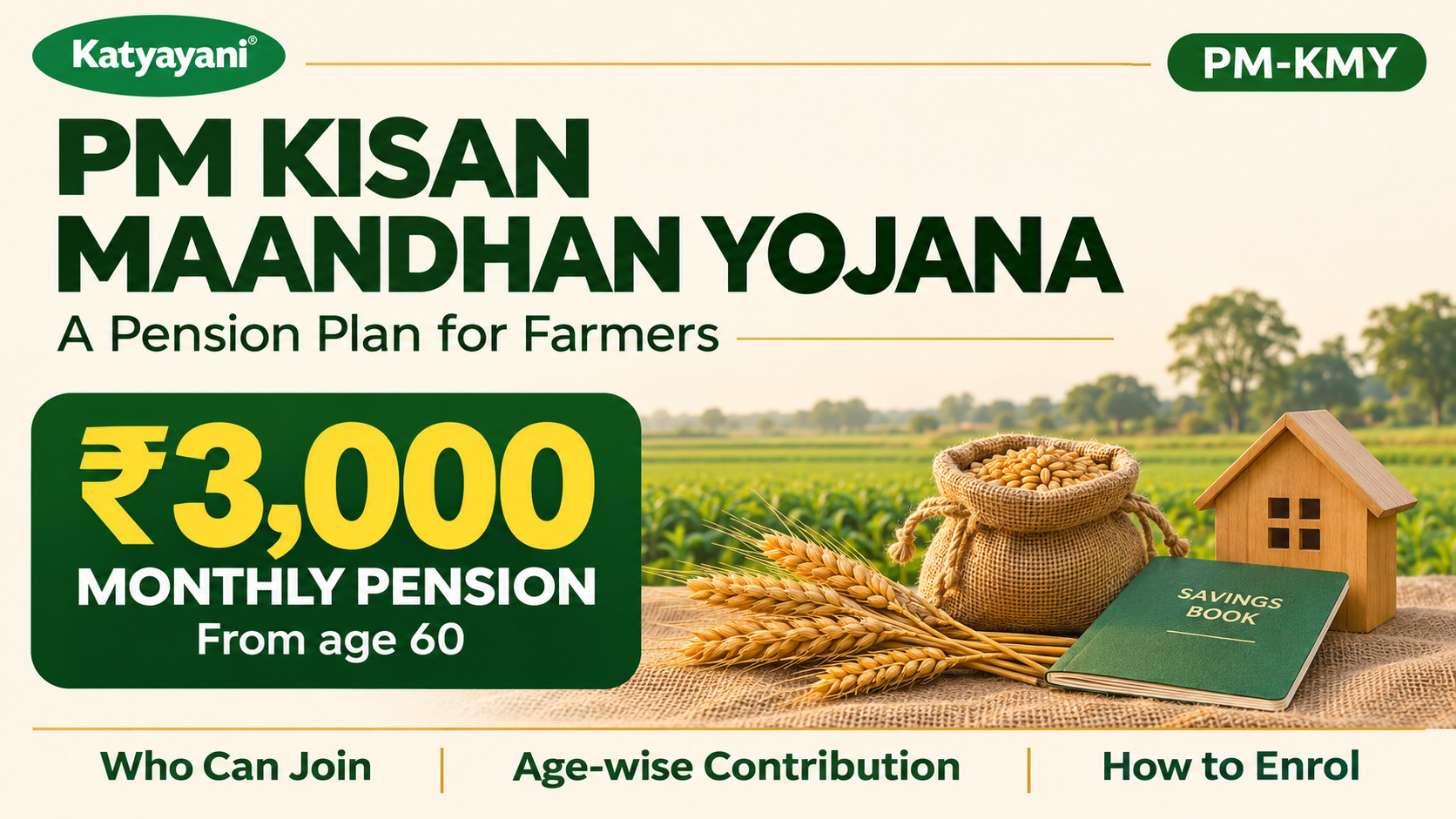
PM Kisan Maandhan Yojana (PM-KMY) is a voluntary pension scheme of the Department of Agriculture and Farmers Welfare for small and marginal farmers. You can join between age 18 and 40 if you hold up to 2 hectares of cultivable land and are not in an excluded group. You pay a fixed monthly amount that depends on your age at entry, from Rs 55 to Rs 200, and the Central Government puts in an equal amount. From age 60 you get a minimum pension of Rs 3,000 a month, and your spouse gets 50% as family pension. LIC is the pension fund manager. You enrol at a Common Service Centre with Aadhaar and bank details. As per PIB (11 Sep 2026) and the Lok Sabha reply of 10 Feb 2026, 24,96,252 farmers had enrolled by 6 Feb 2026.
What is PM Kisan Maandhan Yojana and who runs it?
PM Kisan Maandhan Yojana, short name PM-KMY, is an old-age pension scheme for small and marginal farmers. It is voluntary and contributory. The Department of Agriculture and Farmers Welfare runs it as a Central Sector Scheme, and the Life Insurance Corporation of India (LIC) is the pension fund manager and pays the pension.
The PIB backgrounder of 11 September 2026 says the scheme was launched on 12 September 2019 and marked seven years on 12 September 2026. The pmkmy.gov.in portal carries the line "Ministry of Agriculture & Farmers Welfare, Government of India" and is developed by Common Service Centres (CSC), which handle enrolment.
| Item | What the official pages say | Source |
|---|---|---|
| Full name | Pradhan Mantri Kisan Maandhan Yojana (PM-KMY) | pmkmy.gov.in scheme page |
| Type | Voluntary and contributory pension scheme; Central Sector Scheme | Operational Guidelines; PIB 11 Sep 2026 |
| Administered by | Department of Agriculture and Farmers Welfare, Ministry of Agriculture and Farmers Welfare | PIB 11 Sep 2026 |
| Pension fund manager | Life Insurance Corporation of India (LIC) | FAQ page; Guidelines |
| Enrolling agency | Common Service Centres (CSC); State Nodal Officers as an alternative | FAQ page; Guidelines |
| Entry age | 18 to 40 years | Scheme page |
| Assured pension | Rs 3,000 a month after age 60 | Scheme page |
Why does a farmer pension scheme matter for small farmers?
A farmer has no retirement date and often no pension. The Operational Guidelines say farming becomes hard at an advanced age and small and marginal farmers have little or no savings for old age. PM-KMY tries to fill that gap with a fixed monthly pension that starts at 60, so an older farmer is not fully dependent on children or on hired work.
Think of a farmer in his late twenties who owns one hectare. Every rupee goes to seed, fertiliser and school fees, so nothing is set aside for old age. A small monthly debit that the Government matches rupee for rupee builds something for later without a lump sum. The Guidelines add that income and price support already existed, but an old-age net was missing. For those other supports, see the live guide on agriculture subsidy schemes in India lists them, and the agri schemes calendar.
Who can join PM Kisan Maandhan Yojana?
A small or marginal farmer aged 18 to 40 can join. You must hold cultivable land of up to 2 hectares as per the land records of your State or Union Territory, and you must not fall in any excluded group. You also need an Aadhaar card and a savings bank account or the account where PM-KISAN money arrives.
The scheme page says all small and marginal farmers with up to 2 hectares in the age group 18 to 40, whose names appear in the land records of the States and Union Territories as on 1 August 2019, are eligible. The FAQ page repeats that 1 August 2019 is the cut-off date for determining eligibility. The PIB note of 11 September 2026 repeats it.
The Operational Guidelines define a small and marginal farmer as a farmer who owns cultivable land up to 2 hectares as per land records. The FAQ page adds two plain rules. A farmer who owns more than 2 hectares does not get the benefit. A person with no land in his own name does not get it either, because land holding is the test. The pages opened do not say how land bought or inherited after 1 August 2019 is treated, so ask the CSC.
| Condition | What the official pages say |
|---|---|
| Entry age | 18 to 40 years |
| Land | Cultivable land up to 2 hectares as per land records of the State or UT |
| Land record date | Name in land records as on 1 Aug 2019 (scheme page, FAQ, PIB 11 Sep 2026) |
| Gender | Male and female farmers can both join (Operational Guidelines; PIB 11 Sep 2026) |
| Documents to hold | Aadhaar card; savings bank account or PM-KISAN account (scheme page) |
| Not allowed | Anyone in an excluded group, listed in the next section |
Who cannot join PM-KMY? The exclusion list in plain words
Farmers already covered by NPS, ESIC or EPFO, farmers who opted for PM-SYM or PM-LVM, institutional land holders, income tax payers, registered professionals, serving or retired government officers (except multi-tasking, Class IV and Group D staff), and holders of high public posts cannot join PM-KMY. The list is the same on the scheme page and in the Guidelines.
| Excluded group | Detail as written on the official pages |
|---|---|
| Covered by other statutory social security | National Pension Scheme (NPS), Employees' State Insurance Corporation scheme, Employees' Provident Fund Organisation scheme and similar |
| Opted for a Labour Ministry pension | Pradhan Mantri Shram Yogi Maandhan Yojana (PM-SYM) or Pradhan Mantri Laghu Vyapari Maandhan Yojana (PM-LVM; named Vyapari Maandhan on the portal) |
| Institutional land holders | All institutional land holders |
| Constitutional post holders | Former and present holders of constitutional posts |
| Public representatives | Former and present Ministers and State Ministers, Members of Lok Sabha, Rajya Sabha, State Assemblies and Councils, Mayors of Municipal Corporations and Chairpersons of District Panchayats |
| Government and public sector staff | Serving or retired officers and employees of Central and State Government offices, PSEs and autonomous bodies, and regular employees of local bodies. Multi Tasking Staff, Class IV and Group D employees are not excluded |
| Income tax payers | All persons who paid income tax in the last assessment year |
| Registered professionals | Doctors, engineers, lawyers, chartered accountants and architects registered with professional bodies and practising |
The Guidelines say the State or UT Government can certify eligibility on the basis of a self declaration by the farmer. If the declaration is wrong, the farmer is not eligible for the financial benefit. The FAQ page spells out what that means: the farmer gets back his own contributions without interest, and the Central Government's matching contribution is stopped.
How much do you pay every month? The official contribution table by entry age
The monthly contribution depends only on your age when you join. It runs from Rs 55 at entry age 18 to Rs 200 at entry age 40. The Central Government pays an equal amount into the pension fund. Superannuation age is 60 for every row. The table below is copied from the scheme page.
The table is on the pmkmy.gov.in scheme page and the same figures appear in the Operational Guidelines and in the PIB note of 11 September 2026. The last column is the sum of the two shares, as the page shows it.
| Entry age (years) | Superannuation age (years) | Member's monthly contribution (Rs) | Central Govt's monthly contribution (Rs) | Total monthly contribution (Rs) |
|---|---|---|---|---|
| 18 | 60 | 55.00 | 55.00 | 110.00 |
| 19 | 60 | 58.00 | 58.00 | 116.00 |
| 20 | 60 | 61.00 | 61.00 | 122.00 |
| 21 | 60 | 64.00 | 64.00 | 128.00 |
| 22 | 60 | 68.00 | 68.00 | 136.00 |
| 23 | 60 | 72.00 | 72.00 | 144.00 |
| 24 | 60 | 76.00 | 76.00 | 152.00 |
| 25 | 60 | 80.00 | 80.00 | 160.00 |
| 26 | 60 | 85.00 | 85.00 | 170.00 |
| 27 | 60 | 90.00 | 90.00 | 180.00 |
| 28 | 60 | 95.00 | 95.00 | 190.00 |
| 29 | 60 | 100.00 | 100.00 | 200.00 |
| 30 | 60 | 105.00 | 105.00 | 210.00 |
| 31 | 60 | 110.00 | 110.00 | 220.00 |
| 32 | 60 | 120.00 | 120.00 | 240.00 |
| 33 | 60 | 130.00 | 130.00 | 260.00 |
| 34 | 60 | 140.00 | 140.00 | 280.00 |
| 35 | 60 | 150.00 | 150.00 | 300.00 |
| 36 | 60 | 160.00 | 160.00 | 320.00 |
| 37 | 60 | 170.00 | 170.00 | 340.00 |
| 38 | 60 | 180.00 | 180.00 | 360.00 |
| 39 | 60 | 190.00 | 190.00 | 380.00 |
| 40 | 60 | 200.00 | 200.00 | 400.00 |
How to read it: find the row for your age on the day you enrol. A farmer who joins at 18 pays Rs 55 a month and the Government adds Rs 55. A farmer who joins at 29 pays Rs 100 and the Government adds Rs 100. A farmer who joins at 40 pays Rs 200 and the Government adds Rs 200. The amount does not change with the size of your land, so a farmer with half a hectare and one with two hectares pay the same at the same age.
You pay this amount until you reach 60. The FAQ page says a State or UT Government can choose to share a farmer's contribution, so ask your State agriculture office. The pages opened do not name any State that does.
How does the government matching contribution work, and where does the money go?
For every rupee you pay, the Central Government pays one rupee into the pension fund. LIC keeps the Government's share in a separate account and uses it, with the fund earnings, only to pay pensions on the vesting date. If a farmer leaves early, the Government's share does not go to him. It goes back to the pension fund.
The FAQ page says the Government's co-contributions "would not be paid to subscribers in case of pre-mature exits". Another rule farmers miss: if a farmer becomes ineligible later, the Government's contribution stops, but he can keep operating the account by paying the whole amount himself. At 60 he can withdraw his own contribution with interest equal to the prevailing savings bank rate.
The Lok Sabha reply of 10 February 2026 also gives a spending figure. It says there is no State-wise allocation of funds under PM-KMY, and that since 2019 a total of Rs 540.66 crore has been utilised for PM-KMY across the nation. The PIB note of 11 September 2026 repeats the same figure "as of February 2026".
How much pension will you get, and from what age?
The scheme gives a minimum assured pension of Rs 3,000 a month, and it starts when the subscriber turns 60. The amount is fixed in the scheme papers. The pension is paid into the subscriber's account every month. There is no provision to commute the pension, which means you cannot take a lump sum in place of it.
The scheme page says that once the applicant reaches 60, he or she can claim the pension and a fixed amount is deposited every month. The Operational Guidelines say plainly: "There is no provision for commutation of pension under any circumstances." The benefit is also personal. The Guidelines say it cannot be assigned, charged or handed over to anyone else.
What happens to your spouse if you die? Family pension and continuing the scheme
If the subscriber dies after the pension has started, the spouse gets 50% of the pension as family pension. On the Rs 3,000 pension that is Rs 1,500 a month, as the PIB note of 11 September 2026 states. It goes only to the spouse, and only if the spouse is not already a PM-KMY beneficiary. After both die, the corpus goes back to the fund.
If the subscriber dies before 60 after paying regularly, the spouse has a choice. The spouse can continue the scheme by paying the remaining contributions at the same rate, and the same pension is then payable to the spouse at the vesting date. Or the spouse can exit and take the subscriber's contributions with interest. The FAQ page says the interest is the fund interest earned or the savings bank interest, whichever is higher.
If there is no spouse, the subscriber's contributions with interest go to the nominee or nominees. The Guidelines say every subscriber must name the spouse or dependants as beneficiaries in writing, and the nomination can be changed at any time, online or at the CSC, without the nominee's consent. Check your nominee name when you enrol, because a wrong name can delay a claim later.
| Situation | What happens | Source |
|---|---|---|
| Subscriber dies after 60 (pension running) | Spouse gets 50% of the pension as family pension, if the spouse is not already a PM-KMY beneficiary | Scheme page; FAQ; PIB 11 Sep 2026 |
| Subscriber dies before 60, spouse alive | Spouse may continue by paying the remaining contributions, or exit with contributions plus interest | FAQ page; Guidelines |
| Subscriber dies before 60, no spouse | Subscriber's contributions with interest go to the nominee(s) | FAQ page; Guidelines |
| Both subscriber and spouse have died after vesting | The accumulated corpus is credited back to the fund | Scheme page; Guidelines |
| Subscriber becomes permanently disabled before 60 and cannot pay | Spouse may continue by paying contributions, or exit with the subscriber's share and interest | Scheme page |
How do you enrol in PM-KMY, step by step?
You enrol at your nearest Common Service Centre (CSC). Take your Aadhaar card, your bank passbook or account details with the IFSC code, and your mobile number. The Village Level Entrepreneur (VLE) at the CSC checks your Aadhaar details, fills the registration online, prints a mandate form for your signature, and then you receive a pension account number and a pension card.
The steps below follow the scheme page and the PIB note of 11 September 2026. The Operational Guidelines also allow enrolment through the State Nodal Officer, but the CSC route is the main one.
- Visit the nearest CSC. Carry Aadhaar, bank passbook or cheque book or a bank statement as proof of the account, and the mobile number you use.
- The VLE enters your Aadhaar number, name and date of birth as printed on Aadhaar, for authentication.
- The VLE fills the online registration: bank account details, mobile number, email address, spouse details if any, and nominee details.
- The system works out your monthly contribution from your age, using the table above. Check that the amount matches your row.
- You pay the first contribution to the VLE (cash or digital: see the box below). Ask for a receipt.
- An enrolment-cum-auto-debit mandate form is printed. You sign it, and the VLE scans and uploads it.
- The system generates a unique Kisan Pension Account Number (KPAN) and a pension card. Keep the card safe, because you need the number for any later change.
- Your data goes to LIC the next day. After that, the contribution is auto-debited from the bank account you named, on the chosen cycle.
Ask the CSC box. Three points differ between official pages, so confirm them at the counter and ask for a receipt. (1) First contribution: the scheme page says cash, the PIB note of 11 September 2026 says digital. (2) Fee: the FAQ page says enrolment is free for the farmer, and the Guidelines say the CSC charges Rs 30 per enrolment, which the Department reimburses. (3) Mobile number: the Guidelines call it optional, the PIB note lists it for OTP. Do not pay for the enrolment itself without asking which rule the CSC follows.
One practical point: name a bank account that keeps a balance on the debit date, because a failed debit counts as a default.
Which documents do you need, and does enrolment cost anything?
You need an Aadhaar card and proof of a bank account with the IFSC code. The mobile number is checked by OTP. No separate land paper is listed on the enrolment steps of the scheme page. The FAQ page says enrolment at a CSC is free of cost for the farmer or spouse, but the Guidelines mention a Rs 30 charge that the Department repays to the CSC.
The FAQ page says enrolment at a CSC is free of cost for the farmer or spouse. The Operational Guidelines say the CSC charges Rs 30 per enrolment and the Department reimburses it, so the Rs 30 is not meant to come from you. Later corrections may carry a fee: the FAQ page says details are validated "on the payment of the Amount / Fee as prescribed by the Government from time to time". The date of birth cannot be changed, so check it on day one.
| Item | What the official pages say | Source |
|---|---|---|
| Aadhaar card | Needed for authentication | Scheme page |
| Bank account proof with IFSC | Passbook, cheque book or bank statement | Scheme page, Step 2 |
| Mobile number | Verified by OTP; Guidelines call it optional | Guidelines; PIB |
| Nominee and spouse details | Captured during online registration | Scheme page, Step 5 |
| Enrolment fee for the farmer | Free of cost at CSC | FAQ page |
| Change of bank details later | Through CSC with PM-KMY number and Aadhaar; a government-set fee may apply; date of birth cannot be changed | FAQ page |
Can PM-KISAN money pay the PM-KMY contribution?
Yes, if you wish. A farmer who gets PM-KISAN can allow the monthly contribution to be debited straight from the PM-KISAN benefit. For that he signs an enrolment-cum-auto-debit mandate for the bank account where PM-KISAN money arrives. It is optional. A farmer who does not get PM-KISAN, or does not agree, names an ordinary bank account instead.
The FAQ page says the small and marginal farmers have the option to allow payment of the voluntary contribution from the financial benefits received under PM-KISAN directly. The PM-KISAN portal is the official site for that scheme. For the PM-KISAN payment itself, instalment dates and eKYC, see the live guide on PM-KISAN instalment status, and for the AI chatbot see Kisan e-Mitra.
The contribution is still your money, only taken from a payment you were going to receive. A delayed PM-KISAN credit can leave the account short on the debit date. The pages opened do not say what happens if PM-KISAN stops, so ask the CSC.
What if you miss a payment? Default, dormant account and how to restart
A failed auto-debit makes the account "in default". The demand is repeated on the next payment cycle. If nothing is paid for six months, the account becomes dormant and no more demands are raised. A dormant account can still be restarted by paying all dues with interest, even after three years, when the SMS alerts stop.
The Operational Guidelines explain the rules in detail. LIC raises demands on three payment cycles in a month, the 1st, 11th and 21st, and if one of those days is a holiday the next working day is used. If the debit fails on a cycle, the demand repeats on the next cycle for up to six months from the due date.
| Time since first unpaid contribution | What the Guidelines and FAQ say |
|---|---|
| Up to 1 month | No late fee. Pay the contribution amount only. Three payment-cycle demands are raised without interest |
| After 1 month | No interest on the instalment that fell due just before the payment cycle date. If older instalments are also pending, a late fee or savings bank interest is charged on them |
| Interest method | Simple interest if a particular instalment is late by up to 12 months. For longer delay, compound interest for completed years and simple interest for the rest |
| Rate | The rate on the payment-cycle date, as declared by the Government from time to time |
| 6 months unpaid | Account becomes dormant. No more demands are raised, SMS alerts or notices are sent for three years from the first unpaid contribution |
| After 3 years | Alerts stop. The farmer can still ask about status through the call centre or online and can restart by paying all dues with interest |
Keep your pension card and the bank statement showing each debit. The Guidelines say that in a dispute, the decision of LIC of India is binding on the subscriber.
Can you leave the scheme, and what do you get back?
Yes, you can exit. If you leave within ten years of joining, you get back only your own contributions with savings bank interest. If you leave after ten years but before 60, you get your own contributions with accumulated interest, the actual fund earnings or the savings bank rate, whichever is higher. The Government's share is not paid out.
These two rules are on the scheme page under "Benefits on Leaving the Pension Scheme". The Government's share stays in the pension fund. The Guidelines say the same: co-contributions and fund earnings are transferred back to the Pension Fund on a premature exit.
| When you exit | What you get back | Government share |
|---|---|---|
| Less than ten years from joining | Your own contributions with savings bank rate of interest | Not paid. Goes back to the pension fund |
| Ten years or more from joining, before age 60 | Your own contributions with accumulated interest actually earned by the fund, or savings bank interest, whichever is higher | Not paid. Goes back to the pension fund |
| Wrong declaration found | Your contributions back, without interest (FAQ page) | Government matching stops |
| You become ineligible but keep paying yourself | You may keep operating the account. At 60 you can withdraw your contribution with savings bank interest (FAQ page) | Government contribution (50%) stops |
The pages opened give no worked example of what a farmer holds in any year, so none is printed here. Before leaving, ask the CSC or LIC for your account statement.
How do you fix a mistake, change your nominee or raise a complaint?
For a wrong bank detail or other wrong entry, go to the CSC with your PM-KMY number and Aadhaar. The date of birth cannot be changed. You can change the nominee in writing, online or at the CSC, at any time. For a complaint, you can approach the CSC or LIC, or lodge it on the CPGRAMS portal. The PM-KMY helpline on the portal is 1800-3000-3468.
The portal home page shows the helpline 1800-3000-3468 and a support email at csc.gov.in. The Lok Sabha reply of 10 February 2026 says farmers can lodge grievances with the respective stakeholders or on the CPGRAMS portal. The reply gives year-wise grievances on CPGRAMS for PM-KMY: 2 in 2019-20, 1 each in 2020-21, 2021-22 and 2022-23, 2 in 2023-24, 12 in 2024-25 and 12 in 2025-26, all shown as resolved with none pending.
On disputed debits, the FAQ page puts the duty of recording correct details on the CSC and the duty of settling the dispute on LIC. Note the date and amount of the debit, keep a passbook entry, and go to the CSC first. The CSC portal lists the centres.
How many farmers have joined PM-KMY? Latest official figures and the state-wise table
As on 6 February 2026, 24,96,252 farmers had enrolled in PM-KMY, as per the Lok Sabha reply of 10 February 2026 and the PIB note of 11 September 2026. Haryana leads with 5,74,510 enrolments, followed by Bihar with 3,46,326. The latest official data found is dated 6 February 2026; no newer figure was found in an official page.
The Lok Sabha Unstarred Question No. 1656 was answered on 10 February 2026 by the Minister of State for Agriculture and Farmers Welfare, Shri Ramnath Thakur. It gave a State-wise annexure, "as on 06.02.2026", with a total of 24,96,252. The PIB backgrounder of 11 September 2026 describes the same count as "over 24.96 lakh" and rounds Haryana to around 5.75 lakh. The table below uses the exact figures from the reply.
| State or Union Territory | Farmers enrolled (as on 6 Feb 2026) |
|---|---|
| Andaman and Nicobar Islands | 522 |
| Andhra Pradesh | 32,426 |
| Arunachal Pradesh | 2,379 |
| Assam | 13,664 |
| Bihar | 3,46,326 |
| Chandigarh | 530 |
| Chhattisgarh | 2,02,913 |
| Delhi | 372 |
| Goa | 151 |
| Gujarat | 66,687 |
| Haryana | 5,74,510 |
| Himachal Pradesh | 3,582 |
| Jammu and Kashmir | 1,27,019 |
| Jharkhand | 2,53,459 |
| Karnataka | 73,662 |
| Kerala | 1,366 |
| Ladakh | 115 |
| Lakshadweep | 72 |
| Madhya Pradesh | 1,17,738 |
| Maharashtra | 80,769 |
| Manipur | 591 |
| Meghalaya | 751 |
| Mizoram | 306 |
| Nagaland | 1,186 |
| Odisha | 1,57,785 |
| Puducherry | 150 |
| Punjab | 13,062 |
| Rajasthan | 39,115 |
| Sikkim | 39 |
| Tamil Nadu | 1,10,669 |
| Telangana | 9,928 |
| The Dadra and Nagar Haveli and Daman and Diu | 287 |
| Tripura | 855 |
| Uttar Pradesh | 2,52,528 |
| Uttarakhand | 2,176 |
| West Bengal | 8,562 |
| Total (as printed in the reply) | 24,96,252 |
The spread is uneven: Haryana, Bihar, Jharkhand, Uttar Pradesh and Chhattisgarh lead, and many States show very small numbers. The reply gives no reasons, so none are guessed here.
PM-KMY or PM-SYM: how is the farmer pension different from the e-Shram pension scheme?
PM-KMY is for small and marginal land-holding farmers and is run by the Agriculture Ministry. PM-SYM (Pradhan Mantri Shram Yogi Maandhan) is a pension scheme of the Ministry of Labour and Employment for unorganised workers with monthly income of Rs 15,000 or less. A farmer cannot be in both: opting for PM-SYM excludes a farmer from PM-KMY.
The FAQ page on pmkmy.gov.in describes PM-SYM as a voluntary and contributory pension scheme for unorganised workers of entry age 18 to 40 with monthly income of Rs 15,000 or less, with a minimum monthly pension of Rs 3,000 after 60, and family pension of 50% for the spouse. The maandhan.in home page lists PM-SYM and the National Pension Scheme for Traders, both with entry age 18 to 40 and an assured pension of Rs 3,000 a month. The PM-KMY exclusion list names PM-SYM and PM-LVM as schemes that block a farmer from joining PM-KMY.
| Point | PM-KMY (farmers) | PM-SYM (unorganised workers) |
|---|---|---|
| Run by | Ministry of Agriculture and Farmers Welfare | Ministry of Labour and Employment |
| Who | Small and marginal farmers with up to 2 hectares of cultivable land | Unorganised workers with monthly income of Rs 15,000 or less, not covered by NPS, ESIC or EPFO and not income tax payers |
| Entry age | 18 to 40 | 18 to 40 |
| Pension | Minimum Rs 3,000 a month from 60 | Minimum Rs 3,000 a month from 60 |
| Family pension | 50% to the spouse | 50% to the spouse |
| Pension fund manager | LIC | Not stated on the pages opened |
| Can a farmer take both? | No. Opting for PM-SYM or PM-LVM excludes a farmer from PM-KMY | Same rule from the other side is not stated; follow the PM-KMY exclusion list |
The e-Shram portal pages on PM-SYM were not readable when this post was prepared, so how the two portals link is not described. A landless farm worker or a farmer with more than 2 hectares cannot join PM-KMY (FAQ page); PM-SYM is the scheme to ask about. Ask the CSC to check your income and cover.
What mistakes do farmers make with PM-KMY?
The common mistakes are joining without checking the exclusion list, giving a bank account that runs empty, not checking the contribution row for their age, not naming a proper nominee, and treating PM-KMY like PM-KISAN. Each one can stop the Government's matching share or lead to a default.
- Joining while excluded. An income tax payer, a person with NPS, ESIC or EPFO cover, or a serving government employee is not eligible. A wrong declaration means the Government's matching share stops and the farmer gets his own contributions back without interest.
- Giving an account that is often empty. A failed debit puts the account in default. Six months of unpaid contributions make it dormant.
- Not checking the amount. The CSC system works out the monthly amount from your age. Compare it with the table before you sign.
- A wrong date of birth. The Guidelines and FAQ say the date of birth cannot be changed at any time.
- No clear nominee. Name the spouse or dependants. Write the names exactly as on documents.
- Thinking the pension starts at once. The pension starts at 60, as per the scheme page.
- Expecting a lump sum. The Guidelines say the pension cannot be commuted.
- Missing the SMS alerts. The Guidelines say an SMS confirms each contribution where a mobile number is on record, so keep the number current.
What is new or changed in 2025-26 for PM-KMY?
The pages opened show no change in the rules. The entry age of 18 to 40, the land limit of 2 hectares, the Rs 3,000 pension and the Rs 55 to Rs 200 contribution table are the same on the pmkmy.gov.in scheme page and in the PIB note of 11 September 2026. What is new is the latest dated data: the enrolment figure as on 6 February 2026 and the seventh-anniversary note.
The newest official items found: the Lok Sabha reply of 10 February 2026 (24,96,252 enrolments as on 6 February 2026, Rs 540.66 crore utilised since 2019) and the PIB backgrounder of 11 September 2026, which marks seven years and repeats those figures.
| Item | Latest official statement found | Date |
|---|---|---|
| Enrolment | 24,96,252 farmers enrolled | As on 6 Feb 2026 (Lok Sabha reply, 10 Feb 2026) |
| Funds utilised | Rs 540.66 crore since 2019 | As of Feb 2026 (Lok Sabha reply; PIB 11 Sep 2026) |
| Seven-year note | Scheme marks seven years on 12 Sep 2026 | PIB, 11 Sep 2026 |
| Contribution table and eligibility | Same on the scheme page and the PIB note | Opened 17 Nov 2026 |
| Newer Parliament reply | None found on official pages | Searched 17 Nov 2026 |
Other farmer schemes run on dates and deadlines. For the wider picture, see the Kisan Diwas guide to central farmer schemes, and for loans against the same land, the guide on the Kisan Credit Card. If you need your land record to prove ownership, the guide to checking land records online and the guide on the AgriStack Farmer ID may help. Before you enrol, ask the CSC for the current rules, because the Government can update them.
Conclusion
PM Kisan Maandhan Yojana asks a small or marginal farmer aged 18 to 40 to pay a fixed monthly amount of Rs 55 to Rs 200, set by age at entry, while the Central Government pays the same amount. From 60, the farmer gets a minimum pension of Rs 3,000 a month and the spouse gets 50% after the farmer's death. You enrol at a CSC with Aadhaar and bank details, and LIC manages the fund. Check the exclusion list first, name a bank account that keeps a balance, check the date of birth and nominee, and keep your pension card. The latest official count found is 24,96,252 farmers as on 6 February 2026 (Lok Sabha reply, 10 February 2026).

Leave a Comment