
 14 min read
PMKSY is the Pradhan Mantri Krishi Sinchayee Yojana, India's irrigation scheme with the motto "Har Khet Ko Pani". Only one part, Per Drop More Crop, pays a farmer directly: 55% for small and marginal farmers and 45% for others, up to 5 hectares (PIB, 29 Aug 2026). As of 24 Nov 2026, official pages show approval for the other parts for 2021-26 only.
What is PMKSY and what does it do?
PMKSY is the Pradhan Mantri Krishi Sinchayee Yojana. It is a Government of India scheme to bring water to more fields and to use each drop well. Its motto, "Har Khet Ko Pani", means water for every field. The Cabinet Committee on Economic Affairs approved it in July 2015.
The PMKSY operational guidelines explain why. India had about 141 million hectares of net sown area, and only about 65 million hectares (45%) had irrigation when the scheme was framed. Fields that depend on rain carry more risk and give less. The PIB note of 29 August 2026 adds that farm irrigation uses more than 80% of India's available water, yet only about 50% of the net sown area is irrigated.
So PMKSY does two jobs. It builds irrigation sources and canals. It also pushes farmers to waste less water, mainly with drip and sprinklers.
The money comes in cycles. The PIB backgrounder of December 2021 says the Cabinet approved central support of Rs 37,454 crore to States during PMKSY 2016-21, and then Rs 93,068 crore for 2021-26. These are scheme-level figures. They do not tell you what reaches one village.
Who runs PMKSY, and which office does what?
No single office runs PMKSY. The PIB release of 21 July 2026 says the Ministry of Jal Shakti runs AIBP and Har Khet Ko Pani, and the Ministry of Rural Development runs Watershed Development. The About PMKSY page gives Per Drop More Crop to the Department of Agriculture and Farmers Welfare. So one scheme name has many offices behind it.
| PMKSY part | Run by (PIB, 21 Jul 2026, and the PMKSY portal) | What a farmer deals with |
|---|---|---|
| AIBP (Accelerated Irrigation Benefit Programme) | Department of Water Resources, River Development and Ganga Rejuvenation, Ministry of Jal Shakti | Central money for irrigation projects, given to States |
| Har Khet Ko Pani | Same department | Minor irrigation, water bodies, canal command area, groundwater |
| Watershed Development | Department of Land Resources, Ministry of Rural Development | Soil and water works on rain-fed and degraded land |
| Per Drop More Crop | Department of Agriculture and Farmers Welfare | Drip and sprinkler subsidy. This is the one you can claim. It sits under PM-RKVY since 2022-23 |
The portal also names the bodies that watch the scheme. A National Steering Committee under the Prime Minister supervises it. A National Executive Committee under the Vice Chairman of NITI Aayog tracks progress. In each State, a State Level Sanctioning Committee headed by the Chief Secretary approves projects.
For you, planning starts at the district. The PDMC guidelines say farmers are chosen as per the State Annual Action Plan, which is drawn from District Irrigation Plans. The portal adds that States also use State Irrigation Plans, and projects run at State level. Ask the district office what the annual plan covers for your block. The guidelines ask for more focus on rain-fed areas and on crops that use a lot of water.
What are the parts (components) of PMKSY?
PIB lists three components: AIBP, Har Khet Ko Pani and Watershed Development. The PMKSY portal menu still shows Per Drop More Crop (micro irrigation and other interventions) beside them, plus convergence with MGNREGA. The PIB backgrounder of 24 December 2021 says the first three were approved to continue during 2021-26. The PIB backgrounder of 30 June 2026 says Per Drop More Crop was a PMKSY component from 2015-16 to 2021-22 and has been part of PM-RKVY since 2022-23.
| Part | Plain meaning | Who benefits first |
|---|---|---|
| AIBP | Money to finish major and medium irrigation projects | Farmers in the canal command area |
| Har Khet Ko Pani | New small water sources, repair of water bodies, canal command works, groundwater | Areas that need water sources |
| Watershed | Soil and water works on rain-fed land | Rain-fed and degraded land |
| Per Drop More Crop: micro irrigation | Subsidy on drip and sprinkler | The individual farmer |
| Per Drop More Crop: other interventions | Farm-level water storage and similar work | Individual farmers or groups, based on local need |
AIBP is a central programme that gives money to irrigation projects. As the PMKSY guidelines say, it aims to finish ongoing major and medium irrigation projects faster, including national projects. It backs projects, not individual farmers.
The 2021 backgrounder sets the 2021-26 target. The plan was to create 13.88 lakh hectares of extra irrigation potential and finish 60 ongoing projects with 30.23 lakh hectares of command area. It also says central funding of 90% of the water component was given for two national projects, Renukaji Dam in Himachal Pradesh and Lakhwar in Uttarakhand.
The June 2026 backgrounder says AIBP has received Rs 21,023 crore of central assistance since 2016-17, benefiting 17.30 million farmers. It adds that in 2025-26 the government approved M-CADWM (Modernization of Command Area Development and Water Management) as a sub-scheme of PMKSY-AIBP, with an initial outlay of Rs 1,600 crore. It aims to bring water from major and medium projects to fields through piped and micro irrigation systems.
What does Har Khet Ko Pani pay for?
Har Khet Ko Pani pays for the work that brings water to the farm gate. The PMKSY guidelines list new minor irrigation sources, repair of water bodies, command area development, groundwater development and lifting water to dry areas. It is done through the same department that runs AIBP.
| Item in the guidelines | What it means |
|---|---|
| New minor irrigation sources, surface and ground water | Small tanks, ponds, wells and similar sources |
| Repair, restoration and renovation of water bodies | Old tanks and ponds that have silted up are brought back |
| Command area development | Channels from the source to the farm |
| Ground water development | Used where groundwater is plentiful, so extra rain water can be stored in a sink |
| Traditional systems | The guidelines name examples such as Khatri and Kuhl in Himachal Pradesh and Zabo in Nagaland |
The same backgrounder gives targets. Surface minor irrigation and repair of water bodies were to add 4.5 lakh hectares of irrigation. The ground water part, approved for 2021-22, aimed at 1.52 lakh hectares. For water bodies, central help was raised from 25% to 60% in general areas.
What is Per Drop More Crop, and why is it the part farmers claim?
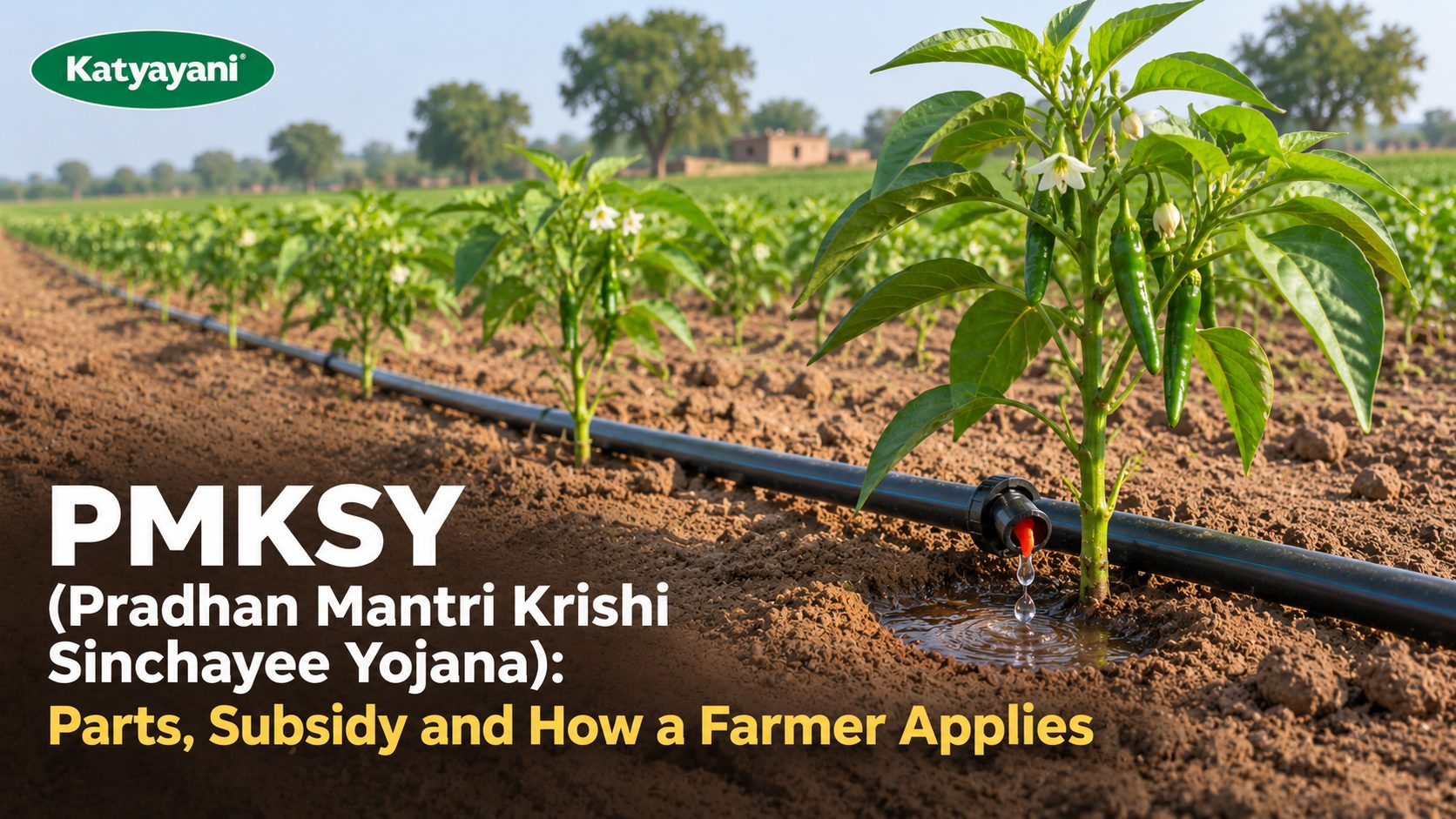
Per Drop More Crop (PDMC) gives a subsidy for micro irrigation, meaning drip and sprinkler systems. They put water near the plant roots and waste less. PDMC is the only part where an individual farmer applies and gets the subsidy in his bank account.
PDMC has changed homes over the years. The PIB note and the PMKSY micro irrigation page give this history.
| Period | What the scheme was called or where it sat |
|---|---|
| January 2006 | Centrally Sponsored Scheme on Micro Irrigation |
| 2010-11 | Upgraded to the National Mission on Micro Irrigation |
| 2014-15 | Moved into the National Mission on Sustainable Agriculture as "On Farm Water Management" |
| 2015-16 to 2021-22 | Per Drop More Crop, a core part of PMKSY |
| 2022-23 onward | Per Drop More Crop under PM-RKVY (Pradhan Mantri Rashtriya Krishi Vikas Yojana) |
The PMKSY portal's About page records Rs 4,043.38 crore for Per Drop More Crop in 2022-23. That is an old year, not a current budget.
PIB adds that PM-RKVY became an umbrella scheme in October 2024, and States may move funds between its components to suit local needs. For 2025-26, Rs 8,957.72 crore was released or sanctioned for PM-RKVY, including Rs 3,226.36 crore for PDMC.
How much subsidy do I get on drip and sprinkler under PMKSY?
Small and marginal farmers get 55% and other farmers get 45% of the approved cost of a drip or sprinkler system, up to 5 hectares per farmer. This is the central rate in the PIB note of 29 August 2026. Some States add more from their own budgets, so your State rate may be higher.
The PDMC guidelines 2024 explain who pays. The Centre and the State share the subsidy 60:40, except in the North Eastern and Himalayan States, where it is 90:10. In Union Territories the Centre pays all of it. The subsidy follows the unit costs in the guidelines, not the bill you pay.
| Rule | What the guidelines and PIB say |
|---|---|
| Subsidy rate | 55% for small and marginal farmers, 45% for other farmers |
| Area limit | Up to 5 hectares per beneficiary. The land may be in one place or many places |
| Cost sharing | 60:40 Centre to State. 90:10 in NE and Himalayan States. 100% Centre in Union Territories |
| Higher unit cost for subsidy sums | 25% higher in NE, Himalayan States, Jammu and Kashmir and Ladakh. 15% higher in States with low micro irrigation use |
| Payment | Direct Benefit Transfer. Aadhaar details are needed |
| Quality | Only BIS-marked systems and parts can be supplied |
Here is an example with made-up numbers, not a real quote. Say the approved unit cost of a drip system for your plot is Rs 1,00,000. A small farmer gets 55%, which is Rs 55,000. A farmer with larger land gets 45%, which is Rs 45,000. In a 60:40 State, the Rs 55,000 splits as Rs 33,000 from the Centre and Rs 22,000 from the State. If your bill is higher than the approved unit cost, you pay the extra.
Who can claim, and what limits apply?
Farmers, groups and institutions can claim, up to the 5 hectare ceiling. You need Aadhaar. If you took a subsidy, you can claim again on the same land only after 7 years, the projected life of the system. Leased land is allowed if you show a lease agreement of at least 7 years.
| Question | Answer from the PDMC guidelines 2024 |
|---|---|
| Can I claim again on the same land? | Only after 7 years, the projected life of a micro irrigation system |
| Is there an exception? | You may get the extra subsidy to change from sprinkler to drip on the same plot after at least 3 years |
| Can a tenant claim? | Yes, with a lease agreement for at least 7 years from the approval date |
| Is there an area ceiling? | Yes, 5 hectares per beneficiary in all |
| Is Aadhaar needed? | Yes. Aadhaar details must be linked through a web-based registration. Other papers are accepted only until Aadhaar is issued |
| Can I choose the company? | Yes. You buy from any maker on the State approved list of registered manufacturers |
The guidelines say manufacturers are registered for five years, and repeated failures can get them removed from the list. A company that is not on your State list is not a safe choice for subsidy.
How do I apply for the drip or sprinkler subsidy?
Apply through your State agriculture or horticulture department. The guidelines say enlisting of farmers should stay open round the year, and each State runs its own web portal. The central PDMC portal has a "State PDMC Link" page but no application steps, so start with your State page.
- Find your State PDMC or micro irrigation portal from the State PDMC Link on the central portal, or ask the block agriculture or horticulture office.
- Keep your Aadhaar, bank account details and, for leased land, the 7 year lease agreement ready. Your State portal lists any other papers.
- Register on the State portal and submit the application with your plot details and crop.
- Pick a company from the State approved list and get a design and cost estimate based on the crop and its spacing.
- Wait for the sanction. Pay your share to the company or the nodal agency, as your State rules say.
- The company installs the system. An official inspection follows, and then the subsidy comes by DBT.
The guidelines also set the job of the State office. It publicises the scheme at block and village level, names a nodal officer, shares the approved supplier list and rate list with farmers, and collects the applications. It then sends each one to the local office of the company you chose. The State decides whether you pay your share to the maker or to the nodal agency. You can buy from any maker on the approved list.
For a State-level walk-through, see our guide to the micro irrigation subsidy in Tamil Nadu. Steps and portal names differ by State, so use it as an example, not as a rule for yours.
Which drip and sprinkler systems does PDMC cover?
PDMC covers drip and sprinkler systems. Drip puts water on the root zone through small outlets. Sprinklers throw water through nozzles, like rain. Pick the type that matches your crop and plant spacing. The table follows the PIB note of 29 August 2026.
| System | What it is | Suits (as PIB describes) |
|---|---|---|
| On-line drip | A dripper is fitted at each plant on the pipe | Crops with uneven spacing |
| In-line drip | Drippers built into the pipe at fixed gaps | Water reaches all plants evenly |
| Micro sprinkler | Low-radius sprinkler | Leafy vegetables, nurseries, hardening of seedlings |
| Mini sprinkler | Larger radius than micro sprinkler | Groundnut, potato, onion, ginger, short fodder, frost protection |
| Portable sprinkler | Pipes can be shifted from place to place | Plains and uneven land |
| Rain-gun | Large volume sprinkler, 10,000 to 32,000 litres per hour, throw radius 24 m to 36 m | Large areas that need to be covered in a short time |
PIB also says PDMC supports fertigation, which means giving fertiliser with the irrigation water, and micro irrigation run from tube wells, river lift and solar pumps. If you plan a solar pump, read our guide to the PM-KUSUM solar pump subsidy too. The two schemes are separate, so check each one's rules.
What is the "Other Interventions" part, and can it pay for a farm pond?
Other Interventions is the second half of Per Drop More Crop. The PMKSY guidelines say it covers water storage and similar work at farm level. The PIB note says States and UTs can now use it for micro-level storage such as diggis (large farm water tanks) and water harvesting systems, for single farms or for groups.
The rules have changed. Earlier, spending on these works was capped at 20% of the total allocation in general States and UTs, and at 40% in North Eastern States, Himalayan States, Jammu and Kashmir and Ladakh. PIB says States can now go beyond those limits to suit local needs.
What your State offers, and at what rate, is the State's call. For one State's farm pond scheme, see our guide to the Krishi Bhagya farm pond subsidy. Do not assume your State has the same one.
Where does watershed development fit inside PMKSY?
Watershed Development is the part for rain-fed land, and the Department of Land Resources runs it. For 2021-26, the 2021 backgrounder says it aims to finish sanctioned projects on 49.50 lakh hectares of rain-fed and degraded land and bring 2.50 lakh hectares under protective irrigation.
Our full guide covers how these projects work, who pays and how a village joins: watershed development under PMKSY 2.0.
Is PMKSY still running in 2026-27?
As of 24 Nov 2026, official pages show approval for AIBP, Har Khet Ko Pani and Watershed Development for 2021-26 only (PIB, 24 December 2021). The PIB backgrounder of 30 June 2026 still gives 2021-26 as the approved period, and the PIB release of 21 July 2026 still lists all three as components. No page names an approval for 2026-27 or later. So we cannot say the scheme has ended, and we cannot say it has been renewed.
Money is still being set aside. The Union Budget 2026-27 gave Rs 6,587 crore to PMKSY (PIB, 30 June 2026). A Budget allocation is not a scheme approval. Per Drop More Crop is separate and runs under PM-RKVY.
The Lok Sabha reply of 21 July 2026 lists PDMC and PKVY as separate lines among the schemes of the Department of Agriculture and Farmers Welfare. For Bihar, it shows a 2026-27 PM-RKVY outlay with a PDMC line of Rs 104.16 crore. That is one State, not the national figure.
What to check before you apply:
- Ask your district horticulture or agriculture office if micro irrigation enlisting is open this year.
- Ask for your State rate, since some States add to the central 55% and 45%.
- Check the State portal for the current guideline and the list of approved suppliers.
- Ask which department handles your need. Per Drop More Crop is with agriculture or horticulture, canals and dams with irrigation, and watershed work with rural development.
- Do not buy a system before you get written approval. Our agriculture schemes calendar helps you track yearly windows.
How much area has PMKSY micro irrigation covered so far?
As of July 2026, PDMC has brought over 115 lakh hectares under micro irrigation, about 8.11% of India's net sown area, says the PIB note of 29 August 2026. In 2025-26, 12.30 lakh farmers benefited, and around 20% of them were women. Maharashtra, Karnataka, Andhra Pradesh, Tamil Nadu, Gujarat and Rajasthan covered the largest areas.
| Item | Figure in PIB note, 29 Aug 2026 |
|---|---|
| Area under micro irrigation since the scheme began | Over 115 lakh hectares (July 2026) |
| Share of net sown area | About 8.11% |
| Farmers benefited in 2025-26 | 12.30 lakh |
| Women among beneficiaries | Around 20% |
| Central assistance released in the last three years | Rs 8,123.24 crore |
| PDMC funds in 2025-26 under PM-RKVY | Rs 3,226.36 crore |
These are national totals. They do not tell you if your block has funds. They do show that micro irrigation still covers only a small part of India's net sown area.
What do studies say about the benefit of micro irrigation?
Studies report gains in water saving, cost and income, but the ranges are wide. PIB (29 August 2026) quotes a NITI Aayog evaluation of 2020-21 and the Economic Survey 2020-21. They are a few years old, so treat the numbers as past ranges, not a promise for your field.
| Study quoted by PIB | What it reported |
|---|---|
| NITI Aayog evaluation, 2020-21 | Income gains of 10% to 69%. Water use efficiency up by 30% to 70% |
| Economic Survey 2020-21 | Water savings of 20% to 48%. Energy savings of 10% to 17%. Labour cost down 30% to 40%. Fertiliser savings of 11% to 19%. Yield up 20% to 38% |
| IIM Ahmedabad study, 2023, six States | Farmers mostly adopt micro irrigation because groundwater is falling, to suit crop needs and for long-term benefit |
PIB also gives one farmer's case. A farmer in Palnadu, Andhra Pradesh, put drip and fertigation in his two-acre acid lime orchard. PIB says his yield rose from 90 to 105 quintals per acre, and his cost of cultivation fell from Rs 3.0 lakh to Rs 2.4 lakh. That is one farm, so do not use it to forecast your own.
Drip also works well with other water-saving practices, such as mulching.
What mistakes make a PMKSY claim fail?
Most failures come from papers and company choice. The usual ones are a lease shorter than 7 years, a claim on land that got subsidy within the last 7 years, and a system from a company that is not on the State list. Check each before you pay anything.
| Mistake | Rule behind it | What to do |
|---|---|---|
| Buying from any shop | Subsidy is for registered manufacturers on the State list, with BIS-marked parts | Pick a company from the State approved list |
| Short lease | Leased land needs a lease of at least 7 years from approval | Get a registered lease of 7 years or more before applying |
| Second claim too soon | Same land can claim again only after 7 years | Check the date of your last claim |
| Aadhaar not linked | DBT needs Aadhaar details linked through registration | Link first, then apply |
| Claiming on more than 5 hectares | Ceiling of 5 hectares per beneficiary | Apply for 5 hectares or less in total |
| Applying outside the State process | The State agency compiles the applications, and enlisting is open round the year | Apply on the State portal or through the block office |
Keep every receipt and your application number. If the State portal is down or the page is old, go to the block or district office. The guidelines make the State agency answerable for the process.
What must the company do before the subsidy is paid?
The company must design the system for your crop, install it with BIS-marked parts, train you, give a warranty and a user manual, and get your signed certificate of installation. The subsidy reaches your bank account only after the department checks the work.
The PDMC guidelines set these duties. The system must match the water need of the crop. Each field system should carry its own QR code, and the parts must show a date of manufacture. The subsidy is the lower of the set unit cost or the actual Bill of Quantities. To release it, you need a proper invoice with serial number and GSTIN, countersigned by the maker.
| Step | Who does it | What the guidelines say |
|---|---|---|
| Crop water need and design | Company | Assess the need for your crop and design to match it |
| Estimate | Company, then the State agency | The agency approves the estimate and issues a work order |
| Installation | Company | BIS-marked parts, date of manufacture printed, QR code on each field system |
| Training and warranty | Company | Training on running and care, a warranty and a user manual |
| Sign-off | You | You sign a certificate of successful installation |
| Payment | State agency | Released to your bank account after physical check |
Registered companies must also give free after-sales service for three years from installation, and keep service centres at the local level. The guidelines say the system may be insured for its expected life. The State decides who pays the premium.
How is PMKSY different from PM-KUSUM, MIDH and PKVY?
PMKSY is about irrigation and water. PM-KUSUM is about solar pumps, MIDH is about horticulture crops and PKVY is about organic farming. You can use more than one, but each has its own form and rules.
| Scheme | Main aim | Where to read |
|---|---|---|
| PMKSY (Per Drop More Crop) | Drip and sprinkler subsidy and farm water storage | This guide |
| PM-KUSUM | Solar pumps for irrigation | The solar pump guide linked earlier in this post |
| MIDH | Horticulture crops, including post-harvest buildings such as pack houses and cold storage (Lok Sabha, 21 Jul 2026) | The MIDH guide linked at the end of this post |
| PKVY | Organic farming clusters | Our guide to PKVY |
What if the PMKSY page or portal I find looks old?
Old pages are common. The PMKSY portal's About page was last updated on 12 June 2019. Use the portal to learn how the scheme is built, but confirm the current rate and enlisting status with your State department. For newer numbers, a dated PIB release or Lok Sabha reply is a better guide.
Also check the scheme name. Per Drop More Crop now sits inside PM-RKVY. At the block office, ask for it as "Per Drop More Crop" or "micro irrigation subsidy".
Other schemes may suit the same farm. See our list of agriculture subsidy schemes. If you grow fruit or vegetables, our guide to MIDH covers the horticulture mission, which also has a drip link.
Conclusion
Under PMKSY, only Per Drop More Crop gives a farmer a direct subsidy: 55% or 45% on drip and sprinkler, up to 5 hectares. Apply through your State portal with Aadhaar and land papers, use a listed company and keep every receipt.



Leave a Comment