
 16 min read
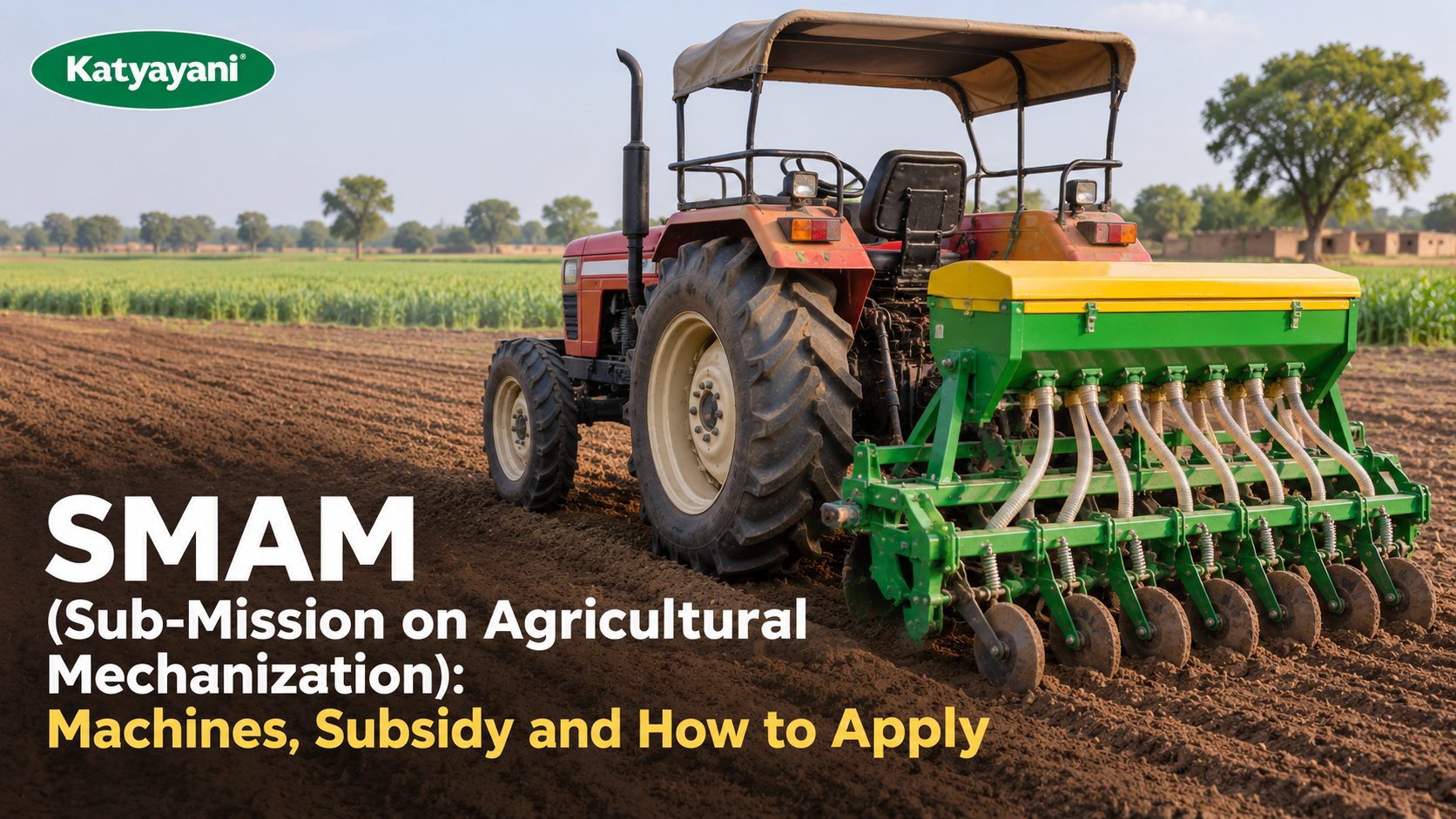
SMAM is the central scheme that helps farmers buy farm machines. As of 24 Nov 2026, its October 2026 guideline gives 50% subsidy to small and marginal, SC, ST and women farmers and farmers of the North East and Himalayan regions, and 40% to others, with a cap for each machine. It now sits under PM-RKVY, and the subsidy comes by DBT.
What is SMAM, and does it still exist as a separate scheme?
SMAM is the Sub-Mission on Agricultural Mechanization. It helps farmers buy farm machines and set up machine rental centres. It still exists, but as part of PM-RKVY. The October 2026 guideline calls it a centrally sponsored scheme "under the umbrella of PM-Rashtriya Krishi Vikas Yojana".
The PM-RKVY introduction note explains the change. RKVY became a cafeteria scheme from 2022-23 by merging several schemes, including agriculture mechanisation. It was renamed PM-RKVY from 2024-25. The PM-RKVY guidelines list nine parts, and SMAM, which includes crop residue management, is one of them.
DA&FW has re-issued the SMAM rules more than once. The farmech site lists editions for 2020-21, 2025 and 2026. The August 2026 edition was followed by the October 2026 edition, sent to the states on 14 October 2026. Both give the same 50% and 40% rates and the same rules for custom hiring centres and farm machinery banks. Caps for tractors, power tillers, combine harvesters, transplanters, reapers, weeders and the Kisan Drone are also the same. The October edition adds machines such as a self-propelled cotton picker, an electric agri cart and precision farming machines to Annexure-I, so use the October edition.
Older web pages may quote a 2020 or 2024 rule, so check the date on the guideline cover. Our agriculture subsidy guide shows where SMAM sits among other schemes.
The guideline has four aims. It wants to take machines to small and marginal farmers and to regions with low farm power. It promotes custom hiring so that a farmer need not own every machine. It spreads awareness through demonstrations and training. And it makes sure machines are tested and certified at designated centres.
The farmech overview explains why. About 84% of holdings in India are below 1 hectare. Mechanisation is between 45% and 50% in India, against above 90% in industrialised countries. Farm power was 2.49 kW per hectare in 2018-19, and the target is 4.0 kW per hectare by 2030.
What does SMAM pay for?
SMAM pays for machines bought by individual farmers, custom hiring centres, farm machinery banks, drone hiring by small farmers and model villages. It also pays for demonstrations, training and machine testing. States run the first group. The Centre pays fully for demonstrations, skilling, testing and grassroots innovation.
| Component | Who gets help | What the guideline gives |
|---|---|---|
| Machines for individual ownership | Farmers | 50% or 40% of machine cost, with a cap per machine |
| Machines for FRA patta holders | Forest Rights Act patta holders | 90% of machine cost, beneficiary list from the Ministry of Tribal Affairs |
| Custom Hiring Centres | Rural entrepreneurs, SHGs, FPOs, Panchayats, PACS, farmers' cooperatives | 40% of project cost up to Rs 250 lakh |
| Farm Machinery Banks | DAY-NRLM federations and women SHGs, FPOs, Panchayats, PACS, cooperatives | 80% of project cost up to Rs 30 lakh |
| North Eastern Region | Farmers and FRA patta holders | 100% for a machine costing up to Rs 1.25 lakh; 95% for FMBs up to Rs 30 lakh |
| Drone hiring | Small and marginal farmers in low mechanised regions | Rs 2,000 per hectare, up to 2 hectares a year |
| Model villages | Villages with very low mechanisation | State buys machines and lends them at very low rent or free |
| Demonstrations, skilling, testing, grassroots ideas | FMTTIs, ICAR, SAUs, KVKs, FPOs and others | 100% central grants (75% for FPOs on demonstration machines) |
If you want to start a rental business, read our guide on how to start a custom hiring centre. The rest of this post is for the buyer of a machine.
Who pays for SMAM, the Centre or the State?
Both. For the state-run components, the Centre and the State share the cost 60:40. For the North Eastern and Himalayan States the share is 90:10. For Union Territories the Centre pays 100%. States may also keep 25% of the budget as flexi funds for other mechanisation ideas that fit the scheme.
Each state sends one Annual Action Plan. It is prepared by 15 February, shown to the Ministry between February and March, and approved by the State Level Sanctioning Committee, led by the Chief Secretary, by 31 March. The guideline gives no application dates for farmers, so ask your district office. For dates of other schemes, see the agriculture schemes calendar.
The PM-RKVY home page shows the plans moving. On 24 November 2026 its notice board listed second mother sanctions for the 2026-27 plans of several states, such as Haryana, Arunachal Pradesh and Andhra Pradesh.
How much subsidy does a farmer get on a machine?
The guideline gives 50% of the machine cost to small and marginal farmers, farmers of the Scheduled Castes and Scheduled Tribes, women farmers and farmers of the North Eastern States and Himalayan regions. All other farmers get 40%. In both cases the subsidy cannot go above the rupee cap set for that machine in Annexure-I.
Take a tractor in the 2WD, above 20 and up to 40 PTO HP class, and say it costs Rs 7 lakh. This price is made up, only to show the method. For a small farmer, 50% is Rs 3.5 lakh, but the cap is Rs 3.00 lakh, so the subsidy is Rs 3.00 lakh. For a farmer in the 40% group, 40% is Rs 2.8 lakh, but the cap is Rs 2.40 lakh, so the subsidy is Rs 2.40 lakh. You pay the rest.
The caps keep the subsidy low on costly machines. The notes under Annexure-I say the maximum subsidy includes GST. For the tax on tractors, see GST on tractors and farm machinery. For state rates and examples, see our tractor subsidy guide.
What is the maximum subsidy for common machines?
Annexure-I gives two caps for each machine, one for the 50% group and one for the 40% group. The table shows some common machines from the October 2026 edition. The full list is longer, so read the annexure for your machine.
| Machine (Annexure-I, October 2026) | Cap at 50% (Rs lakh) | Cap at 40% (Rs lakh) |
|---|---|---|
| Tractor 2WD, up to 20 PTO HP | 2.00 | 1.60 |
| Tractor 4WD, up to 20 PTO HP | 2.45 | 1.96 |
| Tractor 2WD, above 20 and up to 40 PTO HP | 3.00 | 2.40 |
| Tractor 4WD, above 20 and up to 40 PTO HP | 3.60 | 2.88 |
| Power tiller, 8 BHP and up to 11 BHP | 1.00 | 0.80 |
| Power tiller, above 11 BHP | 1.20 | 1.00 |
| Self-propelled rice transplanter, walk behind, 4 rows | 1.70 | 1.36 |
| Crop reaper cum binder, 3 wheel | 1.92 | 1.54 |
| Power weeder or rotary tiller, engine 2 BHP up to below 5 BHP | 0.40 | 0.32 |
| Crop reaper, diesel, petrol or battery operated | 0.85 | 0.68 |
| Multi utility machine with drone carrier | 1.56 | 1.25 |
| Kisan Drone | 5.00 | 4.00 |
The caps are in Rs lakh, so 0.32 means Rs 32,000. Small tools have small caps. A rotary tiller with a 5 to 7.5 BHP engine, for example, has a cap of Rs 0.75 lakh at 50% and Rs 0.60 lakh at 40%.
Does the cap include GST, and who sets the machine price?
Yes, the cap includes GST, so you cannot add GST on top of it. States may fix machine prices through empanelment, and your subsidy is the lower of two figures: the percentage of the state-fixed price, or the cap. States may also add new machines under the right category.
That last point matters. A machine missing from the central table may still be funded if your state added it, so ask your district office. The guideline also asks states to keep empanelled prices reasonable against the open market. Makers of electric tractors must give operating limits, charging needs and suitable farm uses in their technical literature, so ask for that sheet before you buy one.
Always work out both figures and take the smaller one. Say your state fixed a machine at Rs 2 lakh and the cap is Rs 1.60 lakh at 40%. Then 40% of Rs 2 lakh is Rs 80,000. That is below the cap, so your subsidy is Rs 80,000. These numbers are made up.
Which precision and irrigation machines are on the list?
Annexure-I also lists precision farming machines, specialised machines and irrigation equipment. It includes a smart boom sprayer with sensors and AI, GNSS auto-steering for tractors, soil moisture indicators, polyhouse spraying systems, pivot and reel irrigation machines, and portable pumps up to 15 HP. The caps are below.
| Machine (Annexure-I, October 2026) | Cap at 50% (Rs lakh) | Cap at 40% (Rs lakh) |
|---|---|---|
| Self-propelled smart precision sprayer, boom type, with sensors and AI | 12.00 | 9.60 |
| GNSS-based auto-steering system for tractors | 2.00 | 1.60 |
| Automatic spraying system for polyhouse, up to 200 sq m | 1.30 | 1.04 |
| Vehicle mounted sprayer for locust control | 2.50 | 2.00 |
| Digital Soil Moisture Indicator | 0.036 | 0.029 |
| Portable irrigation pump up to 15 HP (ISI/BEE labelled, minimum 4 star) | 0.10 | 0.08 |
| Centre pivot irrigation machine, suitable up to 4.00 ha | 1.75 | 1.40 |
| High precision reel irrigation sprinkler system | 2.75 | 2.20 |
| Solar or electric animal deterrent bioacoustics equipment, with solar panel | 0.35 | 0.28 |
A soil moisture indicator has a cap of only Rs 3,600 at 50%, while a smart sprayer goes up to Rs 12 lakh. If you plan drip or sprinklers, the main subsidy for them sits in another PM-RKVY part, Per Drop More Crop. Our micro irrigation subsidy guide shows how one state runs it.
Which machines are meant for custom hiring centres, not individuals?
The guideline says expensive machines should go to Custom Hiring Centres and Farm Machinery Banks, not to single farmers. These are tractors above 40 HP, combine harvesters, sugarcane harvesters and other machines marked with a star in Annexure-I. If a state still funds them for individuals, it should cap that at 25% of the machine distribution budget.
| Star machine (Annexure-I) | Cap at 40% (Rs lakh) |
|---|---|
| Tractor 2WD, above 40 and up to 50 PTO HP | 3.60 |
| Tractor 4WD, above 50 PTO HP | 5.20 |
| Combine harvester, self-propelled | 7.68 |
| Combine harvester, track type, cutter bar above 6 feet | 10.00 |
| Maize combine harvester, self-propelled | 9.60 |
| Self-propelled cotton picker, 2 rows | 28.00 |
| Self-propelled sugarcane harvester (CHC only) | 40.00 |
If you want a big machine, talk to the district office about joining or starting a group. The SHG and FPO comparison helps you decide which group fits.
Is there extra support for tribal farmers and the North East?
Yes. Forest Rights Act (FRA) patta holders get 90% of the machine cost, and the Ministry of Tribal Affairs supplies the beneficiary list. FRA patta holder SHGs and FPOs get 90% of project cost for Farm Machinery Banks up to Rs 30 lakh, with per-machine caps worked from Annexure-I. The PM-RKVY guidelines say the beneficiary share of FRA patta holders is only 10% in each component, which matches.
In the North Eastern Region, a machine costing up to Rs 1.25 lakh gets 100% of its cost. Farm Machinery Banks get 95% of project cost up to Rs 30 lakh, and above Rs 30 lakh the cap is Rs 28.50 lakh. North Eastern and Himalayan farmers also fall in the 50% group for other machines. If you are not sure of your group, ask the state agriculture department for the category list.
How does SMAM help with drones?
SMAM supports drones in three ways. A Kisan Drone has a cap of Rs 5 lakh at 50% (Rs 4 lakh at 40%). A Kisan Drone CHC run by an agriculture graduate gets 50% of the basic cost or up to Rs 5 lakh. Small farmers in low mechanised regions get Rs 2,000 per hectare when they hire a drone service.
The hiring aid is paid by DBT for up to 2 hectares a year. It is for farmers who hire drones from Custom Hiring Centres and women SHGs, and the state must sign MoUs with them. The area must be georeferenced and monitored online. Drones come as a package under the Namo Drone Didi scheme rules, with that scheme's drone specification and pilot training syllabus. For licence, pilot and spraying rules, read our agri drone subsidy guide.
What documents do I need to register on the DBT portal?
The portal FAQ lists Aadhaar card, Record of Right of land, a passport size photo, a copy of the bank passbook, a copy of an ID proof other than Aadhaar and, for SC, ST or OBC farmers, a caste certificate. A mobile number is compulsory, because an OTP comes to it. Your state may ask for more.
The DBT portal FAQ is dated 28 November 2019, so treat it as a guide to the method. State portals may look different today. It says four types of users register on their own: farmer, society, entrepreneur and manufacturer. A dealer cannot register alone. A manufacturer registers its dealers.
Enter your name exactly as on your Aadhaar card, and pick your district, sub-district, block and village from the list. Fill your category (SC, ST or General), your type (small, marginal or large) and your gender with care. A wrong entry can get the application debarred at physical verification. Bank details are needed to receive the subsidy, and land details are needed before you apply for an implement.
You can edit your details until you apply. After applying, you can edit only after you withdraw the application. Once you have received the benefit, the record cannot be changed unless the state nodal officer asks. The guideline says a Soil Health Card may be needed for the subsidy. If you have none, a soil sample can be tested and the cost adjusted against the subsidy. Our Soil Health Card guide explains how to read one.
What are the steps to apply for subsidy on a machine?
Register on your state's DBT or farm machinery portal, add your land and bank details, apply for the machine from the list, wait for approval, buy from a registered dealer of an empanelled manufacturer and let the state verify the machine. The subsidy then reaches your bank account by DBT. Your state sets the exact order and dates.
- Ask your district agriculture office whether SMAM applications are open and on which portal.
- Register as a farmer. Give Aadhaar, mobile, category and the other details exactly as on your papers.
- Add your land details and bank details. The FAQ says both are compulsory before you can apply.
- Pick the implement from the portal list and submit the application.
- Choose any machine and variant from the manufacturers your state has empanelled. The guideline says you may negotiate the final price with the dealer.
- The dealer uploads the bill on the portal. The FAQ says the subsidy goes to the farmer or the dealer, as selected by the dealer when the bill is uploaded.
- The state checks the machine. The subsidy then comes to you by DBT.
The central guideline does not say whether you must wait for approval before buying. Your state's order decides that, so ask the district office and get the answer in writing before you pay. States with their own portals must link them to the central portal. Our guides to the Rajkisan portal and DBT Agriculture Bihar show two state portals.
If more farmers apply than the state target, the guideline asks states to pick applicants by an online lottery, not first come, first served. States must set this up on their own portals. Areas with a low level of mechanisation should get focus.
Small machines have a quick route. Advanced machines costing up to Rs 10,000 may be sold at fairs and exhibitions for small and marginal farmers. Application, approval, purchase, checking and subsidy payment can all happen on the spot, and all enlisted manufacturers of such machines may be invited.
Do not assume you can claim every year. The FAQ says that whether a farmer can get a subsidy more than once in a year, or on the same machine again after some time, depends on the state.
What should I check on the machine before I pay?
Check that the manufacturer is empanelled by your state, that the machine has a valid test report, that it carries a unique code and a label plate, that the displayed maximum price matches the quote and that costly self-propelled machines have a telematics kit. The state checks all of this when it verifies your machine.
| Check | What the guideline says |
|---|---|
| Empanelled maker | States empanel makers on machine quality, test report and warranty and after-sales service |
| Test report | Makers need a test report from an FMTTI or an institute chosen by DA&FW. For tools below Rs 50,000, self-certification may be accepted, though a first-time maker needs a test report |
| Price | Maximum selling prices should be shown on the maker's website and in the dealer's shop. Makers must register each product with its MRP on the central portal |
| Unique code | A laser cut serial code, as per the portal format, on machines of Rs 1.00 lakh and above. Cheaper machines have an engraved serial number. Tractors and combine harvesters do not need the laser cut code |
| Label plate | Shows maker name and address, model, type and size, unique code, month and year of making and prime mover size |
| Telematics | Self-propelled machines of Rs 1.00 lakh and above need an app-based tracker kit. Makers must fit it as standard on machines made after 1 June 2023 |
| Georeferencing | Every machine costing Rs 1.00 lakh and above must be georeferenced |
Keep the bill, the warranty card and the test report. If the dealer cannot show the code on the machine body, do not accept delivery until it is fixed. A machine that does not match the maker's stock list on the portal may fail the state check.
What does the Centre fund fully under SMAM?
The Centre pays 100% for demonstrations of new machines in farmers' fields, skill training in farm mechanisation and drones, performance testing of machines, and grassroots innovation. These are not subsidies on a farmer's purchase, but they decide how fast good machines reach villages.
| Central component | What the guideline gives |
|---|---|
| Demonstrations | Institutions get 100% of the cost of machines for demonstration; FPOs get 75%. If an institution hires the machine from a CHC, it gets Rs 6,000 per hectare for contingent costs (Rs 3,000 per hectare where it bought the machine) |
| Krishi Sakhis | Paid Rs 100 per hectare from the demonstration funds to upload data and geo-plot demonstrations on Krishi MApper |
| Skilling | Run by FMTTIs and state-chosen institutions under the common norms for skill development. Drone pilot training goes through Remote Pilot Training Organisations |
| Testing | Testing institutions get a one-time grant of Rs 1.5 crore each, and up to Rs 1.00 crore more for new facilities |
| Grassroots innovation | Phase 1, projects up to Rs 5 lakh: up to 90% of cost for concept, prototype or model validation. Phase 2, projects of Rs 5 lakh to Rs 35 lakh: up to 90% for working models, farm trials, patenting and technology transfer |
The farmech FAQ page says four Farm Machinery Training and Testing Institutes work at Budni (Madhya Pradesh), Hisar (Haryana), Garladinne (Andhra Pradesh) and Biswanath Chariali (Assam). To see a machine at work, ask your KVK or district agriculture office about demonstrations near you.
If you have built a new machine yourself, use the grassroots route. Proposals go through the State, ICAR institutes or an FMTTI. They must state the problem and the benefit clearly, and a committee under the Mechanization and Technology Division judges them.
What are model villages of farm mechanisation?
Model villages are villages with very low mechanisation where the state buys crop-specific machines and gives them to small and marginal farmers at very low rent or free. The Agriculture Department or Agricultural Engineering owns the machines, and a private partner may run them on a commission. More villages may be picked for the next year in advance.
States may pay for this from flexi funds, but not more than 25% of the flexi funds can go to it. Villages in backward areas, with a high share of cultivable land and crops that gain from machines, may be preferred. Ask your block office if your village is listed.
What mistakes cause a SMAM application to fail?
The usual mistakes are a wrong category or farmer type, a name that does not match Aadhaar, a missing land or bank entry, a machine that is not on the list, a maker that is not empanelled, and a machine without the right code. Most can be fixed before you apply or before you pay the dealer.
The FAQ says wrong category, farmer type or gender entries can get an application debarred at physical verification, so fill them exactly. Add land and bank details before you apply. Check the star mark and the cap in Annexure-I before you pick a machine. Ask the district office for the state list of empanelled makers, and ask the dealer to show the unique code and test report before you pay.
Do not believe old rates or a "free tractor" offer, and do not pay anyone for a place in a scheme. Do not assume every state works the same either. The central guideline leaves many steps to states, so read your state's order.
Keep one file for your application with the acknowledgement, the dealer's quotation, the final bill, a copy of the test report and screenshots of each portal step. This is plain good practice, not a rule from the guideline. If an application is rejected, ask the district office for the reason in writing, fix it and apply again when your state next opens the window.
How does SMAM fit with the other parts of PM-RKVY?
SMAM is one of nine parts of PM-RKVY. The others are the Detailed Project Report component, Per Drop More Crop, Soil Health and Fertility, Paramparagat Krishi Vikas Yojana, Rainfed Area Development, Agro-Forestry, the Crop Diversification Programme and the fund for agri start-ups. Each part has its own rules and its own money.
This matters when someone offers you an "RKVY subsidy". It could mean any one of these parts. The machine subsidy is SMAM. Organic farming clusters are under PKVY, which our PKVY guide explains. Start-up grants are in our RKVY-RAFTAAR agri startup guide. Find out which part the offer belongs to before you pay anyone.
Where can I check the latest SMAM rules and my state's portal?
Start with the agrimachinery.nic.in portal, which links to the DBT system, the testing portal and the FARMS app. The farmech site has the guideline. For portal problems, the central helpdesk email on the portal is support-agrimech@gov.in. For your own application, ask your district agriculture office or the state nodal officer.
Crop residue machines have their own revised guideline (2026) on the farmech site. The PM-RKVY guidelines list crop residue management with SMAM, so read that guideline if you want a straw management machine. For a way to deal with straw without a machine, see our parali management with decomposer guide.
If an agent offers faster approval for a fee, say no. The subsidy goes by DBT to the farmer's bank account, and a place on the list is not for sale.
Conclusion
SMAM now runs under PM-RKVY, with 50% or 40% subsidy and a cap on every machine. States set the window and the portal. Check your category, read Annexure-I for your machine and see the code and test report before you pay.

Leave a Comment