
 15 min read
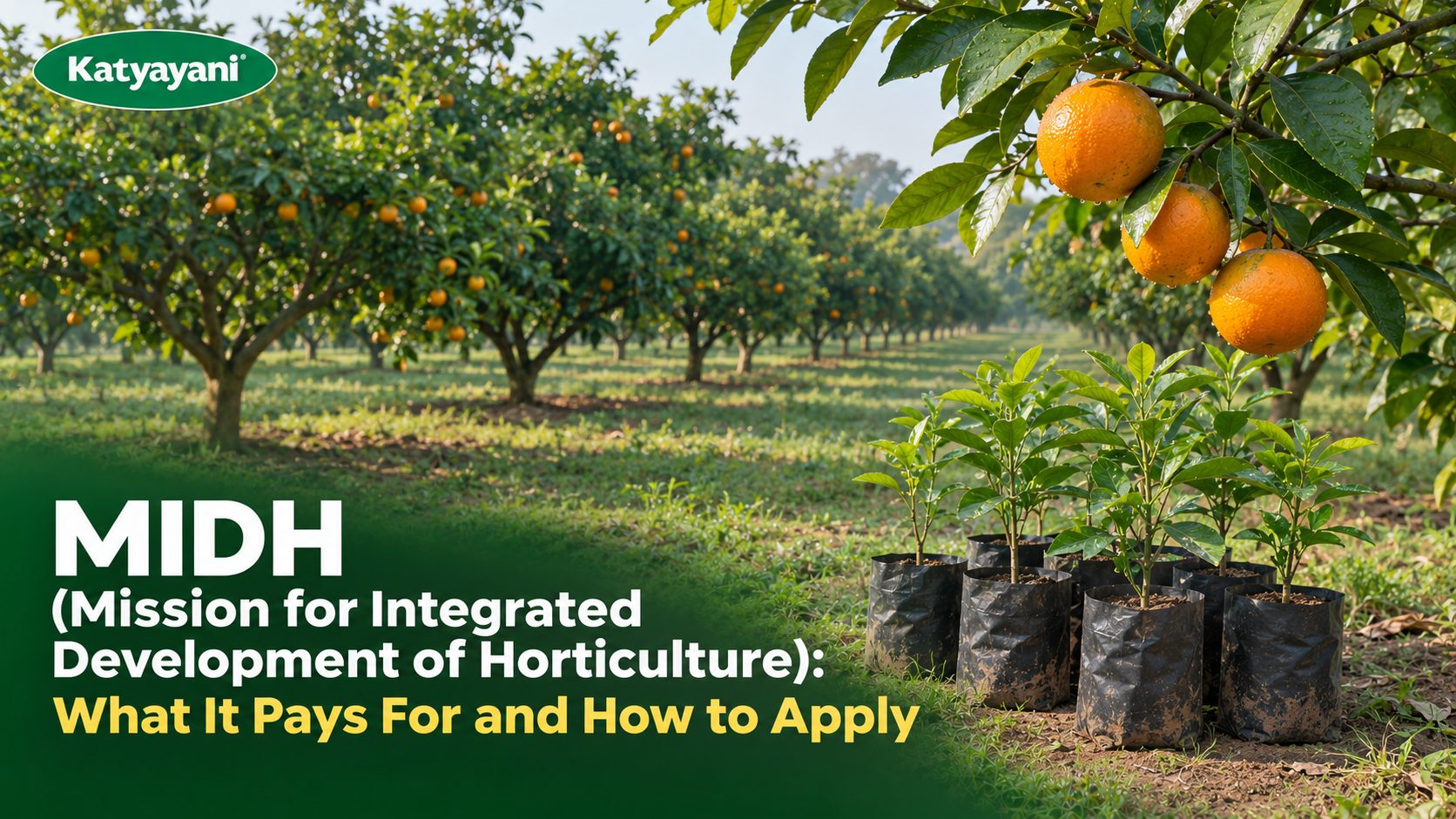
MIDH is the central scheme that pays part of the cost of new orchards, polyhouses, mushroom units and cold storage. New gardens get 40% of the cost norm (50% in special areas), up to 2 hectares. You apply through your State Horticulture Mission. As of 24 Nov 2026, NHB has paused new applications.
What is MIDH and who runs it?
MIDH is the Mission for Integrated Development of Horticulture. It is a Centrally Sponsored Scheme of the Department of Agriculture and Farmers Welfare. The MIDH Operational Guidelines 2025 say it covers fruits, vegetables, root and tuber crops, mushrooms, spices, flowers, medicinal and aromatic plants, coconut, cashew, cocoa, bamboo and other horticulture crops.
The National Horticulture Mission (NHM) is one of its sub-schemes, so you may hear people call it the "NHM subsidy". The Centre writes the rules and gives money. The State Horticulture Mission (SHM) or a similar State agency runs the scheme, and you apply through it. A State Level Sanctioning Committee headed by the Chief Secretary approves each State's Annual Action Plan.
The Lok Sabha reply of 21 July 2026 lists MIDH among the schemes of the Department. It adds that MIDH gives assistance for pack houses, ripening chambers, cold storage and refrigerated transport.
What are the sub-schemes of MIDH, and who pays for each?
MIDH has six sub-schemes. The Centre pays 60% of the outlay in most States, and 90% in the North East and Himalayan States. For the National Horticulture Board (NHB), the Coconut Development Board (CDB), the Central Institute for Horticulture (CIH), Nagaland national level agencies and UTs without a legislature, the Centre pays 100%.
| Sub-scheme | Where it works | Central share |
|---|---|---|
| NHM (National Horticulture Mission) | All States and UTs except the North East and Himalayan region | 60%, State 40% |
| HMNEH (Horticulture Mission for North East and Himalayan States) | North East and Himalayan States, all districts | 90%, State 10% |
| NBM (National Bamboo Mission) | All States and UTs | Not listed separately in the funding rule |
| NHB (National Horticulture Board) | All States and UTs, focus on commercial horticulture | 100% |
| CDB (Coconut Development Board) | All States and UTs | 100% |
| CIH (Central Institute for Horticulture) | North Eastern States, focus on training and capacity building | 100% |
The split is simple for a farmer. A new orchard, a small polyhouse or a mushroom unit goes through the State mission (NHM or HMNEH). Large commercial projects, such as big cold storages, go through NHB.
Who can get MIDH assistance?
For marketing and post-harvest work, the guideline lists individuals, groups of farmers, partnership and proprietary firms, Self Help Groups, FPOs, companies, corporations, cooperatives, local bodies, APMCs and marketing boards, and State Governments. Who can claim, and at what rate, is set item by item.
Under its new provisions, the guideline also covers Vibrant Villages beneficiaries and patta land holders. For area expansion items the limit is 2 hectares per beneficiary.
The NHB route has its own rules. An NHB circular of 21 August 2026 says only one member of a family (spouse, father, mother, sons and daughters) can take assistance under NHB schemes. It also lists who is not eligible: serving government employees, sitting Ministers and legislators, retired pensioners drawing Rs 10,000 or more a month, and groups of farmers.
What does MIDH pay for?
MIDH pays for planting material and nurseries, new gardens (area expansion), protected cultivation, inputs and organic farming, machines, and post-harvest work such as pack houses and cold storage. Each item has a cost norm, and the government pays a share of that norm.
Every percentage in this guide is on the cost norm in the guideline, not on your bill. If your project costs more than the norm, you pay the extra. For protected cultivation structures, pond lining and HDPE vermibeds, the guideline asks for material that meets BIS standards.
The guideline also lists newer items under "new provisions". New crops include Kamalam (dragon fruit), date palm, avocado, blueberry, rambutan, makhana, water chestnut (singhara), onion, garlic and hybrid vegetables. New support covers ultra high density plantations with trellis, hydroponics and aeroponics, sensor-based fertigation, solar fencing, solar pumps for drip, solar cold storage and crop dryers. It also backs cluster-based development of high-value crops for export and import substitution.
Not every State takes up every item. Each State picks items in its Annual Action Plan, so a new item may not be open in your district this year.
How much subsidy does MIDH give for a new orchard or garden?
For a new fruit garden, the guideline gives 40% of the cost norm in general areas and 50% in North Eastern and Himalayan States and other special areas. It covers up to 2 hectares per beneficiary. For most fruit crops the money comes in two instalments of 60:40. The second needs at least 80% of plants alive in the second year.
| Fruit group (examples) | Cost norm | Pattern of assistance |
|---|---|---|
| Strawberry | Rs 2.0 lakh per ha without drip | 40% in general areas, 50% in NE, Himalayan and special areas, up to 2 ha |
| Dragon fruit with support system | Rs 6.75 lakh per ha | Same rate of assistance, in two instalments (60:40) |
| Grape with support system and Kiwi | Rs 3.00 lakh and Rs 2.50 lakh per ha | Same |
| Banana and pineapple by suckers | Rs 1.10 lakh per ha | Same |
| Avocado, fig, blueberry and similar | Rs 1.25 lakh per ha | Same |
| Papaya, custard apple, amla, ber, jamun and similar | Rs 75,000 per ha | Same |
| New orchards of mango, guava, citrus, litchi, pomegranate (regular spacing) | Rs 1.25 lakh per ha | Same. High density Rs 2.00 lakh per ha, ultra high density Rs 3.0 lakh per ha |
Drip is paid separately. The area expansion rate is "without drip", and drip is paid "as per PDMC norms". If you add drip to a new orchard, the PDMC guidelines pattern applies to that part: 55% for small and marginal farmers and 45% for other farmers, from the Centre and State together, up to 5 hectares (see PIB, 29 August 2026). Buy planting material from NHB-accredited nurseries. Pick high yielding varieties and plant them in identified clusters.
Take a made-up plot to see how it works. A grower plants 1 hectare of guava with regular spacing. The cost norm is Rs 1.25 lakh per hectare. At 40%, the assistance is Rs 50,000. Part of it is paid first and the rest after the second-year survival check. If the grower spends more than the norm, the extra is not covered.
What does MIDH give for vegetables and flowers?
For hybrid vegetables the norm is Rs 60,000 per hectare. For onion and garlic grown from open-pollinated seed it is Rs 50,000 per hectare. The share is 40% in general areas for up to 2 hectares, paid in a single instalment. In the North East, Himalayan and special areas it is 50%, and in Vibrant Villages 80% of the maximum cost.
| Item | Cost norm | Pattern of assistance |
|---|---|---|
| Hybrid vegetables (tomato, brinjal, capsicum, okra, cucumber, cabbage and others) | Rs 60,000 per ha | 40% in general areas, single instalment, up to 2 ha. 50% in special areas. 80% of maximum cost in Vibrant Villages |
| Onion and garlic, open pollinated | Rs 50,000 per ha | Same pattern |
| Cut flowers | Rs 1.25 lakh per ha | 40% in general areas, up to 2 ha |
| Loose flowers | Rs 50,000 per ha | 40% in general area, up to 2 ha |
| Aromatic plants such as lemongrass, tulsi, vetiver | See guideline Annexure V | 40% in general areas, up to 2 ha |
For crop advice on vegetables, read our guide to rainy season vegetables. Spice growers should read our post on Spices Board subsidies, which covers their norms.
How much does MIDH give for polyhouse, shade net and tunnels?
The guideline gives 50% of the cost norm for polyhouse, shade net house, tunnels and anti-hail nets, up to 4,000 sq m per beneficiary after a letter of 12 August 2025. The norm depends on structure and size. A naturally ventilated tubular polyhouse is Rs 1,200 per sq m up to 500 sq m, and a shade net house is Rs 710 per sq m. These are the NHM and HMNEH norms.
| Structure | Cost norm in the guideline | Assistance |
|---|---|---|
| Fan and pad polyhouse | Rs 1,800 per sq m up to 500 sq m, Rs 1,600 for 500 to 1,008 sq m, lower rates for bigger sizes | 50%, up to 4,000 sq m per beneficiary |
| Naturally ventilated tubular polyhouse | Rs 1,200 per sq m up to 500 sq m, Rs 1,050 for 500 to 1,008 sq m, lower rates for bigger sizes | 50%, up to 4,000 sq m |
| Bamboo or cable purlin polyhouse | Rs 450 per sq m | 50%, up to 4,000 sq m. Bamboo type limited to 20 units of up to 200 sq m each |
| Shade net house (tubular) | Rs 710 per sq m | 50%, up to 4,000 sq m |
| Plastic or non woven tunnel | Rs 80 per sq m | 50%, up to 4,000 sq m |
| Walk-in tunnel | Rs 720 per sq m | 50%, limited units per beneficiary, each up to 800 sq m |
| Anti-bird and anti-hail net | Rs 50 per sq m | 50%, up to 10,000 sq m |
Say a grower builds a 500 sq m naturally ventilated tubular polyhouse. At Rs 1,200 per sq m the cost norm is Rs 6,00,000. At 50%, the assistance is Rs 3,00,000. If the real cost is Rs 7,50,000, the extra Rs 1,50,000 is not covered, so the grower pays Rs 4,50,000 in all.
These rates are 15% higher in the North East, Himalayan States, Scheduled areas, Vibrant Villages and the Andaman and Nicobar and Lakshadweep islands. For full cost, loan steps and crop choice, read our guide to polyhouse and shade net subsidy.
The DA&FW letter of 12 August 2025 raised the protected cultivation limit under NHM and HMNEH from 2,500 to 4,000 sq m per beneficiary, and for NHB to 4,000 sq m and above. It changes only the area limit. The cost rates above are from the guideline dated 31 December 2024, so check the rates your State mission uses before you plan a structure. NHB projects follow NHB rates (see the cold storage section).
What help is there for mushroom units?
For mushroom production, spawn and compost units, the guideline gives 100% of the cost to public bodies and 40% to private ones, as credit-linked back-ended subsidy. It is 50% in North East, Himalayan and special areas. These are the State route rates. For NHB integrated mushroom units, the NHB circular of 21 August 2026 gives 35% in general areas and 45% in special areas. A small 200 sq ft unit has a norm of Rs 2.00 lakh with 50% help, for up to 5 units per beneficiary.
| Unit | Cost norm | Assistance |
|---|---|---|
| Production unit | Rs 30 lakh per unit | 40% private (50% in special areas), 100% public. Credit-linked back-ended |
| Spawn making unit | Rs 20 lakh per unit | Same |
| Compost making unit | Rs 30 lakh per unit | Same |
| Low-cost small production unit (200 sq ft) | Rs 2.00 lakh per unit | 50% per unit, up to 5 units per beneficiary |
For steps, documents and State add-ons, see our guide to mushroom cultivation subsidy. The guideline also wants to promote low-cost small mushroom units for start-ups and women entrepreneurs.
What does MIDH offer for nurseries and clean planting material?
MIDH pays for nurseries, tissue culture units and seed production, with 100% help for public bodies and a lower share for private ones. In July 2026 the Government told Parliament that the Clean Plant Programme under MIDH has an outlay of Rs 1,765.67 crore. Its aim is disease-free planting material for growers.
The Lok Sabha reply of 28 July 2026 says clean mother stocks of crops such as grape, citrus, pomegranate, guava, mango, avocado, litchi and dragon fruit will be held at Clean Plant Centres hosted by ICAR institutes. These centres will pass clean plants to certified nurseries. Support is planned for 15 large and 60 medium nurseries, but the reply says the criteria for money to nurseries were still being prepared.
| Nursery item (guideline Annexure V) | Cost norm | Assistance |
|---|---|---|
| Large nursery, 1 to 2 ha | Up to Rs 30 lakh per ha | 100% public, 40% private |
| Small nursery, 0.4 to 1 ha | Rs 20 lakh per ha | 100% public, 50% private |
| New tissue culture unit | Up to Rs 250 lakh per project | 100% public, 40% private (credit-linked back-ended) |
| Hi-tech plug type nursery | Rs 1,200 per sq m, 0.2 to 1 ha | 100% public, 50% private (credit-linked back-ended) |
| Seed production of vegetables, open pollinated | Rs 50,000 per ha | 100% public, 35% private in general areas (50% special) |
A new nursery or tissue culture lab must get accreditation within 18 months of the last instalment. If you are buying plants, ask the nursery for its accreditation.
What support is there for INM, IPM, organic farming and GAP?
For INM and IPM (integrated nutrient and pest management), the guideline gives 30% of a Rs 5,000 per hectare norm, up to 2 hectares. It also supports plant health clinics, vermicompost units, organic farming and GAP certification. Organic farming help follows the PKVY norms, which Lok Sabha replies of July 2026 give as Rs 31,500 per hectare over three years.
| Item | Norm and share (guideline Annexure V) |
|---|---|
| INM and IPM promotion | Rs 5,000 per ha, 30% for up to 2 ha per beneficiary |
| Plant health clinics and organic clinics | 100% public sector, 50% private sector |
| Vermicompost unit | Rs 1,00,000 per permanent unit of 30 ft x 8 ft x 2.5 ft, 50% |
| HDPE vermibed | Rs 16,000 per bed, 50%, BIS IS 15907:2010 |
| Organic farming and certification | As per PKVY norms. Certification through agencies accredited by APEDA or NCONF |
| GAP and Bharat GAP | Certification through agencies approved by APEDA or NCONF. NHB is nodal agency for Bharat GAP |
The guideline also has advice on organic farming. Grow only crops that fetch a premium, line up buyers first, get certified by accredited agencies and avoid isolated patches. Our guide to organic farming for beginners explains the certification routes. For the scheme itself, see the PIB note on PKVY.
The INM line says the subsidy can be used for liquid biofertilisers of Rhizobium, Azospirillum, Azotobacter, phosphate solubilising bacteria and potash mobilising bacteria in demonstrations and other programmes. It names no shop or brand.
What does MIDH give for cold storage and post-harvest work?
For cold storage and pack houses, MIDH gives credit-linked back-ended subsidy of 35% of the cost norm in general areas and 50% in North Eastern, Himalayan and special areas. Cold storage up to 5,000 MT is under NHM and HMNEH. Larger projects go under NHB. All must follow NCCD guidelines.
| Item (guideline Annexure V) | Cost norm | Assistance |
|---|---|---|
| Cold storage Type 1 (up to 5,000 MT), civil construction including PUF or PIR panels | Rs 9,600 per MT | 35% general areas, 50% special areas, credit-linked back-ended |
| Cold storage Type 1 (up to 5,000 MT), combination of civil and PEB construction including PUF or PIR panels | Rs 12,000 per MT | Same |
| CO2 scrubber for controlled atmosphere | Up to Rs 50 lakh per project | Same |
| Pack houses, pre-cooling, ripening chambers, reefer vans | Per item in guideline | 35% general, 50% special, credit-linked back-ended |
The NHB route has changed. The NHB circular of 21 August 2026 says NHB gives credit-linked back-ended subsidy of 35% of eligible project cost in general areas and 45% in the North East, Himalayan States, Scheduled Areas, Vibrant Villages, Andaman and Nicobar and Lakshadweep. It caps the NHB subsidy at Rs 2.00 crore for any cold storage project and leaves land cost out of the project cost.
New cold storage must be multi-chamber and energy efficient. The guideline counts 3.4 cubic metres (120 cubic feet) of chamber volume as one MT of capacity. Groups and FPOs with at least 25 members may get back-ended subsidy without a credit link if they can meet their share of the cost.
For the business side, read our post on cold storage subsidy and business. For loans with interest relief, see the Agriculture Infrastructure Fund. Do not assume the two can be combined. Ask the bank and the mission first.
What does credit-linked back-ended subsidy mean?
The bank lends the money first, you build the project, and the subsidy is paid later, after an inspection. You get no cash at the start. The guideline uses this system for most entrepreneur projects, such as cold storage, pack houses, tissue culture and mushroom units.
The new provisions relax this for small projects. Credit linkage is optional for projects up to Rs 30 lakh, and the subsidy is paid in two instalments into a TRA, escrow or SRF account after a satisfactory joint inspection report. Ask your mission if this applies to you. See the Kisan Credit Card guide for farm credit basics.
Here is a made-up case. The approved project cost on the norm is Rs 10 lakh and the share is 35%, so the subsidy is Rs 3.5 lakh. The bank lends the money, the unit is built, the inspection is done, and only then is the Rs 3.5 lakh released. Until then you must pay the loan instalments yourself.
How do I apply for MIDH assistance?
For most items, apply through your State Horticulture Mission or the District Horticulture Officer. Each State must have a fair, open system for taking applications. Large commercial projects go to the National Horticulture Board (NHB), but as of 24 Nov 2026, NHB's notice of 8 October 2026 pauses new applications on its portal until further orders. Ask your district horticulture office which route fits your project.
The State mission prepares annual plans. A District Mission Committee, usually headed by the Collector, picks clusters and builds an online system for choosing beneficiaries. Funds go to the beneficiary by electronic transfer, preferably DBT. States also report on the MIDH SURAKSHA portal. Here are the usual steps.
- Visit or call the District Horticulture Officer. Ask which items and cluster crops are in this year's State Annual Action Plan.
- Pick the item and check its cost norm and share in the State circular.
- Prepare a project report for bigger items. If you need a loan, talk to the bank early.
- Apply on the State portal or at the office, as the State asks.
- Wait for the sanction before you start work or buy material.
- Build to the norms, get the inspection done and keep every bill.
The NHB website has an online user section for its schemes. The NHB circular of 8 October 2026 suspends receipt of new applications for Grant of Clearance under all NHB schemes, with immediate effect and until further orders. Applications already received continue, and NHB says the pause is not a permanent end to the schemes. NHB will announce any re-opening on its website, and its home page (checked 24 Nov 2026) shows no later notice. While it is paused, prepare your project report and contact your State Horticulture Mission. The NHB helpline is 1800 180 1404 (toll-free).
Write down who you spoke to, the date and the reply. Take the item number and cost norm from the State circular, not from a shop or dealer. Be careful with agents who ask a fee to "get" a sanction, because States are meant to run a fair and open system.
The guideline gives no fixed list of documents, and each State sets its own. Keep your Aadhaar, land record or lease, bank passbook and a quotation or project report ready. Also see how to check land records online before you apply.
What does MIDH say about machines and training?
MIDH pays for horticulture machines as per SMAM norms. Only machines used for horticulture are covered. Groups, SHGs and women farmer groups with at least 10 members can get help if they bear the balance 60% of the machine cost. The State mission signs an agreement with the group for upkeep.
The guideline also funds training: residential courses of one year for supervisors, six months for gardeners and three months for entrepreneurs, plus short farmer training. Front line demonstrations on one hectare get up to 75% of cost, and public sector farms get 100% up to Rs 25 lakh per project. For rules on tractors and machines, see our guides to SMAM and tractor subsidy.
Is MIDH running in 2026-27?
Yes, as far as the official pages show. The Lok Sabha reply of 21 July 2026 lists MIDH among the Department's schemes, and the Clean Plant Programme under it was described in Parliament on 28 July 2026. The NHB site carries the MIDH guideline and notices. As of 24 Nov 2026, NHB itself has paused new applications under its notice of 8 October 2026.
The guideline in use is dated 31 December 2024. A DA&FW letter of 12 August 2025 raised the protected cultivation limit to 4,000 sq m, and the NHB circular of 21 August 2026 revised NHB subsidy rates. State plans change every year, so before you invest, check three things: whether your State has the item in this year's plan, the current cost norm, and whether funds are available. Our agriculture subsidy schemes list and the schemes calendar help you track the other options.
Can I combine MIDH with other schemes?
Often yes, because the guideline itself links MIDH to other schemes. Drip is paid as per PDMC norms, organic farming as per PKVY norms and machines as per SMAM norms. Labour on area expansion, such as digging and fencing, can come from MGNREGS. Each scheme has its own form, so apply to each one, and ask your office if the same item can be claimed twice. For drip, see our guide to PMKSY and drip subsidy.
For organic conversion, read our guide to PKVY. A State may add its own top-up on MIDH items. Ask your State mission for its latest circular, and keep copies of every sanction letter, bill and inspection note.
What mistakes make a MIDH application fail?
Most failures come from a few errors. Farmers start work before sanction, buy non-BIS material, use a nursery that is not accredited, pick an item that is not in the State plan, or count the subsidy on the bill instead of the norm.
Wait for the sanction letter before you build. Ask for BIS-marked material and keep the invoice. Check the nursery's accreditation. Do not take up organic farming in an isolated patch, because the guideline advises against it. Use the latest State circular or NHB notice for rates, since norms may have changed since the guideline.
Conclusion
Pick the item, check its norm in your State plan, apply through the State mission (or NHB for commercial projects), wait for sanction and keep your bills. The subsidy is a share of the norm, not of your bill.



Leave a Comment