
 14 min read
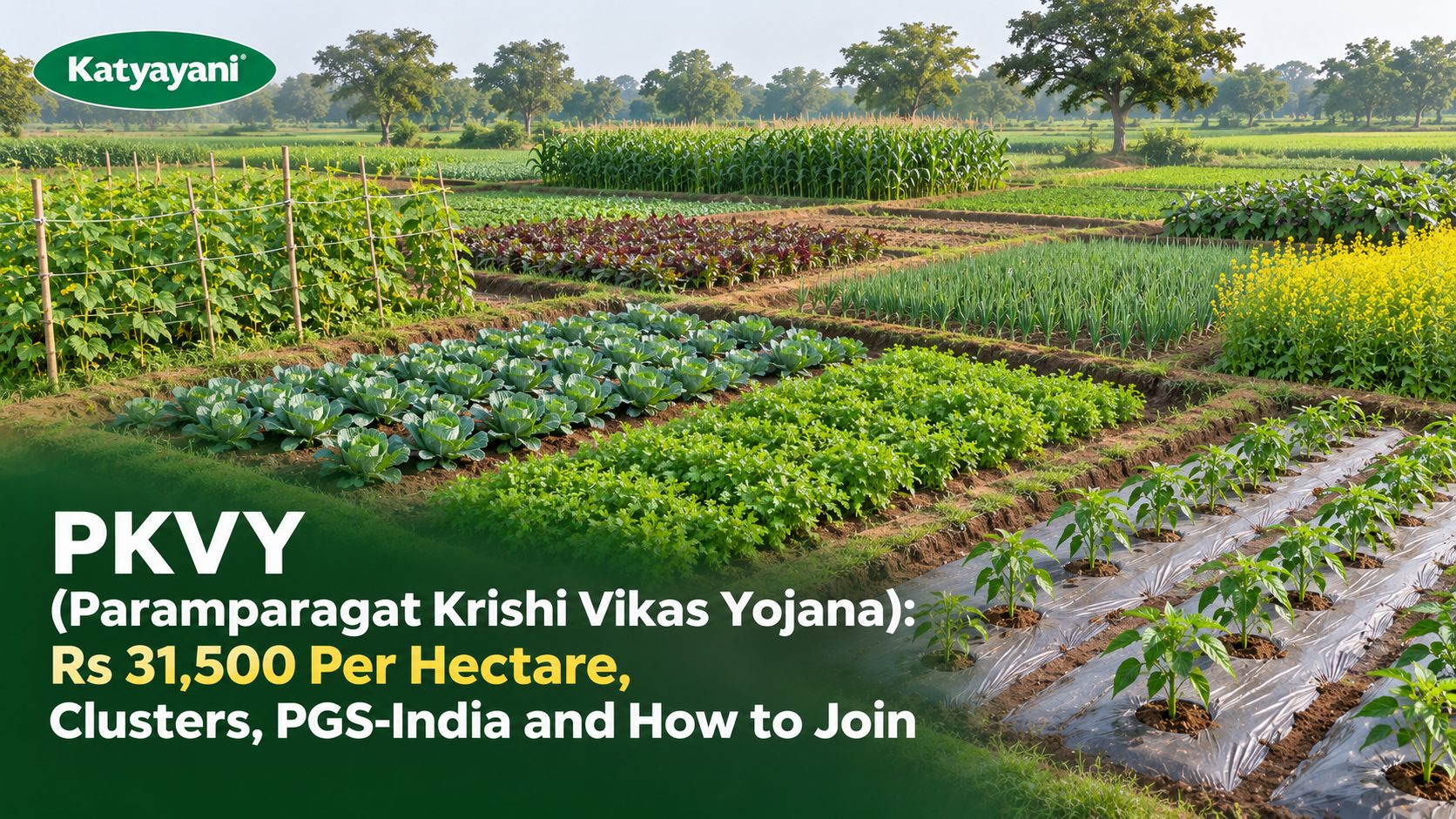
PKVY (Paramparagat Krishi Vikas Yojana) is a central scheme, started in 2015, that helps farmers move to organic farming in groups. It gives Rs 31,500 per hectare over three years, but only Rs 15,000 of that reaches you by DBT, for organic inputs. PIB says all farmers can join, up to 2 hectares of land. Lok Sabha replies of July 2026 show it is still running. You apply through your State's Regional Council.
What is PKVY?
PKVY is the Paramparagat Krishi Vikas Yojana, or "traditional farming improvement scheme". The Government of India launched it in 2015 under the National Mission for Sustainable Agriculture. It helps farmers move to organic farming in groups. The PIB backgrounder on PKVY calls it the cornerstone of India's organic farming movement.
The scheme works through clusters. Lok Sabha reply 1598 of 28 July 2026 describes PKVY as end-to-end support for organic farmers, from production to processing, certification and marketing. Its main aim is to form organic clusters outside the North Eastern States so that farmers can build a supply chain.
PIB lists seven aims: eco-friendly farming that improves soil health, less use of chemical inputs, lower cost and higher income, chemical-free food, low-cost ways to protect the environment, support for farmer collectives, and direct links to local and national markets.
How much money does PKVY give per hectare?
PKVY gives Rs 31,500 per hectare over three years. Of this, Rs 15,000 comes to the farmer by Direct Benefit Transfer for organic inputs, Rs 4,500 is for marketing, packaging and branding, Rs 3,000 is for certification and residue testing, and Rs 9,000 is for training. PIB and the Lok Sabha give the same split.
| Head | Rs per hectare over 3 years | What it pays for |
|---|---|---|
| Organic inputs | 15,000 (by DBT) | On-farm and off-farm organic inputs, including organic compost |
| Marketing, packaging, branding and value addition | 4,500 | Help to sell the produce as organic |
| Certification and residue analysis | 3,000 | Certification cost and residue testing |
| Training, awareness and capacity building | 9,000 | Training and exposure of farmers |
| Total | 31,500 | Over three years |
The Lok Sabha reply of 28 July 2026 says the Rs 15,000 is the part sent to the farmer. The reply does not say how the other heads are given. Ask your Regional Council which of these services your cluster gets.
Here is an example. Say you enrol 1 hectare. The scheme counts Rs 31,500 for that hectare over three years, but your direct bank transfer is Rs 15,000 in all. With 2 hectares, the totals double: Rs 63,000 in all, of which Rs 30,000 is the direct input payment, Rs 9,000 is for marketing, Rs 6,000 is for certification and Rs 18,000 is for training.
Who runs PKVY, and where does it apply?
The Ministry of Agriculture and Farmers Welfare runs PKVY, and the States carry it out. The Lok Sabha reply of 28 July 2026 says PKVY has been in place since 2015-16 in all States and Union Territories. In the North Eastern States the organic scheme is MOVCDNER. Money for PKVY now comes through PM-RKVY.
The Lok Sabha reply of 21 July 2026 lists PKVY, along with PDMC, soil health and the natural farming mission, among the PM-RKVY interventions for climate-resilient and sustainable farming. PIB (29 August 2026) says PM-RKVY was restructured in October 2024 as an umbrella scheme, and that States can move funds between components. It began in 2007-08 as the Rashtriya Krishi Vikas Yojana, and Rs 8,957.72 crore was released or sanctioned for it in 2025-26.
What is the cluster approach in PKVY?
In PKVY, farmers join in groups so that a whole block of land follows the same organic rules. PIB says farmers are mobilised into groups of 20 hectares each. This gives uniform standards and lowers cost, because farmers share resources.
Training and capacity building have been central, says PIB. Clusters help farmers cut chemical inputs, improve soil with organic amendments and use mixed farming. PKVY uses PGS-India or NPOP certification, and PIB also notes support for farmer collectives, processing and marketing. The MIDH guideline gives a warning for horticulture: do not go organic in isolated patches, grow crops that fetch a premium and line up buyers before you start.
Our guide to organic farming for beginners explains the steps on the farm itself, such as soil, inputs, records and the conversion period.
Who is eligible for PKVY?
PIB says all farmers and institutions are eligible, up to a maximum landholding of two hectares. The set-up is meant to help small and marginal farmers reach the support.
PIB gives no other condition. It does not say how a cluster or village is chosen, whether tenants can join, or if you can pick your own cluster. Ask your block agriculture office or Regional Council. PIB describes the support as assistance under four heads, not a loan, so no bank loan is needed.
How do I apply for PKVY?
Go to your Regional Council. PIB says farmers begin there, and the council guides them through enrolment and certification. The councils collect all applications into an Annual Action Plan and send it to the Ministry for approval. After sanction, the money goes from the Centre to the State and then to the council, which pays the farmer by DBT.
- Find the Regional Council for your area. The block agriculture office can tell you which one it is.
- Tell them your land size (2 hectares or less) and ask if your village has a cluster this year.
- Ask the council how to join a group of farmers in your area.
- The council puts the applications into an Annual Action Plan and sends it to the Ministry for approval.
- The council guides you on enrolment and certification.
- After approval, funds go from the Centre to the State and then to the council, which pays you by DBT. Make sure your bank account details with the council are correct.
The PGS-India portal lists a helpdesk number, 0120-2764212, and an email, nbdc@nic.in. Its home page shows 97 Regional Councils, so there may be one near you.
Do not pay anyone to "enrol" you. The route PIB describes is through the Regional Council. Keep your land papers ready; our guide on how to check land records online helps. You can also read about the AgriStack Farmer ID.
What is PGS-India, and how is it different from NPOP?
PGS-India is a low-cost, farmer-based way to certify organic produce, run by the Ministry of Agriculture and Farmers Welfare. NPOP is a third-party system run for the Ministry of Commerce by APEDA, used for export and large-scale sale. PIB says PKVY uses both. PGS-India mainly serves the local market.
| Point | PGS-India | NPOP |
|---|---|---|
| Type | Participatory. Farmers inspect each other and declare produce organic (PIB) | Third-party certification by an accredited agency (PIB) |
| Run by | Ministry of Agriculture and Farmers Welfare | Ministry of Commerce and Industry, through APEDA |
| Best for | Domestic market, small and marginal farmers | Export and large-scale sale |
| Entry points on the portal | Individual farmer, local group, large area certification, processor | Through accredited certification agencies |
The PGS-India portal calls the system "a quality assurance initiative that is locally relevant" and says it works outside third-party certification. Regional Councils and facilitating agencies help groups with training and data upload. PIB explains that farmers check one another's practices and then declare the produce organic. The portal adds that taking part may involve signing an application and a pledge.
The Lok Sabha reply of 28 July 2026 says 16.35 lakh hectares have been certified under PGS-India, benefiting 24.14 lakh farmers, and that more than 500 brands have been built under it. For NPOP it gives 39.68 lakh hectares certified up to 2025-26. Our guide to NPOP organic certification covers the export route in full.
How is PKVY different from MOVCDNER?
MOVCDNER is the organic scheme for the eight North Eastern States, and PKVY covers the rest of India. MOVCDNER gives Rs 46,500 per hectare over three years and includes support for farmer producer organisations. PKVY gives Rs 31,500. Both are described in the Lok Sabha replies of July 2026.
| Item | PKVY | MOVCDNER (North Eastern States) |
|---|---|---|
| Total help per hectare, 3 years | Rs 31,500 | Rs 46,500 |
| Organic inputs | Rs 15,000 by DBT | Rs 32,500 for inputs, of which Rs 15,000 is DBT |
| Certification and training | Rs 3,000 certification, Rs 9,000 training | Rs 10,000 for internal control system, training and certification |
| Marketing | Rs 4,500 | Rs 4,000 for value chain marketing at State level |
| Extra | Cluster approach | Creation of Farmer Producer Organisations |
If you live in the North East, ask your State agriculture department which scheme applies to you. All eight States have built their own organic brands under MOVCDNER: Organic Arunachal, Organic Manipur, Mission Organic Mizoram, Naga Organic, Sikkim Organic, Megha, Tripura Organic and Asoma. The reply's table shows 51,150 hectares covered under MOVCDNER from 2023-24 to 2026-27.
How is PKVY different from the National Mission on Natural Farming?
PKVY is for organic farming, with clusters and certified produce. The National Mission on Natural Farming (NMNF), approved on 25 November 2024, is a separate scheme for natural farming with bio-inputs. Their rates, rules and forms are different, so check which one fits your village.
| Point | PKVY | NMNF |
|---|---|---|
| Approved | 2015 | Union Cabinet, 25 Nov 2024 |
| Help to the farmer | Rs 31,500 per ha over 3 years (Rs 15,000 DBT for inputs) | Output-based incentive of Rs 4,000 per acre per year for 2 years, up to 1 acre per farmer |
| Certification | PGS-India or NPOP | Natural Farming Certification System under PGS-INDIA NATURAL, with financial help of Rs 2,100 per hectare for two years |
| Field support | Regional Councils and clusters | Krishi Sakhis, bio-input resource centres and training through KVKs and SAUs |
The Lok Sabha reply of 11 August 2026 says that under NMNF 24,102 clusters have been formed over 12.60 lakh hectares, with 26.76 lakh farmers enrolled, 8,100 Bio-Input Resource Centres and 40,182 Krishi Sakhis. For the steps, see our guide to the natural farming mission subsidy.
What has PKVY achieved so far?
PIB reports that, as on 30 January 2025, Rs 2,265.86 crore had been released under PKVY for 2015 to 2025. About 15 lakh hectares were under organic farming, 52,289 clusters had been formed and 25.30 lakh farmers had benefited (February 2025).
| Item | Figure | Source |
|---|---|---|
| Funds released under PKVY, 2015 to 30 Jan 2025 | Rs 2,265.86 crore | PIB backgrounder |
| Released for PKVY under RKVY in 2024-25 | Rs 205.46 crore | PIB backgrounder |
| Area under organic farming | About 15 lakh hectares (Feb 2025) | PIB backgrounder |
| Clusters formed | 52,289 (Feb 2025) | PIB backgrounder |
| Farmers benefited | 25.30 lakh (Feb 2025) | PIB backgrounder |
| Farmers supported under PKVY and MOVCDNER together | 36,38,043 till July 2026 | Lok Sabha, 28 Jul 2026 |
| Expenditure under PKVY and MOVCDNER together | Rs 3,70,353.02 lakh, which is about Rs 3,703.5 crore | Lok Sabha, 28 Jul 2026 |
The PGS-India home page gives its own totals: 97 Regional Councils, 79,051 groups, 24,96,117 farmers, 2,56,020 valid certificates and 17,22,791 hectares of certified area. These are PGS-India totals, not PKVY alone.
PIB also says 1.26 lakh hectares adopted in 2023-24 continued, and 1.98 lakh hectares of new area went under three-year conversion in 2024-25. These totals show reach. They do not show what any one farmer earned.
What is Large Area Certification under PKVY?
Large Area Certification (LAC) is a fast route to organic certification for whole areas where chemical farming has never been used, such as tribal belts, islands and eco-preserved zones. PIB says it began in 2020-21 and cuts the conversion period from two or three years to a few months. It is a different track from a normal cluster.
PIB lists these examples. In Dantewada, Chhattisgarh, 50,279 hectares were adopted in 2023-24. West Bengal adopted 4,000 hectares. The Car Nicobar and Nancowry Islands have 14,491 hectares declared certified organic, and all 2,700 hectares of cultivable land in Lakshadweep is certified organic. Sikkim, which PIB calls the only 100% organic State in the world, got Rs 96.39 lakh for 60,000 hectares. Ladakh has a proposal for 5,000 hectares, backed with Rs 11.475 lakh.
The Lok Sabha reply of July 2026 shows 51,779 hectares of LAC area and 11,044 farmers in Dantewada under PKVY. If your area has never used chemicals, ask your State office whether LAC applies. It can save you the long conversion wait.
What is the Jaivik Kheti portal?
Jaivik Kheti is an online platform for direct sale of organic products from farmers to consumers. PIB says that by December 2024, 6.23 lakh farmers, 19,016 local groups, 89 input suppliers and 8,676 buyers had registered on it.
The Lok Sabha reply of July 2026 adds that natural farming products certified under the Natural Farming Certification System are available on the Open Network for Digital Commerce (ONDC). More than 22.47 lakh farmers had registered under this system, and over 14.43 lakh had been issued natural farming certificates.
Does MIDH also support organic farming?
Yes. The MIDH guideline says organic farming of fruits, vegetables, aromatic plants and spices is supported "as per PKVY norms". Organic certification should be through agencies accredited by APEDA or NCONF, and organic farming should be taken up only for crops that fetch a premium and have buyers.
This extra help is for a maximum of 4 hectares per beneficiary, spread over three years. Read our guide to MIDH to see what it pays for. Ask your district horticulture office and Regional Council whether you can take the PKVY norms through MIDH or through the PKVY cluster. Do not assume you can claim both for the same land.
How does PKVY link with FPOs and markets?
PIB says PKVY supports farmer collectives for farming, processing and certification. It also notes that 9,268 FPOs had registered by 31 December 2024 under the central scheme for forming and promoting 10,000 FPOs. If you sell as a group, see our guide to the FPO credit guarantee scheme for credit support.
The Rs 4,500 per hectare head covers marketing, packaging, branding and value addition. Brands help too. The Lok Sabha reply says more than 500 brands have been built under PGS-India, such as Organic Himachal, Organic Jharkhand, Kerala Organic, Tamil Nadu Organic Products and Organic Uttarakhand. Ask your council how your group can use such a brand or build one.
What should I ask the Regional Council before joining a cluster?
PIB describes the support as being for "a three-year period". Organic farming is a long-term change, so ask the council how the payments are spread over those years and what happens if you leave the cluster early. If you can, ask in writing and keep a copy of the replies.
- Is my village and my plot in the Annual Action Plan this year?
- How many hectares will count for me, up to 2 hectares?
- When and how will the Rs 15,000 input support reach my bank account?
- Which certification route is used, PGS-India or NPOP, and what will I do for it? Who pays for it?
- What training and marketing help does the cluster get, and where will the produce be sold?
- Who keeps the cluster records, and what records must I keep?
- Who do I call if a payment or certificate is delayed?
If the replies are vague, ask the block agriculture office.
Is PKVY still running in 2026?
Yes, the official replies show it as a running scheme. The Lok Sabha reply of 28 July 2026 says PKVY is implemented in all States and UTs, with the Rs 31,500 rate. The reply of 21 July 2026 lists a 2026-27 PM-RKVY plan for one State with a PKVY line of Rs 30.60 crore. That is a State example, not a national figure.
PIB's reference list names a revised PKVY guidelines file. Plans can change each year, so check the current text at your State office, and ask your block office if your village has a cluster this year. Our agriculture schemes calendar and the list of agriculture subsidy schemes help you track related options.
What mistakes should a farmer avoid with PKVY?
Do not pay an agent to enrol you. Do not expect the full Rs 31,500 as cash, because only Rs 15,000 per hectare is the DBT input part. The rest funds training, certification and marketing.
Do not join alone, since the scheme works through clusters. Do not sell produce as organic before PGS-India or NPOP certification is complete. Do not mix up PKVY with the natural farming mission, which has different rates, rules and forms.
Also get a soil test first, so your inputs match your field. See how to read a soil health card. Keep every receipt, the cluster list and your certification record. They help if a payment is delayed or the council asks for proof.
Conclusion
PKVY gives Rs 31,500 per hectare over three years to organic clusters, but only Rs 15,000 of it is the direct input payment. Join through your Regional Council, keep to the 2 hectare limit, complete certification and keep your records.
Leave a Comment