
 15 min read
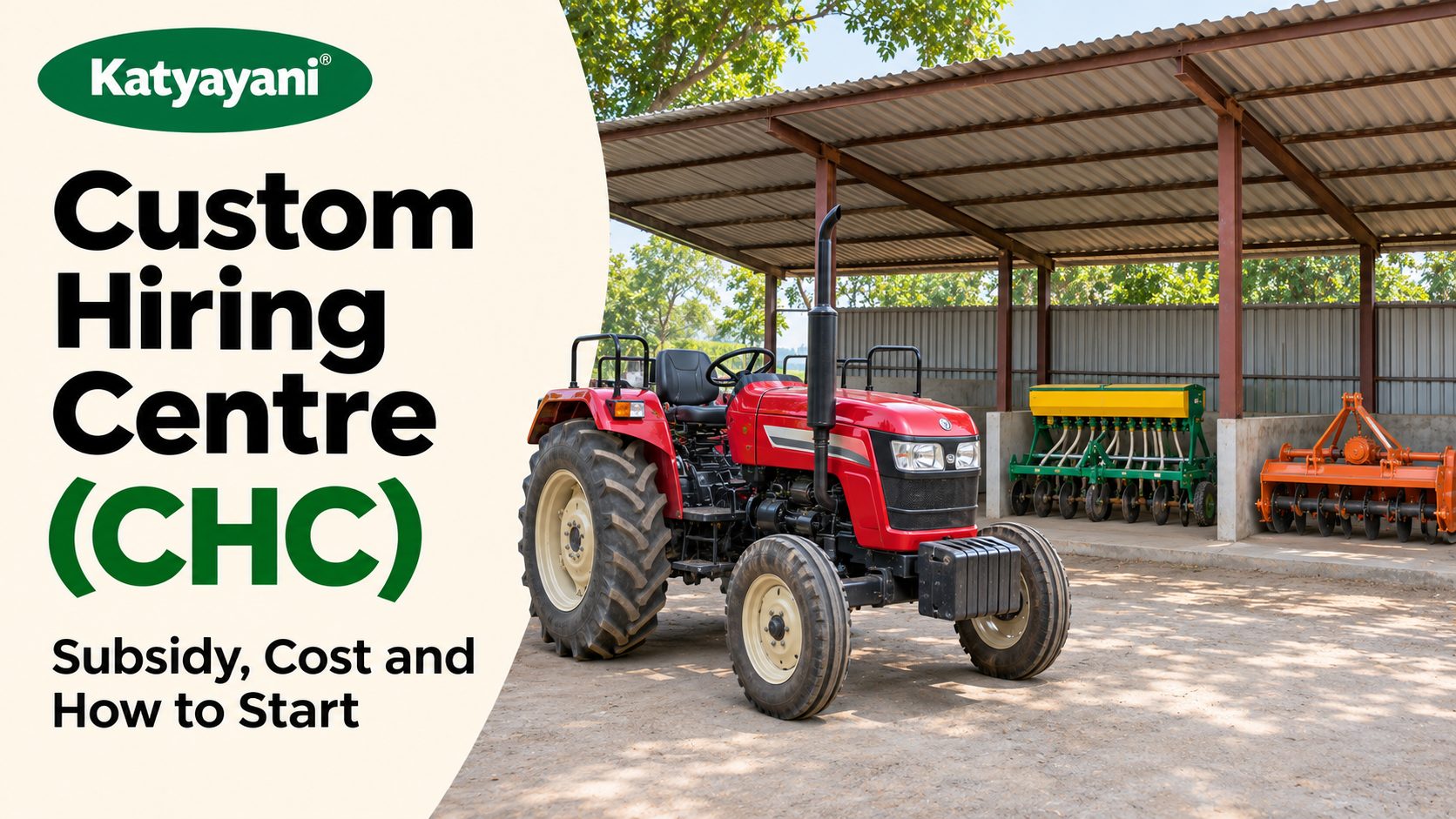
A Custom Hiring Centre (CHC) owns farm machines and rents them to farmers by the hour or the job. Under the Sub-Mission on Agricultural Mechanization (SMAM), a CHC gets a subsidy of 40% of project cost for projects up to Rs 250 lakh, with a cap for each machine. It works with a bank loan, and the subsidy is paid to the bank. Rural entrepreneurs, SHGs, FPOs, Panchayats and cooperative societies can apply. The rules here come from the October 2026 SMAM guideline. Your state agriculture department opens applications.
What is a Custom Hiring Centre (CHC)?
A Custom Hiring Centre is a business that owns farm machines and rents them to farmers who cannot afford their own. The farmer pays for the work, such as ploughing, sowing or harvesting. The CHC owner keeps the machine, the operator and the repairs.
The Mechanization and Technology Division overview calls CHCs run by cooperative societies, self help groups and rural entrepreneurs the best alternative for small and marginal farmers. The reason is size. The same page says about 84% of holdings in India are below 1 hectare, so a combine or a big tractor does not pay for most families.
| Term | Meaning |
|---|---|
| CHC | Custom Hiring Centre. A set of machines kept for hire |
| FMB | Farm Machinery Bank. A smaller village-level set of machines run by a group |
| Back-ended subsidy | Subsidy that goes to your bank and is adjusted against your loan at the end. It is not paid to you first |
| FARMS app | The government mobile app where CHCs list machines and farmers book them |
A CHC is not a shop that sells machines. It is a service business. Your income depends on how many days each machine works in a year.
Why does the government support Custom Hiring Centres?
A small farm cannot keep a costly machine busy. So the government wants farmers to rent a machine for a few hours instead of buying it. The SMAM guideline lists this as a main aim: promote custom hiring to offset the high cost of owning machines on small landholdings.
The farmech overview gives the farm power figures. Farm power per hectare rose from 0.48 kW in 1975-76 to 1.84 kW in 2013-14 and 2.49 kW in 2018-19. The page sets a target of 4.0 kW per hectare by 2030. It also says mechanisation in India is between 45% and 50%, against above 90% in industrialised countries.
The guideline says expensive machines should reach farmers through CHCs and Farm Machinery Banks. These are tractors above 40 HP, combine harvesters and sugarcane harvesters. The scheme discourages individual ownership of them. To see how one farmer buys a tractor, read our tractor subsidy guide. For the whole scheme, see SMAM explained.
Who can start a CHC under SMAM?
The October 2026 SMAM guideline names six types of applicant: rural entrepreneurs (rural youth and farmers working as entrepreneurs), self help groups under DAY-NRLM, Farmer Producer Organisations (FPOs), Panchayats, Primary Agricultural Cooperative Societies and cooperative societies of farmers. Agriculture graduates can apply for Kisan Drone CHCs.
| Applicant | What the guideline says |
|---|---|
| Rural entrepreneur | Rural youth and farmers working as entrepreneurs are eligible |
| SHG under DAY-NRLM | Eligible. States must earmark 10% of CHC and Hi-Tech Hub funds for DAY-NRLM SHGs |
| FPO, Panchayat | Eligible |
| PACS or farmers' cooperative society | Eligible (agriculture, horticulture, makhana and similar societies) |
| Agriculture graduate | Eligible for a Kisan Drone CHC. Must have passed class 10 and have a trained drone pilot |
The state agriculture department invites the applications and may add its own conditions. Ask your district office before you plan. If you are unsure whether to form an SHG or an FPO first, read our SHG or FPO comparison.
How much subsidy does a Custom Hiring Centre get?
A CHC gets 40% of the project cost as financial assistance for projects costing up to Rs 250 lakh. For each machine, the subsidy cannot go above the cap in Annexure-I of the guideline. A Kisan Drone CHC for an agriculture graduate gets 50% of the basic cost of the drone and its attachments, or Rs 5 lakh, whichever is less.
| Point | What the October 2026 guideline says |
|---|---|
| Rate for a CHC | 40% of project cost for projects costing up to Rs 250 lakh |
| Cap per machine | The maximum shown against 40% in Annexure-I for that machine |
| Kisan Drone CHC (agriculture graduate) | 50% of the basic cost of the drone and attachments, or Rs 5.00 lakh, whichever is less |
| Projects above Rs 50 lakh | Approved through a Detailed Project Report (DPR) system |
| Funding share | Centre and State share the cost 60:40. For North Eastern and Himalayan States it is 90:10. Union Territories get 100% central funds |
| How it is paid | Credit-linked back-ended subsidy (see the loan section below) |
Here is an example with a made-up price. A group plans a self-propelled combine harvester that costs Rs 25 lakh. Forty per cent of that is Rs 10 lakh. But the Annexure-I cap for this machine at 40% is Rs 7.68 lakh. So the subsidy is Rs 7.68 lakh, not Rs 10 lakh. The group must find the rest from its own money and the loan.
The 40% is a ceiling, not a promise. The state decides how many CHCs it can fund in a year. Compare it with other support in our agriculture subsidy guide before you plan.
What is the maximum subsidy for each machine?
Annexure-I lists a rupee cap for every machine. For a CHC, the cap is the figure in the 40% column. A star in Annexure-I marks expensive machinery. The guideline says such machines should go only through CHCs and Farm Machinery Banks. The table shows a few common machines from the October 2026 edition.
| Machine (October 2026 Annexure-I) | Cap at 40% (Rs lakh) | Star machine? |
|---|---|---|
| Tractor 2WD, up to 20 PTO HP | 1.60 | No |
| Tractor 4WD, above 20 and up to 40 PTO HP | 2.88 | No |
| Tractor 2WD, above 40 and up to 50 PTO HP | 3.60 | Yes |
| Tractor 4WD, above 50 PTO HP | 5.20 | Yes |
| Power tiller, above 11 BHP | 1.00 | No |
| Combine harvester, self-propelled | 7.68 | Yes |
| Combine harvester, track type, cutter bar above 6 feet | 10.00 | Yes |
| Sugarcane harvester, self-propelled (CHC only) | 40.00 | Yes |
| Maize combine harvester, self-propelled | 9.60 | Yes |
| Self-propelled cotton picker (2 rows) | 28.00 | Yes |
| Self-propelled rice transplanter, 4 to 8 rows | 4.80 | Yes |
| Kisan Drone | 4.00 | No |
The full list has many more machines, including precision farming machines added in the October 2026 edition. Open the SMAM guideline and read Annexure-I for the machine you plan to buy. Market prices change, but the cap stays as printed. If a machine costs more than its cap allows, you pay the difference. The notes under Annexure-I also say the cap includes GST. The subsidy is the lower of two figures: the percentage of the price your state has fixed, or the cap.
How does the bank loan and back-ended subsidy work?
You take a term loan from a bank. The bank pays out the full project cost, including the subsidy part, but not your own margin money. The state sends the subsidy to the bank in two halves. The bank keeps it in a separate account in your name and adjusts it against the loan at the end. You pay no interest on the subsidy part.
Annexure-II of the guideline gives the steps. They are the same for CHCs and for Farm Machinery Banks above Rs 10 lakh.
- You send the project proposal, the project report and papers to a bank, on the bank's form.
- The bank checks it and prepares a project profile and a claim form for the advance subsidy.
- The State Level Project Sanctioning Committee, which includes a bank representative, clears the project. The bank gives the loan only after this.
- The implementing agency releases 50% of the eligible subsidy to the bank as advance. It sits in a subsidy reserve account in your name.
- You buy the machines and tell the bank. The sanctioning committee and bank officials visit and check the machines on site.
- The agency releases the other 50% of the subsidy to the bank after the inspection report.
- The bank adjusts the full subsidy against your loan at the end of the repayment period.
| Loan point | What Annexure-II says |
|---|---|
| Eligible lenders | Commercial banks, RRBs, State Cooperative Banks, SCARDBs, scheduled primary urban cooperative banks, ADFCs and similar institutions. Cooperatives can also use loans from NCDC |
| Interest rate and scale of finance | Decided by the bank under its own Board-approved policy |
| Security | As per RBI norms |
| Repayment period | Generally up to 5 years, with a grace period of one year |
| Interest on subsidy part | None |
| Working capital | The bank may give it separately |
The guideline does not say how much margin money you must bring. That is the bank's decision, so ask the branch early. Our Agriculture Infrastructure Fund guide covers another credit scheme for farm infrastructure. It has its own list of eligible projects, so check that list before you assume a CHC qualifies.
Can small projects skip the bank loan?
In some states, yes. The guideline says a state may exclude proposals costing up to Rs 10 lakh from the credit-linked, back-ended route. Even then, cash purchases are not allowed. Every payment must go through a bank account, and the records must match your bank statements.
This is the state's choice. One state may keep every project on the loan route. Another may exclude small projects. Ask your district agriculture office which route applies to you before you buy any machine. Keep every invoice and every bank transfer proof, because the state also checks the machines on site.
What is the difference between a CHC and a Farm Machinery Bank?
A Farm Machinery Bank (FMB) is a smaller, village-level machinery set run by a group. It gets 80% of the project cost for projects up to Rs 30 lakh. A CHC gets 40% for projects up to Rs 250 lakh. FMBs are meant for villages with low mechanisation, not for single entrepreneurs.
| Point | CHC | Farm Machinery Bank |
|---|---|---|
| Subsidy rate | 40% of project cost | 80% of project cost |
| Project size for that rate | Up to Rs 250 lakh | Up to Rs 30 lakh |
| Who can run it | Rural entrepreneurs, SHGs, FPOs, Panchayats, PACS, farmers' cooperatives | DAY-NRLM cluster level federations and women SHGs, FPOs, Panchayats, PACS, farmers' cooperatives |
| Tractors | No special limit stated | Not more than one tractor per project |
| Where | Districts chosen in the State plan | Villages with low mechanisation, rainfed and aspirational districts preferred |
| Bigger projects | DPR above Rs 50 lakh | If the project costs more than Rs 30 lakh, assistance is capped at Rs 24 lakh |
For a Farm Machinery Bank, the per-machine cap is double the 40% figure in Annexure-I. At least 25% of FMB funds should go to processing, value addition and by-product management by DAY-NRLM women SHGs. If you run a farmers' group, our FPO credit guarantee scheme guide covers another route to funds.
Which machines should a CHC buy?
Buy machines that match the crops and work in your area. The guideline allows location and crop specific machines, post-harvest and value addition machines, and precision farming tools including Kisan Drones. The aim is to keep each machine busy through the year, since demand rises and falls with the season.
The guideline also wants a CHC to serve both crop production and processing needs. A centre with one machine that works ten days a year is a weak plan. In a wheat and sugarcane belt, for example, you can plan machines for land preparation, sowing, harvest and transport, so work is spread over months.
- Start from the crops of your area and the work farmers now do by hand or hire from far away.
- List the weeks when each machine will be needed. If two machines are needed in the same week, plan an operator for each.
- Check the machine in Annexure-I. States may add new machines, so ask your state office if the one you want is allowed.
- Check that the manufacturer is empanelled by your state and that the machine has a valid test report.
If you plan to offer drone spraying, our agri drone subsidy guide covers the licence and spraying rules for a service business.
What rules must a CHC follow?
The guideline sets rules on training, records and machines. The CHC owner must take training from an FMTTI or another reputed institute. The CHC must be georeferenced and uploaded on the FARMS mobile app, and its data must go on the Krishi MApper. Self-propelled machines costing Rs 1 lakh or more need a telematics kit that tracks the machine.
| Rule | What the guideline says |
|---|---|
| Training | Adequate training from an FMTTI or another reputed training institute is mandatory for CHC beneficiaries |
| Georeferencing | Every machine costing Rs 1.00 lakh and above must be georeferenced. The CHC itself must be georeferenced and uploaded on the FARMS mobile app |
| Telematics | Self-propelled machines of Rs 1.00 lakh and above, such as tractors, reapers and transplanters, need an app-based telematics kit. Manufacturers must give it as a standard fitting on machines made after 1 June 2023 |
| Data | All CHC data and capital assets must be uploaded on the Krishi MApper |
| Machine identity | Machines carry a standard unique code and a label plate. The guideline sets the format. Tractors and combine harvesters are exempt from the laser cut code |
| Soil Health Card | May be needed to get the subsidy. If you have none, a sample can be tested and the cost adjusted from the subsidy |
| Upkeep | The CHC must be maintained and upgraded from time to time |
| Payments | For projects a state keeps outside the loan route, cash purchases are not allowed and every payment must show in your bank statement |
Ask your state office what applies in your state. The guideline says the Soil Health Card "may be necessary", so it depends on the state. Our Soil Health Card guide shows how to read the card.
How do I list my CHC on the FARMS app?
Download the FARMS (Farm Machinery Solutions) app from Google Play. Register as a CHC owner with your mobile number and an OTP, take a live photo of your CHC, upload an ID proof, and add each machine with its hiring cost. The app needs internet and works on Android.
The FARMS app FAQ gives the details. Both CHC owners (farmers, societies and entrepreneurs) and farmers who hire can register. Government CHCs are registered by the state nodal officer on the DBT portal.
- Install the FARMS app and allow location, camera and file access.
- Choose CHC owner and enter your details. A six digit OTP comes to your mobile. Your user ID is your mobile number and the password comes by SMS.
- Take a photo of the CHC standing in front of it. The app records latitude and longitude, so a photo from the gallery is not accepted.
- Upload one ID proof. A GST number is optional for now, as per the FAQ.
- Add each machine. You can also add a non-subsidised or personal implement for hire. You can add 1 to 25 machines.
- Set the hiring cost for each machine. The FAQ says it must not be more than four digits per unit.
- When a farmer books, you get an in-app alert and an SMS. At the end of the job, the farmer gives a six digit PIN to close the booking.
If a machine is not on the list, write to your state nodal officer. The FAQ says the state officer asks the M&T Division to add it. Farmers search for a CHC within 5, 20, 50 or 200 km of their village. For a few machines, such as combine harvesters, cotton pickers and sugarcane harvesters, the search covers the whole country.
Who decides the hiring rate?
You do. The FARMS app FAQ says the hiring price is decided only by the CHC and the M&T Division does not review it. The only limit in the FAQ is that the rate must not run to more than four digits per unit. Farmers can rate you after each job, and you can rate them.
The same FAQ says the government gives no subsidy on hiring through the app. The SMAM guideline has one narrow exception. In low mechanised regions, small and marginal farmers get Rs 2,000 per hectare for hiring drones from CHCs and women SHGs, for up to 2 hectares a year, paid by DBT. The area must be georeferenced and monitored online.
Set a rate that covers the operator, fuel, repairs and the loan cost. The guideline gives no sample rate. Ask other CHCs in your district what they charge, and match your rate to the local work.
How do I check if my CHC will make money?
Work backward from the days each machine will really be hired. Divide the yearly cost of the machine by the days it will work, then add the daily running cost. That is the lowest rate you can charge without a loss. If farmers near you will not pay it, the machine is a poor choice.
| Item | How to work it out |
|---|---|
| Yearly loan payment | The loan instalments for the year, from the bank schedule, with no interest on the subsidy part |
| Yearly fixed cost | Operator pay, insurance, shed, upkeep and the telematics and registration costs, if any |
| Working days a year | Days you can honestly expect the machine to be hired, based on the crops near you |
| Running cost a day | Diesel or power, oil, small repairs and the operator's daily share |
| Lowest daily rate | (Yearly loan payment + yearly fixed cost) divided by working days, plus running cost a day |
Here is an example with made-up numbers. The yearly loan payment and fixed cost for one machine add up to Rs 1,20,000, and you expect 60 working days. That is Rs 2,000 a day before running cost. With a running cost of Rs 800 a day, your lowest daily rate is Rs 2,800. If you can find only 30 days of work, the same machine needs Rs 4,000 plus Rs 800, which is Rs 4,800 a day. The number of working days decides everything.
Talk to farmers before you apply. Ask which jobs they still do by hand or hire from another village, and what they would pay. A good CHC plan starts with that list, not with the machine catalogue.
What are the steps to start a CHC?
First check whether your district is in the State Annual Action Plan and whether the state has opened applications. Then form your group or register your enterprise, take the training, make a project report, approach a bank, get sanction, buy from empanelled manufacturers, get the machines inspected, register on the FARMS app and start hiring.
- Ask the district agriculture office or the state agriculture department if CHCs are open this year and which districts are chosen.
- Decide who will own the CHC: you alone, an SHG, an FPO or a cooperative society.
- Take the training from an FMTTI or another reputed institute in your state. The guideline makes it mandatory.
- Plan the machines for your crops. Prepare the project report with costs, loan amount and your margin money.
- Apply at a bank on its form, with the project report and other papers.
- Wait for the State Level Project Sanctioning Committee to clear the project. The bank gives the loan only after this.
- Buy from a manufacturer empanelled by your state. The guideline says you may choose any machine and negotiate the price. Check the displayed maximum price.
- Ask the bank and the committee to inspect the machines. The second half of the subsidy comes after that.
- Register your CHC on the FARMS app, then add your machines.
States run the scheme. The guideline says each State Government prepares an Annual Action Plan, with a plan by 15 February and final approval by 31 March each year. So the window in your state may differ from your neighbour's. See the agriculture schemes calendar and watch your state portal.
How do I buy machines the right way?
Buy only from manufacturers the state has empanelled, and pick a machine with a valid test report. The guideline lets you choose any machine and variant from the empanelled list and negotiate the final price. The subsidy comes through DBT. Maximum selling prices must be shown on the manufacturer's website and in the dealer's shop.
Machines must carry the standard unique code and label plate. Manufacturers must register on the agrimachinery.nic.in portal and upload their stock state-wise, and the state checks the code on your machine against that stock. So buy only machines that carry the code and the plate.
Our GST on farm machinery guide explains the tax on tractors and implements. The Annexure-I cap already includes GST, so read the invoice carefully before you pay.
What mistakes can lose a CHC its subsidy?
The common mistakes are buying before sanction, paying in cash, not checking the machine and its cap in Annexure-I, skipping the training, buying from a firm that is not empanelled and not uploading the CHC on the FARMS app. Each goes against a rule in the guideline.
| Mistake | How to avoid it |
|---|---|
| Buying before the sanction letter | Wait for the State Level Project Sanctioning Committee to clear the project, since the bank loan comes only after that |
| Paying in cash | Pay through your bank account and keep proof of every payment |
| Wrong machine or no cap check | Look up the machine and its cap in Annexure-I before you sign |
| Skipping the training | Complete the mandatory training and keep the certificate |
| Firm not empanelled | Ask the district office for the state list of manufacturers |
| No georeferencing or no FARMS entry | Upload the CHC and machine photos with location as the rules say |
| Plan with no work days | Test each machine with the worksheet above before you apply |
| Ignoring the bank early | Meet the loan officer first, since margin money and security are the bank's decision |
If you run a self help group, our SHG bank linkage guide explains how SHGs build a credit record with a bank.
Where can I get help or check the current rules?
Start with your district agriculture office or the state nodal officer for farm mechanisation. For portal questions, the helpdesk email on the portal is support-agrimech@gov.in. The central guideline and the machine list sit on the agrimachinery.nic.in portal and the farmech site.
The farmech FAQ page says there is no separate law to promote mechanisation, and that SMAM and CRM are the national schemes, covered under RKVY. The PM-RKVY guidelines list SMAM as one of nine parts of PM-RKVY. The PM-RKVY home page carries the 2026-27 state sanction notices. The DBT portal FAQ for farm machinery (dated 28 November 2019) explains how farmer registration worked at that time.
Older articles may quote old caps, so check the date on the cover of any guideline. The latest one on the farmech site was forwarded on 14 October 2026. If a state office quotes a different rate, ask for the order in writing.
Conclusion
A CHC earns only if its machines work many days a year. The subsidy is 40% with a cap per machine, and it reaches you through your bank at the end, not before. Test the plan with real work days, meet the bank early and wait for the sanction before you buy.




Leave a Comment