 15 min read
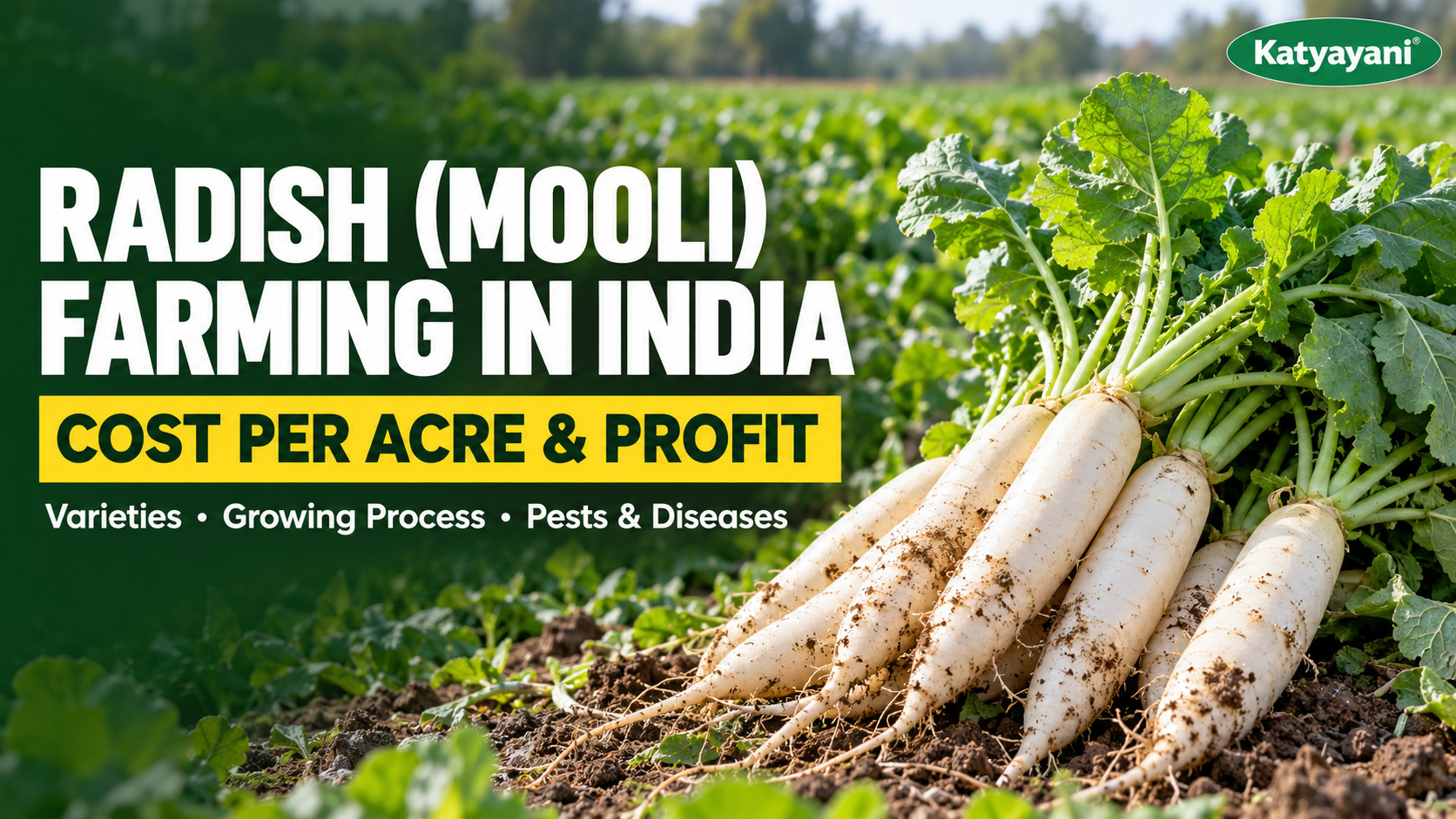
Radish (mooli) is a 25 to 60 day root crop. In India, grow the tropical (Asiatic) types such as Pusa Chetki, Pusa Desi, Pusa Reshmi and Japanese White in most places, and the temperate type Pusa Himani or White Icicle in cool months and hills. Use light sandy-loam soil with pH 6 to 7, 15 to 20 tonnes of well-rotted FYM per hectare (about 6 to 8 tonnes per acre), and 4 to 5 kg seed per acre. NHB puts yield at 25 to 35 tonnes per hectare for tropical types (about 10 to 14 tonnes per acre). One Kangra cost survey gives about Rs 40,550 per acre in total cost, and the break-even price at 10 tonnes per acre works out to about Rs 4 per kg. Profit is price-driven, so check your live mandi rate before you sow.
Tropical or temperate radish: which type should you grow in India?
Match the type to the month you sow. Tropical (Asiatic) radish is the long white mooli you see in the mandi, and it suits most of the plains. Temperate (European) radish is the small, quick type that likes cool weather and the hills. NHB sorts Indian radish into these two groups, and almost every decision after this, from spacing to yield, follows from the group.
| Point | Tropical or Asiatic type (mooli) | Temperate or European type |
|---|---|---|
| Root | Long and white, often 25 to 45 cm | Short, round or small, white or red |
| Days to harvest | 40 to 65 days depending on variety (NHB varieties page) | 25 to 30 days for White Icicle and Rapid Red White Tipped; 55 days for Pusa Himani |
| Spacing | 45 x 8 cm (NHB) | 20-30 x 8 cm (NHB) |
| Average yield | 25 to 35 tonnes per hectare in 40 to 60 days (NHB) | 15 to 20 tonnes per hectare in 35 to 40 days (NHB) |
| Heat tolerance | Handles more heat; Pusa Chetki is the heat-tolerant pick (NHB) | Wants cool weather; Pusa Himani is the one NHB says can be grown through the year in the hills, except November to January |
| Best for | Mandi sale of long white mooli across the plains | Salad, kitchen gardens, hills, cool-season sowing |
In plain words: if you sow in the plains in September to November, you want a tropical type. If you sow a small salad radish in a cool December in the plains, a temperate type is fine and will be ready in about a month. The best taste, texture and size come at 10 to 15 degrees Celsius according to the NHB soil and climate page, and TNAU says about 15 degrees. Once days get long and hot, the plant tries to flower before the root fills. That is bolting, and the root left behind is hard, pithy and sharp.
Which are the best radish varieties in India?
There is no single best variety, only the right one for your sowing month. For the northern plains, the NHB varieties page gives Pusa Desi, Pusa Reshmi and Japanese White for the main season, Pusa Chetki for summer and the monsoon, and Pusa Himani for December to February. Read the sowing window on the packet before you pay for seed.
| Variety | Type | Sowing window (as NHB gives it) | Days to harvest | Root |
|---|---|---|---|---|
| Pusa Desi | Tropical | Mid-August to mid-October, northern plains | 50 to 55 | Pure white, 30 to 35 cm, tapering, green stem end |
| Pusa Chetki | Tropical | Mid-March to mid-August in north and central India; through the year in south and west | 40 to 45 | Medium long, stumpy, pure white, mildly pungent; a summer and monsoon crop, April to September |
| Pusa Reshmi | Tropical | Mid-September to mid-November; tolerates slightly higher heat | 55 to 60 | 30 to 45 cm, white with green top |
| Japanese White | Tropical | October to December in plains; July to September in hills | 60 to 65 | Cylindrical, 25 to 30 cm long, 5 cm thick, crisp, mild |
| Punjab Safed | Tropical | September to October | 50 to 60 | White, 30 to 40 cm, smooth, free of forking; stays edible about 10 days after full size |
| Arka Nishant | Tropical | Not given | Not given | Long, marble white; NHB says resistant to pithiness and early bolting |
| Pusa Himani | Temperate | December to February, northern plains | 55 | 30 to 35 cm long, 10 to 12 cm thick, sweet, mildly pungent |
| White Icicle | Temperate | Mid-October to February | 25 to 30 | 12 to 15 cm, icy white, for kitchen gardens |
| Rapid Red White Tipped | Temperate | Mid-October to February | 25 to 30 | Small, round, red with white tip |
Look at the days column and the window column together. A farmer who wants a quick summer crop looks at Pusa Chetki (40 to 45 days, heat tolerant). A farmer who wants a big, solid winter root for the mandi looks at Japanese White or Pusa Reshmi and waits 55 to 65 days. Punjab Safed has one more advantage: NHB says the roots stay edible for about 10 days after reaching full size, which gives you room if the truck is late.
TNAU lists Co 1, Pusa Reshmi, Pusa Chetki, Pusa Desi, Japanese White and Arka Nishant as popular plains varieties in Tamil Nadu, and White Icicle, Scarlet Globe and Rapid Red White Tipped for the hills. In the Kangra summer trials, farmers moved from local seed to "improved hybrids" with line sowing, and the roots stopped bolting in April-May sowing (Indian Farming, October 2025). The article does not name those hybrids. Ask your KVK or a licensed seed dealer which hybrid is tested for your district and month.
The Common Seed Mistake: Sowing a winter variety in summer is the usual cause of a crop that bolts. The Kangra farmers had broadcast varieties that "bolt early without forming appropriate marketable sized roots" in April-May (Indian Farming 2025). If you see tall flower stalks and thin roots at 30 days, the variety did not suit the month. Next time, check the sowing window first.
When to sow radish: which month is right for mooli ki kheti?
In the north Indian plains, sow from 1 September to 1 December. In the hills, sow from June to September. In peninsular India radish grows almost all year round except a few summer months, and NHB gives April to June as the best sowing time in the south. If you want steady income instead of one big harvest, sow in small batches every 15 to 20 days.
| Region | Sowing window | Source |
|---|---|---|
| Northern plains (main season) | 1 September to 1 December. NHB gives September to January for winter sowing in general | NHB planting page |
| Hills | June to September. TNAU says June to July | NHB, TNAU |
| South India | Almost the whole year except a few summer months; best April to June | NHB planting page |
| Tamil Nadu plains | September (best) | TNAU |
| Summer radish in a mid-hill area (Kangra) | April to May sowing, harvested in the June to August summer-rainy season with heat-suited varieties | Indian Farming 2025 |
Think of it as a rolling plan. Say you grow one acre. Instead of sowing the whole acre on one day, sow a fraction of it today and the next fraction 15 to 20 days later, as NHB advises. Radish holds its best size for only a few days, so one big sowing means one big harvest week and a crowded mandi. Staggered sowing spreads the harvest and the price risk.
Which soil suits radish and how should you prepare the field?
Radish wants light, loose, sandy-loam soil rich in humus with pH 6.0 to 7.0 (NHB). Plough deep and fine so that clods do not block the root. Mix 15 to 20 tonnes of well-rotted FYM per hectare, about 6 to 8 tonnes per acre, into the soil at land preparation. Do not use fresh manure. NHB links fresh FYM to forked roots.
You have probably seen the result: a mooli that splits into two or three legs, or bends around a stone or a lump of half-rotted dung. The root grows straight only when it meets loose soil all the way down. Heavy soil does the same thing in another way. NHB says it gives "rough, malformed roots with number of small fibrous laterals". Such roots fetch a lower price even if the yield looks fine.
- Soil and pH. Sandy loam with plenty of humus. TNAU gives pH 5.5 to 6.8 for the highest yield, so aim for about 6 to 6.8 if you can.
- Tillage. Plough until the clods are gone, then form ridges. NHB says radish is usually grown on ridges so the root can go down easily.
- FYM. NHB says 15 to 20 tonnes per hectare of well-decomposed FYM. TNAU says 25 tonnes per hectare. That is about 6 to 8 tonnes and 10 tonnes per acre.
- Test the soil first. The Michigan State bulletin asks growers to fertilise from a soil test, and its general figures apply only when no test is available. A soil health card reading tells you your pH and what to look at next.
- Rotate. Radish is in the cabbage family. Do not grow it after cabbage, cauliflower or mustard on the same land. Soil-borne problems such as black root rot build up on the same field. Our crop rotation guide has plans, and the Connecticut handbook names rotation as the way to avoid black root rot.
How much radish seed per acre, and what spacing should you use?
NHB recommends 10 to 12 kg of seed per hectare, which is about 4 to 5 kg per acre. TNAU says about 10 kg per hectare. Sow in lines on ridges at 45 x 8 cm for tropical types and 20-30 x 8 cm for temperate types. Do not broadcast if you can avoid it.
| Item | Per hectare | Per acre (our arithmetic) | Source |
|---|---|---|---|
| Seed rate | 10 to 12 kg (NHB); about 10 kg (TNAU) | About 4.0 to 4.9 kg | NHB planting, TNAU |
| Spacing, tropical types | 45 x 8 cm on ridges | About 1.1 lakh plants per acre at full stand | NHB (plant count is our calculation) |
| Spacing, temperate types | 20-30 x 8 cm | About 2.0 to 2.5 lakh plants per acre | NHB (our calculation) |
| Spacing, TNAU plains | 15 x 10 cm; paired rows 30 x 15 x 10 cm under drip | - | TNAU |
| Sowing depth | Not stated in the Indian pages I read | - | - |
NHB and TNAU give different spacing because they write for different regions. Follow the one closest to your climate, or ask your KVK. What matters more is line sowing. In the Kangra programme, moving from broadcast to line sowing with seed treatment lifted yield from 115.9 to 170.7 quintals per hectare in 2024-25 (about 47 to 69 quintals per acre), according to the Indian Farming article. When seedlings crowd each other, thin them at the second weeding, as TNAU advises. Crowded roots stay thin.
That article says seed treatment was part of the package but does not name the treatment. Do not treat radish seed with any chemical unless the label lists radish or vegetables. If damping off has hit your field before, a bio-agent in the soil is a gentler start, and the damping-off section below covers it.
What fertiliser does radish need per acre?
NHB suggests 50 to 100 kg nitrogen, 100 kg phosphorus (P2O5) and 50 kg potash (K2O) per hectare. Per acre that is about 20 to 40 kg N, 40 kg P2O5 and 20 kg K2O. Give half the nitrogen and all the phosphorus and potash at sowing, and the rest of the nitrogen 30 days after sowing.
| Source | FYM per ha | N : P2O5 : K2O per ha | Timing |
|---|---|---|---|
| NHB manuring page | 15 to 20 tonnes | 50 to 100 : 100 : 50 kg | Half N plus all P and K at planting; other half N 30 days after planting. Plough in to 25 cm depth |
| TNAU (plains) | 25 tonnes | 25 : 100 : 50 basal, plus 25 N at 30 days (total 50 N) | Basal and one top dressing at 30 days |
| Per acre (our arithmetic from NHB) | About 6 to 8 tonnes | About 20 to 40 : 40 : 20 kg | Same split |
- Put fertiliser deep. NHB says the feeder roots spread through the top 25 cm, so plough fertiliser in to that depth, especially in dry weather, instead of leaving it on top.
- Turn nutrient kg into bags. Divide the nutrient kg by the nutrient share and multiply by 100. For 20 kg N from urea (46 percent N), that is 20 / 46 x 100, about 43.5 kg of urea. Ask your agriculture officer to do the same sum for P and K from your soil test.
- Do not push nitrogen. Michigan State says excess nitrogen and potash "appear to make radishes brittle and may cause cracking under some circumstances".
- Watch boron. Michigan State says radish needs boron, and that low boron causes cracking and poor root development. If your root vegetables crack and a soil test or your KVK points to low boron, a water-soluble boron fertiliser is one route. Katyayani Boron 20 lists cauliflower, a cabbage-family crop, among its crops and names flower drop, fruit cracking and hollow stems as deficiency signs. The page does not list radish and gives no dose, so get the rate from your KVK and do not guess. The US rates in the Michigan bulletin are not Indian doses and are not copied here.
How often should you irrigate radish, and how do you control weeds?
Irrigate straight after sowing. Then water every 10 to 12 days in winter and every 5 to 6 days in summer (NHB). TNAU says once a week in the plains. The exact number of days matters less than keeping the soil evenly moist, because swings between dry and wet are what crack roots.
Picture a field that dries out for ten days and then gets a heavy flood irrigation. The roots take up water fast and swell fast, and the skin splits. Utah State University Extension names erratic irrigation as the main cause of cracking in radish. Michigan State adds that lack of moisture gives irregular maturity and poor roots. So set a rhythm and keep to it.
- Light watering before harvest. NHB suggests a light irrigation a day before harvest so the roots lift easily.
- Two weedings in the rains. NHB asks for two weedings in the rainy season. Growing roots tend to push out of the soil, so earth up and weed early.
- Thin at the second weeding. TNAU says to thin densely sown plants then. Leave the stronger plant at each gap.
- Hold the moisture. A mulching guide explains how mulch keeps soil moisture steady. I did not find an Indian radish trial on mulch, so treat this as general advice.
I found no herbicide for radish on an official Indian page, so weeding here means hoeing by hand or with a wheel hoe. If a dealer offers a weedkiller for radish, ask to see the label line that lists radish.
What is the cost of radish farming per acre?
One survey of Kangra farmers puts the full cost of a rabi radish crop at about Rs 1,00,203 per hectare, or about Rs 40,550 per acre, counting family labour, land rent and interest. Labour was about two thirds of that. The paper does not print the survey year, so treat the rupee values as old and indicative.
| Cost item | Rs per hectare | Rs per acre (our arithmetic) | Share of total |
|---|---|---|---|
| Seed | 3,260 | About 1,320 | 3.3% |
| FYM | 4,000 | About 1,620 | 4.0% |
| Fertilisers | 1,512 | About 610 | 1.5% |
| Plant protection | 2,182 | About 880 | 2.2% |
| Human labour (hired 24,000 + family 42,000) | 66,000 | About 26,710 | 65.9% |
| Tractor or power tiller | 7,500 | About 3,040 | 7.5% |
| Irrigation | 2,727 | About 1,100 | 2.7% |
| Interest on working capital | 1,807 | About 730 | 1.8% |
| Variable cost subtotal | 88,988 | About 36,010 | 88.8% |
| Fixed cost (land rent, land revenue, depreciation, interest on fixed capital) | 11,215 | About 4,540 | 11.2% |
| Total cost (Cost C2) | 1,00,203 | About 40,550 | 100% |
Read the table from the bottom up. Labour is the big line at about Rs 26,700 an acre. Seed, FYM, fertiliser and plant protection together come to only about 11 percent. So the cheapest way to improve profit is not to skimp on seed or manure. It is to waste less labour, harvest on time and sell at a good price. The table is from the 2020 IJCMAS paper on 60 vegetable growers in Nagrota Bagwan block, Kangra, Himachal Pradesh, and it reports radish under rabi vegetables. This is a hill district, so wages and prices differ from Bihar, Punjab or Karnataka. Use it as a template and replace each line with your own local rate.
If Your Family Does The Work: Your cash cost is much lower than Rs 40,550 per acre. The same paper gives a "Cost A1" of Rs 53,461 per hectare (about Rs 21,640 per acre), which leaves out family labour. A farmer who hires all the labour feels the higher number. A farmer who works his own field feels the lower one.
About "per bigha" costs. A bigha is not one fixed size. It changes from state to state and even between districts. Take the per-acre figure above and multiply by the size of your bigha in acres. If a bigha in your village is half an acre, halve every per-acre figure. I did not find a sourced per-bigha cost, so I have not made one up.
What yield and profit can you get from radish per acre?
NHB gives 25 to 35 tonnes per hectare for tropical radish, which is about 10 to 14 tonnes per acre, and 15 to 20 tonnes per hectare for temperate types, about 6 to 8 tonnes per acre. Profit is yield in kilograms times the price you actually get, minus total cost. The price decides most of it, so check your live mandi rate on the day you plan to harvest.
| Source | Yield per hectare | Per acre (our arithmetic) | Crop duration |
|---|---|---|---|
| NHB harvesting and yield page, tropical types | 25 to 35 tonnes | 10.1 to 14.2 tonnes | 40 to 60 days |
| NHB, temperate types | 15 to 20 tonnes | 6.1 to 8.1 tonnes | 35 to 40 days |
| TNAU plains | 20 to 30 tonnes | 8.1 to 12.1 tonnes | 45 to 60 days |
| Kangra summer radish, improved package (average of 5 years) | 171.89 quintals (17.2 tonnes) | About 69.6 quintals | Summer-rainy season |
| Kangra, traditional broadcast (same years) | 115.92 quintals (11.6 tonnes) | About 46.9 quintals | Summer-rainy season |
The Kangra rows show something useful. The same farmers, on the same kind of land, harvested about 48 percent more with improved seed and line sowing than with broadcast sowing. That gain came from technique, not from extra land.
Break-even price: the number to know before you sow
Divide your total cost by the kilograms you expect to harvest. Using the Kangra cost of Rs 40,550 per acre as an example only, this is the price per kilogram you need just to cover cost at each yield level.
| Yield per acre | Source of yield | Break-even price per kg |
|---|---|---|
| About 6.1 tonnes | NHB temperate low end | About Rs 6.70 |
| About 8.1 tonnes | NHB temperate high end, TNAU low end | About Rs 5.00 |
| About 10.1 tonnes | NHB tropical low end | About Rs 4.00 |
| About 12.1 tonnes | TNAU high end | About Rs 3.35 |
| About 14.2 tonnes | NHB tropical high end | About Rs 2.85 |
Each Rs 1 per kg you earn above break-even is about Rs 10,000 per acre at 10 tonnes. This is why a good market day can matter more than a good variety. Live mandi prices change daily and by city, so check Agmarknet or your local mandi before you sow and again before you harvest. I have not put a price in this article because I could not confirm a current one.
What real income figures exist?
- Kangra cost survey (rabi radish). Gross return Rs 1,31,250 per hectare (about Rs 53,120 per acre). Net return over the full cost including family labour (Cost C3 of Rs 1,10,223 per hectare) was Rs 21,027 per hectare (about Rs 8,510 per acre), a benefit-cost ratio of 1.19. Net over the cash-type Cost A1 was Rs 77,789 per hectare (about Rs 31,480 per acre).
- Kangra summer radish programme (Farmers FIRST). The benefit-cost ratio averaged 4.3 for the improved package against 2.6 for local practice over 2020-21 to 2024-25. The article does not say how it counted cost.
- Farm income. Total income of the participating farms rose by about 79 percent. That comes from many changes together, not from radish alone.
You may see claims of "lakhs per acre in 40 days". They do not match any figure above. They need an unusually high price and yield together, and I found no official source for them, so this article does not repeat them. A 40 to 60 day crop that fits between two other crops is a real benefit. The money per acre is modest unless the price is good.
Which pests attack radish, and how do you spot and stop them?
The pests named by the NHB pests page and TNAU are aphids, mustard sawfly and flea beetles. The Connecticut handbook adds diamondback moth larvae and cabbage root maggot. Walk the field once a week and turn leaves over. Because radish is harvested in 25 to 60 days, avoid sprays close to harvest and read the waiting period on the label.
| Pest | What you see | What the sources say to do |
|---|---|---|
| Aphids (turnip, cabbage and green peach aphid) | Small sucking insects on the underside of leaves; leaves discoloured and misshapen. Humid weather helps them multiply (NHB) | NHB and TNAU suggest insecticide sprays at 10-day intervals, but the products named are old. Connecticut says radish often matures before aphids do serious harm. Our mustard aphid guide covers scouting and safe options, and radish and mustard share the same aphid group |
| Mustard sawfly (Athalia proxima) | Grubs make small holes in leaves in the vegetative and flowering stage; the female lays eggs inside leaf tissue (NHB, who call it a serious pest) | Hand-pick larvae when the area is small (NHB). Otherwise use only label-listed products |
| Flea beetle | Tiny shot-holes in leaves (listed by TNAU; the symptom description is general crucifer knowledge) | TNAU lists it with aphid and sawfly. Protect seedlings first |
| Diamondback moth | Larvae mine and eat small holes through the leaves (Connecticut). Resistant to many insecticides worldwide | Remove cruciferous weeds and protect natural enemies. Bt products are registered for it in Connecticut; check the Indian label. Our biopesticides guide explains how Bt-type products work |
| Cabbage root maggot | Small white maggots tunnel into roots and cause wilting and stunting (Connecticut) | Row cover keeps egg-laying flies off in the US. I did not find an Indian label |
| Root-knot nematode | Not covered by any radish page I read | Ask your KVK to confirm it first. Katyayani sells Paecilomyces lilacinus bio-nematicide; its page lists root-knot and other nematodes but names no crops and gives no dose, so use it only on advice |
| Cutworm | Not covered by any radish page I read | Ask your KVK; do not buy a product just because a shop lists it |
A word about shop products. Katyayani has collections for cabbage pests, and radish is in the same family, so many of the pests overlap. The collections for aphids on cabbage, diamondback moth on cabbage and cabbage sawfly are listed for cabbage, not radish. The pages carry no radish label and no dose text, and one product on the sawfly page names other crops. Use them to see what is on offer, then read the pack for radish or for "vegetables" before you spray. For a gentler, bio-agent route, the bio pesticides collection lists Bt, Beauveria, Metarhizium, Verticillium, spinosad and nematode-agent products; again, check the label for your crop.
Both NHB (a page dated 2001) and TNAU (January 2016) list sprays such as malathion, monocrotophos and phosphamidon. I am not repeating those doses. Several of those chemicals may no longer be allowed on vegetables (I could not check each one), and an acceptable one must carry a radish or vegetable line on its label. I searched the CIB&RC insecticide list up to 30 September 2025 and found no row with radish on it. That list is guidance, not law, so check the current registration for your crop group before any spray.
Which diseases affect radish, and what are the symptoms?
The NHB diseases page lists Alternaria blight, white rust, bacterial root rot, radish mosaic and phyllody. White rust shows as white powdery patches under the leaf. Mosaic shows as pale spots between veins and travels by aphids. Black root rot and damping off appear in wet soil. Clean seed, rotation and good drainage prevent most of them.
| Disease | Cause | Symptoms | What the sources suggest |
|---|---|---|---|
| White rust | Albugo candida (fungus-like) | White powdery patches on the underside of leaves; flowering shoots deformed and malformed (NHB) | Clean cultivation and resistant varieties (NHB). TNAU suggests mancozeb 2 g per litre or copper oxychloride 2 g per litre, so check that radish is on the label |
| Alternaria blight | Alternaria raphani (fungus) | Small yellow, slightly raised lesions on leaves, stems and pods; spreads fast in rain; infected seed fails to germinate (NHB, mostly described on the seed crop) | Use disease-free seed; hot-water seed treatment kills the fungus (NHB) |
| Bacterial root rot | Erwinia rhapontici | Inner pith rots, a cavity forms and plants wilt; spreads through implements and irrigation water (NHB) | Clean tools and water; NHB mentions a streptomycin seed dip, which I could not verify on an Indian label |
| Radish mosaic virus | Virus spread by aphids | Small round or irregular pale spots between and next to veins; little distortion (NHB) | Control the aphids; remove infected plants |
| Phyllody | Spread by the jassid Orosius albicinctus | Dull grey to light violet plant; flower parts turn green and leafy (NHB) | Control the jassid vector. Mostly a seed-crop problem |
| Black root rot | Aphanomyces raphani (soil fungus) | Sunken dark streaks and blotches on roots, later dry rot that distorts the root (Connecticut) | Crop rotation is the control named |
| Damping off | Soil fungi (general; Connecticut and gardening guides) | Seedlings fall over at the soil line in wet, cold soil | Raised ridges, no standing water, healthy seed. See the paragraph below |
| Downy mildew, black rot, scab | Not described on a radish page I could read in India | General crucifer problems; I could not source radish-specific advice | Ask your KVK and send a leaf photo |
If you see white powder under the leaf, do not wait for it to spread to the flowering shoots. Remove the worst leaves, keep the field weed-free and check the label of any fungicide for radish or vegetables. For orientation, Katyayani lists fungicides in a collection for Alternaria leaf spot on cabbage. It is a cabbage collection, so the pages carry no radish label, but Alternaria also attacks radish and the collection shows the options. Always read the pack.
Damping off is the one you can mostly stop before it starts. Sow on raised ridges, do not let water stand around seedlings, and use healthy seed. Some growers also add a bio fungicide to the soil. Trichoderma viride bio fungicide lists damping off among the problems it targets in vegetables, but its page does not list radish or give a dose, so read the label first.
Old NHB and TNAU advice for white rust and blight names fungicides such as Difolatan, Dithane Z 78 and Ridomil. Some may no longer be sold in India, so treat the names as history. Use only a fungicide whose label lists radish or the vegetable group, follow the dose and observe the waiting period. For the right way to spray, see our guide to spraying and dusting.
Why do radish roots fork, crack, turn hollow or hot, and what is the fix?
Most root defects trace back to a field or water mistake. Forking comes from fresh FYM and heavy soil. Cracking comes from uneven watering and, at times, low boron or too much nitrogen and potash. Pithiness and a sharp taste come from heat, long days and late harvest. Prevention costs little, and each fix is a habit, not a product.
| Problem | Likely cause (source) | Fix |
|---|---|---|
| Forked, rough roots with many side roots | Fresh undecomposed FYM; heavy soil (NHB) | Use only well-rotted FYM, loosen the soil deep, prefer sandy loam |
| Cracked or split roots | Uneven water, especially a dry spell then heavy irrigation (Utah State); excess nitrogen and potash (Michigan State); low boron (Michigan State); old, large roots left too long (Utah State) | Keep moisture even, do not overfeed N and K, harvest at the right size |
| Pithy, spongy roots | High temperature and long days; roots left in the field too long (NHB, Michigan State) | Sow the right variety for the month, harvest on time |
| Hard, sharp-tasting roots | Heat during growth raises pungency (Utah State, NHB) | Sow in the cool window, irrigate more often in summer |
| Bolting (flower stalk, small root) | Long days and high temperature (NHB, Utah State) | Use the variety meant for that month, such as Pusa Chetki for summer |
| Roots pushing out of the soil | Natural for radish (NHB) | Earth up early |
| Hollow roots | Low boron, reported for radish by LSU AgCenter in a search summary I did not open | Soil test and local advice on boron |
Here is how it looks in the field. A mooli that cuts open spongy and white inside was probably left in the ground a few days too long, or grew in a hot spell. A mooli with a deep crack along its length probably got a heavy irrigation after a dry week. A forked mooli grew in lumpy, heavy or freshly manured soil. Utah State also notes that very cold roots at harvest can split, and that older, large-rooted types split more than young ones. The rule that covers most cases: even water, rotted manure, the right variety, and harvest on time. The hollow-root source is weaker than the rest, so I have flagged it in the VERIFY table.
How and when do you harvest radish, and how do you store it?
Radish is ready in 25 to 60 days depending on the variety. Temperate types are ready 25 to 30 days after sowing, and tropical types take longer. NHB says roots should not be pithy or solid when harvested. Give a light irrigation the day before, then pull the roots by hand. Fresh radish keeps only 2 to 3 days at room temperature, so plan the sale before you pull.
- Check size daily near maturity. Michigan State says radish stays at best size for about 3 days in summer and 5 to 7 days in cool weather before it turns oversize and pithy. That is a US figure, but the pattern holds in India. Punjab Safed is the exception NHB highlights, since its roots stay edible about 10 days after full size.
- Wash, grade and bunch. NHB says to wash the roots, grade them by size and tie them into bunches with the tops on. Good roots are uniform, smooth, firm and free of damage, decay and insects. Tops should look fresh.
- Pack. Most radish goes to market loose or in gunny bags (NHB).
- Cold storage. Topped radish in a perforated polybag keeps for about 2 months at 0 degrees Celsius and 90 to 95 percent humidity (NHB post-harvest page).
- Know your buyer. TNAU names Vellore, Dindigul, Thanjavur and the Nilgiris as growing districts, and Mettupalayam, Dindigul, Coimbatore and Chennai as major markets in Tamil Nadu. NHB lists West Bengal, Bihar, Uttar Pradesh, Karnataka, Punjab and Assam as the main growing states. In your own area, talk to the mandi commission agent before you sow and ask which size and colour of root sells best.
Radish crop plan: what to do from sowing to harvest
The table puts the NHB and TNAU steps in order for a plains crop of tropical types. Days count from sowing. Treat the timing as a guide, not a fixed rule.
| When | Work | Source |
|---|---|---|
| Before sowing | Soil test, plough deep and fine, mix 15 to 20 t per ha (6 to 8 t per acre) of rotted FYM, make ridges, put in half N and all P and K | NHB, TNAU |
| Day 0 | Sow in lines at the right spacing for the type; irrigate immediately | NHB |
| Day 15 to 20 | Sow the next batch if you want a staggered harvest; first weeding and earthing up; scout for flea beetle and aphid | NHB, TNAU |
| Day 30 | Top-dress the remaining nitrogen; second weeding and thinning | NHB, TNAU |
| Through the crop | Irrigate every 10 to 12 days in winter and every 5 to 6 days in summer; keep moisture even | NHB |
| Day 25 to 60 | Harvest as the variety matures; light irrigation the day before; grade and bunch | NHB |
Common radish farming mistakes that cut yield and price
Most losses in radish come from a handful of avoidable habits. If you recognise one of these from last season, that is where to start.
| Mistake | What happens | Do this instead |
|---|---|---|
| Fresh FYM or heavy clay soil | Forked, rough roots that fetch a low price | Rotted FYM, loose sandy loam |
| Winter variety sown in summer | Bolting, small hard roots | Match variety and month (Pusa Chetki for summer) |
| Dry spell then heavy irrigation | Cracked roots | Irrigate on a steady schedule |
| Too much nitrogen | Brittle roots, cracking, leafy plants | Follow the soil test and the NHB split |
| Leaving roots in the field | Pithy and oversize roots | Check daily near maturity, harvest on time |
| Broadcast sowing | 116 versus 171 quintals per hectare in the Kangra trial, where line sowing and an improved package won | Line sow on ridges and thin at the second weeding |
| Radish after radish, cabbage or cauliflower on the same land | Soil-borne disease builds up | Rotate with a non-crucifer |
| Spraying any product with no radish on the label | Residue and legal risk | Check the label; ask the KVK |
| Sowing without a market plan | Everything is ready the same week and the price falls | Stagger sowing every 15 to 20 days |
Conclusion
Radish pays when three things line up: the right type for your sowing month, a loose well-prepared field with even water, and a price above your break-even. On the Kangra cost survey that break-even is about Rs 4 per kg at 10 tonnes per acre. Check your live mandi rate, stagger your sowing, and confirm any spray against its label before you use it.
Questions Farmers Ask
How much does radish farming cost per acre?
How much profit can you make from radish per acre?
How many days does radish take to grow?
Which month is best for mooli ki kheti (sowing radish)?
How much radish seed is needed per acre?
Which are the best varieties of radish in India?
Which soil and fertiliser are best for radish?
How often should radish be irrigated?
Why do radish roots fork, crack or become hollow?
What are the main diseases of radish?
What pests attack radish and how do you control them?
How long can radish be stored?

Microbiologist
Microbiologist at Katyayani Organics. MSc in Microbiology, 2.6 years of experience.
View all authorsRead Next in Rabi & Horticulture Crop Guides

Integrated Pest Management (IPM) in Banana: Weevils, Aphids, Thrips, Nematodes, Sigatoka and Panama Wilt, Stage by Stage
Beetroot Farming in India: Sowing Time, Varieties, Seed Rate, Fertiliser, Diseases, Yield, Cost and Profit per Acre

Leave a Comment