 15 min read
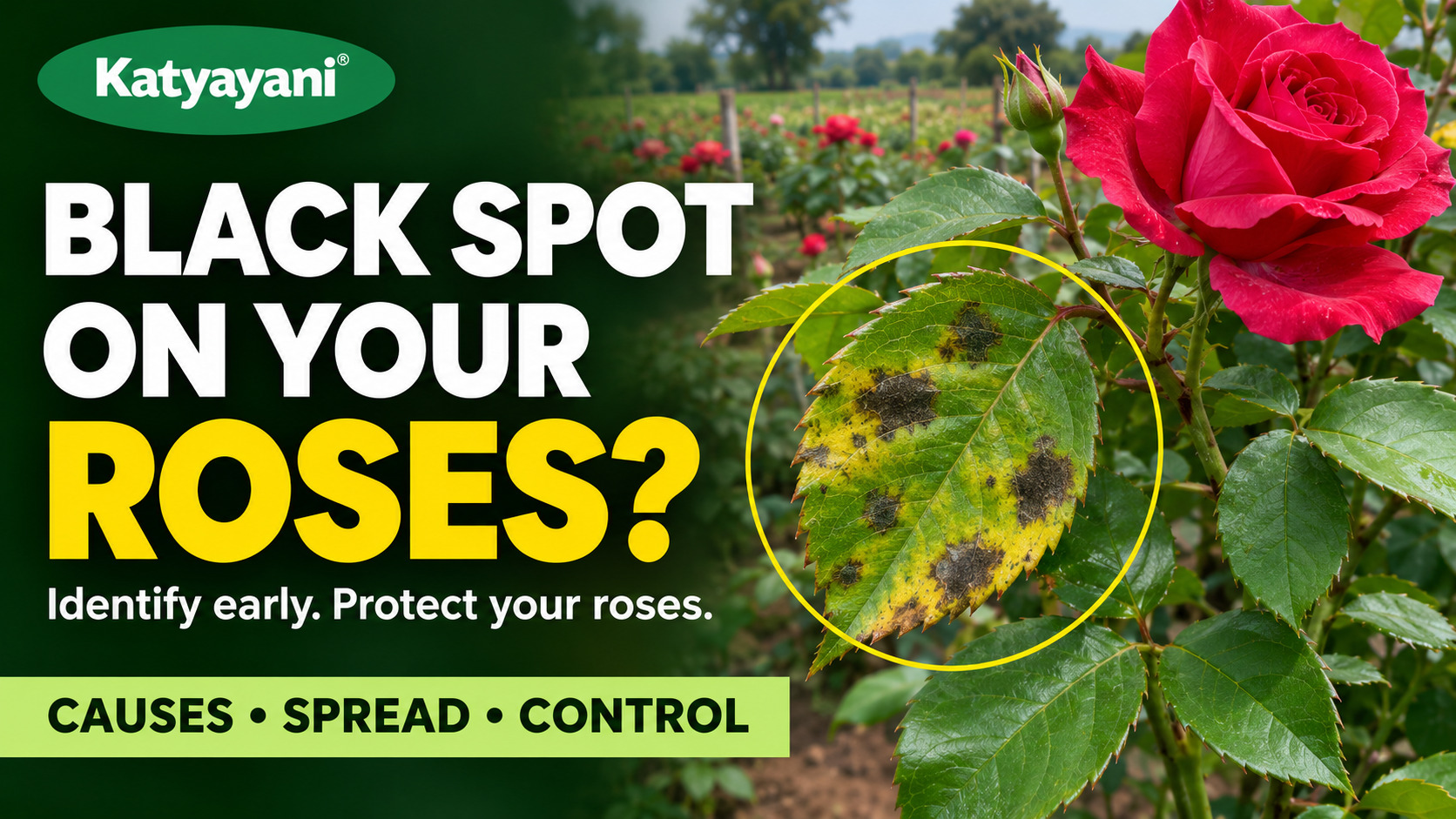
Black spot is a fungal disease of rose caused by Diplocarpon rosae. It makes round black spots with feathery edges, mostly on the upper leaf surface, with yellow tissue around them, and infected leaves drop early (TNAU, UC IPM). The spores need leaves to stay wet for about 7 hours or more and travel in splashing water (UC IPM, Texas A&M). The fungus survives on fallen leaves and on cane lesions, so cleanup and pruning matter as much as spraying (UF/IFAS, Nebraska). Water the soil, not the leaves, in the morning; give roses space and at least 6 to 8 hours of sun. Fungicides protect new leaves and do not remove existing spots. Multi-site fungicides carry low resistance risk and products with different modes of action should be alternated (UF/IFAS, Nebraska). Follow the product label.
What is black spot on roses and what causes it?
Black spot is a leaf disease of rose caused by the fungus Diplocarpon rosae, also written under its asexual name Marssonina rosae. It attacks leaves first, then young stems, and makes plants drop their leaves early. UF/IFAS describes the fungus as a parasite specific to roses, so it does not jump to your tomato or chilli.
The disease is not a sign of dirty soil or a missing nutrient. It is a spore-borne infection that needs water on the leaf. The UF/IFAS bulletin calls it the most serious rose disease in Florida, and the Nebraska extension guide calls it the most important rose disease worldwide. The 2024 Tamil Nadu paper describes it as the most destructive and widespread rose disease, found everywhere except the driest regions.
If you are still setting up your plants, our guide to rose plant care in India covers sun, soil, pruning, feeding and the other rose diseases. This post goes deep on black spot only. Rose powdery mildew has its own separate guide, planned next in this series.
How do you recognise black spot on rose leaves, stems and buds?
Look for round black spots with feathery or fringed edges, mostly on the upper leaf surface, with yellow tissue around them. Older lower leaves go first. Spots can also appear on young stems as raised purple-red then black patches. Badly hit leaves yellow and fall.
| Plant part | What you see | Source |
|---|---|---|
| Upper leaf surface | Black, nearly round spots with feathery margins; UF/IFAS gives a size of about 2 to 12 mm | UF/IFAS; Nebraska |
| Early lesion | Small, dry, reddish-brown spot with a feathery margin before it turns black | Texas A&M |
| Older lesion | Tiny black fruiting bodies inside the spot; white slimy spore masses can be seen in older lesions | UC IPM; UF/IFAS |
| Leaf as a whole | Yellow tissue around the spots; the whole leaf may yellow and drop; some leaves drop without yellowing | TNAU; RHS |
| Young canes | Raised purple-red blotches in the first year that turn black and blistered; RHS also describes small black scabby lesions on young stems | Nebraska; RHS |
| Other parts | Stipules, leaf stalks, flower stalks and sepals can be infected; Illinois also notes red spots on petals | UF/IFAS; Illinois Extension |
Nebraska notes that the lower leaves are usually infected first, then the middle and upper ones. Heavy leaf loss cuts stem length, the number and quality of leaves and blooms, and weakens the plant. In resistant cultivars or in dry weather you may see only small spots and no leaf drop.
How do you tell black spot from other rose leaf problems?
Check the spot edge and the leaf underside. Black spot has feathery black margins on the upper side, and UC IPM says no fungal growth occurs on the undersides. Cercospora has smaller circular spots with grey-tan centres. Powdery mildew is a white powder, rust is orange pustules underneath, and herbicide or sunburn damage does not have fungal edges.
| Problem | How it looks | How to separate it from black spot | Source |
|---|---|---|---|
| Black spot | Black spots, feathery edge, yellow halo, upper leaf surface | Reference problem | UC IPM Pest Note |
| Cercospora leaf spot | Circular spots usually 2 to 4 mm, up to 10 mm; purplish at first, then tan to almost grey centre; black dots in older spots | Smaller circular spots with a tan-to-grey centre, where black spot has the feathery black edge; UF/IFAS says the two are often confused, and Cercospora is not significant once black spot and mildew programmes are in place | UF/IFAS PP267 |
| Powdery mildew | White-to-grey powdery growth on both sides of the leaves | White powder rather than black spots; covered in the planned rose powdery mildew post | UC IPM Pest Note |
| Downy mildew | Angular purple, red or brown spots between veins; pale felty patches underneath | Spots stop at veins; fuzz underneath | UC IPM Pest Note |
| Rust | Small orange pustules on the underside of leaves | Orange pustules, not black spots | UC IPM Pest Note |
| Anthracnose | Red spots turning grey or white with a dark red margin; shot-hole look | Grey or white centre with a dark red margin | UC IPM Pest Note |
| Sunburn | Blackened areas mainly on the south and west side of canes | Occurs on canes in intense sun or reflected heat, not feathery leaf spots | UC IPM Pest Note |
| Herbicide damage | Cupped or yellowed leaves, among other possible symptoms | Cupping and yellowing across the leaf, not separate feathery-edged spots | UC IPM Pest Note |
UF/IFAS also lists Alternaria, Colletotrichum and Glomerella as other fungi that cause rose leaf spots. If the spot does not match the description above, a plant clinic or your nearest KVK can confirm it.
Spray Burn Check: The sources I opened do not describe how spray burn looks on rose, so this is a practical check, not a sourced rule. Ask whether the marks appeared within days of spraying a neem oil, sulphur or other mix in hot sun, and whether they have the feathery black margin. Black spot grows from the lower leaves up over a couple of weeks; chemical scorch usually shows after a single event. UC IPM says not to apply horticultural oils to water-stressed plants or within two weeks of a sulphur spray.
How does the black spot disease cycle work, and where does the fungus survive?
The fungus survives winter or dry spells on fallen leaves and on lesions on canes. When water splashes spores onto new leaves, they infect if the leaf stays wet. New spores form in the spots within about two weeks, so one infection quickly seeds the next wave.
| Step | What happens | Source |
|---|---|---|
| Survival | On living and dead leaves and infected stems; also dormant infections on young stems and buds | UC IPM; RHS |
| Spread | Spores move in splashing water; also by overhead irrigation; windblown leaves can carry it locally | UC IPM; UF/IFAS; Nebraska |
| Infection | Spores must be wet for several hours; UC IPM, Nebraska and Texas A&M give about 7 hours or more | UC IPM; Nebraska; Texas A&M |
| Young tissue | Rose leaves are most susceptible while young and still expanding | Nebraska |
| Symptoms appear | 3 to 16 days after infection | UF/IFAS |
| New spores | Mature spores 10 to 18 days after infection (UF/IFAS); Texas A&M says as early as 11 days | UF/IFAS; Texas A&M |
| Temperature | Spore germination occurs from 59 to 81 degrees F (about 15 to 27 degrees C), so the disease can continue as long as moisture is adequate | UF/IFAS |
| Later in season | Many secondary cycles, peaking in late summer | Illinois Extension |
Two practical points follow. First, once the fungus is in the garden, you are fighting cycles of about two weeks, not a one-time infection. Second, cleaning up leaf litter and cane lesions removes part of the starting stock every year, which is why every extension source starts with sanitation before sprays.
What weather brings black spot, and why is the monsoon a high-risk period in India?
Wet leaves, not just humid air, drive black spot. The fungus needs about 7 hours or more of continuous leaf wetness. Long rainy spells and wet nights in the monsoon can easily give that, so a high-risk period is likely then. That link to the monsoon is my inference from the wetness rule, not a sourced figure.
The UC IPM page adds that the disease can appear wherever leaves stay wet, for example where roses are sprinkler irrigated in the evening or at night. The Nebraska guide says black spot is usually not a problem in greenhouses where humidity is controlled and long foliage wetting is avoided. Nebraska also notes that compact roses with leaves close to the ground, and crowded plantings, hold more humidity inside the canopy.
The sources give a wetness rule and a temperature range, not a rainfall figure or an Indian monsoon calendar. I did not find official state-wise severity data, so treat the monsoon as a likely high-risk period, not a proven worst season, and watch your own beds.
Which roses are more prone to black spot, and does resistance last?
Hybrid teas, grandifloras and miniature roses are more susceptible. Floribundas, shrub roses and climbers are more tolerant, according to Nebraska. Old garden roses and species roses are less affected. Resistance is partial and can fail because the fungus has different races.
| Group | What the source says | Source |
|---|---|---|
| Modern roses, hybrid teas | More susceptible than old garden roses and species; high maintenance in Florida | UF/IFAS |
| Hybrid tea, grandiflora, miniature | More susceptible | Nebraska |
| Floribunda, shrub, climber | More resistant or tolerant | Nebraska |
| Miniature roses | More susceptible than other types | UC IPM |
| Old garden roses and species | Certain species and old garden cultivars are considered more resistant than modern cultivars | UF/IFAS |
| Resistant cultivars | Resistance may vary by environment because of pathogenic races; RHS warns it often does not last as new strains emerge | Nebraska; RHS |
Illinois Extension suggests that in large plantings you mix susceptible and resistant cultivars. I did not find an Indian-tested list of black spot resistant cultivars, and the named cultivars in UF/IFAS and Nebraska were tested in the United States, so I have not copied them. Ask a local rose society or nursery which varieties stay clean in your own city.
Can you control black spot with cleanup and other cultural methods alone?
Cultural control cuts the starting amount of fungus and keeps leaves dry, but on susceptible roses in a wet season it usually needs fungicide help. The RHS says non-chemical steps delay the disease but have limited value because windblown spores arrive from elsewhere. Start with them anyway, because every spray works better on a cleaner plant.
- Collect and destroy fallen leaves. TNAU says to burn diseased leaves; UF/IFAS also recommends removal and burning of fallen leaves; UC IPM says to dispose of leaves and stems away from rose plants.
- Prune out infected canes. Nebraska says to remove and destroy infected canes and fallen leaves in fall; UF/IFAS says prune canes late in winter before new shoots; RHS says prune out stem lesions in spring before leaves appear.
- Do not syringe leaves to fight spider mites unless they will dry quickly; Texas A&M advises avoiding or delaying it.
How to prune, how hard and when in your region is covered in the rose care hub. Here the rule is simply that every infected cane and every fallen leaf is a store of spores.
How should you water, space and site roses to lower black spot?
Give roses open sun and good airflow, water the soil in the morning, and avoid wetting leaves. The aim is to shorten the time leaves stay wet, since infection needs about 7 hours or more of wetness. These steps cost nothing and help every other disease too.
| Practice | What the source says | Source |
|---|---|---|
| Sun | Avoid planting where roses get less than 6 to 8 hours of full sun | UC IPM |
| Dew | Plant where sunlight dries morning dew quickly | TNAU |
| Spacing | Do not plant roses too close; prune the canopy for air circulation | UC IPM; TNAU |
| Watering time | Irrigate in the morning, not in the evening or at night | UC IPM; UF/IFAS |
| Watering method | Avoid overhead or sprinkler irrigation; if you must use it, water in the morning | TNAU; Nebraska |
| Plant shape | Compact roses with leaves near the ground and crowded beds hold more humidity | Nebraska |
Pot growers can do the same: move pots to the sunniest, airiest spot, leave a hand's width between pots, and water the soil with a can or drip line. Our post on a terrace garden soil mix explains drainage for containers.
Does mulch help or hurt when you have black spot?
Mulch helps in two ways: it covers fallen leaves that carry spores, and it reduces soil splashing onto lower leaves. Sources advise 5 cm or more to cover leaves (RHS, UK) or about 3 inches around the drip line (Nebraska). Keep mulch off the stem base and do not pile it against canes.
The RHS says to bury fallen leaves under mulch at least 5 cm (2 in) thick, applied from November to February in the UK. Nebraska says a 3-inch layer of mulch around the drip line reduces splashing of spores from fallen leaves. Both are cold-climate timings, so adjust them to your own cool season. Our guide to mulching types and depth gives general depth rules for beds and shrubs (about 5 to 10 cm for most materials).
One caution from UC IPM: rock mulch can reflect enough heat to sunburn canes, so avoid rock mulch right around rose canes.
When should you start spraying for black spot, and how often?
Start before or at the first sign of disease, because fungicides protect leaves and do not remove existing spots. UF/IFAS starts a protectant at bud break and spaces summer sprays every 7 to 14 days. Illinois starts when new leaves appear and lengthens the interval or skips sprays in dry weather.
| Source | Timing it gives | Region |
|---|---|---|
| UF/IFAS PP268 | First protectant at bud break; during summer, every 7 to 14 days may be necessary | Florida, USA |
| Illinois Extension | Multiple preventive applications starting when new leaves appear; on highly susceptible varieties continue into fall; lengthen interval or skip in dry weather | Illinois, USA |
| UC IPM | Preventive products where weather favours severe disease; fungicides are preventive and applied before infection | California, USA |
| Nebraska | Repeat at the label interval to protect newly emerging foliage; do not spray right before rain or sprinkling | Nebraska, USA |
| RHS | Recommends not using fungicides on home garden roses and checking the UK list of products if you do | United Kingdom |
The RHS position is different from the others because it is written for UK home gardeners and says fungicides, including organic ones, are not recommended. In India's wet season, with a susceptible hybrid tea, many growers will still decide to protect new growth. Whichever way you go, the sourced rule is the same: protect leaves before the wet spell, not after the spots show.
For general advice on sprayer coverage, timing and wash-off, see our guide to fungicide application methods.
What do fungicides do against black spot, and how do you choose one?
Fungicides protect healthy leaves from new infection; they do not remove spots already there. UC IPM, UF/IFAS and Nebraska treat sprays as an add-on to cleanup and watering, for susceptible roses in wet seasons. Check the current CIB&RC registration and the product label before you buy or spray.
| Option | What the sources say | Source |
|---|---|---|
| Preventive fungicides in general | Applied before infection, to protect new growth; where weather favours severe disease they are an option on susceptible roses | UC IPM; Nebraska |
| Multi-site (group M) products | Fungicide resistance is usually low with multi-site products | UF/IFAS |
| Rotation | Rotate or alternate products with different modes of action; all fungicides in the same group share an active ingredient or similar mode of action | UF/IFAS; Nebraska |
| Sulfur, neem oil, potassium bicarbonate | Listed by UC IPM as preventive products that reduce black spot; Texas A&M says neem oil and potassium bicarbonate can give decent control | UC IPM; Texas A&M |
| Not spraying at all | The RHS recommends that UK home gardeners do not use fungicides and relies on cleanup and cultural steps | RHS |
I am not printing label doses on purpose. Rates, water volume and waiting periods differ by product and change with the label, and a rate meant for a field is not a rate for a few rose plants. Use the label and follow it exactly. To read how WP, SC and WG forms differ and how to read the percentage on a pack, see pesticide formulation types.
Powdery mildew needs a different set of products and has its own guide, planned next in this series, so it is not covered here beyond the look-alike table.
How do you rotate fungicides so they keep working?
Alternate or tank-mix products with different modes of action, and do not repeat one product every spray. UF/IFAS says resistance is usually low with multi-site (group M) products, and Nebraska gives the same alternating advice. Always follow the label for mixing and the number of sprays.
One more rule from Nebraska: do not apply a fungicide immediately before rain or sprinkling, which can wash some or all of it off. Rose leaves are waxy, so Nebraska suggests a commercial spreader-sticker or a small amount of household detergent (about half a teaspoon per gallon) to improve coverage; check that the product label allows it.
What does the Tamil Nadu lab study say about fungicides against Diplocarpon rosae?
A 2024 paper from TNAU's Killikulam college tested six fungicides on the fungus grown in a dish. Hexaconazole 5 EC and tebuconazole plus trifloxystrobin stopped growth at every dose tested. Mancozeb did not slow growth at all. This is a dish test, not a field result, and it says nothing about what is approved for rose.
| Fungicide (as tested) | Result in the dish at 0.05% to 0.25% | Source |
|---|---|---|
| Hexaconazole 5% EC | 100% growth inhibition at all concentrations; also effective at 0.025% and 0.001% | Shalini et al. 2024 |
| Tebuconazole 50% + trifloxystrobin 25% WG | 100% inhibition at all concentrations; also effective at 0.025% and 0.001% | Shalini et al. 2024 |
| Carbendazim 50% WP | 100% inhibition only at 0.25% | Shalini et al. 2024 |
| Azoxystrobin 23% | 73.78% inhibition at 0.25% | Shalini et al. 2024 |
| Tricyclazole 75% WP | 53.00% inhibition at 0.25% | Shalini et al. 2024 |
| Mancozeb 75% WP | 0% inhibition at all concentrations | Shalini et al. 2024 |
How to read this honestly. The poisoned-food method puts the chemical into the growth medium, so it measures how well the fungus grows around a chemical, not how well a spray protects a leaf. A contact protectant like mancozeb works by sitting on the leaf and stopping spores, which a dish test cannot show. The same paper tested copper, zinc and iron sulphate in the dish: copper sulphate fully stopped growth at 0.2% and zinc sulphate at 0.3%. That does not mean you should spray those on rose leaves; the paper reports no leaf-safety or field data.
Do organic and biological sprays work on black spot?
Some do reduce it, mostly as preventives. UC IPM lists neem oil, potassium bicarbonate and sulfur as products that reduce black spot, and Texas A&M says neem oil and potassium bicarbonate give decent control. They protect new growth; they do not clear spots already there. The RHS advises against home-made recipes.
| Option | What the source says | Source |
|---|---|---|
| Neem oil | Reduces black spot when used as a preventive; do not apply oils to water-stressed plants or within two weeks of sulfur | UC IPM; UC IPM Pest Note; Texas A&M |
| Potassium bicarbonate | Preventive option listed by UC IPM and Texas A&M | UC IPM; Texas A&M |
| Sulfur | Preventive option; the UC IPM Pest Note says not to apply oils within two weeks of a sulfur spray | UC IPM; UC IPM Pest Note |
| Home-made sprays | RHS does not recommend them because they are unregulated and usually untested | RHS |
| Trichoderma (soil product) | Our gardener's guide says Trichoderma protects soil and roots and that a leaf spray does very little; it is not a black spot treatment | Trichoderma and Beauveria for gardeners |
For a neem product, check the label for the plant and pest. Read our guide to neem oil in the home garden for the heat and stress rules before you spray.
On biologicals: our guide to biopesticides says biologicals work best when applied early, are slower than chemicals, and can be killed by chemical fungicides, so do not mix them blindly. For general organic pest steps read organic pest control for home gardens.
How do you spray roses properly so the fungicide actually works?
Cover both sides of every leaf and the young shoots, spray when leaves can dry afterwards, and avoid rain and midday heat. Thorough coverage matters more than a stronger mix. Follow the label for water volume, repeat interval and protective clothing.
- Clean up first: remove fallen leaves and heavily spotted leaves, then spray, so the sprayer is not wasted on dead tissue.
- Start with the lower, older leaves where Nebraska says infection usually begins, then work up to young growth.
- Cover both leaf surfaces and the stems. Nebraska says thorough coverage of the foliage is needed to get the most from a fungicide.
- Choose a dry, calm window in the cool part of the day. Do not spray right before rain; Nebraska says rain or sprinklers can wash off some or all of the product.
- Wash the sprayer after each use, and keep a dedicated sprayer for fungicides (our guide on fungicide application methods explains calibration and timing).
- Write down the date, product and group each time, so you rotate groups correctly and do not exceed the label count.
Keep a separation between oil sprays and sulphur: UC IPM says not to apply horticultural oils within two weeks of a sulfur spray. Keep it also between a biological product and a chemical fungicide; our Trichoderma guide advises at least seven days.
What is a practical black spot prevention calendar for Indian rose growers?
No Indian month-by-month calendar was found, so use event triggers instead of dates: pruning, first new leaves, the first spell of continuous rain, and each later wet spell. Clean up before the rains, protect new growth, then repeat protection at the label interval during wet weeks and pause in dry weeks.
| Trigger in your garden | What to do | Basis |
|---|---|---|
| After pruning in your cool season | Remove all fallen leaves and infected canes; clean tools; add fresh mulch away from the stem base | Nebraska; UF/IFAS; RHS |
| New leaves appear after pruning | First protectant if you choose to spray (UF/IFAS says bud break; Illinois says when new leaves appear) | UF/IFAS; Illinois |
| Weeks before the monsoon | Fix watering (morning, at the base), thin crowded stems, check sun and spacing | UC IPM; TNAU |
| First continuous rain | Check the lowest leaves weekly for the first spot; remove spotted leaves; protect new growth | Nebraska (lower leaves first); UF/IFAS |
| Wet weeks of monsoon | Repeat protection at the label interval (UF/IFAS: 7 to 14 days in summer); rotate groups | UF/IFAS; Illinois |
| Break in rain or dry weeks | Lengthen the interval or skip, as Illinois advises; keep removing fallen leaves | Illinois |
| After the rains and leaf fall | Collect and destroy fallen leaves; prune out lesions on canes in the next pruning window | UF/IFAS; TNAU; RHS |
This calendar is an event-based pattern built from US and UK extension rules and an Indian university page, not an Indian spray schedule. Regional climate changes the dates a lot, so write your own dates beside each trigger after a season of notes.
What changes for pots, garden beds and commercial rose fields?
The disease and the cycle are the same everywhere. Pots give you more control over leaf wetting and leaf cleanup, home beds depend on watering and spacing, and large plantings need rotation of fungicide groups and a mix of cultivars. I found no Indian cut-flower package, so field advice here is principle-based.
| Setting | What helps | Source |
|---|---|---|
| Pots and terrace roses | Sunniest airy position, space between pots, water at the soil, remove fallen leaves from the pot surface every week | UC IPM; Nebraska |
| Garden beds | Spacing, morning watering, mulch 3 inches around the drip line, annual cleanup | UC IPM; Nebraska |
| Protected cultivation / greenhouse | Control humidity and avoid long foliage wetting; Nebraska says black spot is usually not a problem under such control | Nebraska |
| Large plantings | Mix susceptible and resistant cultivars, alternate fungicide groups, continue spraying on susceptible varieties into the late season | Illinois; Nebraska |
For ground and pot growers new to rose care, the rose care hub covers the basics of pots, feeding and summer-monsoon-winter care.
Why does black spot keep coming back, and what should you do if a spray seems to fail?
Usually because the leaves stay wet, the fungus is re-seeded from fallen leaves or cane lesions, or the spray went on after infection. Fungicides only protect leaves that are clean when sprayed. Fix wetting, cleanup and timing before blaming the product.
| What you notice | Likely reason | Source or logic |
|---|---|---|
| New spots 2 to 3 weeks after a spray | Infection happened before the spray; symptoms show 3 to 16 days after infection and spores 10 to 18 days | UF/IFAS |
| Spots return after rain | Spray washed off, or the interval was too long in a wet spell | Nebraska; UF/IFAS (7 to 14 days in summer) |
| Spots are on lower leaves only and the top is clean | Early infection on lower leaves from soil splash and fallen leaves | Nebraska |
| Clean-looking plant but spots on canes | Cane lesions carry the fungus over; prune them out | Nebraska; RHS |
| Same product used every time | Resistance risk; rotate groups | UF/IFAS |
| Spots look different (small, grey centre) | May be Cercospora or another leaf spot | UF/IFAS PP267 |
| Marks soon after an oil or sulphur spray | Possible spray burn; stop and check the label | UC IPM Pest Note (oil and sulfur interval) |
Finally, accept some leaf loss. Nebraska notes that resistant cultivars or dry weather may show only small spots. A rose that loses a few lower leaves in August but pushes healthy growth afterwards is in better shape than one sprayed on a fixed calendar in a dry fortnight.
Conclusion
Black spot on roses is a wet-leaf disease that lives on fallen leaves and cane lesions and returns every season. The order that works is the one every source gives: clean up and prune out infected canes, put roses in open sun with space, water the soil in the morning, and then protect new growth before the wet spell if you choose to spray. Alternate products with different modes of action and do not expect any spray to erase old spots. Follow the product label. Keep notes for one season and your own wet-week dates will become your best calendar.
Questions Farmers Ask
What causes black spot on roses?
How do you treat black spot on roses?
Which roses are least affected by black spot?
Can a rose bush recover from black spot?
Should you cut back roses with black spot?
How do I tell black spot from Cercospora leaf spot?
Does black spot spread to other plants?
Why do rose leaves turn yellow and drop with black spots?
Does neem oil work on black spot?
Do baking soda or milk sprays work on black spot?
When does black spot appear in India?
Can I prevent black spot without fungicides?

Microbiologist
Microbiologist at Katyayani Organics. MSc in Microbiology, 2.6 years of experience.
View all authorsRead Next in Home Gardening
Powdery Mildew on Rose: Causes, Symptoms, Look-alikes, Prevention and Control in Gardens and Polyhouses

Microgreens: How to Grow at Home (Best Seeds, Days to Harvest, Cocopeat Method, Mould Prevention, Food Safety and Yield per Tray)


Leave a Comment