 15 min read
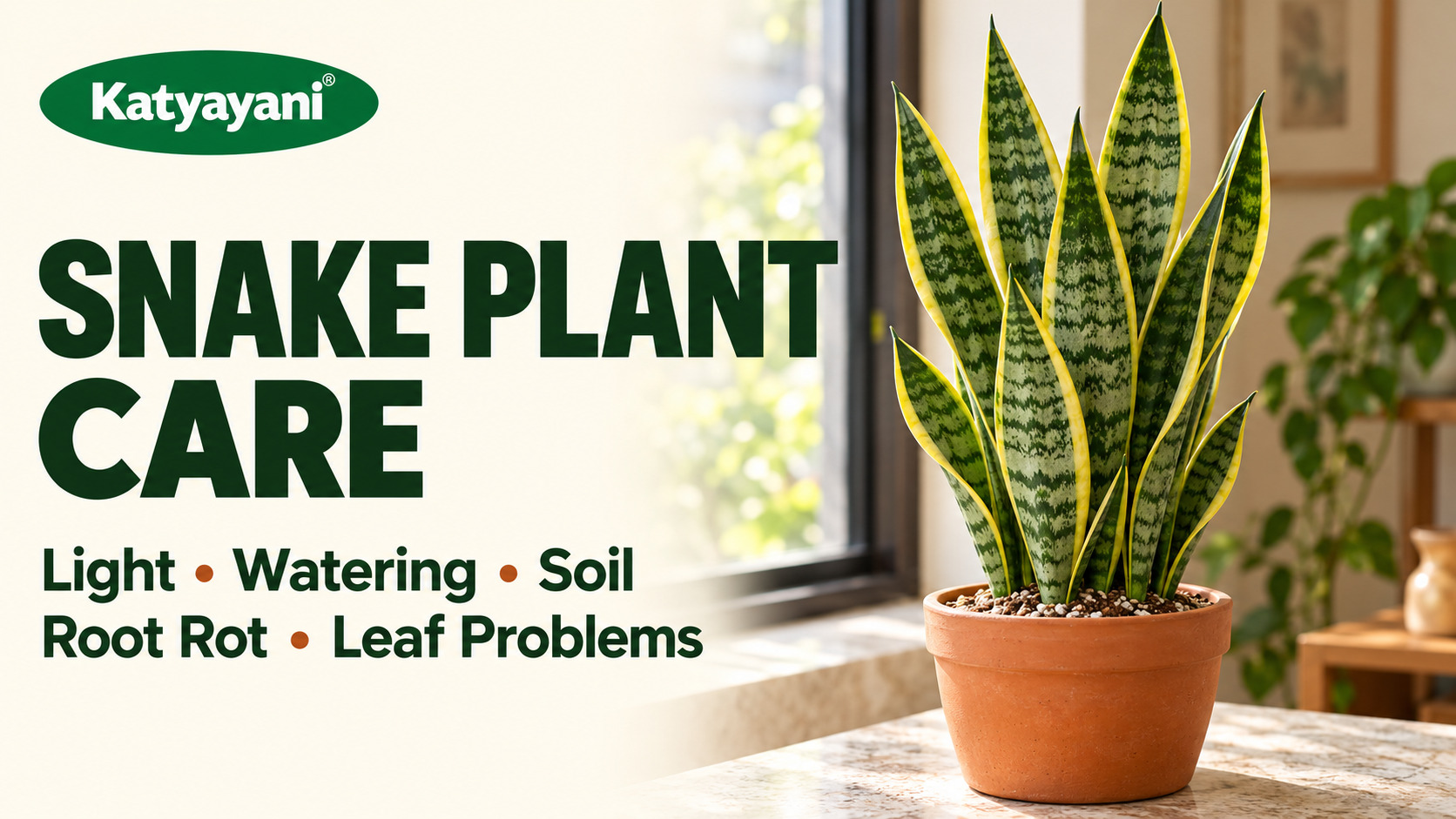
A snake plant (now Dracaena trifasciata, formerly Sansevieria) wants bright indirect light, a quick-draining mix, a pot with drainage holes, and water only when the soil has dried out. Clemson gives 2 to 4 weeks between waterings in the growing season and 4 to 6 weeks in fall and winter. Overwatering and root rot are the main risks. The plant is toxic to cats and dogs if eaten, and the research says plants alone do not clean room air quickly enough to matter.
What is a snake plant, and is it Sansevieria or Dracaena?
The snake plant is a tough, upright houseplant with stiff, sword-shaped leaves. Botanists moved it from the genus Sansevieria into Dracaena, so the correct name today is Dracaena trifasciata. The New York Botanical Garden notes the change followed molecular examination. Nursery tags still say Sansevieria, mother-in-law's tongue or snake plant.
It comes from dry habitats in tropical Africa, and that one fact explains most of its care. A plant built for dry ground stores water in its leaves and thick underground stems, called rhizomes. It copes with neglect far better than with a watering can in every spare minute.
You can use all three names when you search or shop. This guide says snake plant, and uses Dracaena only when the naming matters.
How much light does a snake plant need?
A snake plant grows best in bright, indirect light. It tolerates low light, but growth slows. Hot direct sun can burn the leaves. Start with bright shade or filtered light and adjust from there.
| Source | What it says about light |
|---|---|
| Clemson HGIC | Bright, indirect light is ideal; tolerates low light but grows more slowly; direct, hot sun can burn leaves |
| Penn State Extension | Prefers bright indirect light, tolerates low light well; keep out of direct sun that can burn leaves |
| NYBG | Prefers plentiful sunlight, tolerates some light shade; protect from the strongest summer sun from the south; without moderate sunlight it will not grow well |
| NC State Extension | Partial shade, with direct sun for 2 to 6 hours a day; tolerates very low light |
Bright indirect light is the safest starting point. If you move a plant from shade into brighter light, do it gradually over a few days rather than all at once.
Low light is survivable, not ideal. NC State says the plant tolerates very low light, but Clemson notes growth is slower there, and a slower-growing plant uses less water. That is one more reason to check the soil before watering in a dim room.
How often should you water a snake plant?
Water when the soil has dried out, not on a fixed date. Clemson gives 2 to 4 weeks between waterings in the growing season and 4 to 6 weeks in fall and winter. Penn State says to water only when it is dry. Overwatering is the bigger risk, so if you are unsure, wait a few more days.
The reason is simple. The leaves and rhizomes hold water, so the plant can sit dry for weeks. Penn State puts it bluntly: you can kill it by overwatering, but you can neglect to water it for a month or so. A pot that stays wet starves the roots of air, and rot follows.
- Let the soil dry first. Feel the mix before each watering rather than following a calendar.
- Empty the saucer. NYBG advises emptying any water left in the drip dish after about 15 minutes.
- Use a pot with drainage holes. Penn State recommends only pots with holes.
- Remember the plant's origin. It is built for dry ground, so when in doubt, wait.
If you travel for two or three weeks, a snake plant is among the few houseplants that will cope. A neglected snake plant often looks better than an overwatered one.
How does snake plant watering change with the seasons?
Water less when growth slows. University extension sources suggest roughly 2 to 4 weeks between waterings while the plant is growing, and much longer gaps in the cool months. The soil, not the calendar, is the final judge.
| Source | Growing season | Cool months or winter |
|---|---|---|
| Clemson HGIC | Every 2 to 4 weeks | Every 4 to 6 weeks in fall and winter; more light means more frequent watering |
| NYBG | Let the soil dry slightly between waterings | October to February: water only when needed, no more than every two weeks, and only to keep leaves from puckering |
| NC State Extension | Spring to autumn: allow the soil to dry between waterings | Winter: water every one to two months |
| Penn State Extension | Water only when it is dry | Can be left about a month without water |
The plant is flexible, and the right gap depends on your room, your light and your pot. Use the ranges above as an outer boundary and let a dry soil check decide each time.
Cold plus wet is the combination to avoid. NYBG warns that cold drafts can cause rot and says to keep the plant above 55 F (about 13 degrees C). NC State says it tolerates around 50 F (10 degrees C). Move the pot away from cold window glass in a cold spell.
What is the best soil mix and pot for a snake plant?
Use a fast-draining mix and a pot with drainage holes. Penn State suggests a cactus potting mix or one containing perlite. NYBG suggests potting soil with one third sand or perlite and up to one third peat. Either way, water should run straight through the pot.
| Mix | Parts | Source |
|---|---|---|
| Cactus or succulent mix (ready-made) | Use as is | Penn State Extension |
| Potting soil with sand or perlite and peat | About 1/3 sand or perlite, up to 1/3 peat, the rest potting soil | NYBG |
For a deeper look at how sand, coco peat and compost each change drainage, see our terrace garden soil mix recipe.
Pot choice matters as much as mix. Penn State says to choose only pots with drainage holes, and to use a heavier pot for taller plants because the weight of the leaves can topple the plant, especially when the soil is dry. Penn State also notes that a rootbound plant can crack a clay pot.
Does a snake plant need fertiliser?
Not much. Both Penn State and NYBG suggest feeding only in the growing season. Penn State says monthly with an all-purpose fertiliser at half strength; NYBG says a liquid fertiliser at half strength, once a month. Do not feed in the winter rest period.
NYBG links winter feeding and watering to leggy, floppy growth, because it tells the plant to grow when there is not enough light. More fertiliser will not make the plant look better. If growth is slow for other reasons, see our guide on why plants grow slowly.
What temperature does a snake plant like?
A warm room suits it. NYBG gives 65 to 80 F (about 18 to 27 degrees C) as the comfortable range and says not to let it drop below 55 F (about 13 degrees C). NC State says it tolerates about 50 F (10 degrees C). Cold drafts are the main risk, because NYBG links them to rot.
| Source | Temperature guidance |
|---|---|
| NYBG | 65 to 80 F (about 18 to 27 C); do not go below 55 F (about 13 C); cold drafts can cause rot |
| NC State Extension | Tolerates about 50 F (10 C) |
Keep the plant away from cold glass and doors that open to the outdoors in cold weather.
When and how should you repot a snake plant?
Repot only when the plant has run out of room, ideally in spring. NYBG says snake plants tolerate being root-bound and should be repotted once they run short of room. Penn State says fresh potting media about every 5 years. Use quick-draining soil in a pot with drainage holes.
- Signs it is time: the plant is running short of room, or the roots are straining a clay pot (Penn State notes a rootbound plant can crack clay).
- Mix: quick-draining, such as potting soil with about one third sand or perlite and up to one third peat (NYBG).
- Pot: drainage holes, and a heavier pot for tall plants (Penn State).
- Between repottings: NYBG suggests replacing some of the surface soil every year.
Repotting is also the right moment to divide a big clump, which is how you get more plants, as the next section explains.
How do you propagate a snake plant: division, offsets or leaf cuttings?
Division is the easiest and surest method, and the only one that keeps variegation. Leaf cuttings also work, but take about two months to show new plantlets, and yellow-edged types such as Laurentii come back plain green. Offsets from runners can be cut and potted once they have four or five leaves.
| Method | How | Time and note |
|---|---|---|
| Division (best) | At repotting, separate a section with leaves and roots, then pot each piece in fresh quick-draining mix | Keeps the parent's variegation (Penn State, NYBG, Iowa State) |
| Offsets or pups | Cut a plantlet from the runner or rhizome once it has four or five leaves; let the cut dry for several days; pot in quick-draining mix | Keep in bright indirect light (NYBG) |
| Leaf section cuttings | Cut a leaf into sections about 3 to 4 inches (8 to 10 cm) long, mark the bottom end, push the lower 1 to 2 inches into moist perlite, sand or a perlite and peat mix | Warm, bright indirect light, moist but not wet. New shoots in about two months (Iowa State) |
Keep the orientation right. Iowa State says to mark the end nearest the parent plant, because a section planted upside down will not root.
Variegation is the catch. Iowa State says most variegated snake plants do not come true from leaf cuttings, and Laurentii loses its edge colour this way. If you want a yellow-edged plant, divide. If you are happy with green, cuttings are a cheap way to turn one leaf into a few plants.
What are the signs of root rot in a snake plant?
Root rot comes from overwatering. Clemson, Penn State and NC State all name it as the main risk, and NYBG says shallow roots rot easily if over-watered, causing the plant to fall over. A plant that topples or a base that stays wet is the warning to stop watering and check the roots.
Penn State calls root rot a common affliction of snake plants, due to overwatering. Clemson says the plant can develop root rot and soggy leaves if watered too frequently, and NYBG links cold drafts to rot as well. For how to check the roots and what healthy ones look like, our guide to root rot in containers has the full comparison.
How do you save a snake plant from root rot?
Cut back on water straight away, which is NYBG's advice if you see rot or a toppling plant. The general rescue sequence for container plants (unpot, remove rotted roots, repot in fresh dry mix) is covered step by step in our root rot post. Firm tissue is the part worth keeping.
Our root rot in containers post gives the rescue sequence and the signs that it worked. For a snake plant, the extra points from the sources are to use a quick-draining mix, a pot with drainage holes and to let the soil dry before the next watering. If a base is beyond saving, a firm leaf can be started again as a cutting using the method above.
Why are my snake plant leaves drooping, folding, wrinkled or yellow?
Each symptom has a different usual cause. NYBG links folding or flopping leaves to overwatering or too little sun during active growth, and puckering to too little water in the winter rest. Penn State notes the weight of the leaves can topple a plant, especially when the soil is dry. Check the soil and the base first.
| What you see | Cause given by the sources | What the sources suggest |
|---|---|---|
| Plant falls over or leaves flop | Overwatered shallow roots rot and the plant falls over (NYBG); leaf weight can topple a plant in dry soil (Penn State); too little sun in active growth (NYBG) | Cut back on water; use a heavier pot for tall plants; give brighter indirect light |
| Leaves fold or curl | Usually overwatering or too little sun (NYBG) | Check the soil moisture and light |
| Leaves pucker or wrinkle in winter | NYBG says to water just enough in the winter rest to keep leaves from puckering | Water lightly; do not wait until the leaves shrivel |
| Leaf stops growing | A broken pointed tip may stop the leaf blade growing (NYBG) | Handle the pointed tips gently |
| A damaged leaf | Physical damage | Penn State: cut it off at soil level |
| Yellow leaves | Overwatering and low light are common general causes in houseplants | See our yellow-leaves chart for the full list |
Yellowing has many possible causes across houseplants, from overwatering and low light to nutrient shortages. Our yellow leaves on houseplants chart works through those one by one.
The NYBG answer on flopping leaves puts it this way: the plant rests from about late October to February, and watering or fertilising then tells it to grow when there is not enough winter sun, so the leaves stretch and go lanky. The fix is less water, no feed and better light.
What pests attack snake plants: mealybugs, spider mites and fungus gnats?
The usual three are mealybugs, spider mites and fungus gnats. Penn State says mealybugs and spider mites occasionally bother snake plants, and NC State says to monitor for them. Check the leaf bases, the undersides of leaves and the top of the soil. The descriptions and controls below follow the Clemson factsheet on houseplant insects.
| Pest | How to spot it | What to do (Clemson) |
|---|---|---|
| Mealybugs | Small, pale, cottony or waxy insects (1/8 to 1/4 inch), often in leaf axils and leaf bases; sticky honeydew | Wipe each insect with a cotton swab dipped in rubbing alcohol; use insecticidal soap; repeat, as the wax makes them hard to kill |
| Spider mites | Tiny; light speckling and a faded look; fine silky webbing in bad cases | Spray the leaves, including undersides, with a forceful stream of water; use insecticidal soap; repeat about weekly for several weeks |
| Fungus gnats | Small, weak-flying adults near the soil and light; larvae feed on decaying organic matter and sometimes roots | Let the soil dry between waterings; do not let water sit in the saucer; Bti products can be watered into the mix |
Fungus gnats are a sign of wet soil. Clemson says that mixes rich in peat and other organic matter, plus overwatering, favour them, which is one more reason to let the snake plant mix dry between waterings.
For wider options see our guides on neem oil in the home garden and organic pest control for home gardens.
Do snake plants really purify the air? What the NASA study did and did not show
A snake plant is a fine houseplant, but the research does not support using it to clean your room's air. A 2019 Drexel University review concluded that plants "don't actually clean indoor air quickly enough" to make a difference in a home or office. The 1989 NASA work behind the claim was a laboratory study.
The 1989 NASA report (Wolverton, Johnson and Bounds) looked at whether interior landscape plants can reduce indoor air pollutants. It was a lab study, not a test of a pot on a shelf in a normal room.
The Drexel University release describes what came next. Cummings and Waring applied the clean air delivery rate (CADR), the standard measure used for air purifiers, to the plant studies. Plants removed volatile organic compounds orders of magnitude more slowly than the normal rate of air exchange in a building. By the researchers' estimate it would take 100 to 1,000 plants per square metre of floor space to match a building's air handling or a couple of open windows.
That is the whole point: keep the plant for greenery, not for air cleaning.
Is a snake plant toxic to cats, dogs and children?
Yes, it is toxic if eaten. The ASPCA lists it as toxic to dogs and cats, with saponins as the toxic principle and nausea, vomiting and diarrhoea as the signs. NC State rates the severity low but tags it as a problem for children if ingested, as well as for cats, dogs and horses.
| Who | What sources say | Source |
|---|---|---|
| Dogs and cats | Toxic; saponins; nausea, vomiting, diarrhoea | ASPCA |
| Cats, dogs, horses, children | Low severity; if ingested: vomiting (occasionally with blood), depression, nausea, diarrhoea, loss of appetite, excess salivation; sap can irritate skin | NC State Extension |
| Pets (all species, as a group) | All species of snake plant are toxic because they contain saponin toxins | Penn State Extension |
For pets, the ASPCA page advises calling ASPCA Poison Control at (888) 426-4435 or your local veterinarian as soon as possible if you think an animal has swallowed something harmful; a consultation fee may be charged. For children, NC State tags the plant as a problem if ingested, so keep it out of their reach.
Which snake plant varieties should you grow?
Common types are the standard green Dracaena trifasciata, yellow-edged Laurentii, white-striped Bantel's Sensation, the dwarf Hahnii rosette, and cylindrical forms. Penn State and NC State list these and more. Most share the same basic care.
| Variety | Look | Note |
|---|---|---|
| Standard D. trifasciata | Dark green leaves with lighter green cross-bands, up to about 4 feet (Penn State) | Hardiest and the best starter |
| 'Laurentii' | Yellow-gold leaf edges | Divide to keep the edging; cuttings lose it (Iowa State) |
| 'Moonglow' | Broad, silvery-green leaves | Little variegation (Penn State) |
| 'Bantel's Sensation' | Narrow leaves with white vertical stripes | Slimmer, up to about 36 inches |
| 'Hahnii' (bird's nest) | Dwarf rosette, about 6 inches tall | Penn State says the author repotted it about every 3 years |
| Cylindrical types (D. angolensis) | Round, spear-like leaves; 'Boncel' fans out | Sharp tips; handle carefully |
| Whale fin (D. masoniana) | Broad, paddle-like leaves | A collector's plant |
When you buy, look at the leaf base and check the pot for a drainage hole. Do not buy a plant sitting in a pool of water.
How do you care for a snake plant in winter?
Water far less, stop feeding and keep it away from cold drafts. NYBG treats October to February as a rest period, with water only to keep leaves from puckering and no more often than every two weeks. Other sources allow 4 to 6 weeks (Clemson) or 1 to 2 months (NC State). Keep the plant above about 13 degrees C.
- Cut water. Gaps of two weeks to two months are given in the sources above.
- Do not feed. NYBG ties winter feeding to lanky, floppy leaves.
- Avoid cold drafts. NYBG says they can cause rot.
- Dust the leaves occasionally, as Penn State suggests.
For other indoor plants at the same time of year, see our guide to indoor plant care in winter.
What are the most common snake plant care mistakes?
| Mistake | Why it hurts (source) | What to do instead |
|---|---|---|
| Watering before the soil is dry | Penn State: you can kill it by overwatering | Water only when the soil is dry |
| Pot with no drainage hole | Penn State recommends only pots with drainage holes | Use a pot with a hole |
| Winter watering and feeding | Lanky, floppy growth (NYBG) | Cut water and skip feed in the winter rest |
| Cold drafts | NYBG: cold drafts can cause rot | Keep the plant above about 13 degrees C and away from drafts |
| Hot direct sun | Clemson and Penn State: direct sun can burn leaves | Bright indirect light |
| Light pot under a tall plant | Penn State: leaf weight can topple the plant when the soil is dry | Use a heavier pot |
| Damaging the pointed tips | NYBG: a broken tip may stop that leaf growing | Handle the tips gently |
Conclusion
Snake plant care comes down to a few habits: bright indirect light, a quick-draining mix in a pot with drainage holes, water only after the soil has dried, and quick action if the plant starts to topple or the base stays wet. Test the soil instead of following a calendar. Divide the plant to keep variegation, keep it away from pets and children who chew, and do not rely on it to clean the air. A snake plant that is left alone a little more than you want to is usually a happy one.
Questions Farmers Ask
How often should you water a snake plant?
How much light does a snake plant need?
Why are my snake plant leaves drooping?
How do you know if a snake plant has root rot?
How do you save a snake plant from root rot?
What is the best soil for a snake plant?
Can a snake plant live in low light?
How do you propagate a snake plant?
Why are snake plant leaves wrinkled or curling?
Is a snake plant toxic to cats and dogs?
Does a snake plant purify the air?
How do you care for a snake plant in winter?

Microbiologist
Microbiologist at Katyayani Organics. MSc in Microbiology, 2.6 years of experience.
View all authorsRead Next in Home Gardening

Microgreens: How to Grow at Home (Best Seeds, Days to Harvest, Cocopeat Method, Mould Prevention, Food Safety and Yield per Tray)

Rose Plant Care in India: Sun, Water, Pruning, Feeding, Diseases and Pests (Garden and Pot)

Leave a Comment