 18 min read
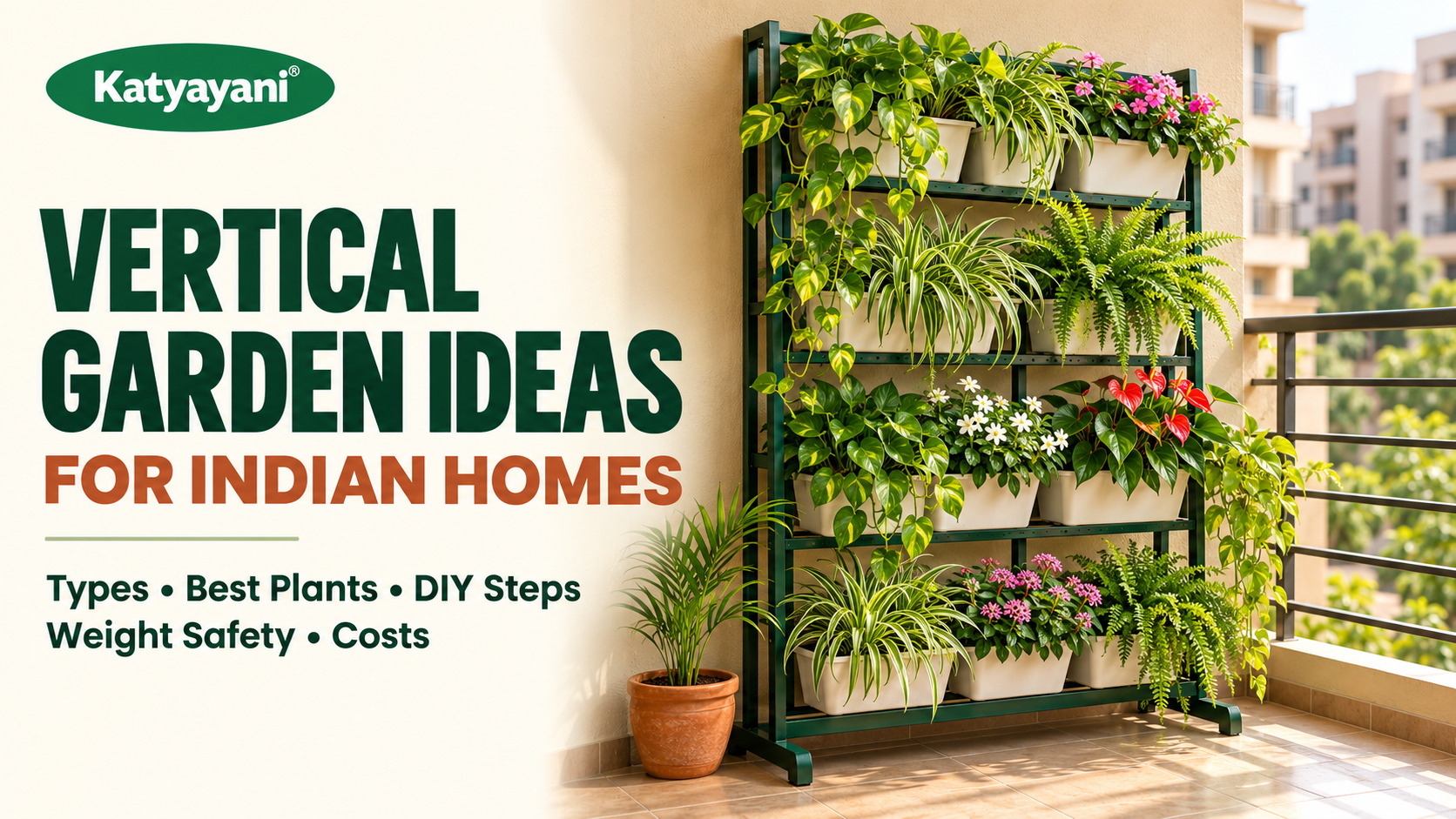
A vertical garden grows plants upward on a wall, rail, frame or trellis so a small space holds many plants. For Indian homes the easy options are pocket planters, pallets, trellises and stacked or railing pots. Match the plants to the light first: leafy greens need about 3 to 6 hours of sun, fruiting vegetables at least 6. Plan for weight, because wet soil is heavy, and protect the wall behind with waterproofing and an air gap. Drip watering saves effort. ICAR-IIHR puts the cost of its Arka vertical structure, which fits in one square metre, at Rs 22,000. Other costs vary by system and vendor, so get two or three written quotes.
What is a vertical garden, and why do people build one at home?
A vertical garden grows plants upward, on a wall, fence, balcony rail or free-standing frame, instead of across the floor. It lets you grow many plants in a small footprint, cools the wall a little through shade, and makes a bare surface look alive. In flats it is often the only way to garden at all.
There are two broad ideas. In the first, plants stay in pots, bags or pockets that you hang or stack. In the second, a climbing plant grows up a trellis, wire or mesh from a pot at the bottom. The first needs more watering and feeding. The second is lighter and slower to cover the wall.
You can grow flowers and foliage, herbs, salad greens and some vegetables this way. ICAR-IIHR built its Arka vertical garden structure for exactly this: growing a family's vegetables in a sunlit utility area, balcony or terrace, with the whole structure fitting in one square metre of floor.
What are the types of vertical garden, and which one suits a flat?
The main types are pocket or felt planters, pallet planters, trellis and climbers, stacked or railing pots, PVC or bucket stacks, hydroponic or aeroponic towers, and full living walls. For a first balcony project, pockets, a pallet or a trellis are the easiest. Hydroponic and living walls cost more and demand daily care.
| Type | How it works | Good for | The catch |
|---|---|---|---|
| Pocket or felt planter | Hanging fabric or plastic pockets in rows; water drains from upper pockets to lower ones (UC ANR) | Herbs, small leafy plants, foliage on a plain wall | Small soil volume dries fast; lower pockets stay wetter than the top ones |
| Pallet planter | A timber pallet lined with weed-block fabric, filled with soil, plants set through gaps (UC ANR) | Herbs, succulents, flowers | Heavy when wet; timber needs to last in rain and damp |
| Trellis with climbers | Plants rooted in a pot or bed climb mesh, wire or a frame | Beans, cucumber, peas, flowering climbers | Needs a firm frame; fruit adds weight |
| Stacked or railing pots | Pots on tiered shelves, rail hooks or a ladder frame | Vegetables, flowers, herbs; the easiest start | Needs space at the base; pots can be knocked over by wind |
| PVC pipe or bucket stack | Wide pipe or buckets with drainage holes and side holes for plants (UC ANR) | Greens, strawberries-type small plants, herbs | Tall stacks tip over unless fixed; see the food-safety note below |
| Hydroponic or aeroponic tower | Plants grow without soil; nutrient water runs past the roots or is misted onto them | Leafy greens, herbs | Needs a pump, timer, pH and nutrient checks; a failure can wilt the plants fast |
| Living wall (modular or felt panel with built-in irrigation) | Plants grow in the wall itself with built-in irrigation | Large indoor or outdoor feature walls | Most expensive; needs engineering, a waterproof backing and regular servicing |
The pocket, pallet, gutter and stack ideas above follow the UC ANR column on vertical gardening. For a first-timer, start with railing pots, pockets or a small pallet on one wall, and learn how much sun and water the spot really gives. Move to a bigger or automated system after one full season.
How much sunlight does your wall get, and why does it decide everything?
Check the wall before buying anything. NC State Extension says leafy greens need about 3 to 6 hours of full sun, root crops 5 to 6 hours, and fruiting vegetables such as tomatoes, cucumbers, peppers and eggplant a minimum of 6 hours. Foliage plants can live on much less. A dark, shaded wall cannot grow vegetables.
| Hours of direct sun on the wall | What it supports | Source |
|---|---|---|
| Under 3 hours, bright but no direct sun | Foliage plants and ferns; no vegetables | Common gardening practice |
| 3 to 6 hours | Leafy greens (lettuce, spinach, kale, palak, coriander) | NC State Extension |
| 5 to 6 hours | Leafy greens plus root crops (radish, beetroot, carrot in deep pots) | NC State Extension |
| 6 hours or more | Tomato, chilli, brinjal, cucumber and beans | NC State Extension |
How to measure: look at the wall at 9 am, 12 noon and 3 pm on a clear day, and note when sun falls on it. Count the hours. Do this in the season you will grow, because the sun angle changes. In Indian summer, west-facing walls get hard afternoon sun that burns tender leaves, and a north-facing wall may get very little. Shade net in front of a hot west wall is a cheap fix.
Which plants are best for a vertical garden in India: indoor, balcony and outdoor?
Pick by light, not by looks. Low-light indoor walls suit pothos, philodendron, spider plant and ferns. Bright balconies suit herbs, flowering annuals, succulents and leafy greens. Full-sun outdoor walls take tomatoes, chillies, beans and climbers. Plants that like different water needs should go in different rows.
| Spot | Plants that usually work | Notes |
|---|---|---|
| Indoor, bright indirect light | Pothos (money plant), spider plant and ferns | Shade-tolerant foliage plants for rooms with bright, indirect light |
| Balcony with 3 to 6 hours of sun | Pudina (mint), coriander, palak, lettuce, methi, basil, spring onion, ajwain | Leafy greens and herbs; sun band from NC State Extension |
| Hot, bright spot | Succulents on a separate, well-drained section | UC ANR notes succulents need very good drainage |
| Full sun, 6 hours or more | Chilli, tomato, brinjal, beans, cucumber, peas in bigger pots on lower tiers | ICAR-IIHR places tomato and chilli in larger base pots |
Here is the ICAR-IIHR layout. At the base of the Arka structure go the large pots: tomato in 16-inch diameter by 12-inch deep pots, and chilli, brinjal, French bean and peas in 12 by 10-inch pots. On the upper levels go shallow pots for leafy vegetables (amaranthus, coriander, palak) and for medicinal herbs such as brahmi, pudina, ashwagandha and shatavari. Heavy, deep-rooted crops sit low and light, shallow ones sit high. Copy that rule on any wall.
Keep thirsty and dry-loving plants apart. Succulents need very good drainage, as UC ANR points out, and will rot beside a row of mint. Put herbs that like regular water together, and succulents on a separate, drier section.
For ideas by season, see our posts on 15 winter vegetables to grow in pots and overwintering herbs indoors.
How do you make a vertical garden at home, step by step?
Choose the wall, check sun and weight, protect the wall, fix a sturdy frame, add containers with drainage, fill with a light mix, set up drip watering, then plant. Do these in order. Most failures come from skipping the first three steps and building a pretty frame on a wall that is too dark or damp.
- Pick the wall and measure sun. Use the 9 am, 12 noon and 3 pm check above. Decide leafy greens, fruiting plants or foliage.
- Check the wall and the floor. Look for damp patches, cracks and peeling paint. Check the balcony floor slopes toward a drain. If the wall is old or damp, repair it first.
- Waterproof and leave an air gap. Put a waterproof layer or sheet between planters and wall, and keep the planters a little off the surface so air moves behind. See the waterproofing section below.
- Fix the frame. Use wall anchors rated for the weight. Mount pockets and panels on a rail or frame, not on loose nails. UC ANR says to mount structures securely to a fence or wall.
- Choose containers and drill drainage. Every pot, bucket, pipe or pocket needs drainage holes. UC ANR lists missing drainage holes in buckets and pipes as a common fault.
- Fill with a light mix. Cocopeat with compost and some vermicompost suits most walls. See the soil mix section.
- Set up drip. Run a main line along the top with a dripper to each pot or pocket. See the watering section.
- Plant from the bottom up. Put big, thirsty plants low and small, shallow-rooted plants high. Water well and check runoff.
- Watch for a week. Look for overwatering at the bottom and dry pockets at the top. Adjust drip timing before you add more plants.
A simple first build: a ladder-style shelf or pallet against a sunny wall, six to eight pots of herbs and greens, a 25-litre drip tank on top. ICAR-IIHR uses a 25-litre plastic container at the top feeding drip laterals, microtubes and drippers in its Arka structure. A full tank is heavy, so the top of the frame needs to be strong.
What soil or cocopeat mix is best for a vertical garden?
Use a light, well-draining mix, not garden soil. ICAR-IIHR's Arka structure uses either soil or soilless cocopeat. NC State advises purchased potting soil in containers because garden dirt can bring weeds, insects and diseases. A common home mix is cocopeat with compost and vermicompost. Lighter media also weigh less on the wall.
| Mix idea | What it does | Watch out for |
|---|---|---|
| Cocopeat (the base) | Holds water, stays light and airy | Dries out quickly in a pocket in summer; buy washed, low-salt cocopeat from a reliable supplier |
| Compost or vermicompost (mixed in) | Adds nutrients and microbes | Do not use fresh manure in a closed balcony; it smells and attracts flies |
| Perlite, coarse sand or small stone bits at the bottom | Improves drainage | Adds weight; use sparingly on a wall |
| Garden soil | Cheap and heavy | Can carry weeds, pests and disease; compacts in small pockets; heavier than potting mix |
Enriched Vermicompost from Katyayani is suited to organic farming and home gardening. Start with a small share of the mix, such as a handful per pot, and watch how the plants respond. For the full mix recipes, see our terrace garden soil mix guide.
How do you water a vertical garden, and is drip irrigation worth it?
Yes. A vertical garden dries faster than a ground bed because soil volume is small and wind passes behind the wall. UC ANR says container gardens need more water than in-ground gardens and suggests drip line for tall or unusual structures. A drip line on a timer saves daily watering and gives each pot the same amount.
- Top-fed gravity drip. A tank at the top feeds laterals and drippers down the structure. This is the ICAR-IIHR Arka design: a 25-litre container at the top.
- Mains or pump timer. A small pump and timer suits larger walls. Set short cycles twice a day in summer rather than one long one.
- Hand watering. Fine for up to a few pots. Water slowly until a little runs out at the bottom.
- Check the bottom. Water running down feeds the lower pots in a pocket system, so they stay wetter. Put thirsty plants lower and drought-tolerant ones higher.
Do a finger test. Push a finger 2 to 3 cm into the mix in the top row and the bottom row. If the top is dry and the bottom is wet, shorten the drip to the bottom and lengthen it to the top. Do this once a week for the first month. Check the drippers for blockage, because a clogged dripper is the most common reason one pocket turns brown.
Leave a drain tray or channel at the bottom that carries water to the balcony drain, not onto the neighbour's balcony. In the rainy season, turn the timer off.
How heavy is a vertical garden, and is your wall or balcony safe for it?
Wet soil is the heavy part, so choose a lightweight mix such as a cocopeat blend, use light pots or pockets, and fix everything to a solid masonry wall with proper anchors. Spread the load across a rail or frame. For old or hollow walls and any larger setup, ask a structural engineer for load limits.
- Light mix. Cocopeat blended with compost weighs far less than garden soil.
- Solid fixing. Use anchors suited to brick or concrete. Do not hang a heavy wall on a thin partition, an old plastered wall or a balcony railing that was not built for it.
- Spread the load. Mount pockets and panels on a rail or frame, and keep heavy pots low.
- Mind the water tank. A full top drip tank is heavy, so the upper frame must be strong.
- Rented flat. Check with the owner and the housing society before drilling.
Structural Check: For a wall that will hold more than a few pots, or any terrace bed, ask a structural engineer to check the wall or slab and the fixing. This is a small cost compared with repairing a failed fixing or a damaged wall.
How do you waterproof the wall behind a vertical garden?
Put a waterproof layer between the planters and the wall, leave an air gap or drainage space behind them, and send runoff to a drain. Treat the waterproof membrane as essential, because leaks behind a planted wall are hidden and slow and can quietly damage the structure.
- Waterproof layer. Fix a waterproof sheet or membrane on the wall behind the planters. Ask your contractor which product suits your wall.
- Air gap. Keep the back of the planters off the wall, so air moves and the surface can dry. A small gap lets the wall dry between waterings.
- Drainage. Put a tray, channel or slope that carries water to the drain. Do not let it pool on the floor.
- Check monthly. Look at the wall behind a pocket for stains, bubbled paint or salt marks, and at the ceiling of the flat below.
- No planters on the bare wall. Soil against a plain painted wall holds damp against it all year.
If you cannot waterproof the wall, use a free-standing frame placed a short distance from it, with a drip tray at the base. That is safer than a hanging wall on an old or damp surface.
How much does a vertical garden cost in India?
Cost varies by system, wall size and vendor. ICAR-IIHR gives the cost of its Arka vertical garden structure (base frame, central support and supports for pots or grow bags) as Rs 22,000. For other systems, get two or three written quotes and compare them line by line using the table below.
| Cost component | What it covers | What drives the price |
|---|---|---|
| Frame or structure | Wall rail, pallet, ladder, steel frame or ready modular panel | Material, wall size and finish |
| Containers | Pockets, pots, grow bags, planter boxes | Number, size and material |
| Waterproofing and wall prep | Membrane, sealing, repairs, drainage tray | Condition of the wall |
| Irrigation | Tank or pump, timer, pipes, drippers, filters | Gravity drip or pump, number of pots |
| Growing media | Cocopeat, compost, vermicompost, drainage layer | Volume per pot or pocket |
| Plants | Seedlings or established plants | Plant type and size |
| Installation and labour | Fitting, drilling, plumbing | Height, access and wall type |
| Monthly maintenance (if outsourced) | Watering checks, pruning, plant replacement, feeding | Visit frequency and wall size |
| Yearly top-ups | New plants, media refresh, pump or dripper replacement | Plant loss and wear on parts |
Tips for comparing quotes: ask every vendor for the same list; ask what media and container size they use per square foot; ask who fixes a leak behind the wall and for how long the guarantee runs; and ask what the monthly charge covers. A cheap quote without waterproofing is not cheaper. The ICAR-IIHR Arka structure is a useful benchmark for a vegetable setup because its page names the pot sizes and the yield.
Prices vary by city and vendor and change often, so always ask what a quote includes before you compare totals.
How do you maintain and feed a vertical garden?
Check the drip weekly, prune dead leaves, replace plants that fail, and feed regularly. UC ANR says container plants need more frequent fertilising because nutrients wash out, with leafy greens needing regular feeding to stay lush and succulents needing less. Keep the nitrogen moderate, because too much invites aphids.
| Job | How often | Why |
|---|---|---|
| Check drippers and tank | Weekly | A blocked dripper dries one pocket |
| Finger test top and bottom rows | Weekly | Fix uneven watering early |
| Prune dead or crowded leaves | Every 1 to 2 weeks | Better airflow lowers mildew risk |
| Feed | Light, regular feeding; follow the pack | Nutrients wash out of small containers |
| Top up media | Every season | Cocopeat and soil settle |
| Replace failed plants | As needed | A gap invites weeds and pests |
Feeding options: compost or vermicompost on top of the mix, or a water-soluble feed at the label dose. Our kitchen garden feeding schedule gives a compost and liquid-feed routine you can adapt. Follow the dose on the pack of whichever product you use.
What pests and fungus problems hit a vertical garden, and how do you handle them?
The usual three are aphids, spider mites and powdery mildew. Start with a strong water spray on sturdy plants, prune affected shoots and improve airflow. Use soap or oil only if needed, and never on water-stressed plants or above 90 degrees F (about 32 degrees C), as UC IPM advises. Too much nitrogen makes aphids worse.
| Problem | What you see | First response | Source |
|---|---|---|---|
| Aphids | Soft pear-shaped insects on new shoots; sticky honeydew; curled leaves | Knock them off with a strong spray of water early in the day; prune badly hit shoots; do not overfeed nitrogen; insecticidal soap or a 1 to 2 percent oil solution if needed | UC IPM Aphids |
| Spider mites | Fine stippling, bronzing, silk webbing on leaf undersides; worse in hot, dusty, dry spells | Keep plants well watered, rinse dust, spray water under the leaves, check with a hand lens before treating | UC IPM Spider mites |
| Powdery mildew | White powdery patches on leaves; favoured by warm dry weather, shade and crowded, nitrogen-rich growth | Prune for airflow, wash spores off with a morning spray, do not overfeed; oil or sulphur products are preventive or for mild cases | UC IPM Powdery mildew |
The dense planting that makes a wall look good is also what powdery mildew and mites like, so thin the growth regularly. Mites love hot, dusty, dry corners, which describes many Indian balconies in April and May. Rinse the wall from time to time.
If you want a gentle spray, Katyayani's Activated Neem Oil 3000 PPM page lists aphids, whiteflies, thrips, jassids and spider mites, but its label dose (400 to 600 ml per acre) is meant for field use. For small gardens, follow our guides on neem oil dilution at home and organic pest control for home gardens, and read the pack. Gardeners dealing with root rot in pots can also read about bio-agents at home.
Can you grow vegetables in a vertical garden?
Yes, if the wall gets enough sun and the pots are big enough. Leafy greens and herbs are the easy start. Climbers such as beans and cucumbers suit a trellis. Tomato, chilli and brinjal need at least 6 hours of sun and deeper pots. ICAR-IIHR reports 200 g to 5 kg of produce per crop cycle from its Arka structure, depending on the crop.
| Crop | Container (ICAR-IIHR Arka) | Where on the wall | Sun |
|---|---|---|---|
| Tomato | 16 inch diameter, 12 inch height; grows about 2 feet | Base | 6 hours or more |
| Chilli, brinjal, French bean, peas | 12 inch diameter, 10 inch height | Base | 6 hours or more (fruiting) |
| Amaranthus, coriander, palak | 26 x 8 x 6 inch (L x W x H) | Upper levels | 3 to 6 hours |
| Brahmi, pudina, ashwagandha, shatavari and other medicinal herbs | 14 x 8 x 6 inch (L x W x H) | Upper levels | Varies; check each plant |
Be realistic about yield. A 200 g to 5 kg range per cycle shows that a wall gives fresh herbs and greens for the kitchen, not a family's full vegetable supply. For chilli in a pot, our post on growing chillies in pots is a good next read.
Is a hydroponic or aeroponic vertical garden a good idea for a home?
It can work for leafy greens and herbs, but it is not a beginner's first project. Plants grow without soil, with nutrient water run past or misted onto the roots. You need a pump, timer, nutrient mix and regular checks. If the pump stops, plants wilt fast. Start with pots and drip first, then try hydroponics once you know your light.
A design guide on Indian living walls says a living wall holds little water reserve, so a failed pump, timer or filter can brown the wall in under a week, and recirculating systems need pH and salt testing and filter cleaning. Those points apply to a home tower too.
Katyayani's Hydroponic Nutrients collection lists nutrient salts, pH up and pH down, and ready mixes for leafy and fruiting crops. Follow the dose on the pack for any nutrient mix. Our hydroponics for beginners guide covers systems, nutrients and mistakes, and the vertical farming and hydroponics business models post covers the commercial side.
Which containers work best for a vertical garden that grows food?
Use food-grade HDPE or polypropylene containers, grow bags or fabric pockets for edible plants, and keep pipe stacks for flowers and foliage. UC ANR describes wide-diameter pipe and bucket stacks for free-standing gardens. Every container needs drainage holes, and tall stacks need firm fixing.
Drill drainage holes in the bottom and side holes for plants, as UC ANR describes, and fix tall pipes firmly because they can tip over. Avoid old drainage or electrical pipe for food plants, and buy new containers from a seller who can name the material.
What mistakes should you avoid when building a vertical garden?
| Mistake | Why it hurts | Do this instead |
|---|---|---|
| Choosing plants before checking sun | Vegetables on a 2-hour wall will not fruit | Measure sun hours first; match plants to NC State's bands |
| Skipping waterproofing | Hidden leaks damage the wall and the flat below | Membrane, air gap, drain tray, monthly wall check |
| No drainage holes in pots, pipes or buckets | Roots rot; UC ANR lists this as a common fault | Drill holes in every container |
| Using garden soil in heavy amounts | Heavier, compacts and may carry weeds and disease | Use a light potting mix or cocopeat and compost |
| Mixing thirsty and dry-loving plants | One group rots or the other dries | Group by water need |
| Hanging a heavy wall on a weak surface | Fixings pull out | Anchor into solid wall, use a rail, check with an engineer |
| Overfeeding nitrogen | Aphids and soft growth | Moderate, regular feeding |
| Leaving it unwatered while away | Pockets dry in days in summer | Drip with a timer and a helper |
| Skipping weekly checks | Small problems become dead rows | Ten minutes a week: drippers, finger test, pests |
Vertical garden care calendar for an Indian balcony
Use this calendar as a general guide and adjust it to your city and wall.
| Season | What to do | Watch for |
|---|---|---|
| Summer (March to June) | Shade net on hot walls, longer or twice-daily drip, mulch the top of each pot, rinse dusty leaves | Spider mites, scorched leaves, dried pockets |
| Monsoon (June to September) | Reduce or turn off drip, check drainage, thin dense growth for airflow | Fungal spots, waterlogged bottom pots, mosquito breeding in trays |
| Post-monsoon and winter (October to February) | Sow leafy greens and winter vegetables, refresh media, resume feeding | Aphids on new growth, powdery mildew in cool dry spells |
Conclusion
A good vertical garden starts with the wall, not the plants: count the sun hours, check the weight and protect the wall from damp. After that, a simple pocket, pallet or pot-and-trellis setup with a light cocopeat mix and drip watering will do well. ICAR-IIHR puts its Arka vegetable structure at Rs 22,000; for other systems, get two or three written quotes with waterproofing and maintenance included. Begin small, learn your light for one season, and expand.
Questions Farmers Ask
What is a vertical garden?
What are the types of vertical garden?
Which plants are best for a vertical garden in India?
How much sun does a vertical vegetable garden need?
How do you make a vertical garden at home?
What soil is best for a vertical garden?
How much does a vertical garden cost in India?
How do you water a vertical garden?
Is a vertical garden heavy for a balcony wall?
How do you stop damp and leaks behind a vertical garden?
What pests attack a vertical garden?
Can I make a hydroponic vertical garden at home?

Microbiologist
Microbiologist at Katyayani Organics. MSc in Microbiology, 2.6 years of experience.
View all authors


Leave a Comment