
 13 min read
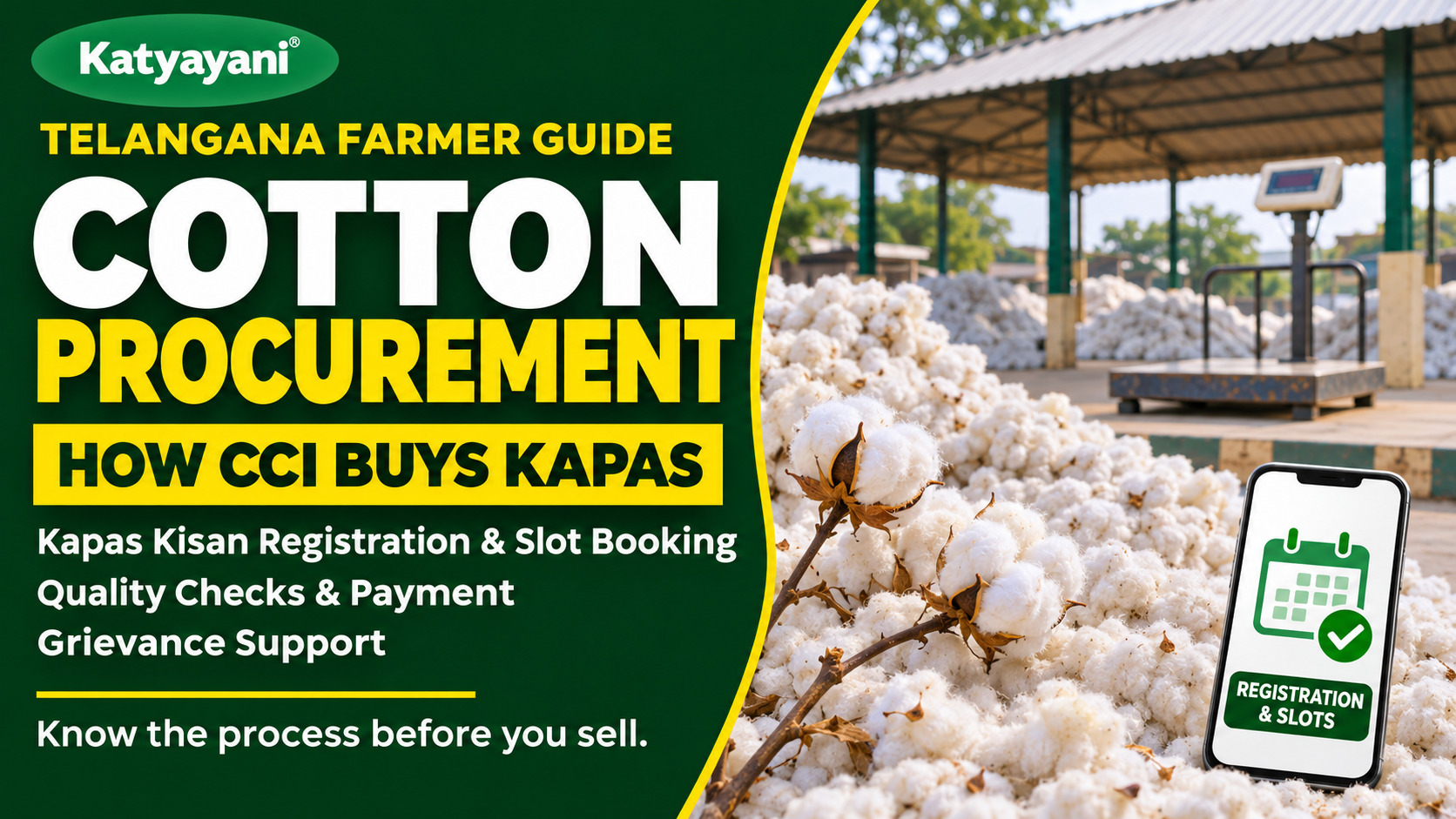
In Telangana, cotton is bought at the minimum support price (MSP) by the Cotton Corporation of India (CCI) when market prices fall below it. Per the CCI pages, the MSP is set by the government before each season, the farmer is identified from land records, Aadhaar and bank details, the kapas is checked for moisture, staple length and micronaire, weighed in front of the farmer, and paid by online transfer 2 to 3 days after CCI receives the purchase slip and farmer details. Farmers register on the Kapas Kisan app, the state government approves, CCI verifies, and the farmer books a slot. CCI lists 131 centres across 30 Telangana districts for 2026-27. The MSP rate, moisture limits and caps change by season, so read the current CCI notice.
What is Telangana cotton procurement?
Telangana cotton procurement is the government-backed buying of kapas from farmers at the minimum support price when the open market pays less. The buyer is the Cotton Corporation of India. Farmers register through the Kapas Kisan system, book a slot, sell at a notified centre and are paid by bank transfer.
The CCI home page describes the corporation as a central agency under the Ministry of Textiles that runs MSP operations for cotton when market prices fall below the MSP level. It also runs commercial operations to supply the textile industry, but those are a separate activity and not what a farmer uses to claim MSP.
Everything in this post comes from the pages that CCI itself publishes and one Press Information Bureau release. Where an official page is silent, the post says so instead of guessing.
Who buys cotton at MSP in Telangana?
The Cotton Corporation of India buys it. The CCI Procurement of Kapas page calls CCI the government's nodal agency, which buys fair average quality (FAQ) cotton when prices drop below MSP. The purchase itself is CCI's. The state approves farmer registrations on the portal, and APMC officials verify identity at the yard.
The same page says CCI buys kapas through two channels: MSP operations and commercial operations. In Telangana, a farmer meets the first one.
So there are two layers. The Centre's agency buys. The state approves registrations and APMC officials verify the farmer. Knowing which is which helps when you need to complain, as the grievance section below explains.
When does CCI buy cotton and when does it not?
CCI steps in when the price of FAQ-grade cotton falls below the MSP. If the open market pays more than MSP, farmers can sell there. The Procurement of Kapas page says CCI officials stay in the market from the start to the end of the season and buy all FAQ-grade kapas that is offered once prices drop below MSP.
This is a floor, not a guaranteed sale of every bale at a fixed price in every condition. The page ties the purchase to FAQ grade. Kapas that does not meet the quality parameters is dealt with under the MSP guidelines, which is why the quality section below matters.
How does the system work from field to payment?
The CCI page describes a series of steps at the market yard: the farmer brings kapas, sells by open auction or e-NAM, identity is checked, CCI buys if the price is below MSP, quality is tested, the kapas is weighed, and CCI pays online. The Kapas Kisan registration and slot steps sit in front of this.
| Stage | What happens | Source |
|---|---|---|
| 1. Registration | Farmer signs up on Kapas Kisan; state government approves; CCI verifies and completes registration | Kapas Kisan portal |
| 2. Slot | Farmer books a slot to sell at a notified centre | Kapas Kisan portal |
| 3. Identity check | Officials verify the farmer from land records, Aadhaar and bank details; the CCI page notes Telangana uses barcode IDs | CCI Procurement of Kapas |
| 4. Price comparison | If FAQ-grade prices are below MSP, CCI buys all FAQ-grade kapas offered | CCI Procurement of Kapas |
| 5. Quality test | Moisture, staple length and micronaire are assessed; portable moisture meters and micronaire testers are used | CCI Procurement of Kapas |
| 6. Weighing | Weighing in the presence of farmers, APMC officials and CCI officials; bid slip issued after auction | CCI Procurement of Kapas |
| 7. Purchase slip | APMC gives CCI a certified weighment or purchase slip and the farmer's bank details | CCI Procurement of Kapas |
| 8. Payment | 100 percent online to the farmer's bank account within 2 to 3 days of CCI receiving the slip and details | CCI Procurement of Kapas |
One caution. The official CCI page describes the process in terms of APMC mandis and does not mention ginning mills as purchase points. Some other reports describe mills being used as centres in Telangana; I could not confirm that on a CCI page, so the weighing and slip details at a mill may differ from the steps above. Ask the market committee or the CCI centre what happens at yours.
How big is CCI's role in Telangana compared with other states?
On CCI's own figures, Telangana is a leading MSP-operation state. The CCI table shows 210.20 lakh quintals for Telangana in 2024-25 out of 505.33 for all states, and 163.42 out of 522.39 in 2025-26. In both years Telangana is ahead of Maharashtra, the next state shown.
The numbers below are taken from the CCI state-wise MSP operations table, under the page heading as printed (lakh quintals). The page marks 2025-26 with an asterisk without explaining it, so treat that column as provisional. The percentage column is my own arithmetic from the page's figures.
| Year | Telangana | All states (page total) | Telangana share (my calculation) |
|---|---|---|---|
| 2014-15 | 192.07 | 461.77 | about 42 percent |
| 2023-24 | 124.24 | 168.60 | about 74 percent |
| 2024-25 | 210.20 | 505.33 | about 42 percent |
| 2025-26* | 163.42 | 522.39 | about 31 percent |
Two points follow. First, the volume bought by CCI swings widely with the market. In a year when private buyers pay above MSP, CCI buys little (the all-state total is 168.60 in 2023-24, against 505.33 the next year); in a year of weak prices it buys a lot. Second, Telangana farmers have used CCI in most of the years shown, so it is a regular part of the selling season, not a rare scheme.
Where are the CCI cotton procurement centres in Telangana?
CCI's statement of centres for crop year 2026-27 lists 131 centres in Telangana across 30 districts. They are run through three CCI branch offices: Adilabad (5 districts, 31 centres), Warangal (16 districts, 62 centres) and Mahbubnagar (9 districts, 38 centres). Check the full list before you load a vehicle.
| CCI branch office | Districts covered | Centres listed for 2026-27 |
|---|---|---|
| Adilabad | 5 | 31 |
| Warangal | 16 | 62 |
| Mahbubnagar | 9 | 38 |
| Telangana total | 30 | 131 |
Source: the CCI statement of centres, crop year 2026-27 (PDF). The file name calls it the list of centres proposed for the crop year, so the final list can differ. Confirm your nearest centre on the Kapas Kisan app or with the district marketing office before you load a vehicle.
The CCI page also says CCI sets up regular centres and satellite centres as needed so farmers do not travel far, and that cotton from satellite centres goes to the nearest processing point.
What is the Kapas Kisan app and who made it?
Kapas Kisan is the digital system through which CCI handles farmer registration, approval and slot booking for MSP cotton purchase. The Kapas Kisan portal describes it exactly that way. The PIB release on the launch adds that farmers can track payment status on it and that it supports several Indian languages.
The portal page lists farmer registration, approval and slot booking under MSP operations and presents CCI as the owner. The PIB release of 2 September 2025 says farmers can register themselves for selling cotton under MSP, schedule a visit to a designated procurement centre to reduce waiting and crowding, and see status updates on quality assessment, accepted quantities and payment processing.
If you search for the app, use the CCI portal or the store listing named Kapas Kisan, and check that the publisher is the Cotton Corporation of India. Do not enter your Aadhaar or bank details on any site that merely looks similar.
How do you register on the Kapas Kisan app?
The portal sets the order: sign up on Kapas Kisan, wait for the state government to approve, then CCI verifies you and completes your registration. Only after that can you book a slot. Because approval happens in the middle, register well before your first picking so that the approval is not what delays your sale.
- Install the Kapas Kisan app from the official source or open the CCI portal, and sign up.
- Fill in the details the app asks for. The CCI Procurement of Kapas page names land records, Aadhaar and bank details as the basis of identity checks, so keep all three ready.
- Submit, then wait for state government approval. The portal names this as a separate step before CCI verification.
- Wait for CCI verification and completion of registration.
- Check that your status shows as registered, then go to slot booking.
The CCI pages I opened do not list the exact fields on the sign-up form, the registration deadline or the approval time. A deadline is a seasonal notice and I have not printed one. Read the app's current notice or ask your mandal agriculture office.
If your phone has weak coverage, ask the village agriculture extension officer or the nearest market yard office to help you register.
How do you book a slot to sell cotton?
Once registered, you book a slot through the same system for a notified centre. The portal states slot booking as the step after approval and verification. The PIB release says digital scheduling at designated centres is meant to reduce waiting time and crowding.
The CCI pages I opened do not give the rules for how many days ahead you can book, how many quintals one slot allows, or how to change a slot. Those rules are set by CCI for the season and can change in the middle of it. Read them in the app before you pick a date.
A practical order of work that fits the sources: dry the kapas, check how much you can load, book the slot for a day the kapas will be ready, and carry the proof of booking together with your identity papers. If you miss the slot, ask the centre or the helpline what the rule is before you drive back.
What documents does a Telangana cotton farmer need?
The CCI Procurement of Kapas page names three: land records, Aadhaar and bank details. APMC officials use these to verify who the farmer is. For Telangana, the page adds that the state uses barcode IDs for farmer identification. Keep copies of all three with you when you sell.
| Item | Why it is needed (per the CCI page) | Practical tip |
|---|---|---|
| Land records | Identity and land verification | Keep a printout or a clear scan; see the land records guide below |
| Aadhaar | Identity check at the yard | Make sure the mobile number linked to it works |
| Bank account details | Payment goes to the farmer's bank account; the APMC passes bank details to CCI | Use an active account in the farmer's own name |
| Registration or slot proof | The route to the centre runs through Kapas Kisan | Keep a screenshot |
If you need to check or download a land record, the state-wise land records guide covers the Telangana portal. The AgriStack and Farmer ID post explains the Farmer ID and notes that MSP procurement is among the uses, with rollout varying by state.
Can tenant farmers sell cotton to CCI?
The CCI pages I opened do not state a rule for tenant farmers. Identity is checked against land records, so a tenant must find out from the agriculture department or the CCI call centre what record the system accepts. Do not assume either way, and ask in writing if you can.
This is a common question because many Telangana cotton growers farm leased land. The official pages are silent on it, and news reports do not settle it either. Until a rule is published in a CCI or state notice, the safe step is to call the Cotton Farmers Call Centre listed on the CCI contact page and ask which record you should use.
What happens on the day you sell?
On the day of the slot you take the kapas to the notified centre, show your identity papers and slot, and the kapas is checked for quality. If it is bought, it is weighed in front of you, you receive the slip, and CCI pays online. The CCI page lists these steps for the APMC yard.
Following the CCI Procurement of Kapas page: the weighing is done in the presence of farmers, APMC officials and CCI officials. After the sale, the APMC gives CCI a certified weighment or purchase slip and your bank details. CCI does not pay you in cash at the gate; it pays to the bank account.
Carry a phone with charge, because the slot proof and payment messages arrive on it, and keep the vehicle driver's number handy in case the centre calls.
What quality checks does CCI apply, and what about moisture?
CCI checks moisture, staple length and micronaire before buying, using portable moisture meters and micronaire testers, and makes deductions according to the MSP guidelines. The CCI pages I opened do not print the moisture percentage limits. The limits sit in the MSP order for the season, so read the current notice.
The CCI page says MSPs are set for different varieties with minimum standards for staple length and micronaire, and that FAQ-grade cotton is what CCI buys.
| Parameter | What the CCI pages say | What is not printed |
|---|---|---|
| Moisture | Tested with portable moisture meters; deductions follow the MSP guidelines | The percentage limit and the deduction per percentage point |
| Staple length | A quality parameter; MSP varieties carry minimum standards | Length cut-offs by variety |
| Micronaire | A quality parameter tested with micronaire testers | Cut-offs |
| Variety | MSP is set for different varieties | Which of your hybrids falls in which group |
I am not printing any moisture figure, because I could not read one on an official page for 2026-27. The CCI MSP order for 2026-27, linked from the MSP operations page, is a scanned document; read the current order or ask the call centre, and check moisture and quality against it before you load.
How can you protect the quality of your kapas before selling?
Sell dry, clean kapas, pick in separate lots, and keep it off damp ground. These are practical field habits, not CCI numbers. They matter because moisture and cleanliness are what the centre tests. Pests that damage bolls also lower what is left after sorting, so field protection in the weeks before picking counts too.
- Pick when the kapas is dry. Avoid picking right after rain or heavy dew and avoid bagging wet kapas, because a moisture meter will find it.
- Keep the first, middle and last pickings in separate lots if you can. Quality varies between pickings and mixing hides the best lot.
- Remove leaf bits, trash and obviously damaged or immature bolls before loading.
- Store under cover on a dry base, and avoid stacking against walls that sweat.
- Do not wet kapas to add weight. Quality tests are done at the centre and the farmer bears the deduction.
Field protection earlier in the season has the same aim. For the common mite problem, read mites in cotton, and for variety choice see disease resistant cotton varieties and hybrids. If you plan crop protection by crop age, the cotton crop kits collection lists cotton spray combos by days after sowing; follow the label and local agriculture department advice for any product.
How and when is payment made?
CCI pays 100 percent online to the farmer's bank account. The Procurement of Kapas page says payment is made within 2 to 3 days of CCI receiving the purchase slip and farmer details from the APMC. The clock therefore starts when CCI has both, not at the moment the vehicle leaves the yard.
That wording is worth reading closely. The 2 to 3 days run from receipt of the slip and details. If your bank details are wrong or your account is inactive, the transfer can fail, and the delay is not CCI's counting period. Check the account number and IFSC code before the sale.
Cash needs can arrive before the payment does. The Kisan Credit Card post explains the revolving credit that many farmers use for crop costs, and the PM Fasal Bima Yojana post explains crop insurance for losses before harvest; check your state's notification for whether cotton is covered in your area.
What should you do if there is a problem with registration, slot or payment?
Start with the Cotton Farmers Call Centre on the CCI contact page, then the Public Grievance portal linked there, then the nearest CCI branch office. The CCI home page also lists a weekly video session for grievances. Keep screenshots, slips and dates to support any complaint.
| Level | Where | What the CCI page says |
|---|---|---|
| 1 | Cotton Farmers Call Centre | 040 45902245, 8:00 AM to 6:00 PM, Monday to Saturday (as listed on the CCI contact page) |
| 2 | Public Grievance portal | pgrs.cotcorp.co.in, linked from the contact page |
| 3 | CCI branch office for Telangana | Adilabad, Warangal and Mahabubnagar branches with email and phone on the contact page |
| 4 | Weekly public-grievance video session | The CCI home page lists a video conference for stakeholders and public grievances every Thursday, 11:00 AM to 12:00 PM |
Phone numbers and hours change, so confirm them on the page before you call. Write down who you spoke to and when. If the problem is with the state side, for example approval of your registration, the district agriculture or marketing office is the right door.
Should you sell to CCI or in the open market?
Sell wherever the net amount is higher after quality deductions, transport and waiting. When the open market pays above MSP, CCI generally does not need to step in. When it pays less, CCI is the floor. The decision is yours; the support exists so that you are not forced to sell below MSP.
To compare fairly, count: the price offered, any moisture or quality deduction, transport cost to the centre, how long you may wait for a slot, and how soon you need the cash. An open-market buyer who pays at once may beat a slower MSP sale if the gap is small; a large gap changes the answer.
If you need the MSP for other crops as a benchmark of how MSP notices are structured, the rabi MSP post explains how the Cabinet approves MSP on the commission's recommendation, though it covers six rabi crops and not cotton. For other schemes and their deadlines, see the agriculture subsidy schemes guide and the agri schemes calendar.
The sister posts in this set that cover other procurement systems, on Kerala paddy, Odisha paddy and what to do when the mandi price falls below MSP, are being published and are not live yet.
What do the official pages not tell you?
The CCI pages I opened leave several practical points open: the current MSP rate, moisture limits, per-acre caps, registration deadline, slot rules and tenant eligibility. Treat each as open until you read the current CCI notice or the Kapas Kisan app, and ask the call centre for anything that stays unclear.
| Question | What the opened pages say | Where to check |
|---|---|---|
| MSP rate for this season | The CCI MSP page links an MSP order for 2026-27 as a scanned PDF; the Procurement page says only that MSP is set before each season | The MSP order linked on the CCI MSP page and the Kapas Kisan app |
| Moisture limit and deduction | Moisture is tested; deductions follow MSP guidelines; no percentage printed | The current MSP order or CCI notice |
| Quantity cap per acre or per farmer | Not mentioned | Kapas Kisan app and the centre |
| Registration deadline | Not mentioned | The app and the district agriculture office |
| Slot booking rules | Slot booking is a step; the rules are not described | The app |
| Tenant farmers | Not mentioned | Call centre; district agriculture office |
| Process at a ginning mill | The CCI page describes the APMC yard and does not mention mills as purchase points | The market committee or CCI centre |
| Centre list for this week | The 2026-27 PDF is a list of proposed centres and may change | Kapas Kisan app and the district marketing office |
If you can get these answers in writing before the season peaks, you will have fewer surprises at the gate.
Conclusion
Telangana cotton procurement is a floor-price system run by the Cotton Corporation of India. You register on Kapas Kisan, the state approves and CCI verifies, you book a slot at a notified centre, your kapas is checked for moisture, staple length and micronaire, it is weighed in front of you, and payment follows to your bank account within 2 to 3 days of CCI receiving the slip and your details. CCI lists 131 centres across 30 Telangana districts for 2026-27. The MSP rate, moisture limits, caps and deadlines change by season, so read the current notice, keep your land record, Aadhaar and bank details ready, and use the call centre and grievance portal if anything goes wrong.

Leave a Comment