
 14 min read
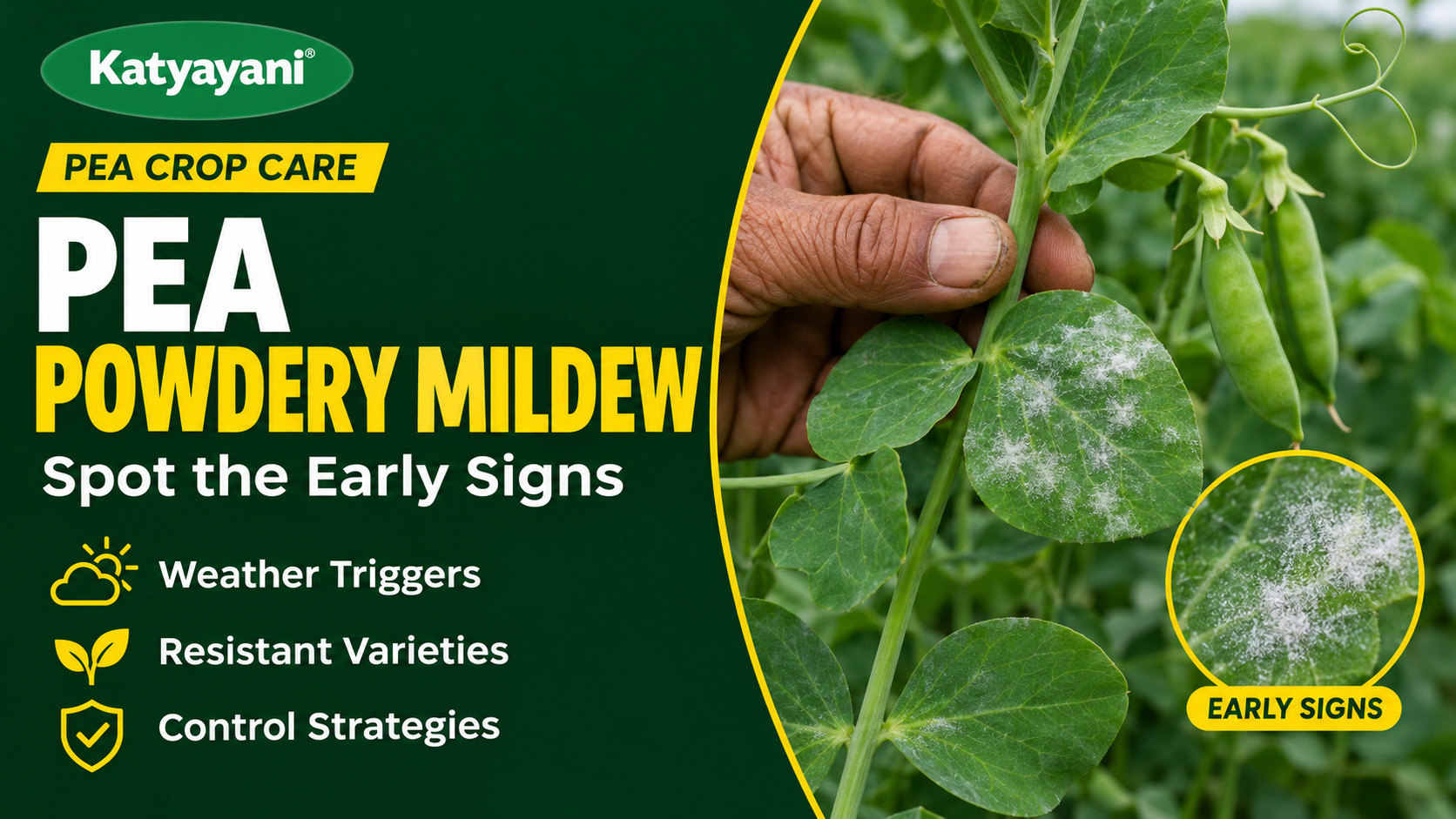
Pea powdery mildew is a fungal disease of pea caused by Erysiphe pisi (older Indian pages write Erysiphe polygoni). The early sign is a white, floury patch on the oldest, lowest leaves, which then spreads to the other leaf side, tendrils, stems and pods. ICAR-IIPR says it can cut field pea yield by up to 80 percent, and a Palampur paper puts garden pea losses at 25 to 50 percent. It favours warm, dry days with cool nights and dew, and late-sown crops suffer most. Choose an early-maturing or tolerant variety, remove old pea residue, and spray at the first white patches, because a fungicide protects the leaf for roughly two weeks and cannot repair a plant that is already white. Always follow the product label and your state advisory.
What is powdery mildew of pea and how much damage can it do?
Powdery mildew of pea is a fungal disease caused by Erysiphe pisi. It coats leaves, stems, tendrils and pods with white powder, weakens the plant and spoils pod quality. ICAR-IIPR reports yield loss of up to 80 percent in field pea, while Palampur researchers cite 25 to 50 percent for garden pea.
The ICAR-IIPR article in Indian Farming names powdery mildew and rust as the major threats to field pea. The Palampur paper in Frontiers in Plant Science calls powdery mildew the most devastating pea disease, with very heavy yield losses of 25 to 50 percent, and says it also degrades green pod quality. The two figures are for different crop types and trials, so neither is a promise for your field. What they agree on is that a late, heavy attack costs real money.
A word on the name. NHB writes the fungus as Erysiphe polygoni, and the NIPHM pea IPM package lists it as Erysiphe pisi, also called E. polygoni. ICAR-IIPR and the Palampur paper write Erysiphe pisi, and this guide uses that name for the same pea disease. The fungus is an obligate biotroph, which means it lives only on a living plant, so it cannot be grown on dead tissue. It also does not spread through rain or free water (Utah State).
For sowing time, seed rate and the full crop plan, read our pea farming guide. This post stays on the disease.
What are the early signs of pea powdery mildew?
Look for small, light-coloured specks on the upper surface of the oldest, lowest leaves. They grow into white, floury colonies that you can rub off with a finger. The patches then spread to the other leaf side, tendrils, stems and pods, and later turn greyish brown.
| Stage | What you see | Source |
|---|---|---|
| Very early | Small, sporadic light-coloured dots on the upper surface of the oldest, lowest leaves | SDSU Extension |
| Early | Small, slightly darkened areas that turn into white powdery spots | NHB; NIPHM |
| Spreading | White floury patches on both sides of the leaf, tendrils, pods and stems | ICAR-IIPR |
| Advanced | Patches turn greyish brown; large aerial parts covered; leaves go chlorotic and distorted before falling; pods small and malformed | ICAR-IIPR; NHB; NIPHM |
| Severe, bluish cast | Foliage can look blue-white, and tissue below the colonies may turn purple; early infection stunts plants | Agriculture Victoria; WSU Hortsense |
| Pods and seed | Severe pod infection can leave grey-brown discolouration on the seed, which lowers grain quality; some pod types show small brown to black spots | Agriculture Victoria; Oregon State |
Because the first patches sit on the oldest leaves at the base of the plant, they are easy to miss from the field edge. Walk in, lift the lower canopy and check the top surface of the lowest leaves. Do this before the first pods fill, not after the whole row looks white.
How do you tell powdery mildew from downy mildew, rust and the natural white bloom on pea leaves?
Powdery mildew is a dry white powder on the leaf surface that rubs off. Downy mildew is a different fungus (Peronospora) and needs a different fungicide. Rust gives reddish-brown pustules that burst to show brown spores. Peas can also carry a natural white film that is not a disease.
| Problem | How it looks or behaves | Source |
|---|---|---|
| Powdery mildew (Erysiphe pisi) | White, floury colonies on the surface, first on the upper side of old leaves | ICAR-IIPR; SDSU |
| Downy mildew (Peronospora) | A separate disease listed beside powdery mildew in the ICAR-IIPR disease table. Fungicides used for downy mildew have no activity against powdery mildew | ICAR-IIPR; Agriculture Victoria |
| Rust (Uromyces) | Flecks on leaves that become reddish-brown pustules, often in humid regions; the entire leaf can look brownish | NHB; ICAR-IIPR |
| Natural white film on the leaf | Peas can naturally carry a white film that is mistaken for powdery mildew; identify it before you spray | SDSU Extension |
The practical test is simple. Rub the white patch with a finger. Powdery mildew comes off as dry powder and the leaf underneath is intact or slightly darkened. If you are unsure between the two mildews, a nearby KVK or the state plant protection office can confirm it, because the fungicide choice depends on the answer. For how the two mildews differ on another crop, our rose powdery mildew guide has a side-by-side comparison.
What causes pea powdery mildew, and how does it spread?
The fungus survives on infected pea stubble and on living plants, and its spores travel on the wind into new crops. Oregon State adds that it can be seedborne. Once a few plants are infected, it spreads quickly through the field by air and on workers moving through the rows.
- Carry-over: Agriculture Victoria says the fungus overwinters on infected pea stubble and releases spores that wind carries into new crops. Oregon State says it usually survives as spores on living plants and can also be seedborne.
- Infected seed: WSU Hortsense says infected seed, often grey-brown, can carry the fungus.
- Legume weeds and volunteers: Utah State advises removing weeds in the legume family and old plant debris before planting a new crop.
- Spread inside the field: air movement and workers brushing through the rows (Utah State).
- Speed: under favourable conditions the fungus can colonise a plant in 5 to 6 days (Agriculture Victoria), and about a week passes between infection and the first new spores (Utah State).
Unlike many leaf diseases, powdery mildew does not spread by rain or free water. Utah State says it needs high humidity or dew for a few hours to infect, and Agriculture Victoria notes that rain is unfavourable because it washes spores off the plant. That is why a dry spell with heavy morning dew is more dangerous than a wet week.
Which weather brings pea powdery mildew?
Warm, dry days with cool nights and dew. Agriculture Victoria gives 15 to 25 degrees C with humidity above 70 percent for four to five days, during flowering and pod filling. ICAR-IIPR describes it as prevailing on warm, dry days with cool nights. Dew on the night is enough for development.
| Source | What it says about conditions | Context |
|---|---|---|
| Agriculture Victoria | 15 to 25 degrees C, humidity above 70 percent for 4 to 5 days; flowering and pod filling late in the season; dew is enough; rain is unfavourable | Field pea, Victoria, Australia |
| ICAR-IIPR | Prevails in warm and dry days with cool nights | Field pea, India |
| NIPHM pea IPM package | 15 to 25 degrees C with humidity above 70 percent for 4 to 5 days, late in the season, at flowering and pod filling; spores are carried by air and keep spreading in dry conditions | Pea, India (central government package; same figures as Agriculture Victoria) |
| SDSU Extension | Warm, dry weather with cool nights and dew favours spread; late planting and a heavy canopy raise the risk; not every year | Field pea, South Dakota, USA |
| WSU Hortsense | Warm days, cool nights and humid weather favour it; often worse in fall | Garden pea, Washington, USA |
| Palampur paper | The north-western Himalayas are a hot spot; Kukumseri (dry temperate, 250 mm annual rain) is used as the screening site, Palampur (humid temperate, 2,500 mm) as the second site | Garden pea, Himachal Pradesh |
The sources use different words but describe one pattern: the leaf does not need to be soaking wet, but it does need cool, humid nights and then a warm, dry day. In north Indian winter fields that pattern shows up after the cold nights of late winter, when the canopy is thick and the pods are filling. I did not find an ICAR calendar that fixes the month the disease starts in the plains, so use the weather and your own field scouting rather than a date.
Does sowing time change how bad powdery mildew gets?
Yes. SDSU says late-planted peas are usually more susceptible than early-planted peas, and Oregon State says spring planting or an early-maturing variety usually avoids serious losses. ICAR-IIPR advises growing early-maturing, short-duration varieties, and it also advises avoiding late planting altogether.
The logic is about timing. The disease is worst at flowering and pod filling, late in the season. A crop that matures early has fewer weeks in that window, so there are fewer chances for the fungus to build up. SDSU adds that early-planted fields can still be hit under the right weather and a heavy canopy, so early sowing lowers the risk but does not remove it.
Our pea farming guide gives the sowing window and varieties for your region. Pick the earliest sowing date that suits the variety, and avoid a second, late sowing next to a crop that is already flowering, because the older field is a spore source for the younger one.
How fast does it spread, and how long do you have to act?
Fast. Agriculture Victoria says the fungus can colonise a plant in five to six days and spreads quickly to neighbouring plants once a few are infected. Utah State says control must start when the first lesion appears, because once leaves are fully covered or yellow it is too late.
| Fact | Figure | Source |
|---|---|---|
| Time to colonise a plant under favourable conditions | 5 to 6 days | Agriculture Victoria |
| Time from infection to first spore production | About 1 week | Utah State Extension |
| How long a fungicide protects the foliage | About 14 days, depending on disease pressure | Agriculture Victoria |
| How long most fungicides protect (field pea) | Up to two weeks | SDSU Extension |
| Interval used in Indian advisories | 10 to 15 days (ICAR-IIPR); 15 days (NHB); second spray after 15 days for one listed group and after 25 days for the sulphur and triadimefon group (NIPHM) | ICAR-IIPR; NHB; NIPHM |
Put these together and the working window is short. A fungicide gives about two weeks of cover, the fungus can take over a plant in about a week, and fungicides have limited systemic activity and do not protect new growth (Agriculture Victoria). Each new leaf the plant puts out after your spray is unprotected. That is why Indian advisories repeat the spray at 10 to 15 days.
Which pea varieties resist or tolerate powdery mildew?
ICAR-IIPR lists field pea lines it calls resistant or tolerant, including IPFD 10-12, IPFD 11-5, IPFD 12-2, IPFD 9-2, IPFD 6-3, IPFD 13-2, IPFD 12-8, IPF 16-13, IPFD 2014-2, Pant Pea 250, HFP 1428, Pant Pea 347 and HFP 715. The popular garden pea Azad P-1 is rated highly susceptible.
| Variety or group | Reaction reported | Source |
|---|---|---|
| IPFD 10-12, IPFD 11-5, IPFD 12-2, IPFD 9-2, IPFD 6-3, IPFD 13-2, IPFD 12-8, IPF 16-13, IPFD 2014-2, Pant Pea 250, HFP 1428, Pant Pea 347, HFP 715 | Listed by ICAR-IIPR as resistant or tolerant cultivars (field pea) | ICAR-IIPR |
| Rachna, Pant P5, DMR 11, HUP 2, JP 885, KFP 103, Ambika, Shubhra, Aparna, Azad P4, Pusa Panna | Listed by the central government NIPHM package as resistant or tolerant to powdery mildew; the package does not say garden or field type and tells readers to contact their SAU, ICAR institute or KVK | NIPHM |
| Azad P-1 (garden pea) | Highly susceptible; scored 4 on a 0 to 4 scale in field and detached-leaf tests in every year | Palampur paper |
| Resistant garden pea types in general | Often medium-sized pods of light-green colour, which consumers like less than long, dark-green pods | Palampur paper |
Three cautions. First, the ICAR-IIPR list is for field pea (dry grain), and green pod growers need a variety that also suits the vegetable market. Second, the NIPHM list is undated, so confirm each name with your KVK, and do not confuse Azad P4 on that list with Azad P-1, which the Palampur paper rates highly susceptible. Third, the Palampur authors explain why so many growers still plant susceptible types: consumers prefer sweet, long, dark-green pods, and Azad P-1 fits that, even though it is highly susceptible. If you grow a susceptible type for the pod market, plan for scouting and an early spray.
Utah State adds that resistance to Erysiphe pisi does not cover other powdery mildew species on peas, and Agriculture Victoria describes resistant varieties as the most effective control. Ask your seed supplier or KVK which of the listed lines is available and sold as certified seed in your area, and do not buy on the strength of a list alone.
Which cultural practices lower the risk of pea powdery mildew?
Sow early, choose an early-maturing or tolerant variety, remove or bury old pea residue, avoid sowing next to last season's pea stubble, keep a break between pea crops, and do not sow seed from a mildewed crop. None of these cures the disease, but together they cut the spores that reach your crop.
- Early, short-duration crop. ICAR-IIPR advises early-maturing short-duration varieties and avoiding late planting.
- Field sanitation. ICAR-IIPR lists field sanitation first. Agriculture Victoria advises incorporating or burning infected stubble soon after harvest where practical, and avoiding sowing next to last season's stubble.
- Break between pea crops. Agriculture Victoria suggests a four-year gap between field pea crops in the same paddock; Oregon State says to rotate for at least one year. Our crop rotation guide has workable sequences. The break lengths differ by source, so treat longer as safer.
- Clean seed. WSU notes infected seed can carry the fungus; Oregon State says it can be seedborne. Use certified seed.
- Weeds and volunteers. Utah State advises removing legume-family weeds and old debris before planting.
- Bower (staking) system. The NIPHM package lists the bower system among its cultural steps for powdery mildew.
- Do not compost diseased material. WSU advises destroying or discarding diseased plant debris rather than composting it.
- Avoid a very dense canopy. SDSU notes that even early-planted fields can be hit when the canopy is heavy; spacing and seed rate are in the pea farming guide.
- Mind movement between blocks. Utah State notes spores spread on workers' clothing moving through the rows; my practical suggestion is to work the clean block first and the mildewed block last.
Several of these steps rest on foreign extension and one on a state university, because the Indian pages opened for this guide gave a short list. The general approach matches the ICAR-IIPR line, which starts the integrated management list with sanitation and variety choice and puts fungicide spray next.
How should you scout, and when should you start spraying?
Start at the first white specks on the lowest leaves. ICAR-IIPR and NHB both say to spray as soon as symptoms appear. SDSU adds that susceptible varieties in disease-friendly weather should be scouted every two days from early pod development, and sprayed when the first symptoms show at low levels in the lower canopy.
| Situation | What the source advises | Source |
|---|---|---|
| First symptoms seen | Foliar spray at initial appearance of symptoms, repeated at 10 to 15 day intervals | ICAR-IIPR |
| First symptoms seen | Sulphur dusting or a spray at the first sign, repeated at 15 day intervals | NHB |
| Susceptible variety, disease-friendly weather | Scout the canopy every 2 days from early pod development; spray when first symptoms are found at low levels in the lower canopy | SDSU Extension |
| You cannot monitor often | A preventive spray may be considered, but only if weather favours disease and the variety lacks resistance | SDSU Extension |
| Disease already heavy | Utah State says that once leaves are fully covered or yellow it is too late | Utah State Extension |
The scouting rule from SDSU is for dry field pea in South Dakota, so read it as logic rather than an Indian schedule. The Indian packages (ICAR-IIPR, NHB, NIPHM) all say to spray when symptoms first appear and none fixes a calendar date. In the same spirit: do not spray too far ahead of the disease, because the cover runs out, and do not wait until the plot is white. My practical suggestion, not a sourced rule, is to check the lowest leaves every two to three days from flowering during any spell of cold nights and dewy mornings. For nozzle choice and coverage, see our guide to choosing an agricultural sprayer.
What do Indian advisories say about sulphur and other fungicides for pea powdery mildew?
Indian institutes name sulphur first. ICAR-IIPR lists a sulphur spray at 0.2 percent, NHB gives sulphur dusting at 2.5 kg per hectare, and the central government NIPHM package lists sulphur as WP, SC, WG or dust. Older active ingredients also appear. Check the current CIB&RC list and your label before buying.
| Source | What it names | Interval or note |
|---|---|---|
| ICAR-IIPR (Indian Farming, 2023) | Foliar spray of sulphur (sold as Sufex) at 0.2 percent, tridemorph at 0.1 percent or dinocap at 0.1 percent (field pea) | At initial appearance of symptoms, repeated at 10 to 15 day intervals |
| NIPHM AESA-based IPM package for pea | Per acre: sulphur 40% WP 2.26 to 3.00 kg in 300 to 400 litres of water; sulphur 52% SC 800 ml in 120 to 160 litres; sulphur 80% WG 750 g to 1.0 kg in 300 to 400 litres; sulphur 85% DP 6 to 8 kg; triadimefon 25% WP at 0.1 percent. The package also lists older products (benomyl, carbendazim, dinocap, fenarimol) | Second spray after 15 days for the first listed group and after 25 days for the sulphur and triadimefon group; the package is undated and does not separate garden from field pea |
| NHB pea sheet | Sulphur dusting at 2.5 kg per hectare, or Calixin 75 EC (5 ml in 10 litres of water) | At 15 day interval from the first symptoms |
Read this table as what Indian government sources published, not as a buying list. The NIPHM package carries no date and still uses an older department name, the NHB sheet is also undated, and the registration of any product can change. Water volume per acre also differs between the NIPHM package and some product pages, so do not mix figures from two places. Which product you may use on pea, at what dose, and with what waiting period before picking, is decided by the current CIB&RC registration and the label on the pack. If the label and a general page disagree, follow the label and your state advisory.
Store page that names pea powdery mildew: the sulphur 80 WDG fungicide page lists pea among the crops for powdery mildew. This guide prints no dose from that page, because the dose and spray volume should be taken from the pack. Browse the wider fungicide range for other options, and check the crop and disease on each label.
How does sulphur work, and when can it burn pea leaves?
Sulphur is a contact protectant. It stops spores before they infect, so it must go on before the disease or at the very first signs. Oregon State says it volatilises above about 18 degrees C, can burn leaves above about 35 degrees C, and advises against using it above about 29 degrees C.
Oregon State's handbook, written for the Pacific Northwest, says sulphur works as a protectant, so it should be applied before infection and repeated weekly. It converts to vapour as the day warms (above 65 F, or about 18 degrees C), it can damage leaves above 95 F (about 35 degrees C), and the page advises against applying it above 85 F (about 29 degrees C). The WSU Hortsense page gives the same warning: do not apply sulphur products at high temperatures, since leaves may burn.
- Spray in the cooler part of the day. This is the practical meaning of the temperature limits above.
- Do not treat sulphur as a rescue. Because it protects rather than cures, a plant that is already white will not clean up.
- Dust or spray, not both on the same day. I did not find a source on mixing, so keep one product per spray round and test any mixture on a small patch first.
- Note the label. Pack instructions on temperature limits, interval and waiting period override any general figure in this guide.
The temperature figures are from a US handbook. Winter days in the Indian plains are often cooler than these limits, but a warm afternoon can cross them, so the cooler hours are the safer choice. For how dusting, spraying and drenching differ, see our fungicide application methods post.
How do you avoid fungicide failure and resistance?
Use the right fungicide for the right disease, cover both sides of the leaf, repeat at the interval on the label, and change the fungicide group if you need more rounds. Fungicides for downy mildew do not work on powdery mildew, and the limited systemic action of most products means poor coverage leaves unprotected tissue.
- Wrong target. Agriculture Victoria says fungicides used for downy mildew have no activity against powdery mildew. Check the disease before reaching for a product.
- Late spray. SDSU says to apply before disease exceeds low levels, but not too far ahead of onset, so protection is high when the disease starts.
- Poor coverage. Agriculture Victoria stresses good coverage because most products have limited systemic activity and do not protect new growth.
- Same group again and again. Oregon State's table of label limits shows the principle: one product is limited to two sequential applications or two per year. Read the group on the label and rotate when you need further sprays.
- Copper alone. Oregon State says copper is not effective alone against pea powdery mildew and that soil build-up is a concern.
The Palampur authors note a wider concern in favour of resistant varieties: fungicide use has consequences for human health and the environment. Our IDM in chilli post shows how to combine cultural steps with a small number of sprays on another crop, and the same approach works for pea.
Do bio-agents, bicarbonate or home sprays work on pea powdery mildew?
The opened sources do not give a field result that makes them a stand-alone answer. Oregon State says the efficacy of biological products on pea powdery mildew in its region is unknown. ICAR-IIPR suggests Pseudomonas fluorescens as a seed treatment inside its integrated list. Treat bio-agents as support, not a rescue.
ICAR-IIPR lists seed treatment with Pseudomonas fluorescens or Pseudomonas aeruginosa among its integrated management steps for pea powdery mildew, alongside sanitation, early varieties and a sulphur, tridemorph or dinocap spray. No field result for these bio-agents against pea powdery mildew was found in the opened sources, so treat them as support to the other steps. Our biopesticides explainer covers what such products can and cannot do.
Oregon State lists several bicarbonate-based and biological products for US growers, but these are US labels and the page says the efficacy of biologicals there is unknown. I did not find an ICAR or state-university result for milk, baking soda or similar home sprays on pea, so none is recommended here.
What if the crop is already heavily infected, and what about picking green pods?
Sprays slow the spread but cannot restore leaves that are already covered. Utah State says that once leaves are fully covered or yellow it is too late. Protect the plants that are still clean, remove the worst-hit rows from your seed plan, and read the waiting period on the label before the next pod picking.
Green pea pods are picked every few days, so the waiting period on the label matters. ICAR-IIPR makes the point that most cool season pulses are eaten directly as green vegetables and salads, which is why residues from chemical sprays are a concern. Oregon State's table shows waiting periods for US products ranging from the day of harvest to 21 days, which shows how much the number varies by product. Your label is the only number that counts. Mark the spray date in a notebook, and plan the next pick around it.
Pods from a heavily mildewed plant are smaller and may be malformed (NHB), and Agriculture Victoria notes that severe pod infection can discolour dry seed. Do not keep seed from a heavily infected field, because infected seed can carry the fungus (WSU, Oregon State).
How do you manage powdery mildew on peas in pots and kitchen gardens?
Give plants room and sun, water at the base, remove the worst leaves, and bin diseased debris instead of composting it. WSU also advises planting early and choosing resistant varieties. Treat with a label-approved product at the first white spots, and avoid sulphur in hot weather.
Our winter vegetables in pots guide names powdery mildew as a common pea problem and advises spacing plants, watering only at the base and removing badly affected leaves. WSU Hortsense recommends non-chemical steps first: plant peas early, do not replant fall peas in the same spot, grow resistant varieties and clean up garden debris. For a home garden, one or two sulphur rounds at the first signs, in cool hours, is the extent of what the opened sources support. Read the pack for dose, interval and waiting period.
What mistakes make pea powdery mildew worse?
Sowing late, planting next to old stubble, leaving residue in the field, saving seed from an infected crop, waiting until the plot is white, and using a fungicide meant for downy mildew are the common mistakes. Each one raises the spore load or lets it build.
- Late sowing or a late-maturing variety. SDSU and Oregon State link both with more disease.
- Residue left standing. Agriculture Victoria lists infected stubble as the carry-over source.
- Saving seed from a mildewed plot. WSU and Oregon State note the fungus can ride on seed.
- Spraying too late. Utah State: too late once leaves are fully covered.
- Wrong product. Agriculture Victoria: downy mildew fungicides do not act on powdery mildew.
- Sulphur in heat. Oregon State and WSU warn of leaf burn in high temperatures.
- Relying on one defence. ICAR-IIPR lists sanitation, variety, early sowing and spray together, not one alone.
What does a simple pea powdery mildew plan look like for the rabi season?
Build it in stages: clean the field and use clean seed, pick an early or tolerant variety, sow on time, scout the lowest leaves from flowering, spray at the first white spots, repeat on the label interval and rotate groups if you need more rounds. This outline gives the order of steps, not doses, which come from the label.
| Stage | What to do | Why |
|---|---|---|
| After harvest and before sowing | Remove or bury pea residue; clear legume weeds; avoid sowing next to last season's stubble | Removes the main carry-over source (Agriculture Victoria, Utah State) |
| Variety and seed | Early-maturing or tolerant variety suited to your region; certified seed | Less time in the high-risk window; seed can carry the fungus (ICAR-IIPR, WSU) |
| Sowing | Sow on time, not late; avoid a very dense stand | Late crops are more susceptible (SDSU, ICAR-IIPR) |
| Vegetative stage | Normal crop care; look at the lowest leaves each week | First specks are on the oldest leaves |
| Flowering to pod fill | Check every 2 to 3 days in cold-night, dewy spells | This is the high-risk window (Agriculture Victoria) |
| First white specks | Spray a product whose label names pea and powdery mildew; cover both leaf sides; note the waiting period | ICAR-IIPR and NHB: spray at initial appearance |
| 10 to 15 days later | Repeat if the weather stays favourable; change the fungicide group if more rounds are needed | Protection lasts about two weeks (Agriculture Victoria) |
| Last picking | Respect the waiting period before the final picks | Green pods are eaten fresh |
| After harvest | Do not keep seed from a heavily infected plot; remove residue | Cuts next season's spores |
If you only do three things, make them early sowing with a tolerant variety, a weekly look at the lowest leaves from flowering, and a label-approved spray at the first white specks.
Conclusion
Pea powdery mildew is a timing problem more than a product problem. The fungus lives on old pea residue and sometimes on seed, loves cool dewy nights followed by dry warm days, and hits late-sown crops hardest. Choose an early-maturing or tolerant variety, clean the field and use clean seed, and look at the lowest leaves every few days from flowering. Spray at the first white specks with a product whose label names pea and powdery mildew, cover both leaf sides, and repeat on the label interval, because one spray protects for about two weeks and does not protect new growth. Keep sulphur for the cooler hours, do not use a downy mildew fungicide on this disease, and read the waiting period before you pick green pods. Where the label and an older page differ, follow the label and your state advisory, and ask your KVK or state horticulture department when in doubt.


Leave a Comment