
 12 min read
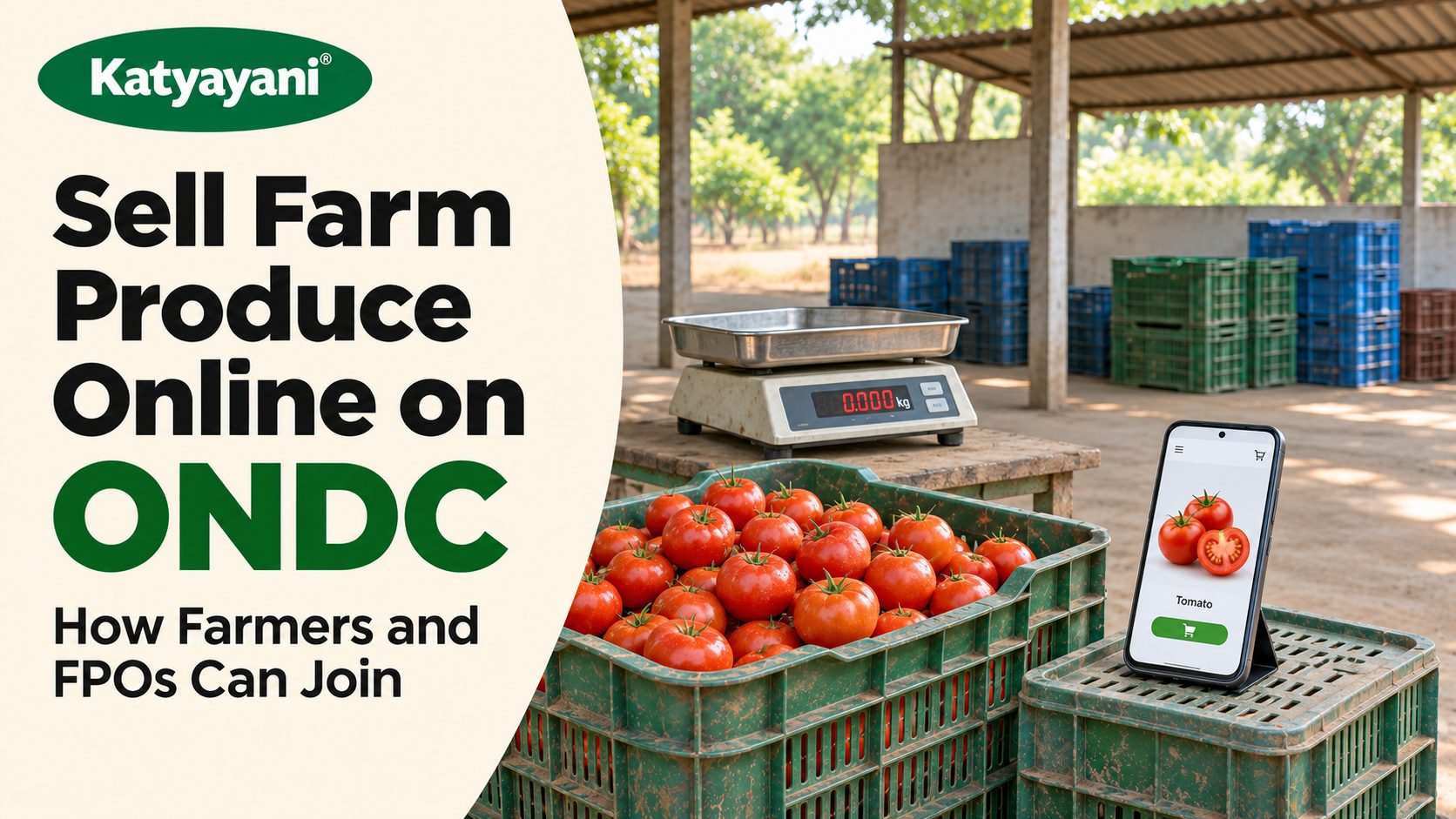
ONDC (Open Network for Digital Commerce) is an open network started by DPIIT, Ministry of Commerce. You cannot sell on it directly. A farmer or FPO joins through a seller app that lists the produce. SFAC told Parliament that 4,675 FPOs were onboarded on ONDC till February 2025. Ask any seller app for its fees in writing before you sign.
What is ONDC and how does it work?
ONDC stands for Open Network for Digital Commerce. It is an initiative of the Department for Promotion of Industry and Internal Trade (DPIIT), Ministry of Commerce and Industry. It is not one shopping app. It is a set of open rules that lets different buyer apps and seller apps trade with each other.
The PIB backgrounder of 4 January 2025 says ONDC was launched in April 2022. It does not own or run any e-commerce service. It only helps apps connect. Think of the phone network. You can call a person on another company's SIM because the network is shared. In the same way, a buyer on one app can order from a seller listed through another app.
PIB adds that ONDC is a non-profit Section 8 company, incubated at the Quality Council of India, with Protean as co-founder. Its stated goals are lower selling costs and more choice for buyers. Any platform that follows its open protocols can take part, and the PIB document names no fee for farmers.
| Role on the network | What it does (as PIB describes it) |
|---|---|
| Buyer application | Lets customers find and order from sellers on the network |
| Seller application | An interface for businesses to list and manage what they sell |
| Logistics provider | Moves goods between regions |
| Technology enabler | Gives IT systems and tools |
For a farmer, the seller application matters most. That is where you sign up and put your produce on the network.
Can a farmer sell directly on ONDC?
No. The ONDC retail page says sellers join the network through a seller app. So a farmer or FPO signs up with a seller application, and it lists the produce on the network. Buyers then see it in their own buyer apps.
PIB (4 Jan 2025) says ONDC standardises cataloguing, inventory, order management and order fulfilment. So the same product details can work across different apps. If one seller app does not suit you, you can try another.
This is different from mandi selling. For auction lots, read our guide to e-NAM registration. In our view, ONDC suits packed produce sold to households, shops or businesses better than auction lots. That is practical advice, not an official statement.
Is agriculture a category on ONDC?
Yes. PIB (4 Jan 2025) lists Agriculture as one of 13 domains on the network. It covers agricultural input, output and services. Grocery is another domain, and it includes foodgrains and fruits and vegetables. So farm produce can appear under more than one category.
The same document says ONDC began with food and beverage and grocery, then added more, including B2B. Ask your seller app which category it will use for your produce.
How many FPOs are already on ONDC?
SFAC told Parliament that 4,675 FPOs had been onboarded on ONDC till February 2025. The SFAC reply is dated 27 March 2025 and answers Lok Sabha Question 4880. It also says all 10,000 FPOs under the central scheme are registered, so more than four in ten had joined ONDC by then.
| Item | Figure | Source and date |
|---|---|---|
| FPOs onboarded on ONDC | 4,675 (till Feb 2025) | SFAC reply, 27 Mar 2025 |
| FPOs registered on e-NAM | 4,392 | SFAC reply, 27 Mar 2025 |
| FPOs registered under the 10,000 FPO scheme | All 10,000 | SFAC reply, 27 Mar 2025 |
| FPOs with processing infrastructure commissioned | 2,698 | SFAC reply, 27 Mar 2025 |
Joining is not the same as selling. "Onboarded" means an FPO joined through a seller route. The SFAC reply gives no figure for how many FPOs sell each month or how much they sold. Treat joining as the first step.
The PIB backgrounder of 1 March 2025 adds that the 10,000th FPO was registered in Khagaria district, Bihar, and that about 30 lakh farmers are connected to FPOs. If you are not in a group yet, see how an SHG differs from an FPO.
Which government bodies help farmers get on ONDC?
PIB (4 Jan 2025) names the Ministry of Agriculture and Farmers Welfare and NABARD as bodies onboarding FPOs and farmers to the network. SFAC, which supports FPO formation, reports the FPO numbers. CSCs have gone live on ONDC, and the Department of Fisheries works with it for fisher groups.
| Body | Role stated in an official document |
|---|---|
| Ministry of Agriculture and Farmers Welfare and NABARD | Onboarding FPOs and farmers to the network (PIB, 4 Jan 2025) |
| SFAC | Reports 4,675 FPOs onboarded on ONDC till Feb 2025; says FPOs are shown ONDC and GeM to reach wider markets (SFAC reply, 27 Mar 2025) |
| CSC network | CSCs have gone live on ONDC to connect villages to the national digital market (PIB, 4 Jan 2025) |
| Department of Fisheries | A digital route for fisher groups, fish farmers and FPOs to buy and sell on ONDC (PIB, 4 Jan 2025) |
The CSC home page shows 4,67,491 functional centres across India in its September 2026 data. Ask the operator whether the centre can help you reach a seller app. Do not hand over papers or money to anyone you cannot identify.
What help is there for a first-time seller?
PIB (4 Jan 2025) lists a seller handbook in 14 languages, a "Feet on Street" programme, a WhatsApp bot called ONDC Sahayak in 5 languages, an online ONDC Academy and a tie-up with Bhashini for Indian-language apps. The handbook is aimed mainly at first-time sellers.
| Support | What it is, as PIB describes it |
|---|---|
| Seller handbook | Guide to succeed in digital commerce, in 14 languages, for first-time sellers |
| Feet on Street | Helps network participants find and teach sellers, help them join through seller apps and build a first basic catalogue |
| ONDC Sahayak | WhatsApp bot in 5 languages that gives information to sellers and buyers |
| ONDC Academy | A store of text and video lessons and good practices |
| Bhashini tie-up | To improve app development and e-commerce in Indian languages |
| Awareness workshops | Held with industry groups to teach small sellers about ONDC |
PIB states no fee for any of these. Still, if someone says they are from ONDC and wants money for a "registration", stop. Use the official helper channels.
How do I start selling on ONDC, step by step?
Choose a seller app, sign up, build your product list, set prices and stock, then take orders and ship. Each app sets its own rules for documents and fees, so ask first. An FPO should also decide who will handle orders every day.
- Pick two or three products that you can pack well and deliver without damage.
- Find seller applications. Ask the CSC operator, your FPO's promoting agency or your district agriculture office which ones work with farm sellers. Compare at least two.
- Ask each app for its fee, payout time, delivery help and support language, in writing. Use the question table below.
- Sign up with the app you pick. Keep your FPO registration papers and bank details handy. The exact list of papers depends on the app.
- Build your catalogue. Take clear photos and write the pack size, the net weight and where the produce comes from.
- Set a price and a stock count you can meet. Update stock daily during the season.
- Pack and hand over each order on time. Keep a record of orders, payments and returns.
What should I ask a seller app before I sign up?
Ask about fees, payout time, delivery, returns and support, and get the answers in writing. A phone promise is not enough. The table is a checklist, not a list of facts about any app.
| Ask this | Why it matters |
|---|---|
| What fee or commission do you charge, and on what? Any sign-up or monthly charge? | You need to know your margin after all cuts. A fixed charge hurts a seller with few orders |
| How many days until money reaches my bank? | FPOs need cash to pay members |
| Who delivers, and who pays if produce spoils on the way? | Fresh produce can be damaged in transit |
| What happens when a buyer returns an order? | Returns can eat your profit |
| Can I get help in my own language? | Support in Hindi or your local language saves mistakes |
| Which papers do you need from me? | Lists differ from app to app |
| Who can see my customer details? | Your buyers are your future business |
Compare two apps and read what other FPOs say about them. If a company asks for a large sum before listing you, or promises fixed monthly sales, walk away.
What kind of produce is easiest to sell online?
Graded, packed produce that travels well. Pulses, millets, spices, honey, jaggery and cold-pressed oils keep well. Fresh vegetables and fruits need quick delivery and careful packing, so start with a nearby area. This is practical advice, not a figure from an official page.
| Type of produce | What to plan for |
|---|---|
| Packed grains, pulses, millets | Cleaning, grading, a clean pack with batch date |
| Spices and dry produce | Moisture control and good sealed packs |
| Fresh vegetables and fruits | Fast pick-up, cool and airy packing, a small delivery area |
| Processed food (flour, pickles, oil) | Food-safety rules; ask your food-safety officer what you need before you start |
| Seed, plant and input products | Rules for seed, fertiliser and pesticide sales differ; check with your agriculture office |
Packed food can come under food-safety and labelling rules. Ask your food-safety officer which licence or registration your product needs. Our guide on packaging and labelling rules for food exports shows how detailed labels can get. A clear label with your name and pack date helps buyers trust you.
How is ONDC different from e-NAM?
e-NAM is the National Agriculture Market electronic trading platform, which SFAC implements. ONDC is an open network of buyer and seller apps for many kinds of goods. The SFAC reply lists both as market routes for FPOs, so an FPO can use both.
The SFAC website calls e-NAM a "single unified market for agricultural products" with "much higher price discovery for farmers". If the mandi price is low, see what to do when the mandi price is below MSP.
| Point | e-NAM | ONDC |
|---|---|---|
| What it is | National agriculture market electronic trading platform | Open network of buyer and seller apps |
| Run by | Implemented by SFAC (Ministry of Agriculture) | Initiative of DPIIT, Ministry of Commerce and Industry |
| How you join | See our e-NAM guide | Through a seller app |
| FPOs on it (SFAC, Feb-Mar 2025) | 4,392 | 4,675 |
Which government schemes can an FPO use alongside ONDC?
The SFAC reply of 27 March 2025 lists FPO management cost of up to Rs 18 lakh, a matching equity grant of up to Rs 2,000 per member with a ceiling of Rs 15 lakh per FPO, and a credit guarantee on project loans up to Rs 2 crore. It also lists AIF, AMI, PM FME and drone support.
| Support for FPOs | What the SFAC reply says |
|---|---|
| FPO management cost | Rs 18 lakh per FPO (the period is stated differently in two official papers; ask SFAC) |
| Matching equity grant | Up to Rs 2,000 per farmer member, ceiling Rs 15 lakh per FPO |
| Credit guarantee | Up to Rs 2 crore of project loan per FPO |
| Agriculture Infrastructure Fund (AIF) | Credit guarantee loans up to Rs 2 crore with 3% a year interest subvention |
| Agricultural Marketing Infrastructure (AMI) | Up to Rs 50 lakh for storage and Rs 30 lakh for non-storage infrastructure |
| PM Formalisation of Micro Food Processing Enterprises (PM FME) | Credit-linked grant at 35%, up to Rs 10 lakh, for micro food processing enterprises |
| Kisan drones | 40% of the basic cost or Rs 4 lakh, whichever is less |
The reply is only a summary, and each scheme has its own rules. Guidelines and the state-wise FPO list sit on the SFAC FPO scheme page. Our guides on the FPO credit guarantee scheme, the Agriculture Infrastructure Fund and AMI warehouse subsidy explain each one. For other support, see agriculture subsidy schemes.
The PIB backgrounder of 1 March 2025 says the Ministry of Agriculture links FPOs to institutional buyers and to e-commerce platforms like ONDC and e-NAM. It names FPO services that suit online selling: cleaning, sorting, grading, packing and pooling members' produce. It also says the Ministry of Food Processing offers a credit-linked capital subsidy of 35% of eligible project cost and a 50% grant for branding and marketing. Read the scheme terms before you count on either.
Storage and packing space helps you meet online orders. If you plan a cold room, see cold storage subsidy and business. An FPO that holds stock can also look at e-NWR loans against warehouse receipts.
Is there money help to get a small business on ONDC?
Possibly. PIB (4 Jan 2025) describes the MSME-TEAM initiative of the Ministry of MSME. It aims to help five lakh micro and small enterprises, of which two and a half lakh are women-owned, onboard ONDC. It is valid from 2024 to 2027. Whether your FPO or farm business counts as one depends on its registration.
The help covers catalogue preparation, account management, logistics, and packaging material and design. It reaches sellers through seller network participants, with awareness workshops preferred in Tier 2 and Tier 3 cities and MSME clusters. Ask a seller app or your district industries office, not a stranger on the phone. Do not pay anyone who claims to arrange it.
How do I avoid fake seller apps and middlemen?
Do not pay anyone who promises "guaranteed ONDC orders". Check a seller app's fees in writing, read reviews from other FPOs, and use official help such as ONDC Sahayak. Keep copies of every agreement.
| Warning sign | What to do |
|---|---|
| Asks a large fee before listing you | Do not pay. Ask for a written fee list |
| Promises fixed monthly sales | Walk away |
| Asks for your bank OTP or card PIN | Never share |
| Says it is "ONDC itself" and asks you to pay | ONDC works through seller apps. Check with the CSC or your agriculture office |
| Asks for originals of land or company papers | Give copies only |
How do I price produce for online sale?
Add up every cost for one pack: the produce, cleaning, packing, labels, delivery share, the app fee and a small margin for loss. Then compare your price with nearby shop and mandi prices. If you cannot cover your cost and stay close to the market, change the pack, the product or the delivery area.
Here is a worked example. The numbers are made up to show the method, not real prices. Say an FPO sells a 500 g pack of whole moong dal.
| Cost item (example only) | Rs per pack |
|---|---|
| Dal bought from members and cleaned | 40 |
| Pouch, label and carton share | 6 |
| Delivery share | 12 |
| Seller app fee (use the real fee from your app) | 5 |
| Allowance for damage and returns | 2 |
| Total cost | 65 |
| Margin the FPO wants | 8 |
| Selling price | 73 |
Now check this price against nearby shops. If they sell a similar pack at Rs 60, the FPO has two choices. It can cut cost, for example with a larger pack that shares the delivery cost. Or it can show better quality and a clear origin, because a buyer who sees the village and the FPO name may accept a fair higher price. Do not copy the example numbers.
How should I pack and deliver farm produce bought online?
Pack so that produce arrives in the same state it left. Use clean, dry, food-safe pouches or boxes, seal them well, and label the product, net weight, pack date and your name. Fresh items need airy, cool packing and quick hand-over.
| Product | Packing tip | Check before dispatch |
|---|---|---|
| Grains and pulses | Sealed pouch inside a carton | Dry and free of insects |
| Spices and powders | Airtight pouch or jar | No moisture, correct weight |
| Honey, jaggery, oil | Leak-proof container, padded | Lid tight and sealed |
| Fresh leafy vegetables | Ventilated crate, keep cool | Pick and dispatch the same day |
| Fruits | Padded box with a divider | No bruised fruit in the box |
PIB (4 Jan 2025) lists logistics providers as one of the roles on the network, so delivery partners can be built into the order flow. How they charge and who pays for damage depends on the seller app, so ask. Send one test parcel to a friend in another town and fix what goes wrong before you take many orders.
What should an FPO have in place before it lists a product?
Registration papers, a working bank account, a person in charge of orders, a clear product list and a way to pack and deliver. PIB (1 Mar 2025) describes an FPO as an organisation of farmer-producers registered under Part IXA of the Companies Act or under a state Cooperative Societies Act.
Selling online adds daily work. Someone must answer orders, check stock, pack and track payment, and a backup person should cover when the first is away. If the board names no one, orders will pile up and buyers will leave. Treat it like a small shop that is open every day.
Fix a grade and a pack size for each product, work out your cost per pack, and keep a simple order and payment register. Agree with members when and how they get their share. This is common sense, not a rule from an official page.
What mistakes do new sellers make?
The usual ones are listing more stock than you have, weak packing, unclear pack sizes, late order handling and not tracking payments. Start small. Update stock daily, say the net weight and unit price in every listing, and reply to complaints the same day. Match every order with a payment in your bank statement each week. Widen your range only when the first few products run smoothly.
Where can I learn more and who do I call?
Start with the ONDC Sahayak WhatsApp bot and the ONDC Academy named in the PIB document. For FPO matters, contact the agency that promoted your FPO or SFAC. For a nearby helper, ask a CSC. The agri schemes calendar shows which support schemes open in which month.
| Need | Where to go |
|---|---|
| Learn the basics of ONDC | ONDC Academy and the seller handbook (PIB, 4 Jan 2025) |
| Quick answers in your language | ONDC Sahayak WhatsApp bot (5 languages) |
| Help from a person nearby | A nearby CSC (PIB says CSCs have gone live on ONDC) |
| FPO papers, equity grant, credit guarantee | SFAC or your promoting agency |
| Fisher groups | Your state fisheries office (PIB says the Department of Fisheries works with ONDC); see PM Matsya Sampada Yojana |
Conclusion
ONDC is a way to reach buyers, not a guarantee of sales. Join through a seller app, ask for its fees in writing, start with a few well-packed products and track every order and payment.

Leave a Comment