
 16 min read
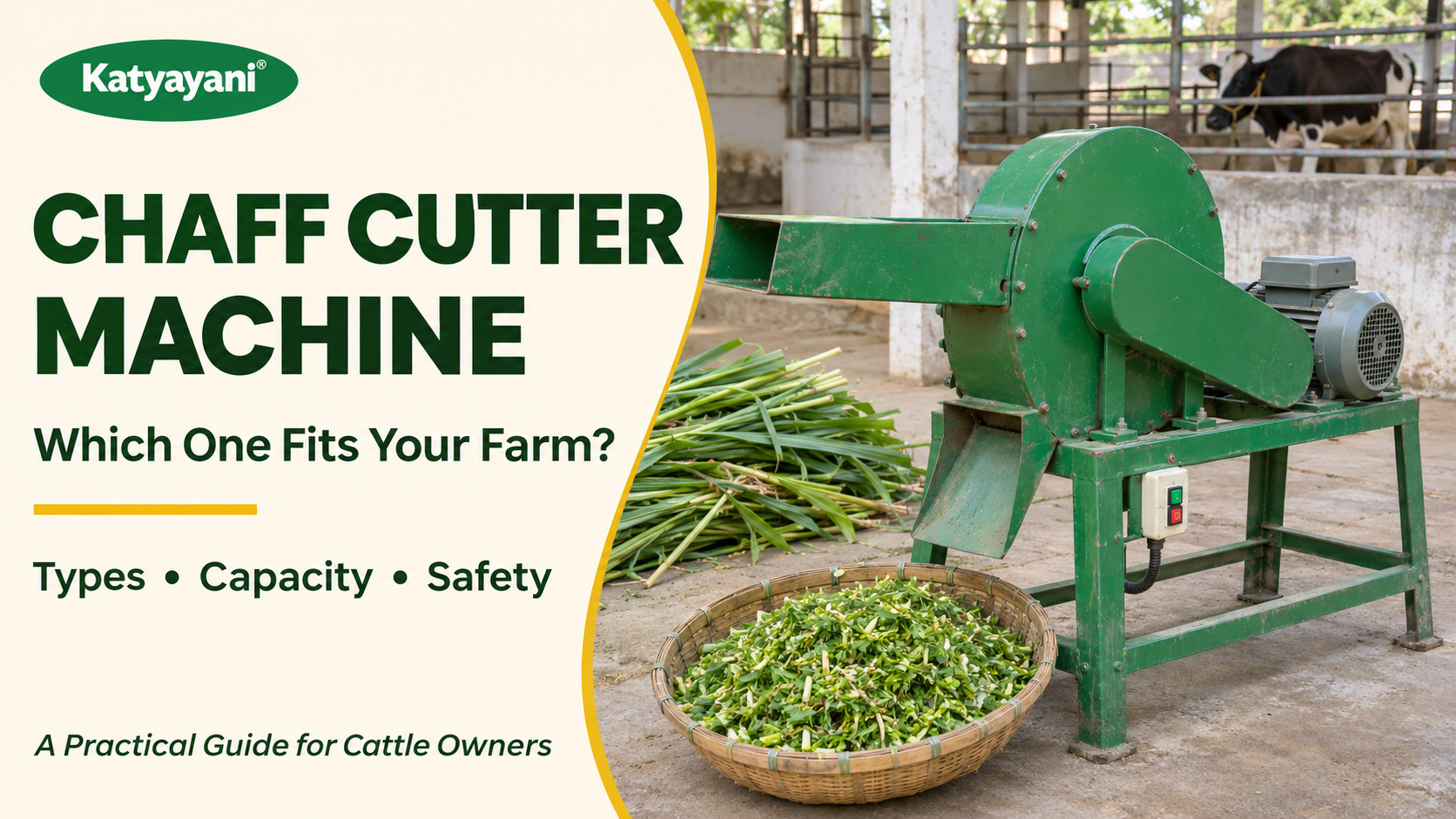
A chaff cutter machine chops green and dry fodder into small pieces so cattle eat more of it and waste less. There are three common types: a hand or hand-and-pedal cutter (TNAU rates one at 300 kg of green fodder an hour), an electric motor driven cutter (TNAU lists a 1.5 hp model that cuts 1.6 to 3.2 tonnes a day) and a PTO driven tractor cutter (TNAU says 30 hp or more). The best one is the one that matches your herd size and power supply. Chaff cutters were behind most amputation cases in one Punjab study, so buy a machine built to the BIS chaff cutter standard (IS 11459:2024, which took over IS 15542) and never feed it by hand.
What is a chaff cutter machine and what is its purpose?
A chaff cutter machine is a fodder chopper. It cuts green fodder, dry fodder and straw into short pieces so that cattle and other farm animals can eat them easily. TNAU states the purpose in one line: to cut the chaff into bits for easy assimilation by animals, with uniform sized bits.
Think of the same fodder lying whole in a manger. The animal pulls out the soft leaves, leaves the thick stalk and steps on the rest. A chaff cutter changes that. Every bite now holds some leaf and some stem. Here "chaff" means chopped fodder and straw, and the machine is also called a fodder cutter or a fodder chopping machine.
The TNAU page for the hand-and-pedal model describes its job as cutting green fodder, dry fodder and paddy straw. The TNAU power cutter page says it cuts all kinds of dry and green fodder into small pieces for cattle. The TNAU tractor cutter page adds that chopped straw or hay helps mix the forages that are fed to cattle.
Why chop fodder? What are the benefits of using a chaff cutter?
Chopped fodder is eaten more completely. A magazine article by authors from ICAR-NDRI Karnal and JAU Junagadh (Pashudhan Praharee, 2022) says chaffing reduces the wastage caused by soiling and by animals picking only the softer parts, and that shorter, denser pieces take less time to chew and move faster through the gut, which raises voluntary feed intake.
| Benefit | What the source says | Source |
|---|---|---|
| Less waste at the manger | Chaffing reduces the considerable wastage from soiling and from selective feeding of the softer parts | Pashudhan Praharee, ICAR-NDRI authors |
| More feed eaten | Chopped forage is denser, needs less chewing time and passes faster, which increases voluntary feed intake | Pashudhan Praharee |
| Better use of the fibre | Smaller pieces give microbes more surface to work on, so the article says it improves digestibility at little cost | Pashudhan Praharee |
| Easy mixing | Chopped straw or hay mixes with other forages and feed | TNAU tractor chaff cutter page |
| Less effort than hand cutting | TNAU says the pedal model asks less effort because hand and leg forces are used together, and the operator feels less fatigue | TNAU hand-and-pedal page |
There are costs too. The same article says leaves can be lost during chopping and that green forage with a lot of water can lose moisture. So chop close to feeding time, not a week of fodder at once. The article gives no number of days. It also says magnets fitted around the machine catch nails and metal pieces before they reach the animal, which is a simple safety step for the herd.
Why does waste matter at national level? PIB (6 Apr 2025) quotes the Union Minister on a national green fodder deficit of about 11 percent, with only 8.5 million hectares under cultivated fodder. A farmer cannot fix that deficit alone, but a dairy family can stop throwing away part of what it grows. The PIB release also lists specialised fodder farm machinery to reduce manual labour among the technologies shown at ICAR-IGFRI, Jhansi.
We did not find an official trial that puts one percentage on the feed saved by chaffing, so we do not print one. Seller pages quote bigger numbers, and those are not from a trial we could open.
What are the different types of chaff cutters?
By power source there are three main types: hand or hand-and-pedal operated, electric motor driven (power operated), and tractor PTO driven. By feeding system, IS 15542 names two designs for power machines: a feeding chute type and a conveyor type. Some power machines also carry a blower.
| Type | How it is driven | What TNAU or BIS lists | Typical user |
|---|---|---|---|
| Hand-and-pedal chaff cutter | Hand and leg together; curved blade on a spring-loaded lever | 300 kg green fodder an hour; 40 kg; 920 x 540 x 1225 mm (TNAU) | No power needed |
| Power operated (electric motor) | Electric motor, flywheel with knives, feed rollers | 1.5 hp, 3 blades, 25 mm chaff length, 55 kg, 1.6 to 3.2 tonnes a day (TNAU) | Needs an electric supply |
| Tractor operated (PTO) | Tractor PTO at 540 rpm | 30 hp and above, 5 to 10 mm chaff size, 900 kg (TNAU) | Listed by TNAU under custom hiring |
| Chute-fed power cutter | Rectangular or trapezoidal trough behind the shear plate | Trough at least 900 mm long (IS 15542) | The feeding design named first in the standard |
| Conveyor-fed power cutter | A conveyor takes the fodder to the feed rolls | Conveyor at least 1200 mm long, covered for at least 450 mm near the feed rolls (IS 15542) | Machines that need a longer feeding path |
You will also see words like "table model", "vertical shaft" and "three roller" on sellers' pages. We could not confirm those names from an official source, so they are not used here as types. Ask for the feeding system and the safety features, because those are what a standard describes.
How does a hand-operated chaff cutter work?
A hand or hand-and-pedal chaff cutter has a feeding tray, a curved blade on a spring-loaded lever and a frame. You push fodder through the tray and work the lever. TNAU says its improved model uses hand and leg forces together, so the operator feels more comfortable and tires less.
The TNAU hand cum pedal operated chaff cutter is a manually operated machine with no power need. It weighs 40 kg and measures 920 x 540 x 1225 mm. TNAU rates it at 300 kg of green fodder an hour and calls it suitable for green fodder, dry fodder and paddy straw. The page is dated 2016.
Here is plain arithmetic on the TNAU rating, and the feed figure is only an example of ours. If you chop 180 kg of green fodder in a day, then at 300 kg an hour the machine needs 180 divided by 300, which is 0.6 of an hour or about 36 minutes of steady work. If you chop 1,800 kg, the same sum gives 6 hours. Do this sum with your own daily fodder weight before you choose a machine, because the answer tells you how many hours a person will be working beside the blade.
How does a power operated (electric) chaff cutter work?
A power chaff cutter drives a flywheel that carries the knives. Feed rollers pull the fodder through a chute to a shear plate, and the knives cut it as the flywheel turns. TNAU lists a 1.5 hp electric motor model with 3 blades, a 25 mm chaff length and a 55 kg weight.
IS 15542 gives the parts in its list of materials: flywheel, frame, cover plate, shear plate, feed rolls and their shafts, spring, tie rod, worm and worm gear, legs, shafts and axles, feeding chute, blade cover, pulley, blower, discharge box and belts. Two design points are worth knowing. The standard asks for a way to change the tilt of the knives to the flywheel plane to avoid feed interference, and for a way to change the direction of rotation of the feed rollers, which helps when a jam must be cleared. Cast iron parts are to have a hardness of 160 to 220 HB.
TNAU rates the power operated model at 1.6 to 3.2 tonnes a day. TNAU does not say how many hours that day has, so we cannot turn it into an hourly figure without guessing. It lists these fodders for it: bajra, jowar, corn, berseem, sugarcane, paddy, grass and groundnut. That page was updated in April 2023.
What is a tractor operated chaff cutter and who needs one?
A tractor operated chaff cutter takes its power from the tractor PTO. TNAU lists a model that needs a tractor of 30 hp and above, runs at 540 rpm on the PTO, weighs 900 kg and cuts to 5 to 10 mm. TNAU lists it under custom hiring.
The TNAU page says the machine cuts straw or hay into small pieces, suits dry grass, fresh grass, corn stalk and straw, and puts a low load on the tractor. It is a heavy machine, so it makes sense where one machine serves many farms, for example a village group, a gaushala or an entrepreneur who makes hay and silage.
A PTO machine also brings the tractor's own danger, which is the turning PTO shaft. The PDKV Akola testing sheet for tractor operated chaff cutters records the propeller shaft type and length, the hub dimensions as per IS 4931:1995, and the method of transmission. Ask to see those entries for any PTO cutter you consider. IS 15542:2005 (clause 8.3) also asks for guards on the PTO shaft of PTO-driven chaff cutters. See also our tractor subsidy post if you are buying a tractor along with implements.
Which chaff cutter machine is best for your farm?
There is no single best chaff cutter. The best one matches the weight of fodder you chop, your power supply and your safety habits. TNAU lists a manual model with no power need, a 1.5 hp electric model and a PTO model for a tractor of 30 hp or more. Pick a machine built to the BIS safety standard.
| Your situation | Type to look at | Why, from the sources |
|---|---|---|
| No power supply, small daily fodder weight | Hand-and-pedal | Manual, no power need, rated at 300 kg of green fodder an hour (TNAU hand-and-pedal page) |
| Electric supply, larger daily fodder weight | Power operated, about 1.5 hp | TNAU lists 1.6 to 3.2 tonnes a day for a 1.5 hp model (TNAU power cutter page) |
| Gaushala, large dairy, hay or silage unit | Heavy duty power or tractor PTO | NLM names heavy duty power operated chaff cutters for fodder entrepreneurs (DAHD NLM guidelines) |
| A group that cuts fodder for many farms | Tractor PTO, 30 hp and above | TNAU lists it under custom hiring (TNAU tractor cutter page) |
| Any buyer | A machine with a flywheel lock, front blade guard and covered chute | Listed in IS 15542:2005 and carried into IS 11459:2024 |
Work out your own daily fodder weight and divide it by the hourly rating, as in the example above. We do not give a herd size for each type, because no official page we opened sets one. The Gurdaspur study in the safety section is a reminder that long hours beside a cutter raise the risk of a tired-hand injury.
What capacity and horsepower should you look at?
Read capacity as kg an hour or tonnes a day, and read power in hp or kW. From TNAU: 300 kg an hour by hand-and-pedal, 1.6 to 3.2 tonnes a day at 1.5 hp, and 30 hp or more at the tractor PTO. SMAM groups engine or electric motor cutters below 3 hp as one class.
| Item | Hand-and-pedal | Power operated | Tractor operated |
|---|---|---|---|
| Power | Manual | Electric motor, 1.5 hp | Tractor 30 hp and above, PTO 540 rpm |
| Capacity | 300 kg green fodder an hour | 1.6 to 3.2 tonnes a day | Not stated on the TNAU page in a usable unit |
| Blades | Curved blade on a lever | 3 blades | Not stated |
| Chaff length | Uniform bits; not stated in mm | 25 mm | 5 to 10 mm |
| Weight | 40 kg | 55 kg | 900 kg |
| Source | TNAU 2016 | TNAU, Apr 2023 | TNAU, Apr 2023 |
Capacity claims differ from seller to seller and depend on the fodder. Dry straw and wet green fodder feed through at different speeds. A test centre measures capacity under set conditions. The PDKV sheet shows what such a centre records: the number of blades, flywheel diameter, throat size, the clearance between the fixed and rotating blade, the number and size of feed rolls, the feeding tray and the recommended feeding capacity in kg an hour. Ask the seller for a test report with these entries.
What fodder can a chaff cutter chop, and does it differ for green and dry fodder?
It chops both. TNAU lists bajra, jowar, corn, berseem, sugarcane, paddy, grass and groundnut for its power cutter, and dry grass, fresh grass, corn stalk and straw for its tractor cutter. Capacity changes with the fodder, so check the fodder list for your own machine.
Our Napier grass post says hybrid Napier is fed fresh and chopped, and gives the cutting stage and stubble height for the crop. Our fodder sorghum post gives the safe cutting stage for sorghum and the silage method, including the chop length for silage. Read those two for the field side. This post stays with the machine.
- Green fodder. Berseem, Napier, maize, bajra, jowar. Chop it close to feeding time, because the ICAR-NDRI authors warn of moisture loss and leaf loss.
- Dry fodder and straw. Paddy straw and other residues. TNAU names paddy straw for its hand-and-pedal model.
- Mixed feeding. The TNAU tractor page says chopped hay or straw helps mix forages fed to cattle.
One caution comes from our sorghum post: young sorghum can carry prussic acid, so the machine does not fix a cutting-stage problem. Chopping does not remove poison. Cut the crop at the right stage first.
What length should you chop fodder to?
The ICAR-NDRI authors give 1 to 4 cm as the usual size for chaffing. The TNAU power cutter is rated at 25 mm and the TNAU tractor cutter at 5 to 10 mm. Silage needs its own, shorter chop. We found no official source that fixes a different length by animal.
| Use | Length | Source |
|---|---|---|
| General chaffing of roughage | 1 to 4 cm | Pashudhan Praharee, ICAR-NDRI authors |
| TNAU power operated cutter | 25 mm | TNAU power cutter page |
| TNAU tractor operated cutter | 5 to 10 mm | TNAU tractor cutter page |
| Napier for silage | 1 to 3 cm, as cited in our Napier post | Napier grass post |
| Sorghum for silage | 5 to 8 cm, as cited in our sorghum post | Fodder sorghum post |
What does that mean at the machine? Look at the chaff length your machine is built for. The TNAU power cutter lists 25 mm and the TNAU tractor cutter lists 5 to 10 mm, so a machine does not cut every length. If a seller cannot tell you the chaff length of the machine, ask for the test report, which should record it.
We do not give separate lengths for cattle, buffalo, goats and sheep. No official page that we opened sets them, and a made-up table would look useful and be wrong.
Which safety features should every power chaff cutter have?
The BIS standard IS 15542:2005 lists them, and BIS carried them into IS 11459:2024. The main ones are a flywheel locking pin with a chain, a front safety guard on each knife, a covered feeding chute (or a spring warning roller), a blade cover, guards on the gears and blower, and an operator manual.
| Safety feature | What IS 15542:2005 says |
|---|---|
| Flywheel locking pin | A linch pin with a chain locks the flywheel when the machine is not in use, so the blades cannot turn by accident |
| Front safety guard | Fitted tightly on each knife; it stands a little away from the blades, pushes limbs away and acts as a warning before the blade hits |
| Feeding chute length and cover | Trough at least 900 mm long, made of mild steel sheet of at least 1.6 mm; the trough on the shear plate side is covered for at least 450 mm |
| Warning roller | A spring roller of at least 40 mm diameter just before the feed rollers; it can replace the chute cover |
| Blade cover | The cutting edge of each blade is covered |
| Chute height | Between 750 mm and 1100 mm |
| Conveyor type | Conveyor at least 1200 mm long, covered for at least 450 mm near the feed rolls, with a feed reversing mechanism; blower and other moving parts guarded with steel sheet of at least 1.6 mm |
| Transmission guard | Worm and pinion assembly covered on all sides with sheet of at least 1.6 mm |
| Idle run test | Run without load for at least 5 minutes at the specified rpm and check for knocking, belt slip, rough shafts, wear and rising bearing temperature |
| Manual | An operator manual in Hindi, English or any other local language |
Which standard is current? A BIS circular of 27 June 2024 says IS 11459:1985 and IS 15542:2005 were merged with IS 7897:1975 (the chaff cutter test code) and revised as IS 11459:2024, with 28 November 2024 as the last date to implement it, after which the old standard stands withdrawn. The circular says the safety requirements earlier covered in IS 15542:2005 were incorporated. We did not open the 2024 text, so the sizes and clause details in this table come from the 2005 standard. Ask the maker which standard the machine follows, and compare its guards with this table. See the BIS circular.
The standard's own foreword explains why it exists. It says power chaff cutters are very common on farms, and that reports of farm workers losing their limbs made safety provisions more urgent. It also notes the figures in the standard are for illustration and are not a fixed design. Read the full standard if you are a fabricator or a dealer.
How do chaff cutter accidents happen?
Evidence from India is thin but clear on one point. A 2024 door-to-door survey in the border belt of Gurdaspur district, Punjab found that chaff cutters were responsible for most of the incidents that required amputation. The Indian standard says the same kind of thing in its foreword: workers were losing limbs in power cutters.
The Journal of Agromedicine study by authors from Dr B R Ambedkar NIT Jalandhar collected data door to door with the help of village leaders. Its abstract says the mean age of victims was 35.02 years, 124 (91.18%) of the victims were men, and 21 (15.4%) of the cases were fatal, with tractor rollovers causing most of the deaths. Less educated and older adults aged 31 to 45 years were more prone to incidents. For chaff cutters it says that eighteen (45%) of the incidents happened in the evening between 3:00 PM and 6:00 PM, and 12 (30%) of these incidents occurred due to fatigue. The authors recommend special training on safe operation of machinery and a definite work and rest schedule to prevent fatigue.
Read that as a pointer, not a national rate. It is one district and one survey. But the time-of-day finding fits what farmers know: the evening chopping session comes after a full day of work, when hands and attention are tired.
What are the safe working rules while chopping fodder?
Run the machine only with every guard fitted, never push fodder by hand near the rollers, switch off before clearing a jam, lock the flywheel after use, and rest during long jobs. These rules follow what IS 15542 asks the machine to provide and what the Gurdaspur study found about fatigue.
- Check the guards before you switch on. The front blade guard, chute cover or warning roller, and the belt and gear covers must all be in place. If one is missing, do not run the machine.
- Feed from the tray side of the chute cover. IS 15542 asks for the trough on the shear plate side to be covered for at least 450 mm, or for a spring warning roller in its place. Do not remove either.
- Never push fodder by hand near the rollers. If the fodder stops, switch off, wait for the flywheel to stop, and then clear it. Use the reverse feed where the machine has one.
- Switch off, then lock. When you finish, stop the motor and fit the flywheel locking pin so the blades cannot turn.
- Chop in the morning if you can. The Gurdaspur study found a cluster of incidents between 3 pm and 6 pm. Take a rest break in a long job.
- Read the operator manual. IS 15542 asks every machine to come with a manual in Hindi, English or another local language.
- Repeat the idle run after any repair. The standard describes a 5-minute no-load run to check for knocking, belt slip and bearing heat.
How should you check a chaff cutter before you buy or switch it on for the first time?
Ask which BIS standard the machine follows (IS 11459:2024), then ask for the guards, a manual and a test report. Run it idle for at least 5 minutes at its set speed, listening for knocking, watching the belt for slip and feeling the bearings for heat. That is the idle test in IS 15542:2005.
| Check | What to look for | Basis |
|---|---|---|
| Guards | Flywheel pin with chain, front guard on each knife, chute cover or warning roller, belt and gear covers | IS 15542 |
| Manual | In Hindi, English or a local language | IS 15542 |
| Idle run | 5 minutes: no knocking or rattling, no frequent belt slip, smooth shafts, no odd wear or slackness, no marked bearing heat | IS 15542 |
| Feed roller control | Can you change the direction of the feed rollers to clear a jam? | IS 15542 |
| Blade and cast iron parts | Ask which standard the blade follows (IS 1511 is named); cast iron parts 160 to 220 HB | IS 15542 |
| Test report | Blade count, flywheel size, blade clearance, feed roll size, recommended feeding capacity | PDKV testing sheet |
| Capacity | Does the stated figure sit near the TNAU range for that size and power? | TNAU power cutter page |
A machine whose stated output is far above what TNAU lists for the same motor size should make you ask questions. A good seller will show the test report without being asked twice.
How do you look after a chaff cutter so it stays safe?
Use the idle-run checklist as your routine. Listen for knocking, check belt slip and shaft smoothness, look for wear and slack parts, and feel the bearings for heat. Fix any one of these before more chopping. A loose or worn part is how a small fault becomes an injury.
- Every day: look at the guards and the flywheel pin, and clear leftover fodder from the chute and rollers with the machine stopped and the flywheel locked.
- Every week: check belt tension and the bolts that hold the knives and the shear plate. Check for loose guards.
- Blades: a dull blade makes you push harder and feed faster. Resharpen or replace a blade that tears the stem instead of cutting it. The standard points to IS 1511 for blade material and hardness, so ask the seller for a spare that follows it.
- Magnet and metal: keep magnets near the feed side if you chop fodder from fields where wire or nails may lie. The ICAR-NDRI article suggests magnets to hold metal pieces back.
- Storage: keep the machine under cover, with the flywheel locked, away from children.
These are routine habits built from the standard's test list and the magazine article. We did not find an ICAR or TNAU maintenance schedule for chaff cutters, so we do not print hour-based service intervals.
Is there a subsidy for a chaff cutter machine?
Sometimes. The DAC&FW SMAM guidelines of 18 Dec 2025 list a chaff cutter operated by engine or electric motor below 3 hp, and by a power tiller or tractor below 20 BHP, in their machine table. The National Livestock Mission (Jan 2025) names heavy duty power operated chaff cutters for fodder entrepreneurs.
The SMAM guidelines were issued by the Mechanization and Technology Division of DAC&FW under PM-RKVY. The scan we opened is poor, so we do not print the rate. They also say that manufacturers who tested their products at the FMTTIs or an institute named by DAC&FW are eligible to supply machines under the scheme. For tools costing under Rs 50,000 the test report may not be needed, and a self-certification from the maker can be accepted, though a first-time manufacturer may need one. That is another reason to ask for a test report.
Under the NLM guidelines of January 2025, the feed and fodder sub-mission gives private entrepreneurs, SHGs, FPOs, dairy cooperative societies and section 8 companies a 50 percent capital subsidy on the project cost of hay and silage and fodder block units. The machinery includes balers, block making machines, TMR machines, forage harvesters and heavy duty power operated chaff cutters. A silage unit list in the same guidelines (production capacity 2,000 to 2,400 MT a year) also names a power operated chaff cutter. This is for an enterprise, not for a household with two cows.
Rates for a household cutter vary by state and change each year, so we do not print any. Our National Livestock Mission post explains the feed and fodder unit subsidy, and our agriculture subsidy schemes post lists SMAM and the other schemes. If you also want to cover the animals themselves, our livestock insurance post explains how to insure a cow or buffalo.
What mistakes do farmers make with chaff cutters?
The common ones are: feeding by hand into the rollers, running without guards, chopping late in the day when tired, chopping too much at once, and choosing by price and horsepower alone. Each is fixed by a habit or a check from the sections above.
- Hand into the feed mouth. The standard's cover, warning roller and 900 mm trough are there to keep hands out. Do not defeat them.
- Removing the front guard because it slows feeding. The guard is meant to push the limb away before the blade hits it.
- Not locking the flywheel. The locking pin exists to stop accidental rotation when the machine is not in use.
- Chopping a week of fodder at once. The ICAR-NDRI authors warn of moisture and leaf loss in chopped green fodder.
- Expecting any length from any machine. The TNAU power cutter lists 25 mm and the tractor cutter 5 to 10 mm, so check the chaff length before you buy.
- Buying a machine with no manual or no test report. The standard asks for a manual, and test centres record capacity.
- Ignoring tired hands. The Gurdaspur study tied 30 percent of chaff cutter incidents to fatigue.
How do hay and silage units use heavy chaff cutters?
A hay or silage unit chops fodder in bulk before baling or packing it, so it needs a heavy duty cutter. The NLM guidelines list a power operated chaff cutter in the silage unit list, next to a baler, a harvester and a tractor with trolley. The chop length is set by the silage method.
Our live posts give the lengths that their sources use. The Napier grass post cites a 1 to 3 cm chop for Napier silage, and the fodder sorghum post gives 5 to 8 cm for sorghum silage with a moisture target. Those two figures differ, because the crops differ. Follow the crop post you are working from, and check that your machine can cut that length. Our tractor subsidy post is useful if the PTO model is on your list.
Conclusion
A chaff cutter machine chops fodder so animals eat more of it and waste less. TNAU lists three types: a hand-and-pedal cutter rated at 300 kg an hour, a 1.5 hp electric cutter rated at 1.6 to 3.2 tonnes a day, and a PTO cutter for tractors of 30 hp or more. Divide your daily fodder weight by the hourly rating to see which fits. Buy a machine built to the BIS standard IS 11459:2024, with a flywheel lock, front blade guard and covered chute, ask for a test report, never feed by hand, switch off before clearing a jam, and keep tired hands away from the machine.



Leave a Comment